FreedomVoice Pricing, Reviews, Pros and Cons (2026 Guide)
FreedomVoice looks like the cheapest virtual phone line on the market until you read the minute buckets. Here is what the plans really cost, what reviewers complain about, and when a different system wins.
TL;DR
- FreedomVoice is a virtual phone system built for solo operators and small teams, not for outbound sales floors. Its entry plan has historically sat around $9.95/month with a small pooled minute bucket.
- The headline price is not the real price. Minute overages, extra numbers, extra extensions, and per-user CloudPhone seats are where the bill grows.
- Reviews are consistently positive on setup speed and call quality, and consistently negative on reporting, integrations, and the pace of product updates since the 2019 Sinch acquisition.
- If you dial more than a few dozen numbers a day, a per-seat platform with a dialer and CRM logging beats FreedomVoice on cost-per-conversation, even at a higher sticker price.
- Whatever phone system you pick, the bottleneck is usually the contact data, not the software. Bad numbers waste more money than any plan tier.
What is FreedomVoice and who actually uses it?#
FreedomVoice is a cloud phone service that gives a business a professional number — toll-free or local — plus auto-attendant, voicemail-to-email, call routing, and a mobile app, without any desk hardware. Think of it as a receptionist's desk that lives in software: calls arrive at one published number, a menu answers, and the call gets pushed to whichever mobile phone is supposed to take it.
The company launched in 1996 as a voicemail-and-fax service and grew into virtual phone. In 2019 it was acquired by Sinch, the Swedish CPaaS group, and folded into a much larger voice and messaging portfolio. That acquisition matters for the pricing conversation, because a small-business product inside a large enterprise API company rarely gets aggressive roadmap investment.
Two products carry the brand:
- CloudNumber — the lightweight option. One business number, auto-attendant, voicemail-to-email, call forwarding to existing cell phones. No new handsets, no per-seat licensing. This is the plan most sole proprietors, consultants, and trades businesses buy.
- CloudPhone — the fuller PBX. Per-user extensions, desk phone support, softphone, transfers between extensions, and more granular routing. Priced per user, so cost scales with headcount.
The typical buyer is a one-to-ten person business that wants to stop giving out a personal mobile number. It is not built for a team running a hundred outbound dials per rep per day — there is no power dialer, no local presence rotation, no call-recording analytics layer of the sort that cold calling teams expect.
What does FreedomVoice pricing look like in 2026?#
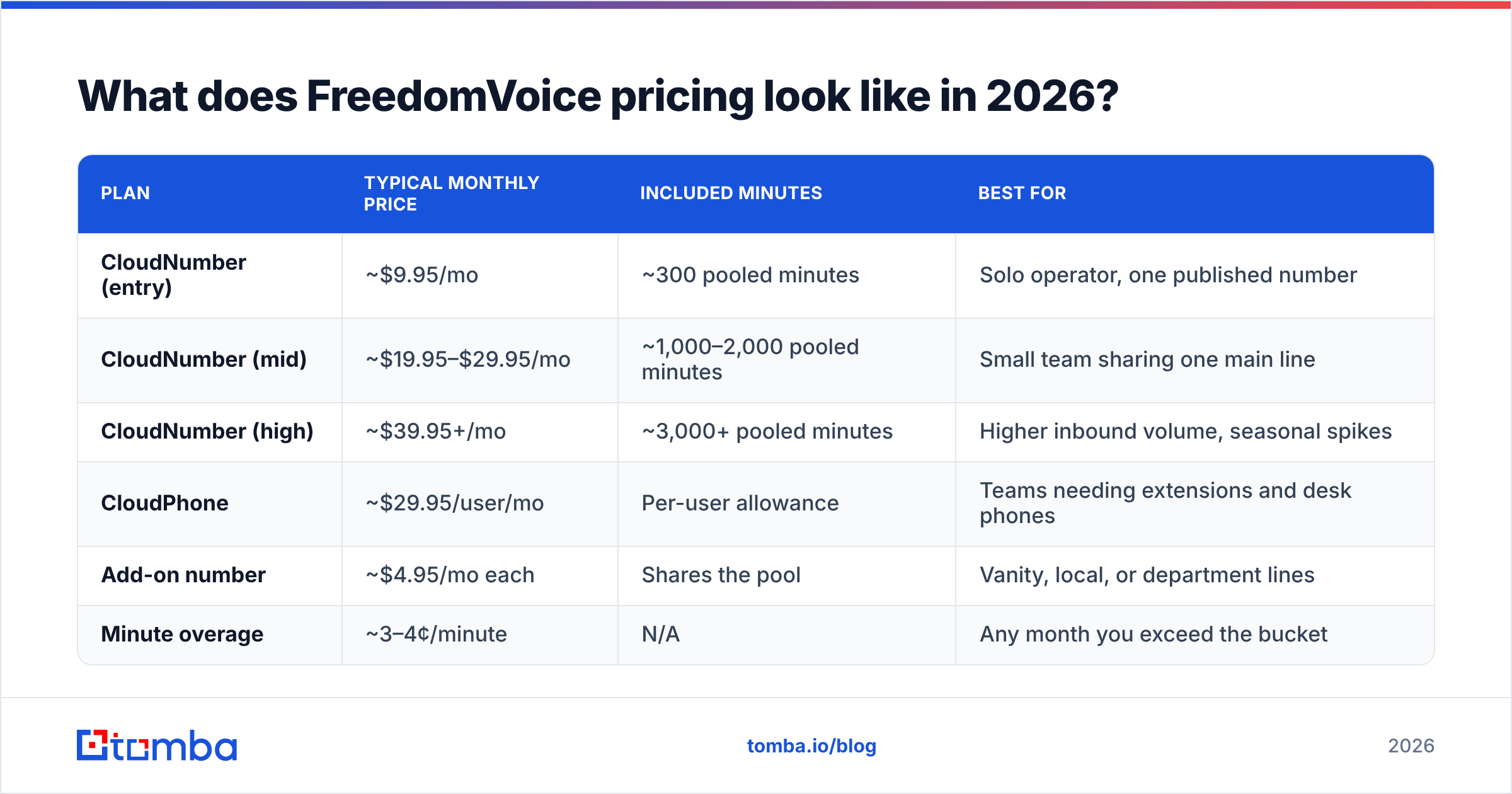
Published rates have been stable for years, which is both the appeal and the warning sign. Here is the structure as commonly listed. Confirm current numbers on the official FreedomVoice site before you buy — Sinch has been consolidating its small-business voice lineup, and plan availability has shifted more than once.
| Plan | Typical monthly price | Included minutes | Best for |
|---|---|---|---|
| CloudNumber (entry) | ~$9.95/mo | ~300 pooled minutes | Solo operator, one published number |
| CloudNumber (mid) | ~$19.95–$29.95/mo | ~1,000–2,000 pooled minutes | Small team sharing one main line |
| CloudNumber (high) | ~$39.95+/mo | ~3,000+ pooled minutes | Higher inbound volume, seasonal spikes |
| CloudPhone | ~$29.95/user/mo | Per-user allowance | Teams needing extensions and desk phones |
| Add-on number | ~$4.95/mo each | Shares the pool | Vanity, local, or department lines |
| Minute overage | ~3–4¢/minute | N/A | Any month you exceed the bucket |
Two structural things to notice.
First, minutes are pooled, not per-user. That is generous when call volume is unpredictable and brutal when it is high. A 300-minute bucket is five hours of talk time across the whole business. One busy support week eats it.
Second, CloudPhone flips the model to per seat, so a six-person team lands near $180/month before add-ons — the same neighborhood as far more capable platforms. The cheap-and-cheerful reputation only holds at the bottom of the range.
What are the hidden costs in FreedomVoice pricing?#
The sticker price is honest. The total cost of ownership is where buyers get surprised. Watch these five line items:
- Overage minutes. At roughly 3–4¢ a minute, a 900-minute month on a 300-minute plan adds about $24 — more than doubling a $9.95 bill. Model your worst month, not your average one.
- Every extra number. Local number for a second city, a vanity toll-free, a dedicated fax line: each is its own recurring line item, and none of them add minutes to the pool.
- Annual vs. monthly. Discounts for prepaying a year are real, but they lock you into a product whose roadmap you cannot see. On a service with an uncertain future, monthly is worth the premium.
- Toll-free inbound economics. Toll-free means you pay for the caller's minutes. If your marketing drives high inbound volume, a local number is usually cheaper per conversation.
- The integration tax. No native CRM logging means someone types call notes by hand. Ten minutes a day per rep is roughly an hour a week — at any reasonable loaded rate, that dwarfs the subscription.

That last point is the one finance teams miss. A $9.95 line that costs a rep 45 minutes a week in manual data entry is not a $9.95 line.
What do FreedomVoice reviews actually say?#
Aggregate sentiment on G2 and comparable review sites has been steady for years, and the pattern is unusually consistent across sources.
What reviewers praise:
- Setup speed. Number live and auto-attendant configured in well under an hour, with no hardware and no IT involvement. This shows up in almost every positive review.
- Call quality and reliability. Few complaints about dropped calls or jitter, which is not a given in budget VoIP.
- US-based support. Long-time customers repeatedly mention reaching a competent human quickly — historically the brand's strongest differentiator.
- Professional first impression. Solo consultants like that a one-person business sounds like a department.
What reviewers criticize:
- Dated admin interface. The web console looks and behaves like software designed a decade ago. Functional, not pleasant.
- Thin reporting. Call logs exist; analytics do not. No talk-time trends, no per-rep dashboards, no connect-rate reporting.
- Weak integrations. No meaningful native CRM sync. Getting call data into HubSpot or Salesforce means middleware or manual entry.
- Mobile app inconsistency. Recurring complaints about notification reliability and app-side call handling.
- Roadmap silence. Since the Sinch acquisition, reviewers note very few new features. For some buyers that is stability; for others it is a product in maintenance mode.
Read the negative reviews with a filter: most complaints come from teams trying to use a small-business receptionist tool as a sales phone system. That is a fit problem, not a quality problem.
What are the pros and cons of FreedomVoice?#
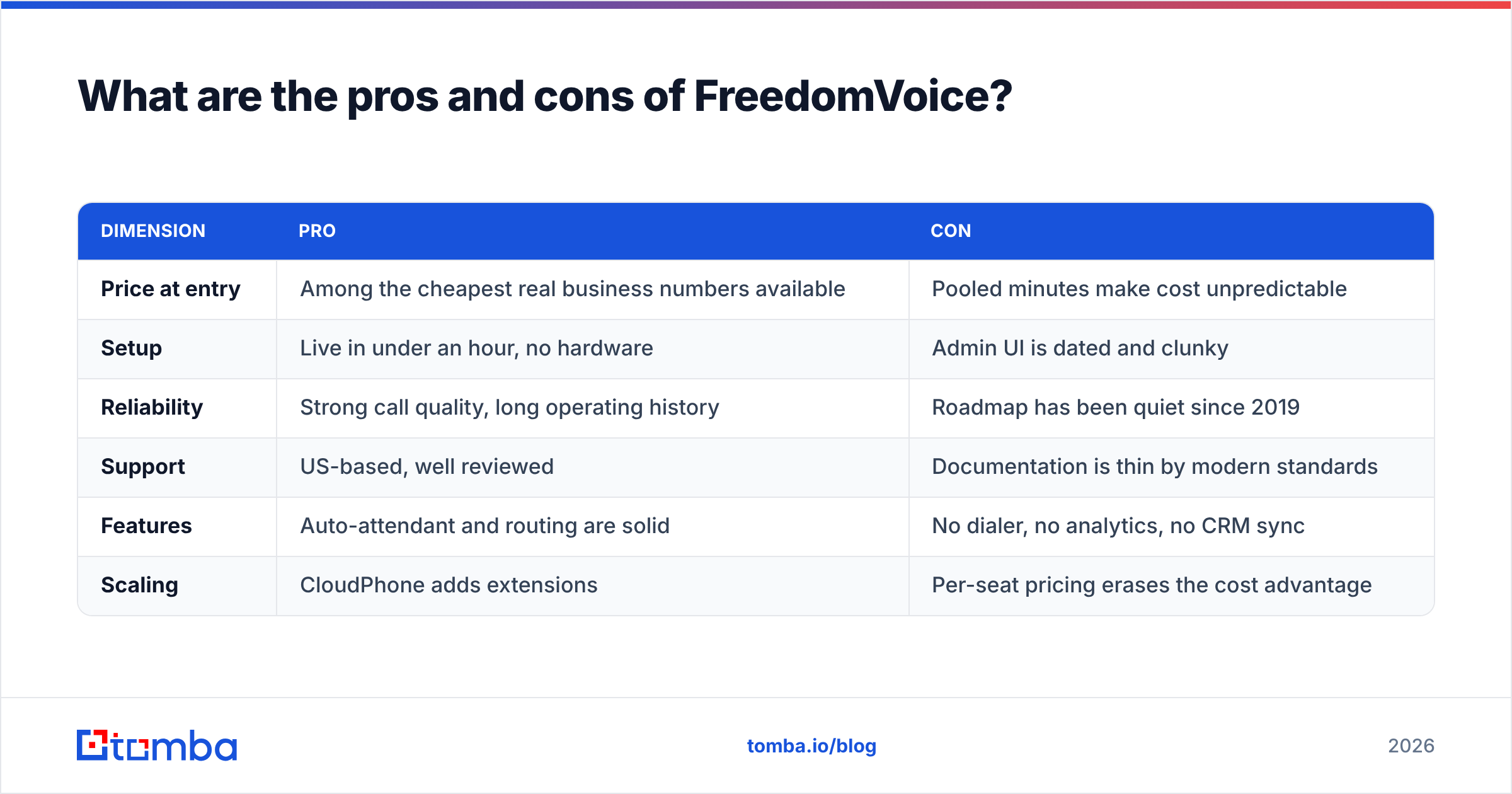
| Dimension | Pro | Con |
|---|---|---|
| Price at entry | Among the cheapest real business numbers available | Pooled minutes make cost unpredictable |
| Setup | Live in under an hour, no hardware | Admin UI is dated and clunky |
| Reliability | Strong call quality, long operating history | Roadmap has been quiet since 2019 |
| Support | US-based, well reviewed | Documentation is thin by modern standards |
| Features | Auto-attendant and routing are solid | No dialer, no analytics, no CRM sync |
| Scaling | CloudPhone adds extensions | Per-seat pricing erases the cost advantage |
The honest summary: FreedomVoice is a good inbound tool and a poor outbound tool. If prospects call you, it does the job cheaply. If you call prospects at volume, you will outgrow it fast.
How does FreedomVoice compare to other virtual phone systems?#
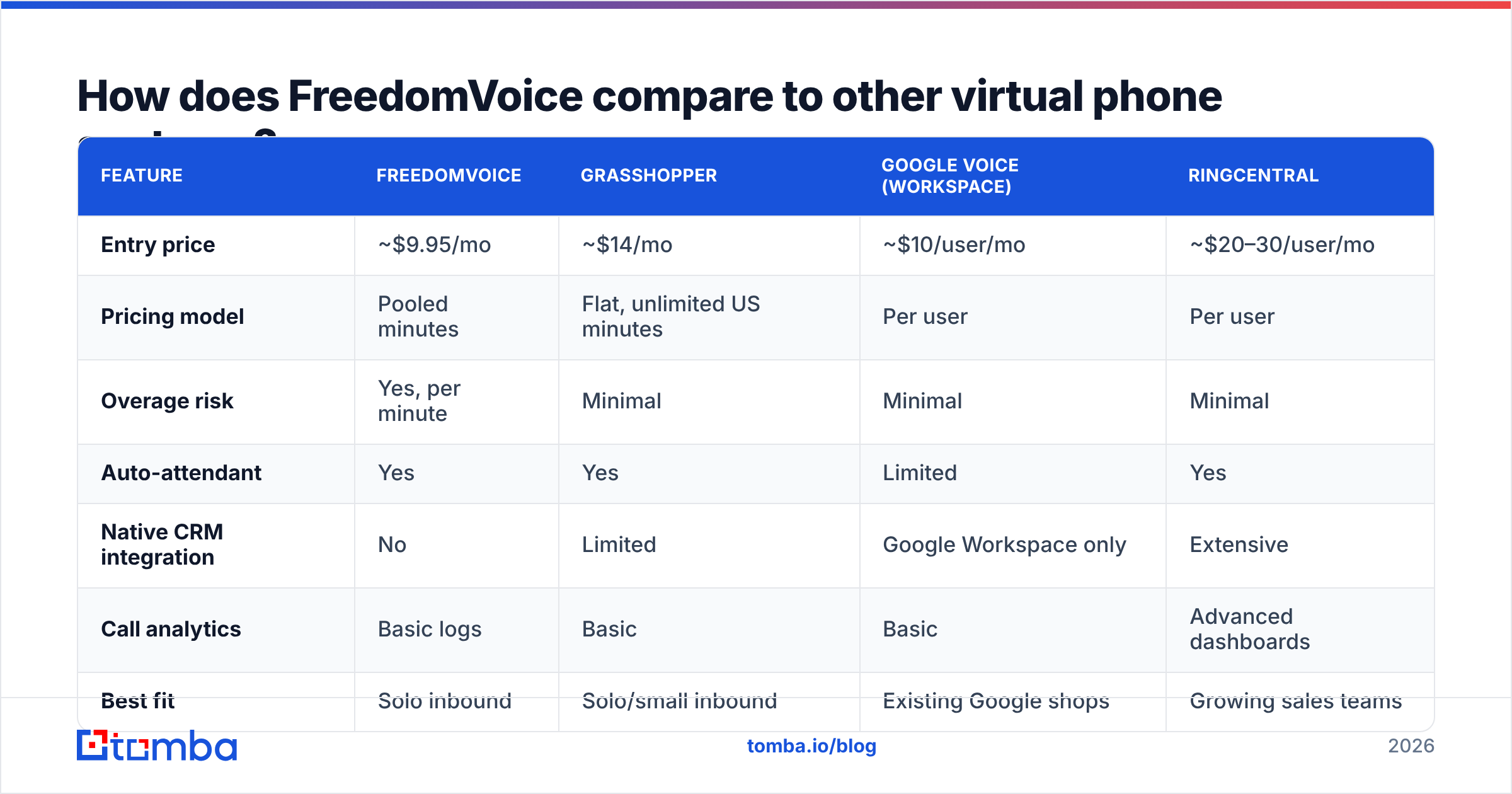
| Feature | FreedomVoice | Grasshopper | Google Voice (Workspace) | RingCentral |
|---|---|---|---|---|
| Entry price | ~$9.95/mo | ~$14/mo | ~$10/user/mo | ~$20–30/user/mo |
| Pricing model | Pooled minutes | Flat, unlimited US minutes | Per user | Per user |
| Overage risk | Yes, per minute | Minimal | Minimal | Minimal |
| Auto-attendant | Yes | Yes | Limited | Yes |
| Native CRM integration | No | Limited | Google Workspace only | Extensive |
| Call analytics | Basic logs | Basic | Basic | Advanced dashboards |
| Best fit | Solo inbound | Solo/small inbound | Existing Google shops | Growing sales teams |
The pattern is clear. FreedomVoice wins on absolute floor price for a genuinely low-volume line. Grasshopper wins on predictability, since unlimited minutes remove the overage variable entirely. Google Voice wins if you already pay for Workspace and want one less vendor. RingCentral wins the moment you need reporting, integrations, and per-seat scale — and you pay accordingly.
If your monthly talk time is under about four hours, FreedomVoice is likely the cheapest option on this list. Cross roughly eight hours and the math inverts, because unlimited-minute competitors stop charging while your overage meter keeps running.
Is FreedomVoice worth it in 2026?#
It depends entirely on which of these three buckets you are in.
Buy it if: you are a one-to-three person business, your calls are mostly inbound, you want to stop handing out a personal mobile number, and your monthly talk time reliably sits under a few hours. At the entry tier it is hard to beat on price, and setup is genuinely painless.
Think twice if: call volume swings month to month, you need call data inside your CRM, or you plan to add headcount this year. The per-minute exposure and the missing integrations will each cost you more than the subscription saves.
Skip it if: you run outbound. There is no power dialer, no local presence, no connect-rate reporting, and no automatic logging. A rep on FreedomVoice dials manually and takes notes by hand. That is a 2010 workflow at a 2026 labor cost.
There is one more consideration worth naming plainly: product direction. FreedomVoice sits inside a company whose center of gravity is enterprise CPaaS. Feature velocity has been near zero for years. That is fine for a stable receptionist line and risky for anything you intend to build a process on. Avoid multi-year prepay here.
What should you fix before you buy any phone system?#
Here is the part most phone-system comparisons skip: the software is rarely the constraint. The data is.
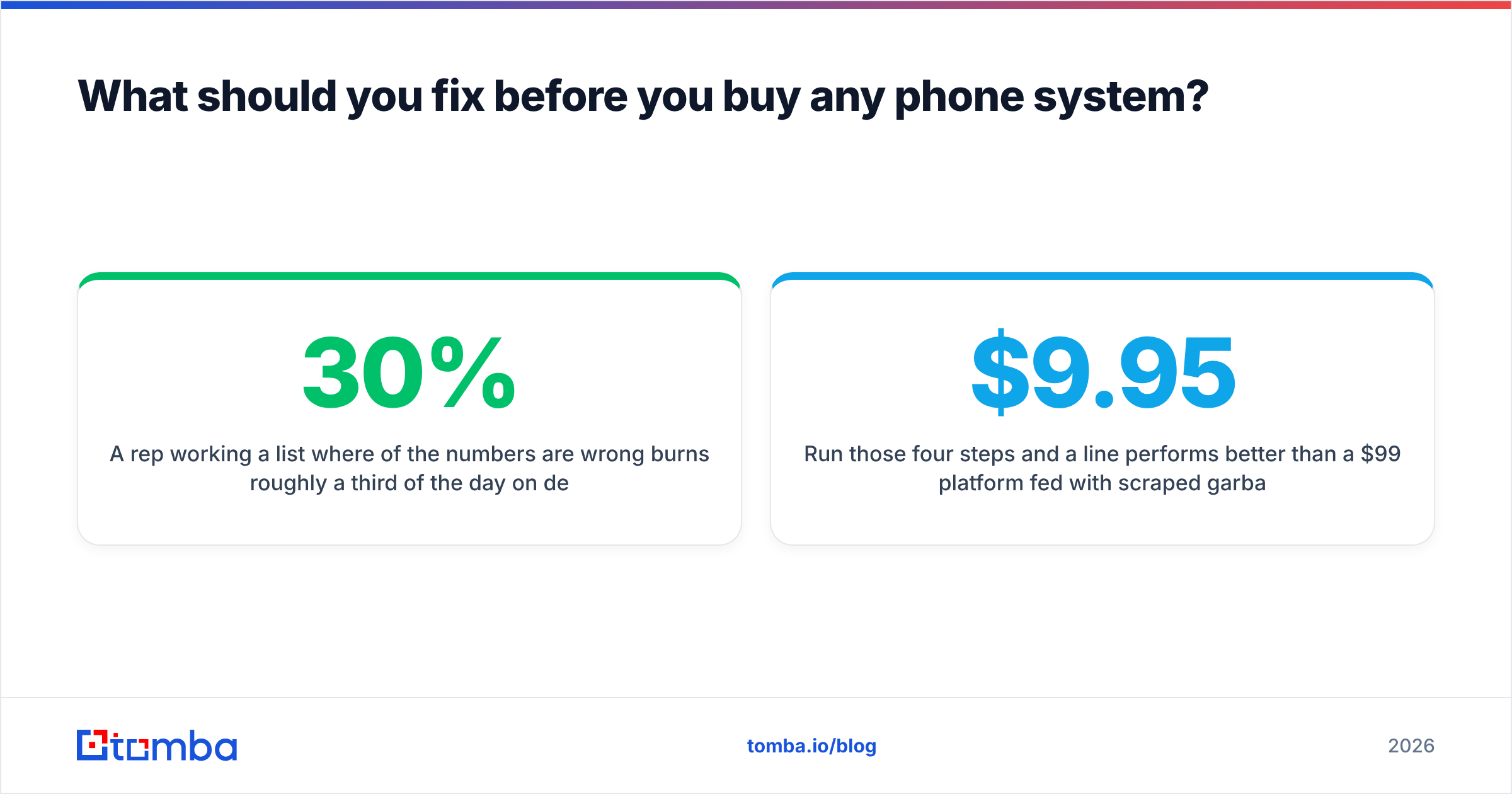
A rep working a list where 30% of the numbers are wrong burns roughly a third of the day on dead air, regardless of whether the dialer costs $10 or $100. Switching platforms does not fix that. Cleaning the list does.
Before you optimize the phone layer, do these four things:
- Validate the numbers you already have. Run your list through a phone validator to strip disconnected lines, invalid formats, and numbers that never belonged to a real business in the first place. Do this before every campaign, not once a year.
- Find direct dials, not switchboards. A main company line routed through a gatekeeper converts far worse than a direct number. A phone finder that returns direct lines changes your connect rate more than any dialer feature.
- Enrich before you dial. Title, company size, and industry let a rep open with something relevant instead of a script. Contact enrichment turns a phone number into a reason to call.
- Keep an email fallback for every number. Most dials go to voicemail. A verified email address on the same record means the attempt still produces a touch. Pair each number with a verified address from an email verifier so no dial is wasted.
Run those four steps and a $9.95 line performs better than a $99 platform fed with scraped garbage. Skip them and no phone system saves you.
Frequently asked questions#
Does FreedomVoice offer a free trial? It has historically offered a 30-day trial on CloudNumber. Confirm current terms at signup, and note whether the trial converts automatically.
Can you port an existing number to FreedomVoice? Yes, standard US number porting is supported. Budget one to two weeks and keep the old service active until the port completes.
Is FreedomVoice good for cold calling? No. It lacks a dialer, local presence rotation, call recording analytics, and CRM logging. Use a dedicated sales-calling platform for outbound.
What happens if you exceed your minutes? You are billed per minute at roughly 3–4¢. There is no hard cutoff, so a high-volume month can produce a bill several times the plan price.
Is FreedomVoice still actively developed? Feature releases have been sparse since the Sinch acquisition. Treat it as a stable utility rather than a growing platform, and prefer monthly billing.
The bottom line#
FreedomVoice is a competent, cheap, unfashionable inbound phone line. At the entry tier it does exactly what it promises, and reviewers have said so consistently for two decades. It is not a sales tool, its pricing punishes volume, and its roadmap is quiet — so buy it for what it is, month to month, and re-evaluate if your call volume climbs.
And before you spend another hour comparing plan tiers, look at your list. If you are dialing numbers scraped off a website or emailing addresses you guessed, the phone system is not your problem. Start with Tomba Email Finder to build verified, enriched contact records — direct emails paired with real company data — then layer whichever phone system fits your volume on top. The free tier covers 25 searches a month, and paid plans start at $49/month; see Tomba pricing for the full breakdown. Fix the data first, and every dial after that is worth more.
Related guides#
Ready to find emails that actually work?
Join 150,000+ professionals who stopped guessing and started sending. Free credits on signup — no credit card required.
Get the Tomba newsletter
Practical outbound tactics and product updates — once every two weeks.
About the author