Freshworks vs HubSpot: Which CRM Wins for B2B Sales in 2026?
Freshworks CRM is cheaper and faster to deploy. HubSpot has the bigger ecosystem and better marketing depth. Here's the honest cost, feature, and data breakdown before you sign a 12-month contract.
TL;DR
- Freshworks CRM (Freshsales) is the cheaper entry point. Paid tiers start around $9/user/month billed annually, with no forced seat minimums and no onboarding fee at the low end.
- HubSpot wins on ecosystem depth. Over 1,700 marketplace integrations, the strongest marketing automation in the mid-market, and a free CRM tier that never expires.
- The real cost gap shows up at scale. HubSpot Sales Hub Professional runs $100/seat/month with a mandatory $1,500 onboarding fee; Freshsales Enterprise is $59/user/month with no equivalent gate.
- Neither tool fills your pipeline. Both are systems of record, not systems of discovery — you still need verified contact data flowing in from a dedicated email finder.
- Pick Freshworks if you're a sales-led team under 30 reps. Pick HubSpot if marketing and sales share one funnel and you need attribution reporting that survives a board meeting.
What Are Freshworks and HubSpot, Exactly?#
They solve overlapping problems from opposite directions.
Think of it like buying a vehicle. Freshworks sells you a well-built sedan — it does the job, the price is on the sticker, and you drive it off the lot the same day. HubSpot sells you a modular platform: the base model is free, but the version you actually want comes with a build sheet, a configuration specialist, and a number that keeps climbing as you add hubs.
Freshworks CRM (marketed as Freshsales, part of the broader Freshworks suite that includes Freshdesk and Freshservice) is a sales-first CRM. Contact management, deal pipelines, built-in phone and email, AI scoring via "Freddy AI," and workflow automation. It was designed for sales teams who found Salesforce bloated and HubSpot expensive.
HubSpot started as an inbound marketing platform and grew a CRM underneath it. Today it sells Marketing Hub, Sales Hub, Service Hub, Content Hub, Operations Hub, and Commerce Hub — all sitting on one shared contact database. That shared database is the actual product. Everything else is a paid surface on top of it.
The strategic difference: Freshworks optimizes for a sales manager who wants reps calling within 48 hours of signup. HubSpot optimizes for a RevOps lead who wants marketing, sales, and support reporting from a single source of truth.
How Do Freshworks and HubSpot Compare on Price?#
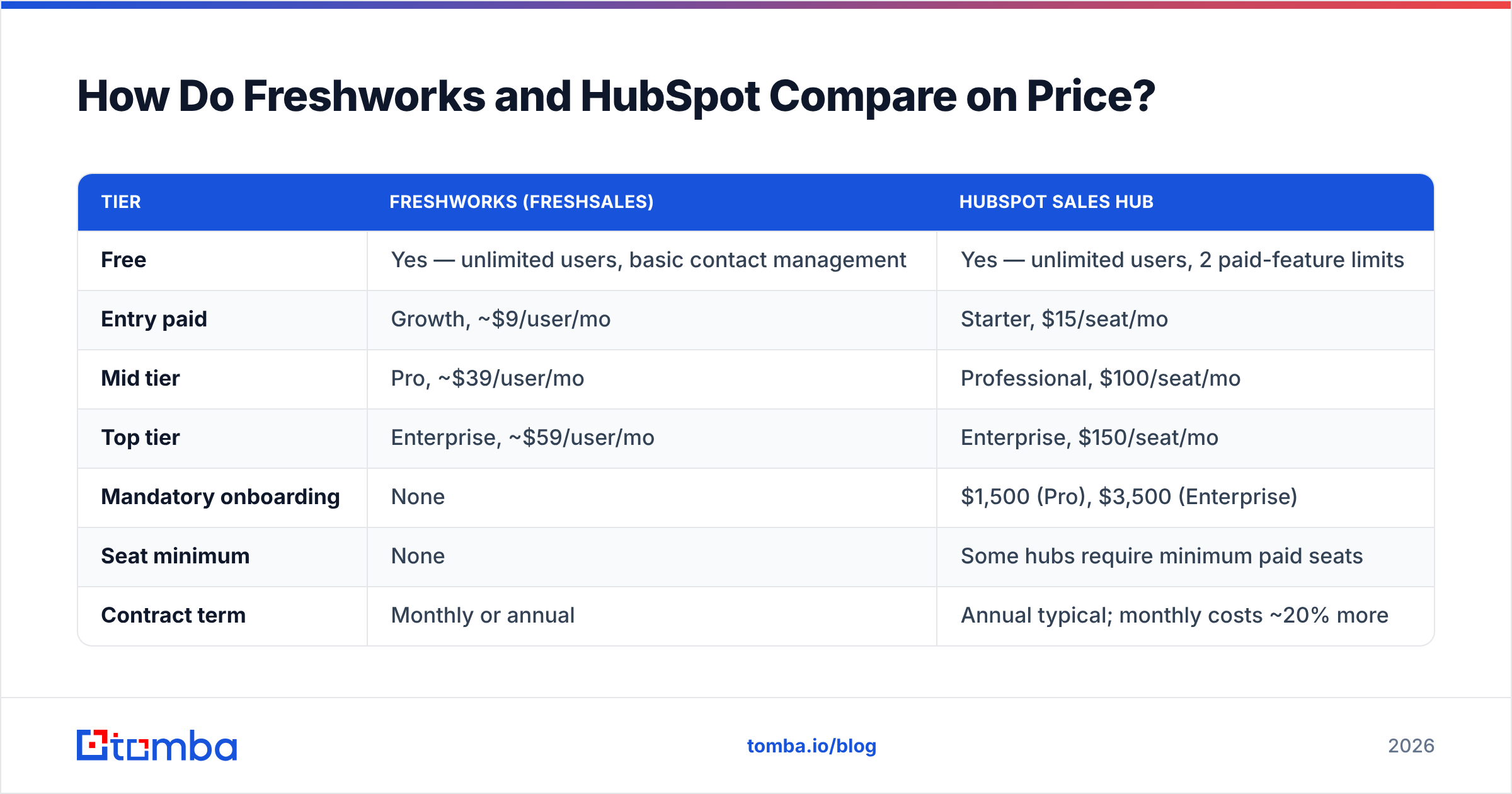
This is where most evaluations end, so let's be precise. Prices below reflect annual billing as published on each vendor's pricing page in 2026.
| Tier | Freshworks (Freshsales) | HubSpot Sales Hub |
|---|---|---|
| Free | Yes — unlimited users, basic contact management | Yes — unlimited users, 2 paid-feature limits |
| Entry paid | Growth, ~$9/user/mo | Starter, $15/seat/mo |
| Mid tier | Pro, ~$39/user/mo | Professional, $100/seat/mo |
| Top tier | Enterprise, ~$59/user/mo | Enterprise, $150/seat/mo |
| Mandatory onboarding | None | $1,500 (Pro), $3,500 (Enterprise) |
| Seat minimum | None | Some hubs require minimum paid seats |
| Contract term | Monthly or annual | Annual typical; monthly costs ~20% more |
The headline gap is roughly 2.5x at the professional tier — and that is before HubSpot's onboarding fee and before marketing contact tiers kick in.
HubSpot's pricing has one detail that catches teams off guard: marketing contacts are billed separately from CRM contacts. You can store a million contacts for free, but the moment you want to email or automate against them, they become "marketing contacts" and enter a tiered price ladder. Teams that import a large cold list without understanding this find their renewal quote doubled.
Freshworks avoids that trap with straightforward per-user pricing, but it has its own catch: the AI features, advanced custom reports, and higher API limits sit in Pro and Enterprise. The $9 Growth tier is genuinely entry-level.
Which CRM Has Better Sales Features?#
Both cover the table stakes. The differences are in depth and where each hits a ceiling.
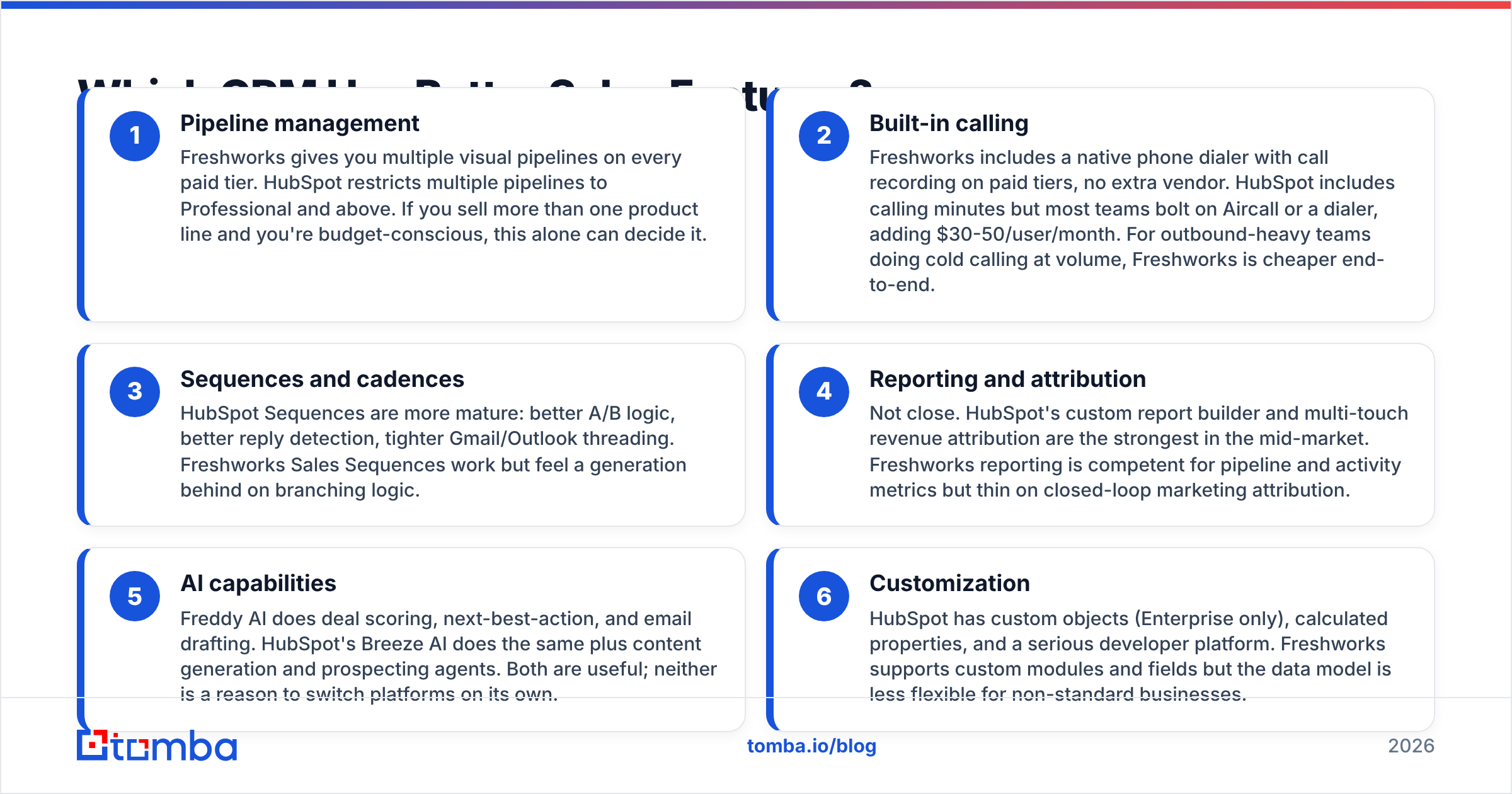
Pipeline management — Freshworks gives you multiple visual pipelines on every paid tier. HubSpot restricts multiple pipelines to Professional and above. If you sell more than one product line and you're budget-conscious, this alone can decide it.
Built-in calling — Freshworks includes a native phone dialer with call recording on paid tiers, no extra vendor. HubSpot includes calling minutes but most teams bolt on Aircall or a dialer, adding $30-50/user/month. For outbound-heavy teams doing cold calling at volume, Freshworks is cheaper end-to-end.
Sequences and cadences — HubSpot Sequences are more mature: better A/B logic, better reply detection, tighter Gmail/Outlook threading. Freshworks Sales Sequences work but feel a generation behind on branching logic.
Reporting and attribution — Not close. HubSpot's custom report builder and multi-touch revenue attribution are the strongest in the mid-market. Freshworks reporting is competent for pipeline and activity metrics but thin on closed-loop marketing attribution.
AI capabilities — Freddy AI does deal scoring, next-best-action, and email drafting. HubSpot's Breeze AI does the same plus content generation and prospecting agents. Both are useful; neither is a reason to switch platforms on its own.
Customization — HubSpot has custom objects (Enterprise only), calculated properties, and a serious developer platform. Freshworks supports custom modules and fields but the data model is less flexible for non-standard businesses.
Is HubSpot's Ecosystem Worth the Premium?#
Often, yes — and this is the honest case for paying more.
HubSpot's App Marketplace lists over 1,700 integrations. Freshworks' marketplace is a fraction of that. If your stack includes a niche billing tool, a specific data warehouse connector, or an industry vertical app, the odds that a maintained HubSpot integration exists are dramatically higher.
That matters more than feature checklists. A CRM that doesn't sync cleanly with your billing system creates manual reconciliation work that outlasts any per-seat savings.
HubSpot also has the deeper partner and talent pool. Hiring a HubSpot admin is easy; hiring a Freshworks admin means training someone. G2 reviews consistently reflect this — HubSpot scores higher on "ease of doing business with" partly because there's an entire consulting industry around it.
Where the premium stops being worth it: if you're purely sales-led with no marketing automation requirement. A 12-rep outbound team that never sends a nurture campaign is paying for infrastructure it will never touch. That team should look hard at Freshworks, or at Freshworks plus a dedicated outbound sequencer.
What About Data Quality — Does Either CRM Solve It?#
Neither does, and this is the gap most comparisons skip entirely.
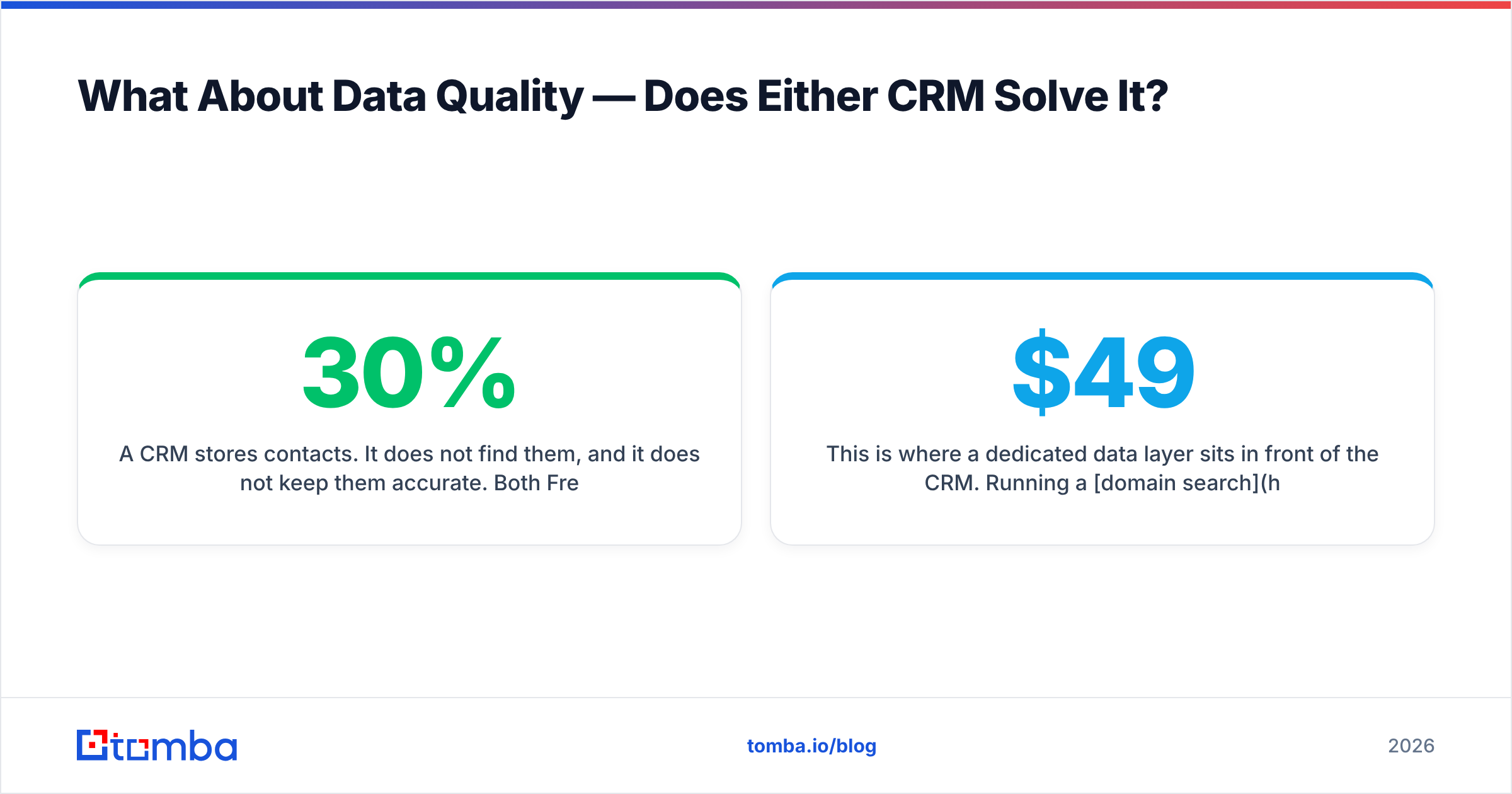
A CRM stores contacts. It does not find them, and it does not keep them accurate. Both Freshworks and HubSpot will happily hold a database where 25-30% of records decay each year as people change jobs — the standard B2B data decay rate cited by Gartner and most data vendors.
The practical consequence: your rep opens a beautifully configured deal record, sends an email to the contact on file, and it bounces. Repeat that a few hundred times and your sender reputation is damaged — which then hurts every campaign you run from that domain, in either CRM.
Both platforms offer some enrichment. HubSpot Breeze Intelligence provides credit-based enrichment on paid tiers. Freshworks pulls limited firmographic data. Neither is built as a contact-discovery engine, and both charge enrichment credits at rates that make bulk work expensive.
This is where a dedicated data layer sits in front of the CRM. Running a domain search to map an account's contacts, verifying each address before it enters the pipeline, and re-verifying quarterly costs a fraction of CRM-native enrichment credits. Tomba pricing starts free at 25 searches/month, with the Starter plan at $49/mo and Growth at $99/mo — priced per-lookup rather than per-seat, so it doesn't scale punitively with headcount.

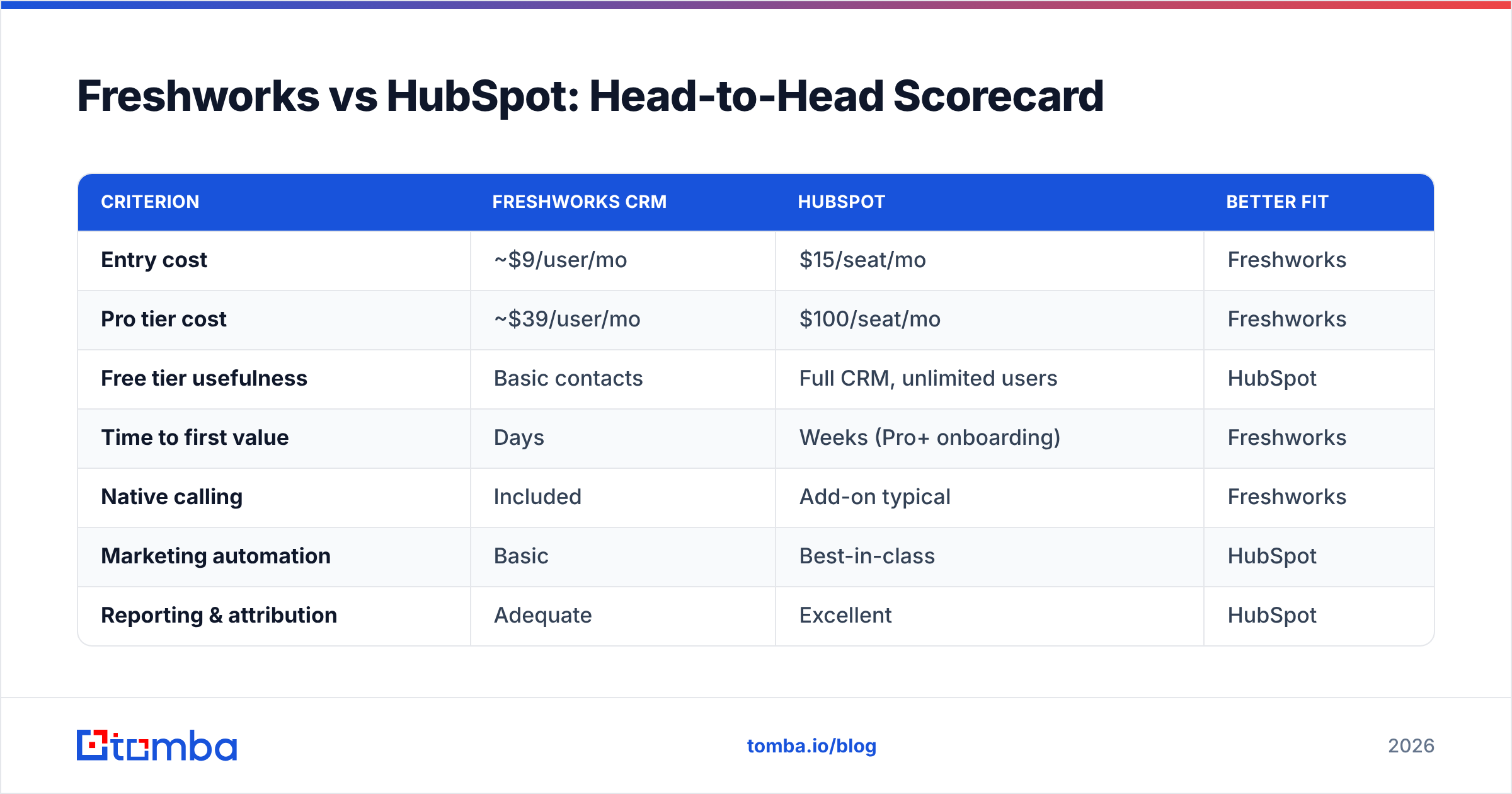
Freshworks vs HubSpot: Head-to-Head Scorecard#
| Criterion | Freshworks CRM | HubSpot | Better fit |
|---|---|---|---|
| Entry cost | ~$9/user/mo | $15/seat/mo | Freshworks |
| Pro tier cost | ~$39/user/mo | $100/seat/mo | Freshworks |
| Free tier usefulness | Basic contacts | Full CRM, unlimited users | HubSpot |
| Time to first value | Days | Weeks (Pro+ onboarding) | Freshworks |
| Native calling | Included | Add-on typical | Freshworks |
| Marketing automation | Basic | Best-in-class | HubSpot |
| Reporting & attribution | Adequate | Excellent | HubSpot |
| Integrations | ~500 | 1,700+ | HubSpot |
| Custom objects | Limited | Enterprise tier | HubSpot |
| Admin talent availability | Scarce | Abundant | HubSpot |
| Hidden cost risk | Low | Marketing contact tiers | Freshworks |
| Contract flexibility | Monthly available | Annual pressure | Freshworks |
Read the pattern: Freshworks wins on cost, speed, and predictability. HubSpot wins on depth, ecosystem, and long-horizon platform value.
Who Should Choose Freshworks?#
Pick Freshworks if three or more of these describe you:
- Sales team under 30 reps with no dedicated marketing operations function
- Outbound-heavy motion where native calling saves a separate dialer contract
- Budget scrutiny on every line item, and per-seat cost is the deciding metric
- You need multiple pipelines without jumping to a $100/seat tier
- You want to be live in a week, not a quarter
- You already use Freshdesk or Freshservice and want one vendor relationship
The honest downside: you'll hit reporting limits sooner than you expect, and if marketing later demands attribution modeling, you'll be running a migration project you didn't budget for.
Who Should Choose HubSpot?#
Pick HubSpot if:
- Marketing and sales report to the same revenue number and need shared data
- You run content, nurture, and paid campaigns that require attribution
- Your stack has niche tools that need maintained integrations
- You expect to double headcount and want a platform that scales without replatforming
- You want to start free and expand — the free CRM genuinely works for small teams
- You have or can hire someone to own the system properly
The honest downside: the price ramp is steep and non-obvious. Model your cost at 3x your current contact count and seat count before signing, and read the marketing contact terms line by line. And if you're evaluating HubSpot mainly for its data enrichment, look at what a purpose-built data enrichment layer costs first — the credit math rarely favors the CRM.
What Do You Actually Need Alongside Either CRM?#
Whichever you pick, three gaps remain open:
Contact discovery. Neither platform finds net-new prospects at scale. HubSpot's prospecting tools work within its own database; Freshworks barely tries. You need a source of verified addresses — that's a bulk email finder or an email finder API feeding the CRM directly.
Verification before send. Import a raw list into either CRM and your bounce rate is whatever the list's decay rate is. Verify first. A pre-send pass through an email verifier removes the addresses that would have hurt your domain.
Ongoing hygiene. Records decay whether or not you touch them. Quarterly re-verification of your active pipeline is cheap insurance compared to the cost of a suppressed sending domain.
Teams that treat the CRM as the whole solution end up with an expensive, well-organized database of contacts who no longer work there.
The Verdict#
For most B2B sales teams under 30 people: Freshworks. The cost difference at the Professional tier — roughly $61/seat/month — is real money that funds a data layer, a sequencer, and a dialer with room left over.
For companies where marketing owns half the funnel: HubSpot. The attribution reporting and ecosystem depth justify the premium, provided you model the true cost honestly and don't get surprised by marketing contact tiers at renewal.
For anyone still deciding: run both free tiers for two weeks with the same 100 real prospects. You'll learn more from that than from any comparison table — including this one.
Fill either CRM with contacts that actually reach a human. Tomba's Email Finder locates verified professional email addresses by domain, name, or company, then confirms deliverability before the record ever hits Freshworks or HubSpot. Start free with 25 searches a month, or move to Starter at $49/mo when your pipeline demands more. Your CRM is only as good as the data you put in it.
Related guides#
Ready to find emails that actually work?
Join 150,000+ professionals who stopped guessing and started sending. Free credits on signup — no credit card required.
Get the Tomba newsletter
Practical outbound tactics and product updates — once every two weeks.
About the author