Full Cycle Sales Team: When It Beats a Split SDR/AE Model
Full cycle reps own prospecting through close. It works brilliantly at some ACVs and quietly destroys pipeline at others. Here's the math, the org chart, and the break-even point.
TL;DR
- A full cycle sales team means one rep owns the entire deal: prospecting, discovery, demo, negotiation, close, and often onboarding handoff.
- It wins below roughly $25K ACV with short sales cycles, and at very high ACV where relationships matter more than volume. It struggles in the messy middle.
- The failure mode is predictable: reps stop prospecting the moment their calendar fills with late-stage deals, and pipeline collapses 60-90 days later.
- Split SDR/AE models buy specialization and forecast stability, but cost 30-50% more per closed deal in headcount and add a handoff where 20-30% of context leaks.
- Whichever model you pick, contact data quality decides whether prospecting time converts. Bad emails burn the exact hours a full cycle rep cannot spare.
What is a full cycle sales team?#
A full cycle sales team is a group of reps who each own every stage of the revenue motion for their accounts. One person builds the list, sends the cold email, books the meeting, runs discovery, delivers the demo, writes the proposal, negotiates terms, and signs the contract. No handoff to an account executive. No SDR feeding them meetings.
Think of it like a chef who also shops for ingredients, plates the dish, and walks it to the table. When the restaurant is small and the menu is tight, that chef knows exactly why the sauce tastes the way it does. When there are 200 covers a night, the same chef burns the sauce because they are stuck at the market.
The alternative — the split model popularized by Aaron Ross's Predictable Revenue and adopted across most of SaaS after 2011 — separates the motion into specialized roles: SDRs or BDRs create pipeline, AEs close it, and CSMs retain it. Both models are legitimate. The mistake is picking one because it's fashionable rather than because your ACV, sales cycle, and deal complexity point at it.
How does a full cycle rep spend their week?#
Here's the part nobody puts in the job description. A full cycle rep's calendar is a zero-sum game, and closing activity always wins the fight for time because it's urgent and it's measured this month.
A realistic breakdown for a healthy full cycle rep at $20K ACV:
- Prospecting and list building — 12-14 hours/week. Sourcing accounts, finding contacts, verifying emails, writing sequences. This is the block that gets sacrificed first.
- Outbound execution — 6-8 hours/week. Cold calls, email sends, LinkedIn touches, follow-ups on non-responders.
- Discovery and demos — 8-10 hours/week. Roughly 6-10 live meetings, plus prep and note-taking.
- Deal management — 6-8 hours/week. Proposals, security questionnaires, procurement chasing, multithreading into the buying committee.
- Admin and CRM hygiene — 4-5 hours/week. Notes, forecast updates, handoff docs.
That's a 40-hour week with zero slack. Add one enterprise deal with a legal review and the prospecting block is the only flexible thing left. This is why full cycle teams produce sawtooth pipeline: a great closing month is almost always followed by an empty quarter.
The fix is not willpower. It's structure — time-blocked prospecting that is protected like a customer meeting, plus tooling that compresses step 1 from 14 hours to 4. Most of that 14 hours is not thinking, it's hunting for contact details. An email finder that returns verified addresses in seconds instead of manual guessing is the difference between prospecting surviving a busy month and prospecting dying in it.
Is a full cycle sales team better than a split SDR/AE model?#
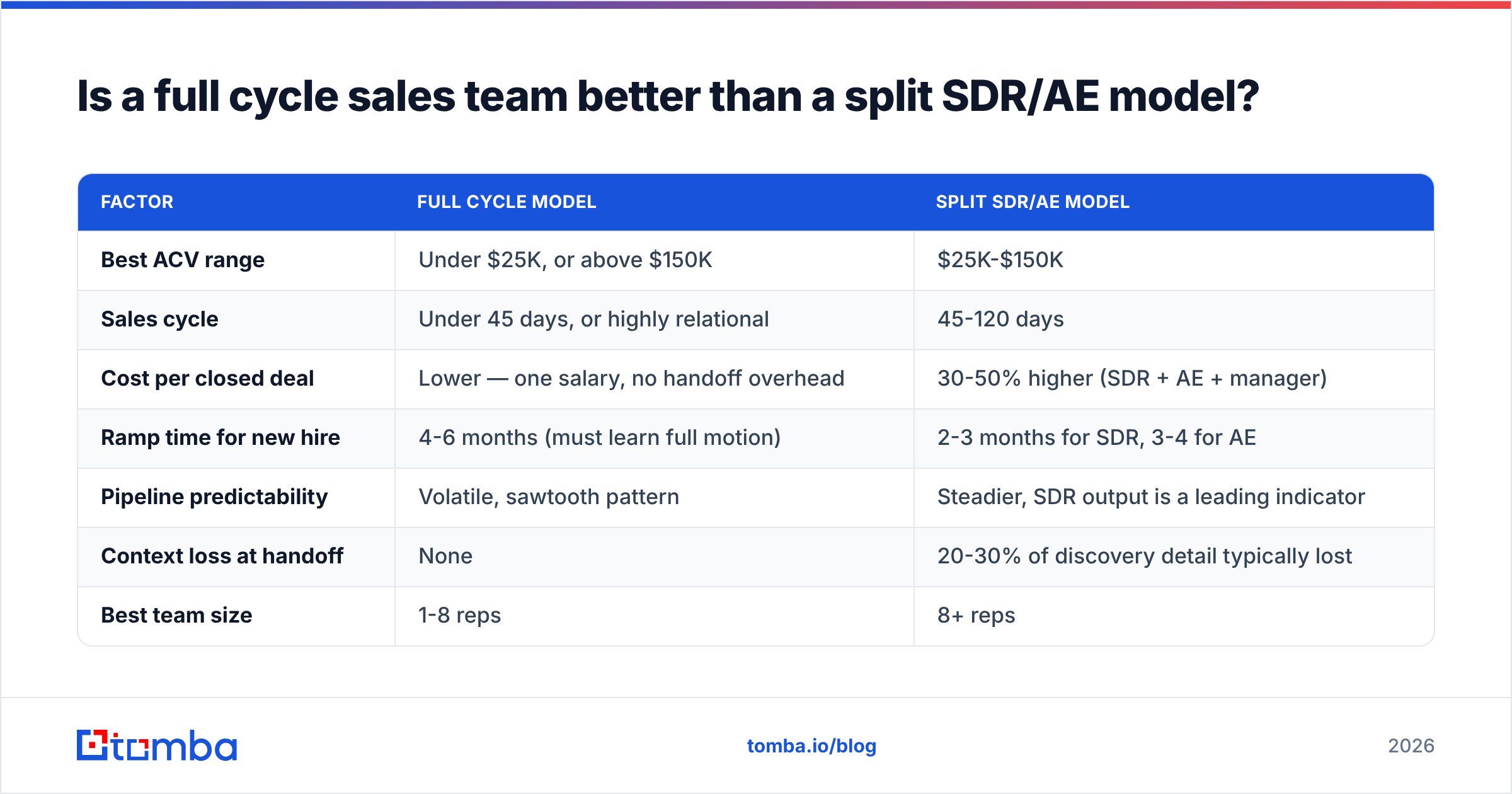
Neither is universally better. The decision hinges on four variables: average contract value, sales cycle length, number of stakeholders, and how much product knowledge a first conversation requires.
| Factor | Full cycle model | Split SDR/AE model |
|---|---|---|
| Best ACV range | Under $25K, or above $150K | $25K-$150K |
| Sales cycle | Under 45 days, or highly relational | 45-120 days |
| Cost per closed deal | Lower — one salary, no handoff overhead | 30-50% higher (SDR + AE + manager) |
| Ramp time for new hire | 4-6 months (must learn full motion) | 2-3 months for SDR, 3-4 for AE |
| Pipeline predictability | Volatile, sawtooth pattern | Steadier, SDR output is a leading indicator |
| Context loss at handoff | None | 20-30% of discovery detail typically lost |
| Best team size | 1-8 reps | 8+ reps |
| Rep skill required | High — must be strong at both hunting and closing | Moderate per role, easier to hire |
| Coaching focus | Broad, harder to specialize | Narrow, faster skill development |
| Failure mode | Prospecting stops when deals heat up | SDRs book low-quality meetings to hit dials |
Read the table as a diagnostic, not a scoreboard. If you're a 4-person team selling a $12K product with a 30-day cycle, splitting roles adds a handoff to a motion that doesn't need one. If you're 15 reps selling a $60K product with six stakeholders and a 90-day cycle, asking one person to cold call on Monday and negotiate an MSA on Friday is asking them to be two different people.
When should you keep reps full cycle?#
Keep the full cycle model when any of these are true:
- You're under 10 reps. Below that headcount you don't have enough volume to keep a dedicated SDR productive, and the manager overhead of two role tracks is real.
- Your ACV is under $25K with a cycle under 45 days. Deals close fast enough that the same person can prospect Monday and close Thursday without the calendar collapsing.
- The first conversation is technical. If a generic SDR can't qualify without misrepresenting the product, the handoff creates more damaged deals than booked meetings. Developer tools and technical infrastructure sales live here.
- You sell relationally into a small TAM. If there are only 900 companies who could ever buy, a rep owning 60 named accounts end-to-end builds relationships an SDR pass-off would erode.
- You're still finding product-market fit. Founders and early reps need unfiltered contact with prospects. Handing prospecting to someone else means the person shaping the roadmap never hears the objection firsthand.
Gartner's research on B2B buying consistently shows buyers spend only about 17% of their purchase journey with any supplier's sales team, split across all vendors considered. When your slice of attention is that thin, continuity of the person holding it matters more than functional specialization.
What breaks when you scale a full cycle team?#
Three things break, in this order.
Pipeline goes sawtooth. Month one is a great closing month because the rep has a full funnel. Month two they're heads-down closing and stop prospecting. Month four the funnel is empty and forecast misses. Then they panic-prospect, and the cycle repeats on a 90-day period. You can see it in a chart of new opportunities created per week — full cycle teams show peaks and troughs where split teams show a flatter line.
Coaching gets diluted. A manager coaching a split team gets to specialize: SDR coaching is about openers, objection handling on the first 20 seconds, and volume discipline. AE coaching is about discovery depth, multithreading, and commercial negotiation. A manager of full cycle reps has to be excellent at both and usually splits attention badly.
Hiring gets brutally hard. The population of people who are genuinely good at cold outbound and good at closing complex deals is small, and they're expensive. Split roles let you hire for one skill and develop the other. Full cycle roles mean you're always fishing in the smallest part of the talent pool.
None of this means full cycle is wrong. It means you need instrumentation. Track new opportunities created per rep per week as a hard, separately-comped metric. If a rep closes $80K but created zero new opportunities, that's a failing month dressed up as a good one.
What does a full cycle sales team actually cost?#
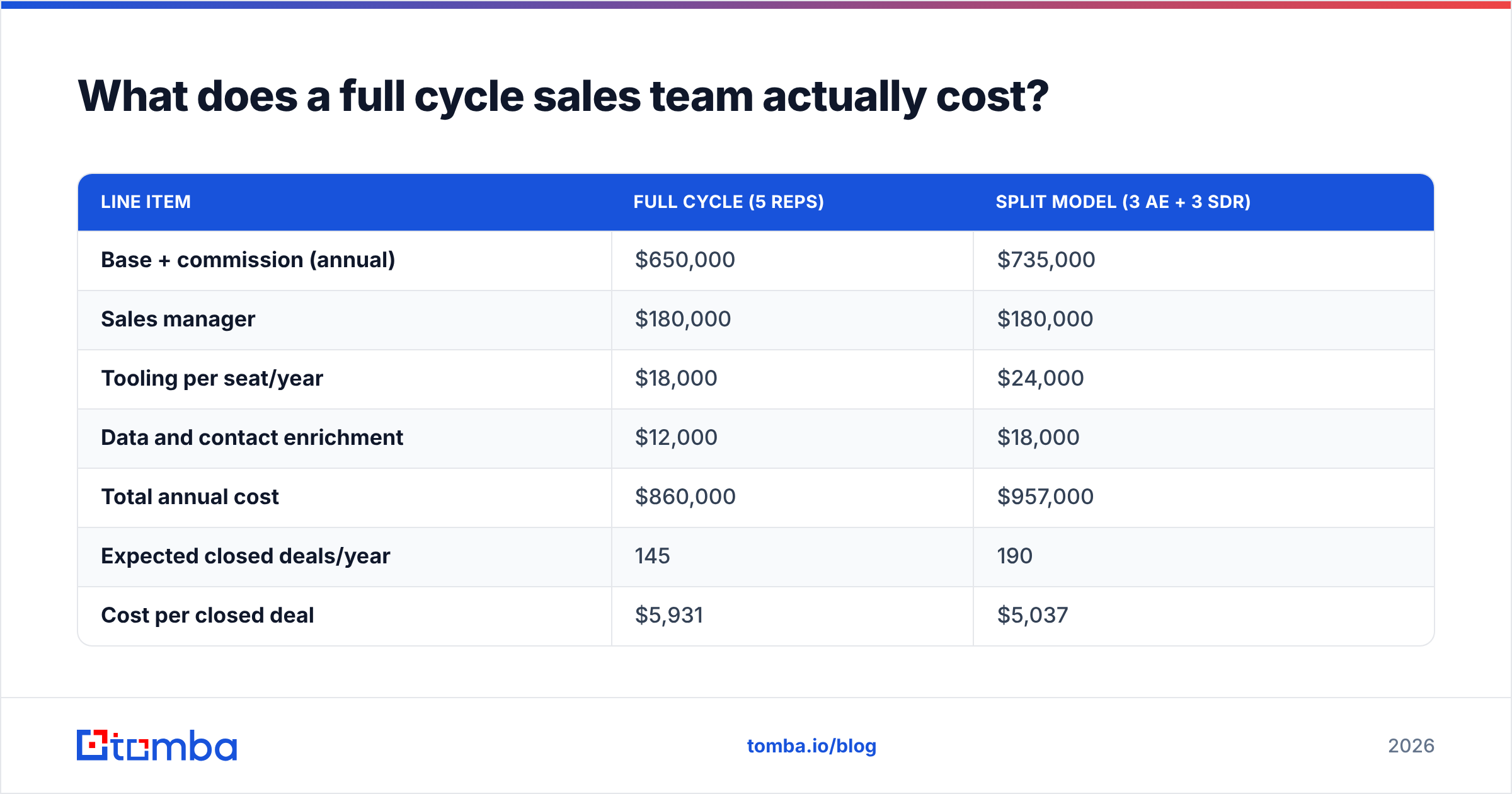
Run the math before you restructure. Fully-loaded cost per closed deal is the number that matters, not headcount.
| Line item | Full cycle (5 reps) | Split model (3 AE + 3 SDR) |
|---|---|---|
| Base + commission (annual) | $650,000 | $735,000 |
| Sales manager | $180,000 | $180,000 |
| Tooling per seat/year | $18,000 | $24,000 |
| Data and contact enrichment | $12,000 | $18,000 |
| Total annual cost | $860,000 | $957,000 |
| Expected closed deals/year | 145 | 190 |
| Cost per closed deal | $5,931 | $5,037 |
| Cost per closed deal at $12K ACV | 49% of ACV | 42% of ACV |
The split model looks better in that table — but only because I assumed 190 deals. Change the assumption to 165 deals (a realistic outcome when handoff quality is poor and SDRs book meetings that don't hold) and the split model's cost per deal jumps to $5,800, erasing the advantage. The split model's economics depend entirely on SDR meeting quality holding up. If your SDRs are compensated on meetings booked rather than meetings that convert to stage 2, you will get exactly what you paid for.

How do you make a full cycle team actually work?#
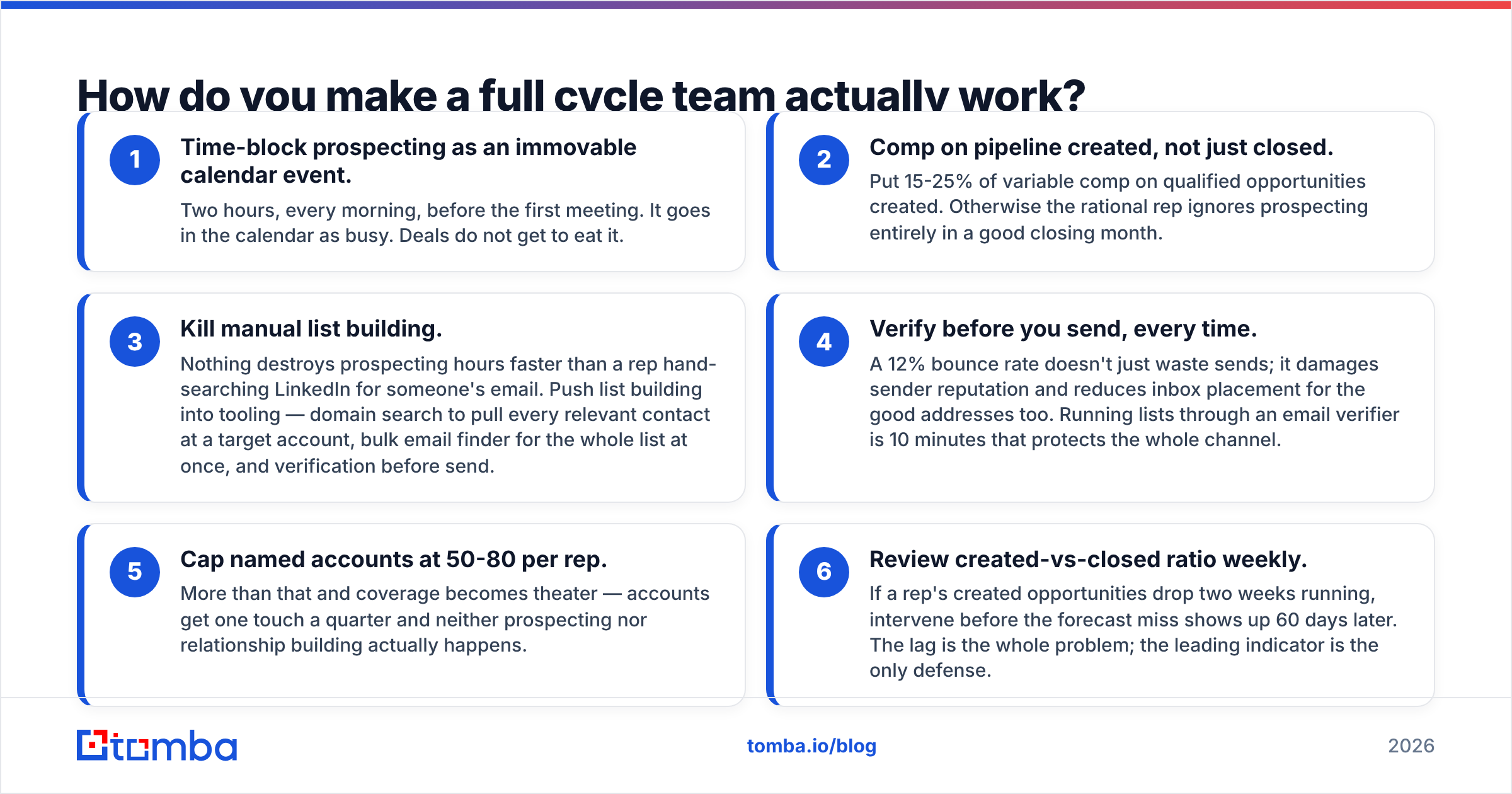
Six operational rules separate full cycle teams that scale from ones that flame out.
- Time-block prospecting as an immovable calendar event. Two hours, every morning, before the first meeting. It goes in the calendar as busy. Deals do not get to eat it.
- Comp on pipeline created, not just closed. Put 15-25% of variable comp on qualified opportunities created. Otherwise the rational rep ignores prospecting entirely in a good closing month.
- Kill manual list building. Nothing destroys prospecting hours faster than a rep hand-searching LinkedIn for someone's email. Push list building into tooling — domain search to pull every relevant contact at a target account, bulk email finder for the whole list at once, and verification before send.
- Verify before you send, every time. A 12% bounce rate doesn't just waste sends; it damages sender reputation and reduces inbox placement for the good addresses too. Running lists through an email verifier is 10 minutes that protects the whole channel.
- Cap named accounts at 50-80 per rep. More than that and coverage becomes theater — accounts get one touch a quarter and neither prospecting nor relationship building actually happens.
- Review created-vs-closed ratio weekly. If a rep's created opportunities drop two weeks running, intervene before the forecast miss shows up 60 days later. The lag is the whole problem; the leading indicator is the only defense.
Rule 3 deserves emphasis because it's the highest-leverage change available. In a split model, an SDR spending three hours on list building is doing their job. In a full cycle model, those three hours came directly out of deal work. Automating research is not a nice-to-have — it's what makes the model viable at all.
What tooling stack does a full cycle rep need?#
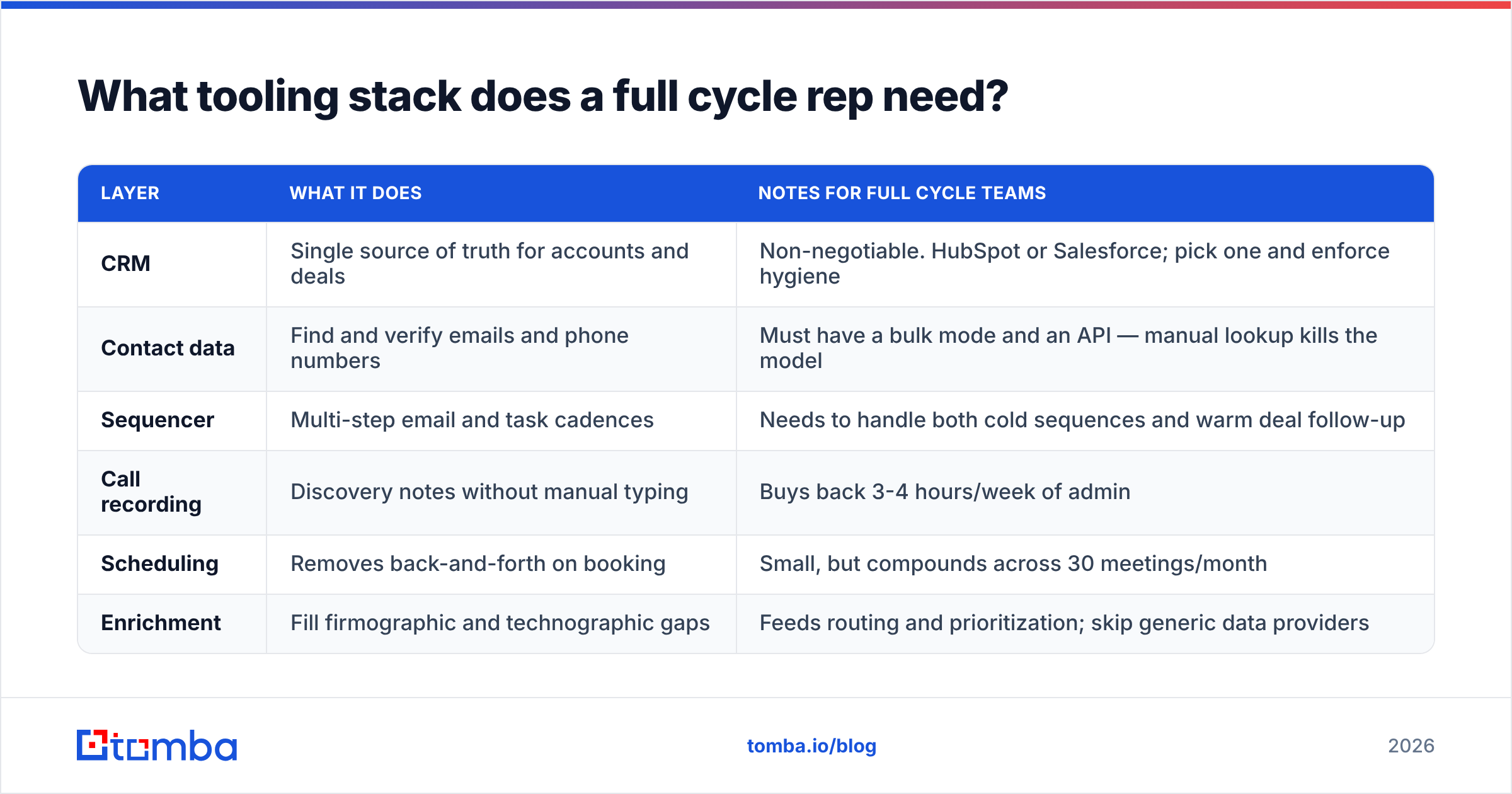
Fewer tools than a split team, but each one has to do more. A full cycle rep switching between eight interfaces loses the time the model was supposed to save.
| Layer | What it does | Notes for full cycle teams |
|---|---|---|
| CRM | Single source of truth for accounts and deals | Non-negotiable. HubSpot or Salesforce; pick one and enforce hygiene |
| Contact data | Find and verify emails and phone numbers | Must have a bulk mode and an API — manual lookup kills the model |
| Sequencer | Multi-step email and task cadences | Needs to handle both cold sequences and warm deal follow-up |
| Call recording | Discovery notes without manual typing | Buys back 3-4 hours/week of admin |
| Scheduling | Removes back-and-forth on booking | Small, but compounds across 30 meetings/month |
| Enrichment | Fill firmographic and technographic gaps | Feeds routing and prioritization; skip generic data providers |
On contact data specifically, the options split into three camps. All-in-one platforms like Apollo and ZoomInfo bundle data with sequencing and cost accordingly. Specialized B2B data providers like BookYourData sell verified lists and work well when you want a clean, pre-built list rather than a self-serve search workflow. Focused finder-and-verifier tools sit in the middle, cheaper per credit and better suited to teams that already own a sequencer.
For that middle lane, Tomba pricing starts free at 25 searches per month, with Starter at $49/mo, Growth at $99/mo, and Pro at $249/mo. For a five-rep full cycle team, the Growth tier typically covers list building without the per-seat pricing that makes bundled platforms expensive when you only need the data layer. The Tomba API also matters more here than it would for a split team — full cycle reps benefit disproportionately from enrichment that runs automatically in the background rather than as a manual step.
How do you transition from full cycle to a split model?#
Don't flip the whole team at once. The standard sequence:
- Trigger point. Split when you cross 8-10 reps and your ACV or cycle length has grown past the ranges in the table above. Two conditions, not one.
- Start with one pod. Take two of your strongest full cycle reps, give them one SDR, and run the pod in parallel with the rest of the full cycle team for a quarter. Compare opportunities created and win rate.
- Fix the handoff before you scale it. Define what "qualified" means in writing, with a specific list of fields that must be filled before an SDR passes a meeting. Most handoff failures are definitional, not motivational.
- Comp the SDR on stage-2 progression, not meetings booked. This single choice determines whether the split model's economics work.
- Expect a dip. Win rate typically drops for one quarter during the transition as AEs learn to close deals they didn't source. Budget for it in the forecast rather than treating it as a failure.
Some teams end up hybrid permanently: full cycle reps on SMB and mid-market, split SDR/AE on enterprise. That's not indecision, it's matching the model to the segment. It's also the most common end state for companies between $10M and $50M ARR.
The honest verdict#
Full cycle is the right default for small teams, fast cycles, technical products, and small TAMs. It's cheaper per deal, it eliminates handoff loss, and it produces reps who genuinely understand the buyer. It fails when you scale it past the point where one calendar can hold both hunting and closing, and it fails quietly — the damage shows up 60-90 days after the behavior changes.
If you run full cycle, treat prospecting time as sacred and automate everything about list building that can be automated. That's the whole game. The reps who succeed in this model aren't the ones with more discipline; they're the ones who need less of it because the research work was compressed from hours into minutes.
Start there. Run Tomba Email Finder against your next target account list and see how much of your prospecting block is actually contact hunting versus real selling. The free tier gives you 25 searches to test it against accounts you already know, and if the numbers hold, that's the two hours a day your full cycle reps stop losing to manual research.
Sources worth reading before you restructure: Gartner's B2B buying research, HubSpot's sales org structure guidance, and peer reviews of sales tooling on G2.
Related guides#
Ready to find emails that actually work?
Join 150,000+ professionals who stopped guessing and started sending. Free credits on signup — no credit card required.
Get the Tomba newsletter
Practical outbound tactics and product updates — once every two weeks.
About the author