FullCircl Pricing, Reviews, Pros and Cons: 2026 Buyer Guide
FullCircl does not publish a price list, so buyers walk into quote calls blind. Here is what the platform actually does, what reviewers report paying, where it wins, where it frustrates, and which cheaper stack covers the same job.
TL;DR
- FullCircl publishes no price list. Every deal is a custom annual quote, usually seat-based with data-volume tiers on top, and buyers consistently report five-figure annual commitments rather than monthly self-serve billing.
- It is a customer lifecycle intelligence and KYB platform built primarily around UK and Ireland company records — Companies House filings, credit and risk signals, ownership structures, trigger events. It is not a global contact-finding tool.
- Reviewers praise the depth of UK company data, the trigger alerts, and the onboarding/compliance workflows. The recurring complaints are opaque pricing, slow implementation, thin coverage outside UK/Ireland, and a UI that feels dated next to newer GTM tools.
- If your job is regulated onboarding, credit risk, or UK SME account planning, FullCircl is a defensible buy. If your job is finding and verifying contact emails at scale, you are paying enterprise rates for the wrong 80% of the product.
- A leaner stack — a dedicated email finder plus a company-data source — covers the outbound half of the job for a fraction of a FullCircl contract.
What is FullCircl and who actually buys it?#
FullCircl is a B2B data and workflow platform formed from the merger of Artesian Solutions (sales intelligence) and DueDil (company and risk data), now part of the Advent-backed nCino ecosystem. Think of it as a credit-bureau-grade company file glued to a sales alerting engine: the same record that tells a compliance officer whether a business is real also tells a relationship manager that the business just filed accounts, changed directors, or opened a new site.
The customer base skews heavily toward regulated UK industries — banking, insurance, business lending, utilities, and professional services. Those buyers have a shared problem: they need to onboard a company quickly without breaching KYB/AML obligations, and they need front-line teams to notice when an existing customer changes shape. FullCircl sells against that combined need, which is why it lands in procurement processes alongside Dun & Bradstreet, Creditsafe, and Experian Business rather than alongside prospecting tools.
That positioning matters for pricing. You are not buying credits. You are buying a data licence plus a workflow product, and licences get priced by seat, by API call volume, by which data modules you switch on, and by how long you commit.
How does FullCircl pricing work in 2026?#
Short answer: it is quote-only, annual, and modular. FullCircl's official site directs every pricing enquiry to a demo request, and no public tier card exists. Anyone quoting you an exact FullCircl list price online is guessing.
What you can establish from buyer reports on G2 and Capterra, plus standard practice among UK company-data vendors, is the shape of the deal:
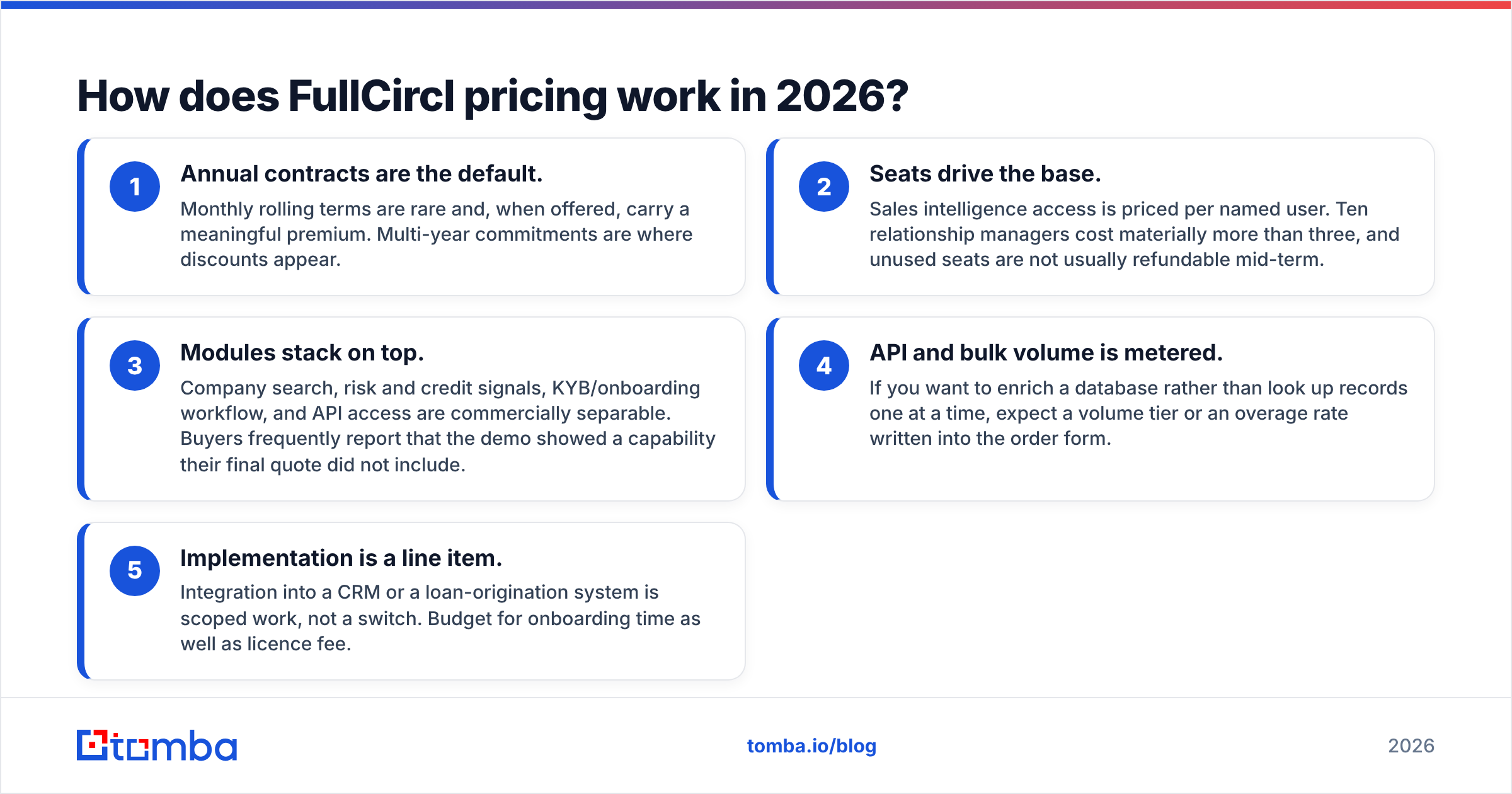
- Annual contracts are the default. Monthly rolling terms are rare and, when offered, carry a meaningful premium. Multi-year commitments are where discounts appear.
- Seats drive the base. Sales intelligence access is priced per named user. Ten relationship managers cost materially more than three, and unused seats are not usually refundable mid-term.
- Modules stack on top. Company search, risk and credit signals, KYB/onboarding workflow, and API access are commercially separable. Buyers frequently report that the demo showed a capability their final quote did not include.
- API and bulk volume is metered. If you want to enrich a database rather than look up records one at a time, expect a volume tier or an overage rate written into the order form.
- Implementation is a line item. Integration into a CRM or a loan-origination system is scoped work, not a switch. Budget for onboarding time as well as licence fee.
Directionally, buyers describe entry commitments in the low five figures per year for small teams, rising into the mid-to-high five figures once onboarding workflow, API access, and a dozen-plus seats are involved. Treat those as reported ranges, not vendor-published facts — your quote depends entirely on modules and seat count.

The practical consequence: you cannot benchmark FullCircl the way you benchmark a self-serve tool. You have to run a real procurement cycle, and you should ask for the price per seat, the price per API call, the overage rate, and the renewal uplift cap in writing before you sign anything.
What do FullCircl reviews actually say?#
Public review sentiment is broadly positive with a consistent set of caveats. Pulling the recurring themes together:
What reviewers like
- The UK and Ireland company file is genuinely deep. Filings, charges, group structures, directorships, and financials in one record beats stitching together Companies House exports by hand.
- Trigger alerts work. Users describe getting usable openers — a funding event, an accounts filing, a director change — rather than generic news noise.
- Compliance teams like the audit trail. For KYB, having the decision, the evidence, and the timestamp in one place is the whole point.
- Account management gets decent marks. Reviewers mention responsive CSMs more often than not.
What reviewers criticise
- Pricing opacity, repeatedly. The complaint is not just cost; it is inability to forecast cost.
- Coverage outside UK/Ireland thins fast. If your ICP is US mid-market or EU-wide, you will find gaps.
- Contact-level data is the weak spot. Company records are strong; named individual emails and direct dials are inconsistent.
- The interface feels older than the newer GTM tools your reps already use, and adoption suffers when reps have to leave their CRM.
- Implementation takes longer than expected, particularly where a CRM or origination system is involved.
That last cluster is the one that decides deals. FullCircl is bought by a compliance or data leader and used by front-line sellers, and the gap between those two audiences is where satisfaction scores diverge.
What are the real pros and cons?#
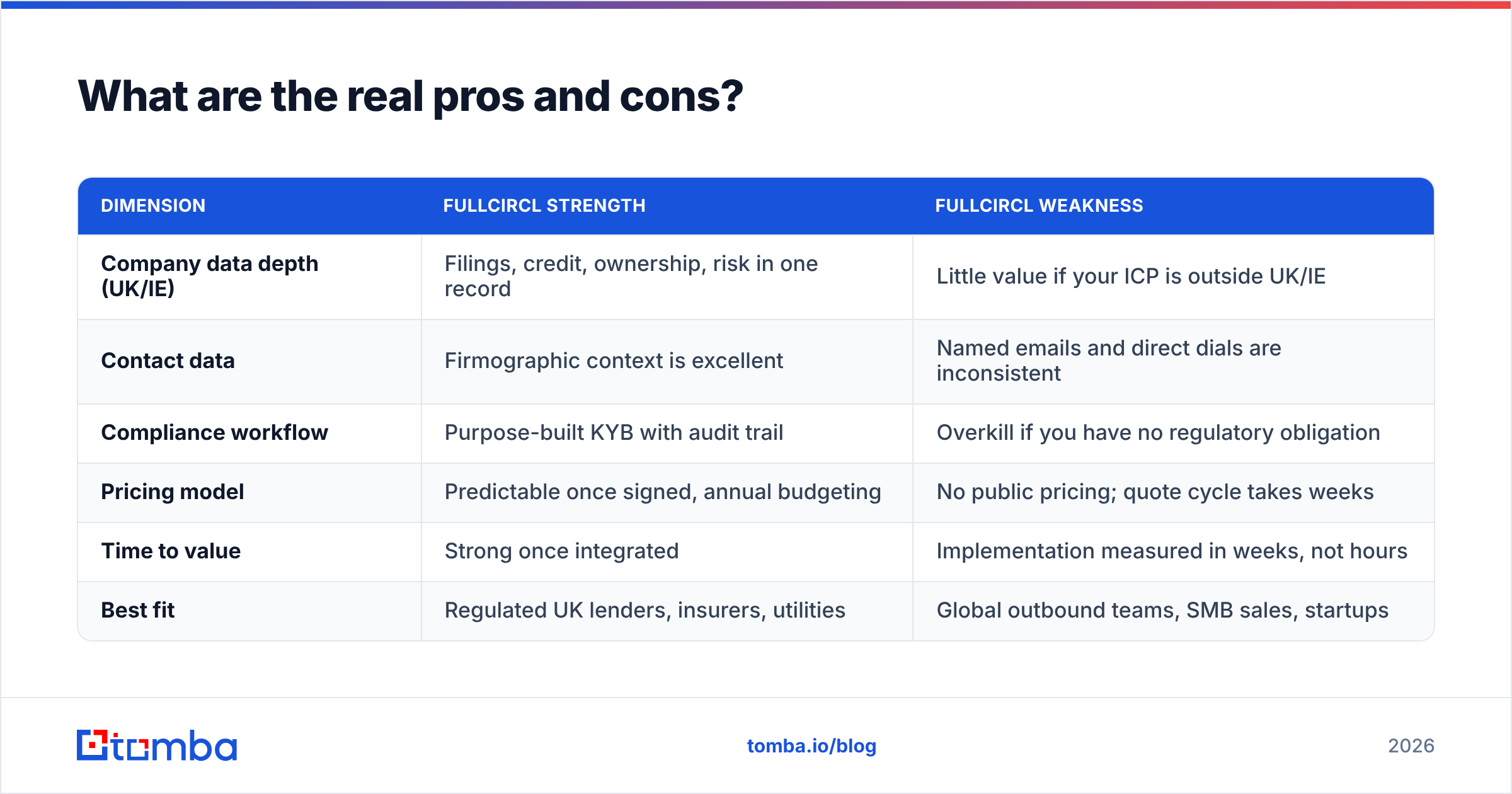
| Dimension | FullCircl strength | FullCircl weakness |
|---|---|---|
| Company data depth (UK/IE) | Filings, credit, ownership, risk in one record | Little value if your ICP is outside UK/IE |
| Contact data | Firmographic context is excellent | Named emails and direct dials are inconsistent |
| Compliance workflow | Purpose-built KYB with audit trail | Overkill if you have no regulatory obligation |
| Pricing model | Predictable once signed, annual budgeting | No public pricing; quote cycle takes weeks |
| Time to value | Strong once integrated | Implementation measured in weeks, not hours |
| Best fit | Regulated UK lenders, insurers, utilities | Global outbound teams, SMB sales, startups |
The honest framing: FullCircl is a risk-and-relationship platform that happens to help sales, not a sales platform that happens to mention risk. Buy it for the first job and the second is a bonus. Buy it for the second job and you will overpay dramatically.
How does FullCircl compare to the alternatives?#
Different tools solve different halves of the problem. Here is the landscape a typical evaluation actually spans:
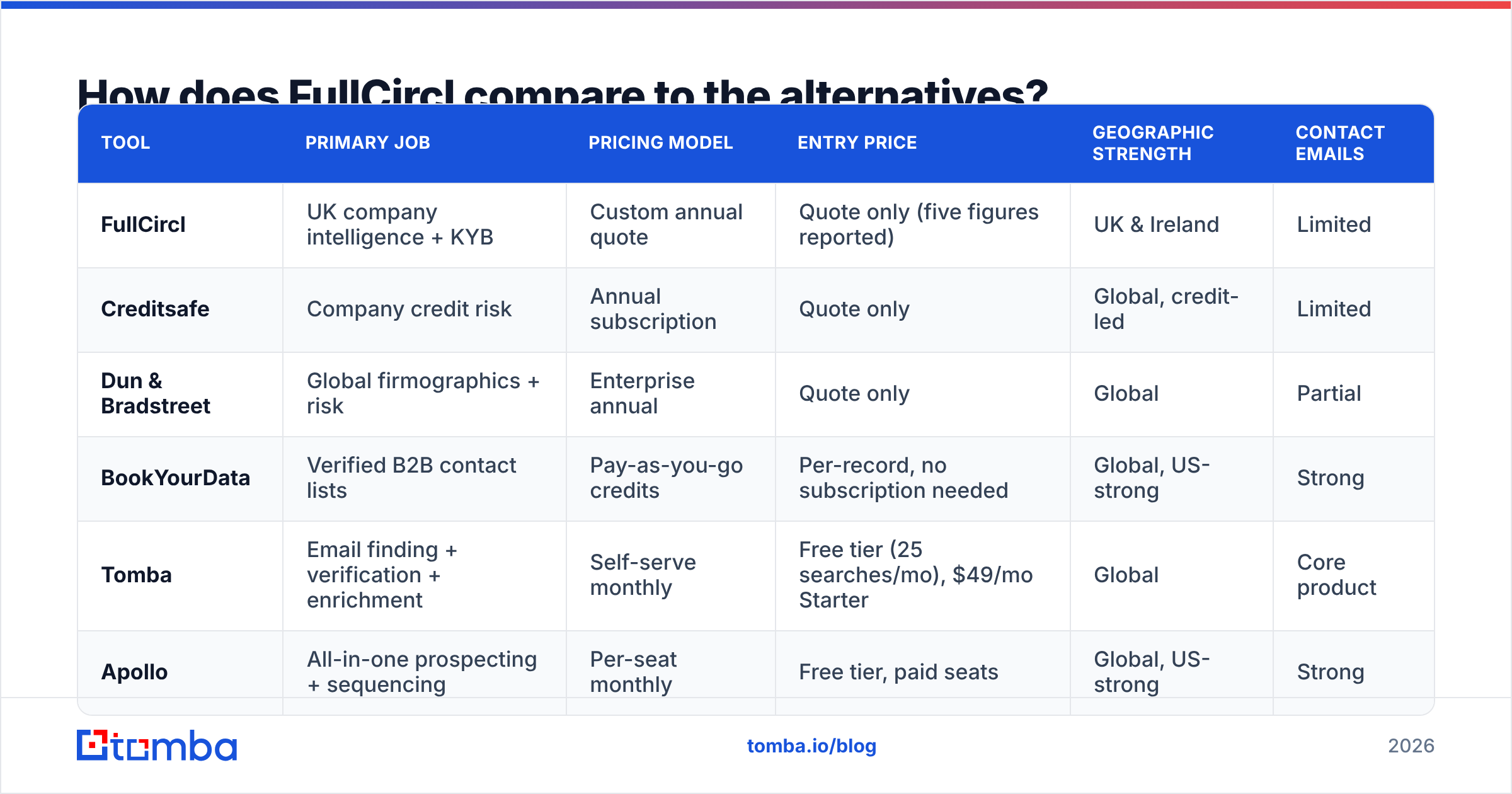
| Tool | Primary job | Pricing model | Entry price | Geographic strength | Contact emails |
|---|---|---|---|---|---|
| FullCircl | UK company intelligence + KYB | Custom annual quote | Quote only (five figures reported) | UK & Ireland | Limited |
| Creditsafe | Company credit risk | Annual subscription | Quote only | Global, credit-led | Limited |
| Dun & Bradstreet | Global firmographics + risk | Enterprise annual | Quote only | Global | Partial |
| BookYourData | Verified B2B contact lists | Pay-as-you-go credits | Per-record, no subscription needed | Global, US-strong | Strong |
| Tomba | Email finding + verification + enrichment | Self-serve monthly | Free tier (25 searches/mo), $49/mo Starter | Global | Core product |
| Apollo | All-in-one prospecting + sequencing | Per-seat monthly | Free tier, paid seats | Global, US-strong | Strong |
Read that table as a build-your-stack menu rather than a winner list. A regulated UK lender needs FullCircl or an equivalent risk source — no email finder substitutes for a KYB audit trail. An outbound team chasing 5,000 new contacts a quarter needs verified deliverable addresses, and a company-risk platform will not produce them.

Where teams waste money is buying one product to do both. They sign a five-figure intelligence contract, discover the contact data is thin, then buy a prospecting tool anyway. The stack was always going to be two products; the only question was whether you paid enterprise rates for the half that a $49/month tool covers better.
Is FullCircl worth it for your team?#
Run these five questions before the demo, not after:
- Do you have a regulatory obligation? If KYB, AML, or credit decisioning is a legal requirement rather than a nice-to-have, a purpose-built platform earns its price. If not, you are buying compliance features you will never audit.
- Is your ICP UK/Ireland-centric? Above roughly 70% UK/IE, coverage works in your favour. Below 40%, you will keep hitting blanks and buying supplementary data anyway.
- How many seats genuinely need it? Seat-priced tools punish "give everyone access." Scope to the users who will open it weekly.
- Who owns the integration? If nobody owns pushing FullCircl data into your CRM, adoption dies in month three and the renewal conversation gets ugly.
- What is your contact-data plan? Assume FullCircl gives you the company and the context, and that you still need a way to get the right person's email. Plan and budget that separately.
If four of five answers point your way, run the procurement. Ask for a pilot with a written path to production pricing, insist the quote itemises seats, modules, API volume, overage, and renewal uplift, and get a data sample scored against your own known-good records before signing.
What is the cheaper stack for outbound-only teams?#
If the honest answer to question one is "we have no compliance requirement, we just want to reach the right people at the right companies," the economics change completely.
A workable lean stack looks like this:
- Company targeting — build your account list from public filings, a lightweight B2B database, or your existing CRM segments. You rarely need bureau-grade risk data to decide who to email.
- Contact discovery — run domain search against target accounts to surface who works there and in what role, then find the specific addresses you need.
- Verification — push every address through an email verifier before it enters a sequence. Bounce rate is the single largest controllable input to sender reputation.
- Enrichment — fill in role, seniority, and firmographics with data enrichment so your segmentation and personalisation have something to work with.
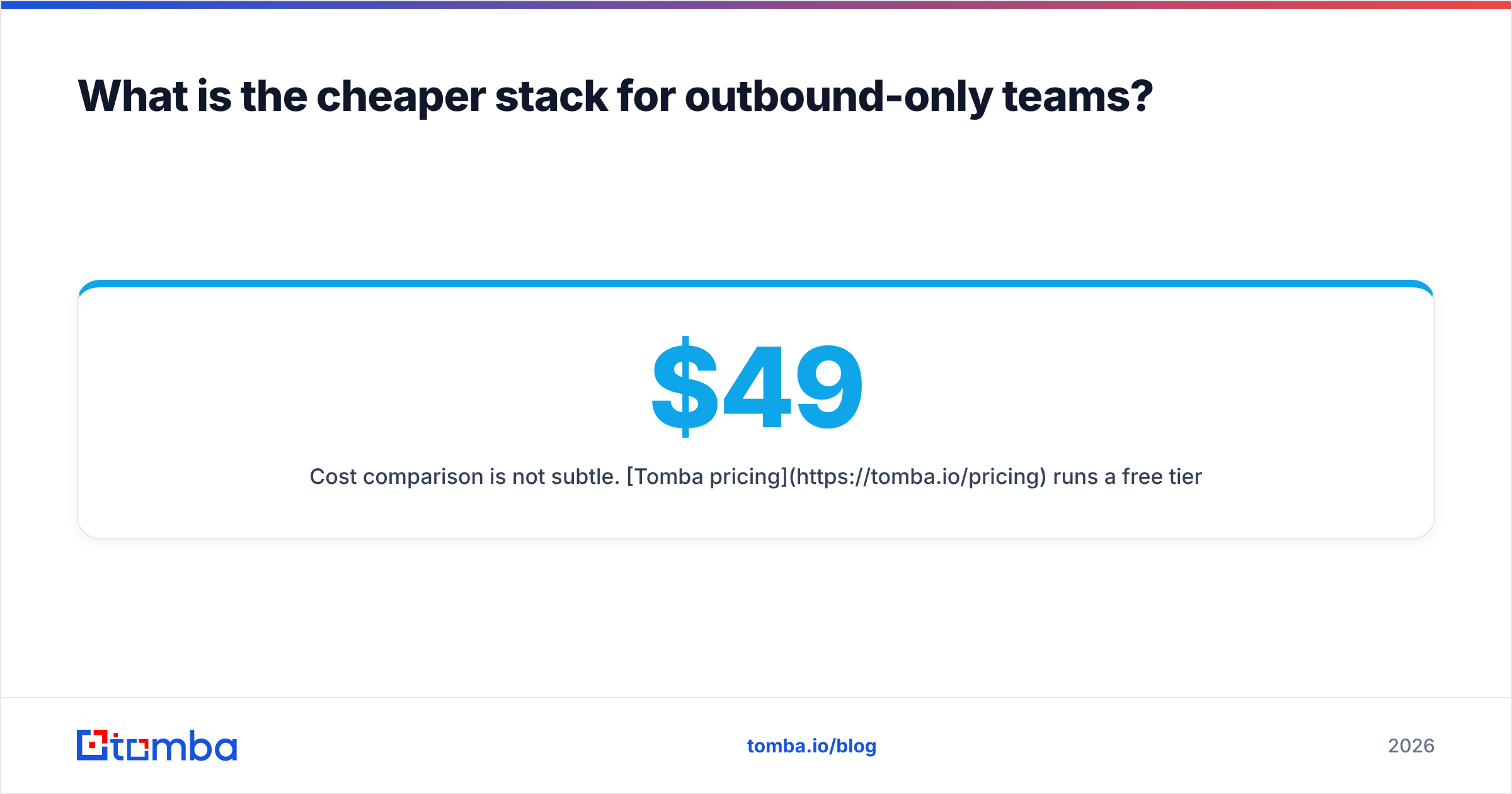
Cost comparison is not subtle. Tomba pricing runs a free tier at 25 searches a month, Starter at $49/mo, Growth at $99/mo, Pro at $249/mo, and custom Enterprise terms — self-serve, monthly, cancellable. A single FullCircl seat-year typically exceeds what a small team would spend on a full year of contact data tooling. That is not a criticism of FullCircl's value; it is a statement that the two products are priced for different buyers with different obligations.
The mistake to avoid is the reverse assumption too: an email finder will not tell you whether a company has filed a charge against its assets or whether the director you are about to onboard is disqualified. If that matters to your business, budget for a real risk platform and stop trying to save money on it.
What should you ask on the FullCircl demo?#
Bring a scorecard, not a wish list:
- What is the price per seat, and what happens if we add three mid-term?
- Which modules are in this quote, and which were shown in the demo but excluded?
- What is the API call allowance and the overage rate per call?
- What is the contracted renewal uplift cap?
- What percentage match rate do you achieve on a 500-record sample from our own CRM?
- What is the realistic implementation timeline to live CRM data, in weeks?
- What is the contact-level email coverage on our specific target segment?
Any vendor confident in its data answers all seven. The match-rate test on your own records is the one that predicts satisfaction better than any review score, because it measures the platform against your ICP rather than a general market.
Ready to fix the contact-data half of the problem?#
FullCircl earns its price when you are onboarding regulated UK customers and need company truth with an audit trail. It does not earn its price as a way to find email addresses — and most teams evaluating it are quietly hoping it will do both.
Split the job. Keep the risk platform for risk, and use Tomba Email Finder for the outbound half: find professional addresses by domain, name, or company, verify before you send, and enrich what you keep. Start on the free tier at 25 searches a month, and scale to Starter at $49/mo when the pipeline justifies it — no procurement cycle, no annual commitment, no quote call required.
Related guides#
Ready to find emails that actually work?
Join 150,000+ professionals who stopped guessing and started sending. Free credits on signup — no credit card required.
Get the Tomba newsletter
Practical outbound tactics and product updates — once every two weeks.
About the author