FullCircl vs Leadzenai: Which B2B Data Tool Wins in 2026?
FullCircl vs Leadzenai is an odd matchup. FullCircl sells UK compliance-grade company intelligence. Leadzen.ai sells fast AI contact discovery. They barely overlap — and picking the wrong one wastes a year of budget. Here is the honest breakdown.
FullCircl vs Leadzenai is an odd matchup. One tool scores companies. The other finds people. Both land on the same shortlist, and that is where teams go wrong. Here is what each tool does well, what it costs, and when neither is the right buy.
TL;DR
- These two tools barely compete. FullCircl is a UK and Ireland company intelligence platform built for regulated industries. Leadzen.ai is an AI contact finder for high-volume outbound teams, strongest in India.
- Pick FullCircl if your bottleneck is qualifying and onboarding companies: credit risk, KYC/KYB, Companies House filings, ownership, and account monitoring.
- Pick Leadzen.ai if your bottleneck is finding people: names, emails, phone numbers, and LinkedIn profiles at a price a small team can absorb.
Two more things are worth knowing before you shortlist either one.
- Neither is a great pure email finder. Both bundle contact data inside a bigger platform. Both are quote-driven or credit-capped in ways that punish heavy prospecting.
- Accuracy is a separate purchase. A dedicated email finder plus a verification step beats either platform's bundled contact data, at a fraction of the seat cost.
What are FullCircl and Leadzen.ai, exactly?#
They solve different halves of the same funnel. That is why one scorecard misleads until you name the job.
FullCircl is a British B2B data platform. It was formed when Artesian Solutions and DueDil merged in 2021. It sells "Customer Lifecycle Intelligence": one company record that serves sales, credit checks, KYB/AML onboarding, and ongoing monitoring. The core data is filed and official — Companies House records, accounts, directorships, group structures, charges, and news signals. Typical buyers are banks, insurers, brokers, and lenders in the UK and Ireland. See the vendor's own pitch at fullcircl.com.
Leadzen.ai is a lead intelligence tool. It indexes a large pool of public professional data and adds AI search on top. You describe the prospect — title, industry, location, company size — and it returns people with contact details. A browser extension pulls contacts while you browse LinkedIn or a company site. Its centre of gravity is India and the wider APAC region. Plans are priced for single reps and small teams, not enterprise buyers. Vendor site: leadzen.ai.
The one-line version: FullCircl tells you whether a company is worth your time. Leadzen.ai tells you who to email there.
FullCircl vs Leadzenai: feature-by-feature comparison#
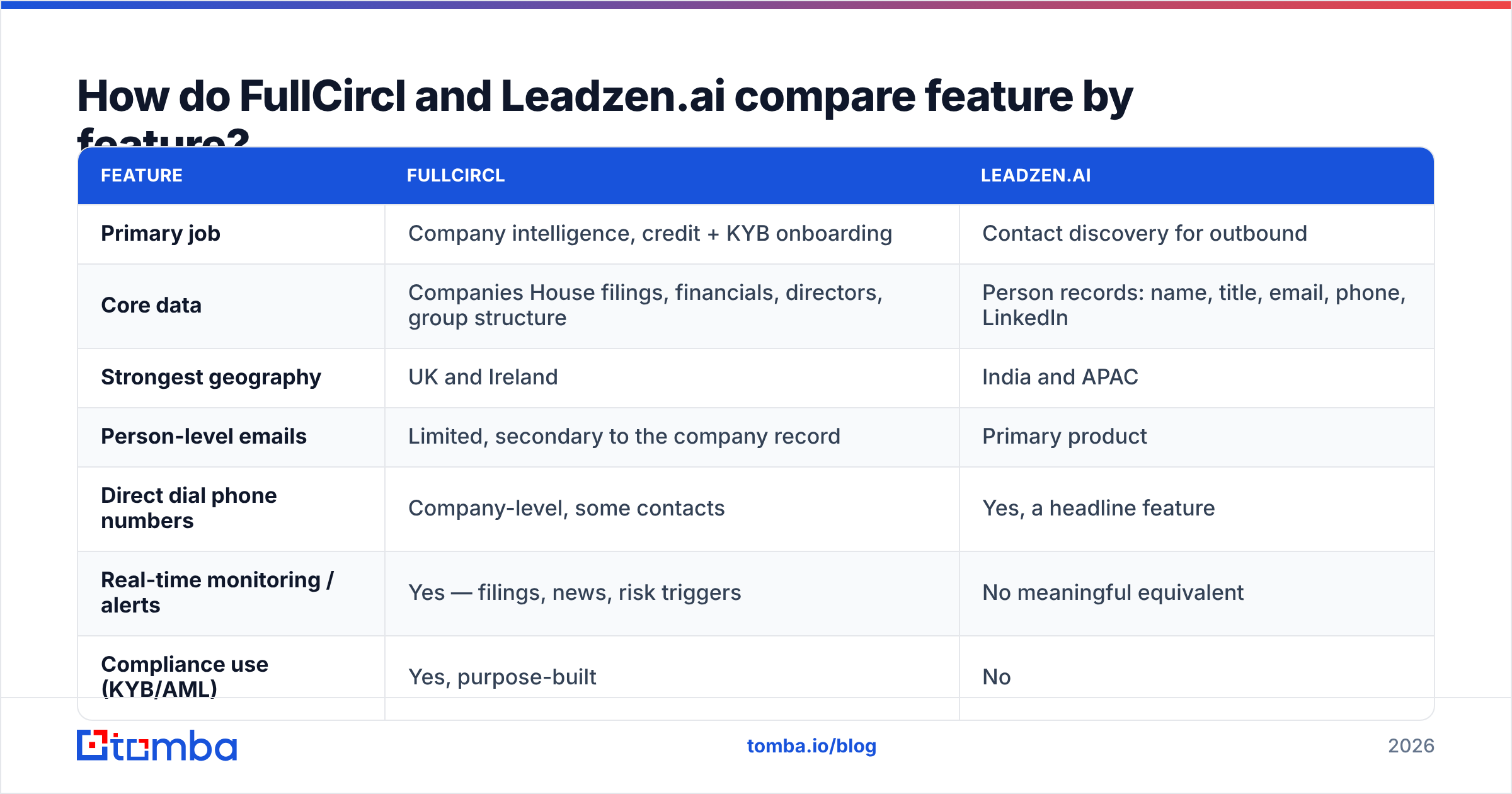
| Feature | FullCircl | Leadzen.ai |
|---|---|---|
| Primary job | Company intelligence, credit + KYB onboarding | Contact discovery for outbound |
| Core data | Companies House filings, financials, directors, group structure | Person records: name, title, email, phone, LinkedIn |
| Strongest geography | UK and Ireland | India and APAC |
| Person-level emails | Limited, secondary to the company record | Primary product |
| Direct dial phone numbers | Company-level, some contacts | Yes, a headline feature |
| Real-time monitoring / alerts | Yes — filings, news, risk triggers | No meaningful equivalent |
| Compliance use (KYB/AML) | Yes, purpose-built | No |
| Browser extension | Available for CRM workflows | Yes, LinkedIn-focused |
| API access | Yes, enterprise contract | Yes, on higher plans |
| Pricing model | Quote-only, annual, seat-based | Published credit tiers, self-serve |
| Typical buyer | Risk, compliance, and commercial teams at lenders/insurers | SDRs, founders, agencies, recruiters |
| Free tier | No — demo only | Trial credits available |
Read that table twice before you shortlist. If more than three rows in the FullCircl column match problems you actually have, you are a FullCircl buyer. Leadzen.ai will not substitute at any price. The reverse is just as true.

Which one has better data coverage?#
Neither, in the abstract. Coverage only means something against your territory and your record type. Here is how the two datasets differ.
- Filed vs. inferred. FullCircl's company data comes from official sources: registry filings, accounts, charges. You can audit it and defend it in a compliance review. Leadzen.ai's person data is pieced together from the public web and professional profiles. That scales faster, but you would not show it to a regulator.
- Depth per company vs. breadth per person. FullCircl may hold fifty fields on one UK limited company. It holds almost nothing on the mid-level manager you want to email. Leadzen.ai has that manager and a mobile number, but little on the company's finances.
- Geography is the hard wall. FullCircl thins out fast outside the UK and Ireland. Leadzen.ai gets shaky outside India and APAC, especially for direct dials.
The next three differences tend to show up after you buy, not during the demo.
- Refresh cadence. Registry data updates on a filing schedule. It is reliable, but months behind on things like headcount. Contact data decays 2–3% per month as people change jobs. That is why person-level data needs email verification before you send.
- Catch-all domains break both. Neither tool resolves catch-all servers, which accept every address and tell you nothing. That is a specialist job. A catch-all verifier exists because plain SMTP checks return "unknown" on those domains.
- Compliance posture. FullCircl is built for GDPR-heavy, audited work. Export personal data from any aggregated tool into cold outreach and you own the lawful-basis question. Check the G2 reviews to see how buyers in your region handle it.
Practical takeaway: teams selling into UK regulated markets often buy FullCircl for account selection and risk. Then they bolt a separate contact source on top. The platform was never built to hand an SDR fifty verified emails on a Tuesday morning.
What does each one actually cost?#
This is where the comparison gets uncomfortable. Only one of them will tell you a price without a call.
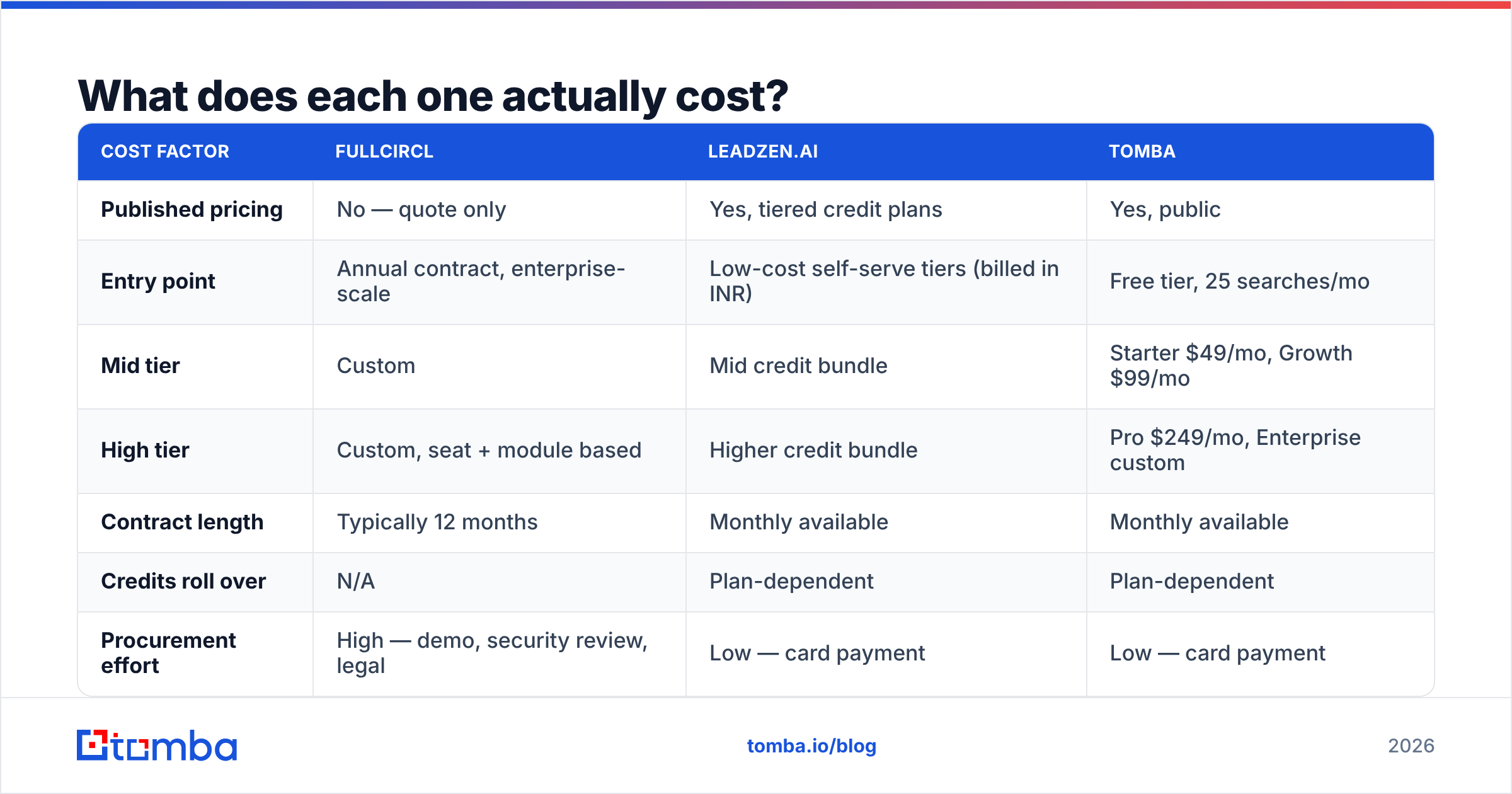
| Cost factor | FullCircl | Leadzen.ai | Tomba |
|---|---|---|---|
| Published pricing | No — quote only | Yes, tiered credit plans | Yes, public |
| Entry point | Annual contract, enterprise-scale | Low-cost self-serve tiers (billed in INR) | Free tier, 25 searches/mo |
| Mid tier | Custom | Mid credit bundle | Starter $49/mo, Growth $99/mo |
| High tier | Custom, seat + module based | Higher credit bundle | Pro $249/mo, Enterprise custom |
| Contract length | Typically 12 months | Monthly available | Monthly available |
| Credits roll over | N/A | Plan-dependent | Plan-dependent |
| Procurement effort | High — demo, security review, legal | Low — card payment | Low — card payment |
Two honest caveats. First, FullCircl's lack of public pricing is not a scandal. It is normal for compliance-grade data sold into banks, where seat cost is small next to one bad onboarding call. Second, Leadzen.ai's published rates move and are quoted in rupees. Convert at today's rate rather than trusting a number in any blog post, including this one.
What the table does show is the buying gradient. A four-person SDR team that needs contacts next week will not survive a FullCircl security review. A compliance officer at a lender will not accept AI-inferred person data as a KYB source. Budget shape follows use case. For straight contact buying, the published-price end of the market — including Tomba pricing — is where most teams land.
Who should choose FullCircl?#
Choose FullCircl when the expensive mistake in your business is onboarding the wrong company, not missing an email.
That describes you if:
- You lend, insure, or extend credit, and a bad counterparty costs six figures.
- You need KYB/AML checks, UBO discovery, and audit trails in the same system that surfaces prospects.
- Your target market is UK and Ireland limited companies.
- You want triggered alerts — a filing, a director change, bad news — routed into Salesforce or Dynamics.
- Your team thinks in terms of portfolio monitoring rather than sequence steps.
Where FullCircl frustrates people: it is not a speed tool for prospecting. Reps who want a list of 500 heads of finance will find the workflow heavy. Person-level coverage is shallow, and the seat cost is hard to justify across a whole SDR bench.
Who should choose Leadzen.ai?#
Choose Leadzen.ai when the expensive mistake is an empty pipeline, and your territory sits where its data is strong.
That describes you if:
- You run outbound into India or APAC and Western databases keep returning thin results.
- You need mobile numbers as much as emails — recruiting, staffing, and agency teams especially.
- You want to buy with a card today, not a purchase order in six weeks.
- Your workflow is LinkedIn-first, so a browser extension matters more than an API.
Where Leadzen.ai frustrates people: credits burn fast, and accuracy varies by segment. Senior titles at large firms are covered far better than SMB operational roles. There is no compliance-grade company layer underneath. You are buying contacts, not a risk platform.
Where do both platforms fall short?#
Both share one structural weakness: contact data is a feature inside a bigger product, so nobody owns the accuracy number.
That shows up in four predictable ways. Here are the first two.
- No transparent accuracy reporting. Bundled contact data rarely ships with a confidence score per record. If you cannot see why the tool thinks an address is right, you cannot triage bounces.
- Verification is an afterthought. Finding a likely address and proving a mailbox exists are different problems. Search-first platforms usually skip the second one. That is how deliverability quietly slips, and once your sender reputation drops, every later campaign underperforms.
The other two show up on the invoice.
- Credits get spent on failures. Many bundled tools charge for a search even when the result is unusable. A finder that only charges on a confirmed result changes your cost per usable contact.
- Enrichment is one-directional. You can search, but pushing a stale CRM list back through for a refresh is usually a bolt-on. Dedicated data enrichment treats that as a first-class workflow.
Most teams land on a split stack. Keep the platform that solves the strategic problem, whether that is risk and account selection or regional lead discovery. Then route the contact layer through a specialist that publishes its accuracy method and charges per verified result. Analysts such as Gartner have flagged this unbundling for years. The "one platform for everything" pitch keeps losing to composable stacks on both cost and quality.
FullCircl vs Leadzenai: which should you pick?#
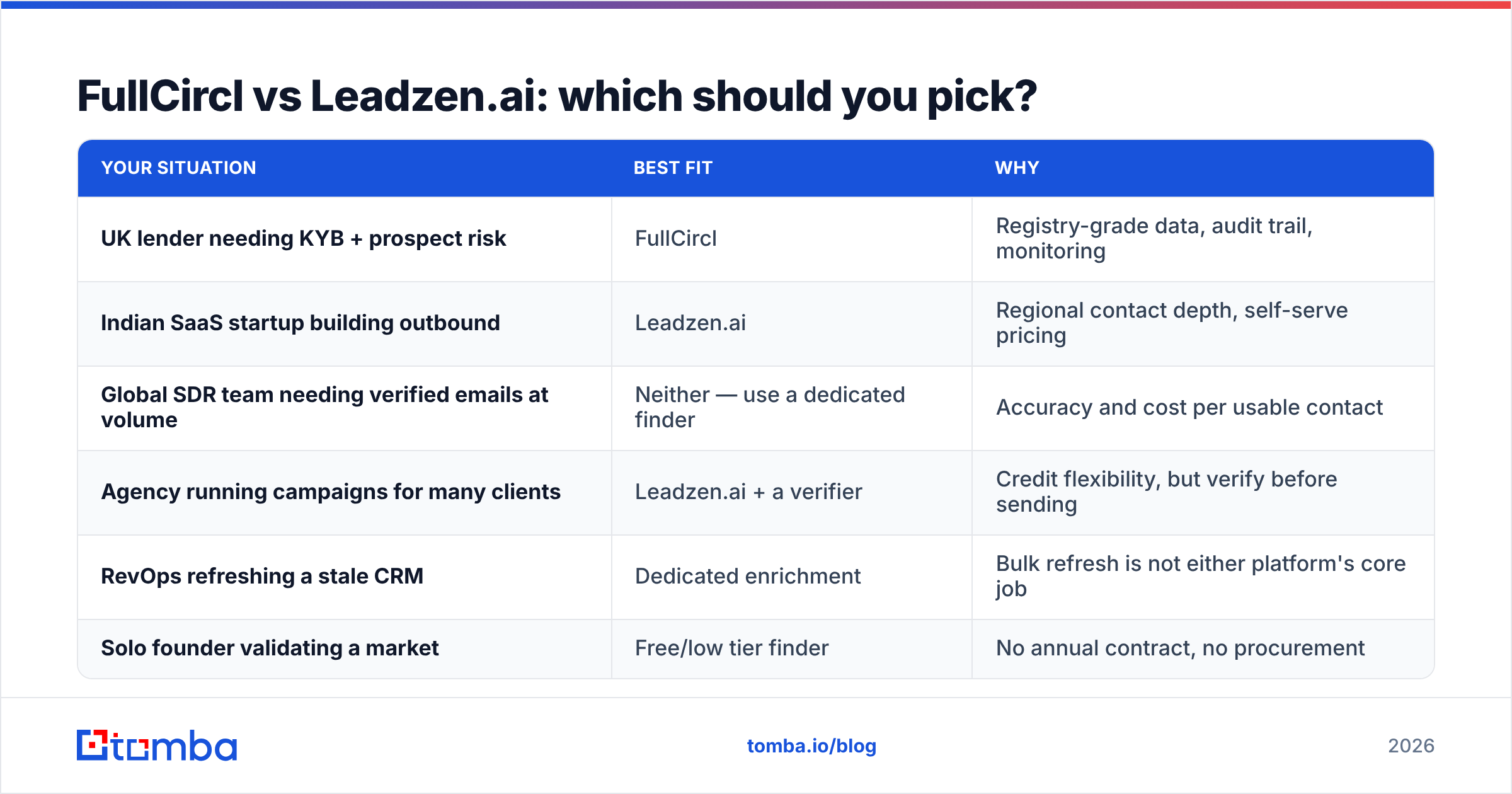
| Your situation | Best fit | Why |
|---|---|---|
| UK lender needing KYB + prospect risk | FullCircl | Registry-grade data, audit trail, monitoring |
| Indian SaaS startup building outbound | Leadzen.ai | Regional contact depth, self-serve pricing |
| Global SDR team needing verified emails at volume | Neither — use a dedicated finder | Accuracy and cost per usable contact |
| Agency running campaigns for many clients | Leadzen.ai + a verifier | Credit flexibility, but verify before sending |
| RevOps refreshing a stale CRM | Dedicated enrichment | Bulk refresh is not either platform's core job |
| Solo founder validating a market | Free/low tier finder | No annual contract, no procurement |
The verdict, stated plainly. FullCircl wins on company intelligence and compliance. Leadzen.ai wins on cost-to-first-contact in its home region. Neither wins the email accuracy contest — because neither was built to.
Suppose you already own one and outbound results are flat. The honest diagnosis is rarely "wrong platform." Usually the contact layer under your sequences is unverified. Run 200 addresses through a verifier before you switch vendors. If the projected bounce rate comes back above 5%, you found your problem. Fixing it costs far less than a migration.
How do you test either one before committing?#
Run the same controlled bake-off you would for any data vendor.
- Build a golden list. Take 100 contacts you know are correct — current customers, or people who replied last quarter.
- Hold back the emails. Feed each tool only company name, first name, and last name.
- Score three numbers. Match rate, accuracy, and cost per correct record. The third one is what procurement cares about, and the one vendors never lead with.
The next three steps are the ones teams skip, and they decide the outcome.
- Test your actual territory. A tool that scores 92% on US enterprise and 40% on your German mid-market is a 40% tool for you.
- Check the catch-all handling. Count how many results come back "unknown." If it is more than a fifth of your list, you need a catch-all-capable verifier either way.
- Time the workflow. Measure the minutes from "I need a list" to "list is in the sequencer." A tool that wins on data but loses ninety minutes per list is not winning.
Do this before the discount call, not after. Vendors negotiate hardest against numbers, and you only get numbers by generating them yourself.
Ready to fix the contact layer?#
In a FullCircl vs Leadzenai decision, both tools earn their place. One covers regulated UK company intelligence. The other covers fast regional contact discovery. But if you are judged on meetings booked, the lever is verified email accuracy, not another platform seat.
Tomba's Email Finder does one job. Give it a name and a domain. You get back a work address with a confidence score and a verification result attached. The free tier includes 25 searches a month, enough to run the bake-off above. Starter is $49/mo, and Growth is $99/mo when volume grows. Domain search, catch-all verification, phone lookup, and enrichment sit alongside it. Everything is reachable through the Tomba API if you would rather wire it into the stack you already have.
Test it against whichever platform you are weighing. Let the match rate decide.
Related guides#
Ready to find emails that actually work?
Join 150,000+ professionals who stopped guessing and started sending. Free credits on signup — no credit card required.
Get the Tomba newsletter
Practical outbound tactics and product updates — once every two weeks.
About the author