FullCircl vs Lusha: Which B2B Data Platform Wins in 2026?
FullCircl sells UK company intelligence and onboarding risk data. Lusha sells global contact records and direct dials. They barely overlap — here's how to tell which one your pipeline actually needs, and what each really costs.
TL;DR
- FullCircl and Lusha are not really competitors. FullCircl is a UK/Ireland-centric company intelligence and onboarding-risk platform. Lusha is a global contact-data provider built for SDRs who need an email and a mobile number. Teams compare them because both get filed under "B2B data," not because they do the same job.
- Pick FullCircl if your ICP is UK or Irish registered companies, you need Companies House filings, financial health signals, and KYC/AML checks wired into Salesforce or Dynamics.
- Pick Lusha if you need person-level contact data at speed — Chrome extension, CRM enrichment, direct dials — across US and EMEA markets.
- Budget reality: FullCircl is quote-only with annual contracts and typically lands in five figures. Lusha is per-seat and credit-metered, which gets expensive fast once a team of five all need "unlimited" exports.
- Third option most teams miss: if all you actually needed was verified work emails, a dedicated email finder plus verification costs a fraction of either platform.
What are FullCircl and Lusha, exactly?#
FullCircl was formed in 2021 when Artesian Solutions merged with DueDil, and it later absorbed regulatory-data capability through the acquisition of W2 Global Data. That lineage matters: Artesian brought news-based sales triggers, DueDil brought company graph data, and W2 brought identity and AML verification. The result is a platform sold to banks, insurers, and B2B lenders as much as to sales teams — its pitch is "onboard the right customers, faster," not "find me 500 emails."
Lusha started from the opposite end. It is a contact-data company: enter a person or a company, get emails, direct dials, and job titles. Its distribution engine is the browser extension that overlays LinkedIn, and its growth motion is bottom-up — an SDR signs up free, hits the credit ceiling, and asks for a team plan. Over time Lusha layered on intent signals, job-change alerts, buyer intent filtering, and CRM sync, but contact records remain the core asset.
So the honest framing of FullCircl vs Lusha is a question about which half of the prospecting problem you have not solved:
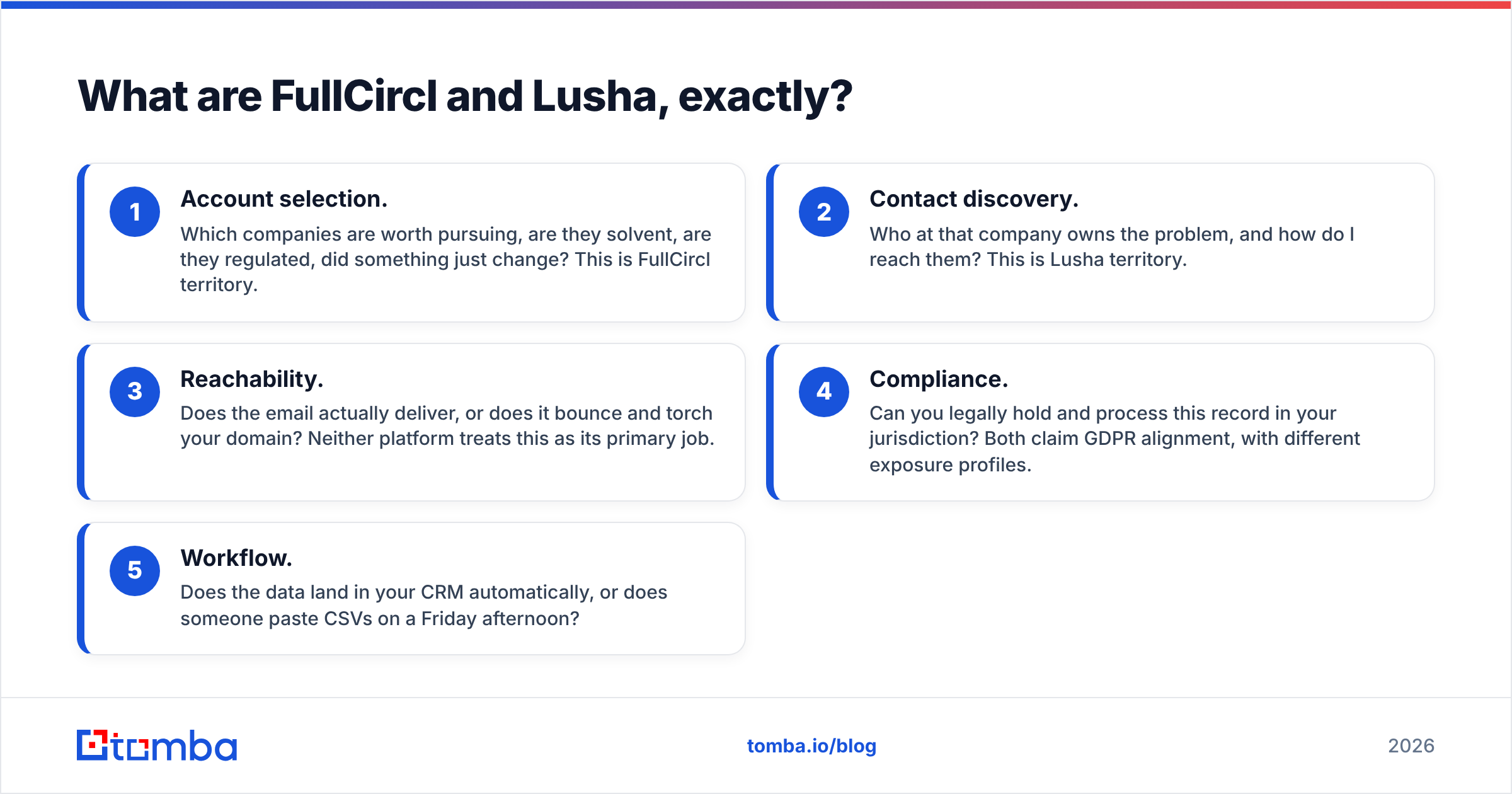
- Account selection. Which companies are worth pursuing, are they solvent, are they regulated, did something just change? This is FullCircl territory.
- Contact discovery. Who at that company owns the problem, and how do I reach them? This is Lusha territory.
- Reachability. Does the email actually deliver, or does it bounce and torch your domain? Neither platform treats this as its primary job.
- Compliance. Can you legally hold and process this record in your jurisdiction? Both claim GDPR alignment, with different exposure profiles.
- Workflow. Does the data land in your CRM automatically, or does someone paste CSVs on a Friday afternoon?
Most teams that end up unhappy with either tool bought it to solve problem 2 and discovered they actually had problem 1 or 3.

How do FullCircl and Lusha compare head-to-head?#
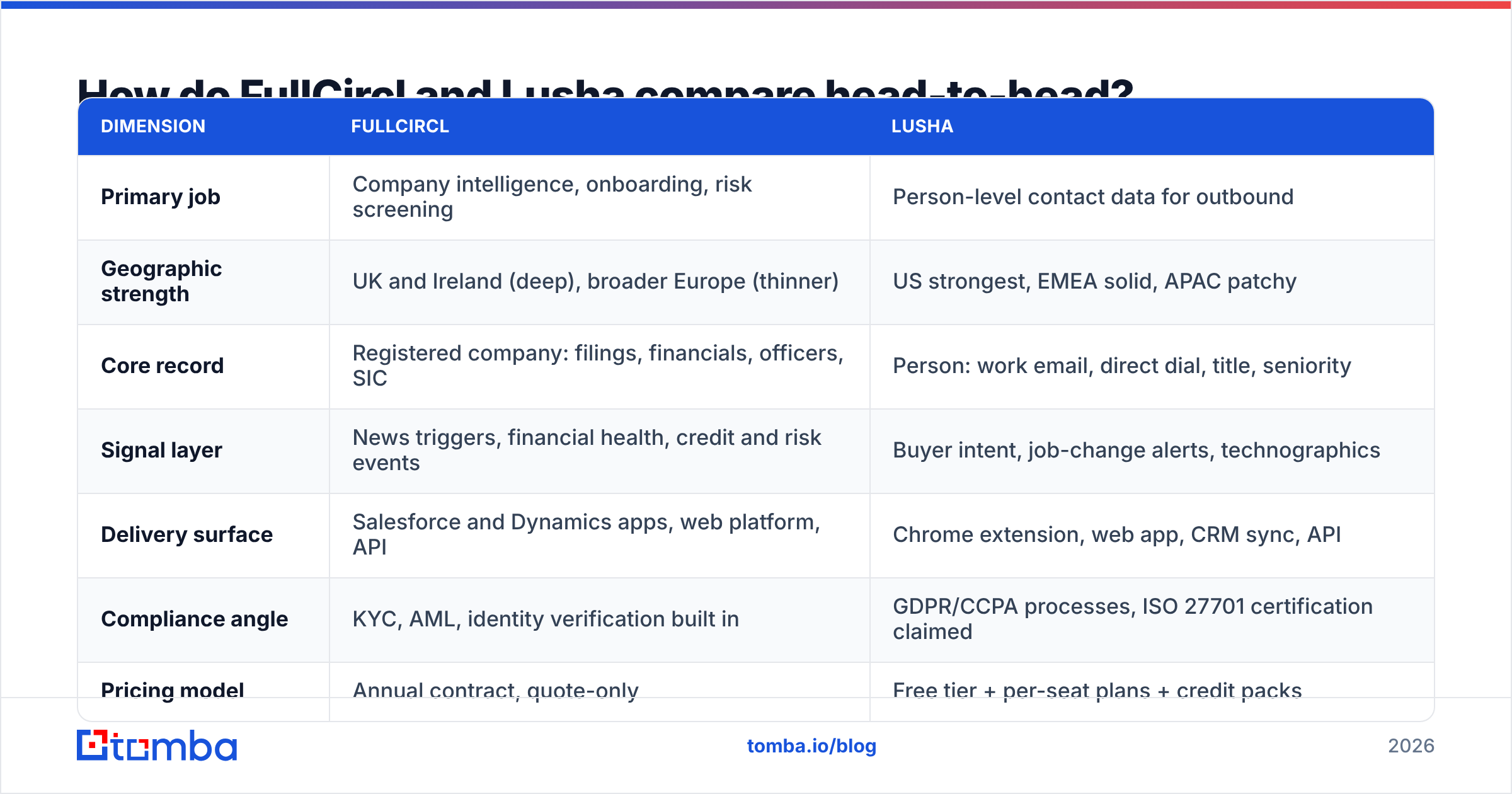
| Dimension | FullCircl | Lusha |
|---|---|---|
| Primary job | Company intelligence, onboarding, risk screening | Person-level contact data for outbound |
| Geographic strength | UK and Ireland (deep), broader Europe (thinner) | US strongest, EMEA solid, APAC patchy |
| Core record | Registered company: filings, financials, officers, SIC | Person: work email, direct dial, title, seniority |
| Signal layer | News triggers, financial health, credit and risk events | Buyer intent, job-change alerts, technographics |
| Delivery surface | Salesforce and Dynamics apps, web platform, API | Chrome extension, web app, CRM sync, API |
| Compliance angle | KYC, AML, identity verification built in | GDPR/CCPA processes, ISO 27701 certification claimed |
| Pricing model | Annual contract, quote-only | Free tier + per-seat plans + credit packs |
| Typical buyer | RevOps, credit, compliance, commercial banking | SDR teams, founders, agency prospectors |
| Time to first value | Weeks (implementation, CRM mapping) | Minutes (install extension, start pulling) |
| Weakness | Little use outside UK/Ireland ICPs | Company-level depth and financials are shallow |
Read that table twice before you sit through either demo. If you sell to US SaaS companies, FullCircl's greatest strength — the depth of its UK registered-company graph — is worth close to nothing to you. If you sell working-capital finance to UK SMEs, Lusha's direct dials do not tell you whether the prospect just filed late accounts.
Which one has better data coverage and accuracy?#
Wrong question. They are measuring different things, and "accuracy" means something different in each system.
For FullCircl, accuracy is largely inherited from official registries. UK company data flows from Companies House filings, so registered address, officers, incorporation date, and filed accounts are as accurate as the source. Where it gets softer is derived data: matched websites, inferred employee counts, sector tagging, and the mapping between a legal entity and the brand your reps actually recognise. Group structures are where most teams see friction — a holding company with eleven subsidiaries can generate eleven records that your CRM treats as separate accounts.
For Lusha, accuracy means "does this email deliver and does this phone ring the right person." Lusha publishes high confidence figures for its own data, as most contact-data vendors do. Independent reviews on G2 tell the more useful story: coverage and quality vary sharply by region and seniority. Senior US contacts tend to resolve well. Non-English-speaking EMEA mid-market contacts resolve less well. Direct-dial hit rates are the most volatile number in the entire category, across every vendor.
Three practical rules regardless of which you buy:
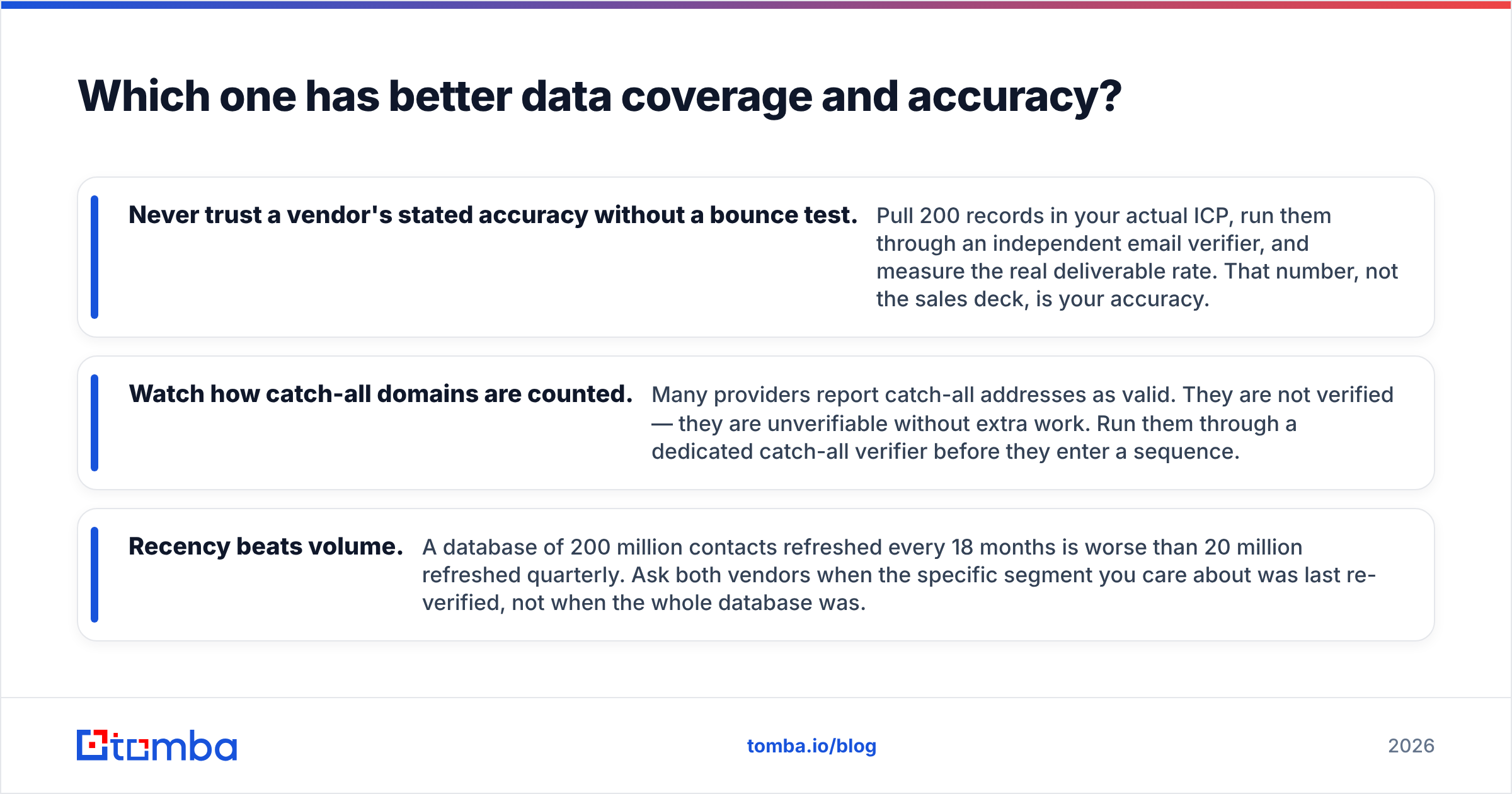
- Never trust a vendor's stated accuracy without a bounce test. Pull 200 records in your actual ICP, run them through an independent email verifier, and measure the real deliverable rate. That number, not the sales deck, is your accuracy.
- Watch how catch-all domains are counted. Many providers report catch-all addresses as valid. They are not verified — they are unverifiable without extra work. Run them through a dedicated catch-all verifier before they enter a sequence.
- Recency beats volume. A database of 200 million contacts refreshed every 18 months is worse than 20 million refreshed quarterly. Ask both vendors when the specific segment you care about was last re-verified, not when the whole database was.
What does each one actually cost?#
FullCircl does not publish list pricing. It sells annual contracts scoped by seats, modules (sales intelligence vs onboarding vs identity verification), and data volume. Public procurement records and buyer reports put mid-market deals comfortably into five figures per year, with implementation and CRM configuration on top. That is defensible if you are a lender screening thousands of applications; it is hard to justify for a four-person SDR pod.
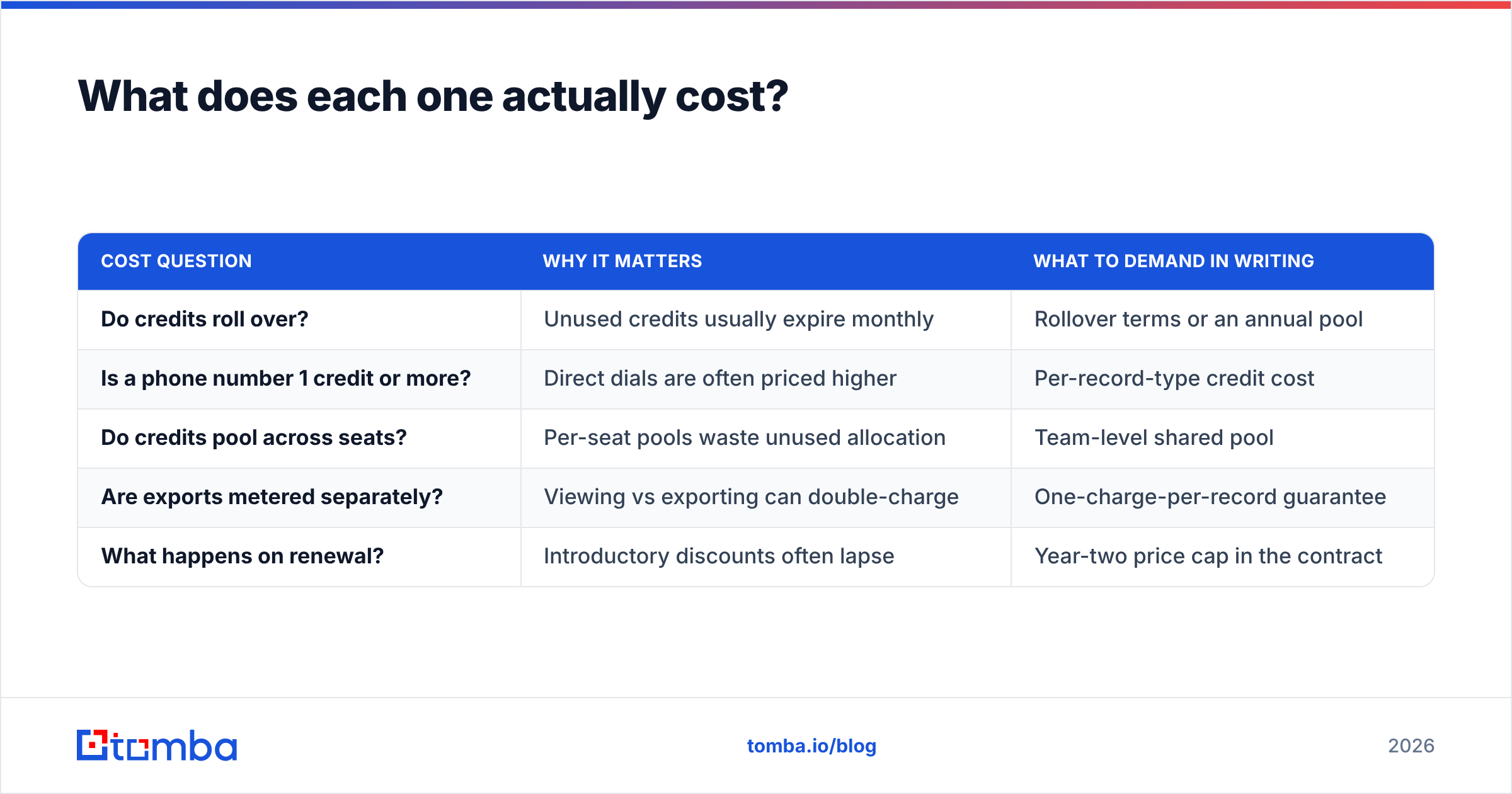
Lusha publishes tiers: a free plan with a small monthly credit allocation, then paid per-user tiers, then a Scale tier on quote. The trap is not the headline seat price — it is the credit mechanics. Ask these before signing anything:
| Cost question | Why it matters | What to demand in writing |
|---|---|---|
| Do credits roll over? | Unused credits usually expire monthly | Rollover terms or an annual pool |
| Is a phone number 1 credit or more? | Direct dials are often priced higher | Per-record-type credit cost |
| Do credits pool across seats? | Per-seat pools waste unused allocation | Team-level shared pool |
| Are exports metered separately? | Viewing vs exporting can double-charge | One-charge-per-record guarantee |
| What happens on renewal? | Introductory discounts often lapse | Year-two price cap in the contract |
For reference on a genuinely cheaper stack: Tomba pricing runs a free tier at 25 searches per month, Starter at $49/mo, Growth at $99/mo, and Pro at $249/mo, with API access rather than per-seat licensing. That is not a like-for-like replacement for FullCircl's risk modules — nothing at that price is — but it does replace the specific job most people buy Lusha for.

Who should choose FullCircl?#
Choose FullCircl when your commercial problem is which company, and should we say yes:
- UK and Ireland ICP. You sell to registered UK or Irish businesses and need entity-level truth, not a scraped company page.
- Regulated onboarding. You run KYC, AML, or credit checks as part of the sales process, and you want screening in the same workflow as prospecting rather than in a separate compliance tool.
- Trigger-based selling. Your best deals come from events — a funding round, a director change, a filing, an adverse credit signal — and you want those pushed to reps inside Salesforce or Dynamics.
- Portfolio monitoring. You need to watch existing customers for risk deterioration, not just find new ones.
Where FullCircl disappoints buyers: teams that bought it hoping for contact-level coverage. Company intelligence tells you the account is worth calling. It does not reliably hand you the operations director's mobile number.
Who should choose Lusha?#
Choose Lusha when your problem is who do I contact, and how fast can I get 300 of them:
- High-velocity outbound. Your SDRs live in LinkedIn, and an extension that fills contact details in one click removes real friction.
- US-heavy targeting. Coverage strength is meaningfully better in North America than in most European mid-market segments.
- Phone-first motions. If cold calling is a real channel for you, direct dials are the differentiator worth paying for — validate them with a phone validator before your dialler burns connect attempts.
- Fast procurement. Card payment, no implementation project, value inside an afternoon.
Where Lusha disappoints buyers: anyone expecting firmographic or financial depth. It will tell you the company size band. It will not tell you the company filed abbreviated accounts and shed 30% of its headcount.
Do you actually need either platform?#
For a large share of teams comparing FullCircl vs Lusha, the honest answer is neither at full price. Break down what you are really buying and price each layer separately:
- Account list. If your target list is definable by industry, size, and location, you can often build it once from public sources or a B2B database rather than renting continuous intelligence you check twice a quarter.
- Contact discovery. Finding a verified work email from a name and a domain is a solved, commoditised problem. It should cost cents, not seats.
- Enrichment. Filling in titles, company size, socials, and tech stack across an existing CRM is a batch job. Run it through data enrichment on a schedule instead of paying a per-user licence for people who log in twice a month.
- Verification. This is the layer teams underfund and then blame the data vendor for. Every list, from every source, needs verification before it touches a sending domain.
- Risk and compliance. This is the one layer you genuinely cannot cheap out on — and it is the only layer where FullCircl's price tag makes obvious sense.
A common working setup: keep FullCircl-style intelligence only if you are regulated, drop the per-seat contact tool, and run finding and verification through an email finder API that your ops team calls from the CRM. Reps stop hoarding credits, and cost scales with records processed instead of headcount.
It is also worth benchmarking against list-first vendors before you decide. Providers like BookYourData sell verified contact lists outright, which suits teams that want a one-time dataset rather than a subscription — a genuinely different commercial model that deserves a look alongside both platforms here.
What about GDPR and compliance risk?#
Both vendors publish compliance positions, and both operate legitimately — but your exposure differs.
FullCircl's core sales dataset is largely built from public registry filings, which is about as defensible a base as B2B data gets in the UK, and its identity-verification modules are designed for regulated onboarding. Its risk surface is mainly about how you use screening outputs, not where the data came from.
Lusha handles personal data — work emails and mobile numbers tied to named individuals. It maintains security and privacy certifications and offers subject-access and opt-out processes, but if you are emailing EU or UK individuals you still carry the controller obligations: a lawful basis, a real opt-out, and a documented source. Review both vendors' current DPAs directly rather than relying on a comparison post, including this one, for legal comfort.
Which one wins in 2026?#
There is no single winner because there is no single job.
FullCircl wins if you are a UK or Irish B2B lender, insurer, or services firm where deciding whether to onboard an account matters as much as finding it. Nothing in the contact-data category replaces registry-grade company intelligence plus AML screening in one workflow.
Lusha wins if you are a volume outbound team, particularly US-facing, that needs contact records in the browser right now and values speed over depth.
Neither wins if your true requirement is "verified work emails for a defined list of companies, at predictable cost." That requirement is overserved by both platforms and priced accordingly. Run a 200-record bounce test against your real ICP with all three options — FullCircl, Lusha, and a dedicated finder — before you sign an annual contract based on a demo dataset the vendor chose.
If contact discovery is the gap you actually need to close, start with the Tomba Email Finder. Search by domain, name, or company, verify every result before it enters a sequence, and pull it into your CRM through the API instead of per-seat licences. The free tier gives you 25 searches a month to run your own accuracy test — enough to see whether you needed a platform or just needed the email.
Related guides#
Ready to find emails that actually work?
Join 150,000+ professionals who stopped guessing and started sending. Free credits on signup — no credit card required.
Get the Tomba newsletter
Practical outbound tactics and product updates — once every two weeks.
About the author