FullCircl vs ZoomInfo: B2B Data Platform Comparison 2026
FullCircl and ZoomInfo both sell B2B data, but they solve different problems: UK regulatory-grade company intelligence versus global contact coverage and intent. Here is how they compare on data, pricing, and real-world fit.
TL;DR
- They are not really competitors. FullCircl is UK and Ireland company intelligence built for regulated onboarding (banking, insurance, fintech). ZoomInfo is a global contact-and-intent database built for outbound sales teams.
- Pick FullCircl if your buyers are UK/IE businesses and your bottleneck is qualification, KYC, credit risk, and compliance — not finding more inboxes.
- Pick ZoomInfo if you need direct dials, verified work emails, org charts, and intent signals across North America and EMEA, and you can absorb a five-figure annual contract.
- Neither publishes pricing. Expect a quote, an annual commitment, and seat-based licensing. ZoomInfo deals commonly land in the $15,000–$40,000/year range depending on seats, credits, and modules.
- Most teams overbuy. If all you need is accurate emails and enrichment on accounts you already identified, a focused tool like Tomba at $49/mo covers it without a platform contract.
What are FullCircl and ZoomInfo, exactly?#
FullCircl is a UK-headquartered customer lifecycle intelligence platform formed when Artesian Solutions merged with DueDil in 2021, later adding identity-verification capability through its W2 acquisition. Its pitch is not "more leads." It is: identify, qualify, onboard, and monitor business customers in regulated markets without seven manual checks. It pulls from Companies House, filed accounts, credit data, sanctions and PEP lists, news signals, and financial filings, then pushes that context into your CRM. You can see the current product breakdown on fullcircl.com.
ZoomInfo is the opposite shape. It is a US-headquartered, publicly traded GTM data platform with a contact database measured in the hundreds of millions of professional profiles, layered with intent topics, technographics, website visitor identification, conversation intelligence (Chorus), sequencing (Engage), and an AI assistant marketed as Copilot. Its center of gravity is the outbound SDR team that needs a name, a title, a mobile number, and a reason to call this week. Details live at zoominfo.com.
The practical difference: FullCircl tells you whether a company is worth onboarding. ZoomInfo tells you who to contact and when. Teams that confuse the two end up paying platform prices for a job a $49 tool does.
How do FullCircl and ZoomInfo compare feature by feature?#
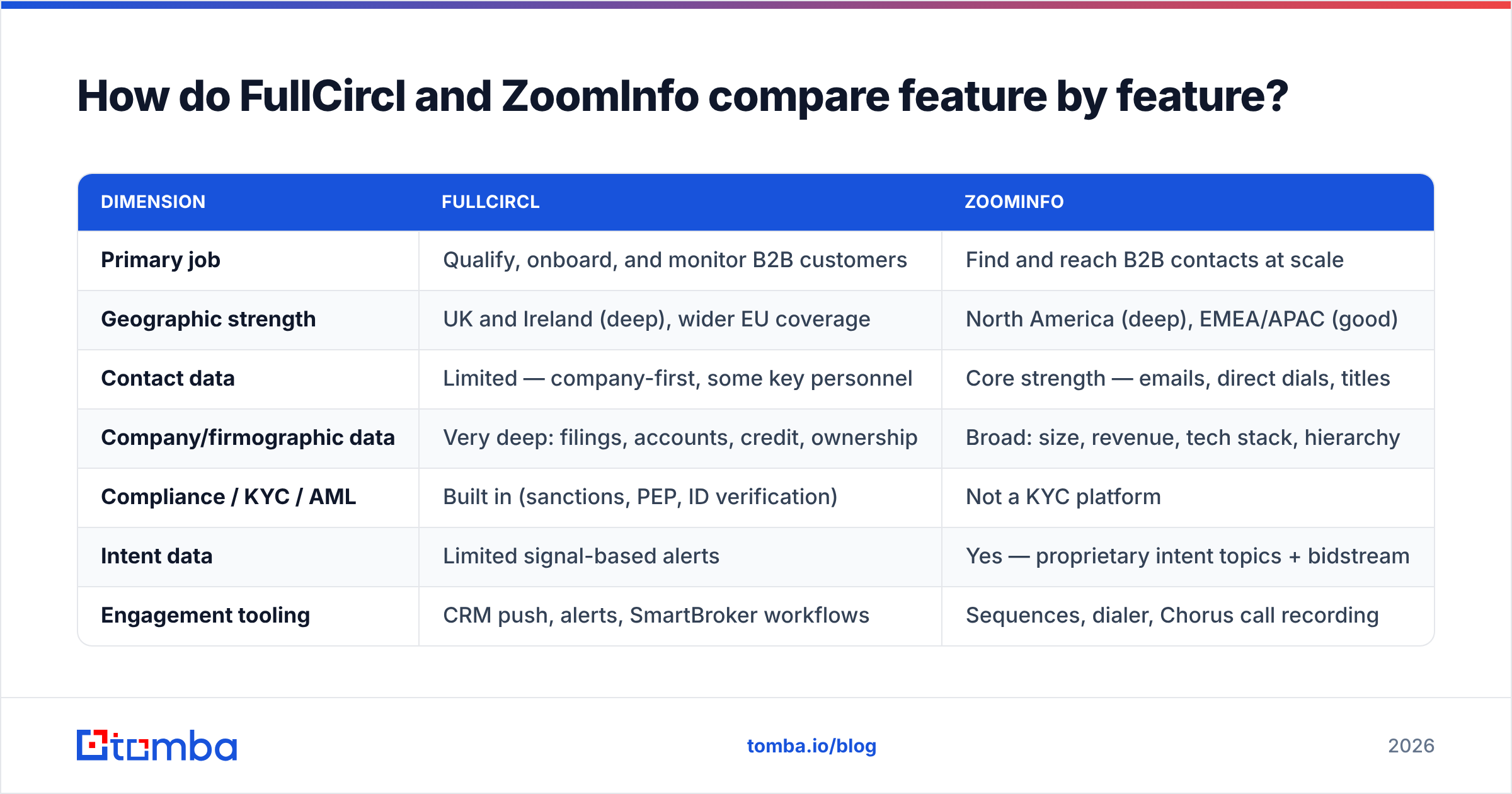
| Dimension | FullCircl | ZoomInfo |
|---|---|---|
| Primary job | Qualify, onboard, and monitor B2B customers | Find and reach B2B contacts at scale |
| Geographic strength | UK and Ireland (deep), wider EU coverage | North America (deep), EMEA/APAC (good) |
| Contact data | Limited — company-first, some key personnel | Core strength — emails, direct dials, titles |
| Company/firmographic data | Very deep: filings, accounts, credit, ownership | Broad: size, revenue, tech stack, hierarchy |
| Compliance / KYC / AML | Built in (sanctions, PEP, ID verification) | Not a KYC platform |
| Intent data | Limited signal-based alerts | Yes — proprietary intent topics + bidstream |
| Engagement tooling | CRM push, alerts, SmartBroker workflows | Sequences, dialer, Chorus call recording |
| Website visitor ID | No | Yes (WebSights) |
| Pricing model | Custom quote, annual | Seat + credit, annual, custom quote |
| Free tier | No | No (limited trial only) |
| Best fit | Regulated UK financial services and insurance | Global outbound sales and marketing teams |
Two rows do the heavy lifting. If "Compliance / KYC / AML" is a line item in your budget, FullCircl is in a category ZoomInfo does not compete in. If "direct dials" and "intent" drive your pipeline math, FullCircl will feel thin no matter how good the company records are.
Which platform has better data coverage?#
Coverage is not one number. Break it into four questions and the answer changes per team.
- Company breadth. ZoomInfo wins globally on raw company count and North American depth. FullCircl wins decisively on UK and Ireland registry-grade detail — filed accounts, directorships, group structures, charges, and credit indicators that ZoomInfo simply does not carry at that granularity.
- Contact depth. ZoomInfo is the clear winner. Verified work emails, mobile numbers, reporting lines, and job-change alerts are its core asset. FullCircl surfaces decision-makers, but you should not buy it as a contact database.
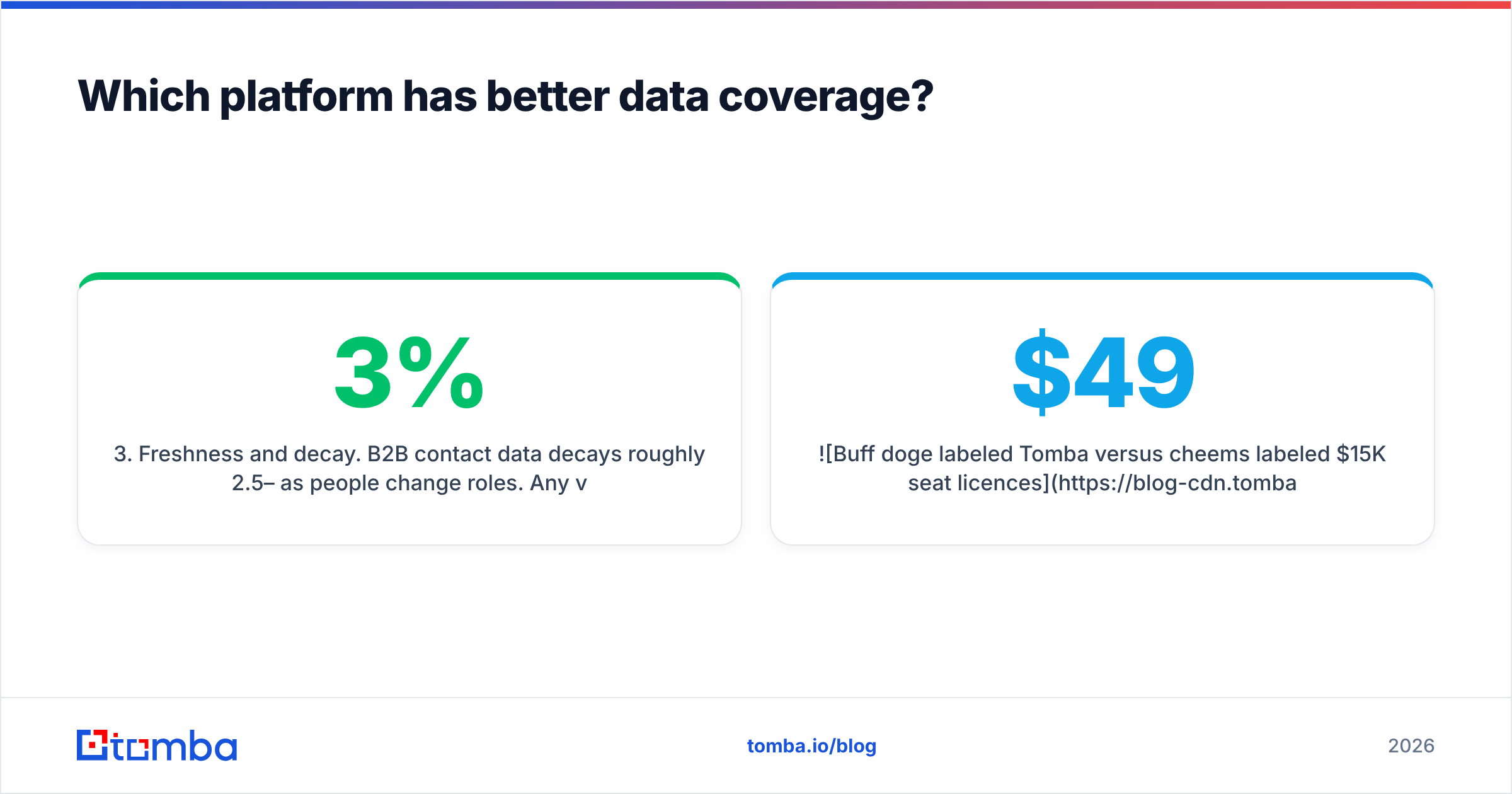
- Freshness and decay. B2B contact data decays roughly 2.5–3% per month as people change roles. Any vendor's "verified" stamp is a snapshot, so re-verification at send time matters more than headline database size. That is why many teams run an independent email verifier over exported lists regardless of source.
- Signal quality. ZoomInfo's intent topics tell you a company is researching a category. FullCircl's alerts tell you a company filed late accounts, changed directors, or hit a credit event. Both are useful; they trigger completely different plays.
- Regulatory data. Sanctions screening, PEP checks, and document-based ID verification are FullCircl territory. There is no ZoomInfo equivalent, and stitching one together from third parties costs more than most teams estimate.

The honest summary: ZoomInfo has more contacts, FullCircl has better records. Neither replaces the other, and the "which has more data" argument is usually a proxy for "which problem am I actually solving."
What does FullCircl vs ZoomInfo actually cost?#
Neither vendor publishes a rate card, which is itself a signal about sales motion. Here is what buyers consistently report on review sites like G2 and in procurement discussions.
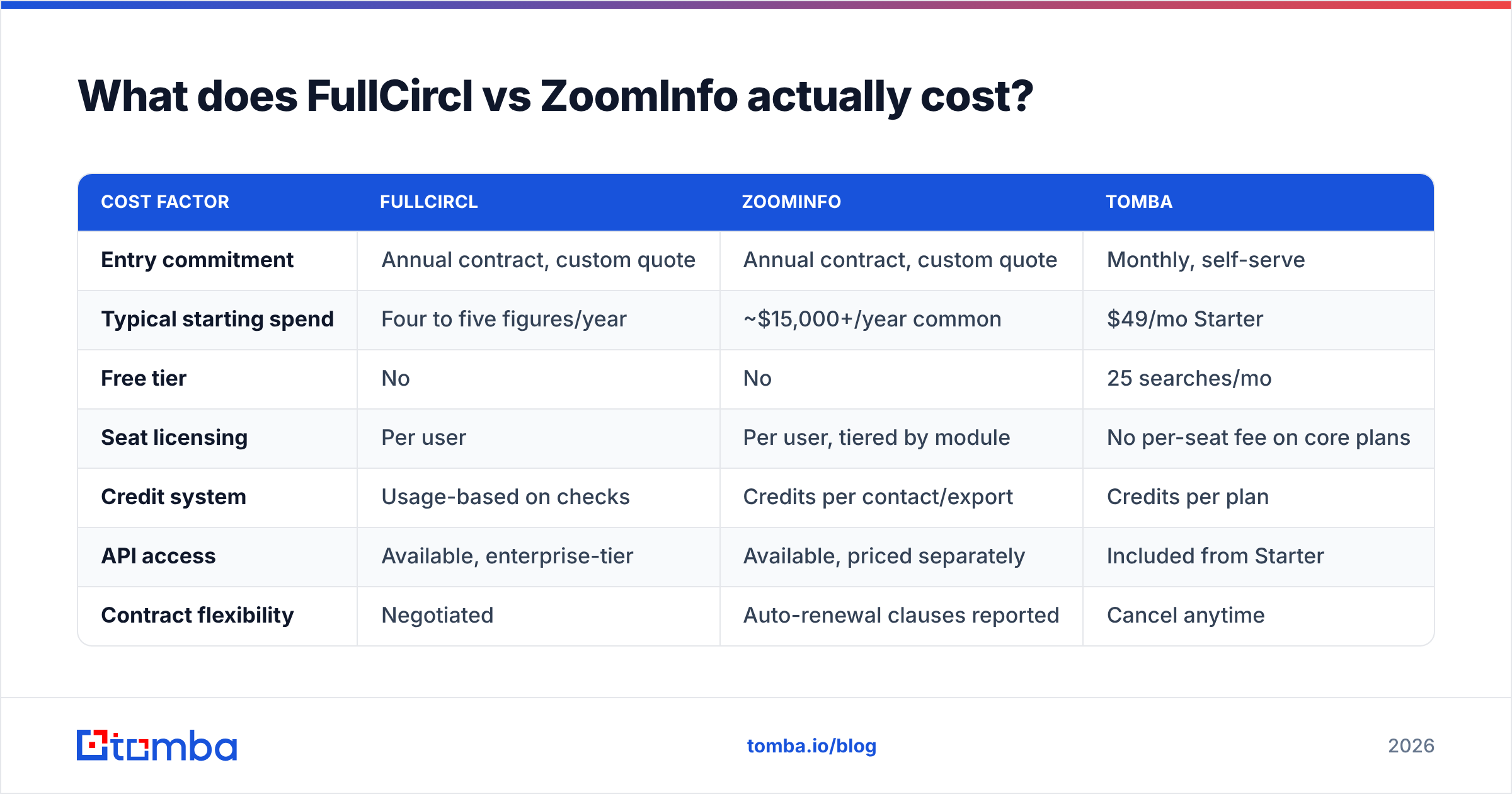
| Cost factor | FullCircl | ZoomInfo | Tomba |
|---|---|---|---|
| Entry commitment | Annual contract, custom quote | Annual contract, custom quote | Monthly, self-serve |
| Typical starting spend | Four to five figures/year | ~$15,000+/year common | $49/mo Starter |
| Free tier | No | No | 25 searches/mo |
| Seat licensing | Per user | Per user, tiered by module | No per-seat fee on core plans |
| Credit system | Usage-based on checks | Credits per contact/export | Credits per plan |
| API access | Available, enterprise-tier | Available, priced separately | Included from Starter |
| Contract flexibility | Negotiated | Auto-renewal clauses reported | Cancel anytime |
Three budgeting warnings that apply to both:
- Modules multiply. ZoomInfo's quoted number is usually one product. Chorus, Engage, Operations, and WebSights are separate lines. FullCircl's onboarding and verification workflows likewise scale by check volume.
- Credits expire. Exports are metered. Teams routinely burn quarterly credit allocations on bulk pulls, then sit data-starved for six weeks.
- Auto-renewal is real. Multiple ZoomInfo reviewers flag renewal terms as a friction point. Read the notice window before you sign, not in month eleven.
Compare that against public Tomba pricing — Free (25 searches/mo), Starter $49/mo, Growth $99/mo, Pro $249/mo — and you can see why smaller teams stall on the platform quote. The question is not "is ZoomInfo worth $15k" in the abstract. It is "does my pipeline need intent and dialers, or does it need 4,000 accurate emails a month?"
Who should choose FullCircl?#
FullCircl is the right call when compliance and qualification are the constraint:
- UK and Ireland commercial banking, insurance, and lending teams who need registry-grade company truth before they open an account.
- Brokers and MGAs using SmartBroker-style workflows to pre-fill and pre-qualify submissions.
- Fintechs with KYB/KYC obligations that would otherwise buy a separate identity-verification vendor and duct-tape it to a data provider.
- RevOps teams doing portfolio monitoring — you want an alert when an existing customer's financial health changes, not another cold list.
Where it disappoints: if you handed FullCircl to a US-focused SDR team and asked for 500 verified director emails in Texas this week, you would be disappointed. That was never the product.
Who should choose ZoomInfo?#
ZoomInfo earns its price when three things are true at once:
- You have enough seats to amortize it. At five to ten reps actively prospecting, the cost per rep starts making sense. At two reps, it rarely does.
- You will actually use intent. Intent data is the differentiator over cheaper databases. If nobody owns the workflow that turns a surging account into a sequence within 48 hours, you are paying for a feature you will not run.
- You need mobiles. Direct dial coverage is the hardest thing to replicate cheaply. If cold calling is a real channel for you, this is the strongest argument in ZoomInfo's favor.
Where it disappoints: European contact coverage is thinner than US coverage, GDPR posture requires more care than the sales deck implies, and the platform is genuinely heavy for a five-person startup. Many of those teams end up on an Apollo alternative or a focused finder instead.

Is there a middle option between the two?#
Yes, and this is where most of the market actually lives. Split your stack into the three jobs and buy each one at its real price:
- Account selection — who is worth targeting. FullCircl for UK-regulated, ZoomInfo for global, or a purpose-built list source. Prebuilt list vendors such as BookYourData are a reasonable option when you want a filtered set delivered rather than a subscription to run.
- Contact discovery — the actual email and phone. This is a commodity job, and paying platform rates for it is where budgets leak. A bulk email finder or a domain search covers it for a fraction of the cost.
- Enrichment and hygiene — keeping the CRM current. Data enrichment via API, run on a schedule, beats a quarterly manual export from any platform.
A concrete example. A 6-person B2B SaaS team targeting UK operations leaders does not need FullCircl's credit and sanctions layer, and cannot justify ZoomInfo's seat minimum. What it needs is: a company list from Companies House filters, emails found by domain and pattern, verification before send, and enrichment written back to HubSpot. That stack runs on the Tomba API plus a sequencing tool for well under $200/month.
The failure mode to avoid: buying a platform to solve a data-quality problem that is actually a process problem. If your reps are emailing stale contacts, more expensive data does not fix it. Re-verifying at send time does.
What do reviewers actually complain about?#
Patterns worth knowing before a demo:
- ZoomInfo: contract rigidity and renewal terms, credit limits arriving faster than expected, European data gaps, and a UI that takes real onboarding time. Data quality on US contacts is broadly praised.
- FullCircl: limited value outside the UK and Ireland, a learning curve on configuring alerts and workflows, and pricing that only makes sense when compliance is in scope. Users in financial services rate the depth of company data highly.
- Both: implementation and CRM integration take longer than the sales cycle implies. Budget for a real onboarding project, not a week.
Which one wins in 2026?#
There is no single winner, and any post that declares one is selling something.
FullCircl wins if you are a UK or Irish financial services, insurance, or lending business where onboarding risk, KYB, and portfolio monitoring are the bottleneck. Nothing in ZoomInfo's catalog replaces registry-grade filings plus sanctions screening in one workflow.
ZoomInfo wins if you run a multi-rep outbound motion across North America, need direct dials and intent, and have the budget and the operational discipline to work the signals. It remains the most complete contact-and-intent platform on the market, and it is priced accordingly.
Neither wins if your actual need is "find and verify work emails for accounts I already know about." That is a $49–$249/month job, not a $15,000/year one, and overbuying here is the single most common B2B data procurement mistake we see.
Start by writing down the job. If the job is compliance, look at FullCircl. If the job is scaled outbound with dials and intent, get a ZoomInfo quote and negotiate the renewal clause hard. If the job is contact data and CRM hygiene, skip both.
Ready to test the cheap option first? Run 25 free searches through the Tomba Email Finder against a list of accounts you already trust — no contract, no seat fee, no annual commitment. If the hit rate and verification quality cover your outbound needs, you just saved a five-figure line item. If they do not, you will walk into your FullCircl or ZoomInfo demo knowing exactly which gap you are paying to close.
Related guides#
Ready to find emails that actually work?
Join 150,000+ professionals who stopped guessing and started sending. Free credits on signup — no credit card required.
Get the Tomba newsletter
Practical outbound tactics and product updates — once every two weeks.
About the author