FullEnrich Reviews 2026: Waterfall Enrichment Tested
An independent look at FullEnrich: how waterfall enrichment actually performs, what credits really cost, where coverage breaks down, and which teams should pick something simpler.
TL;DR
- FullEnrich is a waterfall enrichment tool: one lookup queries 15+ data vendors in sequence and returns the first valid email or mobile number it finds. That architecture is genuinely good at coverage — and genuinely expensive per record.
- Where it wins: hard-to-find mobile phone numbers, US-heavy prospect lists, and teams that already gave up on single-provider tools.
- Where it hurts: credit consumption is unpredictable, "1 contact = 1 credit" hides multi-vendor billing on combined email + phone lookups, and EU/APAC coverage lags US coverage badly.
- If you mainly need work emails at scale, a direct provider like Tomba at $49/mo or a database-first tool like BookYourData typically costs 3-6x less per usable contact.
- Verdict: strong tool, narrow ideal buyer. Buy it for phone-heavy outbound, not as your default email source.
What is FullEnrich and how does waterfall enrichment work?#
FullEnrich is a B2B contact enrichment platform built around a single idea: no data vendor has good coverage on its own, so query many of them.
Think of it like calling a plumber. If you call one, there's maybe a 55% chance they pick up and can come today. If you have an assistant who calls fifteen in order and stops at the first "yes," your hit rate jumps to 85% — but you also pay the assistant. That assistant is waterfall enrichment.
Here's the mechanical flow when you submit a contact to FullEnrich:
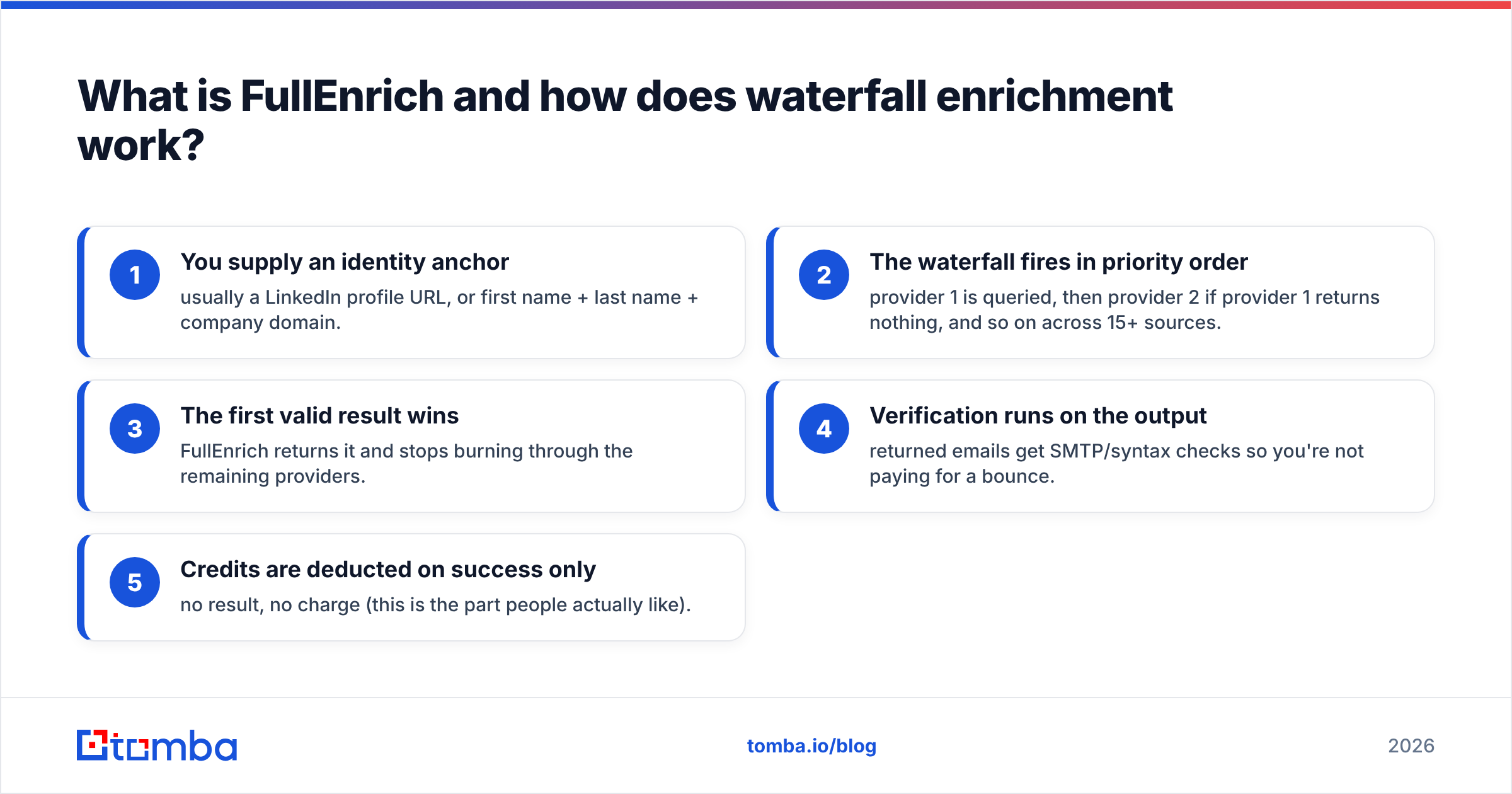
- You supply an identity anchor — usually a LinkedIn profile URL, or first name + last name + company domain.
- The waterfall fires in priority order — provider 1 is queried, then provider 2 if provider 1 returns nothing, and so on across 15+ sources.
- The first valid result wins — FullEnrich returns it and stops burning through the remaining providers.
- Verification runs on the output — returned emails get SMTP/syntax checks so you're not paying for a bounce.
- Credits are deducted on success only — no result, no charge (this is the part people actually like).
The critical nuance most FullEnrich reviews skip: email waterfalls and phone waterfalls are separate waterfalls with separate credit costs. Requesting both on one contact is two billing events, not one. That single fact explains most of the "my credits vanished" complaints you'll find on G2 and Reddit.

Is FullEnrich accurate enough to trust?#
Accuracy is where you have to separate two different numbers that vendors love to blur together.
Coverage rate = of 1,000 contacts submitted, how many came back with any email. Accuracy rate = of the emails returned, how many actually deliver.
FullEnrich's public marketing leans on coverage, and fairly so — cascading across 15+ vendors genuinely does beat any single source. In practice, teams running US-based B2B lists report email coverage in the 70-85% range and mobile coverage in the 40-60% range. Both are strong for phone; email is roughly on par with what a good direct provider hits on the same list.
The accuracy story is more mixed. Because the waterfall returns whatever the first matching vendor says, quality inherits the weakest provider that's high in your priority order. FullEnrich mitigates this with verification on returned emails, which is the right call. But verification cannot fix a stale record that verifies clean — an address that's syntactically valid, accepted by the mail server, and belonging to someone who left the company in 2024.
That's the honest limitation of every waterfall: it optimizes for finding an address, not for finding the right person's current address. If your ICP is enterprise with heavy job mobility, budget for a manual spot-check on 50 records before you trust a 5,000-row export.
Two practical checks before you commit:
- Run a 100-contact pilot on your real ICP, not a demo list. Vendors tune demo lists.
- Check catch-all handling. Waterfall tools often return catch-all domain addresses as "valid" because the server accepts everything. A dedicated catch-all verifier will tell you whether that address is a real mailbox or a black hole.
How much does FullEnrich cost compared to alternatives?#
FullEnrich prices in credits, with plans that scale by monthly credit volume. Credits roll into a shared pool for email and phone, and phone lookups consume meaningfully more than email lookups. There's a free trial to test coverage before you commit.
The comparison that matters isn't sticker price — it's cost per usable contact. A tool with an 85% hit rate at $0.10/credit and a tool with a 70% hit rate at $0.03/credit are not close.
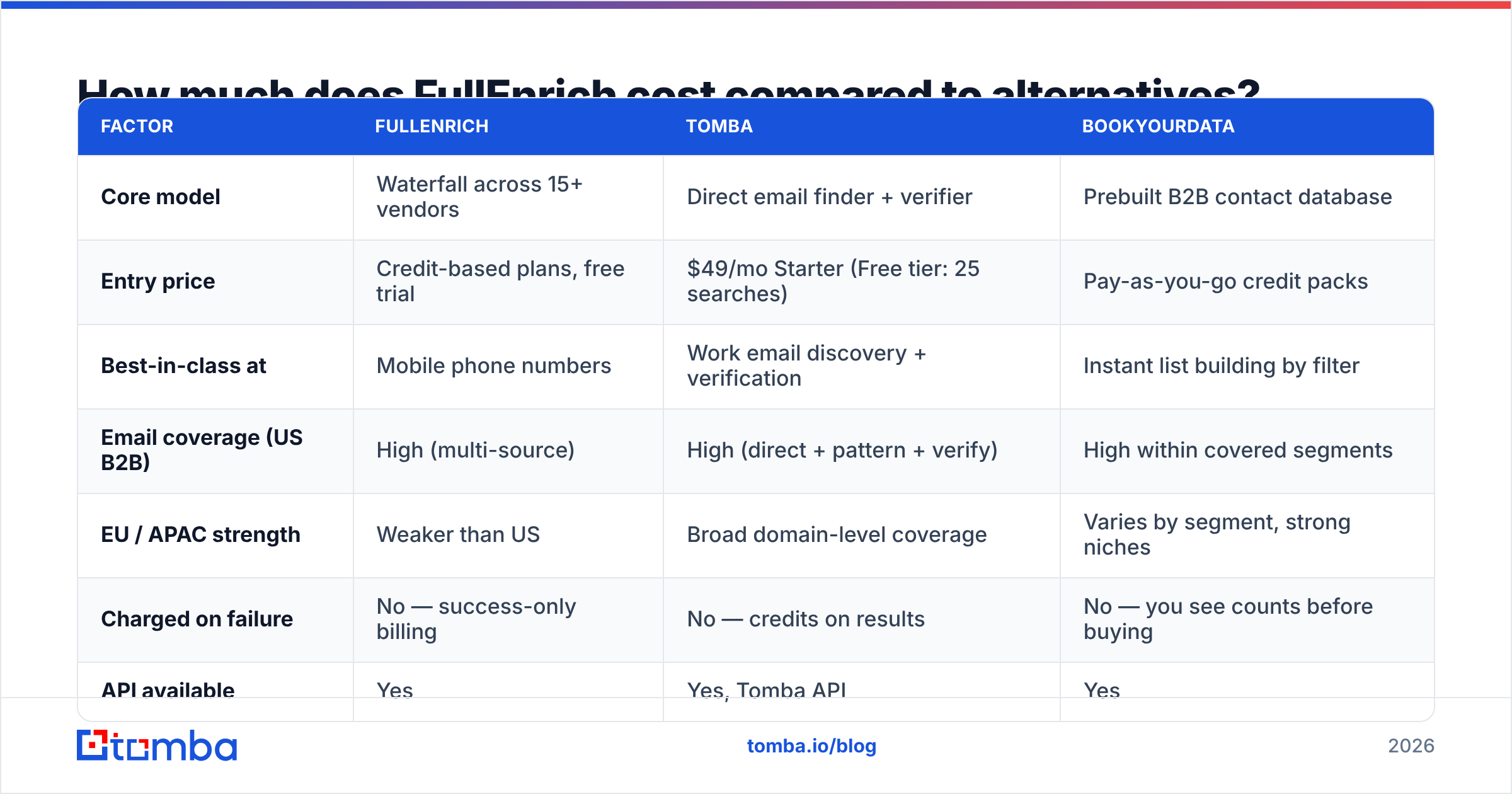
| Factor | FullEnrich | Tomba | BookYourData |
|---|---|---|---|
| Core model | Waterfall across 15+ vendors | Direct email finder + verifier | Prebuilt B2B contact database |
| Entry price | Credit-based plans, free trial | $49/mo Starter (Free tier: 25 searches) | Pay-as-you-go credit packs |
| Best-in-class at | Mobile phone numbers | Work email discovery + verification | Instant list building by filter |
| Email coverage (US B2B) | High (multi-source) | High (direct + pattern + verify) | High within covered segments |
| EU / APAC strength | Weaker than US | Broad domain-level coverage | Varies by segment, strong niches |
| Charged on failure | No — success-only billing | No — credits on results | No — you see counts before buying |
| API available | Yes | Yes, Tomba API | Yes |
| Bulk workflow | CSV + integrations | Bulk email finder, Sheets, Excel | Filtered list export |
| Ideal buyer | Phone-first outbound teams | Email-first outbound + dev teams | Teams who want a list today, no setup |
BookYourData deserves a specific note here because it solves a different problem well: if you know your ICP by filter (industry, title, geography) and want a verified list in the next ten minutes without building an enrichment pipeline, a database-first purchase beats both waterfall and API approaches on time-to-first-email. It's a genuinely different buying motion, not a worse one.
Tomba sits at the other end: you already have accounts, domains, or LinkedIn URLs, and you need emails attached to them programmatically. Tomba pricing runs Free (25 searches/mo), Starter $49/mo, Growth $99/mo, Pro $249/mo, Enterprise custom — flat and predictable, which is exactly what credit-pool waterfalls are not.
When is a waterfall worth paying for?#
Waterfall enrichment earns its premium in three specific situations.
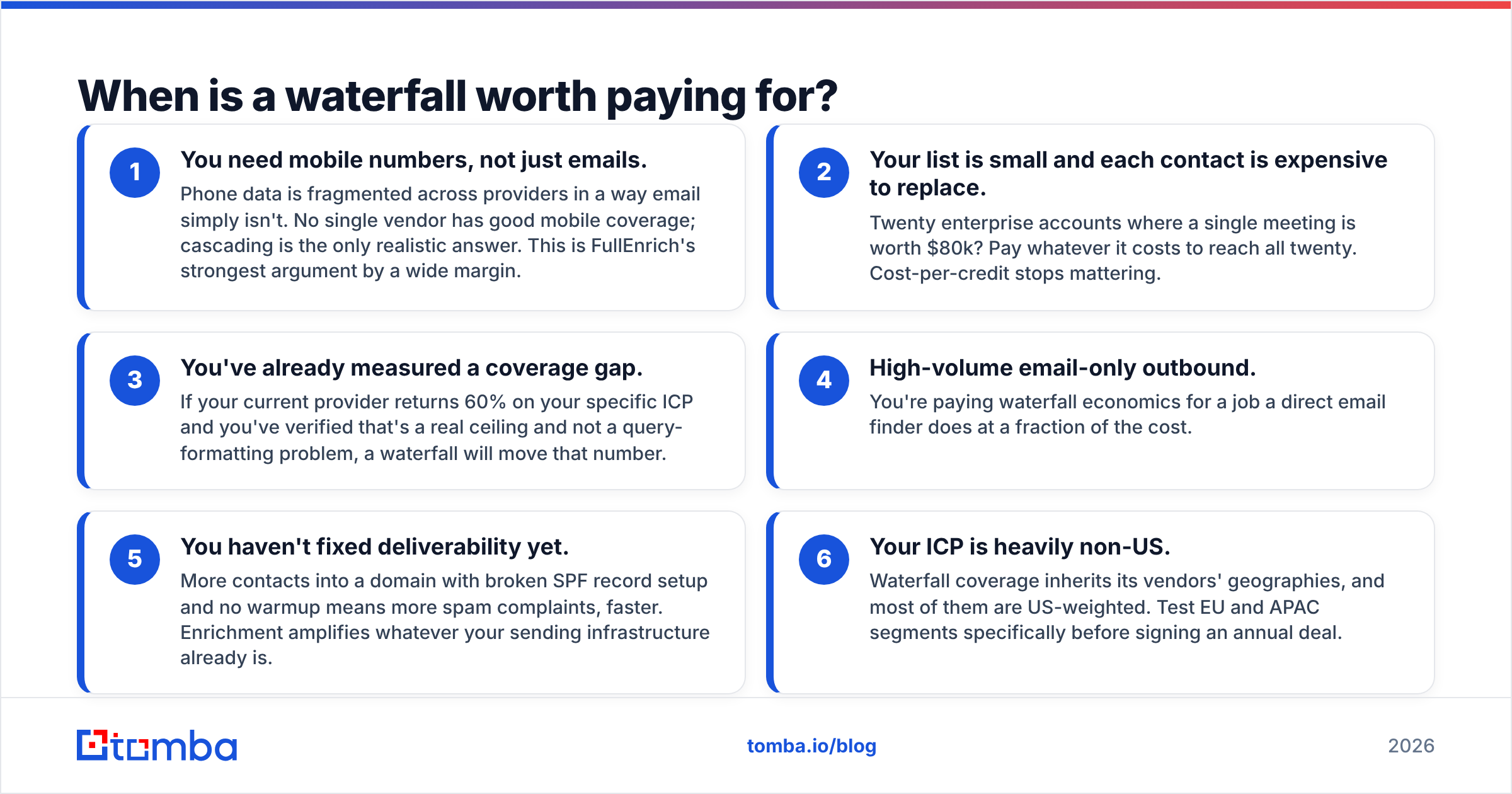
- You need mobile numbers, not just emails. Phone data is fragmented across providers in a way email simply isn't. No single vendor has good mobile coverage; cascading is the only realistic answer. This is FullEnrich's strongest argument by a wide margin.
- Your list is small and each contact is expensive to replace. Twenty enterprise accounts where a single meeting is worth $80k? Pay whatever it costs to reach all twenty. Cost-per-credit stops mattering.
- You've already measured a coverage gap. If your current provider returns 60% on your specific ICP and you've verified that's a real ceiling and not a query-formatting problem, a waterfall will move that number.
And three situations where it's the wrong purchase:
- High-volume email-only outbound. You're paying waterfall economics for a job a direct email finder does at a fraction of the cost.
- You haven't fixed deliverability yet. More contacts into a domain with broken SPF record setup and no warmup means more spam complaints, faster. Enrichment amplifies whatever your sending infrastructure already is.
- Your ICP is heavily non-US. Waterfall coverage inherits its vendors' geographies, and most of them are US-weighted. Test EU and APAC segments specifically before signing an annual deal.

What do real FullEnrich reviews say about the downsides?#
Pulling common threads from public review sites like G2 and practitioner communities, four criticisms recur:
Credit predictability. The most consistent complaint. Because a combined email + phone request bills as two waterfall events, and phone costs more, teams routinely burn a month's credits in a week's bulk run. The fix is procedural, not technical: split your email and phone enrichment into separate passes, enrich phone only for contacts that already passed email verification and matched your ICP filter.
Non-US coverage. Reviewers running German, French, Nordic, or APAC lists consistently report lower hit rates than the US benchmarks. This isn't a FullEnrich flaw so much as a market reality — but it does mean the headline coverage number won't be your coverage number.
Depth of firmographic data. FullEnrich is built for contact data (email, phone), not for the full firmographic and technographic picture. If you also need company headcount, tech stack, funding, and intent, you're layering another tool on top. A dedicated data enrichment or intent platform handles that job better.
Cost at scale. Waterfall economics scale linearly and unforgivingly. At 500 contacts/month it's a rounding error. At 50,000 contacts/month, the per-record premium becomes a real line item that a finance team will ask about.
None of these are dealbreakers for the right buyer. All of them are dealbreakers for the wrong one.
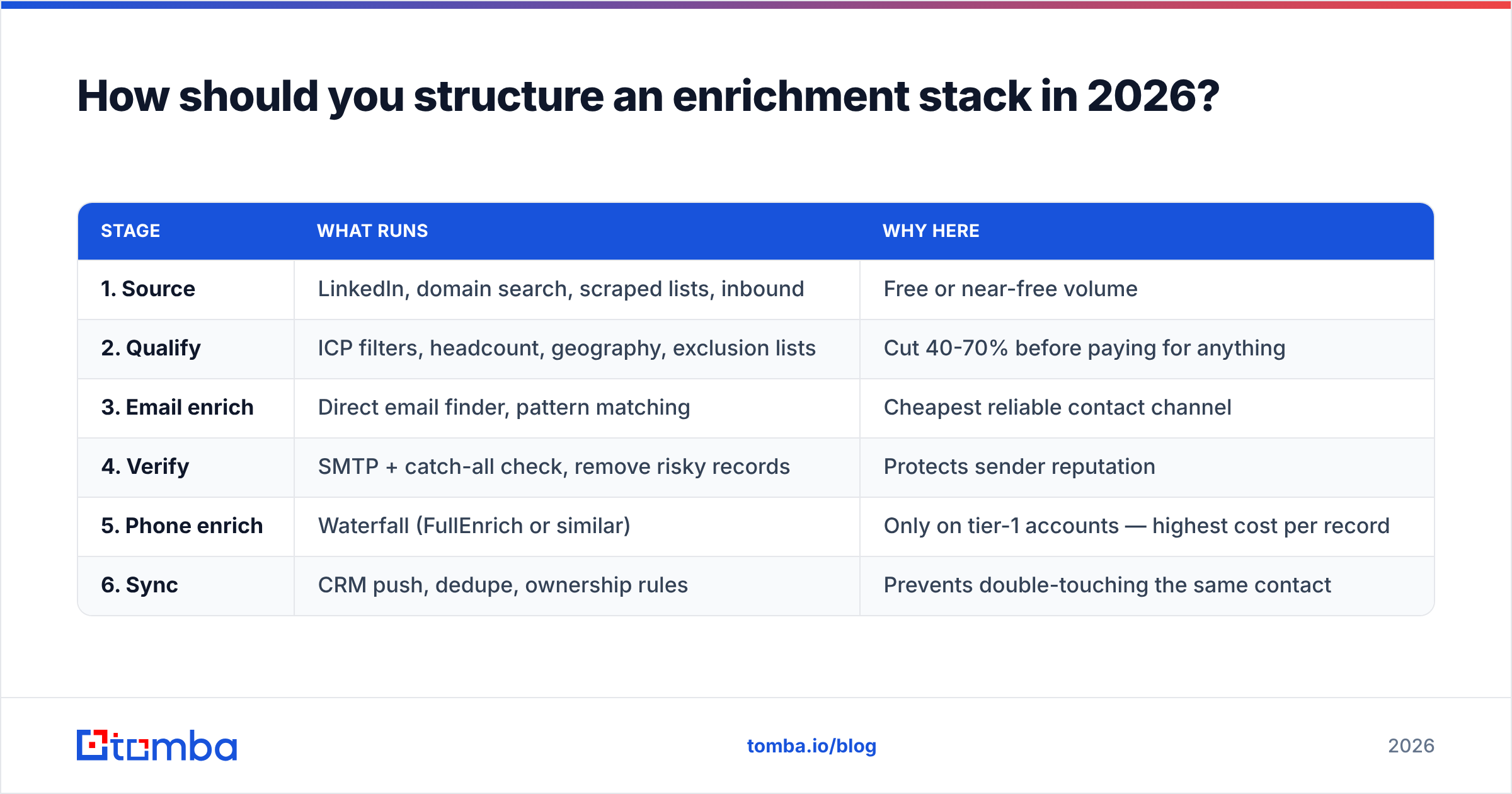
How should you structure an enrichment stack in 2026?#
The pattern that works for most outbound teams is tiered, not single-vendor. Cheap sources first, expensive sources only on records that survived qualification.
| Stage | What runs | Why here |
|---|---|---|
| 1. Source | LinkedIn, domain search, scraped lists, inbound | Free or near-free volume |
| 2. Qualify | ICP filters, headcount, geography, exclusion lists | Cut 40-70% before paying for anything |
| 3. Email enrich | Direct email finder, pattern matching | Cheapest reliable contact channel |
| 4. Verify | SMTP + catch-all check, remove risky records | Protects sender reputation |
| 5. Phone enrich | Waterfall (FullEnrich or similar) | Only on tier-1 accounts — highest cost per record |
| 6. Sync | CRM push, dedupe, ownership rules | Prevents double-touching the same contact |
Notice where the waterfall sits: stage five, after qualification and after email. That ordering is the single highest-leverage change most teams can make to their enrichment bill. You stop paying premium multi-vendor rates on records that a $0.02 lookup would have covered, and you stop paying anything at all on records that never should have entered the pipeline.
The verification step matters more than most teams treat it. According to industry deliverability guidance widely echoed by providers like HubSpot, list hygiene is the dominant controllable factor in inbox placement — an email verifier pass before sending protects the domain that all your enrichment spend depends on.
Which tool should you actually pick?#
Match the tool to your bottleneck, not to the feature list.
- Bottleneck is mobile numbers for cold calling → FullEnrich or another waterfall. This is the clearest use case, and it's a real one.
- Bottleneck is work emails at volume → a direct finder with a flat plan. Predictable cost, API access, bulk workflows.
- Bottleneck is "I need a list of 3,000 CFOs in fintech by Thursday" → a database product like BookYourData. Filter, preview counts, export. No pipeline to build.
- Bottleneck is reply rate, not contact data → neither. Fix targeting and copy before you spend another dollar on enrichment. More bad-fit contacts is not a growth strategy.
- Bottleneck is engineering time → whichever tool has the cleanest API and best docs for your stack. Enrichment you can't automate is enrichment you won't run.
Most teams overestimate how much of their problem is data coverage and underestimate how much is qualification discipline. A 70% hit rate on a well-filtered 500-account list beats an 85% hit rate on an unfiltered 5,000-account list every single quarter.
Final verdict on FullEnrich#
FullEnrich is a well-built tool with an honest architecture and a narrow ideal buyer. The waterfall approach is the right answer to phone-number fragmentation, success-only billing is fair, and the product does what it says.
But it's positioned as a general enrichment layer when its real edge is phone data. If you're buying it to find work emails at scale, you're paying waterfall prices for a commodity lookup — and the coverage delta over a good direct provider won't justify the credit burn once you get past a few thousand records a month.
Rated as a phone enrichment tool: strong. Rated as your default email source: overkill for most teams.
Getting started with a cheaper email layer: if emails are your actual bottleneck, start with Tomba Email Finder. The free tier gives you 25 searches a month to benchmark hit rate against whatever you're running now, Starter is $49/mo, and every result runs through verification before it reaches your CSV. Run the same 100-contact list through both, compare cost per deliverable address, and let the number decide — that's the only FullEnrich review that's actually about your data.
Related guides#
Ready to find emails that actually work?
Join 150,000+ professionals who stopped guessing and started sending. Free credits on signup — no credit card required.
Get the Tomba newsletter
Practical outbound tactics and product updates — once every two weeks.
About the author