7 Best Fundediq Alternatives in 2026, Compared Honestly
Funding-signal tools tell you who just raised. They rarely tell you who to email. Here are seven Fundediq alternatives compared on data depth, contact accuracy, pricing model, and how much manual cleanup each one leaves behind.
TL;DR
- Fundediq sits in the "funding signal" category: it surfaces companies that recently raised capital so you can pitch them while the budget is still warm. That's a trigger, not a contact database.
- Most teams shopping for Fundediq alternatives are really solving one of two problems: the signal coverage is too narrow, or the contact data attached to the signal is too thin to email.
- The honest split: Crunchbase and PitchBook own the funding record, Harmonic and Specter own the early signal, Apollo and Clay own the workflow, and email finders like Tomba own contact accuracy.
- Cheapest credible stack in 2026: a funding data source plus a dedicated email finder. Expect roughly $99–$150/month total instead of a four-figure seat license.
- Verify every address before you send. A funding list is worthless if half of it bounces and your domain reputation takes the hit.
What is Fundediq, and what does it actually do?#
Fundediq belongs to a category that barely existed five years ago: funding-triggered lead generation. The pitch is simple. Companies that just closed a round have three things you want — new budget, new hiring plans, and a mandate to spend fast. Tools in this space watch funding announcements, regulatory filings, and press feeds, then hand you a list of companies matched to your ICP.
That's a genuinely good trigger. A Series A company hiring its first five AEs will buy sales tooling, a CRM, security software, recruiting help, and office infrastructure inside ninety days. Reaching them in week two beats reaching them in month six.
One caveat before we go further: vendor pricing and feature sets in this category change constantly, and Fundediq is a smaller player than the incumbents below. Treat every number in this post as a starting point for your own trial, not a quoted contract. Check the vendor's own pricing page before you budget.
The structural weakness of every funding-signal tool — Fundediq included — is the last mile. Knowing that Acme Corp raised $12M tells you nothing about which of the 40 people there owns your budget line, and even less about whether first.last@acme.com will actually deliver.
Why do teams look for Fundediq alternatives?#
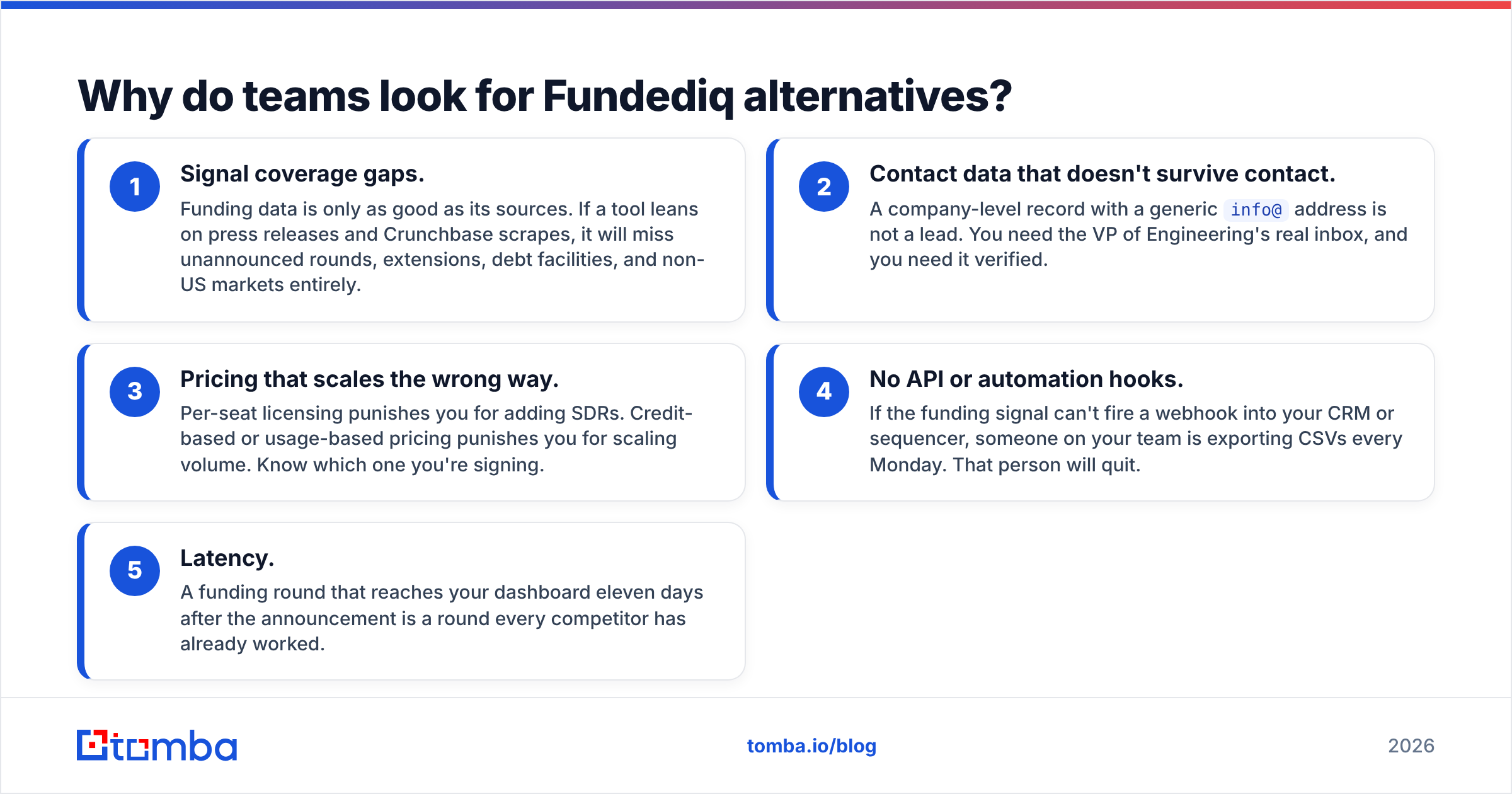
Five reasons come up over and over when teams switch:
- Signal coverage gaps. Funding data is only as good as its sources. If a tool leans on press releases and Crunchbase scrapes, it will miss unannounced rounds, extensions, debt facilities, and non-US markets entirely.
- Contact data that doesn't survive contact. A company-level record with a generic
info@address is not a lead. You need the VP of Engineering's real inbox, and you need it verified. - Pricing that scales the wrong way. Per-seat licensing punishes you for adding SDRs. Credit-based or usage-based pricing punishes you for scaling volume. Know which one you're signing.
- No API or automation hooks. If the funding signal can't fire a webhook into your CRM or sequencer, someone on your team is exporting CSVs every Monday. That person will quit.
- Latency. A funding round that reaches your dashboard eleven days after the announcement is a round every competitor has already worked.

What should a funding-signal prospecting stack include?#
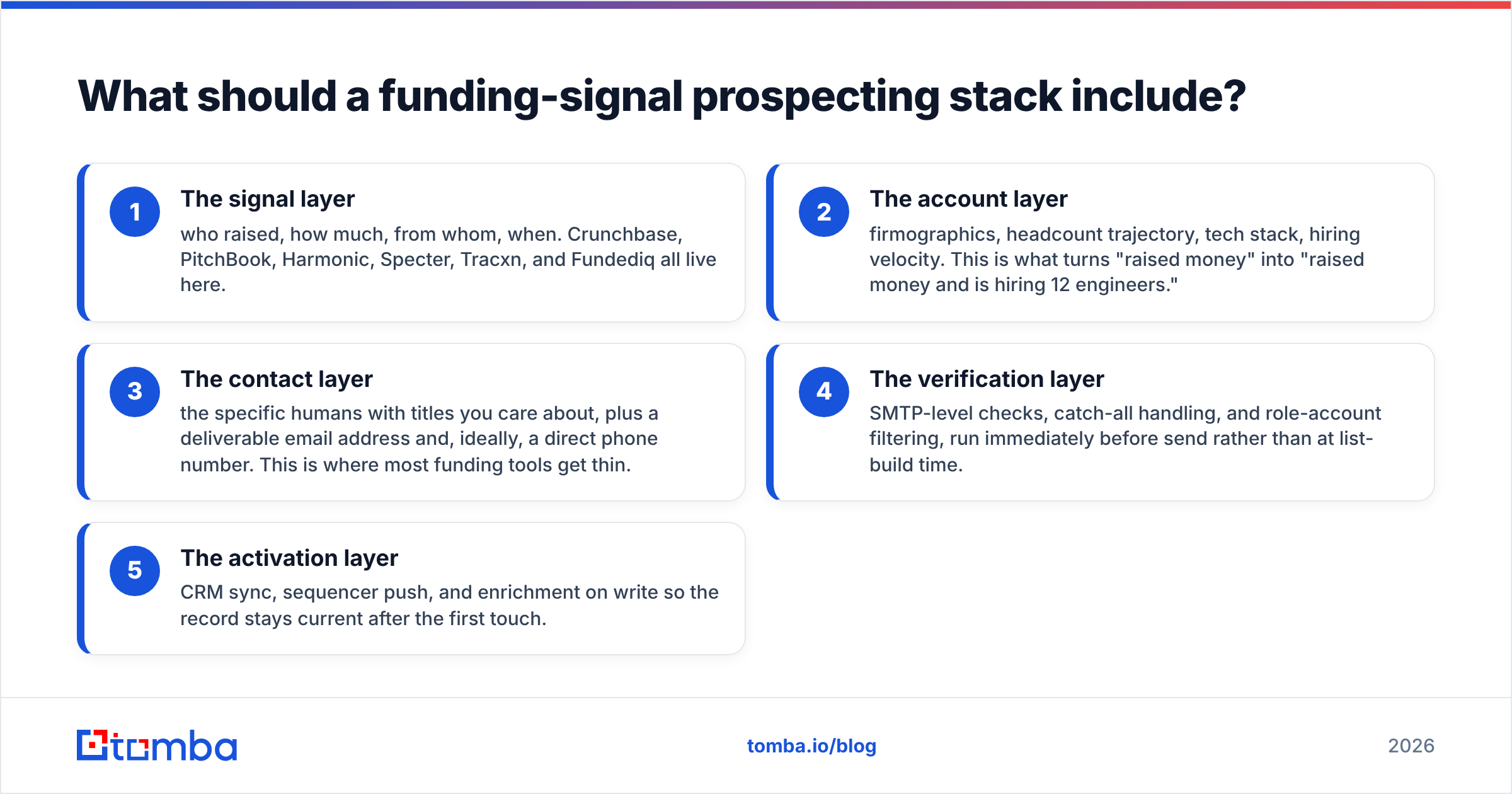
Before comparing vendors, get clear on which layer you're actually buying. Most teams overpay because they buy one tool hoping it covers all four.
- The signal layer — who raised, how much, from whom, when. Crunchbase, PitchBook, Harmonic, Specter, Tracxn, and Fundediq all live here.
- The account layer — firmographics, headcount trajectory, tech stack, hiring velocity. This is what turns "raised money" into "raised money and is hiring 12 engineers."
- The contact layer — the specific humans with titles you care about, plus a deliverable email address and, ideally, a direct phone number. This is where most funding tools get thin.
- The verification layer — SMTP-level checks, catch-all handling, and role-account filtering, run immediately before send rather than at list-build time.
- The activation layer — CRM sync, sequencer push, and enrichment on write so the record stays current after the first touch.
A tool that nails layers 1 and 2 but hands you unverified guesses at layer 3 is not a complete replacement for a stack. It's one component priced like a platform.
Which Fundediq alternatives are worth comparing in 2026?#
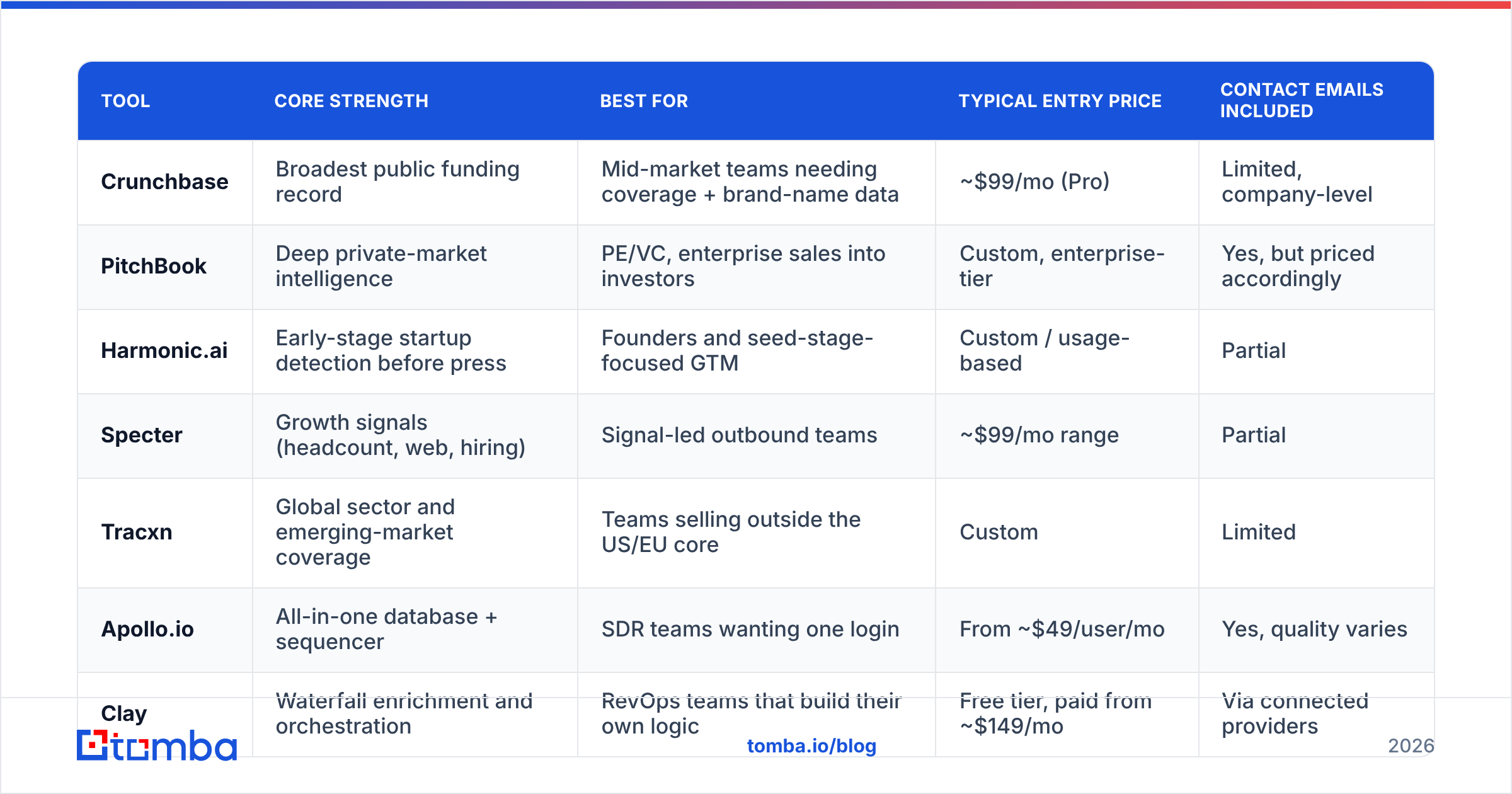
| Tool | Core strength | Best for | Typical entry price | Contact emails included |
|---|---|---|---|---|
| Crunchbase | Broadest public funding record | Mid-market teams needing coverage + brand-name data | ~$99/mo (Pro) | Limited, company-level |
| PitchBook | Deep private-market intelligence | PE/VC, enterprise sales into investors | Custom, enterprise-tier | Yes, but priced accordingly |
| Harmonic.ai | Early-stage startup detection before press | Founders and seed-stage-focused GTM | Custom / usage-based | Partial |
| Specter | Growth signals (headcount, web, hiring) | Signal-led outbound teams | ~$99/mo range | Partial |
| Tracxn | Global sector and emerging-market coverage | Teams selling outside the US/EU core | Custom | Limited |
| Apollo.io | All-in-one database + sequencer | SDR teams wanting one login | From ~$49/user/mo | Yes, quality varies |
| Clay | Waterfall enrichment and orchestration | RevOps teams that build their own logic | Free tier, paid from ~$149/mo | Via connected providers |
| BookYourData | Pay-as-you-go verified B2B contact lists | Buyers who hate subscriptions | Credit packs, no subscription | Yes, verified |
| Tomba | Email finding and verification accuracy | Anyone attaching real inboxes to a signal list | Free tier, Starter $49/mo | Yes, core product |
Prices reflect publicly listed entry tiers at time of writing and move frequently. Cross-check current plans on G2 and each vendor's pricing page.
Crunchbase#
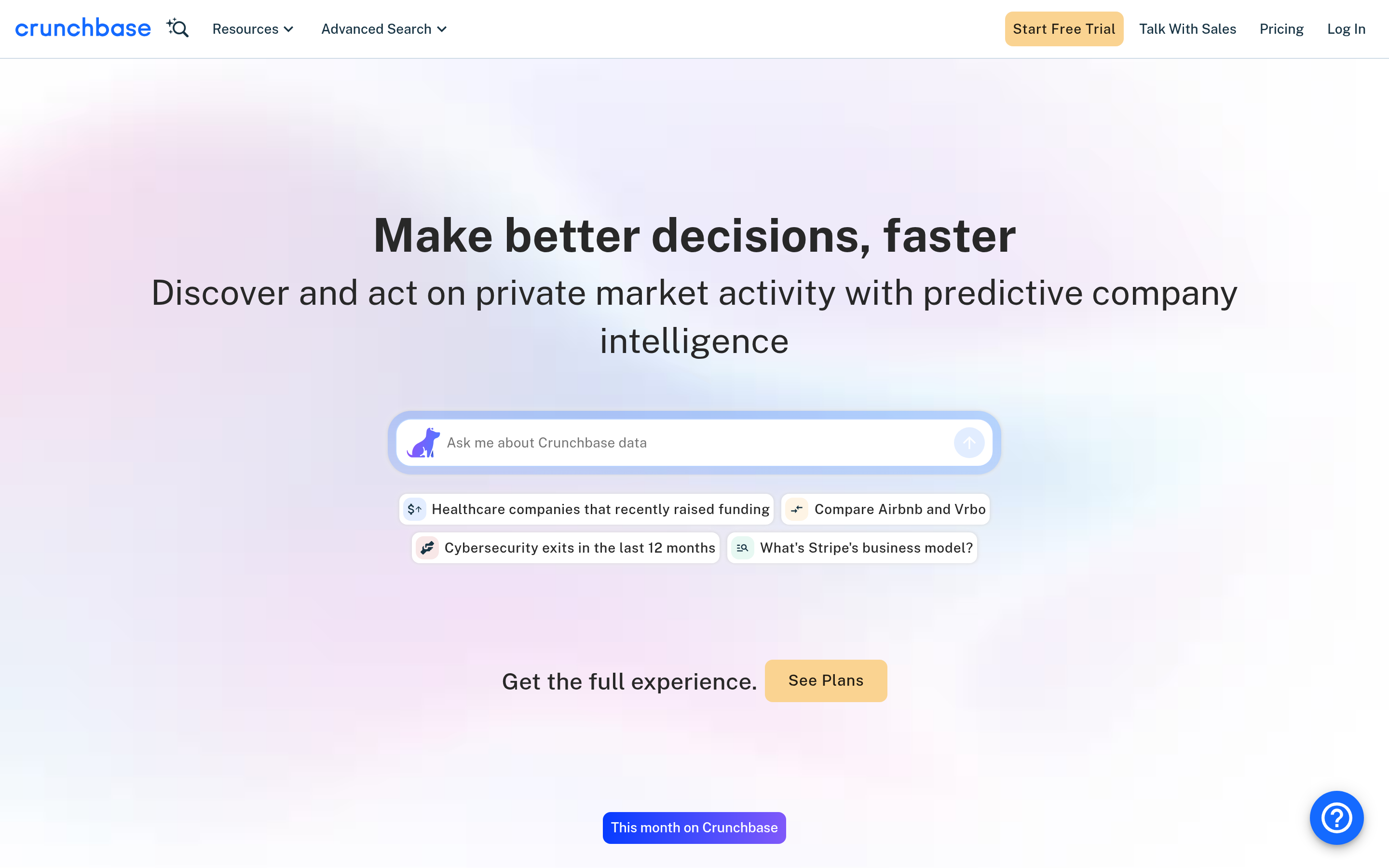
The default answer, and often the right one. Crunchbase has the widest publicly accessible funding record, decent ICP filters, and an API that most RevOps teams can wire up in an afternoon. Where it disappoints: contact data is shallow, and you'll still need a separate way to find the buyer's email. Treat it as a signal source, not a prospecting platform.
Choose it if you want reliable, defensible funding data at a predictable price and already have a contact-data solution.
PitchBook#
PitchBook is the institutional standard. Cap tables, investor relationships, valuations, comps — the depth is real and so is the invoice. For a five-person SDR team chasing seed-stage accounts, it's dramatically overspecified. For someone selling into private equity or doing investor-mapped account planning, nothing else comes close.
Choose it if your deals are large enough that a five-figure annual contract rounds to nothing.
Harmonic.ai#
Harmonic attacks the latency problem. Instead of waiting for a funding announcement, it tracks founder activity, team formation, and early company signals — often surfacing companies before the round is public. That's a real edge for anyone selling to pre-seed and seed companies. The tradeoff is noise: earlier signal means more false positives, and you need a qualification step downstream.
Specter#

Specter leans on growth signals rather than funding events alone — headcount deltas, web traffic movement, job postings, app-store momentum. In practice, "hired 8 engineers in 60 days" is often a better buying indicator than "announced a round," because hiring reflects the money actually being spent.
Tracxn#
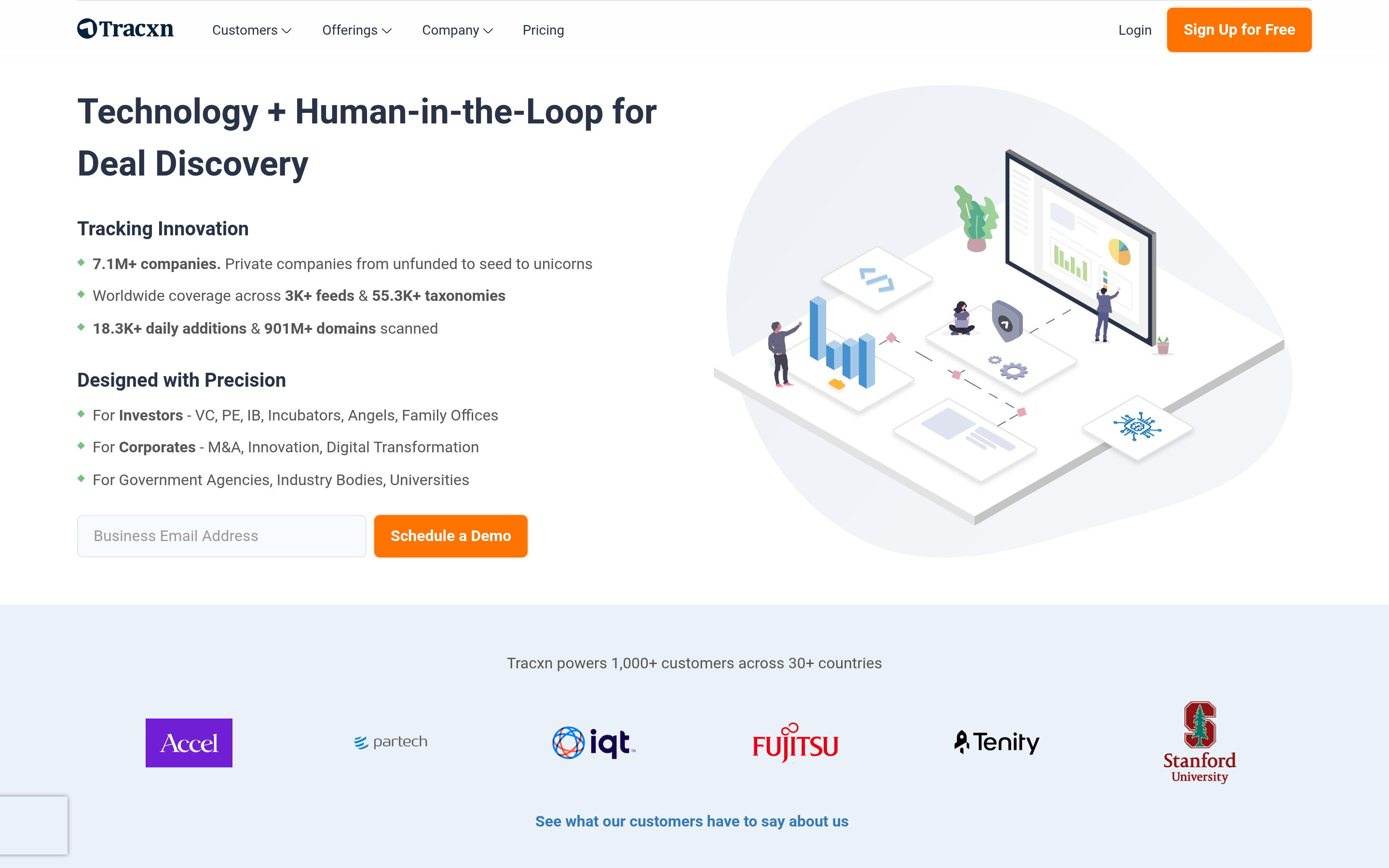
Tracxn is the coverage answer for teams selling outside North America and Western Europe. Its sector taxonomies for Indian, Southeast Asian, and Middle Eastern markets are considerably stronger than the US-centric incumbents. Contact data is thin, so plan for an enrichment layer.
Apollo.io#
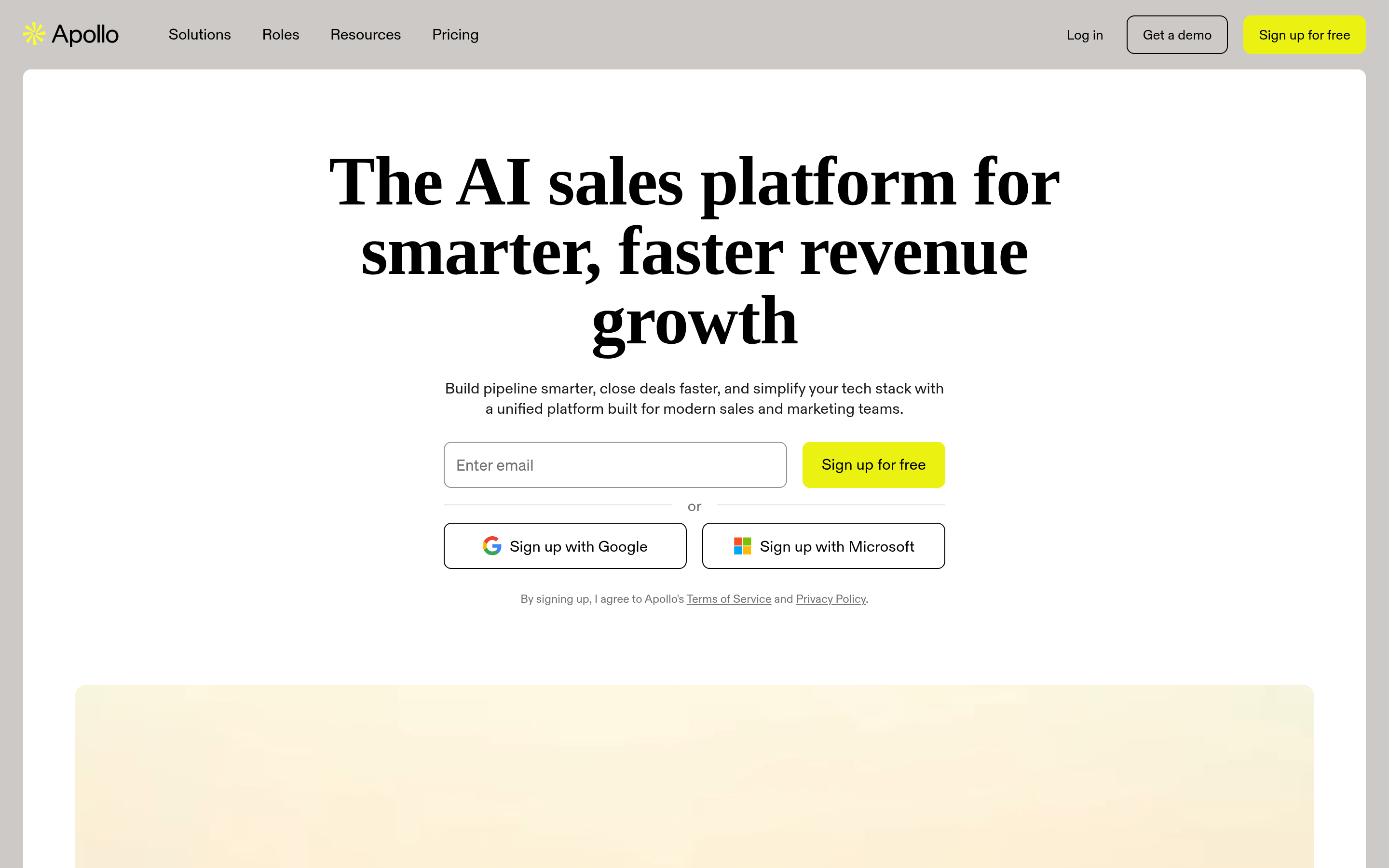
Apollo bundles a contact database, funding filters, and a sequencer into one subscription. The convenience is real and the entry price is low. The recurring complaint is data freshness — titles and emails drift, and bounce rates on unverified Apollo exports are consistently worse than on a dedicated verifier. Many teams keep Apollo for sequencing and route contact data through a specialist. If you're evaluating this route, see our breakdown of Apollo alternatives.
Clay#
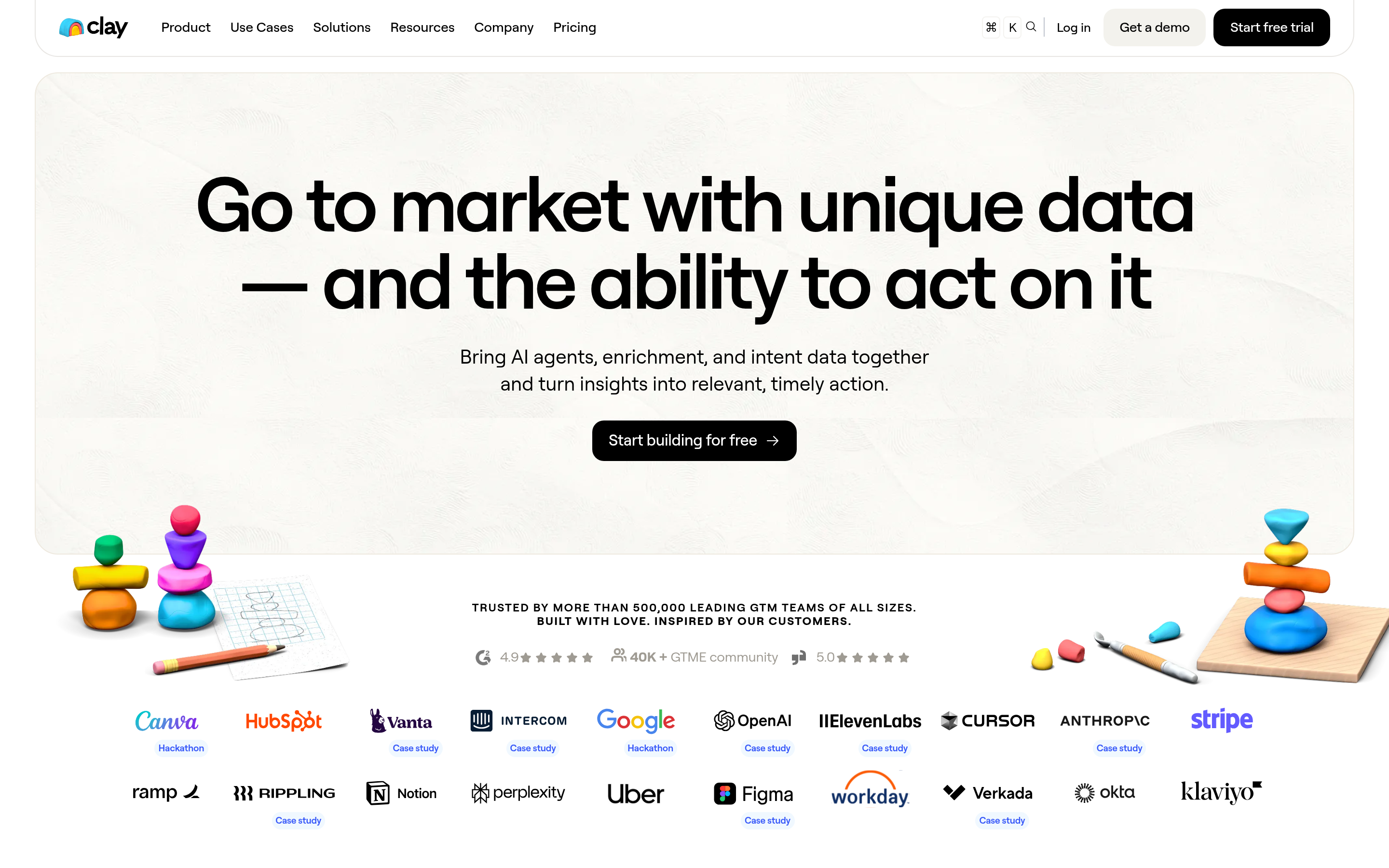
Clay is not a data source; it's the pipe. You connect providers, define waterfall logic ("try provider A, fall back to B, then C"), and let it orchestrate enrichment across your funding list. Powerful, and genuinely the best answer for a RevOps team with the appetite to build. It also multiplies your data spend, because every waterfall step costs credits somewhere.
BookYourData#
BookYourData takes the opposite stance to everyone else on this list: no subscription, pay-as-you-go credit packs, and verified contacts at the point of purchase. If your funding-triggered campaigns are seasonal or campaign-based rather than always-on, not paying for twelve months of access you use four times is a legitimate advantage. It's a contact-data source rather than a funding-signal engine, so it pairs with a signal tool rather than replacing one.
Is a funding database enough without verified emails?#
No — and this is the single most expensive mistake in signal-led outbound.
Here's the sequence that burns domains. You pull 400 freshly funded accounts. You guess email patterns or accept whatever the platform's unverified "likely" addresses are. You load them into a sequencer. Fifteen percent bounce. Your bounce rate crosses the threshold where mailbox providers start routing you to spam, and now your good prospects stop seeing your emails too.
The fix is a verification step between list build and send. A dedicated email verifier runs SMTP-level checks, flags role accounts and disposables, and separates genuinely valid addresses from catch-all domains that will accept anything and deliver nothing. Catch-all domains are especially common at recently funded startups running Google Workspace with permissive settings — exactly the accounts on your funding list.
The workflow that actually holds up:
- Pull the funding signal from your chosen source (Crunchbase, Harmonic, Specter, Fundediq — whichever fits your market).
- Take each company domain and run a domain search to map who works there and in what role, along with the company's actual email pattern.
- Find the specific buyer's address with an email finder rather than permutating and hoping.
- Verify in bulk before send. Discard anything below your confidence threshold instead of "testing" it on your production domain.
- Push the survivors to your sequencer, and sync the enriched record back to the CRM.

How much should a funding-signal stack actually cost?#
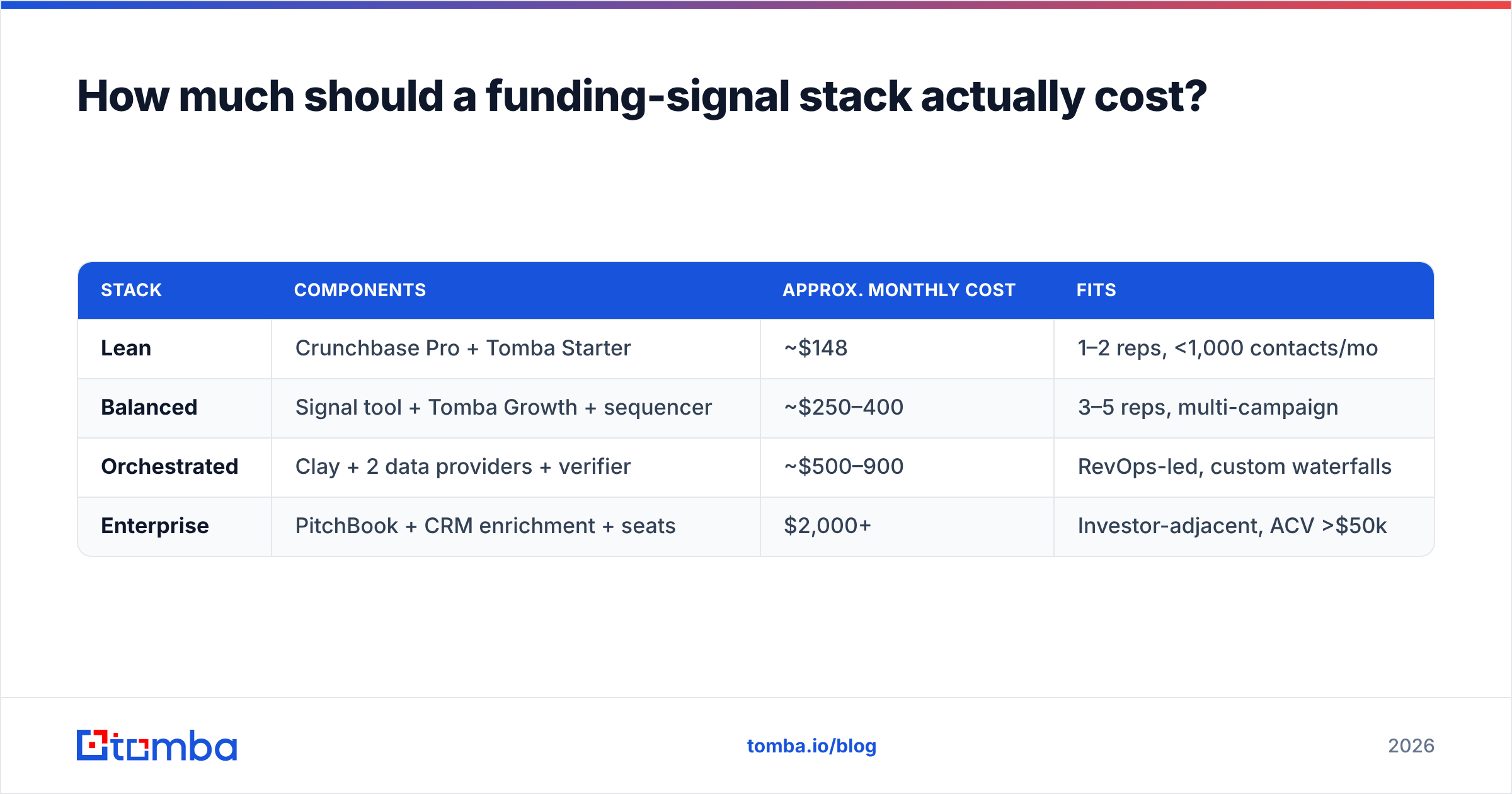
| Stack | Components | Approx. monthly cost | Fits |
|---|---|---|---|
| Lean | Crunchbase Pro + Tomba Starter | ~$148 | 1–2 reps, <1,000 contacts/mo |
| Balanced | Signal tool + Tomba Growth + sequencer | ~$250–400 | 3–5 reps, multi-campaign |
| Orchestrated | Clay + 2 data providers + verifier | ~$500–900 | RevOps-led, custom waterfalls |
| Enterprise | PitchBook + CRM enrichment + seats | $2,000+ | Investor-adjacent, ACV >$50k |
The lean stack surprises people. Tomba's Starter plan at $49/mo plus a funding data subscription covers the entire workflow for a two-person team, with a free tier (25 searches/month) to sanity-check accuracy before you commit a dollar. Compare that to a per-seat platform where adding a third SDR adds several hundred dollars a month whether or not that SDR touches the data.
How do you launch a funding-triggered play in one week?#
Day 1–2: define the trigger precisely. Not "raised money." Something like: Series A or B, $5M–$30M, US or UK, 20–150 employees, hiring for roles that imply your product's use case. Narrow triggers produce better reply rates than broad ones, every time.
Day 3: build the contact map. For each qualified account, identify two personas — the economic buyer and the practitioner who'll feel the pain first. Use domain search to find both, and enrich with title, seniority, and department so your segmentation holds.
Day 4: verify and segment. Run the full list through verification. Split into valid, risky, and catch-all. Send to valid only in week one.
Day 5: write two sequences. One references the round directly ("congrats on the Series A — most teams at your stage hit X problem in the first quarter"). One doesn't mention it at all and leans on the hiring signal instead. Test which lands; the funding-congrats opener is heavily overused and reply rates reflect that.
Ongoing: automate the refresh. Wire the signal source and the Tomba API together so new funding events produce verified contacts without anyone opening a spreadsheet.
Which Fundediq alternative is right for you?#
- You need the broadest reliable funding record: Crunchbase, paired with a dedicated email finder.
- You sell to investors or need cap-table depth: PitchBook, and budget accordingly.
- You want the signal before the press release: Harmonic or Specter.
- You sell outside the US/EU: Tracxn.
- You want one login and can tolerate data drift: Apollo.
- You have RevOps capacity and want custom logic: Clay.
- You'd rather buy verified contacts in packs than subscribe: BookYourData.
- Your bottleneck is contact accuracy, not signal: a specialist email finder and verifier.
Most teams discover that the second problem is the real one. The funding signal is commoditized — half a dozen vendors will sell you the same round announcement. What separates a campaign that books meetings from one that lands in spam is whether the addresses attached to that signal are real.
That's the layer worth investing in. Start with the Tomba Email Finder — it turns a company domain and a name into a verified, deliverable address, with a free tier to test against your own funding list before you pay for anything. Run twenty-five of your hardest accounts through it, compare the results to whatever your current tool returns, and let the bounce rate decide.
Related guides#
Ready to find emails that actually work?
Join 150,000+ professionals who stopped guessing and started sending. Free credits on signup — no credit card required.
Get the Tomba newsletter
Practical outbound tactics and product updates — once every two weeks.
About the author