FundedIQ Pricing, Reviews, Pros and Cons: An Honest 2026 Look
A neutral breakdown of FundedIQ pricing, what real reviewers praise and complain about, where the hidden costs sit, and how the funding-signal category compares to cheaper stacks you can assemble yourself.
TL;DR
- FundedIQ sits in the funding-signal category: it tells you which companies just raised money so you can reach them while budget is fresh. That signal is real, and it is also the most commoditised part of the B2B data stack.
- Pricing is quote-led rather than fully self-serve, which is normal for this category but makes budgeting harder. Expect an annual commitment, seat-based or record-based limits, and an upsell path once you exceed them.
- The strongest reviews praise speed of alerts and enrichment of round details (amount, stage, investors). The weakest reviews cite contact-level gaps: you get the company, not always a deliverable inbox.
- The honest cost of a funding-signal tool is not the licence. It is the licence plus whatever you spend turning "Acme raised $12M" into a verified email address for the right buyer.
- If your ICP is broader than "recently funded," a cheaper stack — a signal source plus a dedicated email finder plus verification — usually beats a single premium subscription.
What is FundedIQ and who is it actually for?#
FundedIQ belongs to a niche that barely existed a decade ago: funding-intent data. The premise is simple. A company that closed a Series A last Tuesday has three things your other prospects do not — money, a mandate to spend it, and a board asking what they bought. Sell into that window and your win rate goes up without changing a word of your pitch.
Tools in this category monitor SEC filings, press releases, investor announcements, and news wires, then push structured records into your CRM or inbox: company, round size, stage, lead investor, headcount, sometimes the hiring plan implied by the raise. If you want the underlying concept, venture capital funding rounds are well documented, and Crunchbase remains the reference dataset most of these tools benchmark themselves against.
The buyer profile is narrow and specific:
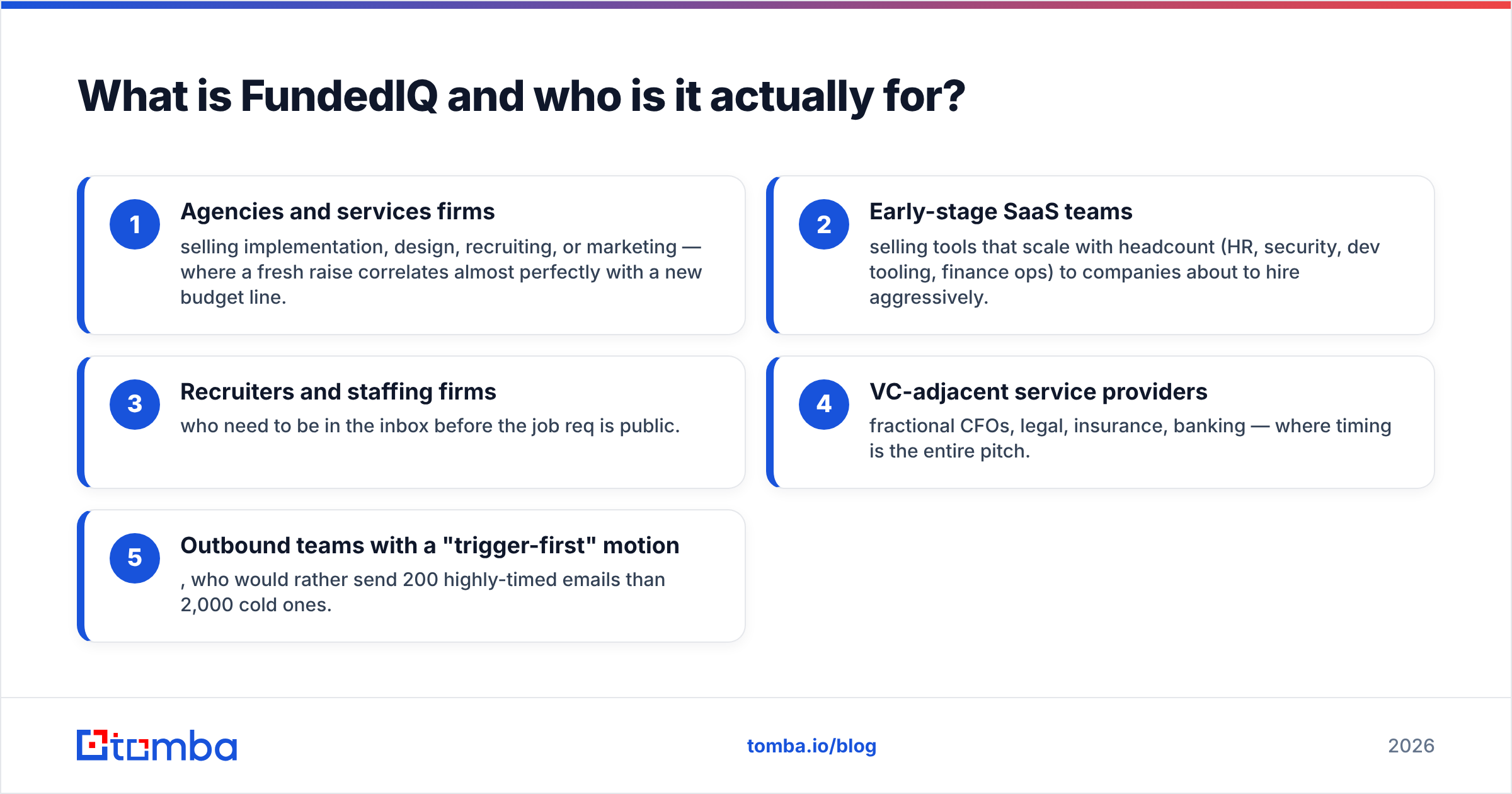
- Agencies and services firms selling implementation, design, recruiting, or marketing — where a fresh raise correlates almost perfectly with a new budget line.
- Early-stage SaaS teams selling tools that scale with headcount (HR, security, dev tooling, finance ops) to companies about to hire aggressively.
- Recruiters and staffing firms who need to be in the inbox before the job req is public.
- VC-adjacent service providers — fractional CFOs, legal, insurance, banking — where timing is the entire pitch.
- Outbound teams with a "trigger-first" motion, who would rather send 200 highly-timed emails than 2,000 cold ones.
If you are none of those, a funding-signal subscription is an expensive way to get a list you could pull manually once a week.
How does FundedIQ pricing actually work?#
Here is the part most reviews skip: FundedIQ, like most tools in this bracket, does not publish a full transparent price card the way a self-serve SaaS does. You get a plan shape, and the real number comes out of a call. That is not a scandal — it is the category norm for data licensing, where the vendor prices on record volume, refresh frequency, and export rights rather than on features.
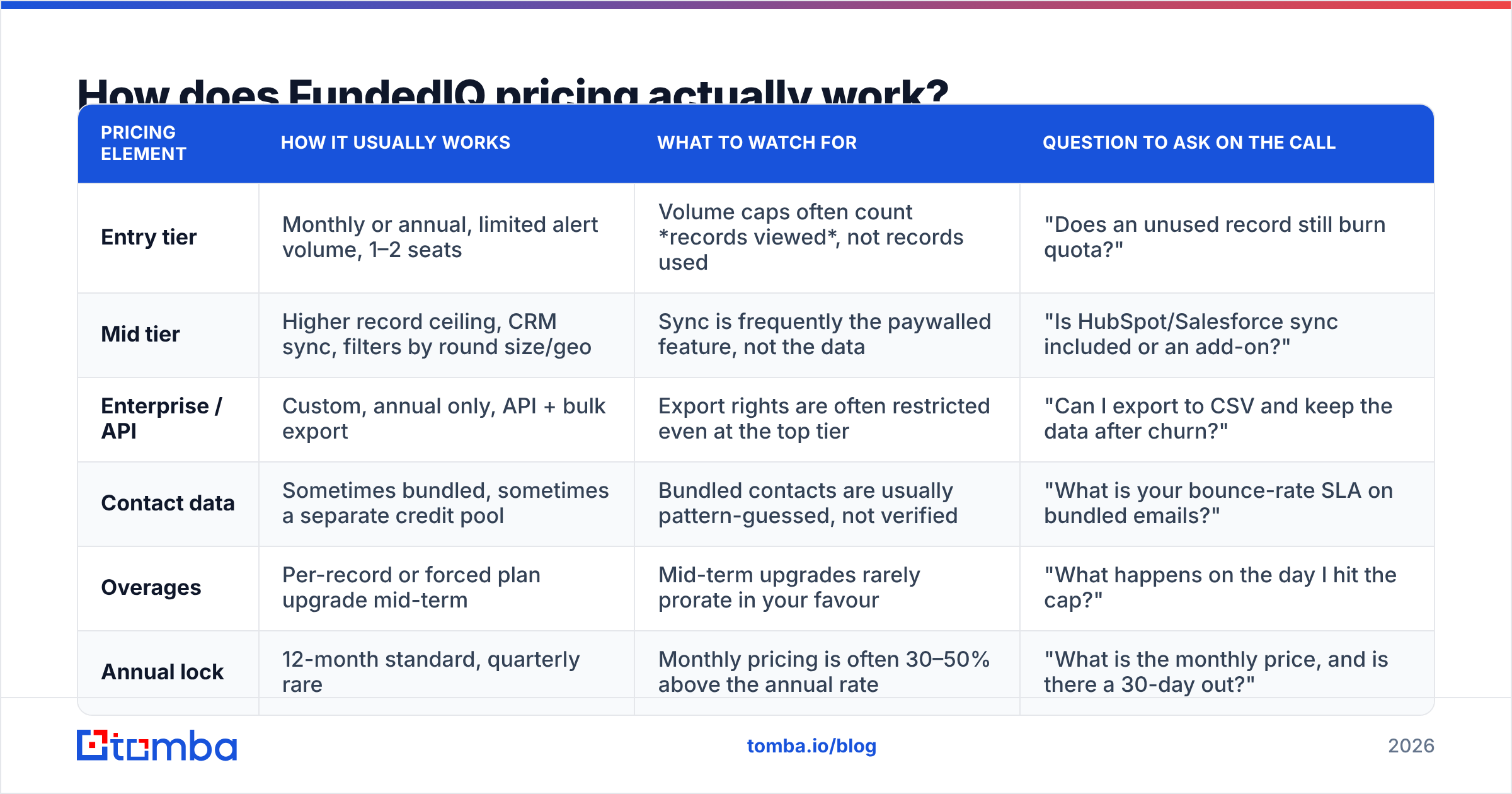
What you should hold vendors to is the structure of the deal, because that is where the surprises live. The table below shows the typical shape of funding-signal pricing across the category. Treat the figures as the range buyers report, not as a quoted price sheet — always confirm current numbers directly with the vendor before you budget.
| Pricing element | How it usually works | What to watch for | Question to ask on the call |
|---|---|---|---|
| Entry tier | Monthly or annual, limited alert volume, 1–2 seats | Volume caps often count records viewed, not records used | "Does an unused record still burn quota?" |
| Mid tier | Higher record ceiling, CRM sync, filters by round size/geo | Sync is frequently the paywalled feature, not the data | "Is HubSpot/Salesforce sync included or an add-on?" |
| Enterprise / API | Custom, annual only, API + bulk export | Export rights are often restricted even at the top tier | "Can I export to CSV and keep the data after churn?" |
| Contact data | Sometimes bundled, sometimes a separate credit pool | Bundled contacts are usually pattern-guessed, not verified | "What is your bounce-rate SLA on bundled emails?" |
| Overages | Per-record or forced plan upgrade mid-term | Mid-term upgrades rarely prorate in your favour | "What happens on the day I hit the cap?" |
| Annual lock | 12-month standard, quarterly rare | Monthly pricing is often 30–50% above the annual rate | "What is the monthly price, and is there a 30-day out?" |
Two structural notes matter more than the headline number.
Record caps are the real price. A $200/month plan that caps you at 300 funding events is more expensive per usable lead than a $500/month plan with 3,000 if your ICP filter throws away 80% of records. Model cost-per-qualified-record, not cost-per-seat.
Contact data is usually a second bill. Funding-signal vendors are excellent at the event and merely adequate at the person. If the plan bundles emails, ask how they are generated. Pattern inference without verification produces addresses that look right and bounce anyway — which is how a "free" bundled contact becomes the most expensive line item on your invoice.
What do FundedIQ reviews say — the pros?#
Pull the sentiment apart and the positive reviews cluster into four themes. These are consistent across the funding-signal category, and they are genuine advantages over doing this manually.
- Timing beats targeting. Reviewers repeatedly say reply rates on freshly-funded accounts run several multiples above their baseline outbound. That is the whole product thesis, and it holds up.
- Round context is genuinely useful. Knowing the amount, stage, and lead investor lets you write a first line that is specific without being creepy. "Congrats on the Series B" is weak; "most teams that raise at your stage double GTM headcount within two quarters" is a reason to reply.
- It removes a chore. Manually scanning news wires, SEC filings, and investor Twitter is 45 minutes a day that nobody does consistently after week three. Automating it is worth real money even before you count the deals.
- Filters make small teams look big. Round size, geography, sector, and stage filters let a two-person team run a focused motion instead of a spray. That is the difference between 40 great sends and 400 mediocre ones.
For third-party sentiment on any tool in this space, G2 and Capterra are the two review sites worth checking — filter by company size, because a 5-seat agency and a 200-seat sales org have opposite complaints.
What are the cons and hidden costs?#
The critical reviews are more interesting, and they are remarkably consistent across every funding-signal product on the market.
The contact gap. This is the number one complaint. You learn Acme raised $12M. You still need to know who the VP of Engineering is and what their email address is. Some plans bundle a contact; many bundle a guess. If your sequences bounce, your sender reputation absorbs the damage, not the vendor's.
Signal decay. A funding announcement is public. Every competitor with a subscription — and a decent number without one — sees it the same day. By day five the buyer has 60 congratulatory emails. The window is narrower than the marketing suggests, which means speed-to-send matters more than list size.
Coverage is uneven. Coverage of US venture rounds above $5M is excellent almost everywhere. Coverage of European seed rounds, bootstrapped raises, debt facilities, and non-English announcements is where products diverge sharply. Test your geography and your round-size band during the trial, not the vendor's demo accounts.
False positives on ICP. A raise is a budget signal, not a fit signal. Plenty of funded companies are wrong for you — wrong size, wrong stack, wrong buying committee. Without a real fit filter layered on top, you replace cold outbound with slightly warmer irrelevant outbound.
The annual lock. Trigger-based motions are seasonal. Funding announcements slow in Q4 and December is dead. An annual contract makes you pay full price for two quiet months. Ask about quarterly terms even if the answer is no.
Is FundedIQ worth it compared to the alternatives?#
Depends on which job you are hiring the tool for. Funding signals, company data, and contact data are three separate problems, and no product is best at all three. Here is how the options stack up.
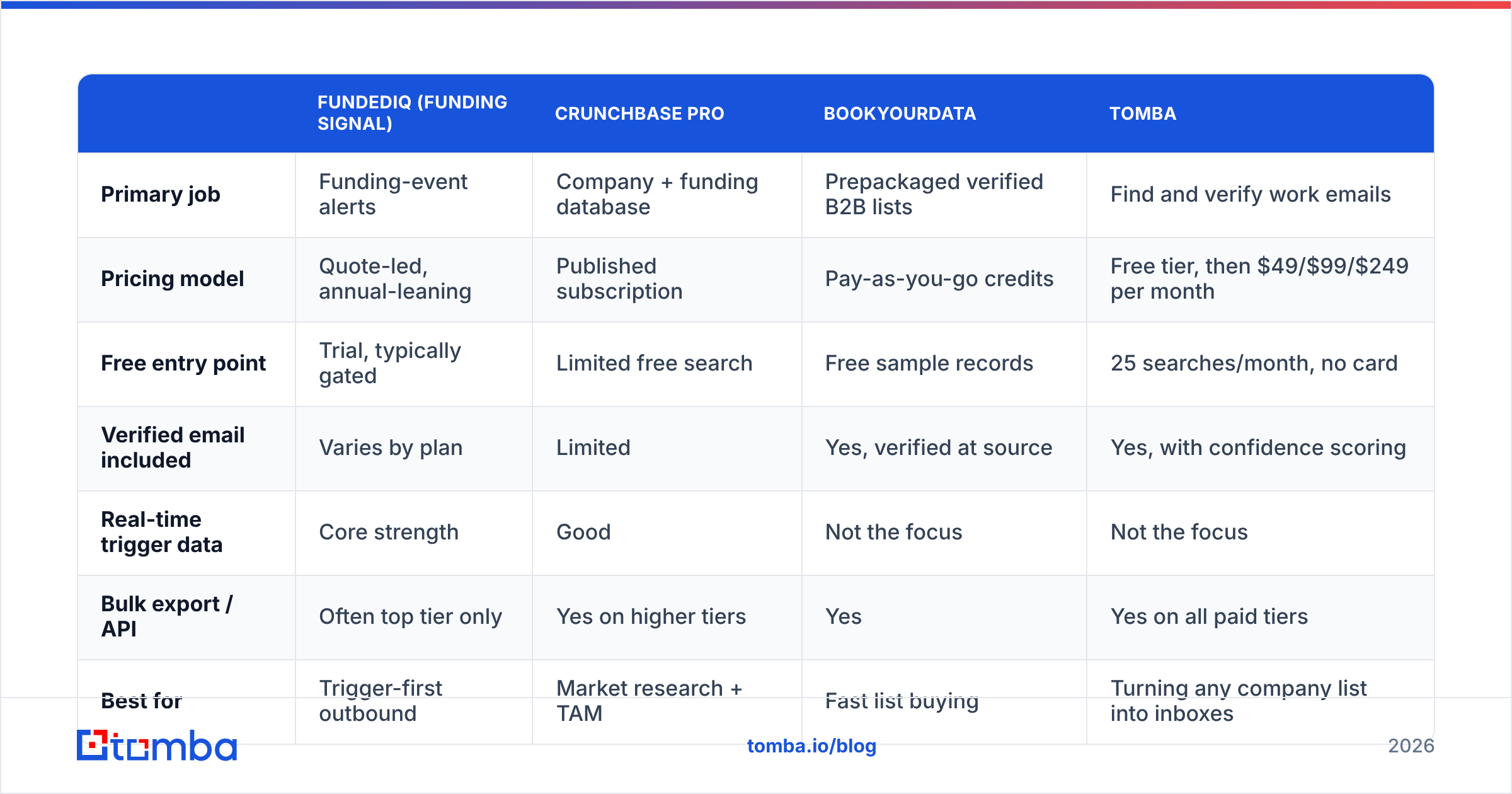
| FundedIQ (funding signal) | Crunchbase Pro | BookYourData | Tomba | |
|---|---|---|---|---|
| Primary job | Funding-event alerts | Company + funding database | Prepackaged verified B2B lists | Find and verify work emails |
| Pricing model | Quote-led, annual-leaning | Published subscription | Pay-as-you-go credits | Free tier, then $49/$99/$249 per month |
| Free entry point | Trial, typically gated | Limited free search | Free sample records | 25 searches/month, no card |
| Verified email included | Varies by plan | Limited | Yes, verified at source | Yes, with confidence scoring |
| Real-time trigger data | Core strength | Good | Not the focus | Not the focus |
| Bulk export / API | Often top tier only | Yes on higher tiers | Yes | Yes on all paid tiers |
| Best for | Trigger-first outbound | Market research + TAM | Fast list buying | Turning any company list into inboxes |
The honest read: these are complements, not substitutes. A funding-signal tool answers when. A database like Crunchbase answers who exists. A list provider like BookYourData answers give me contacts now — a solid, well-regarded option if you want the whole record in one purchase. And a domain search plus email verifier answers how do I actually reach the person, which is the step that determines whether any of the previous three produced revenue.
How do you build a cheaper funding-signal stack?#
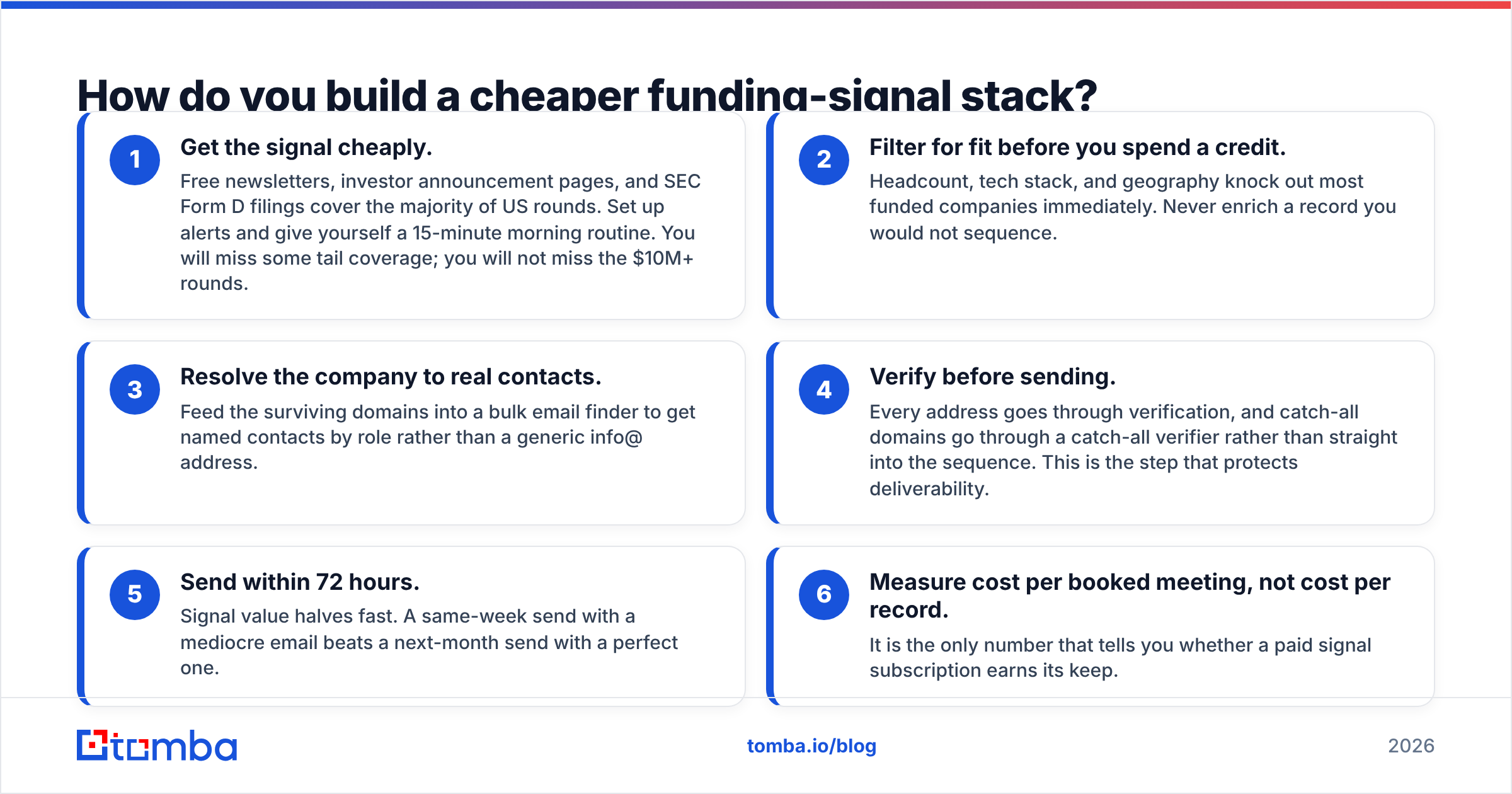
If the quote comes back higher than your outbound budget justifies, you can assemble roughly 80% of the value for a fraction of the cost. The trade is your time for their polish.
- Get the signal cheaply. Free newsletters, investor announcement pages, and SEC Form D filings cover the majority of US rounds. Set up alerts and give yourself a 15-minute morning routine. You will miss some tail coverage; you will not miss the $10M+ rounds.
- Filter for fit before you spend a credit. Headcount, tech stack, and geography knock out most funded companies immediately. Never enrich a record you would not sequence.
- Resolve the company to real contacts. Feed the surviving domains into a bulk email finder to get named contacts by role rather than a generic info@ address.
- Verify before sending. Every address goes through verification, and catch-all domains go through a catch-all verifier rather than straight into the sequence. This is the step that protects deliverability.
- Send within 72 hours. Signal value halves fast. A same-week send with a mediocre email beats a next-month send with a perfect one.
- Measure cost per booked meeting, not cost per record. It is the only number that tells you whether a paid signal subscription earns its keep.
Run that for a quarter and you will know exactly what a FundedIQ-class subscription is worth to you — because you will have a baseline to compare it against. Most teams find the paid tool is worth it once they are sending more than a few hundred triggered emails a month, and pure overhead below that.
What should you ask before signing?#
Five questions, in order of how much money they save you.
- What is the bounce rate on any bundled contact data, and is it contractual? If they will not put a number in writing, treat bundled contacts as leads to verify, not addresses to send to.
- What exactly counts against my quota? Views, exports, API calls, and syncs are sometimes all metered separately.
- What is your coverage in my top three geographies for rounds under $5M? Ask for a sample export, not a slide.
- Can I keep exported data after cancellation? Some data licences say no. Know before, not after.
- What is the month-to-month price? Even if you take the annual deal, knowing the premium tells you how confident they are in retention.
The verdict: is FundedIQ pricing worth it?#
Buy it if funding is the single strongest signal in your ICP and you can send within days of an announcement. In that scenario the subscription pays for itself on one deal, and the alternative — a human scanning news wires — is both slower and more expensive.
Skip it if funding is one signal among several, if your ICP includes bootstrapped or mature companies, or if you are still sending under a few hundred emails a month. Under those conditions you are paying a premium for a list you can approximate for free, and the money is better spent on the step that actually blocks revenue: getting a verified, deliverable address for the right person at each account.
That is the recurring lesson across every pricing review in this category. The signal is the cheap part. The contact is the expensive part. Price the whole chain, not the subscription line.
Start where the bottleneck is. Whatever signal source you land on, you still need a real inbox for a real buyer. Tomba's Email Finder turns a company domain and a name into a verified, confidence-scored work email, with 25 free searches a month to test against your own funded-company list before you commit. Paid plans start at $49/month — see full Tomba pricing — and every plan includes verification, so the addresses you send to are addresses that exist.
Related guides#
Ready to find emails that actually work?
Join 150,000+ professionals who stopped guessing and started sending. Free credits on signup — no credit card required.
Get the Tomba newsletter
Practical outbound tactics and product updates — once every two weeks.
About the author