Funny Cold Call Opening Lines That Actually Book Meetings
Humor buys you four extra seconds on a cold call — or ends it early. Here are the funny cold call opening lines that survive real dials in 2026, the ones that flop, and how to test them without torching your list.
TL;DR
- Humor works on cold calls because it breaks the pattern a prospect has already braced for — not because jokes are persuasive. The goal is disarming, not entertaining.
- The best funny cold call opening lines are self-aware ("I know I'm interrupting your day"), not comedic bits. Self-deprecation outperforms cleverness roughly every time.
- Humor is a permission device. It has to be followed within 10 seconds by a concrete, relevant reason for the call, or the call dies on the laugh.
- Never joke about the prospect, their company, their industry's problems, or anything you learned from a data provider. Punch at yourself and at the awkwardness of the call itself.
- A funny opener on a bad list still fails. If you're dialing wrong numbers or the wrong titles, connect rate — not wit — is your bottleneck.
Why do funny cold call opening lines work at all?#
Because your prospect answered the phone already knowing the script.
Think of a cold call like a door-to-door knock. Before the door opens, the person inside has decided how this goes: polite deflection, then hang up. They have heard "Hi, is this a bad time?" so many times it registers as noise. Humor works because it doesn't fit the script they preloaded. For a second or two, they have to actually process what you said instead of running the deflection routine.
That's the whole mechanism. You're not being funny to make them like you. You're being funny to buy four to eight seconds of genuine attention, which is enough time to say why you called.
The research backs the pattern-interrupt logic more than the comedy. Conversation-intelligence work from Gong has repeatedly shown that openers acknowledging the interruption outperform openers that pretend the call is expected. HubSpot's sales research reaches a similar place in its sales blog: the openers that survive are the ones that lower the prospect's defenses, not the ones that sound most polished.
So a "funny" cold call opener is really a category of honest opener. The laugh is a side effect of unusual candor.
What makes a cold call opener funny instead of cringe?#
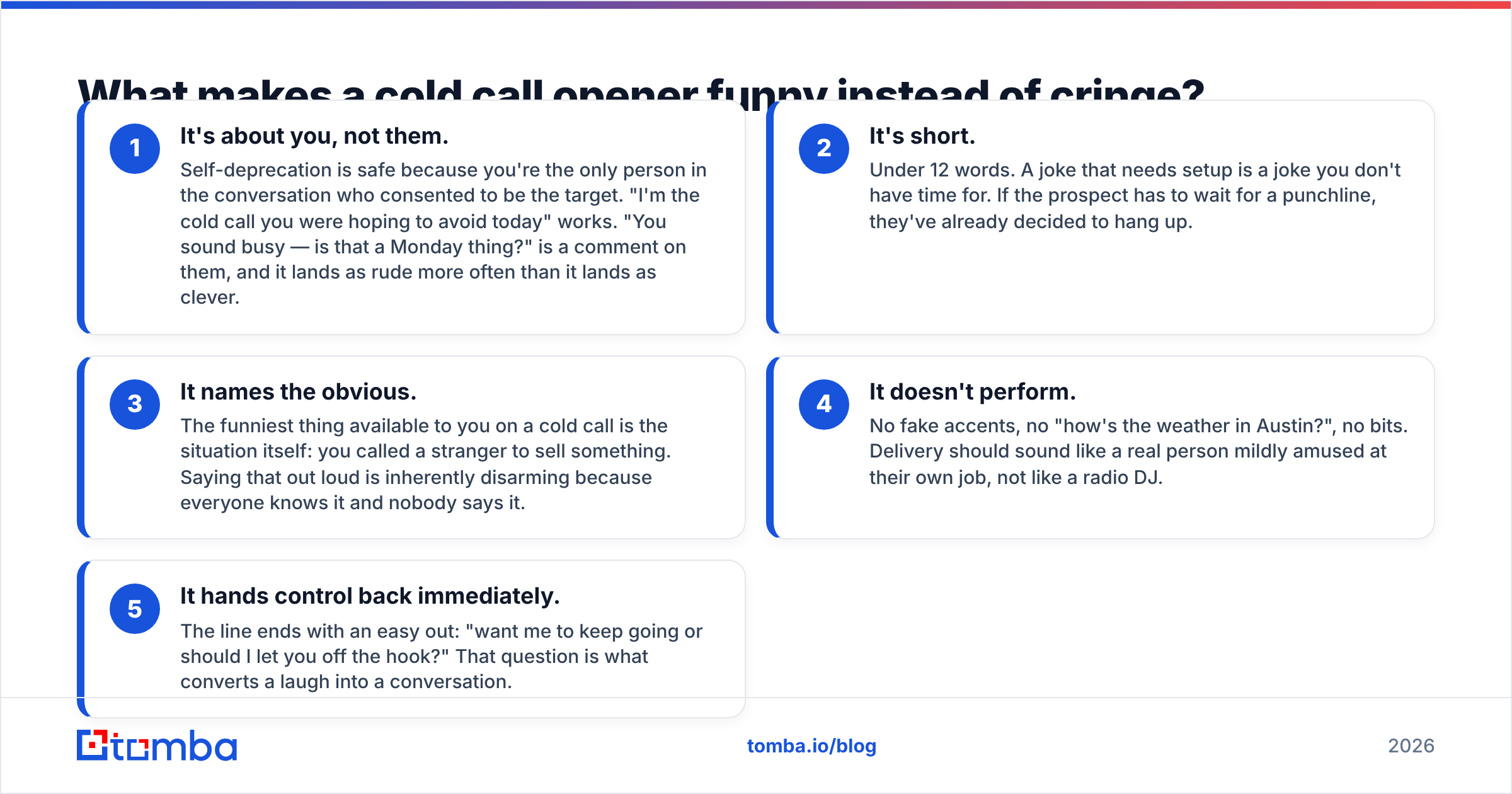
Five things separate an opener that earns a chuckle from one that earns a dial tone.
- It's about you, not them. Self-deprecation is safe because you're the only person in the conversation who consented to be the target. "I'm the cold call you were hoping to avoid today" works. "You sound busy — is that a Monday thing?" is a comment on them, and it lands as rude more often than it lands as clever.
- It's short. Under 12 words. A joke that needs setup is a joke you don't have time for. If the prospect has to wait for a punchline, they've already decided to hang up.
- It names the obvious. The funniest thing available to you on a cold call is the situation itself: you called a stranger to sell something. Saying that out loud is inherently disarming because everyone knows it and nobody says it.
- It doesn't perform. No fake accents, no "how's the weather in Austin?", no bits. Delivery should sound like a real person mildly amused at their own job, not like a radio DJ.
- It hands control back immediately. The line ends with an easy out: "want me to keep going or should I let you off the hook?" That question is what converts a laugh into a conversation.
If your opener fails any of these five, it isn't funny — it's a liability wearing a joke costume.
Which funny cold call opening lines actually work in 2026?#
Here are openers that hold up on real dials, grouped by what they do. Say them flat and fast. Tone carries more of the weight than wording.
The honest interruption
- "Hi [Name], this is a cold call. You can hang up, but you'd be curious for the rest of the day."
- "I'm going to be honest — this is a sales call. I'll make it the shortest one of your week."
- "This is one of those calls you didn't ask for. Thirty seconds and you'll know if it's worth it."
Why it works: naming the call as a cold call kills the prospect's main objection before they raise it. The mild dare in the first version ("you'd be curious") is what earns the laugh.
The self-deprecating open
- "You've probably already decided to say no. I'm calling anyway — that's the whole job."
- "I've been staring at your name on my screen for ten minutes working up to this."
- "Bad news: I'm a salesperson. Good news: I'm a fast one."
Why it works: it makes you a human doing an awkward job rather than a script executing itself.
The permission flip
- "I'll make this weirdly easy — say 'not interested' and I'll disappear forever."
- "Give me one 'no' and I'm gone. Give me twenty seconds and I might save you a headache."
Why it works: offering a guaranteed exit removes the reason to fight you. Most prospects who hear this stay on out of a mix of surprise and relief.
The absurd-specific
- "I rehearsed this in my car and forgot the whole thing — can I just tell you why I called?"
- "My manager bet me you'd hang up in five seconds. You're already at seven."
Why it works: it's an admission, so the prospect isn't the target. The manager-bet line is high-risk — it lands beautifully with sales leaders and startup founders, poorly with compliance, procurement, and clinical buyers.
The lines that reliably flop
- "Did I catch you at a bad time?" — not funny, and it hands them a scripted exit.
- "How are you today?" from a stranger — reads as fake warmth and triggers the deflection reflex.
- Anything referencing their LinkedIn post as a joke — comes off as surveillance.
- Puns on the company name. Every prospect has heard it. Yours will not be the good one.
How do humor openers compare to the standard cold call scripts?#
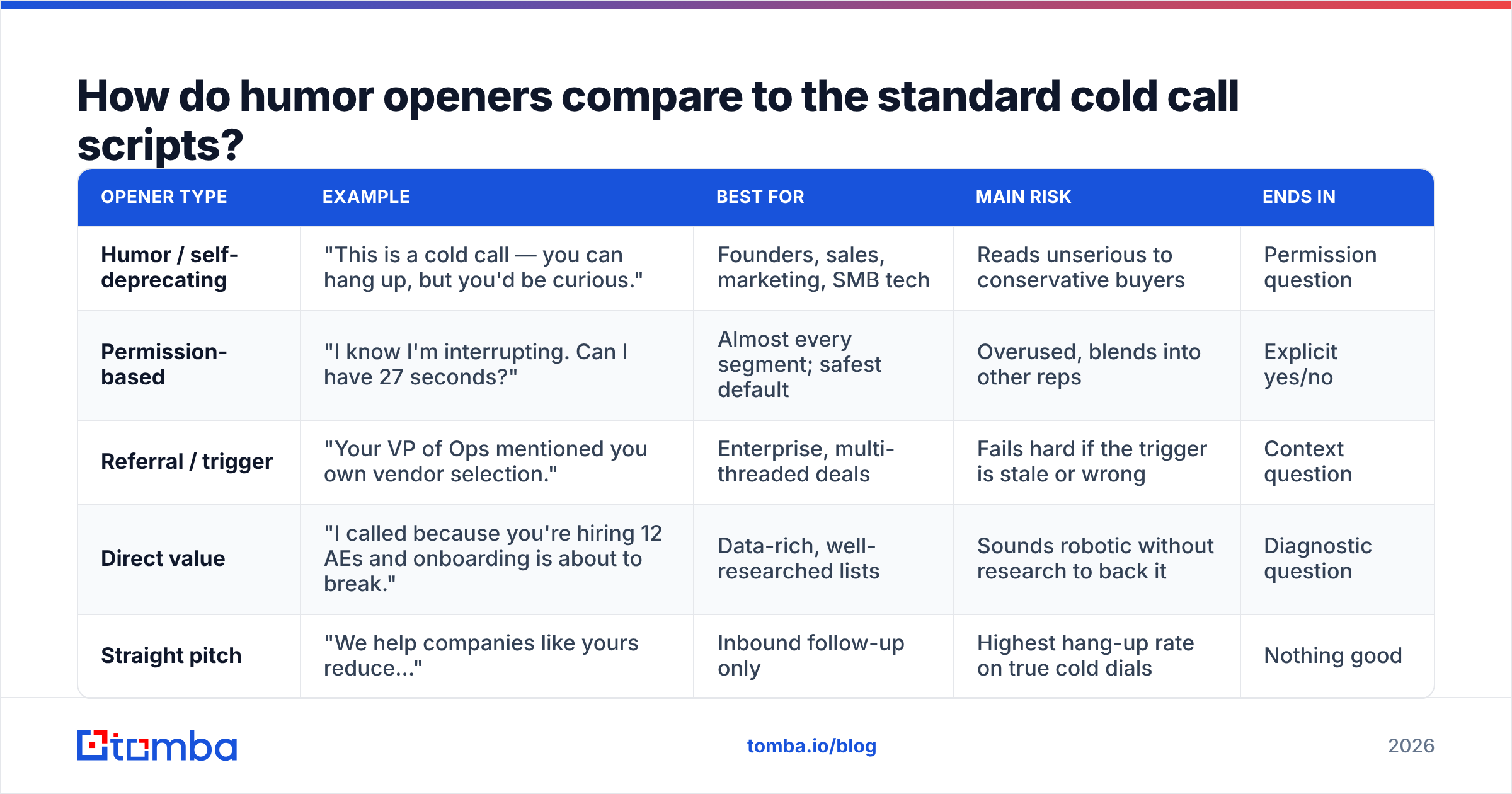
Humor is one tool. It isn't universally better than the alternatives — it's better in specific conditions. Here's an honest side-by-side of the four opener families most SDR teams actually run.
| Opener type | Example | Best for | Main risk | Ends in |
|---|---|---|---|---|
| Humor / self-deprecating | "This is a cold call — you can hang up, but you'd be curious." | Founders, sales, marketing, SMB tech | Reads unserious to conservative buyers | Permission question |
| Permission-based | "I know I'm interrupting. Can I have 27 seconds?" | Almost every segment; safest default | Overused, blends into other reps | Explicit yes/no |
| Referral / trigger | "Your VP of Ops mentioned you own vendor selection." | Enterprise, multi-threaded deals | Fails hard if the trigger is stale or wrong | Context question |
| Direct value | "I called because you're hiring 12 AEs and onboarding is about to break." | Data-rich, well-researched lists | Sounds robotic without research to back it | Diagnostic question |
| Straight pitch | "We help companies like yours reduce..." | Inbound follow-up only | Highest hang-up rate on true cold dials | Nothing good |
The practical read: humor and permission-based openers do the same job (lower defenses), but humor also makes you memorable, which matters when you're calling into a market where six other vendors are dialing the same list this quarter. Trigger-based openers beat both — when your data is accurate. Which is the catch.
Does the joke matter more than the list?#
No. Not close.
A funny opener changes what happens after someone picks up. It does nothing about whether the right person picks up at all. If half your numbers route to a switchboard, a former employee, or a disconnected line, you are optimizing the wrong variable — like perfecting a dinner recipe for guests who never got the address.
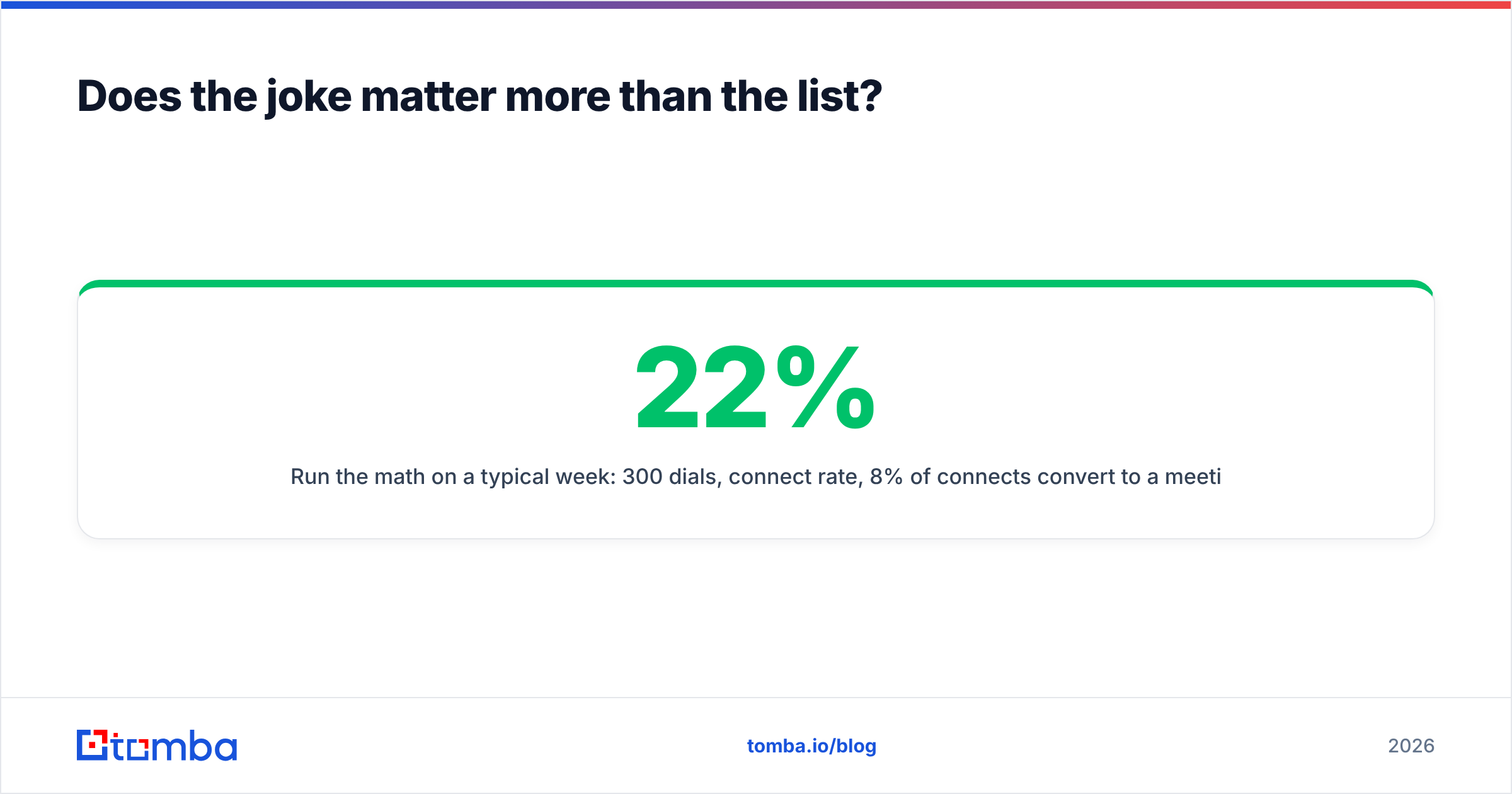
Run the math on a typical week: 300 dials, 22% connect rate, 8% of connects convert to a meeting. That's roughly five meetings. Improve the opener and you might push conversion from 8% to 11% — one extra meeting. Improve the connect rate from 22% to 34% by fixing number accuracy and title targeting, and you get roughly three extra meetings from the same dials. The data fix wins, and it compounds every week.
That's why the sequence matters more than the script:
- Source direct numbers, not switchboards. A verified mobile or direct dial is the difference between a conversation and a gatekeeper. A phone finder that returns direct lines by name and company removes most of the wasted dialing.
- Validate before you dial. Disconnected and reassigned numbers waste time and hurt your dialer stats. Running a list through a phone validator first strips the dead weight.
- Enrich for relevance. Knowing headcount, hiring signals, and tech stack lets you follow a humor opener with something specific. Data enrichment is what turns a joke into a reason.
- Track the right metric. Not dials. Not talk time. Connect-to-meeting conversion, segmented by opener. Your response rate across channels tells you whether the problem is the list or the line.
Vendors differ on where they're strongest — some, like BookYourData, focus on verified contact records at list scale, while others lean on API-first workflows. Check current standings on G2 before you commit budget; the accuracy gap between providers is wider than the pricing gap.
When should you skip humor entirely?#
Four situations where the joke costs you the deal.
Regulated and high-stakes buyers. Healthcare compliance, financial services risk, legal, and public sector procurement all have buyers trained to treat levity as a credibility signal — a negative one. Use permission-based openers there.
When the trigger event is bad news. If you're calling because of a layoff, a breach, an outage, or a bad quarter, humor reads as gloating. Be direct and useful instead.
Senior enterprise buyers you were referred to. A referral is already social proof. Spending it on a joke wastes the strongest asset you have. Lead with the referrer's name.
When you can't deliver it flat. If you have to psych yourself up to say the line, it will sound rehearsed, and rehearsed humor is the worst version. Say it the way you'd say it to a colleague, or don't say it.
How do you land the eight seconds after the laugh?#
This is where most funny openers die. The prospect chuckles, you get flustered, and you fall back into the pitch you were trying to avoid.
Structure the whole thing as three beats, no more than 20 seconds total:
- Disarm (4 seconds): "Hi Dana, this is a cold call — I'll be quick about it."
- Reason (8 seconds): One specific, checkable observation. "You're running an outbound team of nine and posted three SDR roles this month." Not a value prop. An observation.
- Ask (3 seconds): One low-commitment question. "Is ramp time actually the problem, or is it something else?"
Then stop talking. The silence after beat three does more work than anything you said before it.
If they say "not interested," take it. Thank them, hang up, and log it. Fighting a no immediately after a joke turns you from a human into a telemarketer, and you lose the goodwill the opener bought.
How do you test funny openers without burning your list?#
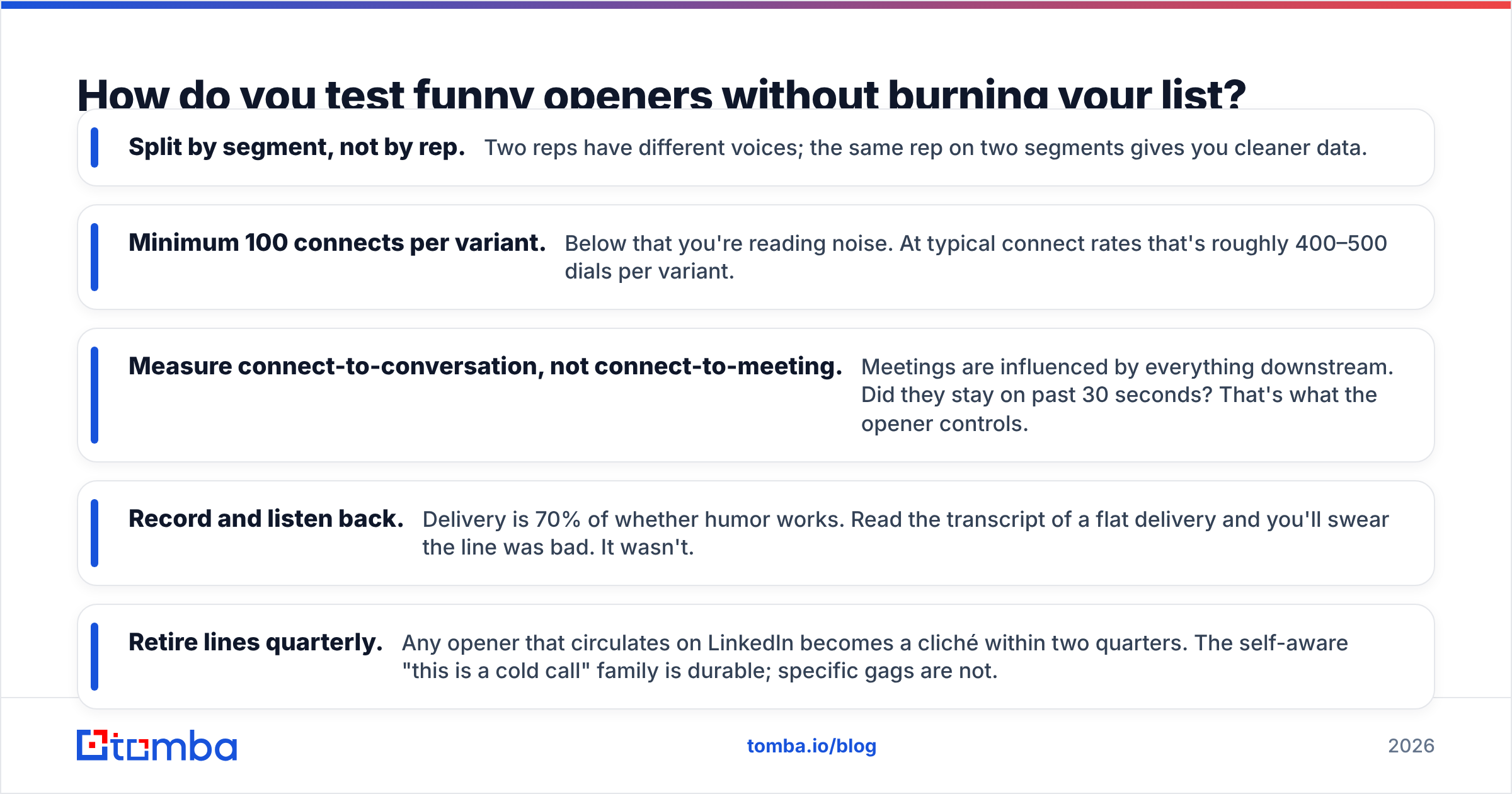
Treat openers like subject lines: rotate deliberately, measure narrowly, and never test more than one variable at a time.
- Split by segment, not by rep. Two reps have different voices; the same rep on two segments gives you cleaner data.
- Minimum 100 connects per variant. Below that you're reading noise. At typical connect rates that's roughly 400–500 dials per variant.
- Measure connect-to-conversation, not connect-to-meeting. Meetings are influenced by everything downstream. Did they stay on past 30 seconds? That's what the opener controls.
- Record and listen back. Delivery is 70% of whether humor works. Read the transcript of a flat delivery and you'll swear the line was bad. It wasn't.
- Retire lines quarterly. Any opener that circulates on LinkedIn becomes a cliché within two quarters. The self-aware "this is a cold call" family is durable; specific gags are not.
Keep a shared doc of what's working per persona. The best-performing line for a CFO will almost never be the best-performing line for a VP of Engineering, and teams that treat "the opener" as one universal script leave meetings on the table.
What should you do next?#
Pick two humor openers from the honest-interruption and self-deprecating families, run them for a week against your standard permission-based control, and only judge them on whether prospects stayed past 30 seconds. That's a clean, cheap test you can finish before the end of a sprint.
Then fix the part that actually caps your output. Most cold-calling teams are gated by list quality, not by charm — wrong numbers, stale titles, and contacts who left twelve months ago. Build your call list on verified contact data first: use the Tomba Email Finder to confirm you have the right person at the right company before you dial, pair it with direct-dial lookup, and follow every unanswered call with an email to the verified address instead of a fourth voicemail. Tomba's free tier covers 25 searches a month so you can test your own segment before paying anything; paid plans start at $49/mo, with full Tomba pricing published up front. Get the list right, and a decent opener is more than enough.
Related guides#
Ready to find emails that actually work?
Join 150,000+ professionals who stopped guessing and started sending. Free credits on signup — no credit card required.
Get the Tomba newsletter
Practical outbound tactics and product updates — once every two weeks.
About the author