Funny Sales Pitch: How Humor Actually Closes B2B Deals
Humor lifts reply rates when it earns the joke — and tanks deals when it doesn't. Here's what actually works in a funny sales pitch in 2026, with real scripts, a risk table, and the lines to never send.
TL;DR
- A funny sales pitch works when the humor is about the buyer's problem, not about you being clever. Self-aware, low-risk humor lifts reply rates; puns and meme walls mostly don't.
- Humor is a multiplier, not a fix. It amplifies whatever relevance you already have — including zero.
- The highest-ROI joke in cold outreach is usually a single line acknowledging that you're a stranger in their inbox. Everything else is optional.
- Seniority, industry, and channel change the safe zone. What kills on LinkedIn dies in a procurement email at a regulated bank.
- Nothing sinks a funny pitch faster than a wrong name, a wrong company, or a bounced send. Clean data is the setup; the joke is only the punchline.
What Is a Funny Sales Pitch, Really?#
A funny sales pitch is a pitch that uses humor to buy attention it hasn't earned yet — and then spends that attention on something useful. That second half is where most reps fail.
Think of humor like the free sample table at a grocery store. The sample gets you to stop walking. It does not, on its own, make you buy the cheese. If the cheese is bad, the sample just means more people find out faster.
In practice, "funny" in B2B sales splits into four very different things, and they carry wildly different risk:
- Self-deprecating humor — you joke about your own position ("I know a cold email from a vendor is the highlight of nobody's Tuesday"). Lowest risk, highest reliability. It signals self-awareness, which reads as respect.
- Situational/observational humor — you joke about a shared industry absurdity ("your CRM has 14 fields called 'Status' and nobody knows which one is real"). Medium risk, highest payoff when your research is right.
- Pattern-interrupt humor — you break the expected format (a two-line email, a weirdly honest subject line, a P.S. that undercuts the whole pitch). Medium risk, scales well.
- Comedic bits and puns — GIFs, wordplay, elaborate premises. Highest risk, lowest reliability, and the most likely to read as junior.
The ranking above isn't a matter of taste. It maps to how much context each type requires from the recipient. Self-deprecation needs none. A pun about their product category needs them to already care.
Does Humor Actually Improve Reply Rates?#
Directionally yes — conditionally. The honest version of the evidence: humor correlates with better engagement in outreach when it's paired with relevance, and correlates with worse outcomes when it substitutes for relevance.
Here's the mechanism, and it's not mysterious. Your prospect is running a two-second triage on every email: is this a human who knows something about me, or a template? Humor is one of the few signals a template can't cheaply fake. A generic "Hope this finds you well" is free to mass-produce. A joke about the specific pain of migrating off a legacy billing system is not.
That's also why humor decays fast once it's copied. The "Are you dead? / Did you fall into a well?" breakup email crushed in 2019 and now reads like a stock photo. Any joke that gets into a top-10 listicle has roughly 18 months before it becomes a negative signal.
What holds up over time:
- Specificity over cleverness. "Your careers page has 9 open SDR roles and one recruiter" beats any pun.
- Brevity as the joke. A 40-word email in a sea of 250-word ones is itself a pattern interrupt.
- Honesty as the joke. "This is a sales email. I'll make it a short one" outperforms elaborate setups more often than reps expect.
- Timing over content. A light joke in a follow-up after they've already replied lands far better than one in a first touch.
HubSpot's research library on sales email performance is a decent public baseline for benchmark reply rates before you start attributing lift to your jokes. Measure against your own control group, not against a blog post.
Which Humor Styles Work Where?#
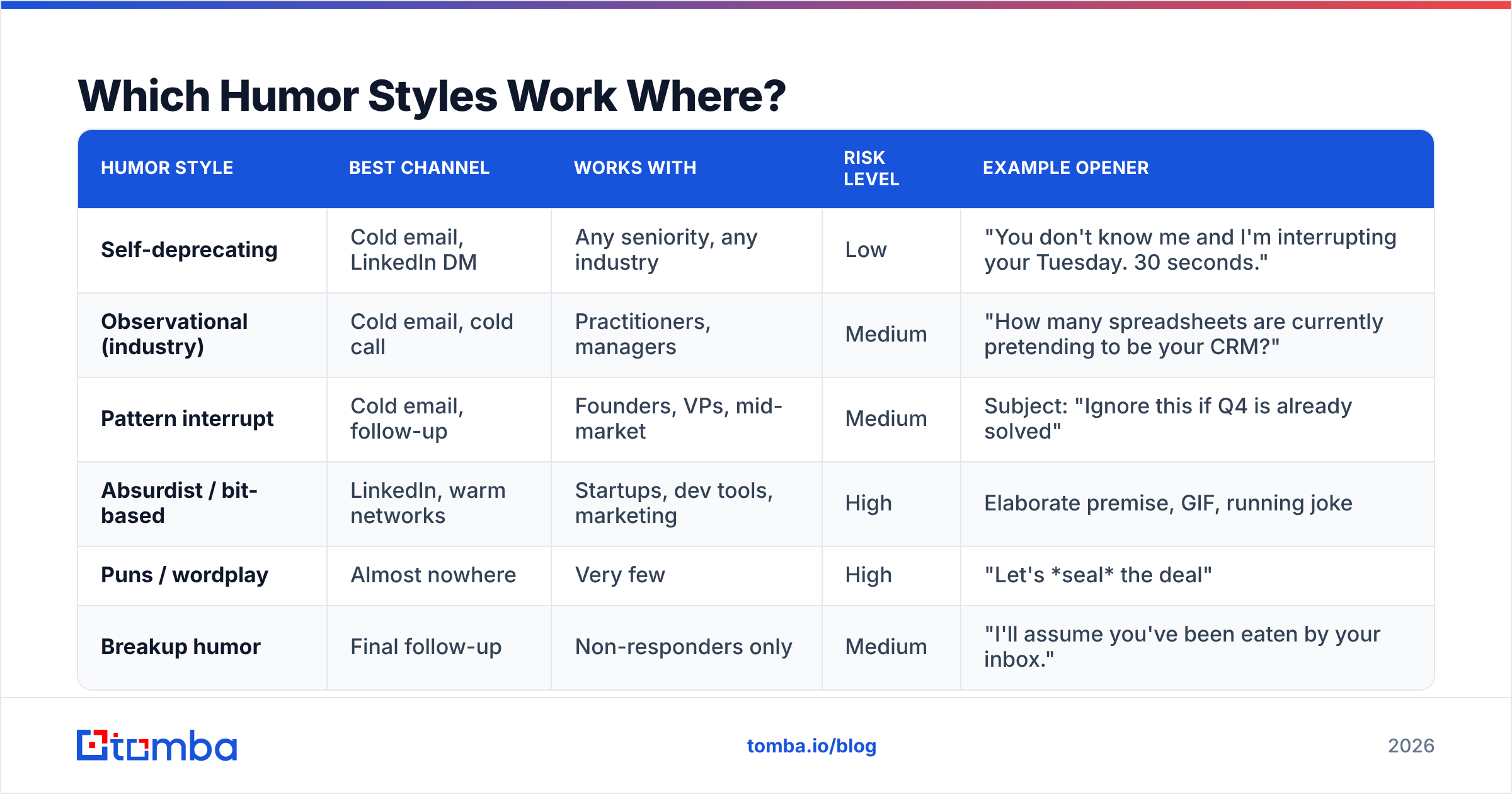
Channel and audience change everything. The same line that gets a laugh in a LinkedIn DM to a startup founder gets forwarded to compliance at an insurance carrier.
| Humor style | Best channel | Works with | Risk level | Example opener |
|---|---|---|---|---|
| Self-deprecating | Cold email, LinkedIn DM | Any seniority, any industry | Low | "You don't know me and I'm interrupting your Tuesday. 30 seconds." |
| Observational (industry) | Cold email, cold call | Practitioners, managers | Medium | "How many spreadsheets are currently pretending to be your CRM?" |
| Pattern interrupt | Cold email, follow-up | Founders, VPs, mid-market | Medium | Subject: "Ignore this if Q4 is already solved" |
| Absurdist / bit-based | LinkedIn, warm networks | Startups, dev tools, marketing | High | Elaborate premise, GIF, running joke |
| Puns / wordplay | Almost nowhere | Very few | High | "Let's seal the deal" |
| Breakup humor | Final follow-up | Non-responders only | Medium | "I'll assume you've been eaten by your inbox." |
Two rules that fall out of this table:
Seniority inverts risk. A CEO of a 20-person startup will laugh at a bit. A VP of Procurement at a Fortune 500 will not — not because they lack humor, but because their inbox is a compliance surface. The more the buyer's job involves risk management, the drier your humor should be.
Regulated industries have a hard ceiling. Healthcare, financial services, government, defense. Keep it to dry understatement and short sentences. The joke is that you respect their time.
What Does a Funny Sales Pitch Look Like in Practice?#
Here are three that work, annotated.
1. The honest cold open (low risk, works everywhere)
Subject: a sales email, but short
Hi Maya — this is exactly what it looks like. I'm at [Company], we help RevOps teams stop paying for three overlapping data tools.
Two questions and I'll go away:
- Are you still running enrichment through two vendors?
- Is that a "someday" problem or a Q3 problem?
— Ben
The humor is entirely in the frame. No jokes, no GIFs, and it will outperform 90% of clever emails because it respects the reader's intelligence.
2. The specific observation (medium risk, high payoff)
Subject: your pricing page has a maze in it
Hi Tom — I counted four different paths from your pricing page to "Contact Sales" and three of them go to the same form. Someone's A/B test escaped containment.
Unrelated: we help B2B SaaS teams route inbound demo requests to the right rep in under 60 seconds. Worth 15 minutes?
This only works because it's true and it took two minutes of actual research. Fabricate the observation and the whole email collapses.
3. The breakup (medium risk, final touch only)
Subject: closing the loop
Hi Sam — I've sent three emails, which by my count is one more than socially acceptable. I'll take the hint gracefully.
If this becomes relevant in Q4, reply "Q4" and I'll disappear until then.
The self-aware count is the joke. It also gives a one-word reply option, which is why breakup emails have historically strong reply rates.
What Are the Five Ways a Funny Pitch Fails?#
Every failure mode I've seen falls into one of these buckets:
- The joke is about you, not them. "I'm not like other sales reps 😎" is a joke you enjoy and they don't. If the punchline requires them to care about your personality, it fails.
- Humor covering a relevance gap. If you can't articulate why you're contacting this person at this company, no joke fixes it. Humor amplifies signal; it doesn't create it.
- Volume kills the bit. A joke sent to 5,000 people gets screenshotted and shared as a bad-outreach example. Humor is inherently a low-volume, high-research play.
- Punching at the prospect. Any joke that implies their current setup is stupid, their team is behind, or their vendor is a joke — dead on arrival. Mock the situation, never the person.
- Wrong name, wrong company, bounced send. The single most common humor-killer, and it has nothing to do with comedy.
That last one deserves its own section, because it's the failure reps least expect.

Why Does Bad Data Kill Good Jokes?#
Because humor raises the stakes on accuracy. A boring, generic email that says "Hi there" is forgettable when it lands wrong. A carefully crafted joke addressed to "Hi Micheal" at the wrong company is memorable — in the way that gets you blocked.
Think of it like a comedian getting a heckler's name wrong mid-roast. The entire bit collapses, and the room turns.
Three data problems that specifically break funny pitches:
- Name errors. Personalized humor requires a correct first name. Nickname mismatches ("Bob" vs "Robert") are survivable; misspellings are not.
- Stale role data. Joking about someone's job when they changed roles four months ago tells them you scraped a list.
- Bounces. A humor-led campaign with a 12% bounce rate isn't just wasting sends — it's damaging sender reputation, which means your good emails stop arriving too.
The fix is unglamorous: verify before you send. Running your list through an email verifier and confirming addresses via domain search costs minutes and protects both the joke and the domain. If you're sourcing contacts at volume, a bulk email finder with built-in verification keeps the setup clean before the punchline ever ships.
There's a broader point here about outbound in 2026: the deliverability environment has tightened. Google and Yahoo's bulk-sender requirements mean spam complaints and unverified sends carry real cost. A funny email that never reaches the inbox is a tree falling in an empty forest.
How Do You Test Humor Without Torching Your Pipeline?#
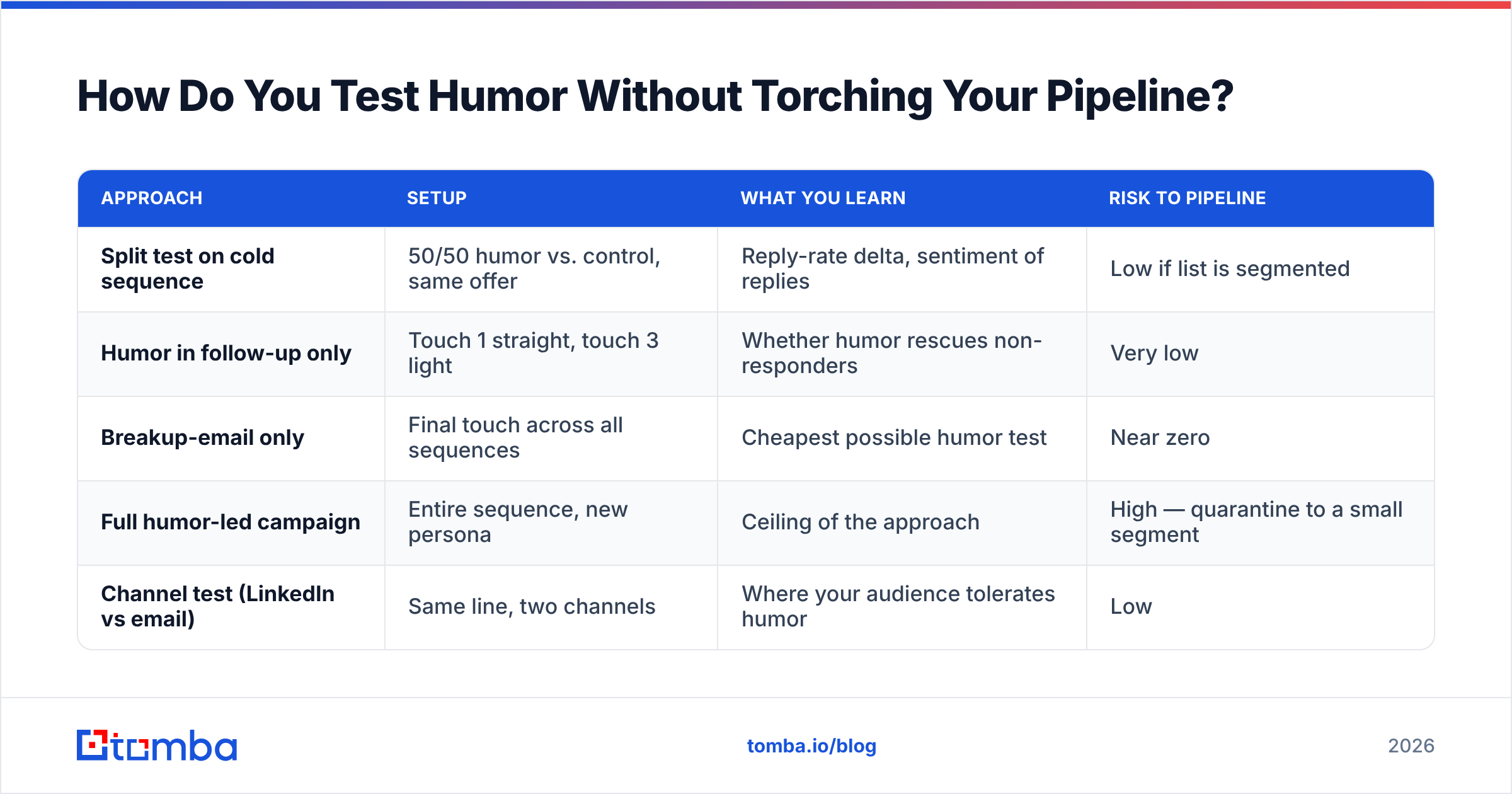
Treat it as an experiment, not a personality change.
| Approach | Setup | What you learn | Risk to pipeline |
|---|---|---|---|
| Split test on cold sequence | 50/50 humor vs. control, same offer | Reply-rate delta, sentiment of replies | Low if list is segmented |
| Humor in follow-up only | Touch 1 straight, touch 3 light | Whether humor rescues non-responders | Very low |
| Breakup-email only | Final touch across all sequences | Cheapest possible humor test | Near zero |
| Full humor-led campaign | Entire sequence, new persona | Ceiling of the approach | High — quarantine to a small segment |
| Channel test (LinkedIn vs email) | Same line, two channels | Where your audience tolerates humor | Low |
Judge on positive reply rate, not open rate. Funny subject lines inflate opens and can depress replies — the email gets opened out of curiosity and then disappoints. If your humor lifts opens by 20% and replies by 0%, the joke is working on the wrong metric.
Also read the texture of the replies. Humor that works produces replies that are themselves a little funny. That's the strongest signal you'll get: you've moved from vendor to person. Watch your response rate over a full sequence rather than a single send, since humor tends to shift where in the sequence people engage.
One more guardrail: get a second reader. Every joke is funnier to its author. If a teammate has to have it explained, cut it. Vendor communities on G2 and peer Slack groups are full of reps who'll tell you honestly whether a line lands — use them before your prospects do.
Is Humor Worth It Compared to Straight Outreach?#
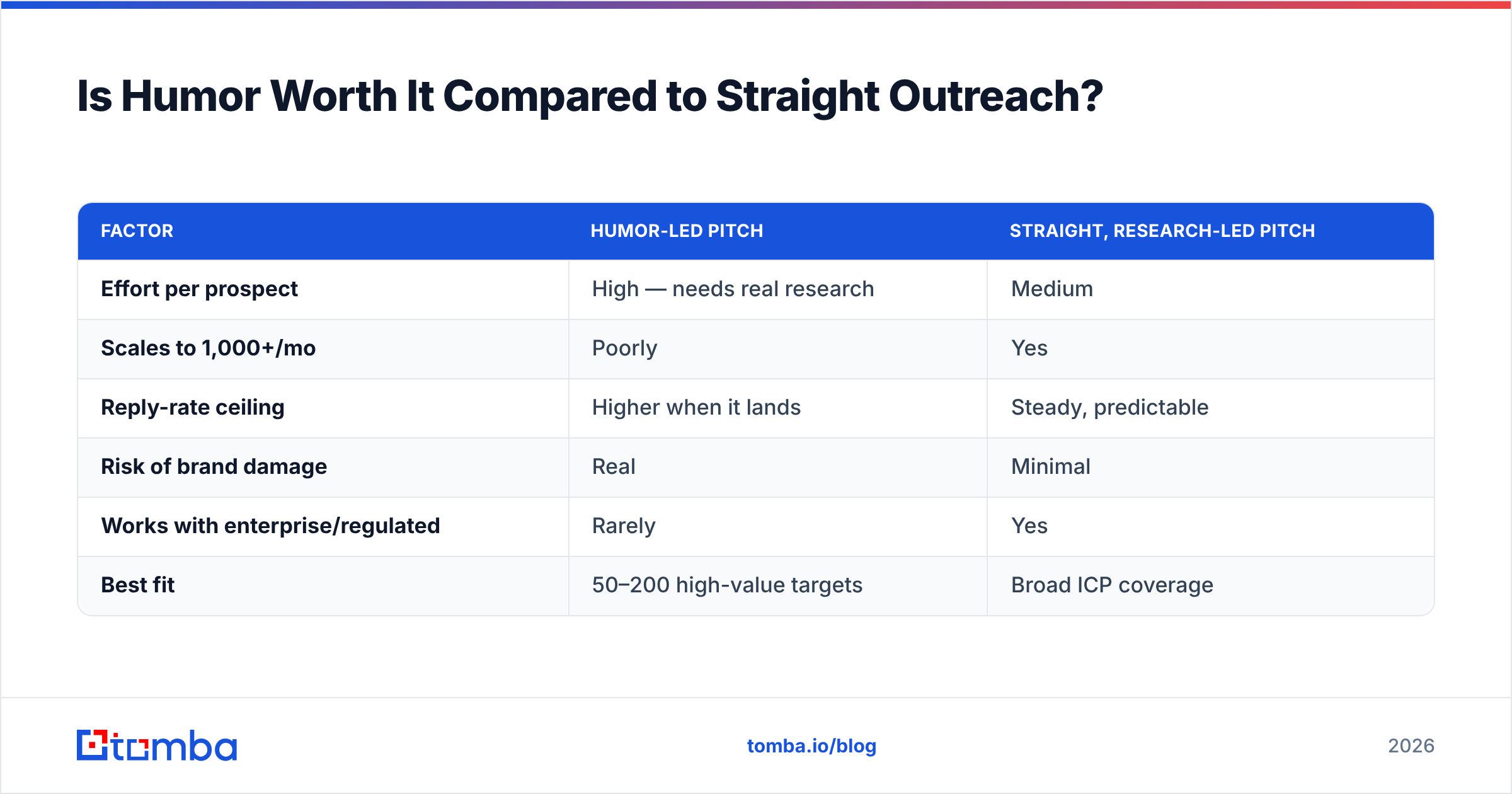
For most teams, the answer is: use humor as seasoning on a well-researched pitch, not as the pitch itself.
| Factor | Humor-led pitch | Straight, research-led pitch |
|---|---|---|
| Effort per prospect | High — needs real research | Medium |
| Scales to 1,000+/mo | Poorly | Yes |
| Reply-rate ceiling | Higher when it lands | Steady, predictable |
| Risk of brand damage | Real | Minimal |
| Works with enterprise/regulated | Rarely | Yes |
| Best fit | 50–200 high-value targets | Broad ICP coverage |
The practical synthesis most good outbound teams land on: run straight, tight, well-targeted messaging as the baseline, and reserve humor for two places — your tier-1 account list where per-prospect research is justified, and your breakup emails where you have nothing left to lose.
That's not a compromise. It's recognizing that humor's cost is research time, and research time is your scarcest resource.
What Should You Do Next?#
Start with the boring half. Before you write a single joke:
- Verify the list. Correct names, current roles, deliverable addresses.
- Write the straight version first. If the pitch doesn't work without the joke, the joke won't save it.
- Add one line of humor. One. Usually self-aware, usually near the top.
- Show it to a colleague. If they don't smile in two seconds, cut it.
- Measure positive replies, not opens. Over a full sequence, not one send.
The teams that win with a funny sales pitch aren't funnier than everyone else. They just did enough homework that they'd earned the right to be casual.
And if step one is where you're stuck — if your list is full of guessed addresses and stale titles — fix that before you write another word of copy. The Tomba Email Finder pulls verified professional emails by name, company, or domain, with a free tier of 25 searches a month and paid plans starting at $49/mo (see Tomba pricing for Growth at $99/mo and Pro at $249/mo). Get the names right, and your jokes get a fair hearing.
Related guides#
Ready to find emails that actually work?
Join 150,000+ professionals who stopped guessing and started sending. Free credits on signup — no credit card required.
Get the Tomba newsletter
Practical outbound tactics and product updates — once every two weeks.
About the author