The Future of Sales in 2026: 9 Shifts That Actually Matter
AI agents write the emails, buyers self-serve 70% of the journey, and headcount is flat. Here's what the future of sales actually looks like in 2026 — and which predictions already failed.
TL;DR
- The future of sales is not "AI replaces reps." It's a smaller, better-paid rep population sitting on top of an automation layer that handles research, sequencing, and CRM hygiene.
- Volume outbound is dead as a differentiator. Every competitor has the same AI writer, so the moat moved to data quality and timing, not word count.
- Buyers now complete most of their evaluation before they talk to you. Your job shifts from explaining the product to de-risking the decision.
- Compensation, team structure, and tooling budgets are all consolidating: fewer seats, higher spend per seat, more API-level usage.
- The three skills that hold value through 2030: judgment on which accounts to work, technical fluency with your own stack, and multi-threading a committee of 6–11 people.
What does "the future of sales" actually mean in 2026?#
Start with the conclusion: selling did not get automated away, it got compressed. The same pipeline number is being produced by fewer humans, more software, and a much shorter list of accounts.
Think of it like commercial aviation. Autopilot did not remove pilots — it removed the flight engineer, the navigator, and the radio operator, then raised the bar for the two people still in the cockpit. B2B sales is going through the same seat reduction. The prospector, the researcher, the note-taker, and the CRM updater are being absorbed into software. The person who reads the room and closes the deal is not.
The measurable version of that story looks like this:
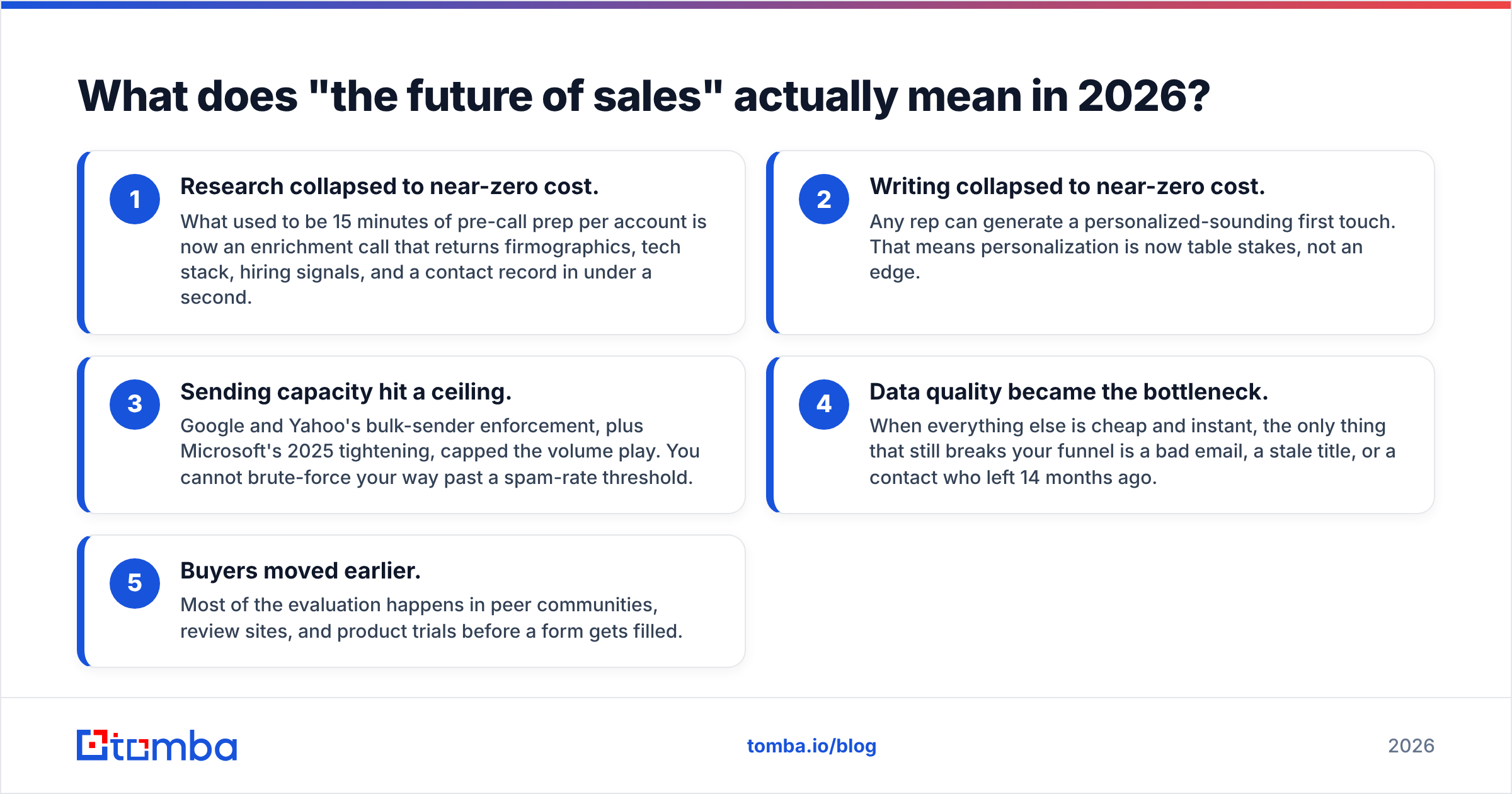
- Research collapsed to near-zero cost. What used to be 15 minutes of pre-call prep per account is now an enrichment call that returns firmographics, tech stack, hiring signals, and a contact record in under a second.
- Writing collapsed to near-zero cost. Any rep can generate a personalized-sounding first touch. That means personalization is now table stakes, not an edge.
- Sending capacity hit a ceiling. Google and Yahoo's bulk-sender enforcement, plus Microsoft's 2025 tightening, capped the volume play. You cannot brute-force your way past a spam-rate threshold.
- Data quality became the bottleneck. When everything else is cheap and instant, the only thing that still breaks your funnel is a bad email, a stale title, or a contact who left 14 months ago.
- Buyers moved earlier. Most of the evaluation happens in peer communities, review sites, and product trials before a form gets filled.
That last point is the one most teams under-price. Gartner's sales research has tracked the shrinking share of the buying journey spent with any supplier rep for years, and the direction has not reversed.
How is the sales team structure changing?#
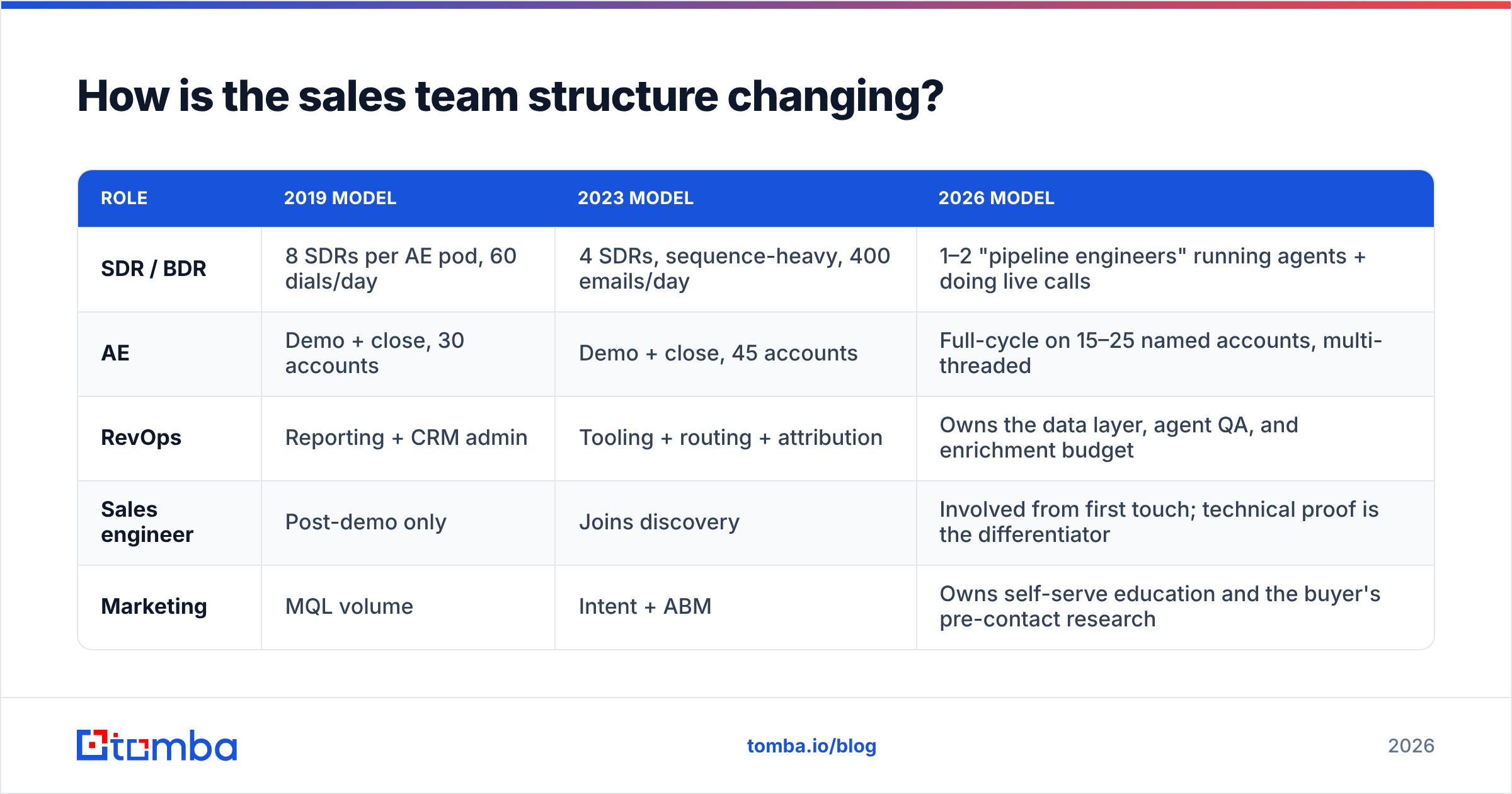
The classic Predictable Revenue split — SDR books, AE closes, CSM renews — is being replaced by a barbell. On one end: a thin layer of high-context sellers. On the other: an automation layer owned by RevOps. The middle-tier "human dialer" role is what disappears.
| Role | 2019 model | 2023 model | 2026 model |
|---|---|---|---|
| SDR / BDR | 8 SDRs per AE pod, 60 dials/day | 4 SDRs, sequence-heavy, 400 emails/day | 1–2 "pipeline engineers" running agents + doing live calls |
| AE | Demo + close, 30 accounts | Demo + close, 45 accounts | Full-cycle on 15–25 named accounts, multi-threaded |
| RevOps | Reporting + CRM admin | Tooling + routing + attribution | Owns the data layer, agent QA, and enrichment budget |
| Sales engineer | Post-demo only | Joins discovery | Involved from first touch; technical proof is the differentiator |
| Marketing | MQL volume | Intent + ABM | Owns self-serve education and the buyer's pre-contact research |
Two consequences follow from that table.
First, the entry-level pipeline into sales careers is narrowing. If you remove the SDR seat, you remove the apprenticeship that produced AEs. Teams that solve this — structured ramp, shadowing, deliberate rotation — will have a hiring cost advantage in three years. Teams that don't will pay 30% premiums for experienced closers forever.
Second, RevOps stops being a support function. When the difference between a 2% and an 8% reply rate is contact-data freshness, the person who owns revenue operations owns the number as directly as any rep does.
Is AI actually replacing sales reps?#
No — but it is replacing sales tasks, and enough tasks add up to a headcount line.
Here is the honest split based on what teams are shipping today:
- Fully automated now: contact discovery, email verification, CRM field updates, call transcription and summarization, meeting scheduling, basic sequence drafting, list building, deduplication.
- Human-in-the-loop: account selection, first-touch messaging on strategic accounts, objection handling scripts, pricing exceptions, forecast calls.
- Still stubbornly human: multi-threading a buying committee, reading political dynamics, negotiating non-standard terms, recovering a deal after a champion leaves, saying "you shouldn't buy this."
The failure mode is teams that automate category one and category two at the same time. AI-generated outbound at high volume produces the exact pattern spam filters were built to catch: near-identical structure, high send rate, low engagement. You get the efficiency on paper and lose deliverability in practice.
A more durable pattern: let agents handle the research and the enrichment, then have a human write the first 40 words. Those 40 words are where the reply rate lives.
What AI genuinely changed about prospecting#
- Signal detection at scale. Job changes, funding rounds, tech-stack swaps, and hiring spikes can now be monitored across thousands of accounts continuously rather than sampled quarterly.
- Instant account briefs. A rep walks into a call knowing the org chart, the last three product launches, and who else at the account has engaged.
- Cheap experimentation. You can test six positioning angles in a week instead of a quarter, provided your sample sizes are honest.
- Data decay handling. Contact records rot at roughly 25–30% per year. Continuous re-verification is now a background job, not a spring-cleaning project.
That last item is why data enrichment moved from a nice-to-have to a line item RevOps defends in budget reviews.
Why does data quality decide who wins?#
Because every other advantage got commoditized.
Your competitor has the same LLM, the same sequencer, the same intent vendor, and probably the same list of accounts. What they may not have is a contact database that is actually current. When two teams email the same VP of Engineering in the same week, the one whose email lands in the inbox — correct address, verified, warm domain, sane volume — wins by default.
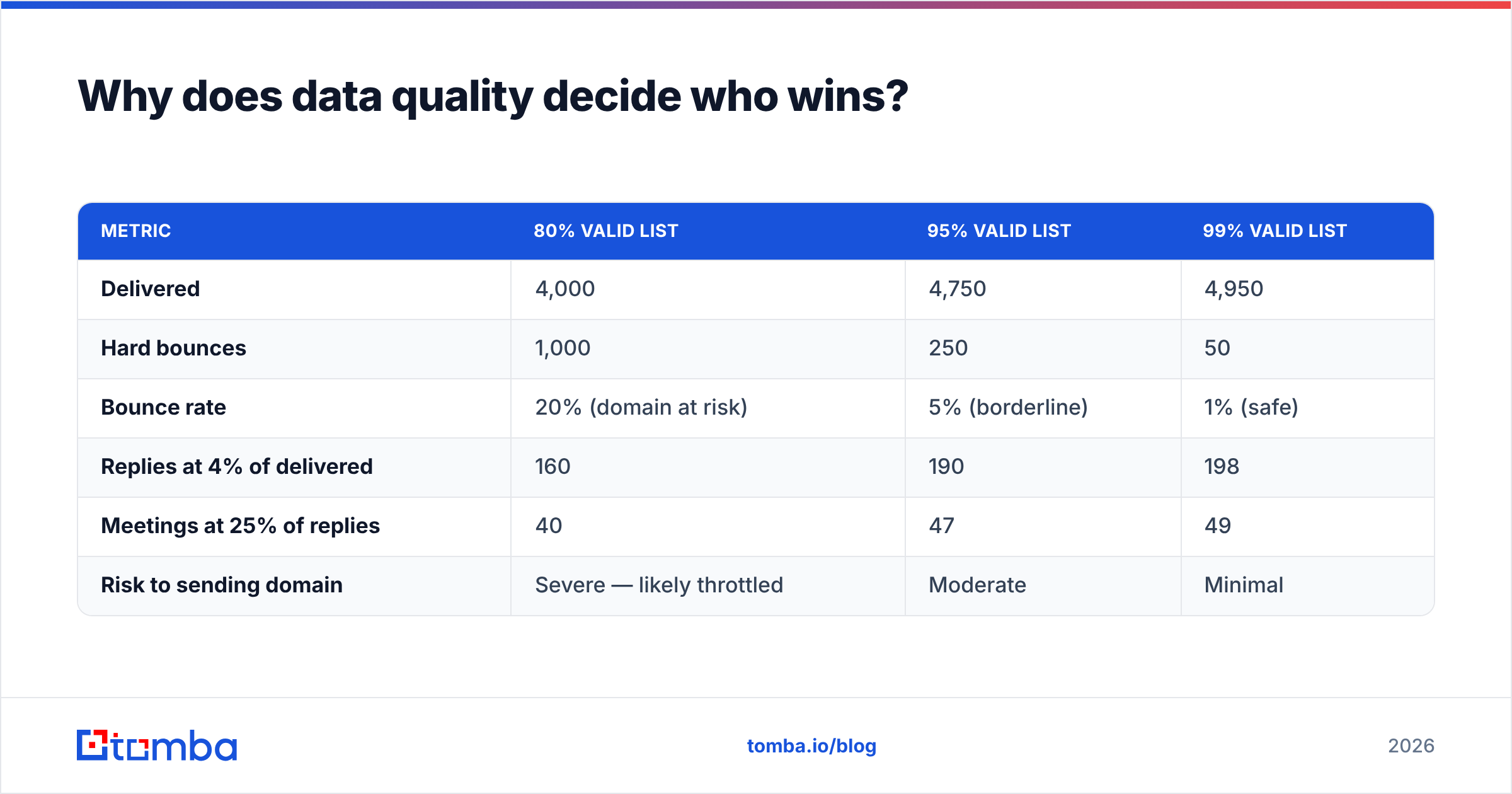
Run the arithmetic on a 5,000-contact campaign:
| Metric | 80% valid list | 95% valid list | 99% valid list |
|---|---|---|---|
| Delivered | 4,000 | 4,750 | 4,950 |
| Hard bounces | 1,000 | 250 | 50 |
| Bounce rate | 20% (domain at risk) | 5% (borderline) | 1% (safe) |
| Replies at 4% of delivered | 160 | 190 | 198 |
| Meetings at 25% of replies | 40 | 47 | 49 |
| Risk to sending domain | Severe — likely throttled | Moderate | Minimal |
The reply-count difference looks modest. The domain risk difference is not. A 20% bounce rate does not cost you 38 meetings once; it costs you the ability to send from that domain for months. That asymmetry is why teams that used to buy the cheapest list now run verification as a gate on every import.
Practically, that means three checks before anything enters a sequence: syntax and MX validity, mailbox existence, and catch-all handling. A catch-all verifier matters more than most teams expect, because catch-all domains are exactly where cheap providers hide their guesses.
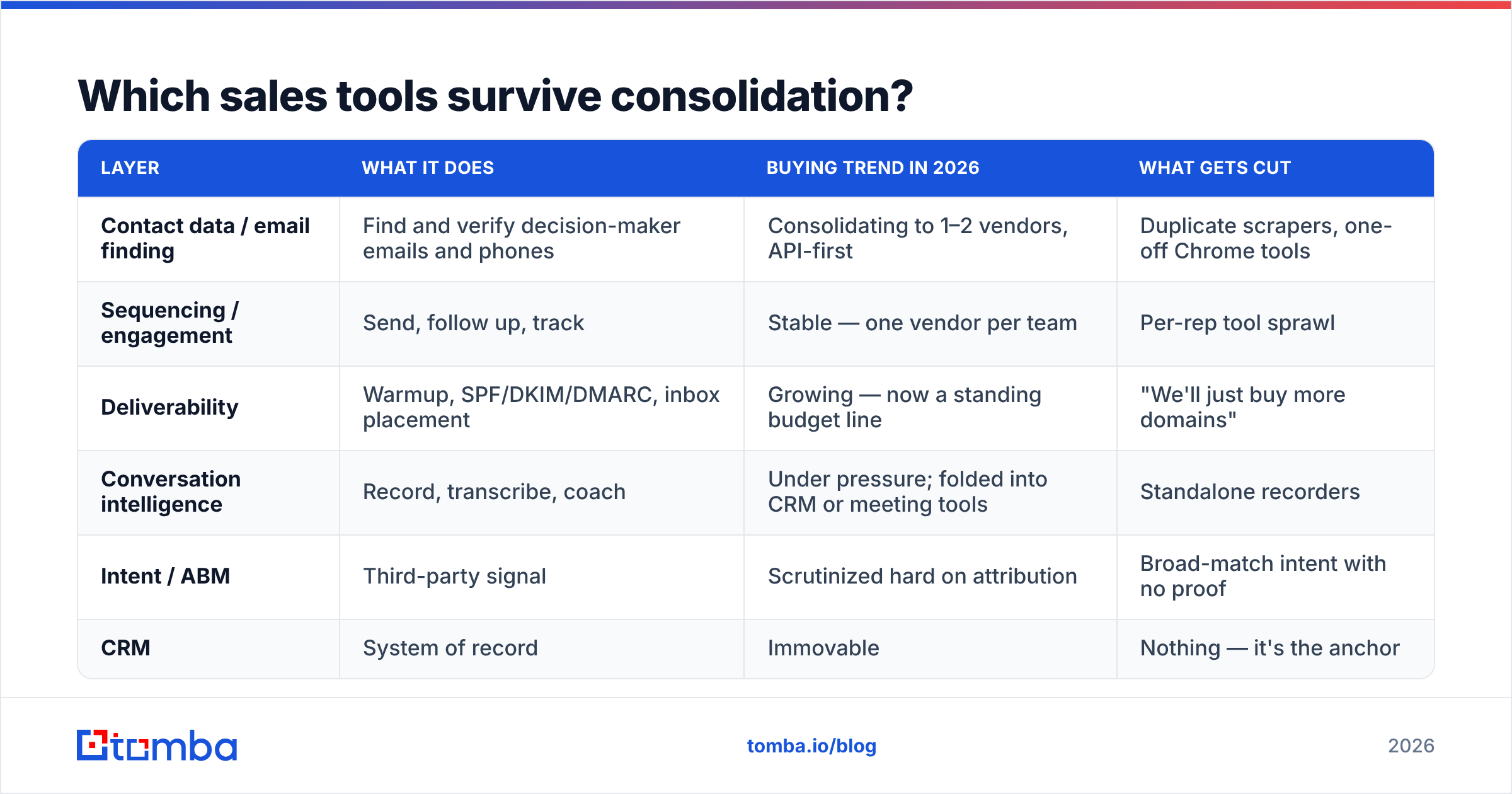
Which sales tools survive consolidation?#
Budgets are not growing, but the number of vendors per stack peaked around 2023 and has been falling since. Buyers are consolidating on platforms that do one layer well and expose an API, plus one or two suites.
| Layer | What it does | Buying trend in 2026 | What gets cut |
|---|---|---|---|
| Contact data / email finding | Find and verify decision-maker emails and phones | Consolidating to 1–2 vendors, API-first | Duplicate scrapers, one-off Chrome tools |
| Sequencing / engagement | Send, follow up, track | Stable — one vendor per team | Per-rep tool sprawl |
| Deliverability | Warmup, SPF/DKIM/DMARC, inbox placement | Growing — now a standing budget line | "We'll just buy more domains" |
| Conversation intelligence | Record, transcribe, coach | Under pressure; folded into CRM or meeting tools | Standalone recorders |
| Intent / ABM | Third-party signal | Scrutinized hard on attribution | Broad-match intent with no proof |
| CRM | System of record | Immovable | Nothing — it's the anchor |
Notice which layer is not being cut: the data layer. When you fire three vendors, the one you keep is the one your sequences literally cannot run without. Reputable providers in that layer include Tomba, ZoomInfo, Apollo, and BookYourData, which takes a pay-as-you-go, verified-list approach that works well for teams that buy in bursts rather than by subscription.
Price-wise, the market has settled into a fairly narrow band for mid-market teams. Tomba pricing runs a free tier at 25 searches a month, Starter at $49/mo, Growth at $99/mo, and Pro at $249/mo, with Enterprise custom — which is roughly where comparable API-first providers sit. Check current numbers on G2 before you commit; this category re-prices often.
What does the future of B2B buying look like?#
The buyer changed more than the seller did.
The committee got bigger. Six to eleven people now touch a mid-market software decision. Security review, procurement, finance, and at least one skeptical engineer all get a vote. Single-threaded deals slip or die.
Procurement got teeth. Multi-year auto-renewals are being challenged. Usage-based and hybrid pricing means the "close" is now the start of a renewal argument, not the end of one.
Peer proof beats vendor claims. Slack communities, Reddit threads, and review sites carry more weight than your case study PDF. HubSpot's sales research has consistently found buyers trusting peer input over rep input, and nothing in 2026 reverses that.
Self-serve is the default first touch. If a prospect cannot see pricing, try the product, or read real documentation without a call, a meaningful share of them will simply pick someone who lets them.
What this means tactically: stop optimizing the pitch and start optimizing the proof. Send the security questionnaire before it's requested. Publish real pricing. Give your champion an internal business case they can forward without editing. The rep's job is increasingly to arm someone else to sell internally.
What skills should sellers build now?#
Four, in priority order.
- Account judgment. With infinite reach, the scarce resource is attention. Knowing which 20 accounts to work — and defending that list against a manager who wants 200 — is the highest-leverage skill on the team.
- Technical fluency in your own stack. Not coding. Knowing what your enrichment provider returns, why a lead scored 82, and how to spot when an AI-drafted email is factually wrong about the prospect's company.
- Multi-threading. Mapping a committee, finding the blocker before they block, and running parallel conversations without contradicting yourself.
- Written clarity. When AI can generate infinite competent prose, the differentiator is a short, specific, obviously-human message that references something real.
Notice what fell off the list: dialing volume, objection-handling scripts, and product memorization. Those are either automated or searchable.
How should you rebuild your stack for this?#
A pragmatic sequence, in order, for a team of five to fifty:
- Fix the data layer first. Nothing downstream works on bad records. Verify on import, re-verify quarterly, and treat bounce rate as a leading indicator, not a report.
- Lock deliverability before scaling volume. SPF, DKIM, DMARC, a warmed domain, and a realistic per-mailbox send cap. Skip this and every other investment compounds negatively.
- Automate research, not judgment. Let agents build the brief. Keep a human on account selection and the opening line.
- Instrument the API layer. Wire enrichment directly into your CRM and workflows through a documented email finder API rather than manual CSV round-trips. Manual exports are where data goes stale.
- Cut one tool per quarter. If a vendor cannot show a metric it moves, it is a subscription, not a system.
- Retrain on committee selling. Run deal reviews on threading depth, not just next-step dates.
What predictions about the future of sales already failed?#
Worth naming, because pattern-matching on failed predictions is cheap insurance:
- "AI SDRs will fully replace human prospecting." They flooded inboxes, reply rates fell across the board, and most teams pulled back to human-supervised sending within two quarters.
- "Video prospecting will be the new cold email." It works for a narrow set of high-ACV motions. It did not become the default channel.
- "Everyone goes product-led, sales teams shrink to nothing." PLG created more need for sales at expansion and enterprise tiers, not less.
- "Intent data will make outbound precise." Broad-match intent still produces a lot of false positives. First-party signals — site visits, doc reads, trial behavior — outperform it consistently.
The pattern: predictions that assume a channel replaces a channel usually fail. Predictions that assume a cost curve collapses usually hold. Research costs collapsed. Writing costs collapsed. Trust did not get cheaper, and neither did accurate data.
Where should you start this quarter?#
Pick the bottleneck, not the trend. For most teams reading this, the bottleneck is not AI adoption — it's that a third of the contacts in the CRM are wrong, and every clever thing built on top of them inherits that error.
Start by finding and verifying decision-maker contacts you can actually reach. The Tomba Email Finder returns verified professional email addresses by domain, name, or company, with confidence scoring and source attribution so you know why a result was returned — and it plugs into your CRM, spreadsheets, or code through the same API your agents call. The free tier gives you 25 searches a month to test accuracy against your own known-good list before you spend a dollar. Run that test on 50 contacts you can verify manually. Whatever the future of sales looks like from there, you will at least be building it on records that are true.
Related guides#
Ready to find emails that actually work?
Join 150,000+ professionals who stopped guessing and started sending. Free credits on signup — no credit card required.
Get the Tomba newsletter
Practical outbound tactics and product updates — once every two weeks.
About the author