Gamalogic vs Leadzen.ai: Which B2B Email Tool Wins in 2026?
Gamalogic and Leadzen.ai both promise verified B2B contact data, but they solve different problems. Here is an honest breakdown of accuracy, credits, API depth, and which one actually belongs in your outbound stack.
Gamalogic vs Leadzen.ai is a common shortlist for B2B email data. Both tools promise verified contacts. In practice they solve different problems. Here is how they compare on accuracy, credits, pricing, and API depth.
TL;DR
- Gamalogic is a focused email finder and verifier. You give it names and domains, it returns addresses with a validity signal. Narrow scope, low friction, developer-friendly.
- Leadzen.ai is a broader lead-intelligence platform: prospect search, company filters, intent-style signals, phone numbers, and a Chrome extension. Wider scope, heavier UI, more sales-team oriented.
- Accuracy is the real fork in the road. Gamalogic leans on pattern generation plus SMTP-style checks; Leadzen.ai leans on its own scraped and licensed database. Neither publishes an audited accuracy figure. Run your own test first.
- Pricing models differ structurally. Gamalogic sells credits; Leadzen.ai sells seats plus credits. That single difference decides which one is cheaper for your team shape.
- If you need a clean API, predictable per-credit costs, and catch-all handling, a dedicated provider like Tomba is worth benchmarking alongside both — start with the Tomba Email Finder.
What are Gamalogic and Leadzen.ai?#
They get lumped together in "B2B data tool" listicles, but they were built for different jobs.
Gamalogic is an email finding and verification service. The core loop is simple: send it a person's name and a company domain, get back a professional email address with a deliverability signal. It also does bulk uploads and offers an API. There is no sprawling prospect database to browse, no intent scoring, no sequencer. It does one category of work.
Leadzen.ai is positioned as a lead-intelligence platform. It ships a searchable B2B contact database. You can filter by industry, geography, headcount, and role. It also adds a browser extension for LinkedIn-style profiles, phone numbers next to emails, and enrichment for lists you already own. The pitch is "find and qualify prospects," not just "resolve this one email."
That difference matters more than any feature-by-feature scorecard. Buying Gamalogic when you actually need a prospect database means you still have to source names somewhere else. Buying Leadzen.ai when all you needed was 5,000 verified addresses per month means paying for a search UI your team will open twice.

Gamalogic vs Leadzen.ai: how do they find emails?#
Every email tool sits somewhere on a spectrum between generate-and-test and look-it-up. Where a vendor sits explains its failure modes.
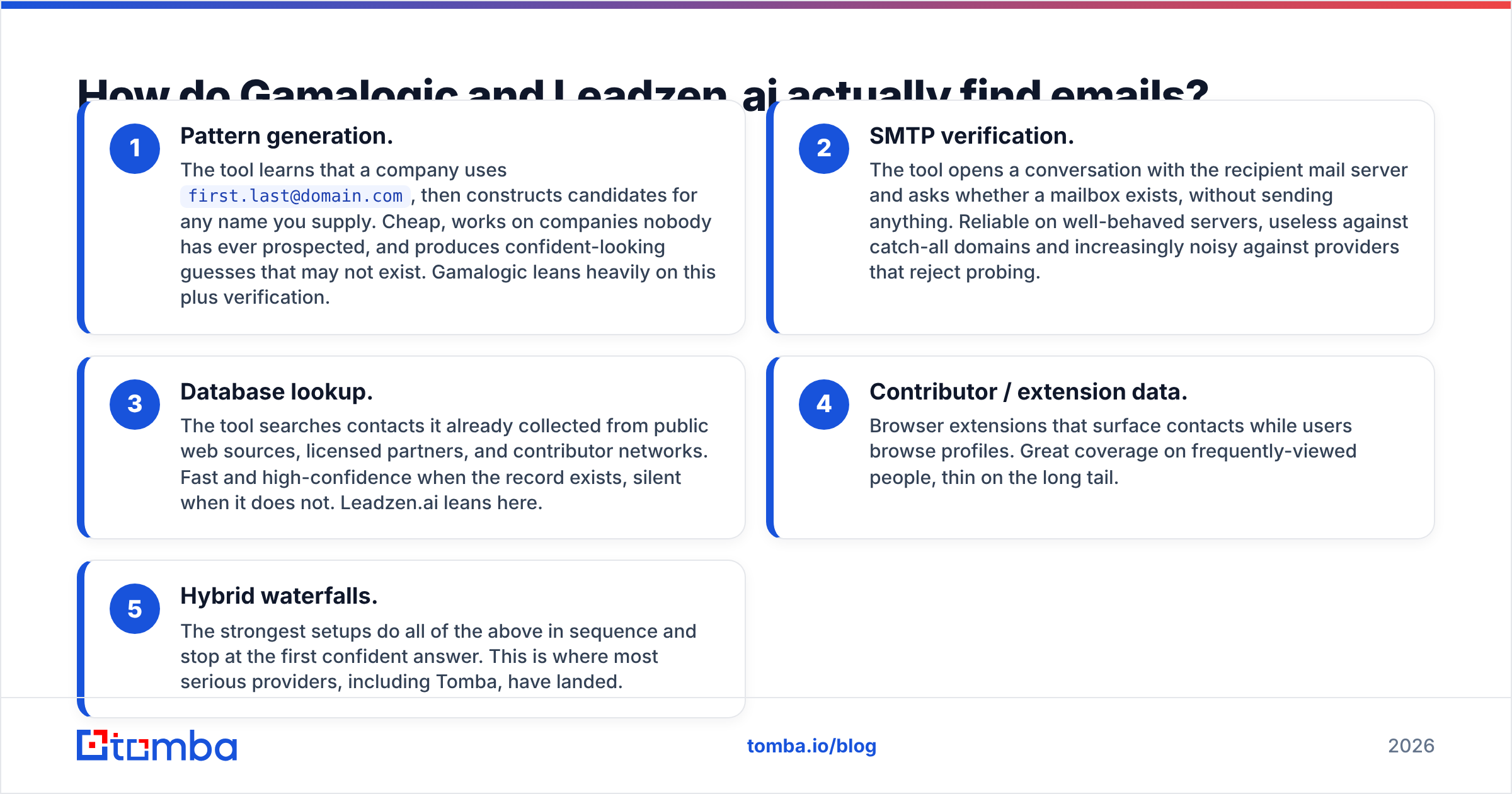
- Pattern generation. The tool learns that a company uses
first.last@domain.com, then constructs candidates for any name you supply. Cheap, works on companies nobody has ever prospected, and produces confident-looking guesses that may not exist. Gamalogic leans heavily on this plus verification. - SMTP verification. The tool opens a conversation with the recipient mail server and asks whether a mailbox exists, without sending anything. Reliable on well-behaved servers, useless against catch-all domains and increasingly noisy against providers that reject probing.
- Database lookup. The tool searches contacts it already collected from public web sources, licensed partners, and contributor networks. Fast and high-confidence when the record exists, silent when it does not. Leadzen.ai leans here.
Two more methods shape the Gamalogic vs Leadzen.ai gap:
- Contributor / extension data. Browser extensions that surface contacts while users browse profiles. Great coverage on frequently-viewed people, thin on the long tail.
- Hybrid waterfalls. The strongest setups do all of the above in sequence and stop at the first confident answer. This is where most serious providers, including Tomba, have landed.
Neither vendor is doing anything exotic. The question is which mix matches your target list. Prospecting into 200-person SaaS companies in the US? A database will cover most of it. Prospecting into regional manufacturers, agencies, or newly-registered domains? Pattern generation plus live verification will out-perform any static database.
Which tool is more accurate for finding emails?#
Nobody should take a vendor's accuracy claim at face value, including the ones on this page. Both companies advertise high validity rates. Neither publishes a methodology, a sample size, or a third-party audit. Treat those numbers as marketing until you run your own test.
Here is a test that takes 30 minutes and settles the argument:
- Pull 100 contacts you already have confirmed emails for — people who have replied to you, signed up, or booked a meeting.
- Strip the emails. Keep first name, last name, company domain.
- Run the list through both tools.
- Score three things separately: hit rate (did it return anything?), precision (was the returned address the one you know is correct?), and catch-all rate (how many came back as "accept-all" or "unknown"?).
That third metric is where tools quietly diverge. A provider that returns "valid" on every catch-all domain will look brilliant on hit rate and then torch your sender reputation three weeks later. A provider that flags catch-alls honestly looks worse on paper and protects your domain. If you send at volume, run flagged addresses through a dedicated catch-all verifier before they enter a sequence.

The general pattern across the category: database-first tools win on hit rate for well-known companies and lose badly on long-tail domains. Verification-first tools are more consistent across company sizes but return fewer results on companies with aggressive mail server configurations. Gamalogic behaves like the second type. Leadzen.ai behaves like the first.
If your bounce rate on a fresh list is creeping past 3%, the tool is not the only variable — your email deliverability setup matters just as much. But a bad data source will defeat perfect authentication every single time.
Gamalogic vs Leadzen.ai: feature by feature#
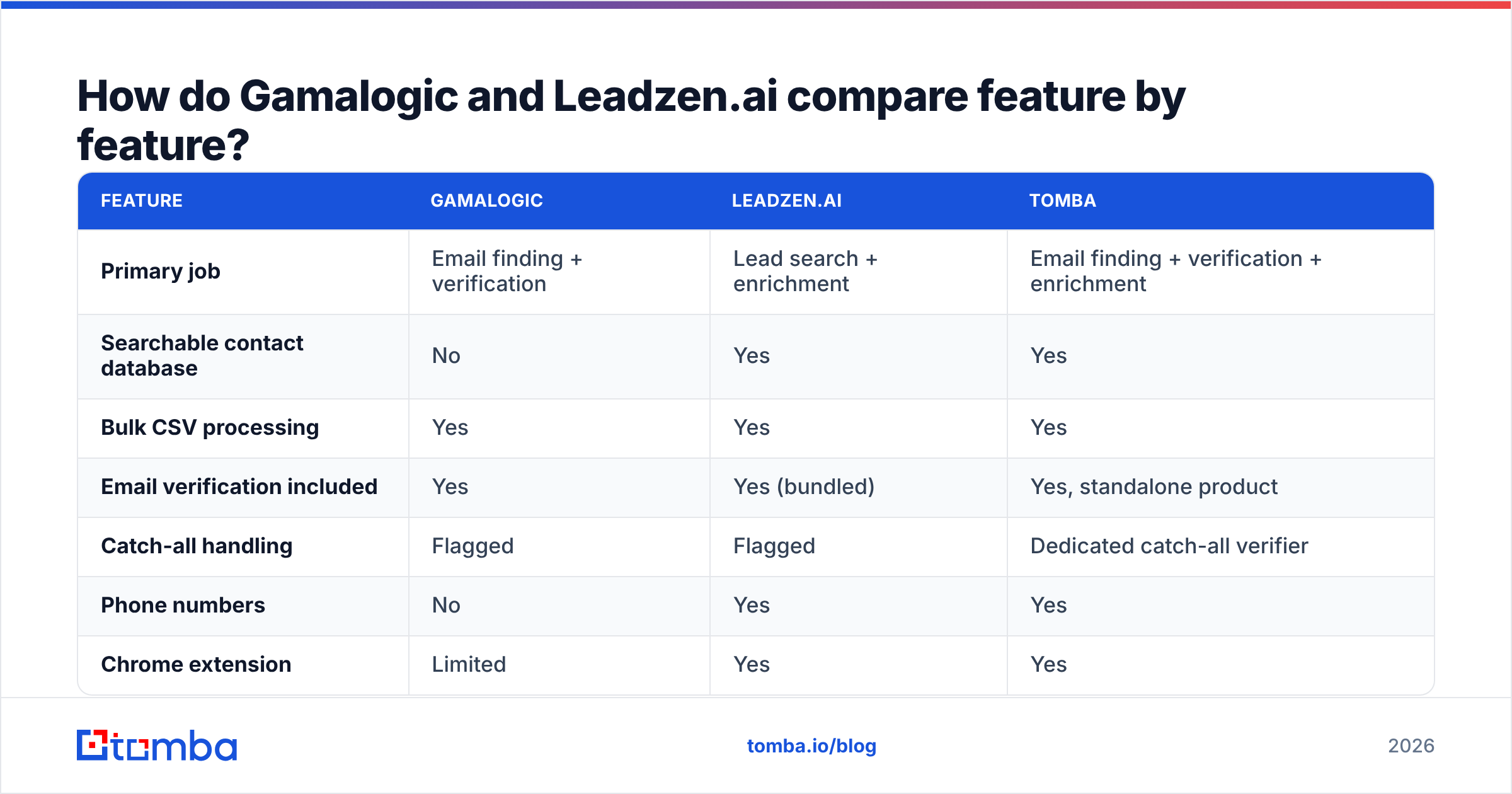
| Feature | Gamalogic | Leadzen.ai | Tomba |
|---|---|---|---|
| Primary job | Email finding + verification | Lead search + enrichment | Email finding + verification + enrichment |
| Searchable contact database | No | Yes | Yes |
| Bulk CSV processing | Yes | Yes | Yes |
| Email verification included | Yes | Yes (bundled) | Yes, standalone product |
| Catch-all handling | Flagged | Flagged | Dedicated catch-all verifier |
| Phone numbers | No | Yes | Yes |
| Chrome extension | Limited | Yes | Yes |
| Public REST API | Yes | Yes | Yes, documented + SDKs |
| Sheets / Excel add-ons | No | No | Yes |
| CRM integrations | Minimal | HubSpot, Salesforce-tier | HubSpot, Salesforce, Pipedrive, Zapier, Make |
| Free tier | Trial credits | Trial credits | 25 searches/month, no card |
| Pricing model | Credit packs | Seats + credits | Flat monthly plans with credits |
| Best for | Developers and lean teams | SDR teams needing discovery | Teams that want data + API + verification in one |

A few honest caveats on that table. Both vendors iterate quickly. Both have shipped features since the last public review cycle, so check the current Gamalogic and Leadzen.ai product pages before you finalize a shortlist. Peer reviews on G2 are worth a scan too. Skip the star ratings, which are noisy at low review counts. Read the two- and three-star reviews instead: that is where the real product boundaries show up.
What does each one cost in practice?#
Published pricing shifts often enough that quoting exact figures in a blog post is a disservice. What does not shift is the shape of each pricing model, and that is what determines your bill.
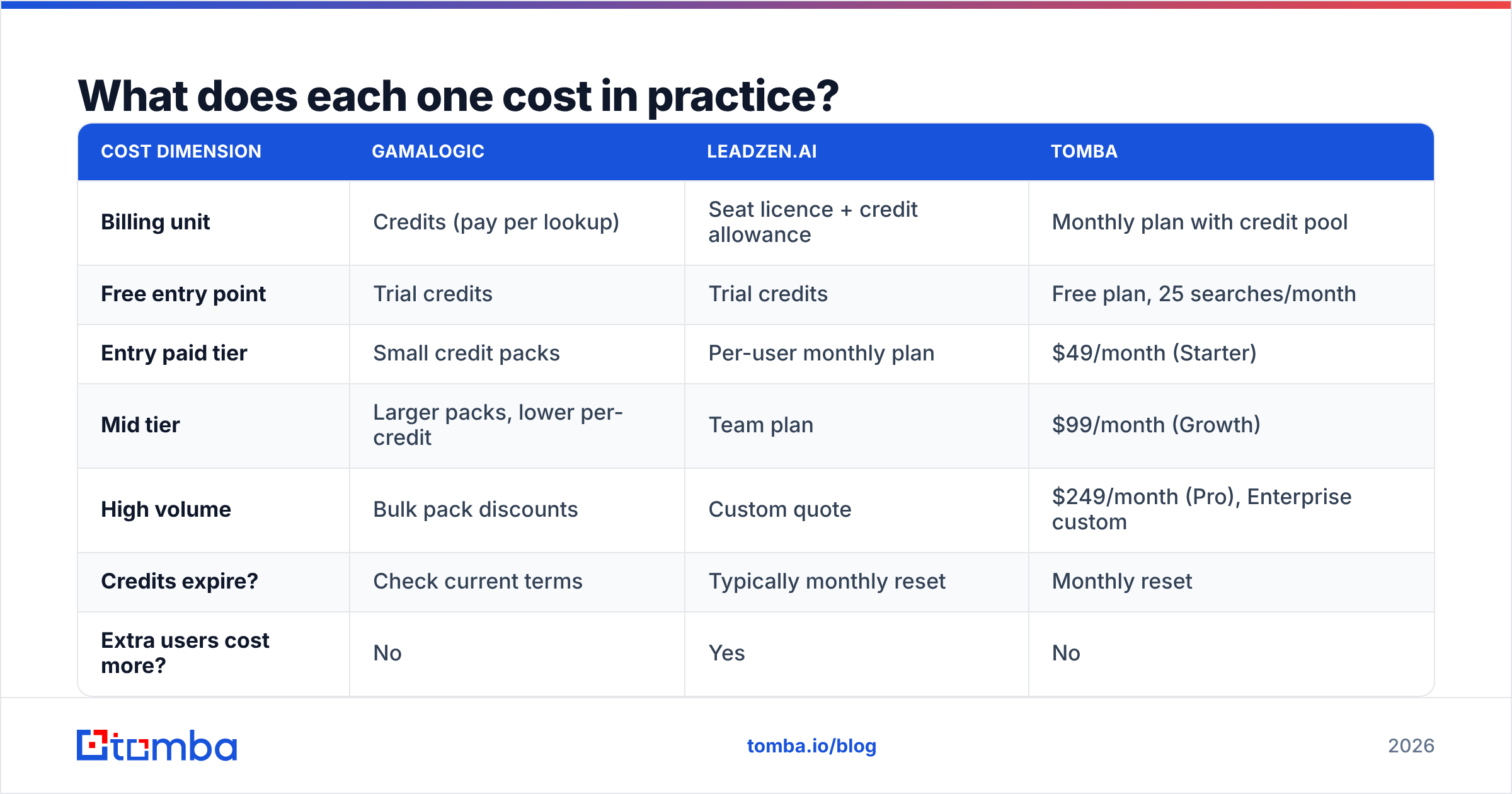
| Cost dimension | Gamalogic | Leadzen.ai | Tomba |
|---|---|---|---|
| Billing unit | Credits (pay per lookup) | Seat licence + credit allowance | Monthly plan with credit pool |
| Free entry point | Trial credits | Trial credits | Free plan, 25 searches/month |
| Entry paid tier | Small credit packs | Per-user monthly plan | $49/month (Starter) |
| Mid tier | Larger packs, lower per-credit | Team plan | $99/month (Growth) |
| High volume | Bulk pack discounts | Custom quote | $249/month (Pro), Enterprise custom |
| Credits expire? | Check current terms | Typically monthly reset | Monthly reset |
| Extra users cost more? | No | Yes | No |
The practical rule: credit-based pricing wins when you have few users and high volume; seat-based pricing wins when you have many users and low volume per user. A two-person founder-led sales team burning 10,000 lookups a month is punished by seat pricing. A ten-person SDR org doing 300 lookups each is punished by pure credit pricing with no shared pool.
Tomba's model sits in between. Flat monthly plans share one credit pool, and there is no per-seat charge, so the bill stays predictable for small teams that grow headcount faster than volume. Full details are on the Tomba pricing page.
One more cost nobody puts in a table: the cost of bad data. If a tool is 20% cheaper but returns 12% invalid addresses instead of 3%, you pay the difference in domain reputation, in warmup time after a blacklisting, and in the meetings you never booked. Price per valid email is the only number that matters.

Who should choose Gamalogic?#
Pick Gamalogic if most of these are true:
- You already have your target list. Names and companies come from a conference roster, a scraped directory, an existing CRM, or a partner list — you just need addresses.
- You want an API more than a UI. Gamalogic's surface area is small, which makes it easy to wire into a script or an internal tool without learning a platform.
- Your volume is spiky. Credit packs suit a team that runs 20,000 lookups in March and 800 in April far better than a per-seat licence does.
- You do not need phone numbers. If your motion is email-only, paying for a multichannel platform is waste.
Where it will frustrate you: there is no discovery layer. If your process starts with "who should we even be talking to," Gamalogic does not answer that question. You will pair it with a database, a scraper, or a list vendor — and at that point you are managing two subscriptions.
Who should choose Leadzen.ai?#
Pick Leadzen.ai if most of these are true:
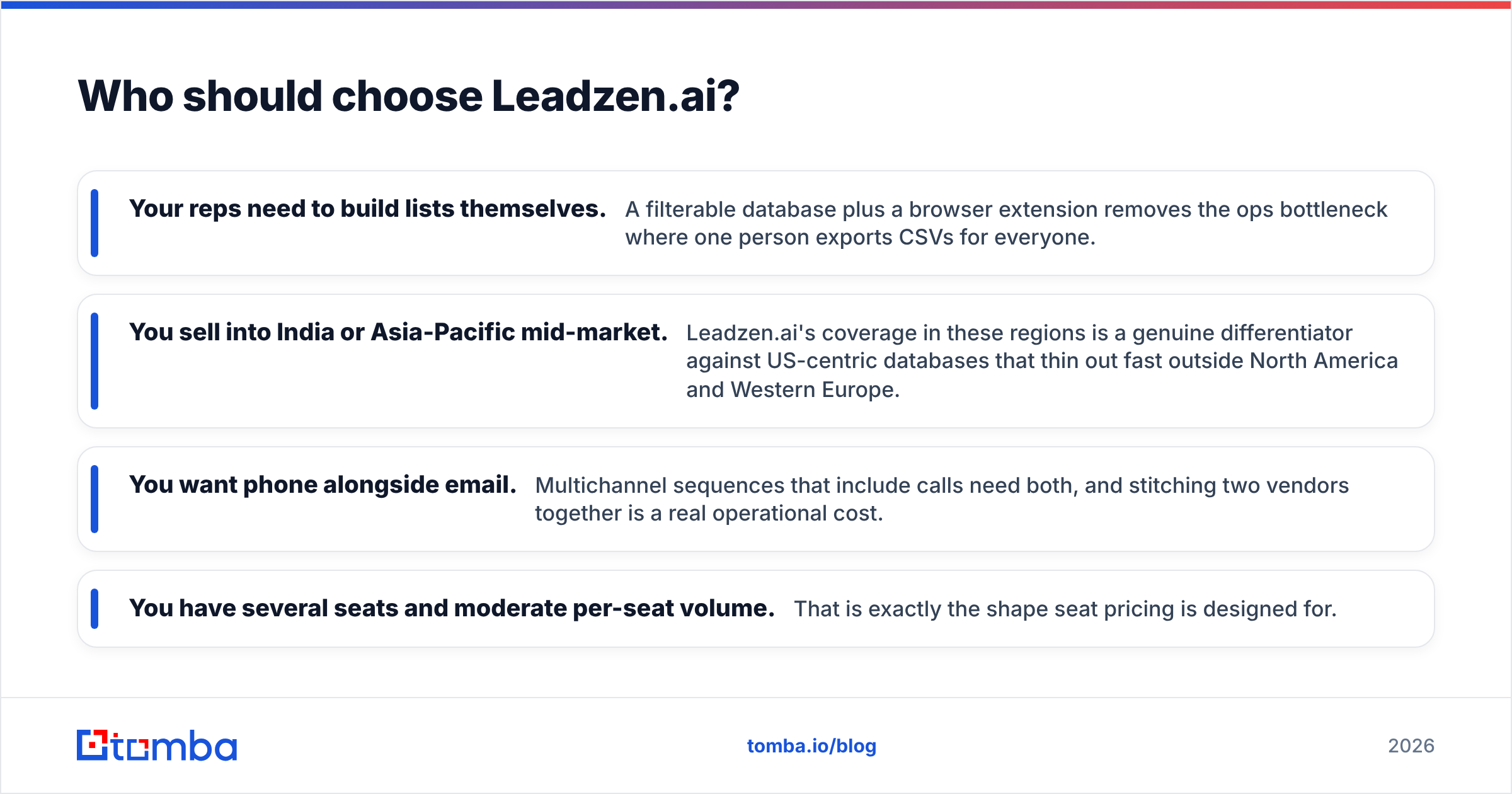
- Your reps need to build lists themselves. A filterable database plus a browser extension removes the ops bottleneck where one person exports CSVs for everyone.
- You sell into India or Asia-Pacific mid-market. Coverage in these regions is a genuine differentiator. US-centric databases thin out fast outside North America and Western Europe.
- You want phone alongside email. Multichannel sequences that include calls need both, and stitching two vendors together is a real operational cost.
- You have several seats and moderate per-seat volume. That is exactly the shape seat pricing is designed for.
Where it will frustrate you: platform tools carry platform overhead. There is a UI to learn, filters to tune, and enough surface area that adoption is a real project rather than a Tuesday afternoon. And because coverage comes from a database, long-tail and newly-registered domains will come back empty more often than a verification-first tool.
Where does Tomba fit in this comparison?#
Honestly: as a third option worth benchmarking, not as an automatic answer.
Tomba overlaps with both. Like Gamalogic, it is verification-first and API-native. The Tomba API covers finder, verifier, domain search, and enrichment endpoints, with SDKs in the usual languages. There is also a CLI and an MCP server if you are wiring data into an AI workflow. Like Leadzen.ai, it ships a searchable B2B database, a Chrome extension, phone lookup, and CRM integrations.
The three places it tends to separate:
- Catch-all is treated as its own problem. Most tools flag catch-all domains and stop. A dedicated catch-all verifier is the difference between skipping 30% of your enterprise list and safely sending to it.
- No per-seat tax. Add reps without re-negotiating. For teams scaling from three to fifteen SDRs, this compounds.
- Spreadsheet-native workflows. Google Sheets and Excel add-ons mean the people who actually build lists do not need to learn a new platform or wait on an ops queue.
The place it does not win: if your ICP is concentrated in a region where a local provider has deeper native coverage, that provider's database will beat a global one on hit rate. Test, don't assume. Run the same 100-contact list through all three and let the numbers pick.
How should you run the final decision?#
Skip the feature matrices — including the one above — for the last mile. Do this instead:
- Build one honest test list of 100 known-good contacts spread across your real ICP, including at least 20 long-tail or non-US companies.
- Run all three tools on trial credits. Every vendor here offers enough free volume to complete this.
- Score price per valid email, not per lookup. Divide total cost by contacts that were both returned and correct.
- Check the catch-all column separately. A tool that hides catch-alls behind a green checkmark is selling you future bounces.
- Time the integration. If it takes a developer two days to wire up, that is a real cost line.
Whichever way it lands, verify before you send. Even a 95%-accurate source leaves 500 bad addresses in a 10,000-contact campaign, which is more than enough to trip a spam filter. Push everything through an email verifier as a final gate, regardless of who supplied the data.
Ready to benchmark a third option?#
Gamalogic vs Leadzen.ai is a close call. Both are credible, and the right pick depends entirely on whether your bottleneck is finding addresses or finding people. Before you sign an annual contract with either, spend 20 minutes putting a third data source through the same test.
The Tomba Email Finder has a free tier with 25 searches a month, no card required — enough to run a real head-to-head on your own list instead of trusting anyone's accuracy claim, including ours. Bring 25 contacts you already know the answers for, and let the results decide.
Related guides#
Ready to find emails that actually work?
Join 150,000+ professionals who stopped guessing and started sending. Free credits on signup — no credit card required.
Get the Tomba newsletter
Practical outbound tactics and product updates — once every two weeks.
About the author