Gamalogic vs Listkit: Which B2B Data Tool Wins in 2026?
Gamalogic verifies emails with a deliverability-first engine. Listkit sells ready-made B2B lists with sequences attached. Here's an honest breakdown of pricing, accuracy, and which one actually fits your outbound motion.
TL;DR
- Gamalogic is an email verification and finding engine built around deliverability — bounce-rate reduction is its headline claim, and its pricing is credit-based and cheap at the low end.
- Listkit is a B2B list-building platform: you filter a database, export contacts, and (on higher tiers) plug them straight into sending infrastructure. It's a workflow product, not a verification lab.
- They're not really the same category. Comparing them fairly means asking whether your bottleneck is data quality or list assembly speed.
- Pricing gap is real: Gamalogic starts in the $20–$40/mo range on credit packs; Listkit's entry plans sit closer to $97/mo and climb fast with contact volume.
- If you want both — accurate finds and verification and an API you can automate against — a dedicated email finder like Tomba (free tier, then $49/mo) usually costs less than either and slots into your existing stack.
Most "Gamalogic vs Listkit" searches come from someone who just got burned. Either a campaign bounced at 12% and got the domain flagged, or a purchased list turned out to be 40% job-changers from 2023. Those are two different failures, and the two tools solve two different halves of the problem.
Let's break down what each one actually does, where the pricing traps are, and which one belongs in your stack.
What is Gamalogic and who is it for?#
Gamalogic is an email verification and email-finding service. Its core pitch is deliverability: run your list through the verifier, remove the invalid and risky addresses, and protect your sender reputation before you hit send.
The product surface is narrow on purpose:
- Bulk email verification — upload a CSV, get back valid/invalid/catch-all/disposable classifications.
- Email finder — supply a name plus a domain, get the likely business address.
- Domain-level search — pull the addresses associated with a company domain.
- API access — programmatic verification for anyone wiring it into a CRM or app.
- Credit-based pricing — you buy blocks of credits rather than seats, which suits spiky usage.
Who it fits: agencies and solo operators who already have lists (scraped, exported from LinkedIn, handed over by a client) and need those lists cleaned before they touch a sending tool. If your bounce rate is the number keeping you up at night, this is the shape of tool you want.
Who it doesn't fit: anyone who needs to build a list from scratch with firmographic filters. Gamalogic will verify a contact you already suspect exists. It won't hand you 4,000 Series-A CTOs in DACH.

What is Listkit and how is it different?#
Listkit is a B2B contact database with an outbound workflow bolted on. You filter by industry, headcount, title, technology stack, and geography; you get a list; on the higher plans you push that list into email sequences without leaving the platform.
The value proposition is speed-to-first-campaign. A new SDR can go from blank screen to a 2,000-contact sequence in an afternoon. That's genuinely useful, and it's the reason Listkit gained traction with agencies running lead-gen as a service.
The tradeoffs are the ones every list marketplace carries:
- Data recency varies by segment. Enterprise tech contacts tend to be fresher than SMB services contacts, because more people are re-scraping the former.
- You're paying for the whole database, not the 300 records you need. Credit ceilings mean the effective cost per usable contact can be well above the sticker price.
- Verification is a feature, not the product. Lists ship "verified," but the depth of that verification is not the same as running a dedicated verifier over the file.
- Contract shape matters. Annual commitments are common on the plans where the export limits stop hurting.
If you want a broader look at how list marketplaces price contacts, G2's B2B data category is a reasonable place to sanity-check vendor claims against real reviewer volume.
Gamalogic vs Listkit: how do they compare head to head?#
Here's the practical comparison. Pricing moves, so treat the numbers as the shape of each vendor's model rather than a quote.
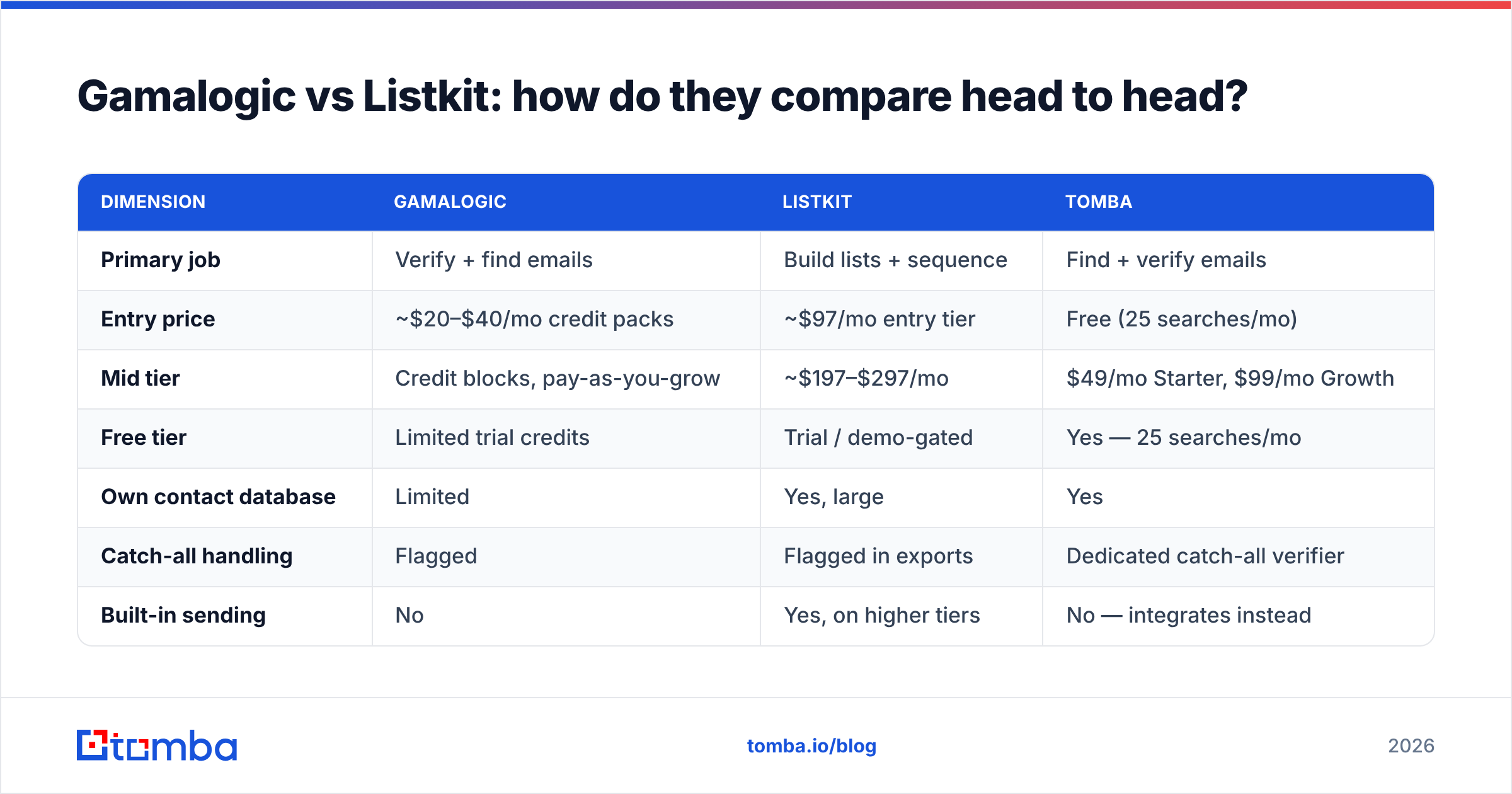
| Dimension | Gamalogic | Listkit | Tomba |
|---|---|---|---|
| Primary job | Verify + find emails | Build lists + sequence | Find + verify emails |
| Entry price | ~$20–$40/mo credit packs | ~$97/mo entry tier | Free (25 searches/mo) |
| Mid tier | Credit blocks, pay-as-you-grow | ~$197–$297/mo | $49/mo Starter, $99/mo Growth |
| Free tier | Limited trial credits | Trial / demo-gated | Yes — 25 searches/mo |
| Own contact database | Limited | Yes, large | Yes |
| Catch-all handling | Flagged | Flagged in exports | Dedicated catch-all verifier |
| Built-in sending | No | Yes, on higher tiers | No — integrates instead |
| API | Yes | Limited | Full REST API + CLI + MCP |
| CRM integrations | Basic | Native on higher tiers | HubSpot, Salesforce, Pipedrive, Zapier |
| Best for | Cleaning existing lists | Fast list assembly | Accuracy-first sourcing at scale |
The table makes the real decision visible: Gamalogic and Listkit sit at opposite ends of the same pipeline. Gamalogic is the quality gate. Listkit is the source. Choosing between them is only a coherent question if you're going to solve the other half some other way.
Which one has better data accuracy?#
Accuracy means two different things here, and vendors exploit the ambiguity.
Verification accuracy is the question "does this mailbox accept mail?" That's what Gamalogic optimizes for. It's measurable: send a test batch, compare predicted bounces to actual bounces, done. Good verifiers land in the 95–98% range on non-catch-all domains and degrade sharply on catch-alls — because catch-all domains accept everything at SMTP time and tell you nothing.
Source accuracy is the question "is this the right person, at the right company, with the right title, today?" That's Listkit's burden, and it's much harder to audit. A record can pass SMTP verification perfectly and still be wrong: the mailbox exists, but the person left 14 months ago and IT never disabled the account. Verification will never catch that.
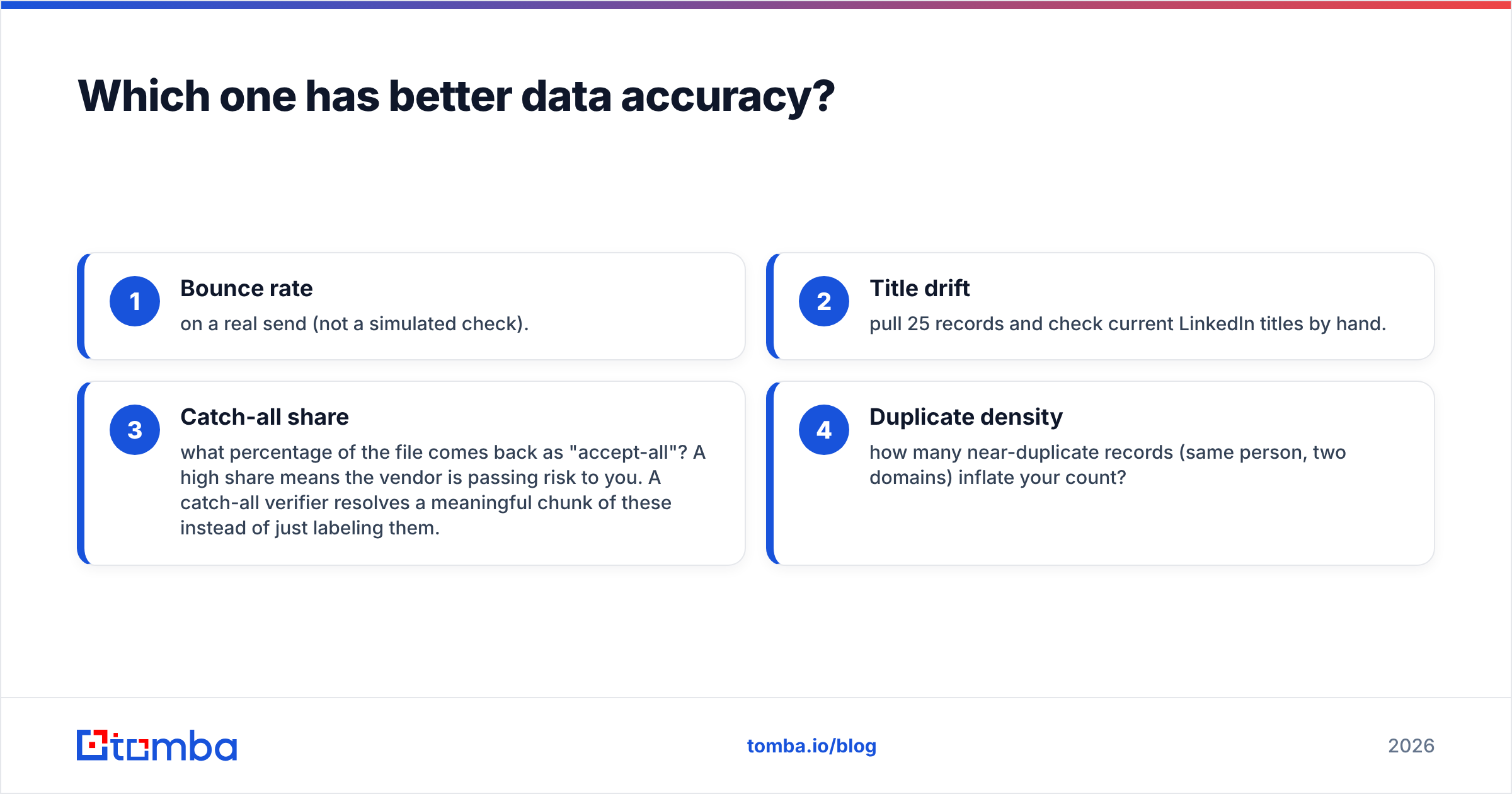
This is why "verified list" claims are weaker than they sound. Verification proves deliverability, not relevance. If you're evaluating either vendor, run the same 200-record sample through both and check three things:
- Bounce rate on a real send (not a simulated check).
- Title drift — pull 25 records and check current LinkedIn titles by hand.
- Catch-all share — what percentage of the file comes back as "accept-all"? A high share means the vendor is passing risk to you. A catch-all verifier resolves a meaningful chunk of these instead of just labeling them.
- Duplicate density — how many near-duplicate records (same person, two domains) inflate your count?
Google's own guidance in the Gmail bulk sender requirements is the actual scoreboard: keep spam complaints under 0.3% and authenticate properly, or delivery degrades regardless of which vendor sold you the list.
What does each one actually cost at real volume?#
Sticker price is the least interesting number. Cost per usable contact is the one that decides your CAC.
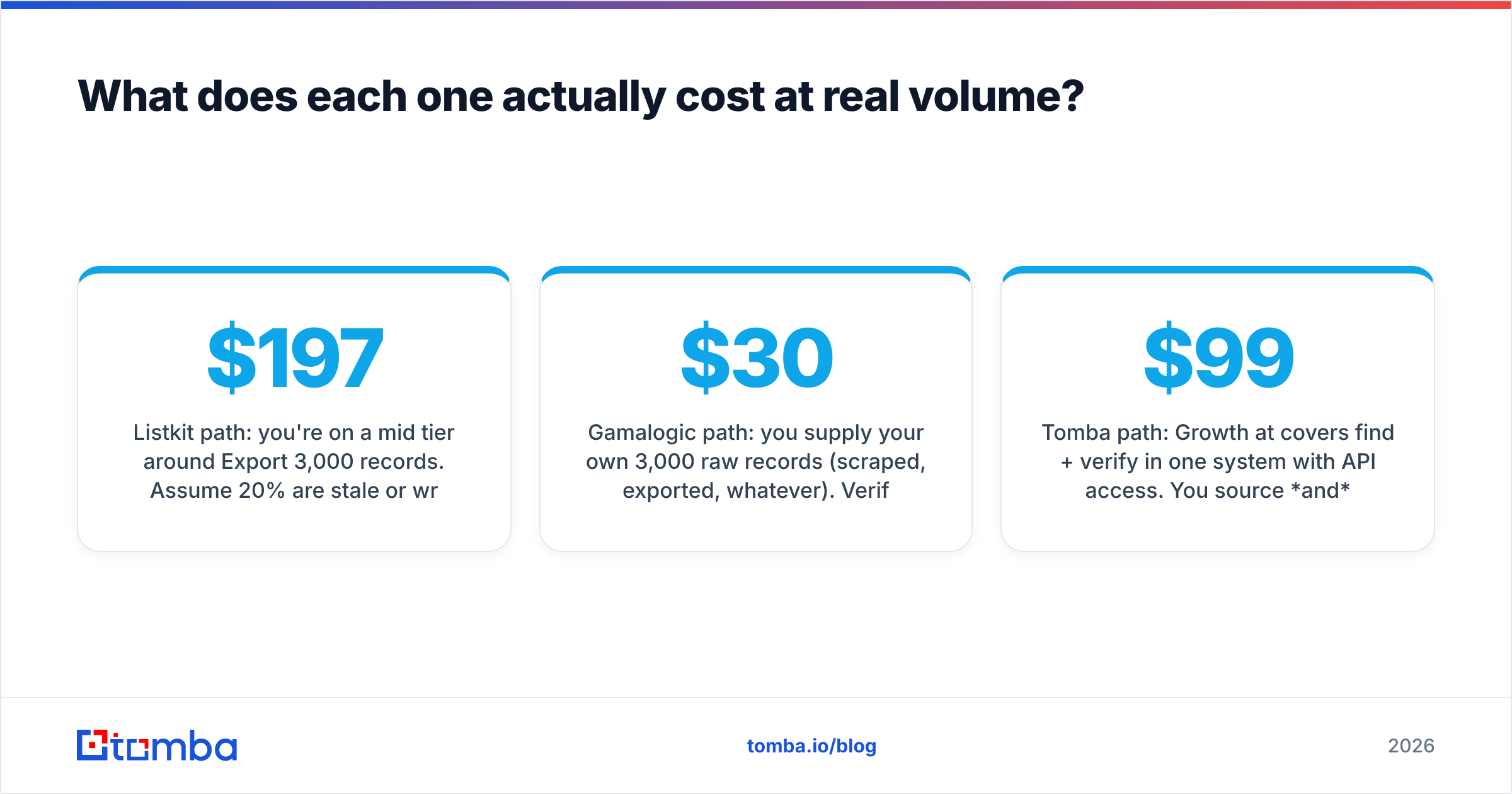
Run the arithmetic on a typical month: you need 3,000 net-new contacts for outbound.
- Listkit path: you're on a mid tier around $197/mo. Export 3,000 records. Assume 20% are stale or wrong-fit after your own filtering, and another 8% bounce. You end up with roughly 2,160 usable contacts. Effective cost: about $0.09 per usable contact — plus whatever you pay for sending infrastructure.
- Gamalogic path: you supply your own 3,000 raw records (scraped, exported, whatever). Verification credits run cheap — call it $30–$50 for that volume. But you've now spent hours sourcing, and sourcing labor is the real cost. Effective cost: low in dollars, high in hours.
- Tomba path: Growth at $99/mo covers find + verify in one system with API access. You source and clean in one workflow. Effective cost lands between the two, with fewer tools to reconcile. Full Tomba pricing breaks the tiers down.
The pattern most teams land on: pay for sourcing where sourcing is genuinely hard (niche verticals, non-English markets), and don't pay list-marketplace prices for contacts you could find directly from a known domain. A domain search against 200 target accounts is often faster and cheaper than filtering a database of 200 million records you'll never use.

Is Gamalogic better than Listkit for cold outbound?#
Neither is sufficient alone, and the honest answer depends on what you already own.
Pick Gamalogic if:
- You have a list source already — a scraper, an existing CRM dump, a partner feed.
- Your bounce rate is above 3% and you've had a domain warning.
- You want cheap, API-driven verification you can run continuously rather than as a one-off cleanup.
- You don't want to pay for a database you'd barely query.
Pick Listkit if:
- You're starting from zero and need volume this week.
- Your ICP is well covered by mainstream firmographic filters (US SaaS, agencies, ecommerce).
- You value having sequencing in the same tab as list building.
- Your team is junior enough that fewer tools genuinely reduces error rate.
Pick neither if: your ICP is narrow, your target accounts are known by name, and you mostly need the right contact at a known company. That's an email-finder problem, not a database problem. Point an email finder at the domain, get the pattern, verify, done — no seven-figure database subscription required.
It's worth noting that the "buy a list" market is broader than these two. Providers like BookYourData occupy a genuinely different lane — pay-per-lead, no subscription, with accuracy guarantees attached — and for teams that buy contacts in bursts rather than continuously, that model can be cleaner than either a credit ladder or a monthly seat. Evaluate on how you actually buy, not on which brand shows up first in search.
How do you evaluate either tool without wasting a month?#
Run a structured 10-day bake-off. This is the part most teams skip and then regret.
- Define the sample. Pick 300 accounts inside your real ICP — not the vendor's demo segment. Same accounts for every tool.
- Pull contacts from each vendor. Same titles, same geography. Record how long each pull takes; time is a cost.
- Cross-verify with a third party. Run every file through a neutral email verifier so you're not grading a vendor's homework with its own answer key.
- Send a real, small campaign. 100 contacts per source, identical copy, same sending domain, staggered. Measure hard bounces, spam complaints, and response rate.
- Audit 25 records manually. Open LinkedIn. Confirm the person still holds the title. This is tedious and it is the single most informative hour you'll spend.
- Score cost per booked meeting, not per contact. That's the only number your CFO cares about.
If a vendor won't let you run this test on a trial or a small paid plan, that's information too.
What about API access and automation?#
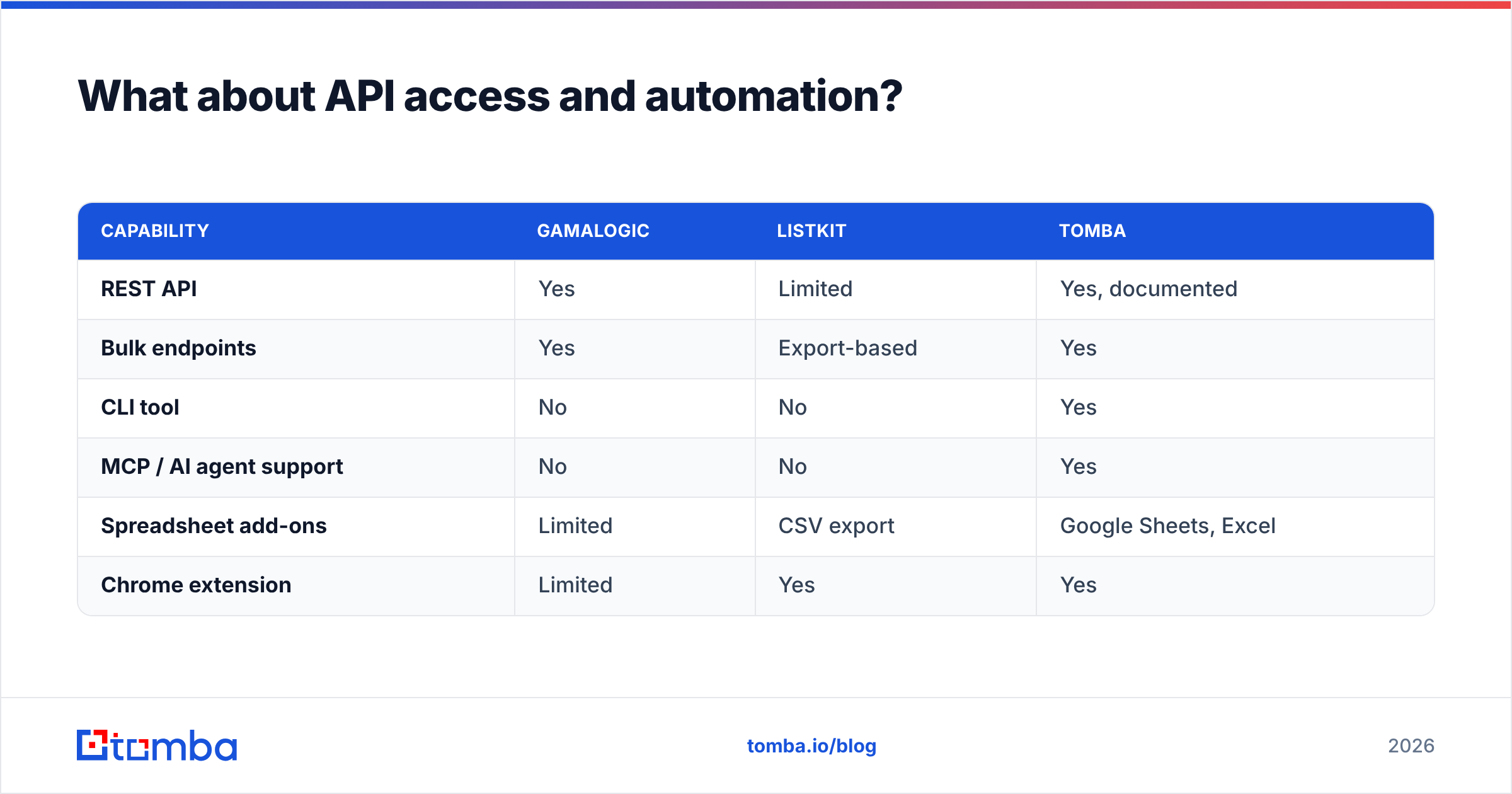
If you're automating, this is where the comparison gets lopsided.
| Capability | Gamalogic | Listkit | Tomba |
|---|---|---|---|
| REST API | Yes | Limited | Yes, documented |
| Bulk endpoints | Yes | Export-based | Yes |
| CLI tool | No | No | Yes |
| MCP / AI agent support | No | No | Yes |
| Spreadsheet add-ons | Limited | CSV export | Google Sheets, Excel |
| Chrome extension | Limited | Yes | Yes |
For RevOps teams building enrichment into a pipeline, API depth beats UI polish every time. A data enrichment call that fires on lead creation is worth more than a monthly CSV export somebody forgets to run. If your workflow lives in Sheets or Airtable rather than a CRM, check whether the vendor ships a real add-on or expects you to paste files around — that difference compounds weekly.
Which should you choose in 2026?#
The straight verdict: Gamalogic wins on cost-efficient verification; Listkit wins on speed to a first campaign; neither wins on being the whole stack.
If your outbound is already running and bouncing, buy verification and fix the leak. If you have no list and no sourcing motion, a list platform gets you moving faster than building scrapers. And if you're doing account-based outbound against a defined target list — which is where most B2B teams end up after their first spray-and-pray quarter — you want a finder-plus-verifier with an API, not a database subscription.
Three closing rules that survive any vendor change:
- Never send to an unverified list, regardless of what the seller labeled it.
- Re-verify anything older than 90 days. B2B contact data decays roughly 2–3% per month; a six-month-old list is materially worse than a fresh one.
- Instrument your own bounce and reply data. Vendor accuracy claims are marketing. Your bounce log is evidence.
Ready to stop choosing between a verifier and a database? Tomba Email Finder does both in one place: find business emails by name, domain, or company, verify them before they hit your sequencer, and automate the whole thing through the API. Start free with 25 searches a month, then scale to Starter at $49/mo when the pipeline justifies it — no annual contract, no database you'll never fully use.
Related guides#
Ready to find emails that actually work?
Join 150,000+ professionals who stopped guessing and started sending. Free credits on signup — no credit card required.
Get the Tomba newsletter
Practical outbound tactics and product updates — once every two weeks.
About the author