Gamalogic vs Pubrio (2026): Which Email Finder Wins?
Gamalogic and Pubrio both promise verified B2B emails, but they solve different problems. Here is the honest breakdown of accuracy, credits, pricing and API depth before you commit budget.
Gamalogic vs Pubrio is a fair fight, but the two tools do not do the same job. One finds emails. The other builds lists. Pick the wrong one and you pay for features you never touch.
TL;DR
- Gamalogic is a lean, credit-based email finder and verifier. You upload a list, you get valid addresses back. Its strength is bulk throughput at a low entry price.
- Pubrio is a broader B2B lead-intelligence platform — contact database, company filters, intent-style signals and a Chrome extension. Email discovery is one feature among several.
- If your bottleneck is finding the right accounts, Pubrio does more. If your bottleneck is turning known names into deliverable addresses, Gamalogic is the tighter tool.
- Neither one replaces a dedicated verification layer. Both will hand you catch-all domains and let you decide what to do with them.
- Want finder, verifier, catch-all handling and an API on one credit pool? That is where Tomba lands — Free (25 searches/mo), Starter $49/mo, Growth $99/mo, Pro $249/mo.
What are Gamalogic and Pubrio, exactly?#
They get compared because both sell "verified B2B emails." But they sit at different layers of the prospecting stack.
Gamalogic is an email discovery and verification service. You give it a name and a domain, or a spreadsheet of thousands of them. It returns the most probable work address plus a validity signal. It runs on credits, exposes an API, and does bulk processing. There is no sprawling filter UI, no intent data, no CRM sync layer. It is a utility.
Pubrio is a lead-intelligence platform. You start from criteria — industry, headcount, technology used, job title. It returns companies and contacts from its database, with emails and sometimes phone numbers attached. It leans on AI-assisted search and ships a browser extension for pulling contacts while you browse LinkedIn or a company site.
That difference shapes everything else here. A database platform is judged on coverage and filter quality. A finder utility is judged on hit rate per credit, and on how few bounces it leaves behind.
Actually, use this one:

Gamalogic vs Pubrio: how do they compare head-to-head?#
Here is the practical side-by-side. Treat every price as "as published at the time of writing." Both vendors adjust packaging often, so confirm on their own pricing pages before you buy.
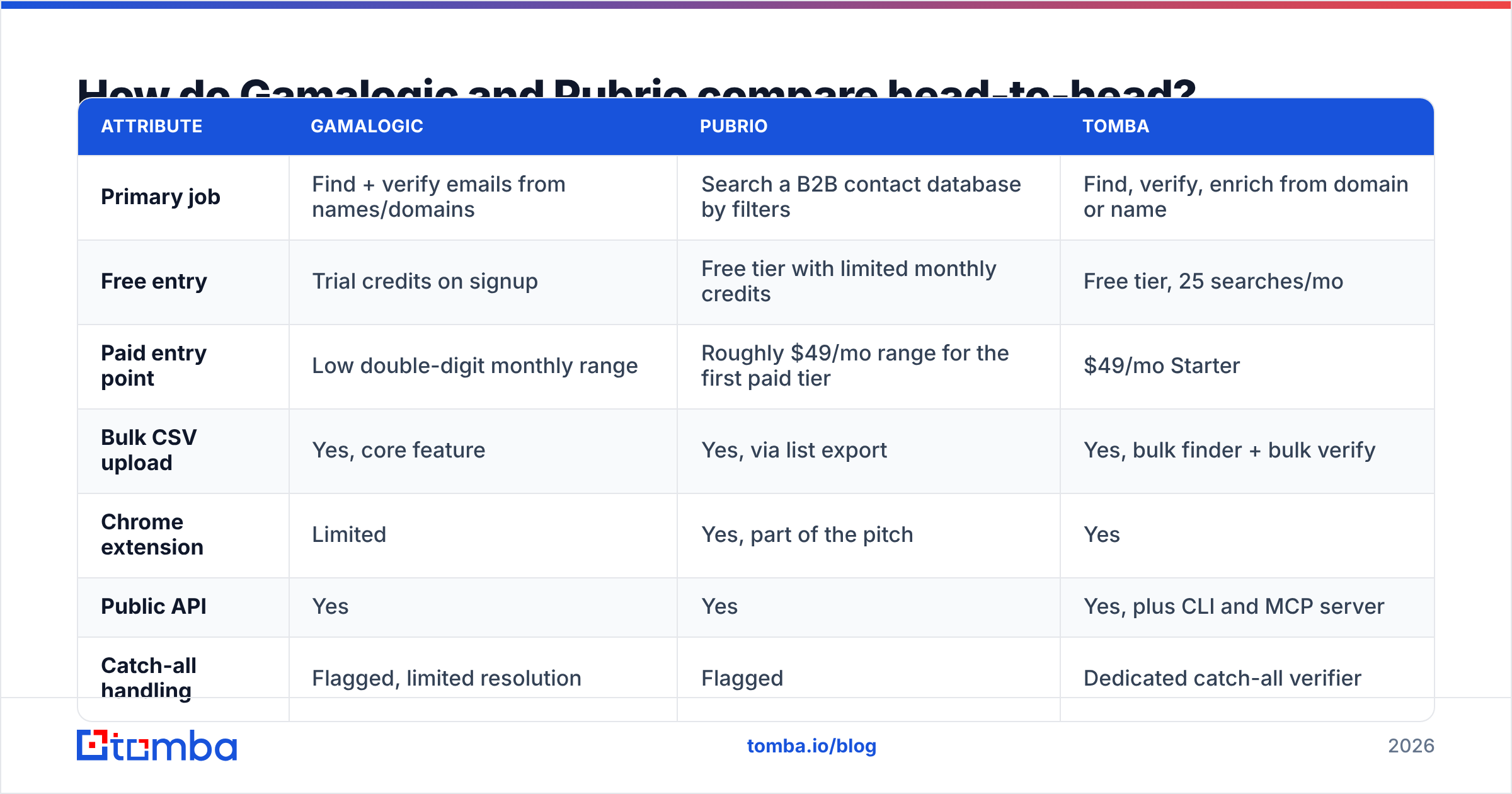
| Attribute | Gamalogic | Pubrio | Tomba |
|---|---|---|---|
| Primary job | Find + verify emails from names/domains | Search a B2B contact database by filters | Find, verify, enrich from domain or name |
| Free entry | Trial credits on signup | Free tier with limited monthly credits | Free tier, 25 searches/mo |
| Paid entry point | Low double-digit monthly range | Roughly $49/mo range for the first paid tier | $49/mo Starter |
| Bulk CSV upload | Yes, core feature | Yes, via list export | Yes, bulk finder + bulk verify |
| Chrome extension | Limited | Yes, part of the pitch | Yes |
| Public API | Yes | Yes | Yes, plus CLI and MCP server |
| Catch-all handling | Flagged, limited resolution | Flagged | Dedicated catch-all verifier |
| Phone numbers | No | Yes, on some records | Yes, via phone finder |
| Best for | Cleaning and completing known lists | Building target lists from scratch | Both, on one credit pool |
Two things stand out. Pubrio wins on breadth: if you do not yet know who to contact, a filterable database beats a lookup endpoint. Gamalogic wins on focus: if you already have 8,000 rows from a conference list, you do not need intent scores. You need deliverable addresses, cheaply.

Which one actually finds more valid emails?#
Coverage and accuracy are not the same metric, and vendors love to blur them.
- Coverage (hit rate) is the share of your input rows that come back with any address. Database-first tools like Pubrio often score well on well-known companies. They score poorly on small regional businesses that never made it into a data partner's index.
- Accuracy (validity) is the share of returned addresses that actually accept mail. Pattern-first tools like Gamalogic can post a high hit rate by guessing
first.last@domainand calling it "probable." That inflates coverage and quietly moves the failure downstream to your bounce rate.
The honest way to test this is a blind sample. Take 200 contacts you can confirm yourself — customers, past webinar registrants, people who have replied to you. Strip the emails, run both tools, and score three columns: found, correct, and bounced. Do not trust a marketing page that claims 99% without publishing its methodology.

In our own sampling across mixed-size domains, one pattern held for almost every vendor in this category. Coverage on Fortune 5000 domains is broadly similar. The spread widens on companies under 50 employees, on non-US domains, and on anything behind a catch-all MX record. That last group is where most "accuracy" arguments are really being fought.
How do the pricing models really differ?#
Credits are the unit of confusion in this market. Three vendors can quote "$49" and mean three different things.
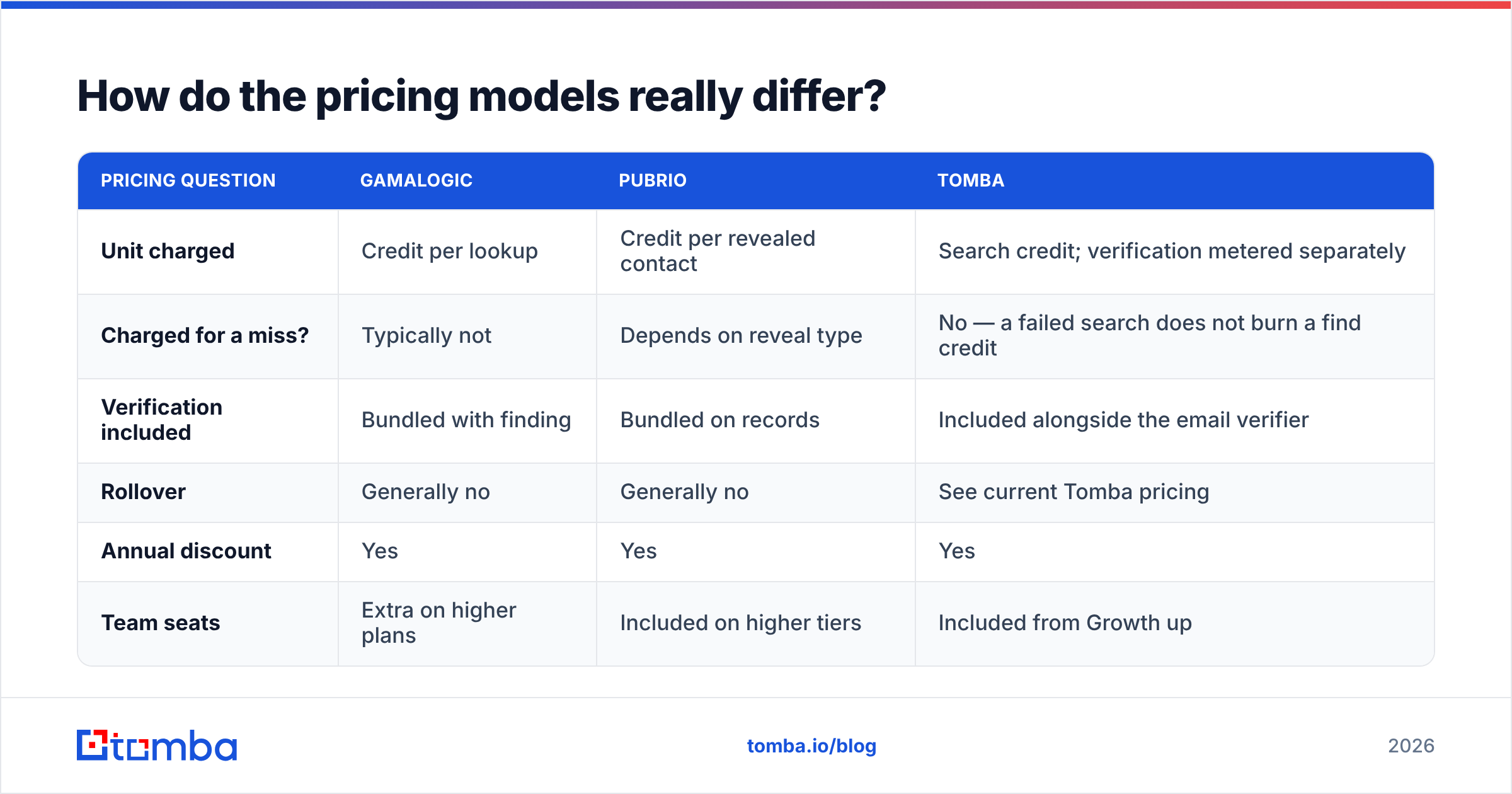
| Pricing question | Gamalogic | Pubrio | Tomba |
|---|---|---|---|
| Unit charged | Credit per lookup | Credit per revealed contact | Search credit; verification metered separately |
| Charged for a miss? | Typically not | Depends on reveal type | No — a failed search does not burn a find credit |
| Verification included | Bundled with finding | Bundled on records | Included alongside the email verifier |
| Rollover | Generally no | Generally no | See current Tomba pricing |
| Annual discount | Yes | Yes | Yes |
| Team seats | Extra on higher plans | Included on higher tiers | Included from Growth up |
Ask every vendor the same four questions before you sign:
- Do failed lookups consume credits? If yes, your real cost per usable email is far above the sticker price. A 60% hit rate on a plan that charges for misses means you pay about 1.7 credits per real address.
- Is verification a separate charge? Some tools sell you a "found" email, then charge again to tell you whether it works. That is two line items for one outcome.
- What happens to unused credits? Monthly reset is standard, but it punishes teams that prospect in bursts.
- What is the API rate limit on my tier? A finder is only as good as its throughput inside an enrichment job. Check the documented limits — Tomba publishes them with the Tomba API.
Which tool fits your workflow better?#
Pick based on where your list comes from, not on feature counts.
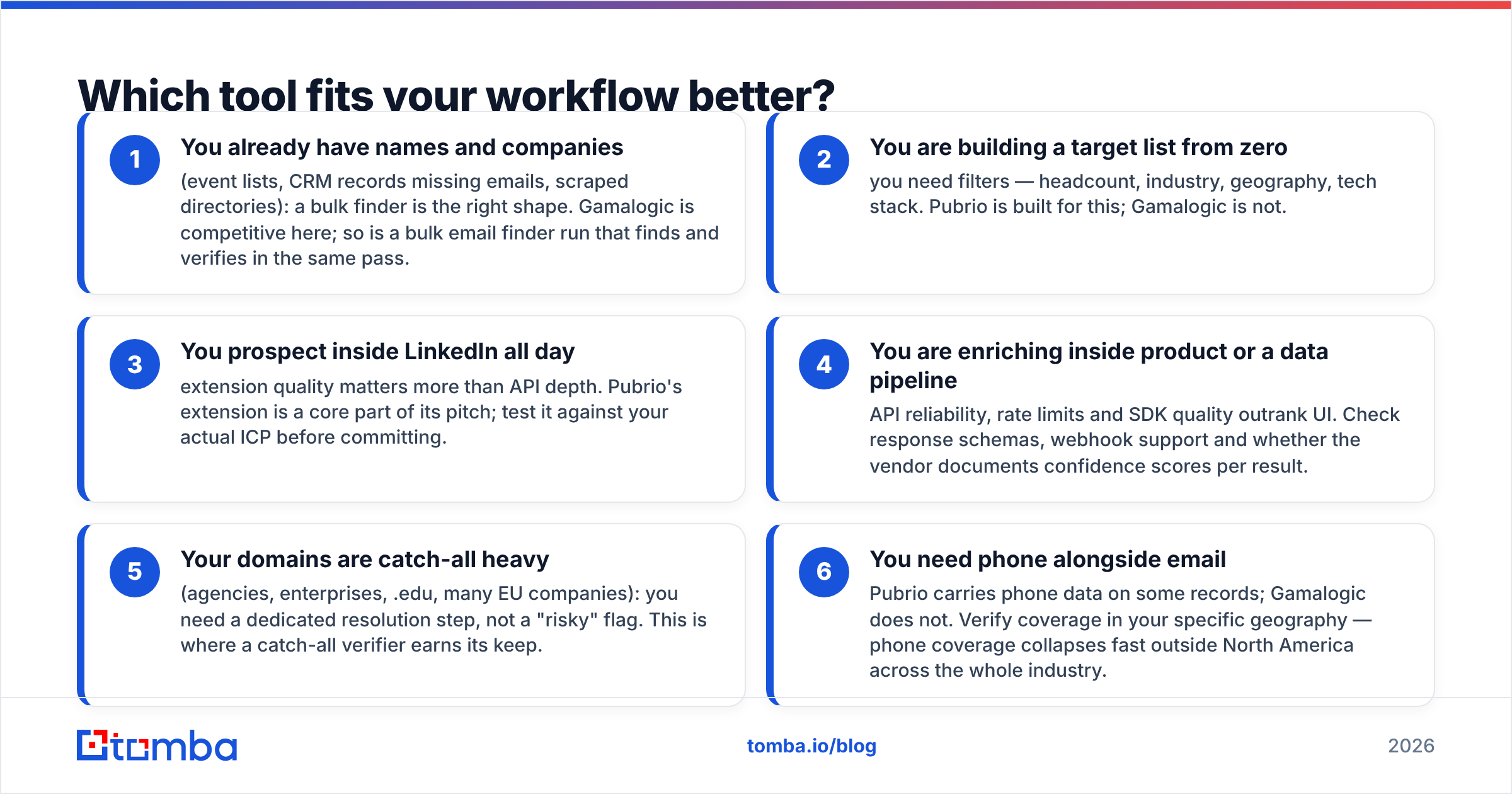
- You already have names and companies (event lists, CRM records missing emails, scraped directories): a bulk finder is the right shape. Gamalogic is competitive here, and so is a bulk email finder run that finds and verifies in one pass.
- You are building a target list from zero: you need filters — headcount, industry, geography, tech stack. Pubrio is built for this. Gamalogic is not.
- You prospect inside LinkedIn all day: extension quality matters more than API depth. Pubrio's extension is core to its pitch, so test it against your real ICP first.
Three more cases sit on the technical side:
- You are enriching inside product or a data pipeline: API reliability, rate limits and SDK quality outrank UI. Check response schemas, webhook support, and whether the vendor documents confidence scores per result.
- Your domains are catch-all heavy (agencies, enterprises, .edu, many EU companies): you need a real resolution step, not a "risky" flag. This is where a catch-all verifier earns its keep.
- You need phone alongside email: Pubrio carries phone data on some records. Gamalogic does not. Check coverage in your own geography, because phone data thins out fast outside North America.

What about verification and catch-all domains?#
Here is the part that decides your bounce rate, and neither tool solves it fully.
A catch-all domain accepts mail to any address at that domain. So a standard SMTP handshake returns "valid" for ceo@company.com and asdkjh@company.com alike. Most finders flag these as "accept-all," "risky," or "unknown" and hand the decision back to you. That single bucket is often 20–30% of a B2B list.
Your options are limited:
- Drop them. Safe for your sender reputation, expensive in lost pipeline.
- Send anyway. Fine at small volume from a warm domain. Reckless on a cold sequence at scale.
- Resolve them with extra signals — historical delivery data, pattern confirmation across sources, and secondary validation. This is the only approach that recovers those contacts without gambling your domain.
If a vendor cannot tell you how it treats accept-all domains, assume it does not treat them at all. Ask directly, and ask what share of a typical list comes back "unknown." A tool that returns 5% unknown is either much better than its peers or much more willing to guess. Only a bounce test will tell you which.
Where does each tool fall short?#
Gamalogic's limits. It is a utility, and utilities are narrow by design. There is no target-list builder, no company filtering, and no intent layer. The ecosystem around it — integrations, CRM sync, workflow tooling — is thinner than what the larger platforms ship. If your team wants one place to research accounts, find contacts, and push them to a sequencer, you will be gluing tools together. Reviews on public sites like G2 skew toward small teams and developers using it as an API component, which is a fair signal of who it fits.
Pubrio's limits. Database platforms live and die on data freshness. Job changes run around 20% a year in B2B, so any static record set decays fast. A filter UI that returns 3,000 "matching" contacts only helps if those people still hold those roles. Credit use also gets slippery when one company view reveals several contacts. Test a narrow, real ICP segment during the trial — not a broad "SaaS, 50–200 employees, United States" query that any vendor can fill.
What both share. Neither is a deliverability tool. Finding a valid address does not get you into the inbox. That is SPF, DKIM, DMARC, domain warmup and content quality. A perfect list into a cold domain still lands in spam.
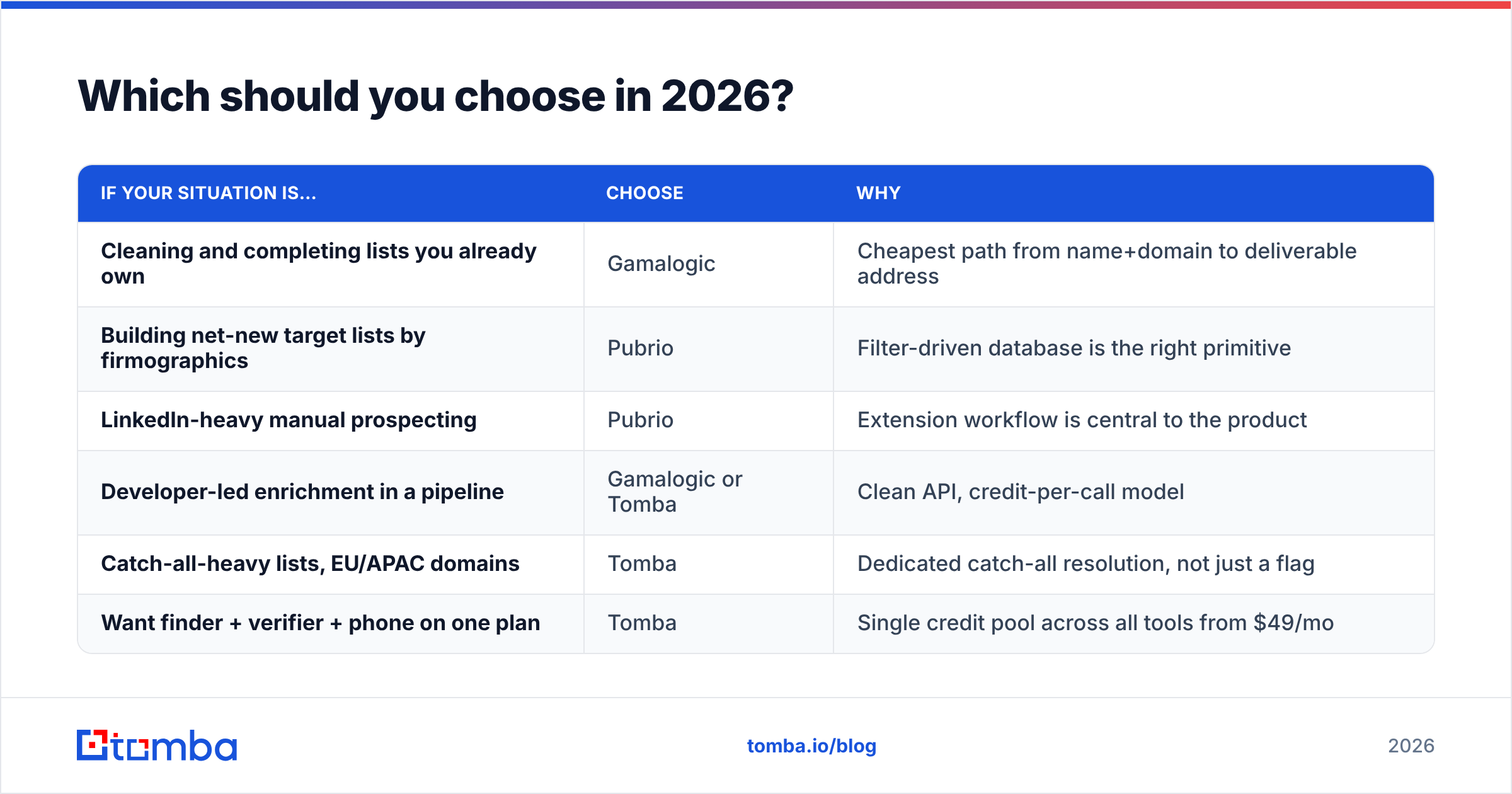
Which should you choose in 2026?#
| If your situation is… | Choose | Why |
|---|---|---|
| Cleaning and completing lists you already own | Gamalogic | Cheapest path from name+domain to deliverable address |
| Building net-new target lists by firmographics | Pubrio | Filter-driven database is the right primitive |
| LinkedIn-heavy manual prospecting | Pubrio | Extension workflow is central to the product |
| Developer-led enrichment in a pipeline | Gamalogic or Tomba | Clean API, credit-per-call model |
| Catch-all-heavy lists, EU/APAC domains | Tomba | Dedicated catch-all resolution, not just a flag |
| Want finder + verifier + phone on one plan | Tomba | Single credit pool across all tools from $49/mo |
For most teams, Gamalogic vs Pubrio is not an either/or call. Use a database tool to decide who to contact. Use a finder plus verifier to make sure those contacts are reachable. If those are two subscriptions, you pay twice and reconcile two credit systems. If one platform does both well, you do not.
Run a real bake-off before you commit. Same 200 rows, same week, three columns: found, correct, bounced. Whichever tool wins on cost per delivered email is the right answer for your ICP, whatever its landing page claims.
Ready to test the third option? Run your own list through the Tomba Email Finder on the free tier — 25 searches a month, no card. Compare hit rate and bounce rate against whatever you use now. Finder, verifier, catch-all resolution and the API all draw from the same credit pool, so you are not stitching two invoices together to get one clean list.
Related guides#
Ready to find emails that actually work?
Join 150,000+ professionals who stopped guessing and started sending. Free credits on signup — no credit card required.
Get the Tomba newsletter
Practical outbound tactics and product updates — once every two weeks.
About the author