Gamalogic vs ZoomInfo: Which B2B Data Tool Wins in 2026?
One is a lean credit-based email finder, the other is a full enterprise sales-intelligence suite with an annual contract. Here is how Gamalogic and ZoomInfo actually compare on accuracy, coverage, pricing, and lock-in.
Gamalogic vs ZoomInfo comes down to one question: are you buying emails, or buying a whole sales platform? Gamalogic is a lean, credit-based email finder. ZoomInfo is an enterprise suite with an annual contract. Here is how they compare on accuracy, price, and lock-in.
TL;DR
- Gamalogic is a credit-based email finder and verifier. You pay per lookup. You can start in minutes, with no sales call.
- ZoomInfo is an enterprise platform. It stacks intent data, org charts, technographics, and workflow tools on top of contacts.
- The two are not really rivals. Gamalogic competes on cost per verified email. ZoomInfo competes on data breadth.
- ZoomInfo sells annual, multi-seat deals with credit caps. Public G2 and Vendr data puts most of them in the five-figure range. Gamalogic costs tens of dollars a month.
- Need clean work emails at volume? An enterprise suite is costly shelfware. Need intent data for ABM? An email finder will not get you there.
- Middle path: Tomba starts at $49/mo, with public pricing and a free 25-search tier.
Gamalogic vs ZoomInfo: what does each tool do?#
They solve two different problems. The pricing pages just make them look alike.
Gamalogic finds and verifies B2B emails. You give it a name and a domain. It returns the most likely work email plus a validity signal. It sells credits, offers an API, and handles bulk CSV files. That is the whole product, and the focus is the point. It is not your CRM, your sequencer, or your intent engine.
ZoomInfo is a sales-intelligence platform. Contacts are only one layer. On top sit company data, org charts, and tech install data. Then come funding signals, hiring signals, and buyer-intent topics from a publisher co-op. It also spots website visitors and pushes records into Salesforce or HubSpot. RevOps teams buy it to run go-to-market, not to look up an address.
So the real question in Gamalogic vs ZoomInfo is not "which tool is better." It is which layer you are paying for. Are you paying enterprise rates for a lookup that costs cents?

Gamalogic vs ZoomInfo: the feature comparison#
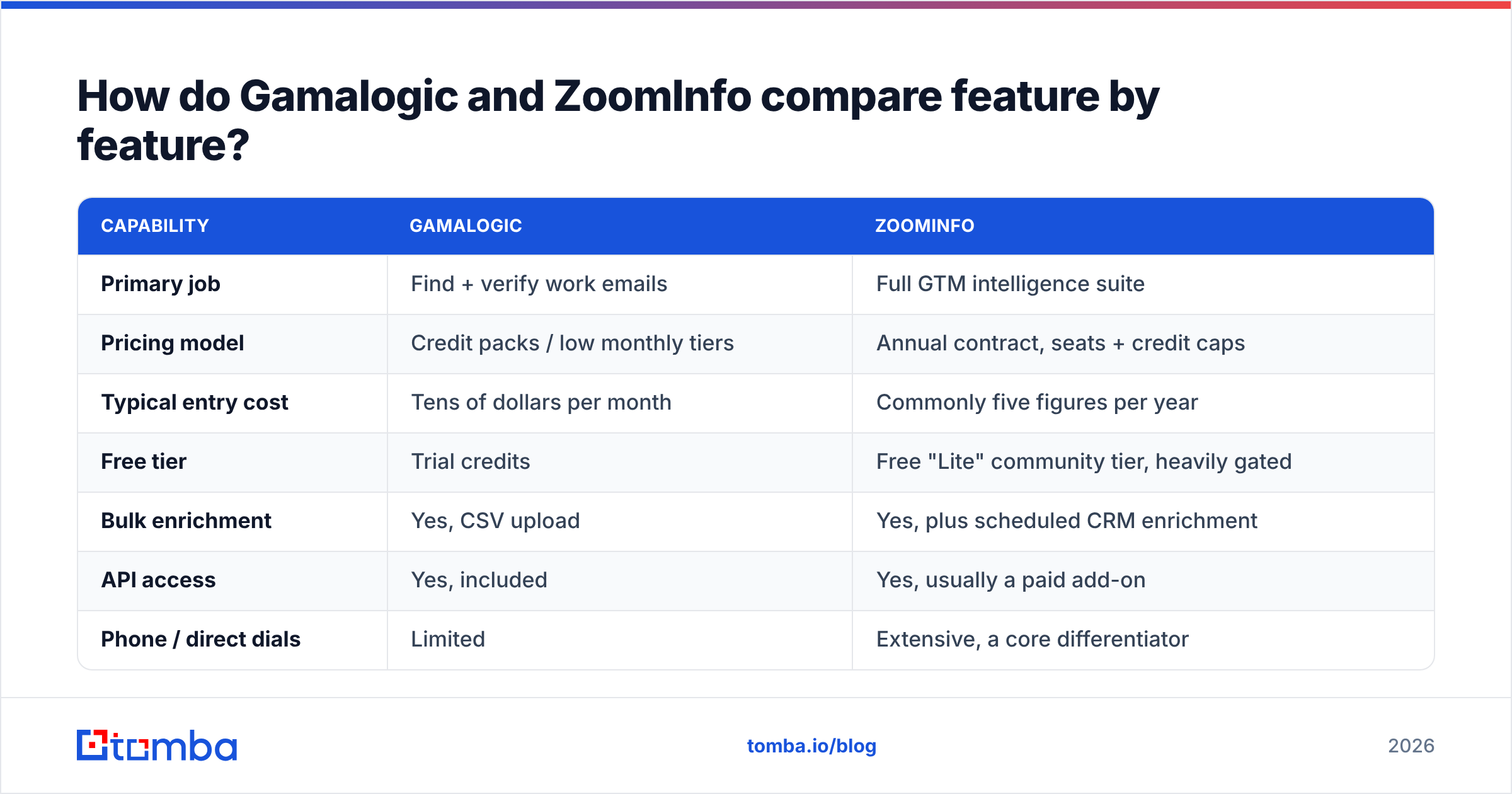
Here is the practical breakdown. Vendor numbers are current as of writing. ZoomInfo quotes per deal, so confirm any price in your own quote.
| Capability | Gamalogic | ZoomInfo |
|---|---|---|
| Primary job | Find + verify work emails | Full GTM intelligence suite |
| Pricing model | Credit packs / low monthly tiers | Annual contract, seats + credit caps |
| Typical entry cost | Tens of dollars per month | Commonly five figures per year |
| Free tier | Trial credits | Free "Lite" community tier, heavily gated |
| Bulk enrichment | Yes, CSV upload | Yes, plus scheduled CRM enrichment |
| API access | Yes, included | Yes, usually a paid add-on |
| Phone / direct dials | Limited | Extensive, a core differentiator |
| Intent data | No | Yes, publisher co-op topics |
| Org charts + technographics | No | Yes |
| CRM native integrations | Limited | Deep (Salesforce, HubSpot, Dynamics) |
| Contract flexibility | Cancel anytime | Multi-year terms common, auto-renew clauses |
| Time to first email | Minutes, self-serve | Days to weeks, demo + procurement |
Read that table as a fork in the road. Everything below the phone row is what you pay for at ZoomInfo prices. If those rows do not matter to your motion, you are shopping in the wrong aisle.
Which tool finds more accurate emails?#
Accuracy is awkward for both vendors. The word means three different things.
The three definitions to keep apart:
- Coverage. Out of 1,000 target contacts, how many return an address at all? ZoomInfo often wins here on large US accounts, thanks to sheer database size. Focused finders often win on SMB, EU, and long-tail domains.
- Deliverability. Of the addresses returned, how many still accept mail? Old databases lose here. A record from 18 months ago is a memory, not a fact. Live SMTP checks beat stale rows.
- Correctness. Did you get the CFO, or a shared
finance@inbox? Catch-all domains are the top source of fake "valid" hits. That is why a catch-all verifier beats another million rows.

The test takes an afternoon. Pull 200 contacts whose emails you already know. Closed-won accounts work well. Run the same list through each vendor, blind. Score the hit rate. Then check every returned address with a neutral email verifier. Do not trust a vendor's own confidence score. Nobody should grade their own homework.
Expect one surprise. The big suite usually returns more addresses. The focused finder usually returns cleaner ones. Which one you want depends on your bottleneck: list size, or sender reputation.
What do Gamalogic and ZoomInfo cost?#
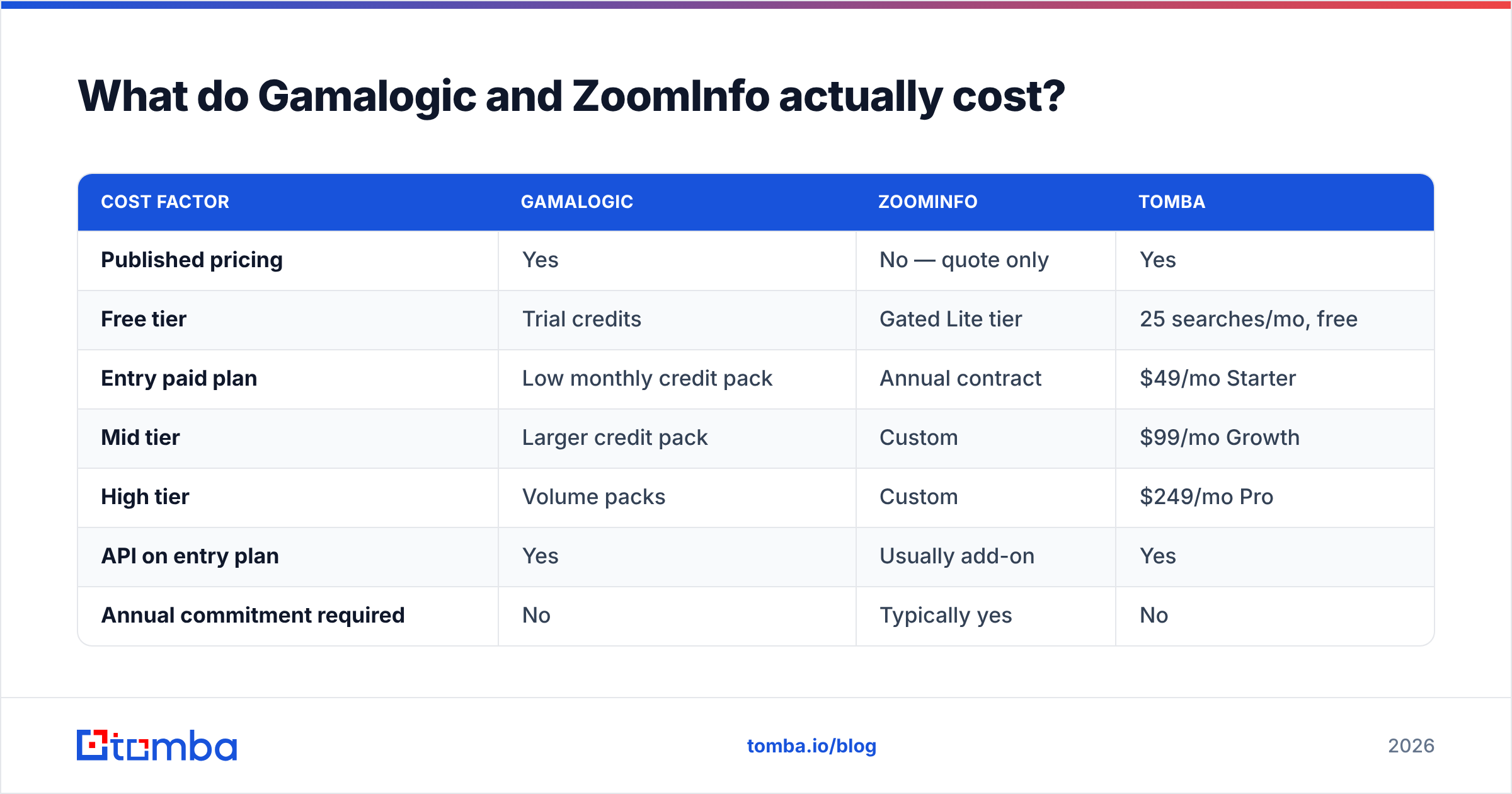
ZoomInfo does not publish prices. The public pattern is clear enough to plan around. Deals are annual and priced per seat. Credits reset each year. Buyers on G2 and procurement sites report entry deals of $15,000 to $40,000. That includes seats, phone credits, and API access. Overages are negotiated, not self-serve.
Gamalogic runs the other way. Credit packs are published. You pay monthly or as you go. There is no procurement cycle.
| Cost factor | Gamalogic | ZoomInfo | Tomba |
|---|---|---|---|
| Published pricing | Yes | No — quote only | Yes |
| Free tier | Trial credits | Gated Lite tier | 25 searches/mo, free |
| Entry paid plan | Low monthly credit pack | Annual contract | $49/mo Starter |
| Mid tier | Larger credit pack | Custom | $99/mo Growth |
| High tier | Volume packs | Custom | $249/mo Pro |
| API on entry plan | Yes | Usually add-on | Yes |
| Annual commitment required | No | Typically yes | No |
| Unused credits | Expire per cycle | Expire at term end | Expire per cycle |
One line costs teams the most money: "unused credits expire." Contracts get sized for your most hopeful quarter. Six months later, half the seats sit idle and the credit pool is barely touched. The invoice already cleared. If your volume swings, monthly Tomba pricing or credit packs protect you.
Is ZoomInfo worth it for a small team?#
Usually not. That is not a knock on the product.
ZoomInfo earns its price in three cases:
- You run ABM. Intent topics, tech data, and org charts are the raw material. No email finder replaces them.
- You have a RevOps owner. CRM enrichment, scoring, and routing are where the platform pays back. Without an owner, you bought a costly search box.
- Your reps live on the phone. ZoomInfo's direct-dial coverage is hard to match, and a phone finder only closes part of that gap.
Does none of that fit? Say you are a team of five sending cold email to a tight ICP. Then you are paying for a layer you will never open. $18,000 a year for 3,000 emails a month works out near $0.50 per contact. You can source that data for cents.
There is a compliance angle too. Big B2B databases draw scrutiny over notice rules, in the EU and in some US states. That is not unique to one vendor. But a bigger database means a bigger surface. Ask every vendor where the data sources come from. Ask how people opt out. Ask us, too. A vague answer tells you plenty.

Where does Tomba fit?#
Tomba sits in the gap: the focus of a finder, the plumbing of a platform.
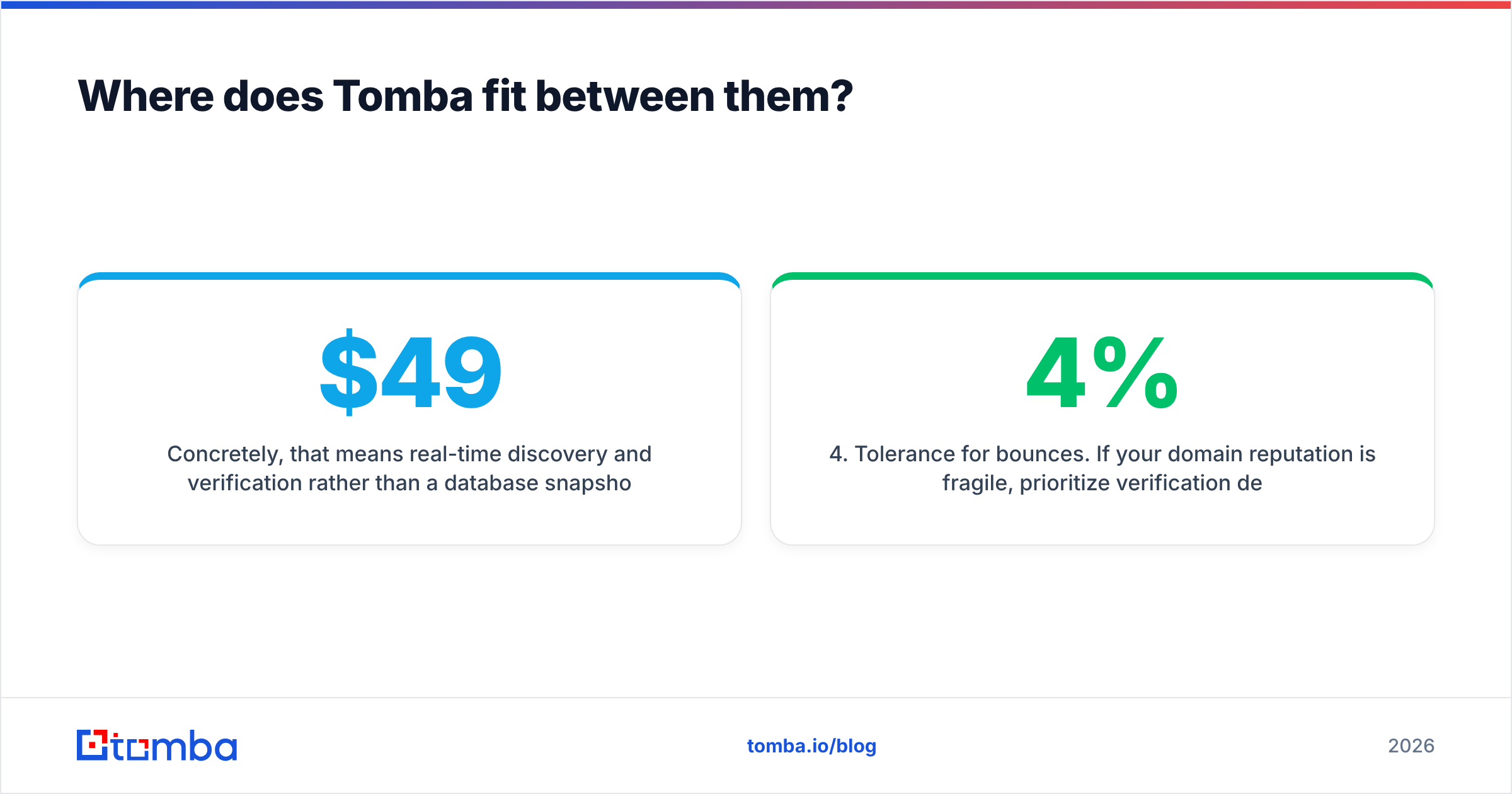
That means live lookups and checks, not a stale database. Pricing is public and starts at $49/mo. The free tier gives you 25 searches. API access is included on every paid plan, not sold as an add-on. Around the core email finder sit domain search, catch-all checks, reverse lookup, phone lookup, and enrichment. There is no intent or org-chart layer, because you would only use it with a RevOps team.

Five things should decide this for you:
- Monthly volume. Under ~5,000 lookups, credit tools win on unit cost. Above ~50,000 with heavy CRM sync, platforms start to make sense.
- Who uses the data. A person in a browser extension? Any tool works. A nightly job? Check if the API is included or billed extra.
- Where your ICP sits. Big databases suit US enterprise. EU, APAC, and SMB lists age fast, so live lookups win.
- Bounce tolerance. Fragile domain? Put verification depth first. A 4% bounce rate on 10,000 sends hurts more than a 12% miss rate.
- Contract risk. Ask about the auto-renewal notice window. The top complaint here is not price. It is spotting that clause 30 days too late.
How to run your own Gamalogic vs ZoomInfo test#
Do not decide from feature pages, including this one. Run this over a week.
Build one list of 200 contacts from your real ICP. Weight it like your pipeline, not like a wish list. Run the list through each free or trial tier. Export three columns: input, returned email, vendor confidence.
Then check all outputs with one neutral verifier, so the scoring stays fair. Use bulk verification instead of checking rows by hand. Score each tool on hit rate, valid rate, and catch-all rate. Last, divide your real annual cost by the number of valid contacts. Cost per usable contact is the only number that survives a budget meeting.
Most teams see the same pattern. The big suite wins on coverage by 10 to 20 points. It loses on cost per usable contact by a wide margin. Whether that trade is worth it depends on the rest of the platform.
The verdict#
Pick ZoomInfo if you have a RevOps team, an ABM motion, a phone-heavy sales floor, and a budget that treats data as infrastructure.
Pick Gamalogic if you want quick lookups, modest volume, and a clear price per credit.
Pick a middle option if you want the second budget with the first tool's reliability. That means live checks, catch-all handling, and an API you can build on.
That is the slot Tomba's Email Finder fills. Start free with 25 searches. Run your own Gamalogic vs ZoomInfo bake-off against the quote sitting in your inbox. Let cost per verified contact decide, not a demo deck. If the big suite wins on your data, buy it. If not, you just saved five figures.
Related guides#
Ready to find emails that actually work?
Join 150,000+ professionals who stopped guessing and started sending. Free credits on signup — no credit card required.
Get the Tomba newsletter
Practical outbound tactics and product updates — once every two weeks.
About the author