Game Film Sessions for Sales Teams: A 2026 Coaching Guide
Most sales coaching is opinion dressed up as feedback. Game film sessions replace it with recorded evidence. Here is how to run them weekly without burning your reps out.
TL;DR
- A game film session is a structured group review of recorded sales calls, borrowed from football coaching: pick a clip, watch it cold, diagnose one behavior, drill the fix.
- The format works because it replaces manager opinion ("be more consultative") with observable evidence ("you asked a closed question at 4:12 and the buyer went quiet for eleven seconds").
- The failure mode is public autopsy. If reps feel graded instead of coached, attendance collapses in three weeks. Rotate the hot seat, cap clips at 4 minutes, and always end with a reps-run drill.
- Tooling matters less than cadence. A 45-minute weekly session with a Zoom recording and a shared doc beats a $40k conversation-intelligence license nobody opens.
- Film only fixes execution. If your reps are calling wrong-fit people at bad addresses, no amount of tape review moves your numbers — fix the data layer first.
What is a game film session in sales?#
A game film session is a recurring meeting where a sales team watches recorded calls together and diagnoses specific, repeatable behaviors.
The analogy is exact. An NFL position coach does not tell a cornerback "cover better." He pulls up the snap, freezes at the receiver's break, and says: your hips were square, you gave up two steps, here is the drill. Sales coaching mostly stops at the first half of that — vague directional feedback with no timestamp attached.
Three things separate a real film session from a call-review meeting:
- A clip, not a call. You review 2-4 minutes of tape, not a 38-minute recording. The clip is chosen in advance because it contains one identifiable moment.
- A single diagnostic focus. This week is discovery questions. Next week is pricing objections. Mixing focuses turns the session into unstructured criticism.
- A drill at the end. Watching does not build skill. The last 10 minutes are role-play where two reps run the corrected behavior live.
Teams that skip step three get a book club. Teams that skip step two get a roast.
Why do most sales film sessions die after a month?#
Because the first three sessions are a manager showing off, and reps notice.
Here is the pattern. Week one, the VP picks a call from the newest rep, narrates every mistake, and the room learns that being on tape is dangerous. Week two, attendance is 80%. Week four, calendar conflicts multiply and the session quietly moves to "as needed," which means never.
The fixes are structural, not motivational:
- Rotate the hot seat on a published schedule. Everyone including the manager submits a call. When the VP's own discovery call gets picked apart, the psychological cost of being reviewed drops to near zero.
- Review wins, not just losses. Roughly half your clips should be calls that worked. Reps learn faster from "why did this land" than from "why did this fail," and it defuses the punishment framing.
- Ban outcome talk. The question is never "did they close." It is "was that the right question at that moment." A rep can play a moment correctly and still lose the deal to budget freeze.
- Cap the session at 45 minutes. Longer sessions get cancelled first when the quarter tightens.
- Let the rep self-diagnose first. Play the clip, then ask the rep on tape what they would do differently. They are right about 70% of the time, and the correction sticks because they authored it.
Gong's own research on call coaching, and broader sales-enablement work from vendors like HubSpot, consistently points at frequency over depth. Weekly and shallow beats monthly and exhaustive.
How does a game film session compare to other coaching formats?#
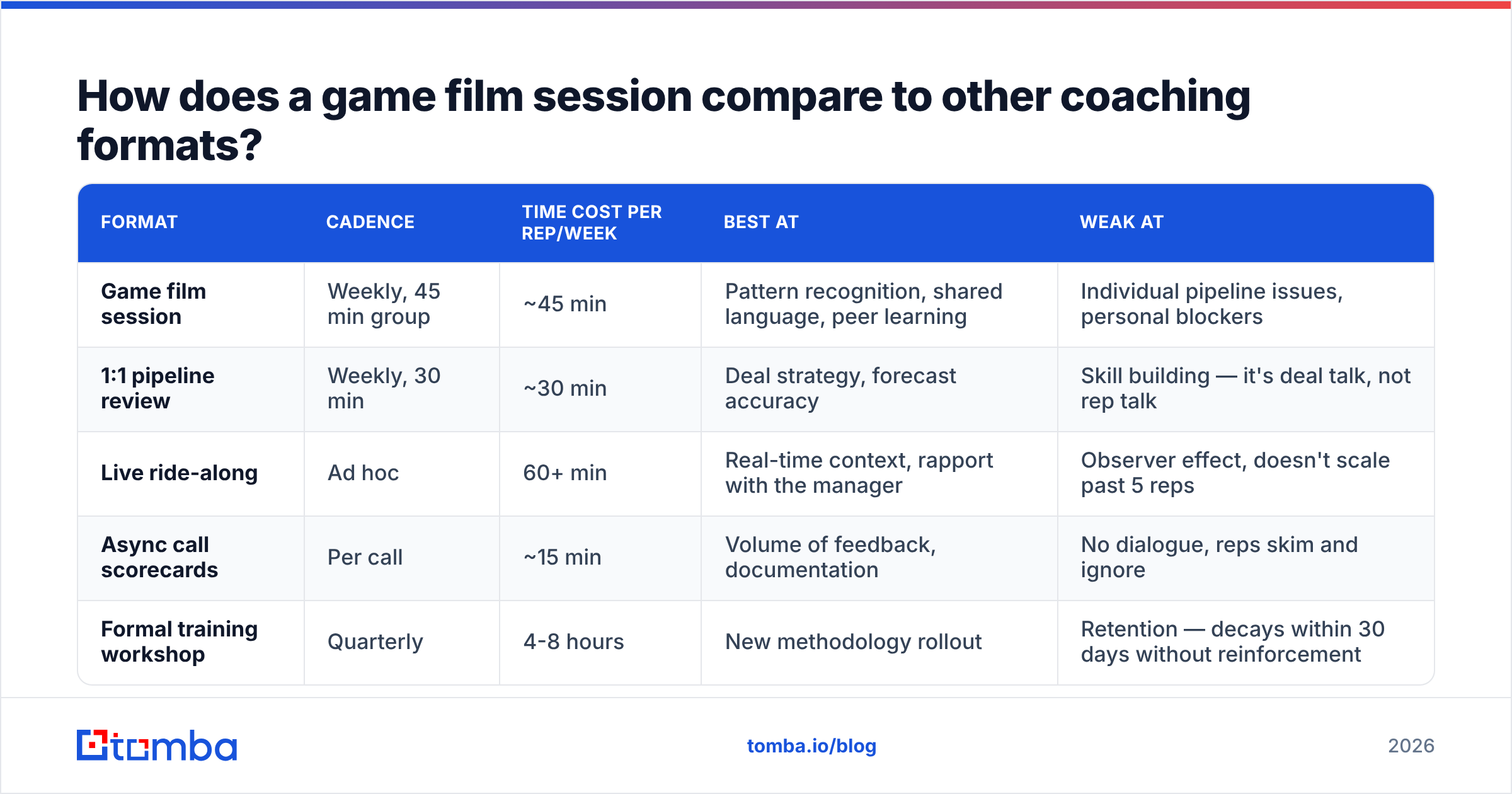
Most teams already run some coaching. The question is what film sessions add that ride-alongs and one-on-ones do not.
| Format | Cadence | Time cost per rep/week | Best at | Weak at |
|---|---|---|---|---|
| Game film session | Weekly, 45 min group | ~45 min | Pattern recognition, shared language, peer learning | Individual pipeline issues, personal blockers |
| 1:1 pipeline review | Weekly, 30 min | ~30 min | Deal strategy, forecast accuracy | Skill building — it's deal talk, not rep talk |
| Live ride-along | Ad hoc | 60+ min | Real-time context, rapport with the manager | Observer effect, doesn't scale past 5 reps |
| Async call scorecards | Per call | ~15 min | Volume of feedback, documentation | No dialogue, reps skim and ignore |
| Formal training workshop | Quarterly | 4-8 hours | New methodology rollout | Retention — decays within 30 days without reinforcement |
The honest read: film sessions are the only format on this list that scales peer learning. In a 1:1, one rep learns. In a film session, eight reps hear the same correction and start using the same vocabulary in their own calls the following week. That shared language is the compounding asset.
What should you actually review on tape?#
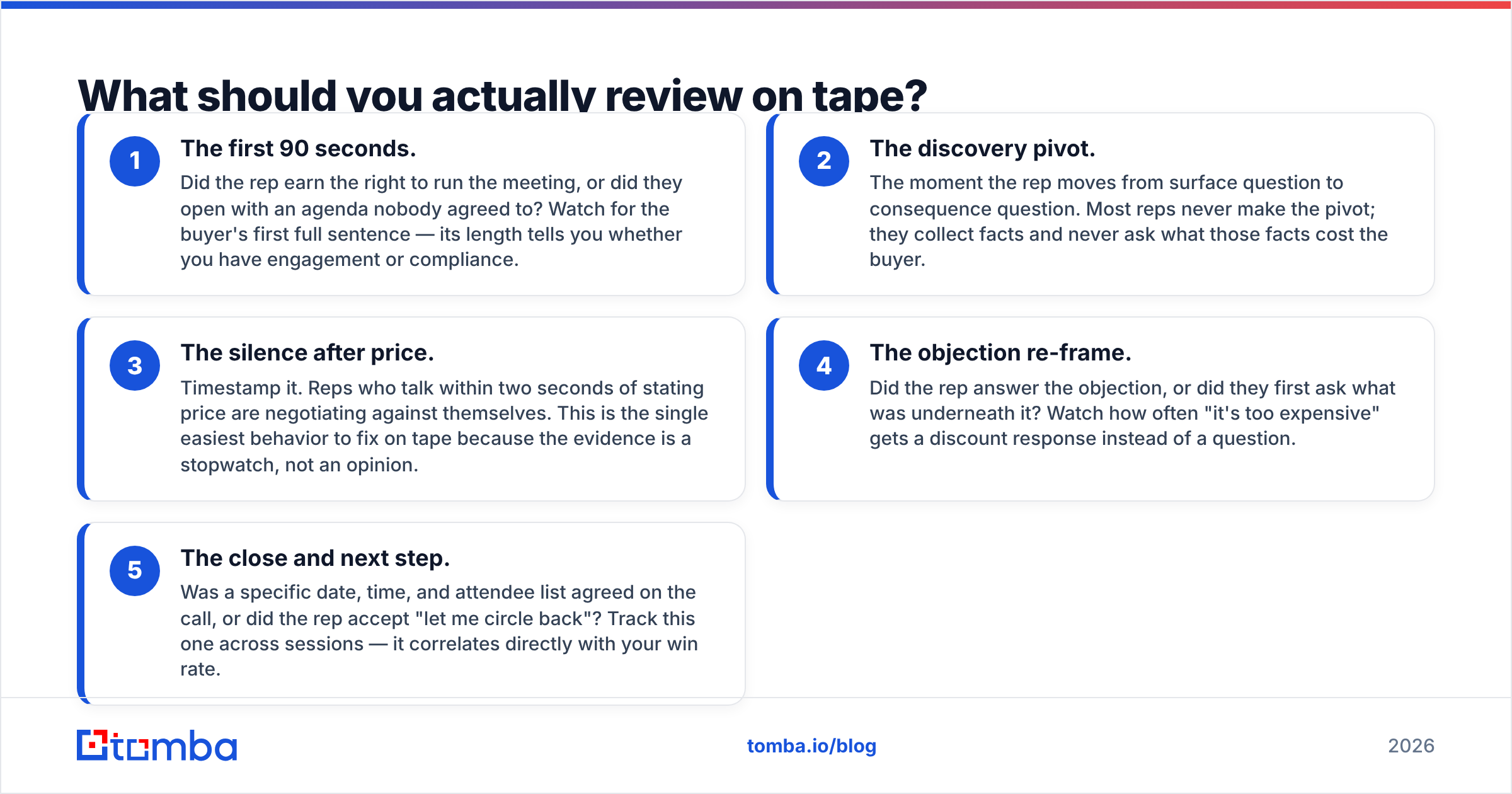
Pick one moment type per session. These five cover most of what breaks in B2B calls:
- The first 90 seconds. Did the rep earn the right to run the meeting, or did they open with an agenda nobody agreed to? Watch for the buyer's first full sentence — its length tells you whether you have engagement or compliance.
- The discovery pivot. The moment the rep moves from surface question to consequence question. Most reps never make the pivot; they collect facts and never ask what those facts cost the buyer.
- The silence after price. Timestamp it. Reps who talk within two seconds of stating price are negotiating against themselves. This is the single easiest behavior to fix on tape because the evidence is a stopwatch, not an opinion.
- The objection re-frame. Did the rep answer the objection, or did they first ask what was underneath it? Watch how often "it's too expensive" gets a discount response instead of a question.
- The close and next step. Was a specific date, time, and attendee list agreed on the call, or did the rep accept "let me circle back"? Track this one across sessions — it correlates directly with your win rate.
[Suggested visual: side-by-side timeline of two recorded discovery calls, with the discovery-pivot moment highlighted in each — one at 3:40, one never occurring]
Keep a running scoreboard in a shared sheet. Not scores out of ten — behavior counts. "Confirmed next step with a calendar invite on the call: 4 of 9 calls this week." Numbers make progress visible in a way that qualitative notes never do.
What tools do you need to run film sessions?#
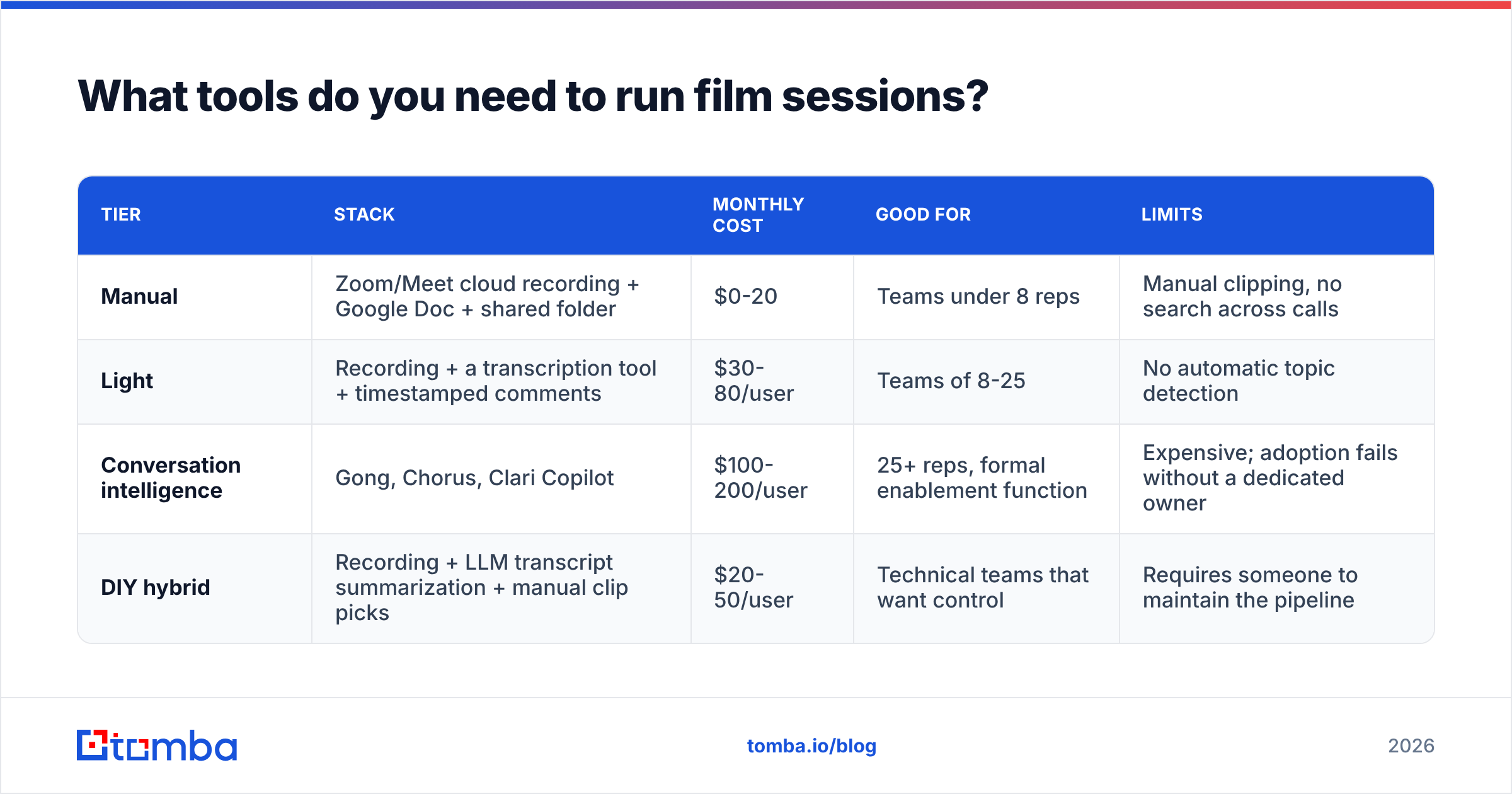
Less than vendors would like you to believe. Here is the tiering:
| Tier | Stack | Monthly cost | Good for | Limits |
|---|---|---|---|---|
| Manual | Zoom/Meet cloud recording + Google Doc + shared folder | $0-20 | Teams under 8 reps | Manual clipping, no search across calls |
| Light | Recording + a transcription tool + timestamped comments | $30-80/user | Teams of 8-25 | No automatic topic detection |
| Conversation intelligence | Gong, Chorus, Clari Copilot | $100-200/user | 25+ reps, formal enablement function | Expensive; adoption fails without a dedicated owner |
| DIY hybrid | Recording + LLM transcript summarization + manual clip picks | $20-50/user | Technical teams that want control | Requires someone to maintain the pipeline |
The uncomfortable truth about the third tier: buying Gong does not create a coaching culture, it creates a searchable archive. Teams with a working manual process get enormous leverage from conversation intelligence. Teams without one get a very expensive tape library. Check the review distribution on G2 and you will see the same split — five stars from teams with enablement headcount, two stars from teams who bought it to fix a coaching problem they never diagnosed.
Start manual. Move up a tier only when clip-finding time — not clip-watching time — becomes the bottleneck.
How do you run the session, minute by minute?#
A 45-minute format that survives contact with a real quarter:
Minutes 0-3 — the focus statement. One sentence. "Today we're only looking at what happens in the ten seconds after we state price." Nothing else gets discussed.
Minutes 3-7 — clip one, cold. Play it without setup. No context about the account, no outcome. Context biases the room toward the result instead of the behavior.
Minutes 7-12 — rep self-diagnosis, then room. The rep on tape speaks first. Then two peers. Then the manager, last and briefest.
Minutes 12-25 — clips two and three. Same structure, ideally one win and one miss on the same behavior. Contrast teaches faster than repetition.
Minutes 25-35 — the drill. Two reps role-play the corrected behavior live. Everyone else watches for the specific moment. This is the part teams cut when they run late, and it is the part that produces the actual behavior change.
Minutes 35-45 — the commitment. Each rep names one call this week where they will run the corrected behavior, and the calls get pulled for next session. This closes the loop and makes the next session's clip selection automatic.
Record the session itself. Reps who miss it can watch, and new hires get a searchable coaching archive from day one — which shortens ramp more than any onboarding deck.
Does film review fix pipeline problems?#
No, and this is where most enablement programs quietly waste money.
Film review improves execution inside conversations you are already having. It does nothing about the two failures that happen before a call exists:
- Wrong-fit targeting. If your reps are booking meetings with people who cannot buy, perfect discovery technique produces perfectly-qualified losses.
- Bad contact data. A rep who spends 40% of the week chasing bounced addresses and dead numbers has fewer calls to review, and the ones they do have are with whoever happened to answer.
Diagnose which layer you are broken at before you invest in coaching. A quick test: pull last quarter's closed-lost reasons. If more than half say "no budget," "not a priority," or "went dark," your problem sits upstream of the call. That is a targeting and data problem, and it is fixed with better contact enrichment and cleaner lists, not better tape.
Teams that get both right see the compounding effect. Clean data means more conversations per rep per week. More conversations means more film to review and faster iteration cycles. Faster iteration means the behavior corrections from Tuesday's session show up in Thursday's calls, while the correction is still fresh.
For teams building the data layer, running your outbound list through a bulk email finder and a email verifier before the sequence launches is a 20-minute step that changes what your reps are calling into. Peers like BookYourData take a database-first approach to the same problem — worth evaluating alongside a finder-plus-verifier workflow depending on whether you need ready-made lists or targeted lookups against accounts you have already picked.
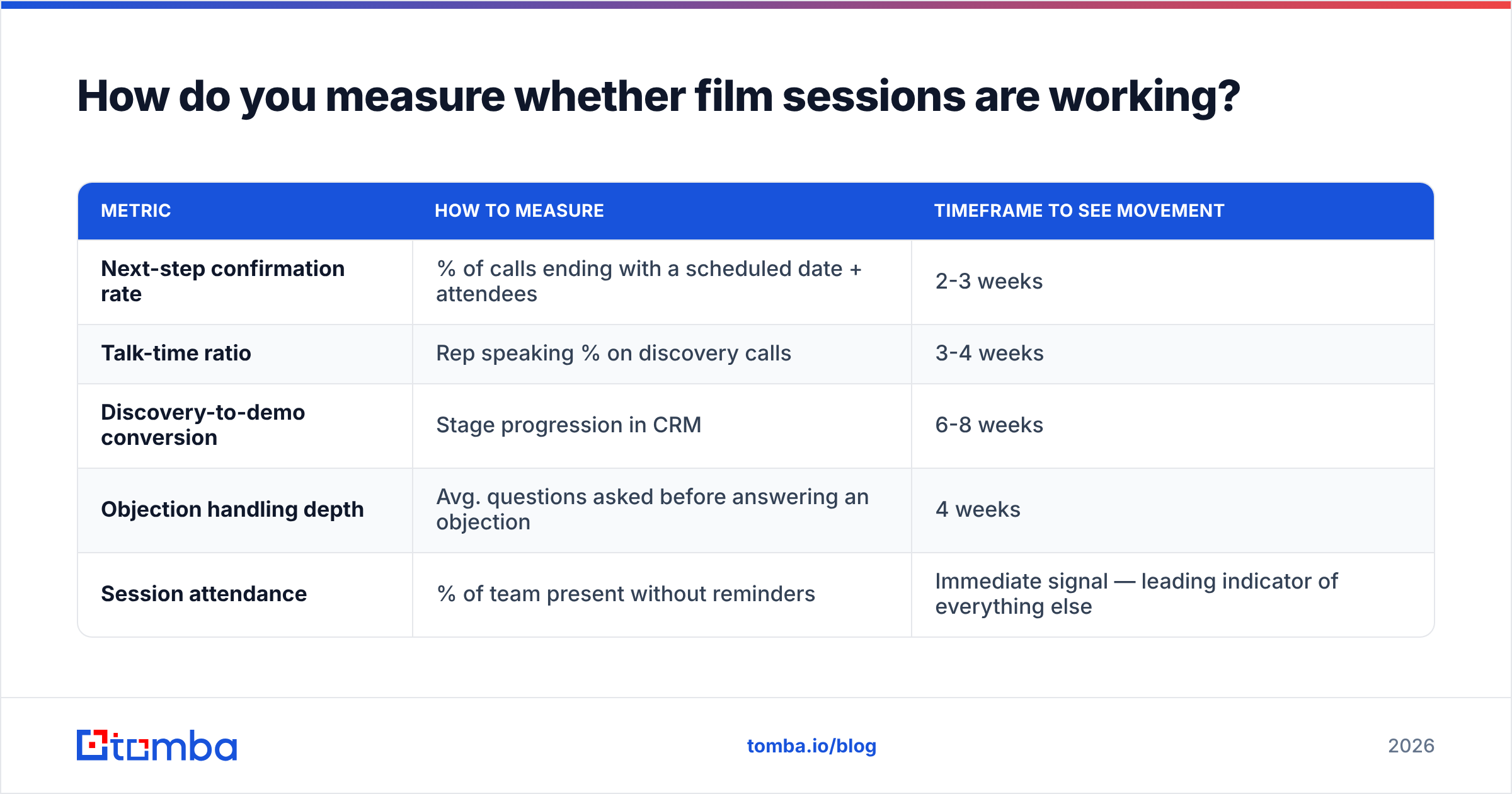
How do you measure whether film sessions are working?#
Track behavior counts, not sentiment. Sentiment surveys after coaching sessions are always positive and always meaningless.
| Metric | How to measure | Timeframe to see movement |
|---|---|---|
| Next-step confirmation rate | % of calls ending with a scheduled date + attendees | 2-3 weeks |
| Talk-time ratio | Rep speaking % on discovery calls | 3-4 weeks |
| Discovery-to-demo conversion | Stage progression in CRM | 6-8 weeks |
| Objection handling depth | Avg. questions asked before answering an objection | 4 weeks |
| Session attendance | % of team present without reminders | Immediate signal — leading indicator of everything else |
Attendance is the honest metric. If reps show up without being chased, the sessions are delivering value. If you are sending reminders, the format is broken and no downstream metric will save it.
Set a 90-day review. If next-step confirmation rate and response rate on follow-ups have not moved by then, the problem is either your clip selection (too generic) or your drills (too short).
Where should you start next week?#
Pick one behavior. Record three calls. Book 45 minutes. That is the whole setup cost.
Do not build a scorecard rubric, do not evaluate conversation-intelligence vendors, do not write an enablement charter. Those come after you have run six sessions and know what your team actually struggles with. The teams that start with tooling selection never run session one.
And before you invest a quarter in sharpening execution, check that your reps have enough of the right conversations to sharpen. If your outbound list is stale or your contact data is guesswork, film review is polishing a car with no engine. Run your target accounts through the Tomba Email Finder to get verified, current contact data for the people who can actually buy — the free tier covers 25 searches a month so you can test the lift before committing, and paid plans start at $49/mo on Tomba pricing. Fill the top of the funnel with real people, then use film sessions to make every one of those conversations count.
Related guides#
Ready to find emails that actually work?
Join 150,000+ professionals who stopped guessing and started sending. Free credits on signup — no credit card required.
Get the Tomba newsletter
Practical outbound tactics and product updates — once every two weeks.
About the author