Gazelle vs LeadzenAI: Which B2B Data Tool Fits Your GTM?
Gazelle.ai and LeadzenAI both market themselves as B2B intelligence platforms, but they solve opposite problems: one finds expanding companies, the other finds people to contact. Here is how they actually compare in 2026.
Gazelle vs LeadzenAI is the wrong fight, and that is the point. One tool finds companies. The other finds people. This guide covers what each does well, what they cost, and which one fits your go-to-market motion in 2026.
TL;DR
- They are not real competitors. Gazelle.ai is a company database. It tracks growth and expansion signals. LeadzenAI is a prospecting tool. It finds names, emails, and phone numbers.
- Pick Gazelle if you work at the company level. It answers “which firms are growing or moving into my region?” far better than “who do I email today?”
- Pick LeadzenAI if you work at the person level. Real-time search, LinkedIn lookups, and bulk pulls are its core, at SMB prices.
- Neither is a clean self-serve buy. Gazelle is quote-based and annual. LeadzenAI is credit-based and cheap, but wasted credits are the hidden cost.
- Most teams still need a third tool: a dedicated email finder and verifier to turn any list into addresses that land.
Gazelle vs LeadzenAI: what is each tool?#
Start with the mismatch. It explains every difference that follows.
Gazelle.ai is a company intelligence platform. Its data covers firmographics, growth signals, financials, and ownership for millions of global firms. Its first buyers were economic development groups. Their job is to bring a factory or a head office to their city. That history still shows. The product is built to find and score companies. Contact data is a side layer, not the main event.
LeadzenAI comes at it from the other side. It is a prospecting tool with real-time search, bulk search, a browser extension, and contact enrichment. The unit of value is one record: a name, a title, a work email, a phone number. It sells to SDR teams, agencies, recruiters, and founders who run their own outbound.
So Gazelle vs LeadzenAI is not a feature bake-off. It is a question about which part of your funnel is broken. Cannot decide who to target? Gazelle is the better tool. Already know your ICP but cannot reach it? LeadzenAI is closer to the problem.
Gazelle vs LeadzenAI: how do they compare head-to-head?#
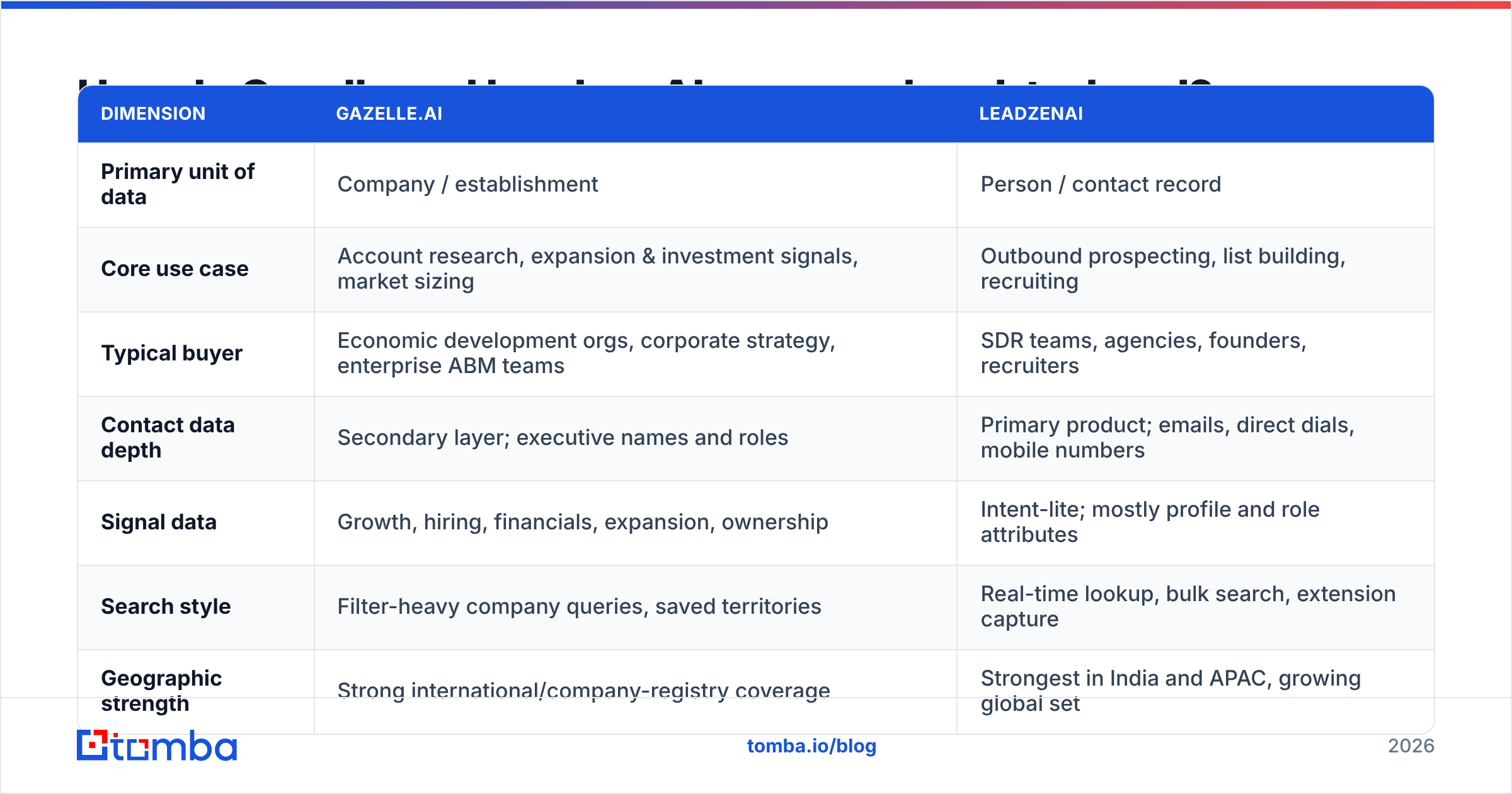
| Dimension | Gazelle.ai | LeadzenAI |
|---|---|---|
| Primary unit of data | Company / establishment | Person / contact record |
| Core use case | Account research, expansion & investment signals, market sizing | Outbound prospecting, list building, recruiting |
| Typical buyer | Economic development orgs, corporate strategy, enterprise ABM teams | SDR teams, agencies, founders, recruiters |
| Contact data depth | Secondary layer; executive names and roles | Primary product; emails, direct dials, mobile numbers |
| Signal data | Growth, hiring, financials, expansion, ownership | Intent-lite; mostly profile and role attributes |
| Search style | Filter-heavy company queries, saved territories | Real-time lookup, bulk search, extension capture |
| Geographic strength | Strong international/company-registry coverage | Strongest in India and APAC, growing global set |
| Pricing model | Quote-based, annual-contract shaped | Credit/subscription, self-serve friendly |
| API access | Available on request / enterprise tiers | Available, tier-dependent |
| Learning curve | Steeper — it is a research tool | Shallow — it is a list tool |
The table makes the trade clear. Gazelle gives you depth per company. LeadzenAI gives you volume per person. Teams get burned when they buy the wrong axis. Then they try to force the other job out of the tool.

What is Gazelle.ai actually best at?#
Four things. All of them are company-shaped.
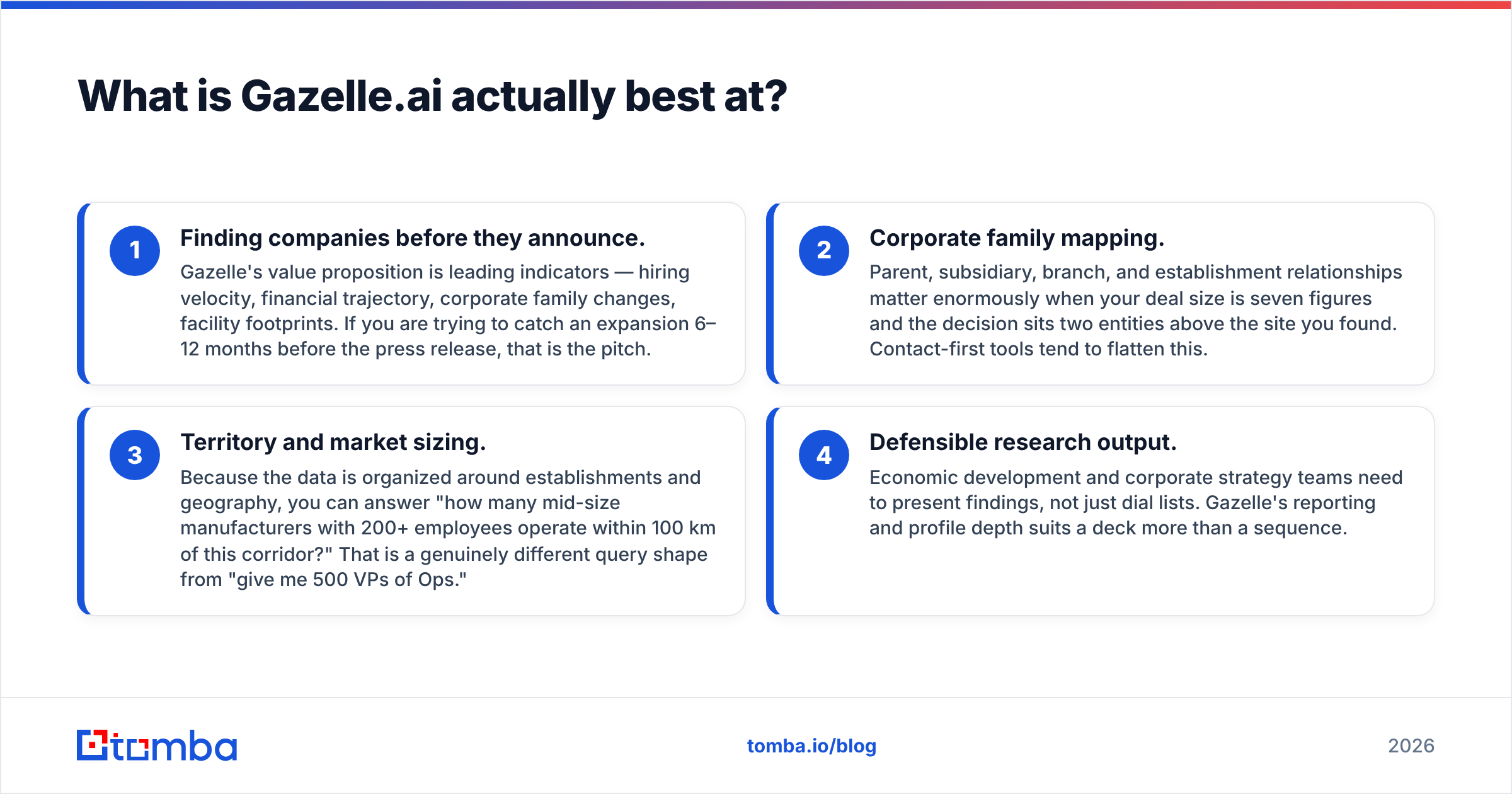
- Finding companies before they announce. Gazelle sells leading indicators: hiring speed, financial trend, corporate family changes, and facility moves. Want to catch an expansion 6–12 months before the press release? That is the pitch.
- Corporate family mapping. Parent, subsidiary, and branch links matter when the deal is seven figures. The decision often sits two entities above the site you found. Contact-first tools flatten that.
- Territory and market sizing. The data is built around sites and geography. So you can ask, “how many mid-size makers with 200+ staff sit within 100 km of this corridor?” That is a different query shape from “give me 500 VPs of Ops.”
- Research you can defend. Strategy teams present findings, not dial lists. Gazelle's reports and profiles suit a deck more than a sequence.
Where it falls short: hand it to an SDR and ask for 2,000 verified work emails by Friday, and you will be let down. The contact layer exists. It was never the point. Email coverage is thinner than a dedicated contact database.
Where does LeadzenAI win?#
LeadzenAI is built for throughput. Its real-time search hits live sources at query time. It does not just serve a stale snapshot. That helps with the biggest problem in B2B data: decay. Roughly a quarter to a third of contact records go stale each year as people change jobs. Data vendors report this pattern often, and reviewers on G2 echo it. A tool that re-checks at query time has a real edge over one that refreshes each quarter.
Its strengths in practice:
- Bulk search. Upload names and companies. Get contact records back. This is the workhorse for agencies.
- Browser extension. Prospect while you browse profiles. No round trip through a web app.
- Phone coverage. Direct dials and mobiles are a real edge over company databases, above all in APAC.
- Price. It is priced for a two-person SDR pod, not a procurement cycle.
Where it falls short: account-level depth is thin. You will not get corporate hierarchy, site detail, or the expansion signals that drive enterprise targeting. Verification quality also varies by region. Records from APAC sources behave differently from EU or US ones, in both accuracy and compliance.
Gazelle vs LeadzenAI: how the data models differ#
Most comparison posts skip this part. It is the one that predicts whether you are happy in month three.
- Snapshot vs live lookup. Gazelle uses a curated corpus, refreshed on a cycle. That is good for consistency. LeadzenAI resolves in real time. That is better for freshness, worse for repeat runs.
- Entity resolution. Gazelle resolves to legal entities and sites. LeadzenAI resolves to people. If your CRM is built around accounts, person-first imports mean weeks of de-duping.
- Coverage bias. Registry data leans toward registered, settled firms. Profile data leans toward people with public profiles. Neither bias is wrong. Both stay invisible until they cost you a segment.
- Verification. Gazelle is not an email verification service. LeadzenAI does some checks. Neither replaces a dedicated email verifier run just before send.
- Compliance. Enterprise buyers ask about GDPR basis, data sources, and suppression. Get it in writing before you sign.
Gazelle vs LeadzenAI pricing in 2026#
Neither vendor makes pricing easy. Treat the table below as a shape, not a quote. Always check the vendor's own pricing page before you budget.
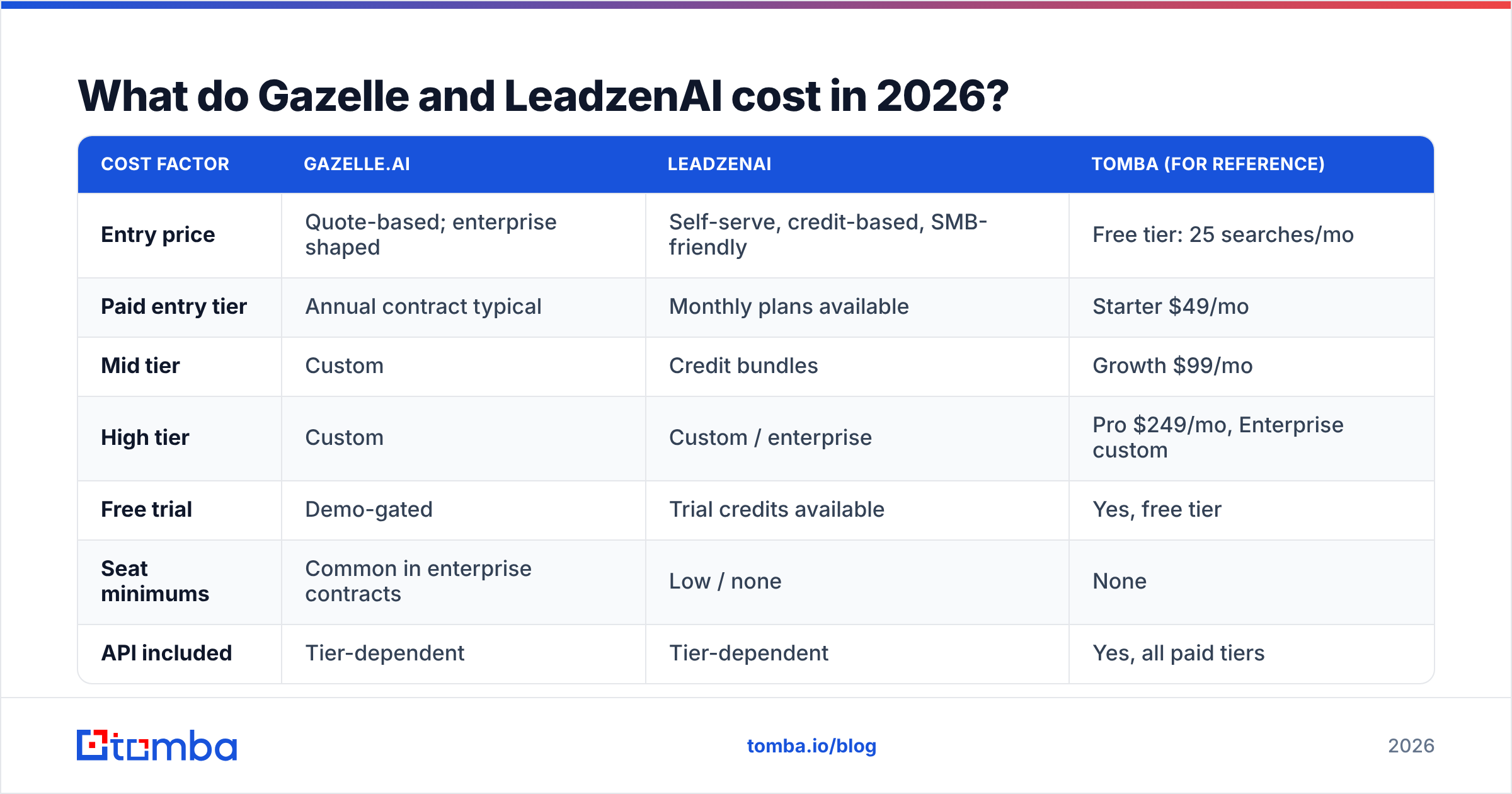
| Cost factor | Gazelle.ai | LeadzenAI | Tomba (for reference) |
|---|---|---|---|
| Entry price | Quote-based; enterprise shaped | Self-serve, credit-based, SMB-friendly | Free tier: 25 searches/mo |
| Paid entry tier | Annual contract typical | Monthly plans available | Starter $49/mo |
| Mid tier | Custom | Credit bundles | Growth $99/mo |
| High tier | Custom | Custom / enterprise | Pro $249/mo, Enterprise custom |
| Free trial | Demo-gated | Trial credits available | Yes, free tier |
| Seat minimums | Common in enterprise contracts | Low / none | None |
| API included | Tier-dependent | Tier-dependent | Yes, all paid tiers |
Two budget traps to plan for.
The annual-commitment trap (Gazelle side). Research tools sold through demos are almost always annual. That is fine for a year-long territory project. It is costly if you only needed three months of mapping.
The credit-burn trap (LeadzenAI side). Credit tools charge for the attempt, not the result. A 10,000-credit plan sounds generous. Then 30% of pulls return a role-based address, a catch-all domain, or a stale record. Model your cost per verified contact, not per credit. Comparing against Tomba pricing? Do the same math on both sides.

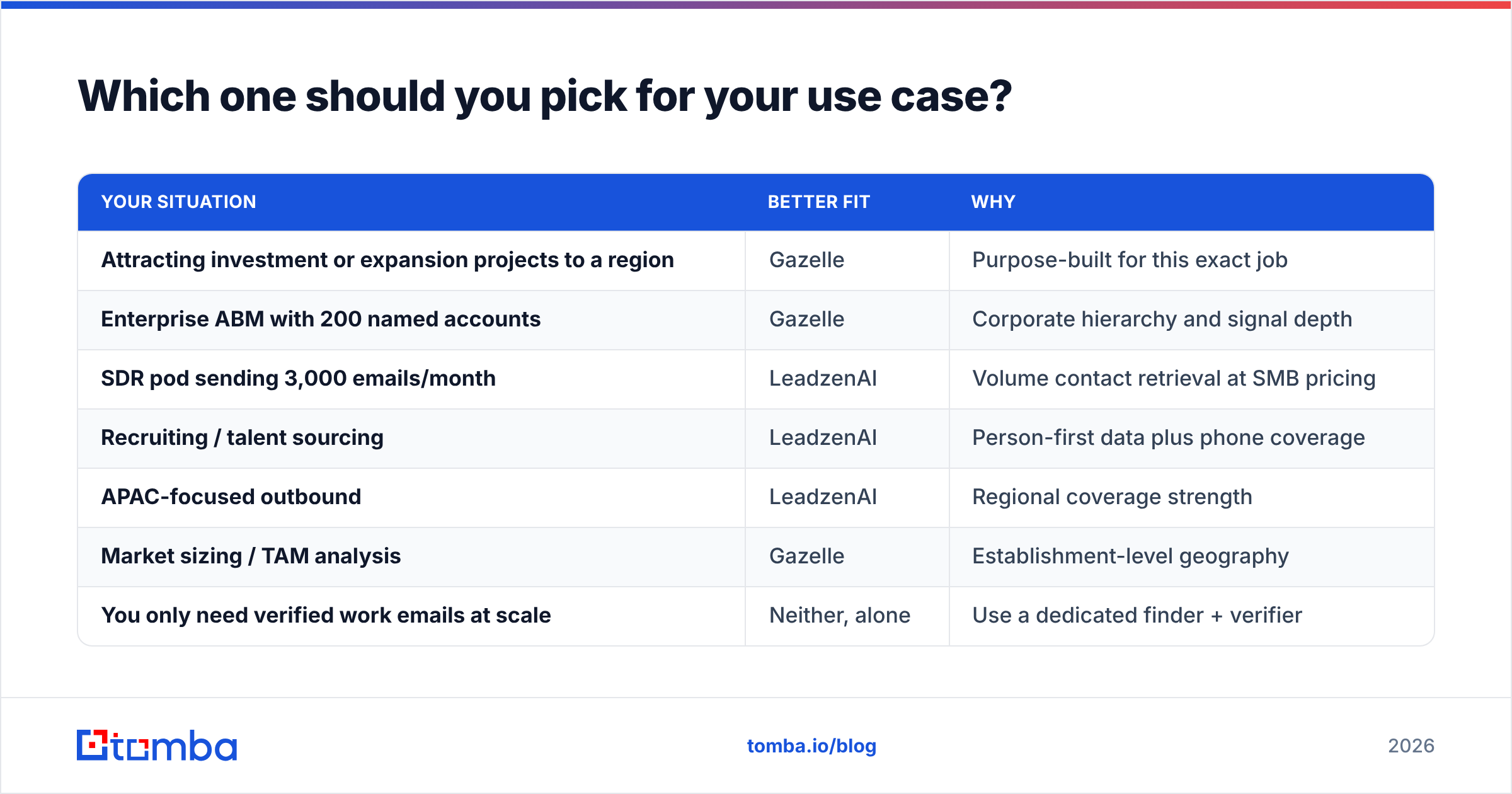
Which one should you pick for your use case?#
| Your situation | Better fit | Why |
|---|---|---|
| Attracting investment or expansion projects to a region | Gazelle | Purpose-built for this exact job |
| Enterprise ABM with 200 named accounts | Gazelle | Corporate hierarchy and signal depth |
| SDR pod sending 3,000 emails/month | LeadzenAI | Volume contact retrieval at SMB pricing |
| Recruiting / talent sourcing | LeadzenAI | Person-first data plus phone coverage |
| APAC-focused outbound | LeadzenAI | Regional coverage strength |
| Market sizing / TAM analysis | Gazelle | Establishment-level geography |
| You only need verified work emails at scale | Neither, alone | Use a dedicated finder + verifier |
| Cold calling motion | LeadzenAI | Direct dial and mobile coverage |
Checking boxes on both sides? That is a real answer, not indecision. Many enterprise teams run a company layer for targeting and a contact layer for execution. The mistake is paying enterprise money for a research tool, then asking it to build lists.
Do you still need an email finder alongside either tool?#
In most stacks, yes. This is less a Tomba plug than an architecture note.
Company platforms tell you which accounts matter, then hand you a thin contact layer. Prospecting platforms hand you contacts with no account context and mixed verification. Either way, the last mile is a separate job. Turning a name plus a domain into an address that lands has its own economics.
That last mile is where a purpose-built domain search and email-finding layer earns its keep:
- Pattern resolution. Most firms use one set format. Picking
first.last@,flast@, orfirst@per domain is solvable with enough observed data. - Catch-all handling. Catch-all domains accept everything at SMTP time, then bounce later. You need real handling, not a green check that means nothing.
- Verify before send. Bounces are the fastest way to wreck email deliverability. Verify right before send, not weeks earlier.
- Bulk economics. Per-record cost matters at 10,000 rows. A tool built to find and verify beats a bundled add-on.
A practical stack for a mid-market team: use Gazelle or your CRM to pick who, use LeadzenAI or another contact database for names and phones, then run a finder-and-verifier pass. Three narrow tools that each do one job well beat one broad tool that does all three at 70%.
What should you ask on the demo call?#
Bring these to both vendors. The answers separate marketing pages from reality.
- “Show me coverage for my exact ICP, live.” Not a curated demo account. Your industry, your geography, your headcount band.
- “What is your refresh cadence, per field?” Financials, headcount, and email addresses decay at very different rates.
- “What happens on a failed lookup — do I pay?” Get this in writing for credit-based plans.
- “What is your documented data provenance?” This matters most for EU and UK contacts.
- “Can I export, and what are the limits?” Some platforms cap export volume in ways that break your workflow.
- “What is the real minimum term and seat count?” Ask before you fall in love with the interface.
Run a 200-record bake-off with both. Verify the outputs yourself. Then compare cost per usable record. That one test outranks every review site.
Gazelle vs LeadzenAI: the verdict#
Gazelle.ai wins on targeting. It tells you which companies deserve attention, where they operate, and what they are about to do. LeadzenAI wins on reach. It gets names, emails, and phones into a sequence this week, with no procurement cycle. The two overlap far less than their marketing suggests. Choosing between them means naming which half of your funnel leaks.
Whichever you pick, do not skip the last mile. Run your finished list through a tool built for that job. The Tomba Email Finder resolves work addresses by name and domain, flags catch-alls, and verifies before you send. It starts free with 25 searches a month, then $49/mo on Starter, with API access on every paid plan. It is cheap insurance against a bounce rate that quietly kills your domain.
Related guides#
Ready to find emails that actually work?
Join 150,000+ professionals who stopped guessing and started sending. Free credits on signup — no credit card required.
Get the Tomba newsletter
Practical outbound tactics and product updates — once every two weeks.
About the author