Gazelle.ai vs Tomba (2026): Which B2B Data Tool Wins?
Gazelle.ai sells company intelligence on an annual quote. Tomba sells verified contact data from $49/mo. They solve different halves of the same problem — here is which half you actually need.
TL;DR
- Gazelle.ai and Tomba are not the same category of tool. Gazelle.ai is company-level intelligence — firmographics, growth signals, expansion indicators, international coverage. Tomba is contact-level data — verified work emails, patterns, phone numbers, enrichment.
- Gazelle.ai is quote-based and typically sold as an annual license through a demo call. Tomba is self-serve with a published price list: free tier at 25 searches/mo, Starter $49/mo, Growth $99/mo, Pro $249/mo.
- If your bottleneck is "which companies should we target, especially outside North America," Gazelle.ai is the stronger answer.
- If your bottleneck is "we know the accounts, we cannot reach the humans inside them," Tomba is the stronger answer — and it is roughly an order of magnitude cheaper.
- Most teams that evaluate both end up running account selection in one layer and contact discovery in another. The comparison below shows where the seam sits.
What is Gazelle.ai?#
Gazelle.ai is an AI-driven company intelligence platform built primarily for economic development organizations, site selection consultants, and enterprise business development teams. Its pitch is prediction: the platform scores companies on likelihood to expand, relocate, invest, or open a new facility, and layers that on top of a global company database with a strong international footprint.
Think of it as a scouting department rather than a phone book. It tells you which teams are about to make a move, based on hiring patterns, financial signals, subsidiary structures, and news events. That is genuinely hard data to assemble, and it explains the pricing model.
What Gazelle.ai is good at:
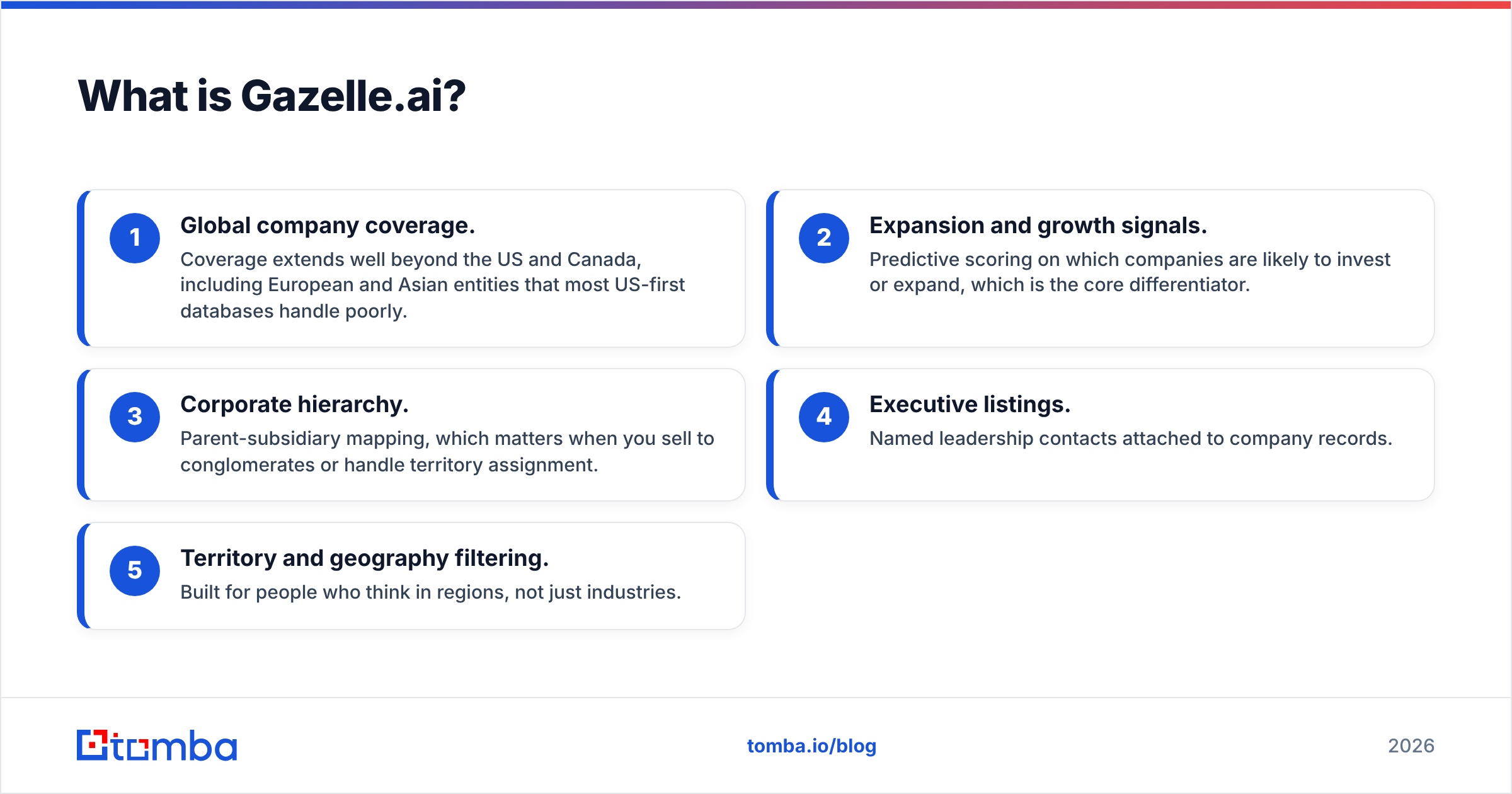
- Global company coverage. Coverage extends well beyond the US and Canada, including European and Asian entities that most US-first databases handle poorly.
- Expansion and growth signals. Predictive scoring on which companies are likely to invest or expand, which is the core differentiator.
- Corporate hierarchy. Parent-subsidiary mapping, which matters when you sell to conglomerates or handle territory assignment.
- Executive listings. Named leadership contacts attached to company records.
- Territory and geography filtering. Built for people who think in regions, not just industries.
What it is not built for: high-volume outbound. It is not a cold email tool, and its contact layer is a supporting feature rather than the product.
What is Tomba?#
Tomba is a contact data platform built around one core job — finding and verifying professional email addresses. The email finder takes a name plus a company domain and returns a verified work email with a confidence score and the sources it was found in. Around it sit a verifier, domain search for pulling every discoverable address at a company, a catch-all verifier, a phone finder, and data enrichment.
The mental model is a locksmith, not a scout. Tomba does not tell you which building to walk into. It gets you through the door once you have picked one.
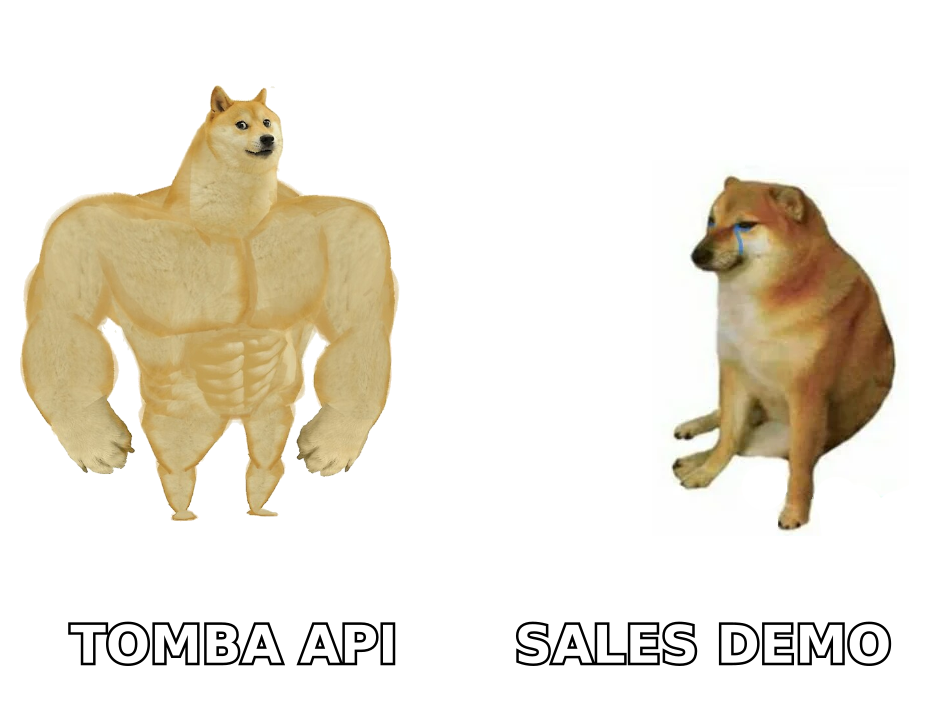
Tomba is self-serve. You sign up, you get 25 free searches, you hit the API within ten minutes. There is no demo gate, no annual commitment, and no procurement cycle — which is exactly why it shows up in evaluations against enterprise data platforms whose sales process takes six weeks.
How do Gazelle vs Tomba compare head-to-head?#
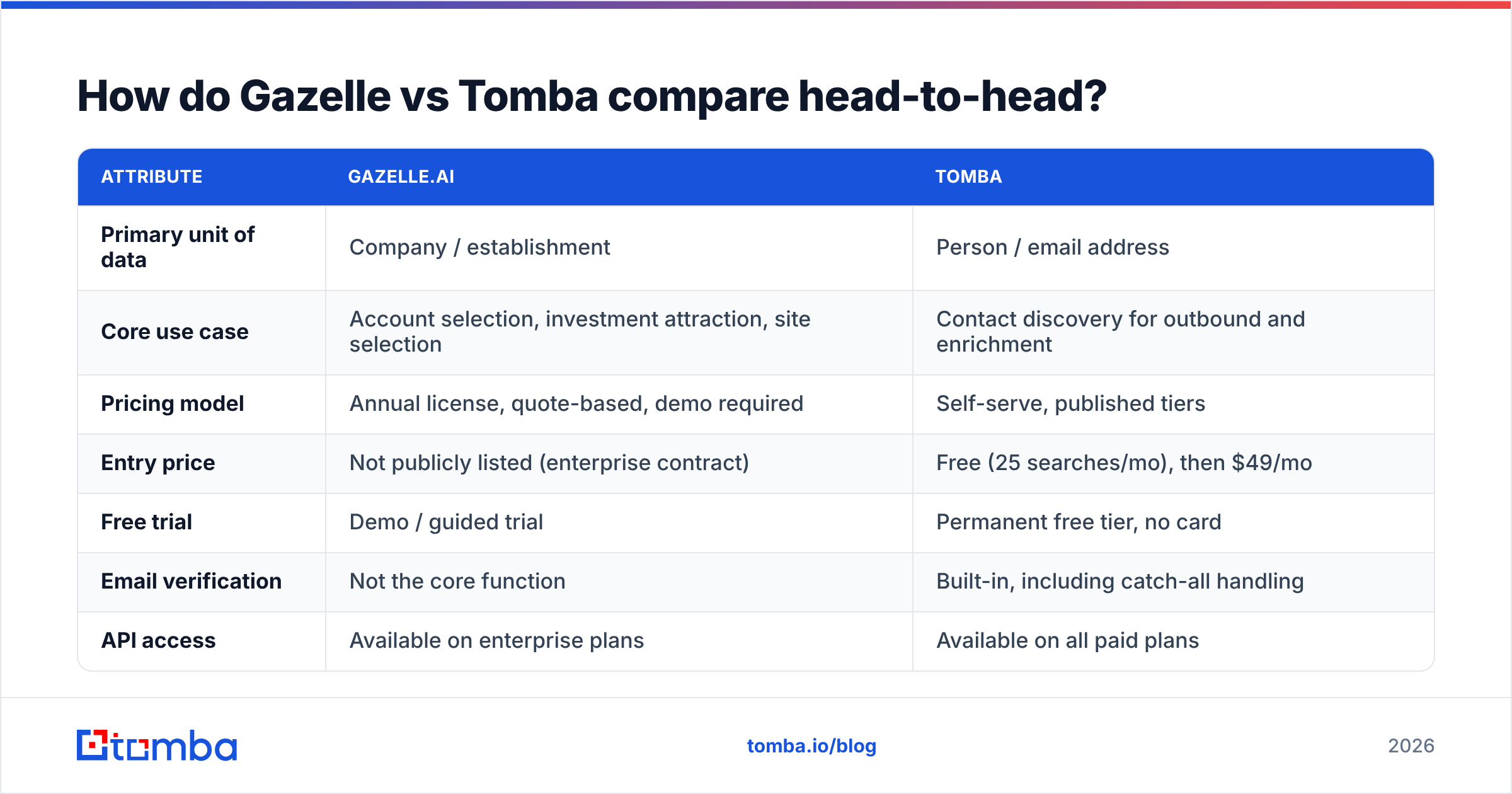
| Attribute | Gazelle.ai | Tomba |
|---|---|---|
| Primary unit of data | Company / establishment | Person / email address |
| Core use case | Account selection, investment attraction, site selection | Contact discovery for outbound and enrichment |
| Pricing model | Annual license, quote-based, demo required | Self-serve, published tiers |
| Entry price | Not publicly listed (enterprise contract) | Free (25 searches/mo), then $49/mo |
| Free trial | Demo / guided trial | Permanent free tier, no card |
| Email verification | Not the core function | Built-in, including catch-all handling |
| API access | Available on enterprise plans | Available on all paid plans |
| Geographic strength | Strong international, incl. EMEA + APAC | Strong global domain coverage, no region lock |
| Predictive growth signals | Yes — core differentiator | No |
| Bulk processing | Platform exports | Bulk finder + bulk verifier |
| Native integrations | CRM exports, enterprise connectors | HubSpot, Salesforce, Pipedrive, Zapier, Sheets, Excel, Airtable |
| Typical buyer | EDO, site selector, enterprise BD | SDR team, growth marketer, agency, developer |
| Time to first result | Days to weeks (sales cycle) | Minutes |
The table makes the honest conclusion obvious: this is not a feature-for-feature fight. One tool answers who, the other answers how do I reach them. Anyone selling you a "winner" without asking which question you are stuck on is guessing.
Which one actually has better data?#
Better at what, is the real question.
Company-level breadth and signal quality: Gazelle.ai wins. Its whole architecture is aimed at establishment-level records, ownership chains, and forward-looking indicators. If you need to know that a German mid-market manufacturer is likely to open a North American facility in the next 18 months, no email finder on earth will tell you that.
Contact-level accuracy and freshness: Tomba wins, and it is not particularly close, because that is the entire product. Every returned address comes with a confidence score plus the public sources it was found on, and every result can be pushed through the email verifier before it enters a sequence. Catch-all domains — the single biggest source of inflated "valid" rates across the industry — get their own dedicated handling instead of being silently marked deliverable.
A practical warning that applies to both tools and to every vendor in this space: no database is accurate in the abstract. Accuracy is a function of your ICP. A platform with excellent coverage of European industrial firms may be thin on US seed-stage SaaS, and vice versa. The only test that matters is running 200 of your target accounts through a trial and measuring what comes back. Tomba's free tier makes that test cost nothing; Gazelle.ai's demo makes it a scheduled conversation.
Also worth understanding before you compare vendors at all: the underlying firmographics that company databases sell are frequently sourced from overlapping public registries. Two vendors quoting wildly different record counts may be describing the same underlying reality with different counting rules.
How does pricing compare between Gazelle and Tomba?#
| Plan tier | Gazelle.ai | Tomba |
|---|---|---|
| Free | Demo only | 25 searches/mo, forever |
| Entry paid | Custom quote, annual | Starter — $49/mo |
| Mid tier | Custom quote, annual | Growth — $99/mo |
| High tier | Custom quote, annual | Pro — $249/mo |
| Enterprise | Custom | Custom |
| Commitment | Typically annual | Monthly, cancel anytime |
| Buying process | Demo → proposal → contract | Card → instant access |
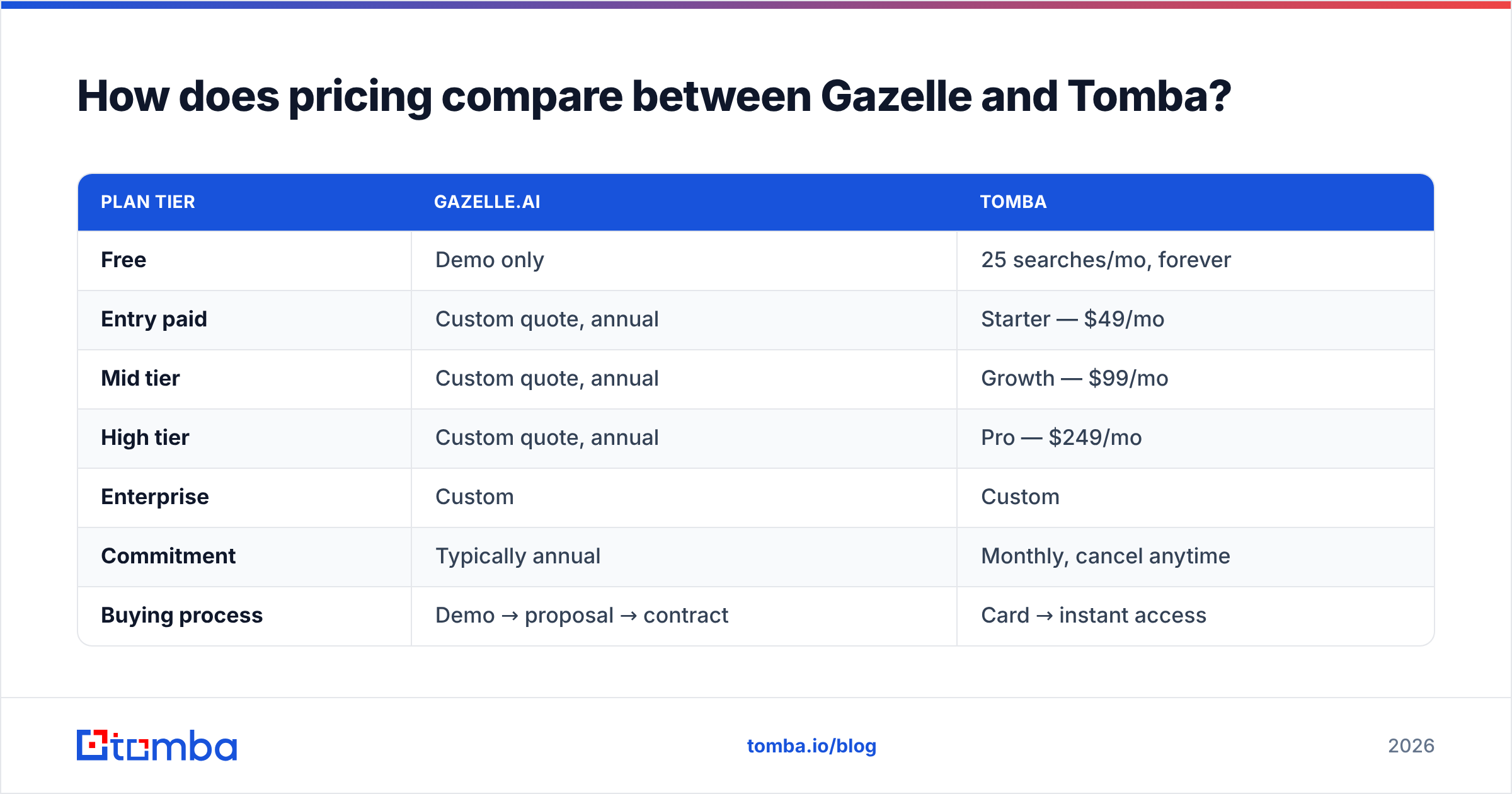
Gazelle.ai does not publish rates, which is standard for platforms sold to economic development agencies and enterprise BD groups — the deal size is set by seat count, geography, and data scope. Expect a four-to-five-figure annual number and a procurement conversation, not a checkout page. That is not a criticism; it is the normal shape of enterprise data licensing.
Tomba publishes everything on the Tomba pricing page. The relevant point for a comparison is not just the sticker price, it is the decision cost. A $49/mo starting point that you can cancel in one click means you can test a hypothesis this afternoon. An annual license means the decision has to be right the first time, which is why it needs a demo, a pilot, and a champion.
Who should choose Gazelle.ai?#
Pick Gazelle.ai when the following describe you:
- You are an economic development organization or site selector. This is the platform's home turf. Nothing in the email-finder category competes here.
- Your targeting question is international. You need visibility into companies whose HQ is in Frankfurt, Osaka, or São Paulo, with subsidiary structures mapped.
- Expansion timing drives your pitch. You are not selling software seats; you are pitching a location, an incentive package, or a multi-year partnership, and knowing when a company is about to move is worth more than a thousand extra email addresses.
- You have a low-volume, high-value motion. Twenty accounts a quarter, each worth six figures. Contact discovery at scale is not your constraint.
- You have budget approval for annual data spend. If a $12,000 line item needs no explanation in your org, the enterprise model is not a barrier.
Who should choose Tomba?#
Pick Tomba when these are true:
- You already know your accounts. Your ICP list comes from your CRM, a conference attendee list, LinkedIn Sales Navigator, or a scraped industry directory — and now you need the humans inside them.
- Volume matters. You are sending hundreds or thousands of touches a month and need bulk find plus bulk verify without per-record enterprise pricing.
- You are technical. The Tomba API drops into your enrichment pipeline, and there is a CLI and an MCP server if you are wiring AI agents into your prospecting stack.
- You need deliverability protection. Verification and catch-all handling are the difference between a 2% bounce rate and a burned sending domain.
- You want to start today. Free tier, no demo, no annual commitment.
Can you use Gazelle and Tomba together?#
Yes, and for a specific profile of team that is the right answer rather than a diplomatic dodge.
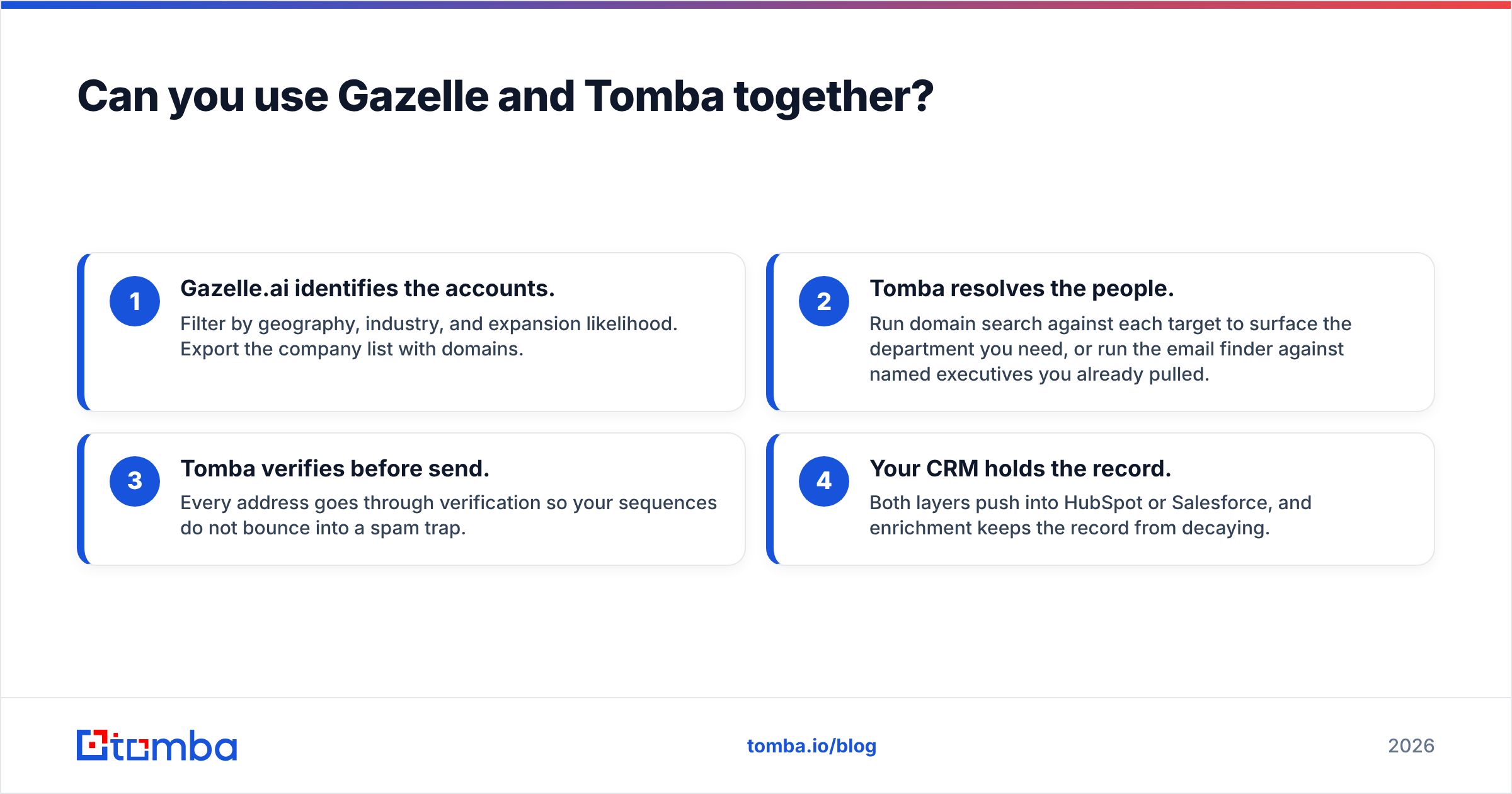
The stack looks like this:
- Gazelle.ai identifies the accounts. Filter by geography, industry, and expansion likelihood. Export the company list with domains.
- Tomba resolves the people. Run domain search against each target to surface the department you need, or run the email finder against named executives you already pulled.
- Tomba verifies before send. Every address goes through verification so your sequences do not bounce into a spam trap.
- Your CRM holds the record. Both layers push into HubSpot or Salesforce, and enrichment keeps the record from decaying.
The seam is clean because the tools do not overlap much. You are paying Gazelle.ai for prediction and paying Tomba for resolution, and neither is subsidizing a feature you already have. Whether that is worth two line items depends entirely on whether account selection is genuinely hard for you — for most SaaS teams selling to a well-understood ICP, it is not, and the Gazelle.ai layer is solving a problem they do not have.
If you want the CRM layer to actually hold this together rather than rot, standardize the field mapping first. HubSpot's documentation on data management is a reasonable starting reference for how to structure company-to-contact associations before you start pumping two data sources into one object model.
What are the other alternatives worth knowing?#
Neither tool exists in a vacuum. A short, honest map of the neighbors:
- BookYourData — a solid choice if you want prepaid, pay-as-you-go B2B lists with a verification guarantee rather than a subscription. Strong fit for teams that buy data in bursts around campaigns instead of continuously.
- Apollo.io — an all-in-one database plus sequencer. Broad but shallow in places; good if you want one bill and can tolerate variable data quality. See the Apollo alternative breakdown for the specifics.
- Clearbit (now part of HubSpot) — enrichment-first, strong for inbound form completion and firmographic appends, less oriented toward outbound contact discovery.
- ZoomInfo — the enterprise default. Deepest US contact coverage in the category, priced accordingly, sold on annual contracts.
The category axis to keep straight: account intelligence (Gazelle.ai, 6sense, Demandbase) answers who to chase; contact data (Tomba, BookYourData, ZoomInfo) answers how to reach them; sequencing (Instantly, Outreach, Salesloft) answers how to send. Vendors blur these lines in their marketing. Your budget should not.
What is the verdict on Gazelle vs Tomba?#
If you must pick one: pick based on which half of the funnel is actually broken.
Gazelle.ai wins for organizations whose value comes from picking the right small number of international accounts at the right moment — economic development, site selection, enterprise BD with long cycles. Its predictive signals and global corporate hierarchy data are not replicable with an email finder, and paying enterprise prices for them is rational when a single won account justifies the year's spend.
Tomba wins for everyone whose target list is already known and whose real cost is the labor and bounce risk of turning company names into reachable people. It is faster to adopt, roughly an order of magnitude cheaper at entry, verification-native, and API-first. For a team of three SDRs, the entire annual Tomba bill is smaller than one month of most enterprise data contracts.
The failure mode to avoid is buying an account-intelligence platform to solve a contact-data problem. It is an expensive way to get email addresses, and the addresses will not be the best ones available.
Start where the friction actually is. If your list of target companies exists and the gap is reaching the decision makers inside them, Tomba's Email Finder will tell you in the next ten minutes whether the data holds up for your ICP. Twenty-five free searches, no card, no demo call — run your hardest 25 accounts through it and judge on the hit rate, not the marketing.
Related guides#
Ready to find emails that actually work?
Join 150,000+ professionals who stopped guessing and started sending. Free credits on signup — no credit card required.
Get the Tomba newsletter
Practical outbound tactics and product updates — once every two weeks.
About the author