GDPR Compliant Lead Generation: The 2026 Practical Guide
Cold outreach to EU prospects is legal — but only if your lawful basis, data sourcing, and notice obligations hold up. Here's how GDPR compliant lead generation actually works in 2026, with the country rules most teams miss.
GDPR compliant lead generation is not a myth. You can still cold email EU prospects. You just have to prove where the data came from, and why you may use it. This guide shows how GDPR compliant lead generation works in practice, market by market.
TL;DR
- GDPR does not ban cold B2B email. It bans email you cannot justify, document, or undo on request.
- Legitimate interest (Article 6(1)(f)) is the workable lawful basis for B2B prospecting. Consent is needed for B2C, and for sole traders in most EU markets.
- Where your data came from matters more than what you send. Scraped and guessed lists fail the accuracy and transparency tests.
- Article 14 says you must tell a prospect you hold their data. Do it within one month, or in your first email. Almost nobody does. It is the cheapest win in GDPR compliant lead generation.
- Country rules differ sharply. Germany and Italy are strict. The UK and Ireland allow B2B email to corporate subscribers without prior consent.
What is GDPR compliant lead generation?#
GDPR compliant lead generation means you can answer four questions about every contact in your CRM. On demand, and in writing.
- Where did this record come from? Name the source. Your website form, a public company page, a licensed data provider, a badge scan.
- What is your lawful basis? One of the six in Article 6. For outbound B2B it is nearly always legitimate interest or consent.
- Have you told the person you hold it? That is Article 14, and it applies when the data did not come from them.
- Can you delete or export it within 30 days? Rights of erasure, access, and objection.
That is the whole framework. The DPA templates, the cookie banners, the processing records — that is just machinery. It exists to keep those four answers true under scrutiny.
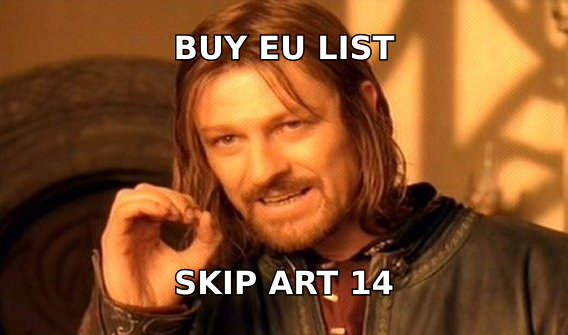
One misreading is common. People treat GDPR as an anti-spam law. It is not. It is a data-provenance law. It bites hardest when your provenance is "we bought a list and hoped." The ePrivacy Directive is the real anti-spam layer, and each member state writes its own version. The two laws interact, and that is where outbound teams get caught.
Which lawful basis actually works for B2B prospecting?#
Legitimate interest, in most cases. Recital 47 says direct marketing "may be regarded as carried out for a legitimate interest." That line carries a lot of weight in GDPR compliant lead generation.
But legitimate interest is not a checkbox. It is a three-part test, and you write it down before you send.
- Purpose test — Is there a real business interest you can state? "Selling warehouse robotics to logistics directors" works. "Building a list to resell" does not.
- Necessity test — Do you need this person's data to get there? If a generic
info@address or a paid ad would do, your case gets weaker. - Balancing test — Would this person expect the contact? A VP of Operations at a 400-person plant expects vendor email at work. A junior designer's personal Gmail does not.
Relevance carries the load. Send a Kubernetes pitch to a dental practice manager and you fail the balancing test. Clean paperwork will not save you. Tight targeting is a control, not just a conversion tactic.
Consent vs legitimate interest: which one do you need?#
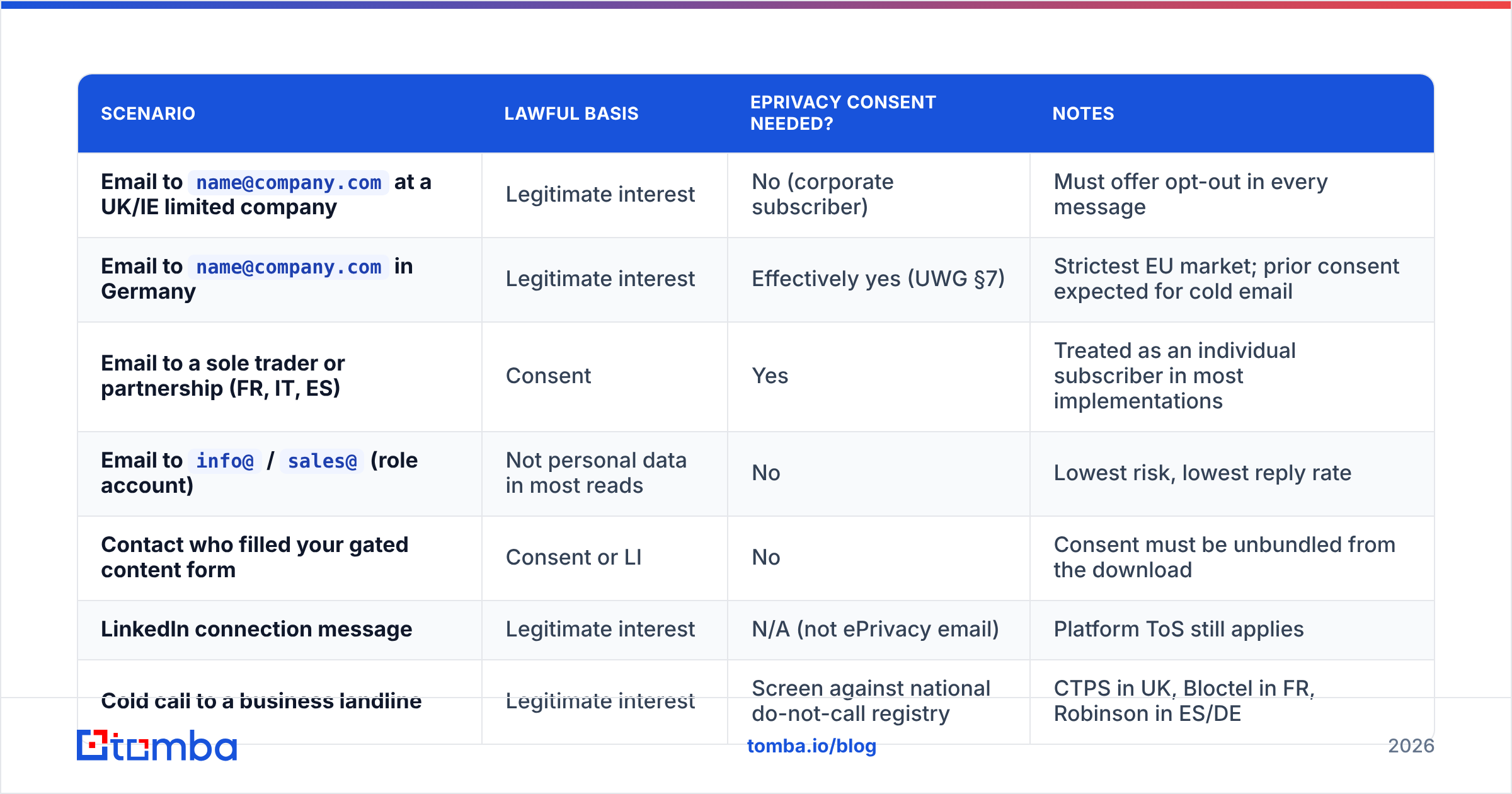
| Scenario | Lawful basis | ePrivacy consent needed? | Notes |
|---|---|---|---|
Email to name@company.com at a UK/IE limited company |
Legitimate interest | No (corporate subscriber) | Must offer opt-out in every message |
Email to name@company.com in Germany |
Legitimate interest | Effectively yes (UWG §7) | Strictest EU market; prior consent expected for cold email |
| Email to a sole trader or partnership (FR, IT, ES) | Consent | Yes | Treated as an individual subscriber in most implementations |
Email to info@ / sales@ (role account) |
Not personal data in most reads | No | Lowest risk, lowest reply rate |
| Contact who filled your gated content form | Consent or LI | No | Consent must be unbundled from the download |
| LinkedIn connection message | Legitimate interest | N/A (not ePrivacy email) | Platform ToS still applies |
| Cold call to a business landline | Legitimate interest | Screen against national do-not-call registry | CTPS in UK, Bloctel in FR, Robinson in ES/DE |
The pattern is simple. GDPR decides whether you may hold and use the data. ePrivacy decides whether you may send the message. You need both to clear. Teams that read only the first half get a surprise from a national regulator.
Where can you legally get B2B contact data?#
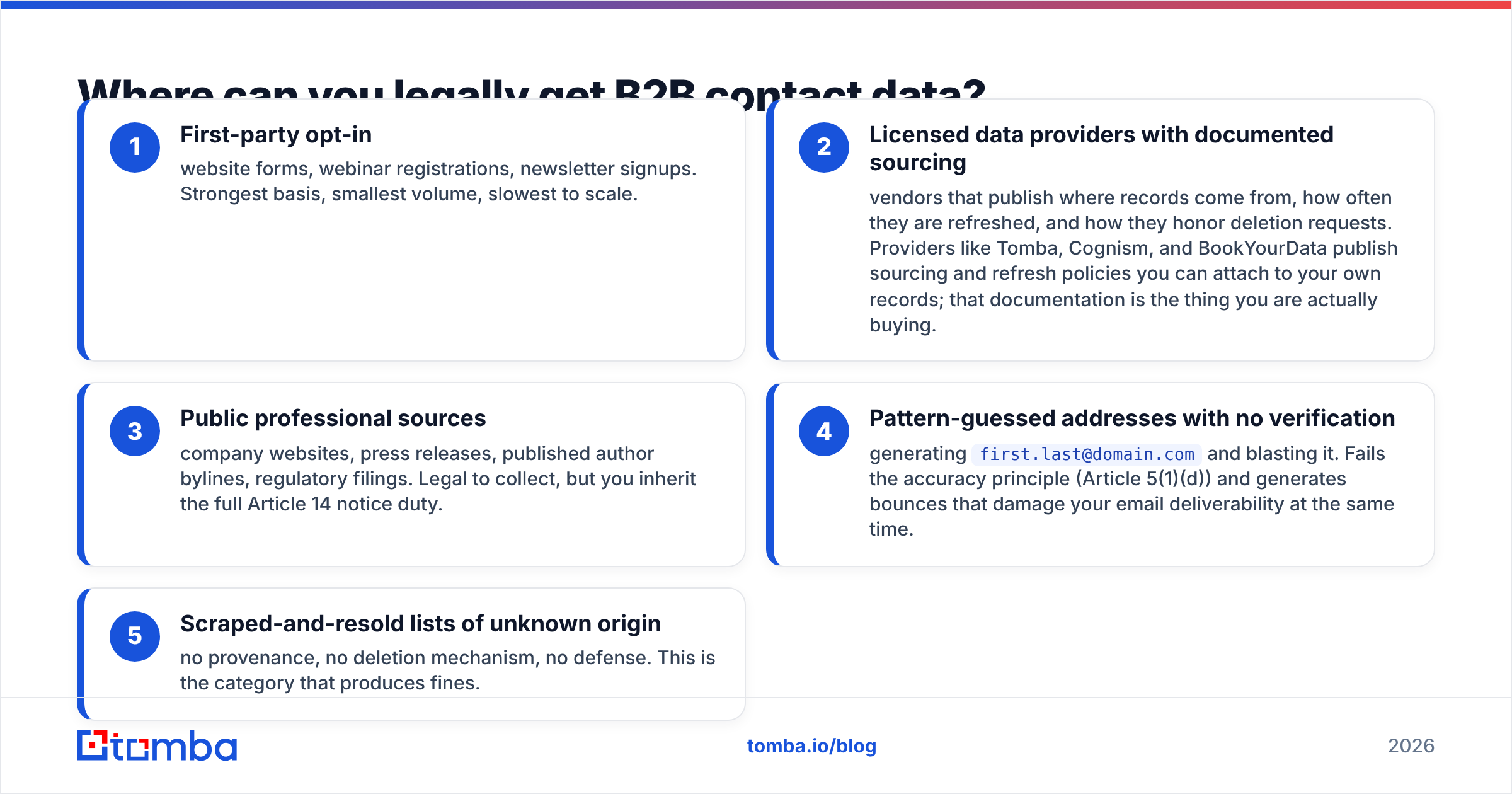
Sourcing is where most programs break. Rank your options by how well they survive an Article 14 request.
- First-party opt-in — website forms, webinar signups, newsletter signups. Strongest basis. Smallest volume. Slowest to scale.
- Licensed providers with documented sourcing — vendors that publish where records come from, how often they refresh, and how they honor deletion. Tomba, Cognism, and BookYourData all publish those policies. That paper trail is the thing you are buying.
- Public professional sources — company sites, press releases, author bylines, filings. Legal to collect, but you inherit the full Article 14 notice duty.
- Pattern-guessed addresses — generating
first.last@domain.comand blasting it. It fails the accuracy principle (Article 5(1)(d)) and wrecks your email deliverability. - Scraped lists of unknown origin — no provenance, no deletion path, no defense. This is the category that draws fines.
The rule of thumb: if a vendor cannot tell you where a record came from, you cannot tell a regulator either. Read the data sources page before you sign. Confirm the vendor processes deletions upstream, not just in your account.
Verification is the other half of GDPR compliant lead generation. Run contacts through an email verifier before you send. It satisfies the accuracy principle. It also keeps your bounce rate under the 2% line that Google and Microsoft enforce for bulk senders.
What does Article 14 actually require you to do?#
Almost every outbound team skips this duty. It is also the easiest one to fix.
Did the data come from anywhere other than the person? Then Article 14 applies. You must tell them within a reasonable period, and at the latest within one month. If your first message lands sooner, tell them then.
You must disclose:
- Who you are — legal entity name and contact details, plus your DPO if you have one.
- What data you hold — the categories, not every field. "Your name, job title, and work email."
- Where you got it — the source. "Your company website" or "a licensed B2B data provider."
- Your lawful basis — and if it is legitimate interest, say what that interest is.
- How long you will keep it — a real retention period, not "indefinitely."
- Their rights — access, correction, erasure, and the right to object to marketing. That last one is absolute.
In practice this is three lines at the bottom of your first email, linked to a privacy page. It costs you nothing. It signals that adults run the program. In several enforcement cases, it was the difference between a warning and a fine.
How do EU country rules differ in 2026?#
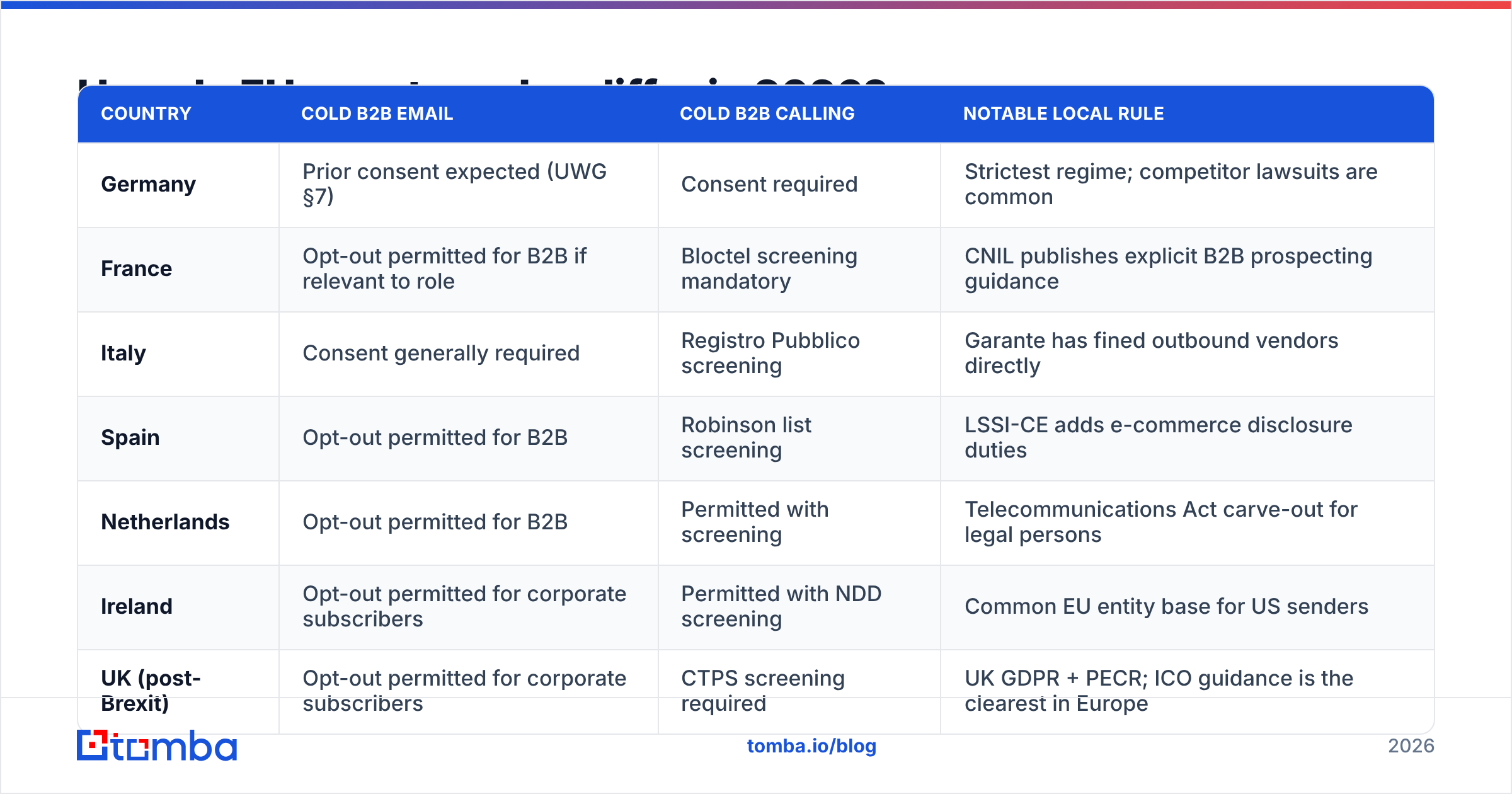
Local rules are the part of GDPR compliant lead generation that most playbooks skip.
| Country | Cold B2B email | Cold B2B calling | Notable local rule |
|---|---|---|---|
| Germany | Prior consent expected (UWG §7) | Consent required | Strictest regime; competitor lawsuits are common |
| France | Opt-out permitted for B2B if relevant to role | Bloctel screening mandatory | CNIL publishes explicit B2B prospecting guidance |
| Italy | Consent generally required | Registro Pubblico screening | Garante has fined outbound vendors directly |
| Spain | Opt-out permitted for B2B | Robinson list screening | LSSI-CE adds e-commerce disclosure duties |
| Netherlands | Opt-out permitted for B2B | Permitted with screening | Telecommunications Act carve-out for legal persons |
| Ireland | Opt-out permitted for corporate subscribers | Permitted with NDD screening | Common EU entity base for US senders |
| UK (post-Brexit) | Opt-out permitted for corporate subscribers | CTPS screening required | UK GDPR + PECR; ICO guidance is the clearest in Europe |
| Poland | Consent generally required | Consent required | Telecom law layers on top of GDPR |
Two takeaways. First, segment sequences by country, not just by persona. A template that is fine in Dublin is a liability in Munich. Second, if a market makes cold email impractical, switch channel instead of raising your risk. LinkedIn, events, and paid demand capture sit outside these ePrivacy email rules.
What does a compliant outbound workflow look like end to end?#
Here is the sequence that holds up. Start with the four steps you take before any message goes out.
- Define the ICP narrowly enough to defend. Write down the job titles, company sizes, and industries where your product truly fits. This doubles as balancing-test evidence.
- Source from documented providers only. Use domain search or a licensed database to build from company-level targeting. Record the source per contact in a CRM field, not a spreadsheet.
- Run a Legitimate Interest Assessment per campaign type. One page: purpose, necessity, balancing, outcome. Date it. Re-run it when the ICP changes.
- Verify before send. Drop invalid and unverifiable addresses. Accuracy is a legal principle here, not just a metric.
Then comes the send itself, and everything that happens after it.
- Put the Article 14 notice in message one. Source, basis, retention, and a working opt-out link. Not just "reply STOP."
- Honor objections within 72 hours, for good. Keep a suppression list that survives CRM migrations and re-imports. Re-contacting someone who objected invites a complaint.
- Log everything. Your Record of Processing Activities (Article 30) should export live from your CRM. It is not a doc someone wrote in 2023.
- Sign DPAs with every processor. Your sequencer, your enrichment vendor, your CRM. Use an email finder API in your product? Then you are a controller passing data to a processor. Paper it.
Is GDPR compliance worth the conversion cost?#
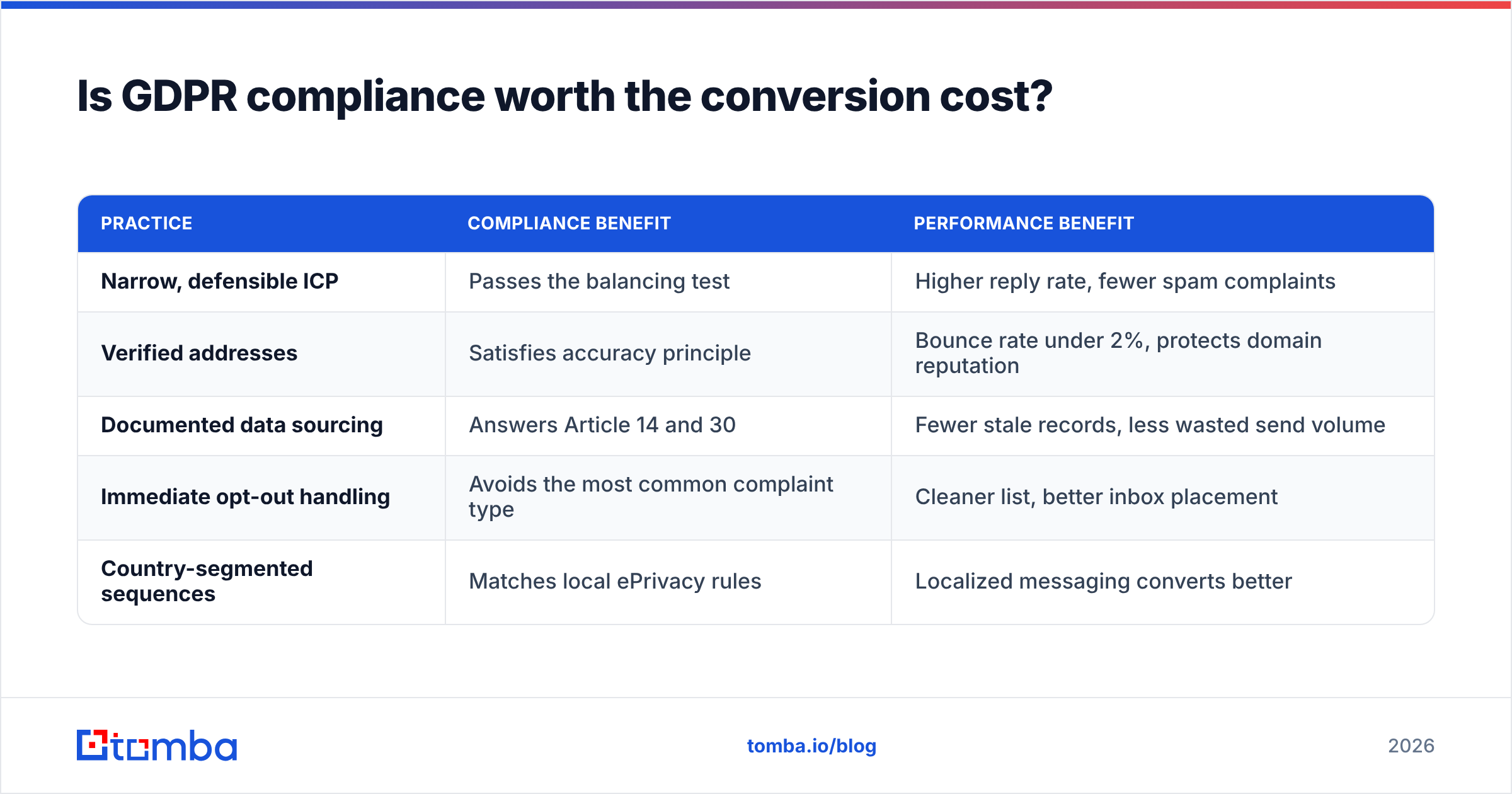
Mostly, yes. It pays for itself. The controls GDPR forces are the same ones that make outbound work in 2026.
| Practice | Compliance benefit | Performance benefit |
|---|---|---|
| Narrow, defensible ICP | Passes the balancing test | Higher reply rate, fewer spam complaints |
| Verified addresses | Satisfies accuracy principle | Bounce rate under 2%, protects domain reputation |
| Documented data sourcing | Answers Article 14 and 30 | Fewer stale records, less wasted send volume |
| Immediate opt-out handling | Avoids the most common complaint type | Cleaner list, better inbox placement |
| Country-segmented sequences | Matches local ePrivacy rules | Localized messaging converts better |
The cost is real, but bounded. A slower list build. A smaller market in Germany and Italy. A few hours of documentation each quarter.
The alternative costs more. An unsourced list, no notice, no suppression list — that is what a regulator finds after one annoyed recipient complains. Fines under Article 83 reach €20 million or 4% of global turnover at the top tier. Marketing cases rarely hit that ceiling. Still, six-figure penalties against mid-market B2B firms are now routine in France, Italy, and Spain.
What about the UK, Switzerland, and US buyers?#
UK. UK GDPR mirrors the EU text. PECR governs the message layer. Cold B2B email to corporate subscribers is still allowed, with a working opt-out. The ICO's direct marketing guidance is the clearest regulator document in this space. Read it even if you only sell into the EU.
Switzerland. The revised FADP tracks GDPR closely, but says less about lawful basis. Unsolicited commercial email needs prior consent under the Unfair Competition Act.
US buyers. CAN-SPAM allows cold email with accurate headers and a working unsubscribe. State laws add more. CCPA/CPRA in California, plus Virginia, Colorado, and Texas, grant access and deletion rights closer to GDPR. Run one global program built to the GDPR standard and you clear the rest. Building to CAN-SPAM and retrofitting for Europe never works.
How do you handle enrichment and CRM data hygiene?#
Enrichment is processing. Every phone number, company size, or tech signal you append expands the personal data you hold. The retention clock, the notice duty, and the deletion duty all stretch to cover those new fields.
Two rules keep this simple. First, enrich only what sales actually uses. A field nobody opens is pure liability. Second, timestamp every enrichment event. Then you can prove when data arrived and when it should age out. Most teams set 24 months for unengaged prospects and delete on schedule. Tools that handle contact enrichment with per-field source attribution save you from rebuilding provenance later.
Where should you start this quarter?#
Pick the three highest-leverage fixes. Add an Article 14 notice to your first-touch template. Add a source field to every CRM contact. Put a real suppression list behind your sequencer. That is a week of work, and it removes most of your practical exposure.
Then fix your sourcing. Guessed addresses and unsourced lists cause both the legal risk and the poor deliverability. It is the one problem you cannot document your way out of. Need verified, provenance-documented business emails to build from? The Tomba Email Finder returns addresses with confidence scores and source attribution. The free tier covers 25 searches a month, and paid plans start at $49/mo — see Tomba pricing for the full breakdown. Start with clean, traceable data and the rest of GDPR compliant lead generation becomes paperwork instead of panic.
Related guides#
Ready to find emails that actually work?
Join 150,000+ professionals who stopped guessing and started sending. Free credits on signup — no credit card required.
Get the Tomba newsletter
Practical outbound tactics and product updates — once every two weeks.
About the author