Generect Reviews 2026: Features, Pricing, Accuracy & Alternatives
An independent look at Generect in 2026: what its real-time LinkedIn sourcing actually does well, where the API pricing gets expensive, and which alternatives fit smaller outbound teams better.
TL;DR
- Generect is an API-first B2B lead data provider built around real-time LinkedIn sourcing — you query a search, it returns structured people and company records instead of serving you a static database dump.
- Its strongest use case is engineering-led GTM: teams that want to pipe fresh leads into their own product, CRM, or internal tooling without maintaining scrapers.
- Its weakest point for small teams is commercial: pricing is quote-led rather than a public self-serve tier, which makes it hard to test cheaply and hard to forecast at low volume.
- Accuracy is respectable on emails sourced from live profiles, but you still need a separate verification step before sending — no real-time sourcing tool removes bounce risk on its own.
- If you mainly need verified work emails per domain or per name, a self-serve email finder with public pricing will usually be cheaper and faster to prove out.
What is Generect and who is it actually for?#
Generect (generect.com) is a B2B lead generation data platform whose central pitch is freshness. Rather than resell a snapshot of a contact database that was compiled months ago, it runs searches against live sources — LinkedIn people and company searches, groups, event attendee lists — and returns structured records through an API or a UI.
The mental model that helps here: most B2B data vendors are supermarkets. They buy inventory in bulk, put it on shelves, and you pick from what's in stock. Some of it is fresh, some has been sitting there since last spring. Generect is closer to a fishing boat with a delivery service — you describe what you want, it goes and catches it now.
That difference matters more than it sounds. Job-change decay in B2B data runs roughly 25–30% per year, and it clusters in exactly the roles outbound teams target. A record sourced today from a live profile is structurally more likely to be correct than one sourced fourteen months ago and never re-checked.
The trade-offs of that architecture are also predictable:
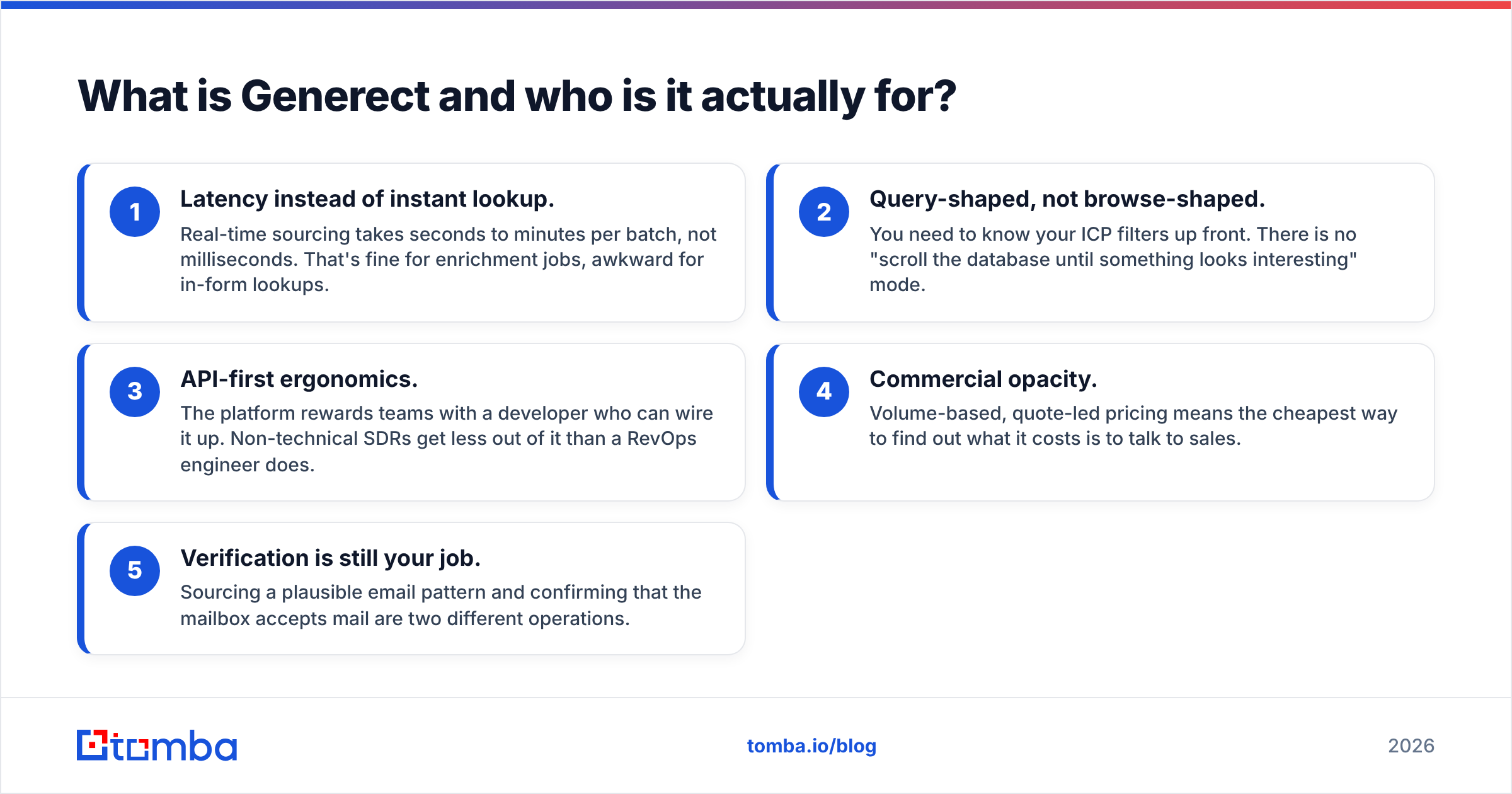
- Latency instead of instant lookup. Real-time sourcing takes seconds to minutes per batch, not milliseconds. That's fine for enrichment jobs, awkward for in-form lookups.
- Query-shaped, not browse-shaped. You need to know your ICP filters up front. There is no "scroll the database until something looks interesting" mode.
- API-first ergonomics. The platform rewards teams with a developer who can wire it up. Non-technical SDRs get less out of it than a RevOps engineer does.
- Commercial opacity. Volume-based, quote-led pricing means the cheapest way to find out what it costs is to talk to sales.
- Verification is still your job. Sourcing a plausible email pattern and confirming that the mailbox accepts mail are two different operations.

What does Generect do well?#
Three things stand out in most hands-on Generect reviews.
Real-time LinkedIn search coverage. If your ICP is defined the way LinkedIn defines it — headcount band, industry, seniority, geography, title keyword — you can translate a Sales Navigator-style query into an API call and get structured JSON back. That's genuinely useful for teams that were previously paying a contractor to babysit scrapers.
Group and event sourcing. Pulling members of a LinkedIn group or attendees of an event is a niche capability that most database vendors don't offer at all, because those lists aren't part of a standing dataset. For community-led or event-led GTM motions, this is the feature people actually renew for.
Developer experience. The product assumes you're building something. Documentation, predictable response shapes, and the ability to trigger searches programmatically make it a reasonable backend for a lead-gen product of your own — an agency dashboard, an internal ICP monitor, a "notify me when someone changes jobs" workflow.
Company-level records alongside people. You get firmographics attached rather than having to join two vendors together, which removes a whole class of matching bugs from your pipeline.
How accurate is Generect's contact data?#
Honest answer: accuracy depends far more on the segment than on the vendor, and anyone quoting you a single global percentage is selling something.
Real-time sourcing helps most where staleness hurts most — recently promoted managers, people who moved companies in the last quarter, headcount-volatile startups. It helps least where the underlying source is thin: personal emails, contacts at companies with almost no digital footprint, and regions where LinkedIn penetration is low. In practice, teams targeting EU mid-market often see materially lower email fill rates than teams targeting US SaaS, regardless of which vendor they use.
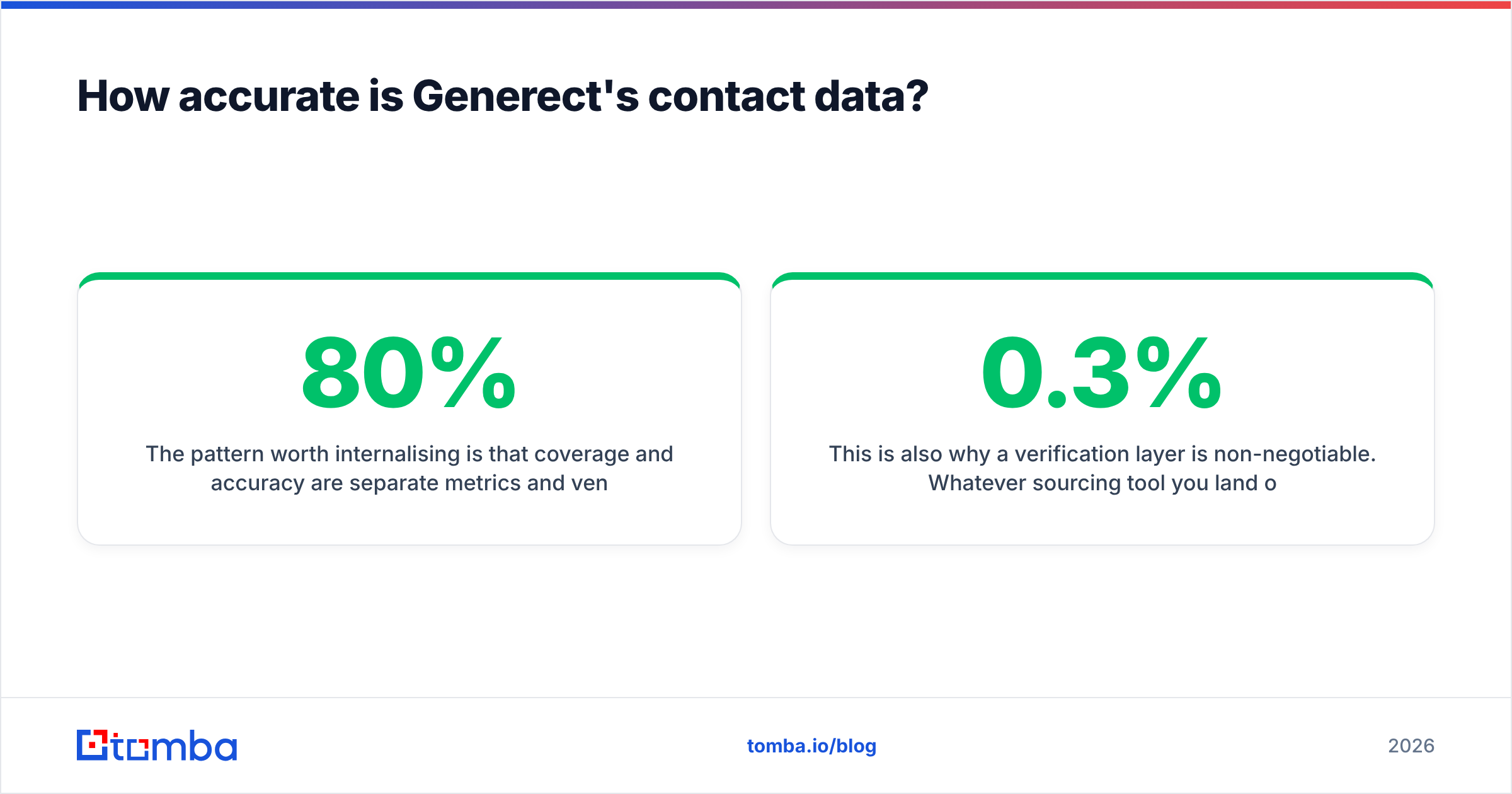
The pattern worth internalising is that coverage and accuracy are separate metrics and vendors love to blur them. A tool that returns an email for 80% of your list and is right 85% of the time delivers 68 usable contacts per 100. A tool that returns emails for 55% but is right 97% delivers 53 — fewer contacts, but a far safer sending profile. Which one is "better" depends entirely on whether your bottleneck is volume or domain reputation.

This is also why a verification layer is non-negotiable. Whatever sourcing tool you land on, run the output through an email verifier before it touches a sequencer. Google and Microsoft both tightened bulk sender enforcement in the mid-2020s, and the practical spam-complaint ceiling of 0.3% documented in Google's bulk sender guidelines leaves very little room for sloppy lists. A 6% bounce rate on a 5,000-contact send is not a data problem you can apologise your way out of — it's a domain reputation problem that takes weeks to unwind.
What are the real limitations of Generect?#
Pricing is quote-led. There's no cheap public entry point that lets a two-person team validate the tool on a Tuesday afternoon. You enter a sales conversation, describe volume, and get a number. For enterprise buyers that's normal. For a bootstrapped agency it's friction, and it makes side-by-side benchmarking against self-serve tools genuinely difficult.
It's not a sequencer. Generect sources and enriches; it does not send, warm up, or manage replies. You'll still need an outbound platform on top, which changes the total cost calculation.
Real-time sourcing has fragility. Any product built on live third-party sources inherits the volatility of those sources. Rate limits, layout changes, and platform policy shifts are structural risks for the entire category — not a Generect-specific flaw, but worth pricing into your dependency planning.
The learning curve is technical. If nobody on your team is comfortable reading API docs, a good chunk of the value stays locked. A Chrome extension or spreadsheet add-in workflow will get a non-technical SDR productive far faster.
Review volume is thin. Compared with the giants, there simply aren't many independent data points on G2 or Capterra yet. That's not evidence of a bad product, but it does mean you're relying more on your own trial than on peer consensus.
How does Generect compare to other B2B data tools in 2026?#
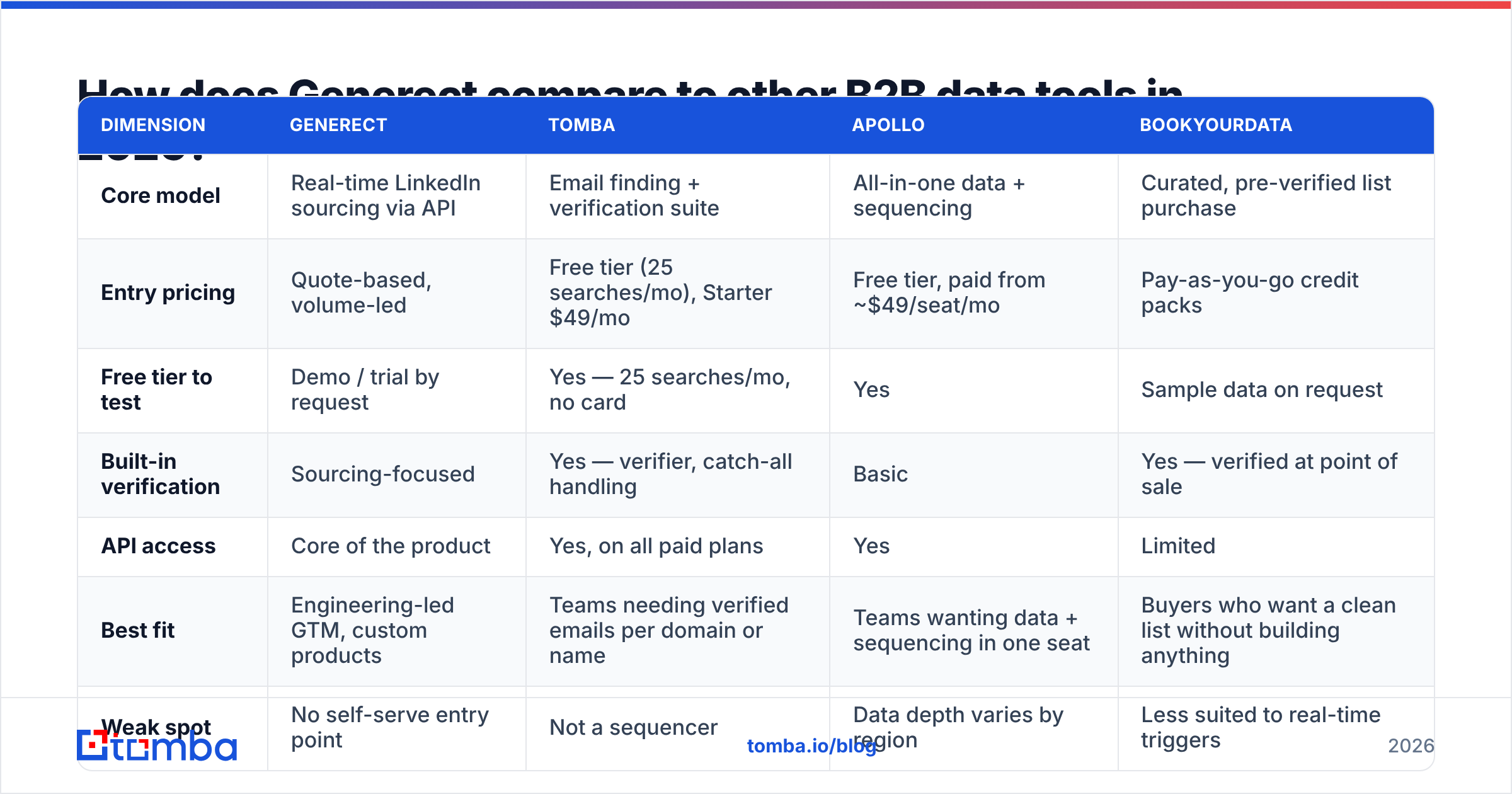
Here's how the main options line up on the dimensions buyers actually weigh. Prices are current published rates where the vendor publishes them; treat quote-led vendors as "call for pricing" and verify before you budget.
| Dimension | Generect | Tomba | Apollo | BookYourData |
|---|---|---|---|---|
| Core model | Real-time LinkedIn sourcing via API | Email finding + verification suite | All-in-one data + sequencing | Curated, pre-verified list purchase |
| Entry pricing | Quote-based, volume-led | Free tier (25 searches/mo), Starter $49/mo | Free tier, paid from ~$49/seat/mo | Pay-as-you-go credit packs |
| Free tier to test | Demo / trial by request | Yes — 25 searches/mo, no card | Yes | Sample data on request |
| Built-in verification | Sourcing-focused | Yes — verifier, catch-all handling | Basic | Yes — verified at point of sale |
| API access | Core of the product | Yes, on all paid plans | Yes | Limited |
| Best fit | Engineering-led GTM, custom products | Teams needing verified emails per domain or name | Teams wanting data + sequencing in one seat | Buyers who want a clean list without building anything |
| Weak spot | No self-serve entry point | Not a sequencer | Data depth varies by region | Less suited to real-time triggers |

A few notes on reading that table honestly.
BookYourData sits in a genuinely different lane and is a solid choice when you'd rather buy a clean, pre-verified list than build a pipeline. If your motion is "one campaign per quarter into a well-defined vertical," a curated purchase can beat any API on total cost of effort — you're not paying an engineer to maintain anything.
Apollo wins on convenience — data and sending in one seat — and loses on depth in some non-US regions. If you've already got a sequencer you like, you're paying for overlap.
Tomba occupies the narrow-and-deep slot: find and verify professional emails, at a published price, with an API you can wire up in an afternoon. It doesn't try to be your sequencer or your CRM. Whether that's a feature or a gap depends on your stack.
Is Generect worth the price?#
Yes, if you're building something. If you have a developer, a defined ICP, and a workflow where lead freshness directly drives revenue — job-change triggers, event follow-up, community-sourced pipeline — Generect's real-time model does something a static database structurally cannot. The quote-based pricing is less annoying when volume is high enough that per-record cost dominates.
Probably not, if you're a small outbound team. If your monthly need is "a few thousand verified work emails at companies matching a filter," you're paying for architecture you won't use. A self-serve tool with a free tier gets you to first send this week, at a cost you can read off a page.
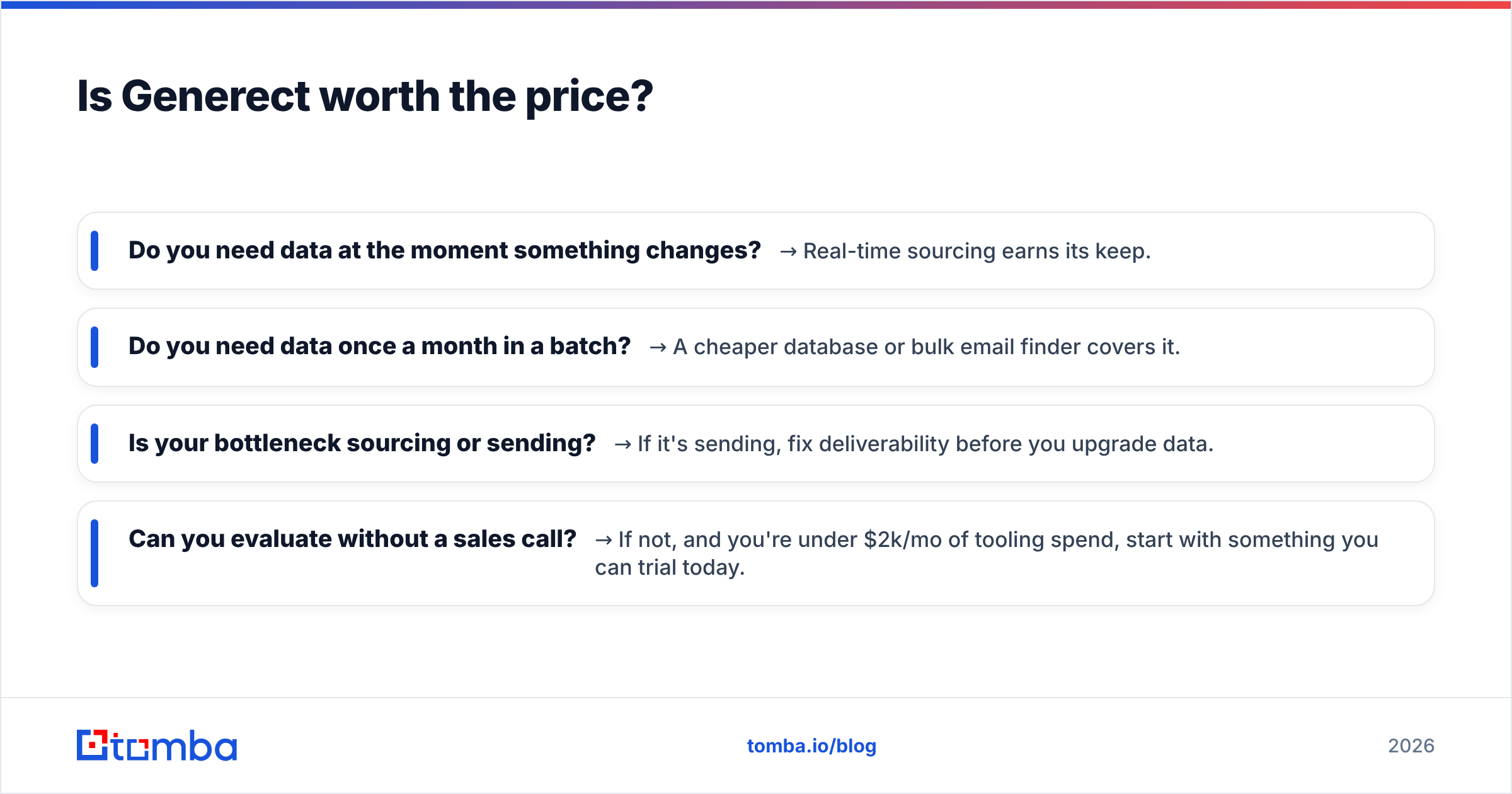
The decision test I'd apply:
- Do you need data at the moment something changes? → Real-time sourcing earns its keep.
- Do you need data once a month in a batch? → A cheaper database or bulk email finder covers it.
- Is your bottleneck sourcing or sending? → If it's sending, fix deliverability before you upgrade data.
- Can you evaluate without a sales call? → If not, and you're under $2k/mo of tooling spend, start with something you can trial today.

What should you check before signing with any data vendor?#
Run the same trial protocol regardless of which tool you're evaluating. It takes an afternoon and saves quarters.
Build a 100-row control list. Take real accounts from your ICP, ideally ones where you already know the correct contact. Run it through every vendor on your shortlist. Measure fill rate and correctness separately.
Verify the output independently. Don't trust the vendor's own "valid" flag as your only signal. Run results through a neutral verifier and see how many the vendor called valid that don't survive scrutiny — especially on catch-all domains, where a naive check returns "accepted" for literally any address.
Test your worst segment, not your best. Everyone looks good on US SaaS VPs. Test the segment where your pipeline actually struggles.
Ask about data sourcing and compliance. Under GDPR, legitimate-interest processing for B2B outreach carries documentation obligations. Ask where records come from and what happens on a deletion request; a vendor that can't answer clearly is a liability you're inheriting. Comparing published data sources is a reasonable baseline for what "clear" looks like.
Price the whole workflow. Sourcing cost plus verification cost plus sequencer cost plus the engineering hours to glue them together. The cheapest line item rarely wins on total cost.
The bottom line on Generect reviews in 2026#
Generect is a credible, technically strong option in a specific slot: API-first, real-time, engineering-led lead sourcing. Teams building products or trigger-based workflows on top of live LinkedIn data will find capabilities here that pre-compiled databases genuinely cannot match. The catch is commercial rather than technical — quote-led pricing and an API-shaped learning curve raise the floor on who can realistically adopt it.
If your actual job is simpler than that — find verified work emails for a list of people and companies, without a procurement cycle — start with a tool you can test today. The Tomba Email Finder gives you 25 free searches a month with no card, verification built into the same workflow, and paid plans that start at $49/mo with published Tomba pricing rather than a discovery call. Run your 100-row control list through it, compare the numbers against whatever else is on your shortlist, and let your own data decide.
Related guides#
Ready to find emails that actually work?
Join 150,000+ professionals who stopped guessing and started sending. Free credits on signup — no credit card required.
Get the Tomba newsletter
Practical outbound tactics and product updates — once every two weeks.
About the author