Generect vs Go4database (2026): Which B2B Data Source Wins?
One sells live, API-first B2B contact data. The other sells pre-built email lists by the record. Here is how Generect vs Go4database compares on accuracy, pricing, compliance, and who should pick which.
TL;DR
- Generect is a live, API-first B2B contact data tool. You query it per lead or per search. Records are built close to the time you ask. Pick it when you need fresh data and code access.
- Go4database is a list vendor. You buy a ready-made file by industry, job title, technology, or region. It is usually a one-time purchase with a big record count.
- The real choice is not "which brand is better." It is live lookup vs. static file. The two models fail in very different ways.
- Static lists go stale by about 2–2.5% per month as people change jobs. A 12-month-old file can be 25–30% dead before you send anything.
- Either way, verify before you send. Neither model gets you out of a verification pass. An unverified list is a deliverability problem waiting to happen.
Generect vs Go4database comes down to one question. Do you want data pulled fresh, or a file bought in bulk? Here is how the two stack up.
What are Generect and Go4database?#
Two very different products sit side by side because both are sold as "B2B data."
Generect is a lead generation and contact data platform. It is built around an API and browser tools. The pitch is real time. It does not ship you a snapshot. It resolves company and person records when you ask for them, using public professional profiles and company sources. You pay for access and volume. Then you plug it into a sequencer, a CRM, or your own scripts.
Go4database is a database vendor in the older sense. It sells ready-made B2B mailing and email lists. You can segment by industry, job function, tech stack, company size, and region. Think healthcare lists, technology-user lists, and SIC-code lists. You describe the segment. They quote a file. You get the records. The deal is usually a one-time purchase, or a custom quote for a bigger build, not a metered plan.
That one structural difference drives the rest. It sets your cost per record, your accuracy, your legal exposure, and how fast the data rots in your CRM.
Generect vs Go4database: how do the two models differ?#
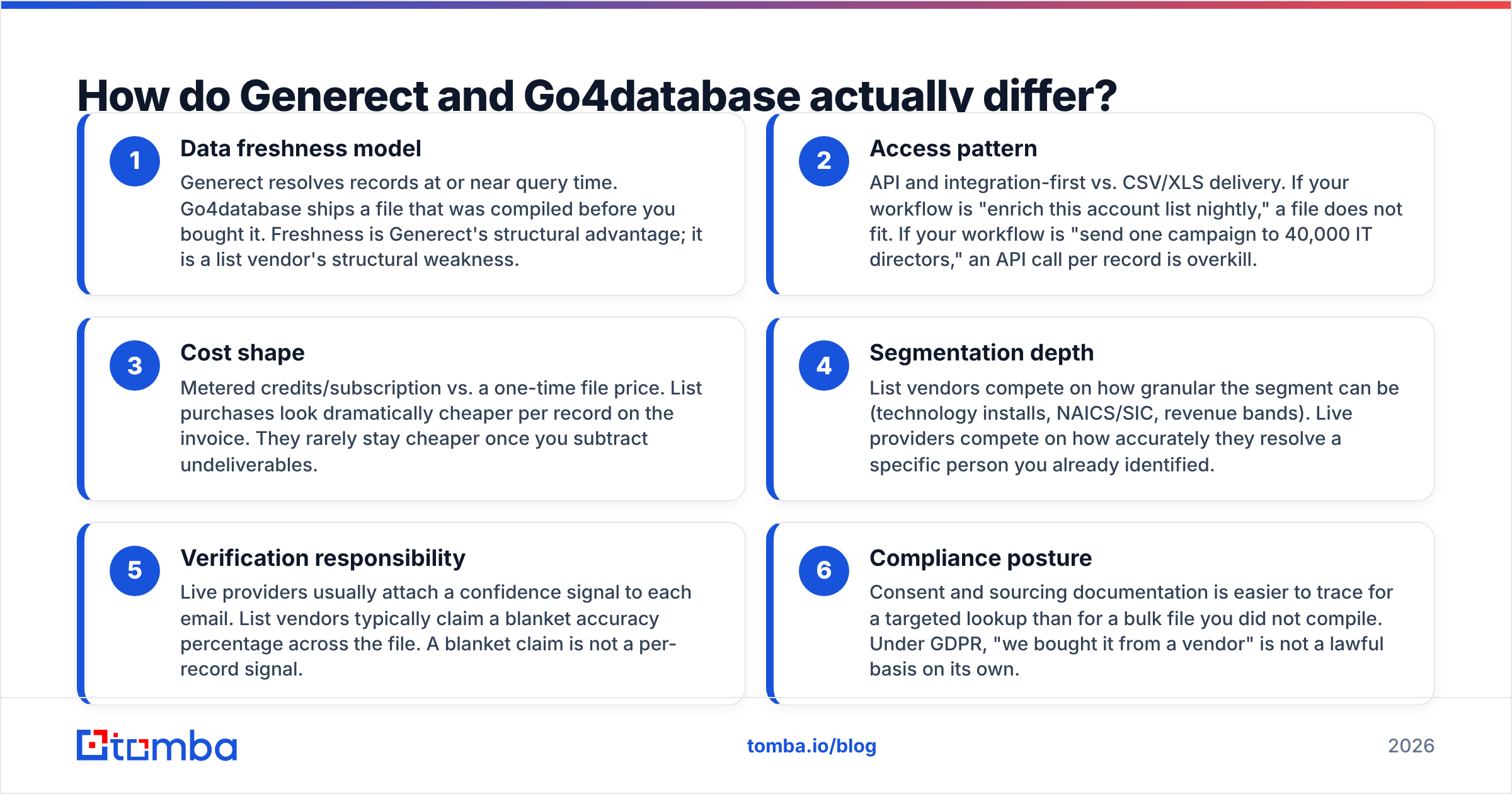
Six things matter more than any feature checklist. Here are the first three.
- Data freshness — Generect builds records at or near query time. Go4database ships a file that was compiled before you bought it. Freshness is Generect's built-in edge. It is a list vendor's built-in weak spot.
- Access pattern — An API and integrations, or a CSV file in your inbox. A file does not fit a nightly enrichment job. An API call per record is overkill when you just want one campaign to 40,000 IT directors.
- Cost shape — Metered credits, or a one-time file price. Lists look far cheaper per record on the invoice. They rarely stay cheaper once you subtract the dead addresses.
The other three are easy to miss, and they cost you the most later.
- Segmentation depth — List vendors compete on how fine the segment can get: tech installs, NAICS/SIC codes, revenue bands. Live tools compete on how well they resolve one person you already named.
- Verification — Live tools usually attach a confidence score to each email. List vendors quote one accuracy number for the whole file. A blanket claim is not a per-record signal.
- Compliance — It is easier to show where one looked-up record came from than to trace a bulk file you did not build. Under GDPR, "we bought it from a vendor" is not a lawful basis on its own.
Generect vs Go4database: the side-by-side comparison#

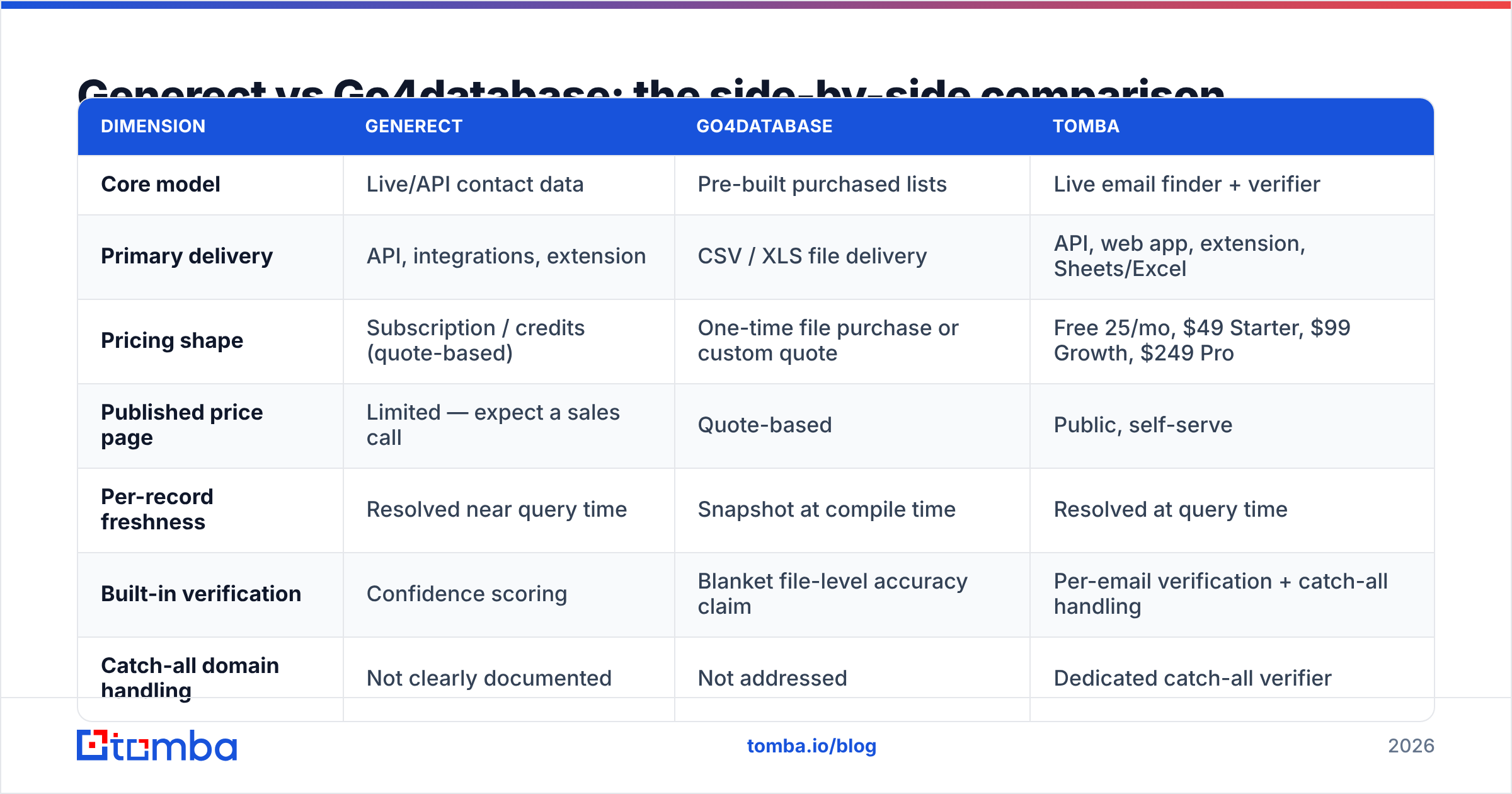
| Dimension | Generect | Go4database | Tomba |
|---|---|---|---|
| Core model | Live/API contact data | Pre-built purchased lists | Live email finder + verifier |
| Primary delivery | API, integrations, extension | CSV / XLS file delivery | API, web app, extension, Sheets/Excel |
| Pricing shape | Subscription / credits (quote-based) | One-time file purchase or custom quote | Free 25/mo, $49 Starter, $99 Growth, $249 Pro |
| Published price page | Limited — expect a sales call | Quote-based | Public, self-serve |
| Per-record freshness | Resolved near query time | Snapshot at compile time | Resolved at query time |
| Built-in verification | Confidence scoring | Blanket file-level accuracy claim | Per-email verification + catch-all handling |
| Catch-all domain handling | Not clearly documented | Not addressed | Dedicated catch-all verifier |
| Best fit | Dev teams automating enrichment | Broad-segment bulk campaigns | Targeted outbound + enrichment at any scale |
| Worst fit | Non-technical one-off list pulls | ABM and personalised sequences | Buying 500k records in one file |
Read that table as three business models, not three vendors. Generect and Tomba answer one question: who is this person, and what is their work email? Go4database answers a different one: give me everyone who fits this profile. Buying the wrong answer is the most common way outbound teams waste budget.
How accurate is each data source?#

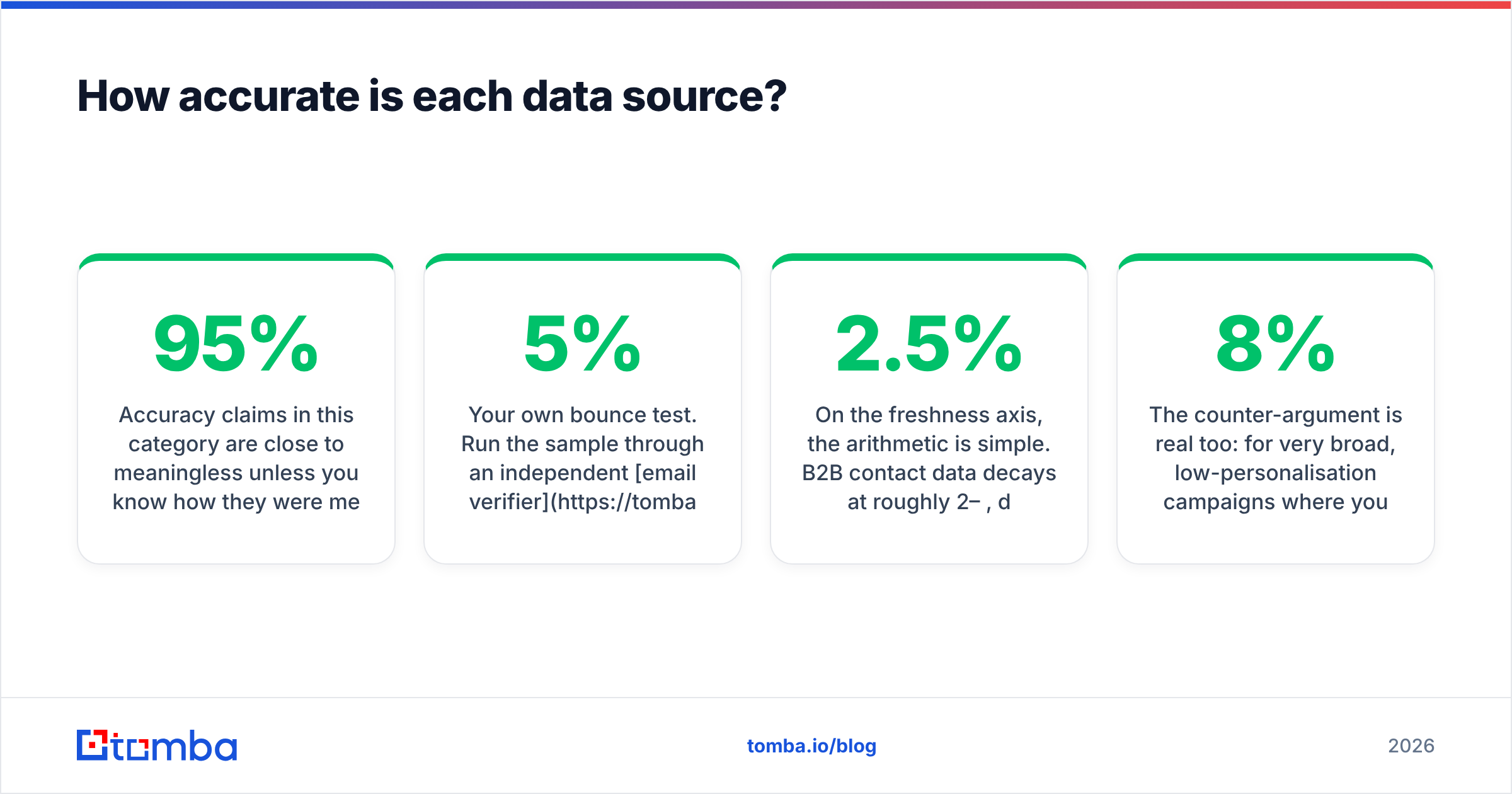
Accuracy claims in this market mean little on their own. You need to know how they were measured. A vendor that quotes "95% accurate" is usually reporting syntax and MX checks. That is not the same as a human reading the inbox.
Insist on three things before you sign anything:
- A dated sample. Ask for 100 records in your exact ICP. Ask when they were last refreshed. A vague answer means the file is old.
- Your own bounce test. Run the sample through an independent email verifier first. If more than 5% bounce on a fresh sample, the full file will be worse.
- Catch-all disclosure. About a fifth of B2B domains are catch-all. The mail server accepts everything and tells you nothing. Vendors that count catch-alls as "valid" inflate their numbers. A catch-all verifier sorts those out instead of guessing.
The freshness math is simple. B2B contact data decays about 2–2.5% per month, mostly from job changes. A live lookup absorbs that decay for you, because the record is built when you ask.
A bought file works the other way. It arrives with the decay that piled up before delivery. Then it keeps rotting on your hard drive. That is the strongest point in Generect's favour, and it holds no matter which brand you prefer.
There is a fair counter-argument. Broad, low-personalisation campaigns only need a big denominator. Paying per record for live lookups is then costly and pointless. If you are inviting 50,000 contacts to one event, and you can live with a 6–8% bounce rate, a file may be the right buy.
What does Generect vs Go4database cost?#
Neither vendor posts full self-serve pricing today. That is a data point in itself. Expect a discovery call before you see a number. Go4database quotes per file and per segment. Generect quotes by volume and access level.
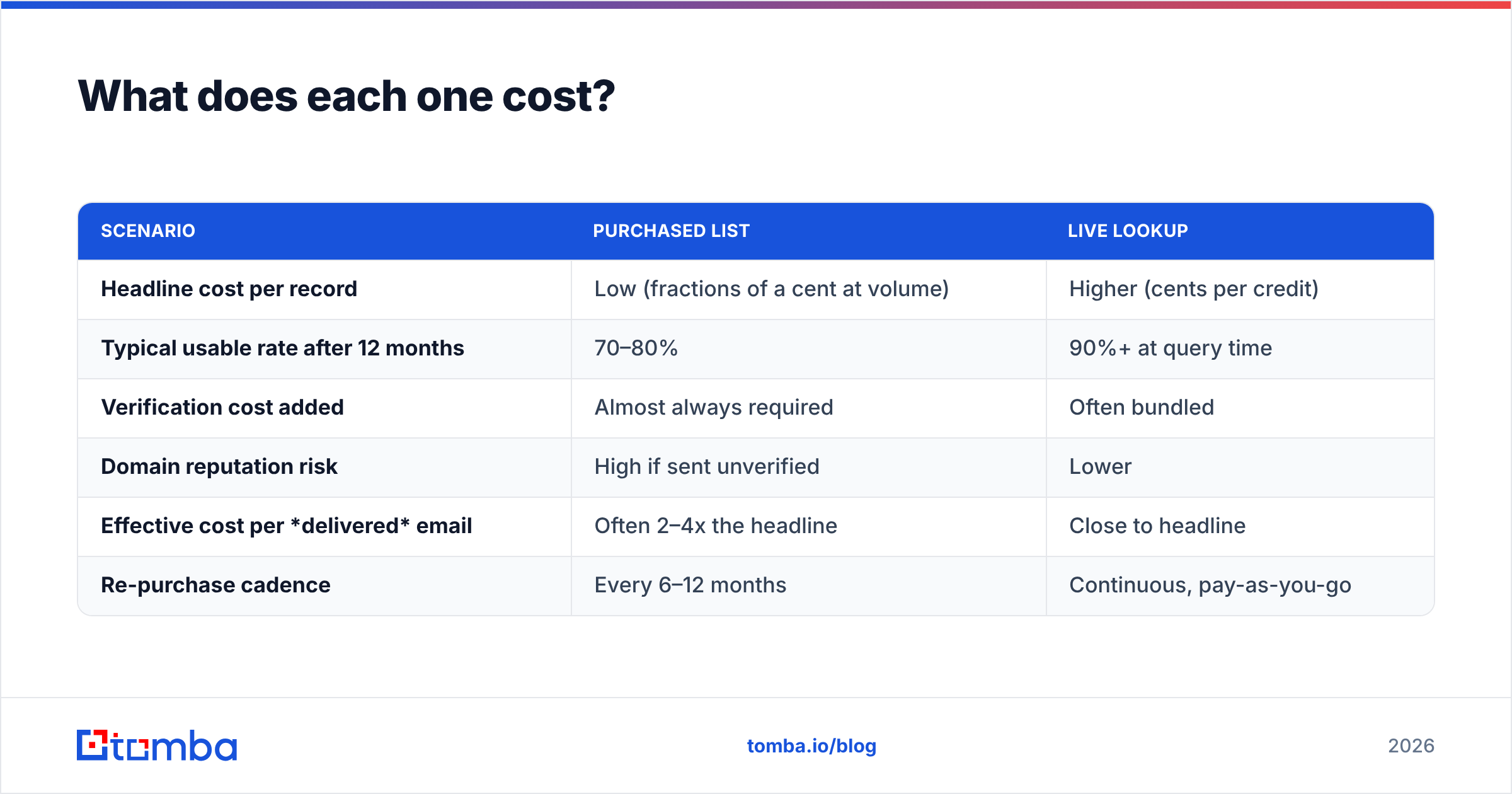
Here is how the economics compare once you account for waste:
| Scenario | Purchased list | Live lookup |
|---|---|---|
| Headline cost per record | Low (fractions of a cent at volume) | Higher (cents per credit) |
| Typical usable rate after 12 months | 70–80% | 90%+ at query time |
| Verification cost added | Almost always required | Often bundled |
| Domain reputation risk | High if sent unverified | Lower |
| Effective cost per delivered email | Often 2–4x the headline | Close to headline |
| Re-purchase cadence | Every 6–12 months | Continuous, pay-as-you-go |
For a transparent benchmark, Tomba pricing is public. The free tier gives 25 searches a month. Starter is $49/mo, Growth is $99/mo, and Pro is $249/mo, with Enterprise on request. Being able to model cost per delivered email without a sales call is worth a lot when you compare three vendors in a week.
Is a pre-built database ever the right call?#
Yes, in narrow cases. Go4database is a fair example of that category.
Buy a file when all of these are true:
- Your segment is defined by firmographics, not by named accounts.
- You need tens of thousands of records, and personalisation stops at
{{company}}. - You send from infrastructure you can afford to burn, on a warmed, separate domain.
- You have budgeted a verification pass as a required line item, not an option.
- Your legal team has reviewed the sourcing documents for every market you target.
Skip the file and use a live source in the opposite cases. That means account-based outbound, a named list of target companies, tight job-title targeting, or sending from your main domain. One bad send to a bought list can undo months of sender reputation work.
What about compliance and data sourcing?#
This is where the two models split the most. It is also where buyers do the least homework.
Under GDPR, legitimate interest can support B2B outreach. But you must document what you collected, where it came from, and why the processing is fair. A targeted lookup is a story you can defend. You resolved one work email, for one named person, at a company you meant to contact about a relevant product.
A 200,000-row file of unknown origin is much harder to justify. The burden sits with you as the controller, not with the vendor.
Run this checklist before you buy:
- Ask for the vendor's data sourcing statement in writing, not a marketing claim.
- Ask whether they suppressed known do-not-contact registries.
- Ask how opt-outs flow back to the vendor's master file.
- Confirm the licence terms. Some list purchases are single-use, and reusing the file breaks the deal.
- Check whether the file holds EU or California residents. Then check that you can handle deletion requests.
Vendor policy pages and review sites like G2 are useful sanity checks. They do not replace a written sourcing statement.
Generect vs Go4database: which should you choose in 2026?#
Choose Generect if your team is technical, your enrichment runs on a schedule, and freshness beats raw volume. The API-first model suits RevOps pipelines, where records are pulled and refreshed all the time rather than loaded once.
Choose Go4database if you need a large, firmographic file for a broad campaign. You should also understand the decay curve you are buying, and have budget for verification and a separate sending domain.
Choose neither on its own. The best outbound teams run a hybrid. They build the target account list from the cheapest source. Then they resolve and verify the actual contacts with a live tool at the moment of send. That gives you list-scale reach with lookup-grade accuracy. It is also why an email finder API usually sits downstream of whichever data vendor you picked.
Whatever you decide, run the same three-step test on both. Pull 100 records in your exact ICP. Verify them independently. Then work out the cost per delivered email, not the cost per row. That number ends most vendor debates in about twenty minutes.
Ready to stop guessing at data quality?#
Maybe your bottleneck is finding the right work email for people you have already named. If so, you do not need another 100,000-row file. Start with the Tomba Email Finder. Search by domain, name, or company. Get a confidence score on every result. Verify catch-alls before they reach your sequencer. The free tier gives you 25 searches a month, so you can run your own accuracy test against whatever Generect or Go4database quoted. Starter is $49/mo when you are ready to scale. Test it against your own ICP, not a vendor's sample file.
Related guides#
Ready to find emails that actually work?
Join 150,000+ professionals who stopped guessing and started sending. Free credits on signup — no credit card required.
Get the Tomba newsletter
Practical outbound tactics and product updates — once every two weeks.
About the author