Generect vs Goava (2026): Which Sales Intelligence Tool Wins?
Generect sells LinkedIn-native lead data through an API. Goava sells Nordic sales intelligence with AI account recommendations. They solve different problems — here is which one belongs in your stack, and where both still need a verification layer.
Generect vs Goava is a fair question, but the two tools do different jobs. One builds contact lists. The other picks which accounts to work. Here is how to tell which one your team needs.
TL;DR
- Generect is a LinkedIn-native lead data platform, built API-first. You describe an audience, or point it at a Sales Navigator search. It returns people and company records with contact data attached.
- Goava is a Nordic sales intelligence platform, built CRM-first. It ranks which companies to call in Sweden, Norway, Denmark and Finland. The ranking uses registry, financial and tech signals.
- They are not real substitutes. Generect answers "who do I contact and how". Goava answers "which accounts deserve my week".
- Pricing shape differs more than price level. Generect bills by credits and volume, and you can start on your own. Goava bills by seat, once a year, after a quote. Budget certainty favours Generect. Forecastable seat cost favours Goava.
- Neither tool checks emails for you. Put an email verifier between the export and your sending tool. Skip that step and you pay for it in bounce rate.
What are Generect and Goava, exactly?#
Both show up on "B2B data platform" shortlists. That is where the likeness stops.
Generect is a lead data provider built on LinkedIn data. Its selling point is audience building without burning your own LinkedIn account. You pick job titles, seniority, headcount, geography and industry. Or you hand it a Sales Navigator search URL. Back comes a list of people with company context and work emails. Some plans add phone numbers.
The product is unusually API-forward for this market. Many users are agencies and product teams. They pull leads straight into their own code rather than clicking through a dashboard.
Goava is a Swedish sales intelligence platform for Nordic B2B teams. Its core product, Goava Discover, reads company registry data, financial filings, tech usage, news and buying signals. Then it tells each rep which accounts to work first. It learns from the deals that rep has already won.
Goava plugs into the CRMs Nordic mid-market teams actually run: Upsales, Lime, SuperOffice, HubSpot and Salesforce. Its pitch is account choice and clean data. It is not a raw contact volume play.
So the honest framing of Generect vs Goava is this. One is a contact engine with near-global reach. The other is an account brain with deep regional reach. Teams selling into Stockholm and Oslo often need both. Teams running global outbound almost never need Goava.

Generect vs Goava: how do they compare head-to-head?#
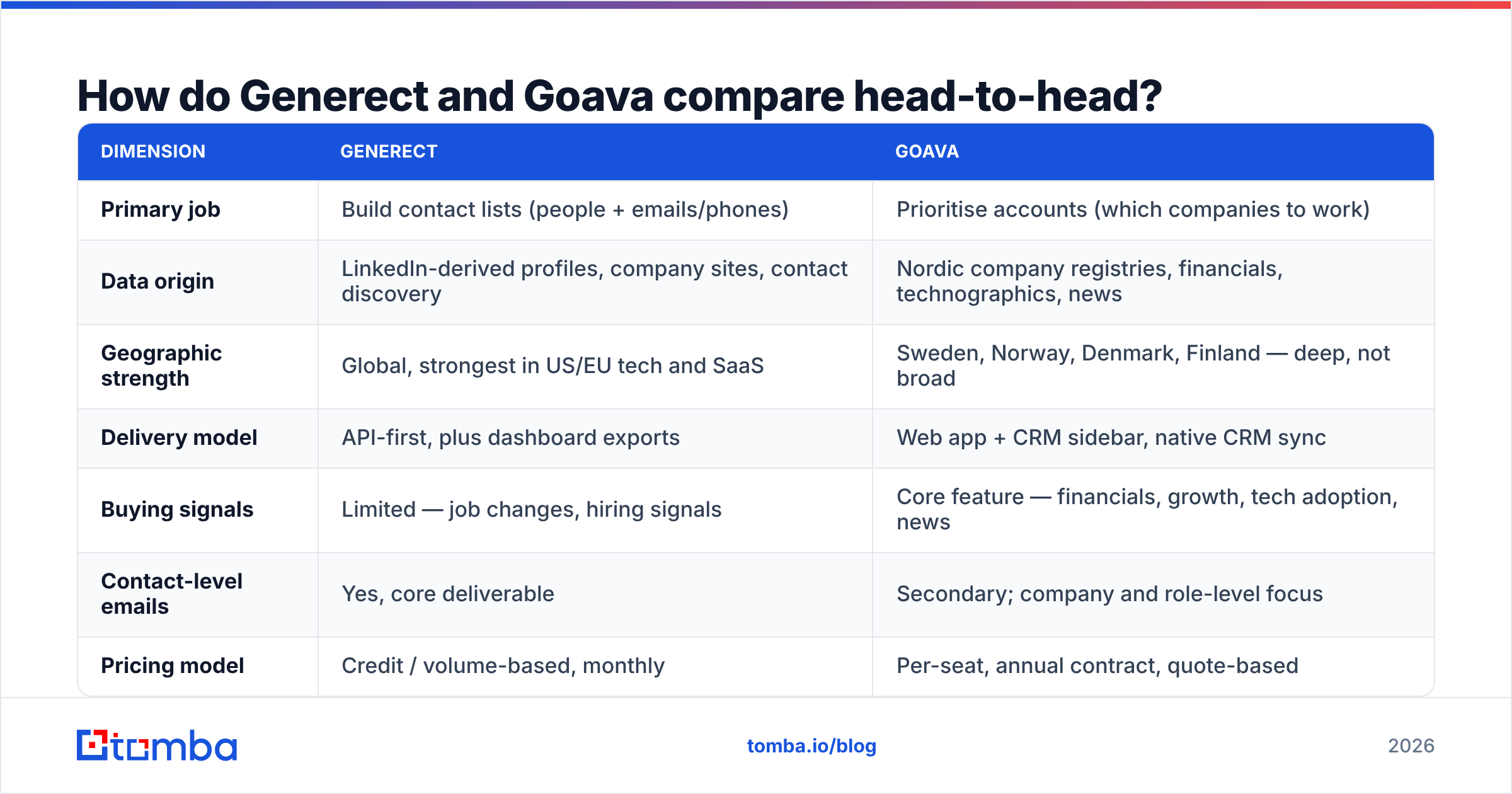
| Dimension | Generect | Goava |
|---|---|---|
| Primary job | Build contact lists (people + emails/phones) | Prioritise accounts (which companies to work) |
| Data origin | LinkedIn-derived profiles, company sites, contact discovery | Nordic company registries, financials, technographics, news |
| Geographic strength | Global, strongest in US/EU tech and SaaS | Sweden, Norway, Denmark, Finland — deep, not broad |
| Delivery model | API-first, plus dashboard exports | Web app + CRM sidebar, native CRM sync |
| Buying signals | Limited — job changes, hiring signals | Core feature — financials, growth, tech adoption, news |
| Contact-level emails | Yes, core deliverable | Secondary; company and role-level focus |
| Pricing model | Credit / volume-based, monthly | Per-seat, annual contract, quote-based |
| Best-fit buyer | Agencies, outbound teams, dev teams building on an API | Nordic mid-market sales orgs with a CRM already in place |
| Weakest point | Account-level intelligence and intent | Contact acquisition outside the Nordics |
Read one row, read the geography row. Goava's edge in the Nordics is real and hard to copy. Swedish and Norwegian registry data is public, structured and rich. Most markets are not. Its weakness outside the Nordics is just as real.
Generect vs Goava data coverage: which one goes deeper?#
Coverage is the wrong single number. Split it into four questions. The answer flips depending on which one you care about.
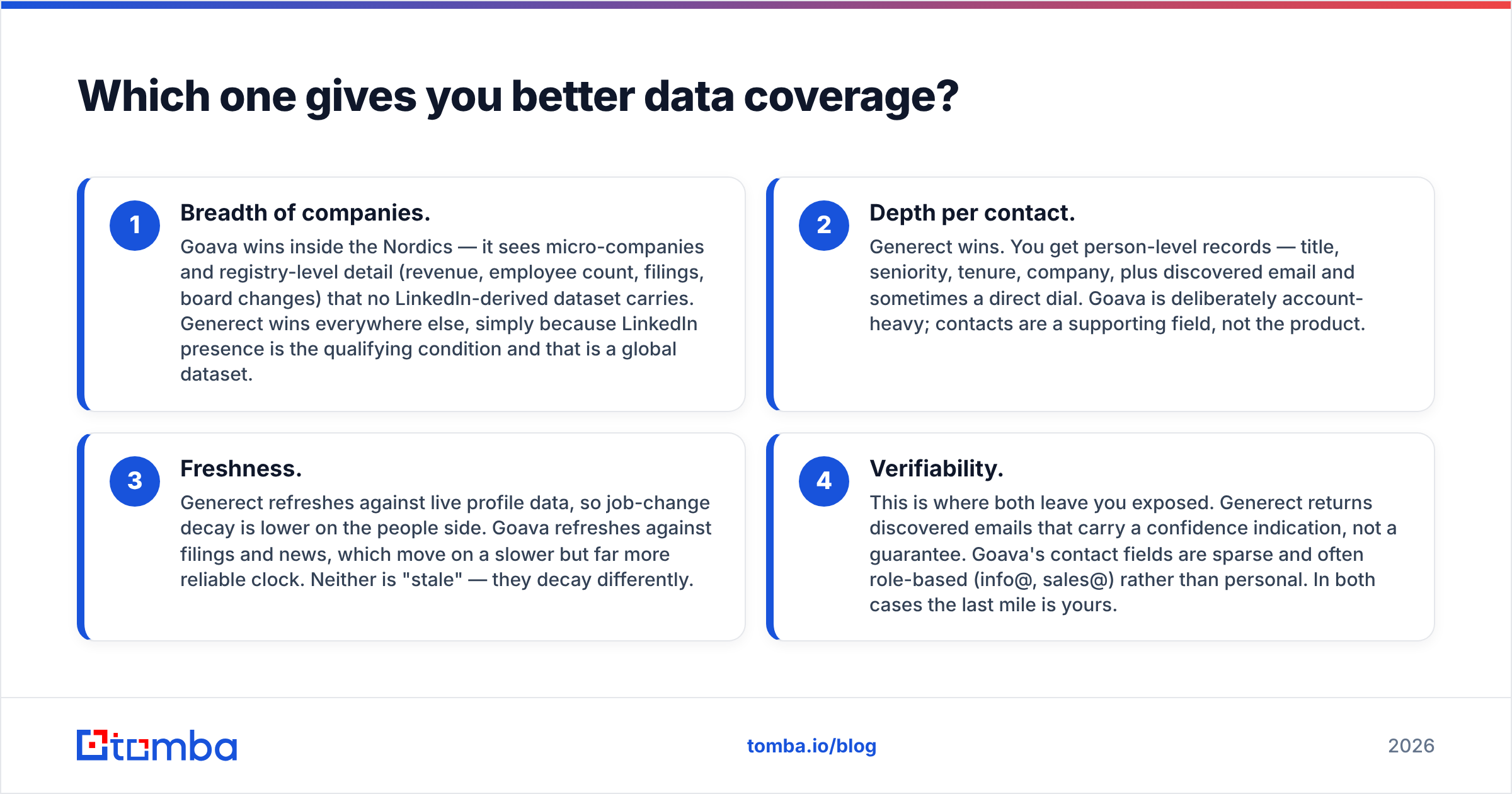
- Breadth of companies. Goava wins inside the Nordics. It sees tiny firms and registry detail: revenue, headcount, filings, board changes. No LinkedIn-derived dataset carries that. Generect wins everywhere else. A LinkedIn profile is the entry ticket, and that is a global pool.
- Depth per contact. Generect wins. You get person-level records: title, seniority, tenure, company, plus a found email and sometimes a direct dial. Goava is account-heavy by design. Contacts are a side field, not the product.
- Freshness. Generect refreshes against live profile data, so job-change decay is lower on the people side. Goava refreshes against filings and news. That clock is slower but far more reliable. Neither is stale. They decay in different ways.
- Can you trust the email? Here both leave you exposed. Generect returns found emails with a confidence score, not a promise. Goava's contact fields are thin and often role-based, such as info@ or sales@. Either way, the last mile is yours.
That fourth point is the one that costs money. A list can look 100% complete in a CSV. It can still land 15–25% invalid at the SMTP layer. Google and Microsoft both weigh bounce rate heavily when they decide inbox placement.
So run the export through a bulk verify pass before it touches your sequencer. That is not nice-to-have hygiene. It is the gap between a warm domain and a burnt one. Some domains accept every address by default. For those you need a catch-all verifier, not a plain syntax-plus-MX check. A normal check marks them "unknown" and leaves you guessing.
Generect vs Goava pricing: how does it actually work?#
Both vendors publish less than you would like. Both change tiers. Treat this as shape, not numbers, and confirm current prices on their own pages.
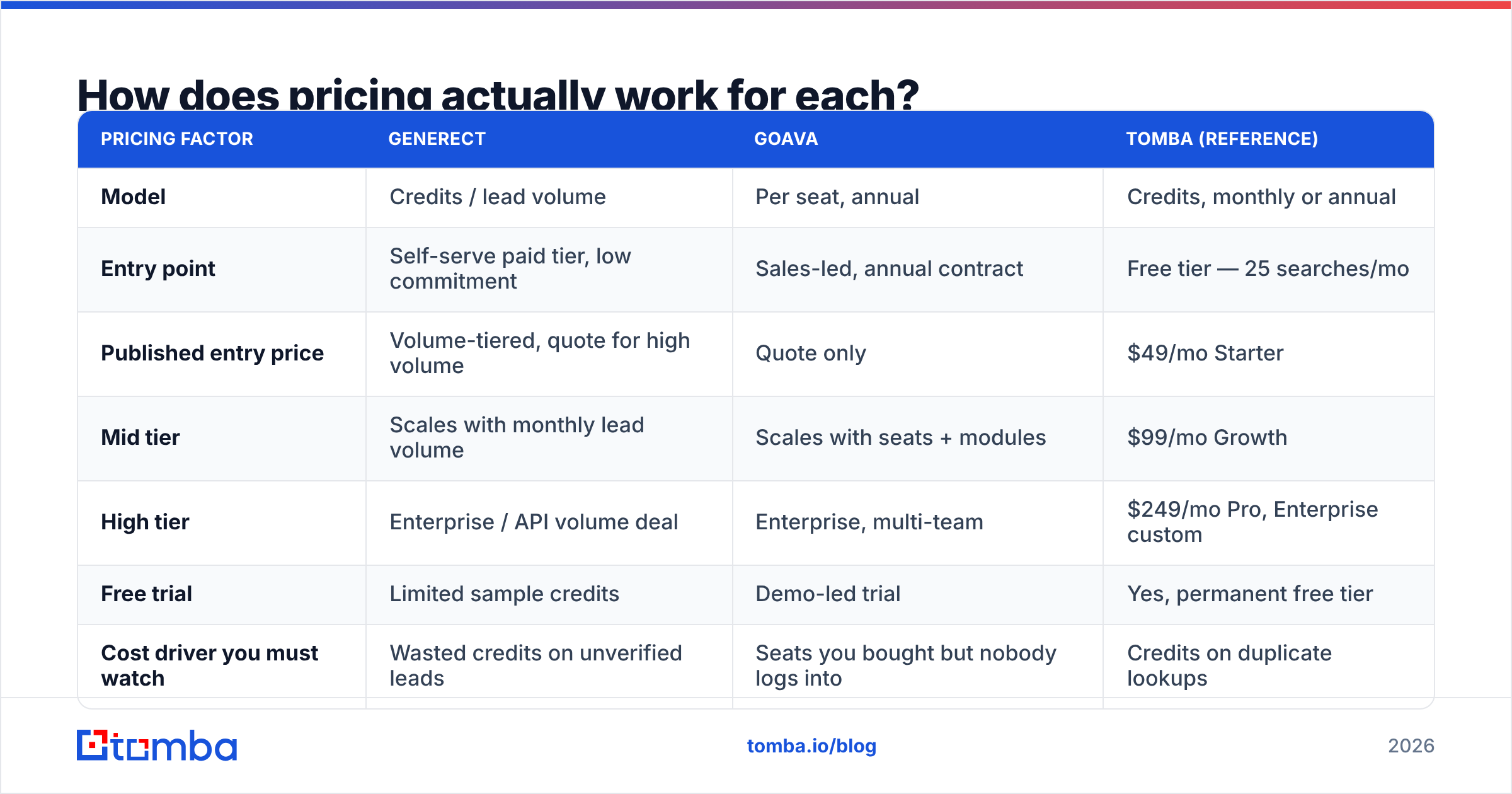
| Pricing factor | Generect | Goava | Tomba (reference) |
|---|---|---|---|
| Model | Credits / lead volume | Per seat, annual | Credits, monthly or annual |
| Entry point | Self-serve paid tier, low commitment | Sales-led, annual contract | Free tier — 25 searches/mo |
| Published entry price | Volume-tiered, quote for high volume | Quote only | $49/mo Starter |
| Mid tier | Scales with monthly lead volume | Scales with seats + modules | $99/mo Growth |
| High tier | Enterprise / API volume deal | Enterprise, multi-team | $249/mo Pro, Enterprise custom |
| Free trial | Limited sample credits | Demo-led trial | Yes, permanent free tier |
| Cost driver you must watch | Wasted credits on unverified leads | Seats you bought but nobody logs into | Credits on duplicate lookups |
Pricing shape matters more than the sticker price. Credit pricing punishes sloppy targeting. Every wide, unfiltered pull burns budget. Seat pricing punishes low use. If four of your ten licensed reps never log in, you paid full price for 60% usage.
Ask which failure mode your team is prone to. Then pick the model that punishes the mistake you don't make.
One more note on Goava. Annual seat deals in the Nordic mid-market often bundle onboarding and CRM setup work. That is real value if your CRM data is a mess. It is pure overhead if it isn't. Get the scope in writing.
Is Generect better than Goava for outbound prospecting?#
For pure outbound, yes, and it isn't close. Build a list, verify it, sequence it. Generect makes the thing outbound needs: a person, a title, a company, and an address that lands. Goava makes a ranked account list. That sits one step upstream.
But "better for outbound" hides a catch. Neither platform is a full outbound stack. You still need:
- A checking layer, because found emails are best guesses. See the coverage section above.
- Sending setup, with warmed domains, SPF, DKIM and DMARC set right, and volume ramped slowly. Check your SPF record before your first send, not after your first spam complaint.
- A sequencer or CRM to run the cadence and log outcomes.
- A backup enrichment step, because every list has gaps. Some companies return nothing. Others return a role address. A domain search against the company website is usually faster than rerunning the whole query with looser filters.
Teams that buy Generect and skip the first two steps hit the same wall every time. Good targeting. Bad deliverability. And a verdict that "the data was wrong" when the data was fine. If your reply rates look broken, audit email deliverability before you blame the vendor.

When should you pick Goava instead?#
Pick Goava when the bottleneck is choice, not contact.
Goava earns its seat cost if three things are true:
- You sell mostly in the Nordics. Not "we have some Swedish customers". A majority of your pipeline. Outside that footprint the data edge fades. You then pay premium seat prices for a thin dataset.
- You already have a CRM your reps use. Goava learns from your closed-won history. No CRM discipline, no signal, no advice worth acting on.
- Your reps waste time picking accounts. Is the complaint "I don't know who to call this week"? Goava fits. Is it "I can't reach the people I found"? It doesn't.
If all three aren't true, skip it. Use a general B2B database with firmographic filters, and spend the difference on execution.
What does a sane stack look like around either tool?#
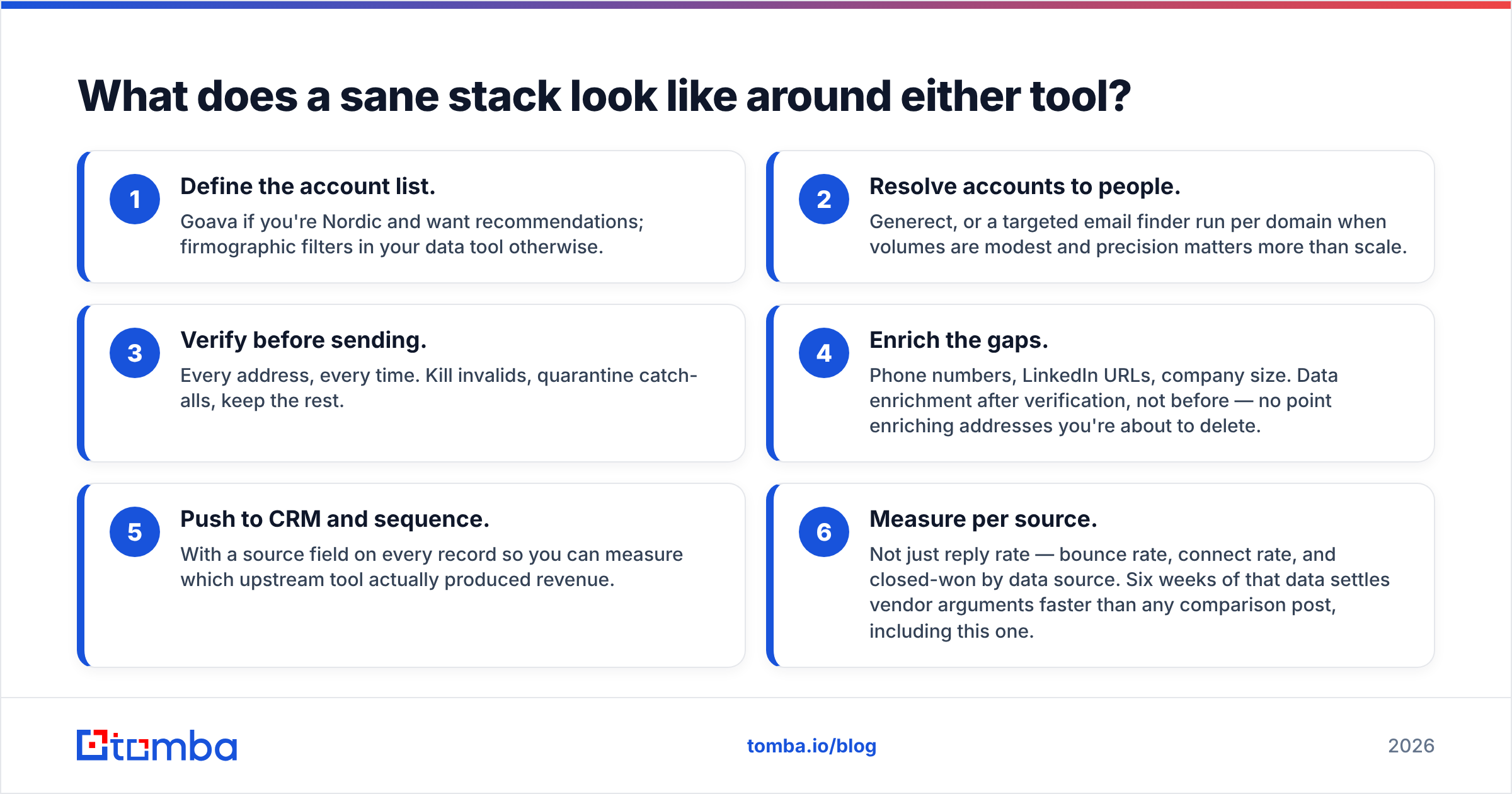
Here is the pattern that works, whichever side of the Generect vs Goava call you land on:
- Define the account list. Goava if you are Nordic and want it ranked for you. Firmographic filters in your data tool otherwise.
- Turn accounts into people. Generect, or a targeted email finder run per domain when volumes are small and precision beats scale.
- Verify before sending. Every address, every time. Kill invalids. Quarantine catch-alls. Keep the rest.
- Fill the gaps. Phone numbers, LinkedIn URLs, company size. Do data enrichment after checking, not before. There is no point enriching addresses you are about to delete.
- Push to CRM and sequence. Tag a source field on every record so you can see which tool made revenue.
- Measure per source. Not just reply rate. Track bounce rate, connect rate and closed-won by data source.
Step six is the one teams skip. Tag records by source at ingest. Then the Generect vs Goava question answers itself with your own numbers inside a quarter.
How do you evaluate them without wasting a quarter?#
Run the same 100-account test against both. Pick 100 real target accounts you know well. Ideally 50 you won and 50 you lost. Ask each platform for contacts and context on them. Then score four things:
- Match rate: how many of the 100 did the tool find at all?
- Contact precision: of the emails returned, how many pass an outside check? Try a free email checker on a sample first, before you commit to a bulk run.
- Signal value: did the account data tell you anything a rep could not find in five minutes on the company website?
- Time-to-list: how many minutes from login to a usable CSV or CRM record?
Then cross-check vendor claims against review volume on G2. Ignore the star rating. It is noise at low review counts. Read the two- and three-star reviews instead. Repeat complaints are where real limits show up.
Generect vs Goava verdict: which should you buy in 2026?#
Buy Generect if you run outbound at volume and need person-level contact data. It is the better fit if you want to pull leads through an API rather than a UI. Agencies, growth teams and script-driven workflows all land here.
Buy Goava if your revenue is Nordic and your CRM is healthy. It fits when your reps' hardest question is which door to knock on. Its regional depth is genuinely hard to copy, and it hooks into the CRMs that region runs.
Buy neither yet if half your sends bounce today. New data cannot fix a broken sending setup. Both tools will look like failures until you fix the layer beneath them.
Whichever way the Generect vs Goava call goes, do not leave contact accuracy to hope. Tomba's Email Finder fills the gaps your main platform leaves. Find work emails by domain, name or company. Check them against real SMTP responses. Push clean records into your CRM through the Tomba API or a no-code integration. Start free with 25 searches a month. Move to Starter at $49/mo when volume justifies it. Full Tomba pricing is public, with no seat minimums and no annual lock-in.
Related guides#
Ready to find emails that actually work?
Join 150,000+ professionals who stopped guessing and started sending. Free credits on signup — no credit card required.
Get the Tomba newsletter
Practical outbound tactics and product updates — once every two weeks.
About the author