Generect vs Heybounce (2026): Which Tool Do You Actually Need?
Generect finds B2B contacts. Heybounce cleans the ones you already have. Here is an honest breakdown of where each one wins, what they cost, and which of them your outbound stack is actually missing.
TL;DR
- Generect and Heybounce are not competitors in the strict sense. Generect is a B2B lead-data platform (contact search, company filters, API). Heybounce is an email verification service. They sit at different points of the same pipeline.
- If your problem is "I don't have enough contacts," Generect is the relevant purchase. If your problem is "my bounce rate is 9% and my domain is getting throttled," Heybounce is.
- Pricing models are structured differently: lead-data platforms typically sell monthly credit subscriptions; verification vendors typically sell pay-as-you-go credit packs that don't expire monthly.
- The overlap is thin. Generect performs some validation on the emails it returns; Heybounce does no sourcing at all. Neither replaces the other.
- Most outbound teams end up paying two vendors for one workflow. A combined find-plus-verify platform removes a handoff, a second invoice, and a second point of failure.
What are Generect and Heybounce, exactly?#
Start by separating the two categories, because a lot of "Generect vs Heybounce" searches come from people who haven't yet decided which problem they're solving.
Generect is a B2B lead generation and data platform. Its pitch is real-time contact and company data — you filter by role, seniority, industry, headcount, geography, or feed it a LinkedIn URL, and it returns contact records. It leans heavily on LinkedIn-derived profile data and exposes an API so engineering teams can pull leads into their own systems instead of exporting CSVs by hand. Buyers are usually SDR teams, agencies running outbound at volume, and product teams building lead-gen features on top of someone else's data.
Heybounce is an email verification service. You give it a list you already own — from a form, a CRM export, a scraper, a purchased file — and it tells you which addresses are deliverable, which are invalid, which are role accounts (info@, sales@), which are disposable, and which sit on catch-all domains where a definitive answer isn't possible via SMTP. Buyers are usually anyone with a deliverability problem: email marketers, cold outreach operators, and RevOps teams cleaning a CRM that's been rotting for three years.
So the honest framing of this comparison is not "which tool is better." It's which half of the pipeline you're missing.

How do Generect and Heybounce compare side by side?#
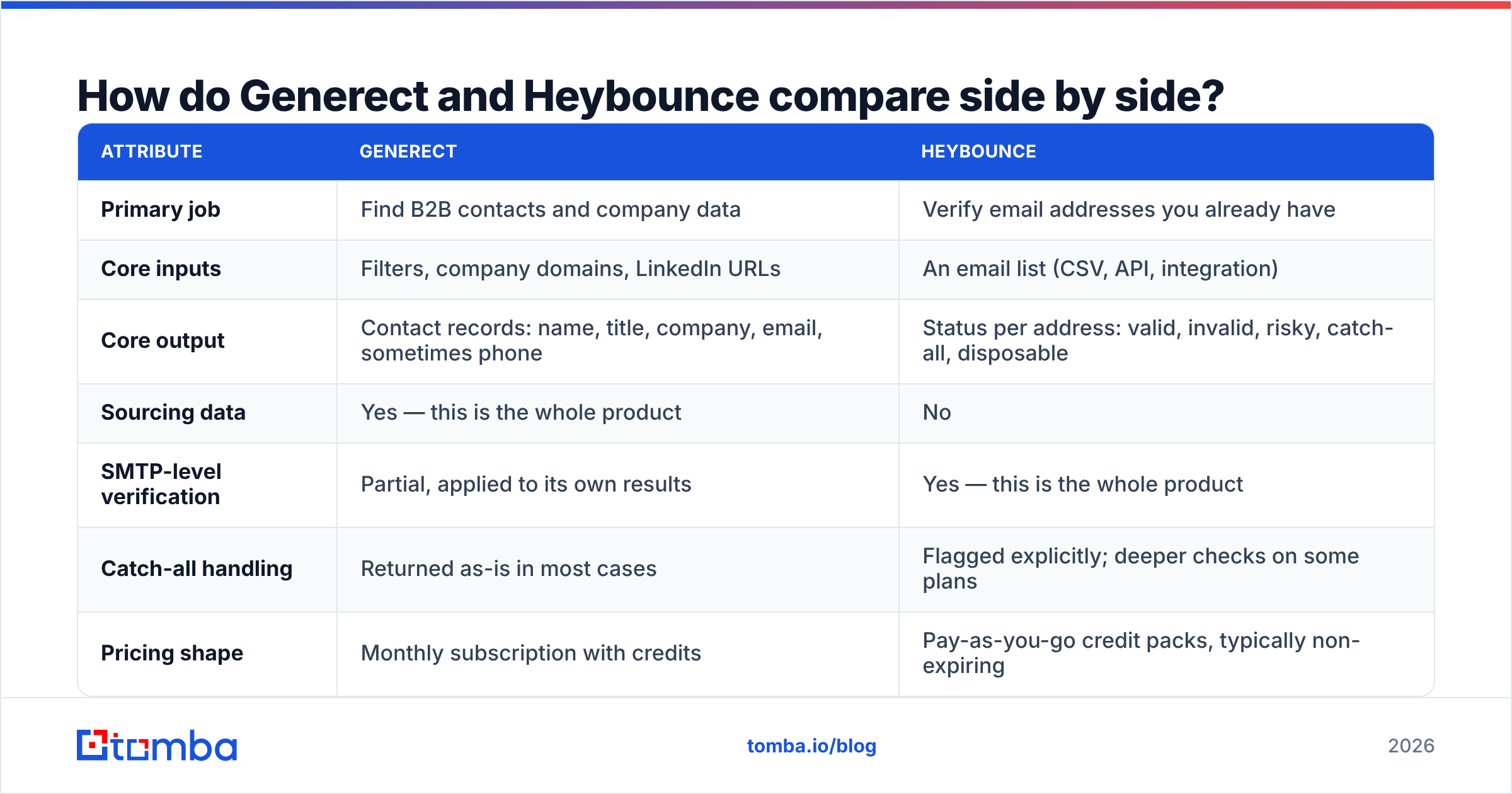
Here's the head-to-head on the attributes that actually change a buying decision. Treat pricing as indicative — both vendors move list prices and run custom deals, so confirm on their own pages before you commit.
| Attribute | Generect | Heybounce |
|---|---|---|
| Primary job | Find B2B contacts and company data | Verify email addresses you already have |
| Core inputs | Filters, company domains, LinkedIn URLs | An email list (CSV, API, integration) |
| Core output | Contact records: name, title, company, email, sometimes phone | Status per address: valid, invalid, risky, catch-all, disposable |
| Sourcing data | Yes — this is the whole product | No |
| SMTP-level verification | Partial, applied to its own results | Yes — this is the whole product |
| Catch-all handling | Returned as-is in most cases | Flagged explicitly; deeper checks on some plans |
| Pricing shape | Monthly subscription with credits | Pay-as-you-go credit packs, typically non-expiring |
| API | Yes, positioned as a core feature | Yes, plus bulk upload |
| Best for | Building a list from zero | Protecting a domain before you send |
| Replaces the other? | No | No |
The row that matters most is the last one. Reviewers on G2 consistently rate these product types on separate criteria — data coverage and match rate for one, accuracy of verdicts and bounce reduction for the other. A team that buys only one and expects both outcomes will be unhappy with whichever they picked.
Which one is more accurate — and accurate at what?#
"Accuracy" means two different things here, and conflating them is the most common mistake in this comparison.
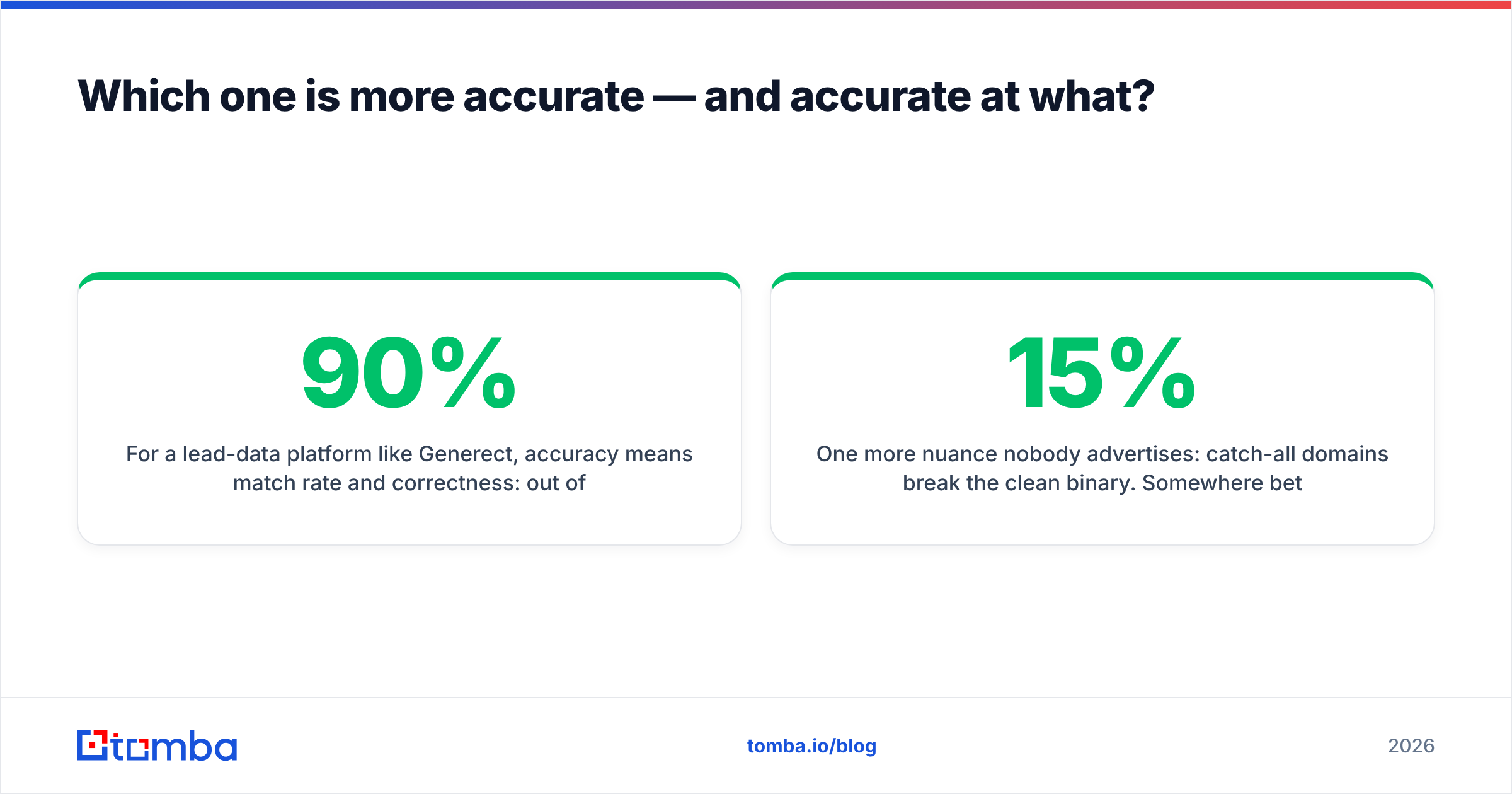
For a lead-data platform like Generect, accuracy means match rate and correctness: out of 1,000 target prospects you searched for, how many did it return an email for, and how many of those emails belong to the right person and still work. A tool that returns an address for 90% of your list but is wrong a third of the time is worse than one that returns 60% and is right almost always — because the wrong 30% costs you domain reputation, not just time.
For a verifier like Heybounce, accuracy means verdict reliability: when it says "valid," does the message land, and when it says "invalid," would it really have bounced. False positives burn your sender score. False negatives quietly delete real prospects from your list, which is the more expensive error because you never see it happen.

The practical test is the same for both: run a sample of 300–500 addresses you already know the answer for. For a finder, use contacts you've already emailed successfully. For a verifier, use a mix of known-good, known-dead, and known-catch-all addresses. Vendor-published accuracy figures are marketing artifacts; your own control list is the only number that predicts your bounce rate.
One more nuance nobody advertises: catch-all domains break the clean binary. Somewhere between 15% and 25% of B2B domains accept everything at the SMTP layer and reject silently afterward. No verifier can return a definitive verdict on those through standard checks. What separates the good ones is whether they tell you clearly that a result is unknowable, or quietly bucket it as "valid" to keep their accuracy stat pretty. If a large share of your target market is enterprise, a dedicated catch-all verifier matters more than a decimal point of headline accuracy.
What does each one cost in practice?#
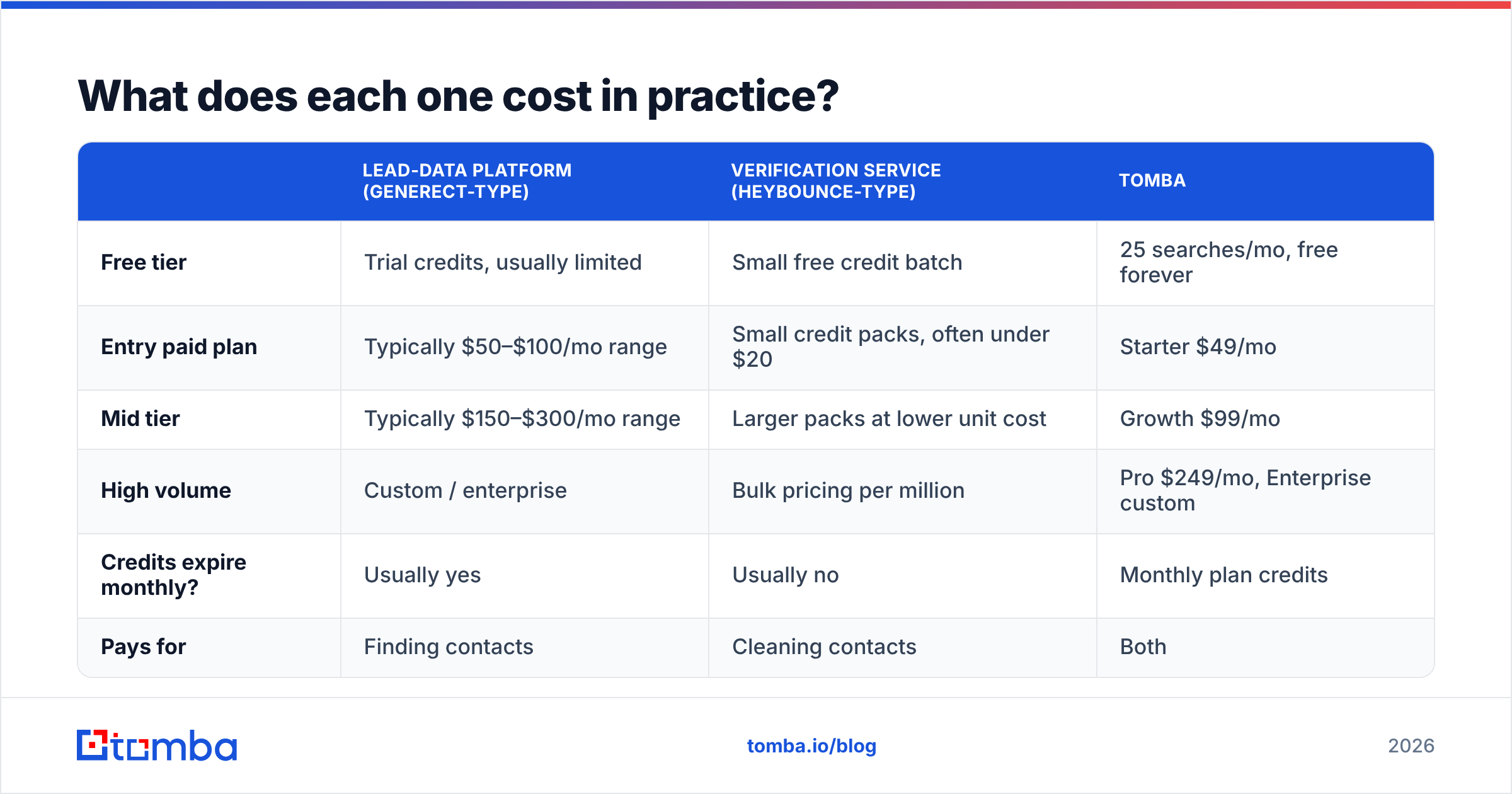
Cost comparison between these two categories is apples-to-oranges unless you normalize on cost-per-usable-contact. Here's the framework, with Tomba included as a reference point for a platform that does both jobs.
| Lead-data platform (Generect-type) | Verification service (Heybounce-type) | Tomba | |
|---|---|---|---|
| Free tier | Trial credits, usually limited | Small free credit batch | 25 searches/mo, free forever |
| Entry paid plan | Typically $50–$100/mo range | Small credit packs, often under $20 | Starter $49/mo |
| Mid tier | Typically $150–$300/mo range | Larger packs at lower unit cost | Growth $99/mo |
| High volume | Custom / enterprise | Bulk pricing per million | Pro $249/mo, Enterprise custom |
| Credits expire monthly? | Usually yes | Usually no | Monthly plan credits |
| Pays for | Finding contacts | Cleaning contacts | Both |
Confirm current numbers on each vendor's own pricing page — this table describes the shape of each pricing model, not a quote. Tomba's figures are exact and published on the Tomba pricing page.
The arithmetic that trips teams up: if you pay a lead-data platform for 5,000 contacts a month and then pay a verifier to clean the same 5,000, you are paying twice for the same record. That's defensible if the sourcing tool's data is genuinely raw. It's pure waste if the sourcing tool already verified them and you never checked.
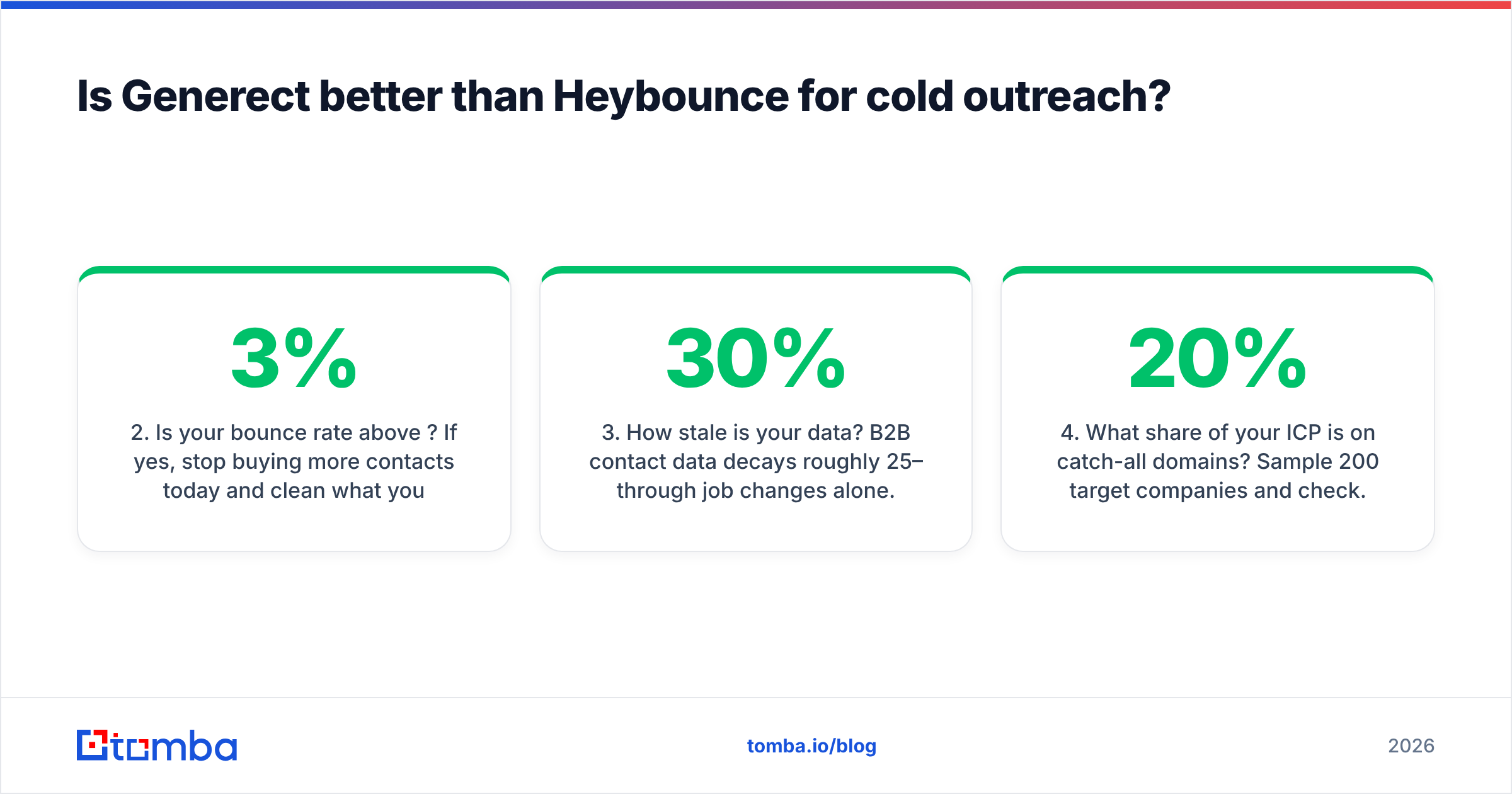
Is Generect better than Heybounce for cold outreach?#
Wrong question, but it's the one people search, so here's the answer in the form that's actually useful. Run through these five checks and the decision makes itself.
- Do you have a list at all? If no, a verifier does nothing for you. You need sourcing first — Generect, or an email finder that works from a domain and a name. Verification is step two by definition.
- Is your bounce rate above 3%? If yes, stop buying more contacts today and clean what you have. Mailbox providers throttle on bounce signals fast, and adding volume to a damaged domain accelerates the damage. This is the Heybounce-shaped problem.
- How stale is your data? B2B contact data decays roughly 25–30% per year through job changes alone. A list you sourced eight months ago and never re-checked is not the list you think it is. Re-verification is recurring maintenance, not a one-time purchase.
- What share of your ICP is on catch-all domains? Sample 200 target companies and check. If it's above 20%, prioritize a vendor with explicit catch-all handling over one with the best headline accuracy number.
- Do you need this inside a workflow or inside a UI? If your ops team lives in scripts, Airtable, or an enrichment pipeline, API quality and rate limits outrank dashboard polish. If your SDRs work from a browser, an extension and a clean export matter more.
Answer honestly and you'll usually find you need one of them urgently and the other eventually — not both this quarter.

When should you use both — or neither?#
Use both when your volume justifies specialists. If you're pulling tens of thousands of records a month from a data platform and sending across multiple domains, a dedicated verifier as a second gate is cheap insurance. Sourcing vendors have an incentive to be generous with what they call deliverable; an independent verifier has no such incentive. Two vendors with opposed incentives is a real control, not paranoia.
Use neither in two situations. First, if your motion is inbound-led and your contacts arrive through forms — then you want a real-time API check at form submission, which is a lighter and cheaper integration than either product's full offering. Second, if your total addressable market is a few hundred named accounts. At that scale, manual research plus a free email checker beats any subscription. Don't buy a data platform to email 200 people.
Use one platform when the handoff between tools is the actual cost. Every export-import cycle between a finder and a verifier introduces format drift, duplicate spend, and a delay during which the data ages further. Teams running weekly list builds usually find that the combined tool wins on total cost of ownership even when it loses on any single feature comparison.

Where does Tomba fit between the two?#
Tomba is the both-halves option, which is why it shows up in this comparison at all.
The email finder covers the Generect side of the job: find professional addresses by domain, by name, or across a whole company. Domain search returns the contacts at a company along with the detected email pattern. The email verifier covers the Heybounce side: syntax, MX, SMTP, disposable and role-account detection, with catch-all domains flagged rather than fudged. Both run through the same API and the same credit balance, so a record found in the morning is verified in the same pipeline without an export step.
Where it's genuinely narrower: Tomba is not a filter-and-browse prospecting database with the kind of firmographic slicing a dedicated lead-data platform builds its UI around. If your workflow starts with "show me every Series B fintech in Germany with 50–200 employees hiring for a VP Sales," a specialist data platform is a better first stop, and Tomba works better as the enrichment and verification layer behind it.
Where it wins: cost per usable contact when you need both jobs done, and a single API surface for engineering teams who don't want to reconcile two vendors' rate limits, credit systems, and status vocabularies. One verdict schema across find and verify is worth more to an ops engineer than any individual feature.
Frequently asked questions#
Can Heybounce find email addresses? No. It's a verification service. You bring the list; it returns a verdict per address. Sourcing is a different product category entirely.
Can Generect replace a dedicated verifier? Partially, and it depends on your risk tolerance. Data platforms validate their own output to some degree, but that check happens at the vendor's chosen strictness, not yours, and it doesn't help with the contacts already sitting in your CRM. High-volume senders should keep an independent verification gate.
How often should I re-verify a list? Before every campaign for cold lists, and quarterly for CRM records. Contact data decays continuously; a verification result is a snapshot with a shelf life measured in weeks, not years.
What bounce rate should I target? Under 2% is the working safety line for cold outreach. Above 5% and you should assume mailbox providers are already discounting your sender reputation.
Which is cheaper? Per unit, verification is cheaper — it's a lookup, not a discovery. But cost per usable contact is the number that matters, and that depends entirely on your match rate. A cheap tool that finds 40% of your list may cost more per usable contact than an expensive one that finds 75%.
The bottom line#
Generect and Heybounce answer different questions, and the "versus" framing hides that. Generect is the answer to an empty pipeline. Heybounce is the answer to a damaged domain. Buy the one that matches the failure you're currently experiencing, and treat the second as a planned purchase for the quarter after.
If you'd rather not run two vendors for one workflow, start with the Tomba Email Finder. The free tier gives you 25 searches a month with no card, which is enough to run your own control-list test against whatever you're using today. Find the contacts, verify them in the same pass, and see what your real cost per usable contact looks like before you sign an annual contract with anyone.
Related guides#
Ready to find emails that actually work?
Join 150,000+ professionals who stopped guessing and started sending. Free credits on signup — no credit card required.
Get the Tomba newsletter
Practical outbound tactics and product updates — once every two weeks.
About the author