Generect vs Interseller: Which B2B Data Tool Wins in 2026?
Generect sells B2B lead data. Interseller sells recruiter outreach. They get compared constantly, but they solve different halves of the same problem. Here is which one actually belongs in your 2026 stack.
TL;DR
- Generect is a data provider. It sells B2B contact and company records, LinkedIn-sourced profiles, and API access. It does not send your emails for you.
- Interseller is an outreach tool with data attached. Owned by Greenhouse since 2021, it is built for recruiters who source a candidate, grab a contact, and run a sequence in one window.
- They are not true substitutes. If you are comparing them head to head, you are probably asking the wrong question: do you need records or do you need a sending workflow?
- Seat pricing is the real cost driver. Interseller has historically been priced per user per month in the $100 range, which punishes teams with many light users. Data-API pricing scales with volume instead.
- A third path exists. Many teams keep their sequencer (Instantly, Lemlist, Greenhouse itself) and bolt on a dedicated email finder for the contact layer, which is usually the cheaper and more accurate split.
What is Generect?#
Generect is a B2B lead-data platform. You search for companies or people by filters (industry, headcount, geography, job title, technology), and it returns structured records: names, roles, company domains, business emails, and LinkedIn profile URLs. It leans heavily on LinkedIn-derived data, and it markets an API for teams that want records pushed into their own systems rather than pulled through a UI.
The buyer profile is clear once you use it: agencies building lead lists at volume, data teams feeding a CRM, and RevOps people who want programmatic enrichment without a full ZoomInfo contract. You can check the current feature set on the Generect site, because data vendors change their coverage claims frequently.
What Generect is not: an outreach platform. There is no meaningful sequencing engine, no inbox rotation, no reply detection. You export or you pipe via API, then you send elsewhere.
What is Interseller?#
Interseller is a sourcing-plus-outreach tool built primarily for recruiting. The classic workflow is a Chrome extension: you open a candidate's LinkedIn or GitHub profile, Interseller finds a personal or work email, adds the person to a sequence, and syncs the record back to your ATS or CRM (Greenhouse, Lever, Bullhorn, and similar).
Greenhouse acquired Interseller in 2021, and the product has been folded into the Greenhouse sourcing story since. That matters for two reasons. First, roadmap priority now follows recruiting use cases, not sales use cases. Second, standalone buyers should confirm current packaging directly on interseller.io before assuming a legacy plan still exists.
Interseller's real strength is closing the loop: source, contact, sequence, and log activity without leaving one tab. Its weakness is that everything is priced and shaped around a seat, and its data is tuned for candidate contacts (including personal emails) rather than broad firmographic B2B coverage.

How do Generect and Interseller actually differ?#
Here is the honest split, feature by feature. Where a vendor does not publish a number, we say so rather than inventing one.
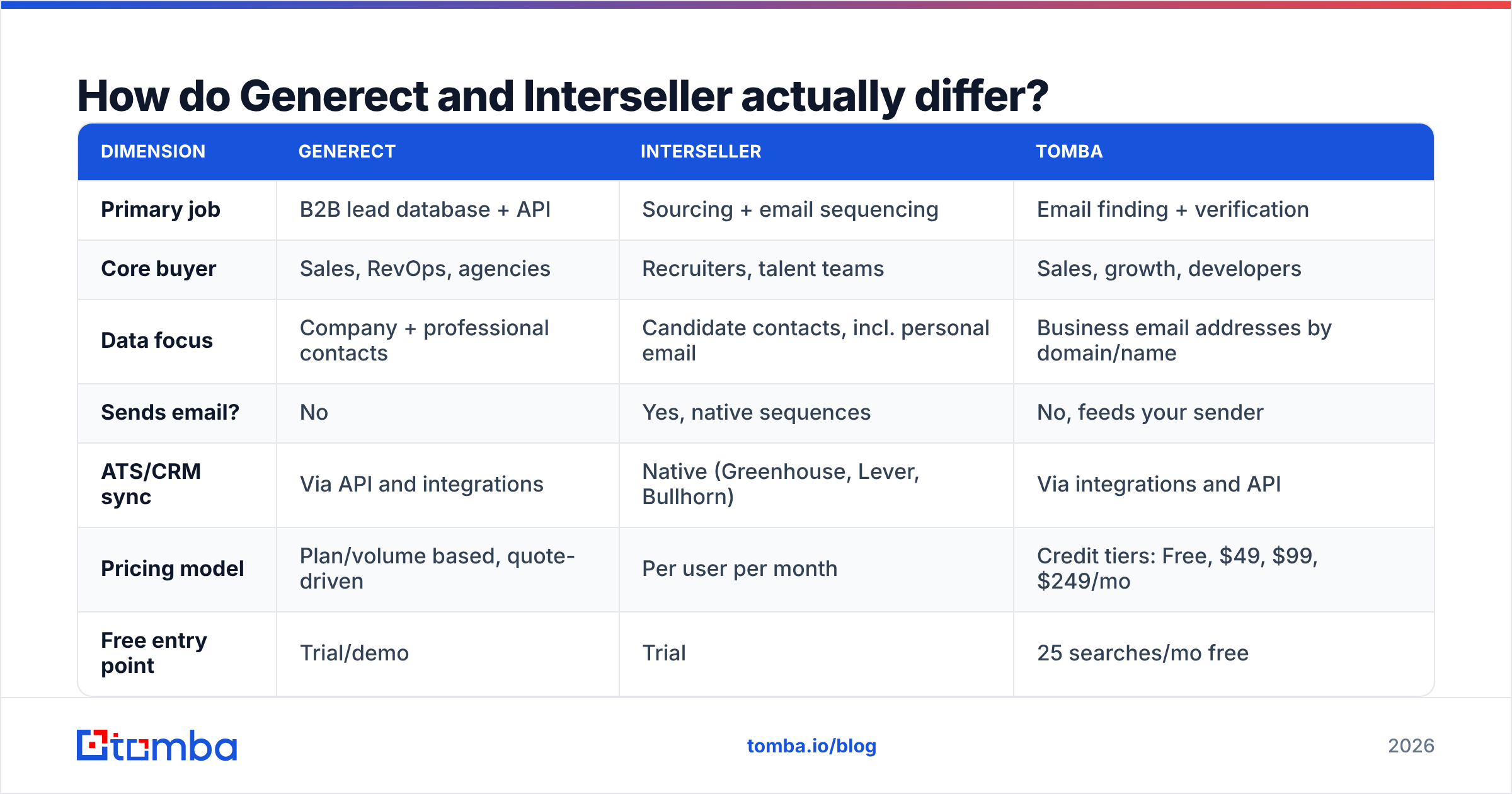
| Dimension | Generect | Interseller | Tomba |
|---|---|---|---|
| Primary job | B2B lead database + API | Sourcing + email sequencing | Email finding + verification |
| Core buyer | Sales, RevOps, agencies | Recruiters, talent teams | Sales, growth, developers |
| Data focus | Company + professional contacts | Candidate contacts, incl. personal email | Business email addresses by domain/name |
| Sends email? | No | Yes, native sequences | No, feeds your sender |
| ATS/CRM sync | Via API and integrations | Native (Greenhouse, Lever, Bullhorn) | Via integrations and API |
| Pricing model | Plan/volume based, quote-driven | Per user per month | Credit tiers: Free, $49, $99, $249/mo |
| Free entry point | Trial/demo | Trial | 25 searches/mo free |
| Public API | Yes | Limited | Yes, documented Tomba API |
| Best at | Volume list building | One-window recruiter workflow | Accuracy on business emails |
Read that table as a diagnosis, not a scoreboard. Generect and Tomba both live in the "get me correct contact records" column. Interseller lives in the "run the outreach" column and carries data as a convenience feature.
Which one has better data?#
Neither wins outright, because they are optimized for different targets.
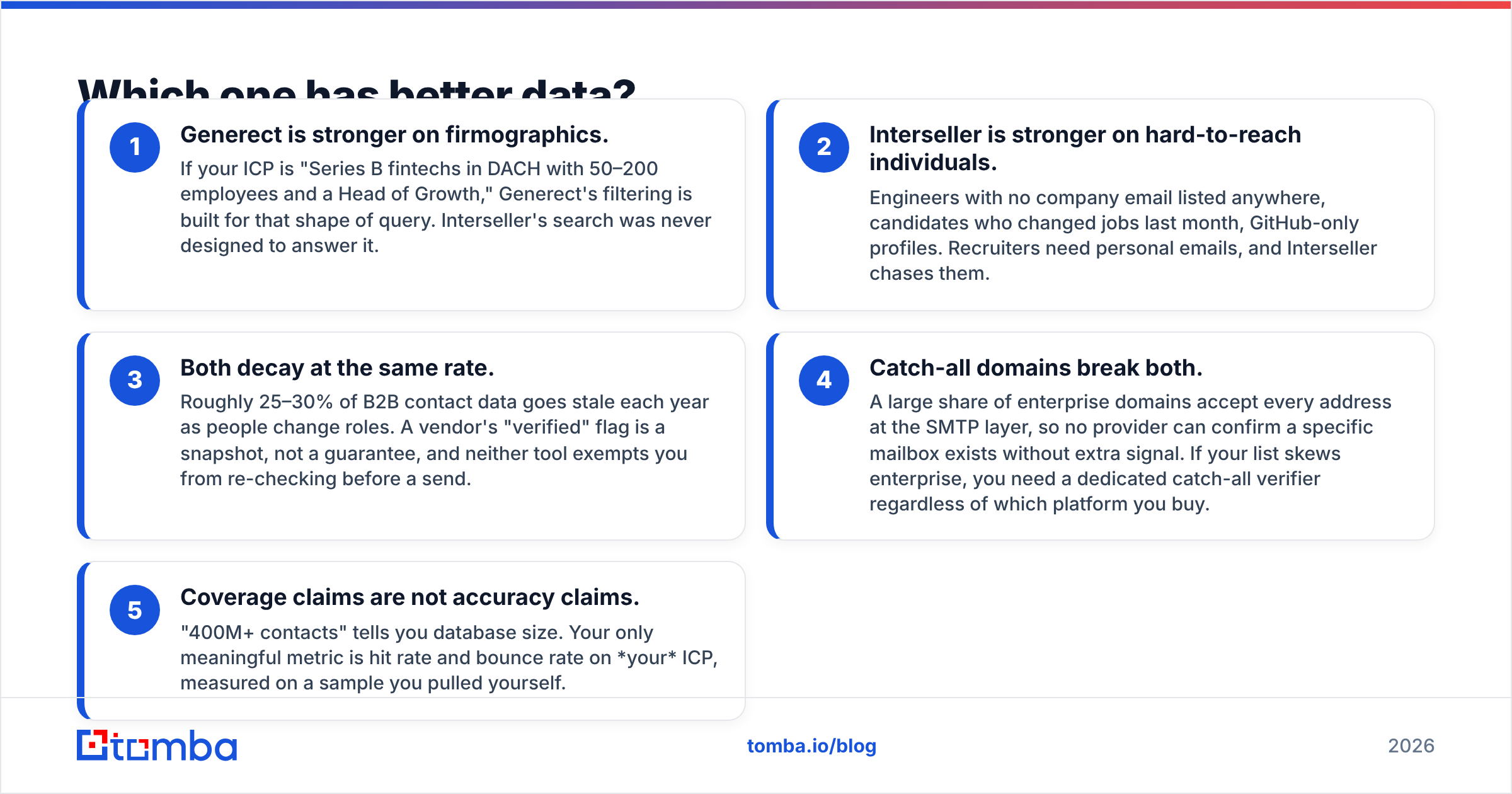
- Generect is stronger on firmographics. If your ICP is "Series B fintechs in DACH with 50–200 employees and a Head of Growth," Generect's filtering is built for that shape of query. Interseller's search was never designed to answer it.
- Interseller is stronger on hard-to-reach individuals. Engineers with no company email listed anywhere, candidates who changed jobs last month, GitHub-only profiles. Recruiters need personal emails, and Interseller chases them.
- Both decay at the same rate. Roughly 25–30% of B2B contact data goes stale each year as people change roles. A vendor's "verified" flag is a snapshot, not a guarantee, and neither tool exempts you from re-checking before a send.
- Catch-all domains break both. A large share of enterprise domains accept every address at the SMTP layer, so no provider can confirm a specific mailbox exists without extra signal. If your list skews enterprise, you need a dedicated catch-all verifier regardless of which platform you buy.
- Coverage claims are not accuracy claims. "400M+ contacts" tells you database size. Your only meaningful metric is hit rate and bounce rate on your ICP, measured on a sample you pulled yourself.
The practical move: take 200 accounts you actually want, run them through each candidate tool during trial, and compare three numbers — match rate, bounce rate after verification, and cost per usable contact. Vendor benchmark decks are marketing. Your 200-row sample is evidence.
What does each one cost?#
Cost is where the comparison stops being academic.
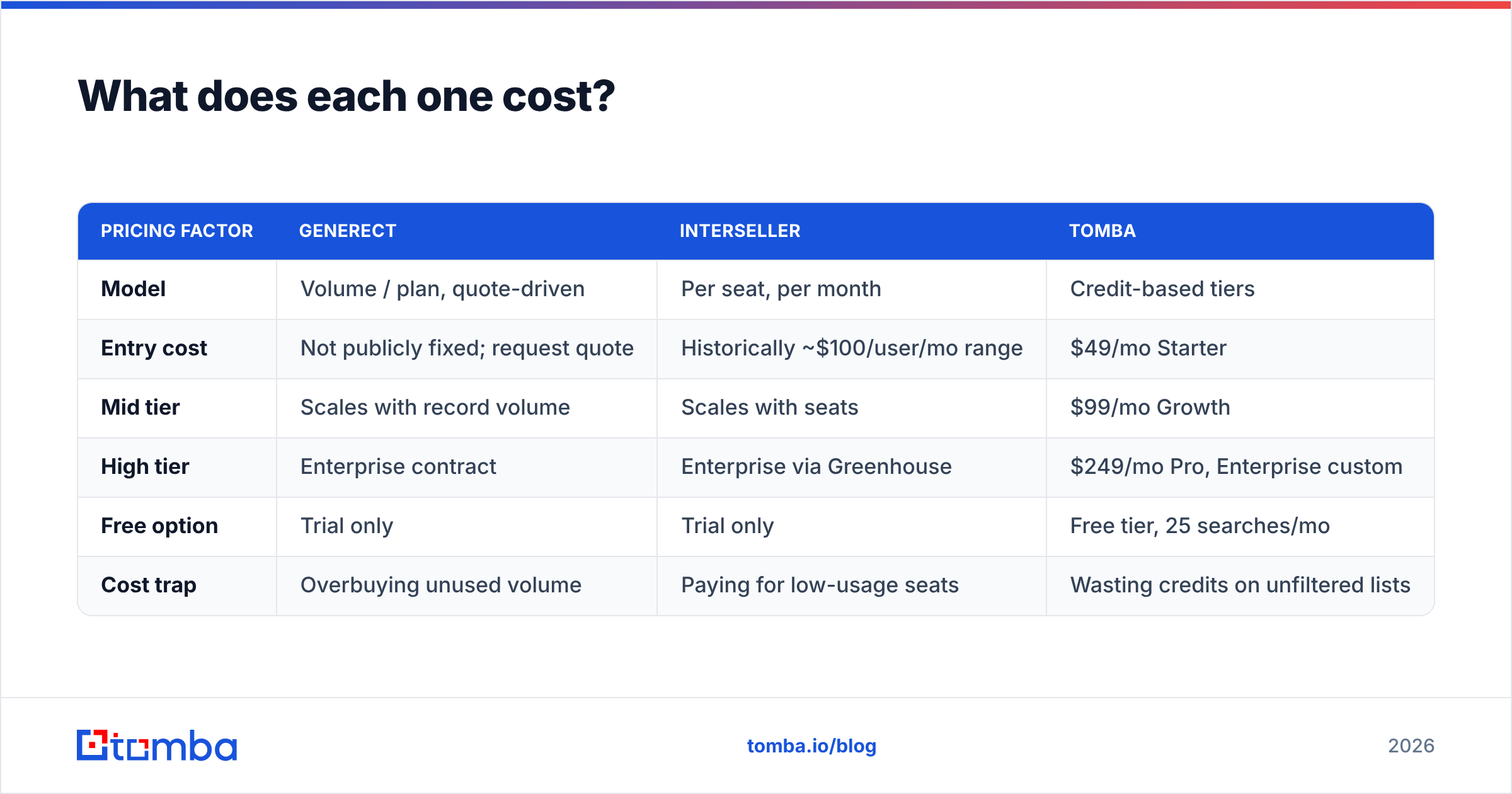
| Pricing factor | Generect | Interseller | Tomba |
|---|---|---|---|
| Model | Volume / plan, quote-driven | Per seat, per month | Credit-based tiers |
| Entry cost | Not publicly fixed; request quote | Historically ~$100/user/mo range | $49/mo Starter |
| Mid tier | Scales with record volume | Scales with seats | $99/mo Growth |
| High tier | Enterprise contract | Enterprise via Greenhouse | $249/mo Pro, Enterprise custom |
| Free option | Trial only | Trial only | Free tier, 25 searches/mo |
| Cost trap | Overbuying unused volume | Paying for low-usage seats | Wasting credits on unfiltered lists |
Two structural warnings.
Seat pricing punishes breadth. If you have eight recruiters and three of them source occasionally, you still pay eight seats. Interseller's model rewards a small team of heavy users and penalizes a wide team of light ones.
Quote-driven pricing punishes small buyers. When a vendor will not publish numbers, the floor is usually higher than a solo operator or a five-person team wants. Ask for the smallest committed plan on the first call rather than the third.
For teams that just need contact data and already own their sending stack, published Tomba pricing makes the math trivial: $49/mo Starter, $99/mo Growth, $249/mo Pro, and a free tier at 25 searches a month to test hit rate before spending anything.
Is Generect better than Interseller for sales teams?#
Yes, in most cases — but not because Generect is a better product. It is because Interseller was not built for you.
Sales teams need account-level targeting, multi-contact coverage per account, CRM hygiene, and enrichment that keeps working after the first touch. Generect's filters and API are pointed at that job. Interseller's sequencing is fine, but if you are running outbound at any scale you probably already own a sequencer with better deliverability tooling, inbox rotation, and A/B testing than a recruiting product will ever prioritize.
The exception: an agency recruiter doing both sales and sourcing from the same desk, where one window beats two better tools. That is a real workflow, and Interseller serves it well.
Is Interseller better than Generect for recruiters?#
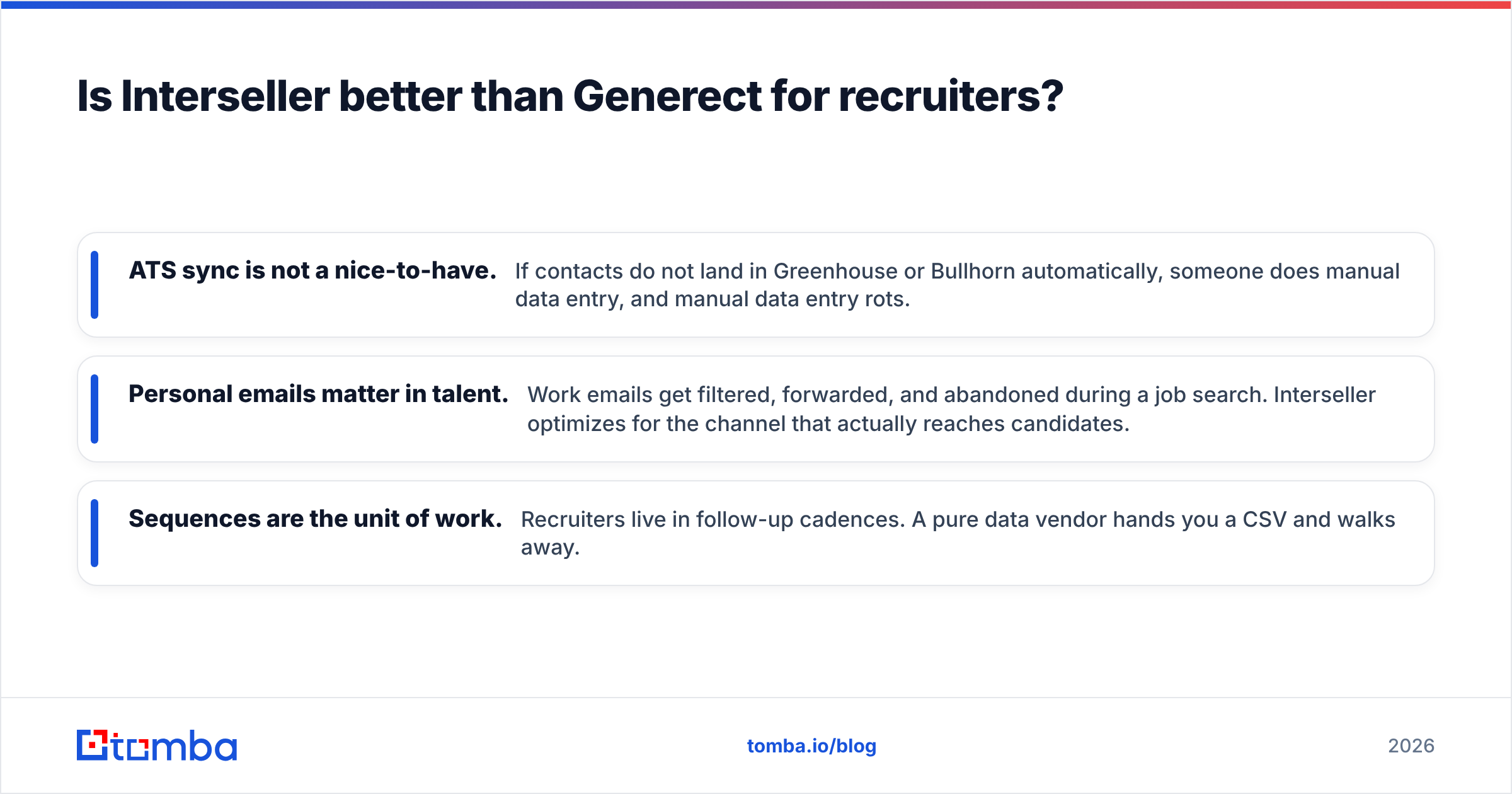
Usually yes. Three reasons.
- ATS sync is not a nice-to-have. If contacts do not land in Greenhouse or Bullhorn automatically, someone does manual data entry, and manual data entry rots.
- Personal emails matter in talent. Work emails get filtered, forwarded, and abandoned during a job search. Interseller optimizes for the channel that actually reaches candidates.
- Sequences are the unit of work. Recruiters live in follow-up cadences. A pure data vendor hands you a CSV and walks away.
Where recruiters still hit a wall: mass company-level research, technographic filters, and any workflow where you need every decision maker at 500 target firms. That is data-platform territory.

Should you split the stack instead?#
This is the option most head-to-head posts skip, and it is often the right one.
The modern outbound stack has three layers, and bundling them into one vendor almost always means one layer is mediocre:
- Discovery — who to contact. ICP filters, company lists, intent signals.
- Contact data — how to reach them. Email address, verification status, phone number.
- Execution — the sending, sequencing, and reply handling.
Bundled tools sell you all three and do one well. A split stack lets you swap the weak link without a migration. Practically, that looks like: your existing list source or CRM for layer one, a dedicated finder and email verifier for layer two, and whatever sequencer your team already trusts for layer three.
The reason layer two deserves its own vendor is bounce rate. Sender reputation is the single most fragile asset in outbound, and a 6% bounce rate on a new domain can take weeks to recover from. Tools that treat verification as a bundled afterthought will happily hand you a "probable" address. A dedicated verifier will tell you it is a catch-all and let you decide. For volume work, running lists through a bulk email finder before import keeps the junk out of your sequencer entirely.
What are the real limitations of each tool?#
Generect limitations
- No native sending, so you need a second tool and a second budget line.
- Pricing is not transparent, which slows small-team evaluation.
- LinkedIn-derived data inherits LinkedIn's staleness: profiles people forgot to update.
- Filter depth is only as good as your ICP definition; vague filters produce expensive noise.
Interseller limitations
- Per-seat cost scales badly across a wide, low-usage team.
- Roadmap is shaped by Greenhouse's recruiting priorities, not sales feature requests.
- Sales-grade firmographic and technographic filtering is thin.
- Deliverability controls are lighter than in dedicated cold-email platforms.
Neither list is a dealbreaker. Both are reasons to trial rather than sign a year up front. Check current user sentiment on G2 too, and weight reviews from companies your size and shape over the aggregate score.
How should you run the trial?#
Do not evaluate on features. Evaluate on one sample.
- Pick 200 real targets from your actual ICP, not a convenient list.
- Run the same 200 through each tool and record match rate.
- Verify every returned address independently with a neutral verifier so you are not grading a vendor with its own answer key.
- Send one small campaign from a warmed domain and record bounce rate and reply rate.
- Divide total cost by usable contacts. That number, not the sticker price, is what you are buying.
Two weeks of that beats two months of demo calls. It also gives you leverage: quote-driven vendors negotiate differently when you can quote their own hit rate back to them.
The verdict#
Choose Generect if you need volume B2B records, ICP-level filtering, and an API to push data into systems you already run. It is a data layer, and it behaves like one.
Choose Interseller if you are recruiting, you live inside Greenhouse or Bullhorn, and the one-window source-to-sequence loop saves your team more time than better data would. It is a workflow product, and it behaves like one.
Choose neither as a monolith if what you actually need is accurate business emails feeding a sequencer you already trust. That is the most common real requirement behind a "Generect vs Interseller" search, and it is the cheapest one to solve.
If that last line describes you, start with the Tomba Email Finder. The free tier gives you 25 searches a month to measure hit rate on your own ICP before spending a dollar, Starter is $49/mo when you are ready to scale, and every result flows through verification and catch-all detection before it touches your sender reputation. Run your 200-row sample through it alongside whichever platform you are evaluating, and let the bounce rate pick the winner.
Related guides#
Ready to find emails that actually work?
Join 150,000+ professionals who stopped guessing and started sending. Free credits on signup — no credit card required.
Get the Tomba newsletter
Practical outbound tactics and product updates — once every two weeks.
About the author