Generect vs Kickbox: Which Tool Does Your Outbound Need?
Generect finds B2B leads. Kickbox verifies email addresses. Comparing them head-to-head only makes sense once you know which half of the outbound data problem is actually costing you money.
TL;DR
- Generect and Kickbox are not really competitors. Generect is a B2B lead-data and API company built around LinkedIn-sourced contacts; Kickbox is an email verification and deliverability service. One fills your list, the other cleans it.
- If your bounce rate is above 3% and you already have contacts, you need a verifier like Kickbox — not more data.
- If your reps are hand-scraping LinkedIn and copying emails into a sheet, you need a data source like Generect — and you still need verification afterwards.
- Buying both means two contracts, two credit pools, and a manual handoff between them. A combined finder-plus-verifier stack removes that seam.
- Pricing models differ fundamentally: Kickbox is pay-as-you-go per verification, Generect is subscription/API-seat based. Compare cost-per-usable-contact, not cost-per-credit.
What are Generect and Kickbox, exactly?#
They solve two different halves of the same pipeline problem, and most teams evaluating "Generect vs Kickbox" are actually trying to answer a different question: where is my outbound data breaking?
Generect is a B2B lead generation and data company. Its core promise is real-time contact data — company and people search, LinkedIn-based lookups, and an API that returns leads on demand rather than serving them from a stale snapshot. It sells to teams building outbound lists, agencies running lead-gen for clients, and engineering teams wiring contact data into their own product.
Kickbox is an email verification and deliverability platform. You give it addresses, it tells you whether they're deliverable, undeliverable, risky, or unknown. It also publishes a proprietary quality signal (the Sendex score), offers deliverability tooling, and runs a real-time verification API for signup forms.
So the honest framing:
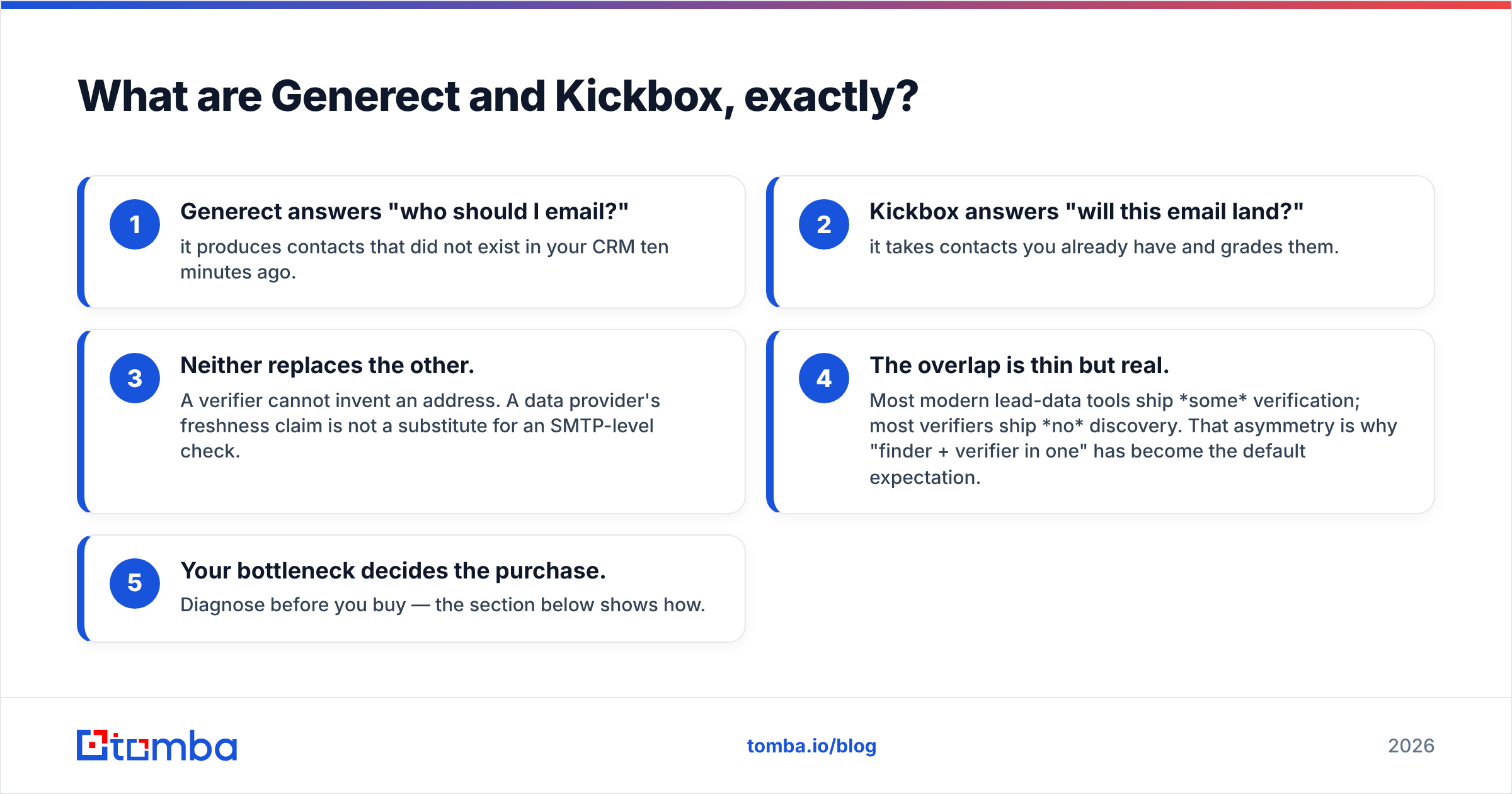
- Generect answers "who should I email?" — it produces contacts that did not exist in your CRM ten minutes ago.
- Kickbox answers "will this email land?" — it takes contacts you already have and grades them.
- Neither replaces the other. A verifier cannot invent an address. A data provider's freshness claim is not a substitute for an SMTP-level check.
- The overlap is thin but real. Most modern lead-data tools ship some verification; most verifiers ship no discovery. That asymmetry is why "finder + verifier in one" has become the default expectation.
- Your bottleneck decides the purchase. Diagnose before you buy — the section below shows how.
How do Generect and Kickbox compare head to head?#
Here is the practical comparison, with the caveat that you're comparing a hammer to a tape measure. Pricing and feature details change — check each vendor's current page before you sign anything.
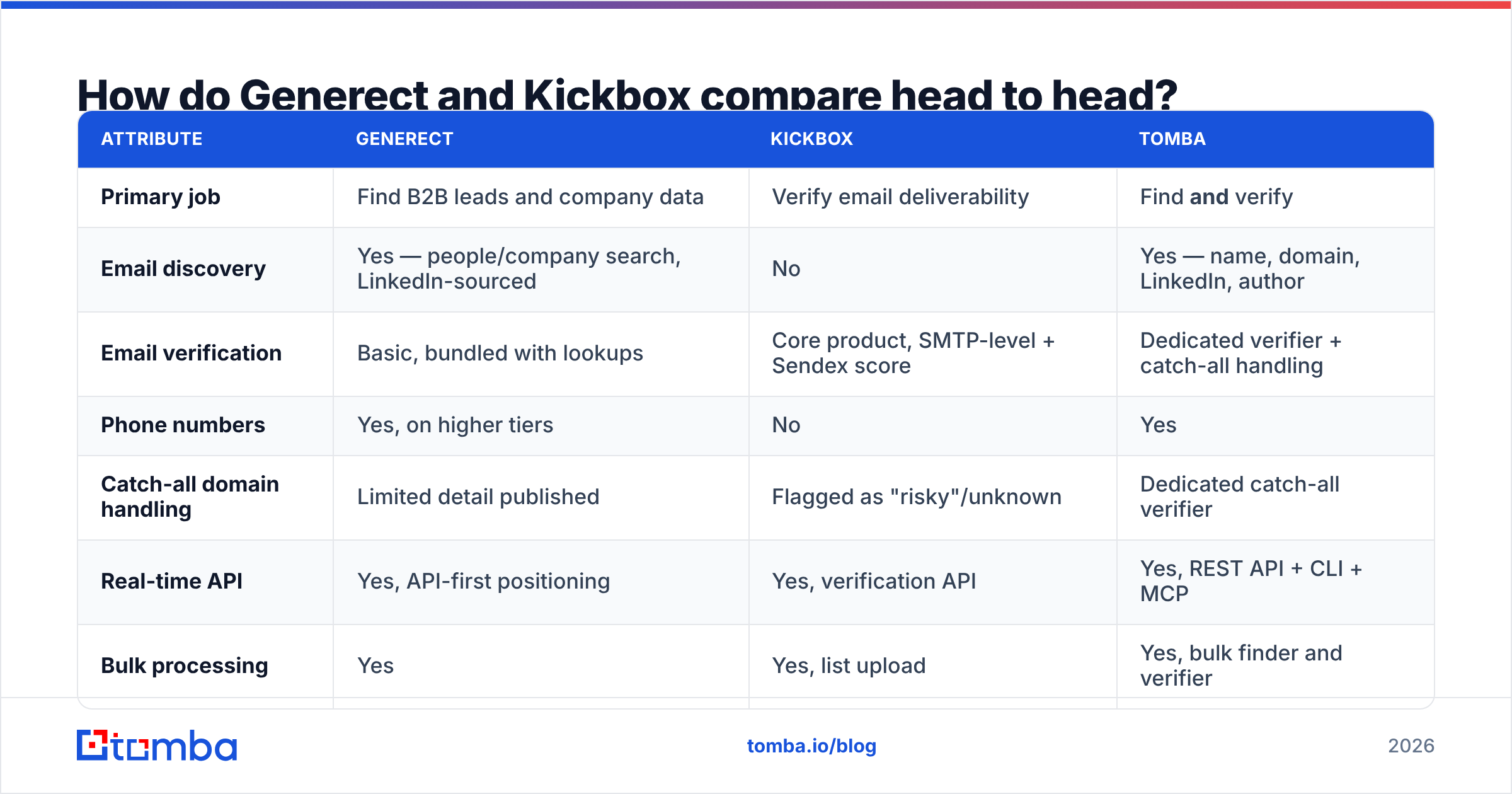
| Attribute | Generect | Kickbox | Tomba |
|---|---|---|---|
| Primary job | Find B2B leads and company data | Verify email deliverability | Find and verify |
| Email discovery | Yes — people/company search, LinkedIn-sourced | No | Yes — name, domain, LinkedIn, author |
| Email verification | Basic, bundled with lookups | Core product, SMTP-level + Sendex score | Dedicated verifier + catch-all handling |
| Phone numbers | Yes, on higher tiers | No | Yes |
| Catch-all domain handling | Limited detail published | Flagged as "risky"/unknown | Dedicated catch-all verifier |
| Real-time API | Yes, API-first positioning | Yes, verification API | Yes, REST API + CLI + MCP |
| Bulk processing | Yes | Yes, list upload | Yes, bulk finder and verifier |
| Free tier | Trial/demo, gated | 100 free verifications | 25 searches/month, no card |
| Pricing model | Subscription tiers | Pay-as-you-go credits | Subscription from $49/mo |
| Best for | Building lists from scratch | Cleaning lists you already own | Teams that need both in one place |
The table exposes the real decision. If you only ever buy one of these two, you are choosing which failure mode you're willing to live with: emailing the wrong people (no data source) or emailing the right people at dead addresses (no verifier).
What does Generect actually do well?#
Generect's strongest pitch is freshness. Static B2B databases decay — the widely cited figure across the industry is roughly 22–30% annual decay for B2B contact records, driven by job changes, company renames, and domain migrations. A tool that queries live sources at request time sidesteps some of that decay by design.
Where Generect tends to fit:
- API-first workflows. If you're enriching records inside your own app or an internal RevOps pipeline, an API that returns structured company + person data matters more than a pretty UI.
- Agency list-building. Agencies churning through new ICPs every month benefit from broad search rather than a fixed database subscription.
- LinkedIn-anchored prospecting. If your ICP definition starts with a LinkedIn Sales Navigator filter, a tool that speaks that language reduces translation loss.
Where it gets thinner:
- Verification depth. Bundled verification in a data tool is usually a syntax + MX + light SMTP check. That's fine for obvious garbage, weaker on catch-all domains and role accounts.
- Pricing transparency. Enterprise-style quoting is harder to compare against per-credit pricing. Ask for effective cost per verified, usable contact, not per lookup.
- Coverage variance by region. Every provider has geographic strengths. Run a 200-row sample against your actual ICP before committing — not against a list of famous companies where everyone scores well.
What does Kickbox actually do well?#
Kickbox is a specialist, and specialists usually win on their one axis. Its verification output is granular: deliverable, undeliverable, risky, unknown — plus a reason code and the Sendex quality score, which is more useful than a naked boolean when you're deciding whether a "risky" address is worth a send.
The strongest use cases:
- Pre-send list hygiene. Upload a list before a campaign, drop the undeliverables, and protect your sender reputation.
- Signup-form protection. Real-time API verification at the point of capture stops typo'd and disposable addresses from ever entering your database.
- Compliance-adjacent hygiene. Cleaning an ageing marketing database before migrating ESPs is a classic, well-scoped Kickbox job.
The limits are equally clear. Kickbox has no discovery function. It will never tell you the VP of Engineering at a target account exists. And like every verifier, it cannot give a definitive answer on catch-all domains — servers configured to accept all mail are structurally unverifiable via SMTP alone, which is why dedicated catch-all verification exists as a separate discipline.
How accurate is each tool, and how would you know?#
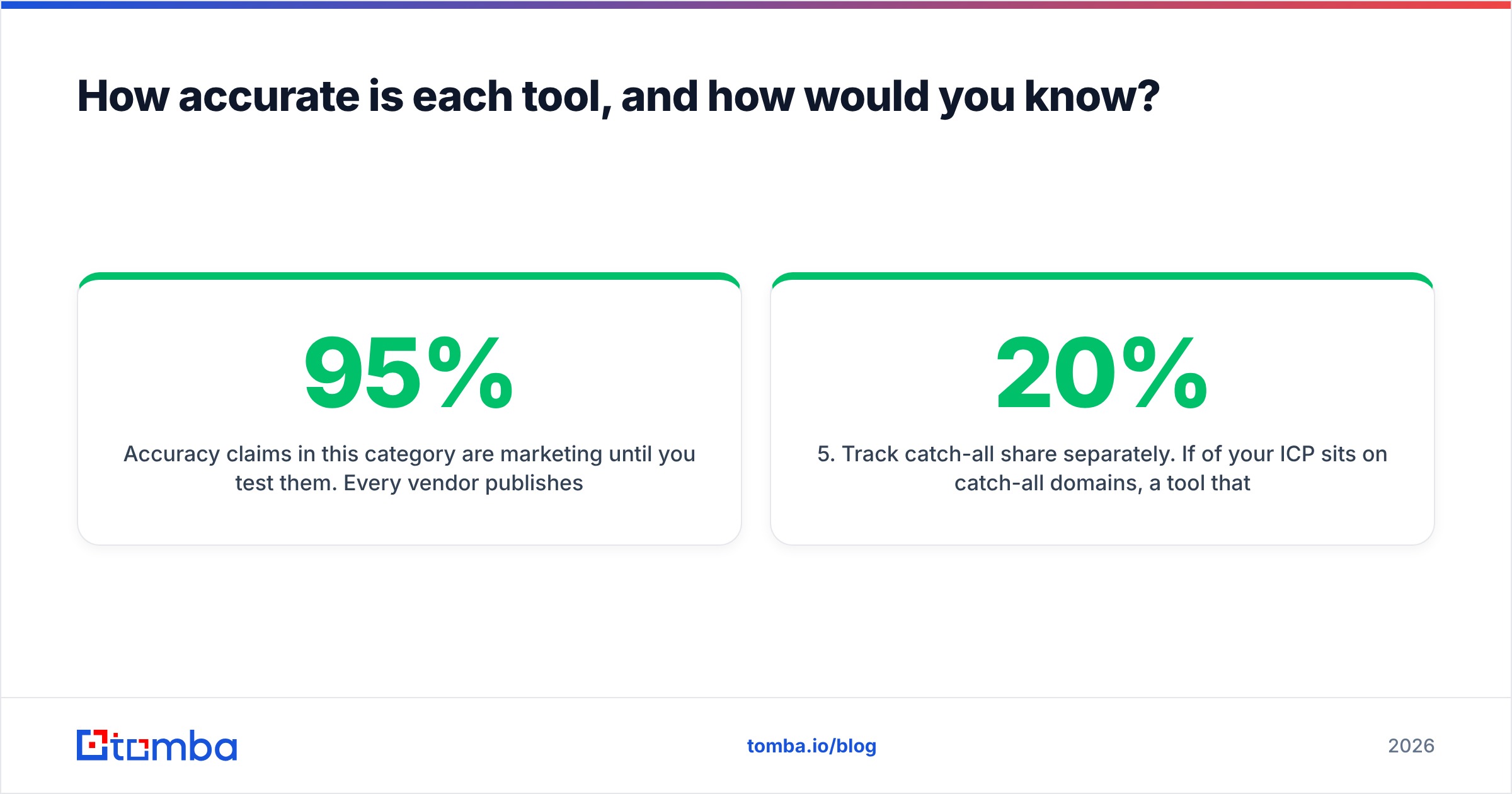
Accuracy claims in this category are marketing until you test them. Every vendor publishes a number above 95%. The numbers are not comparable because the denominators differ — some exclude "unknown" results, some count catch-alls as successes, some measure against a curated internal list rather than your ICP.

Run your own benchmark. It takes about an hour:
- Build a control set of 200 contacts from your actual target market — not tech unicorns, not your existing customers. Mix company sizes and at least three countries.
- Run the same set through each tool. For a finder, measure hit rate (addresses returned ÷ contacts requested). For a verifier, measure agreement with ground truth.
- Send a real, low-volume campaign from a warmed domain to the results. Bounce rate is the only ground truth that matters.
- Score cost per landed email, not cost per credit. A tool at half the price with a third of the hit rate is more expensive.
- Track catch-all share separately. If 20% of your ICP sits on catch-all domains, a tool that marks them all "unknown" just handed you 20% of the work back.
That last point is where most evaluations go wrong. Teams compare headline accuracy, sign a contract, then discover their vertical is dominated by catch-all configurations. Check where the data comes from and how each vendor treats those domains before you commit.

What do Generect and Kickbox cost?#
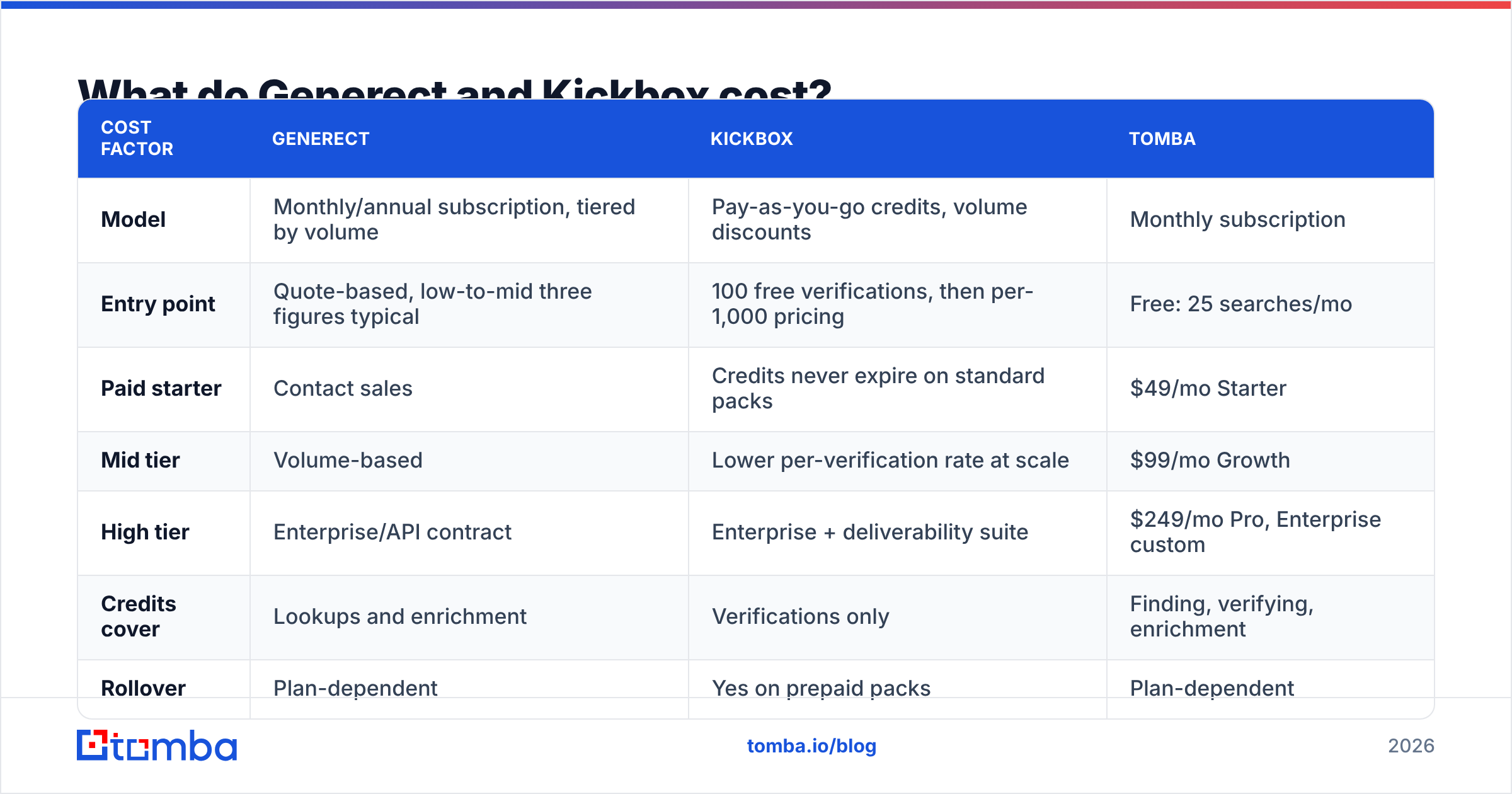
The pricing models are structurally different, which makes side-by-side numbers misleading unless you normalise them.
| Cost factor | Generect | Kickbox | Tomba |
|---|---|---|---|
| Model | Monthly/annual subscription, tiered by volume | Pay-as-you-go credits, volume discounts | Monthly subscription |
| Entry point | Quote-based, low-to-mid three figures typical | 100 free verifications, then per-1,000 pricing | Free: 25 searches/mo |
| Paid starter | Contact sales | Credits never expire on standard packs | $49/mo Starter |
| Mid tier | Volume-based | Lower per-verification rate at scale | $99/mo Growth |
| High tier | Enterprise/API contract | Enterprise + deliverability suite | $249/mo Pro, Enterprise custom |
| Credits cover | Lookups and enrichment | Verifications only | Finding, verifying, enrichment |
| Rollover | Plan-dependent | Yes on prepaid packs | Plan-dependent |
Normalise it like this: take a 5,000-contact month. With a finder-plus-verifier split, you pay the data provider for 5,000 lookups and the verifier for 5,000 verifications — and you pay again for every contact the finder returned that the verifier rejects. That double-charge on waste is the hidden cost of the two-vendor stack. Compare it against a single Tomba plan where finding and verifying draw from one pool.
Pay-as-you-go is genuinely better for one profile: the team that verifies 30,000 addresses in March and nothing until September. Subscriptions punish spiky usage. Be honest about which one you are.
Can one tool do both jobs?#
Yes, and that's increasingly the default. The two-vendor split made sense when verification required specialist infrastructure that data companies couldn't build. That gap has narrowed.
A combined stack looks like this in practice:
- Discovery — the email finder resolves a name plus company domain into an address, or domain search pulls every published address at a company at once.
- Verification in the same call — results arrive pre-scored, so you're not exporting a CSV, uploading it elsewhere, and re-importing.
- Catch-all triage — ambiguous domains route to a specialist check rather than getting dumped into an "unknown" bucket you'll ignore.
- Enrichment — job title, seniority, and company firmographics attach to the record so your sequencing tool has something to personalise with.
- One audit trail — when a campaign bounces, you debug one system, not the handoff between two.
The trade-off is real and worth stating: a specialist verifier will usually beat a bundled one on edge cases, and a specialist data provider may beat a bundled finder in a specific vertical. If email verification is your business — you're an ESP, you're cleaning million-row databases monthly — buy the specialist. For the other 90% of B2B teams sending a few thousand cold emails a month, the integration tax of running two vendors costs more than the marginal accuracy difference.
Cross-check any shortlist against real reviews on G2 rather than vendor case studies. Look specifically at reviews mentioning your company size and region.
Which should you choose?#
Pick by symptom, not by feature list:
- Bounce rate above 3%, list already built — you have a hygiene problem. Kickbox or a dedicated email verifier is the fix. More data will make it worse.
- Reps spending hours a day sourcing contacts — you have a discovery problem. Generect, or a finder with a Chrome extension and bulk mode, is the fix.
- Both, on a real budget — the two-vendor stack works. Accept the operational overhead and the double-billing on rejected contacts.
- Both, on a startup budget — a combined tool wins on total cost and on time-to-first-campaign.
- Engineering-led enrichment inside your own product — compare API ergonomics, rate limits, and response schemas above everything else. Read the docs before the pricing page.
- Spiky, seasonal volume — favour pay-as-you-go credits that don't expire over any monthly subscription.
One thing that is not negotiable regardless of vendor: verify before every send, not once at list-build time. A contact verified in January is a guess by June. Bake verification into the send workflow, not the import workflow.
Ready to stop running two tools?#
If your outbound is stuck between "we don't have enough contacts" and "the contacts we have keep bouncing," you're paying two vendors to solve one problem. The Tomba Email Finder resolves names and domains into addresses and verifies them in the same request — with catch-all handling, bulk processing, and an API that drops into whatever you've already built. Start on the free tier with 25 searches a month, run your own 200-contact benchmark against Generect and Kickbox, and let the bounce rate decide.
Related guides#
Ready to find emails that actually work?
Join 150,000+ professionals who stopped guessing and started sending. Free credits on signup — no credit card required.
Get the Tomba newsletter
Practical outbound tactics and product updates — once every two weeks.
About the author