Generect vs ListKit (2026): Which B2B Data Tool Wins?
Generect sells raw LinkedIn-sourced data through an API. ListKit sells curated, verified cold-email lists in a UI. We compare coverage, accuracy, pricing and API access — and name the buyer each one actually fits.
TL;DR
- Generect is a data-infrastructure play: LinkedIn-sourced company and people records delivered through an API, built for teams that want to pipe leads into their own systems rather than click around a UI.
- ListKit is a workflow play: a curated B2B contact database wrapped in a list-builder UI, marketed hard at agencies and cold-email operators who want a ready-to-send CSV today.
- Neither tool is "more accurate" in the abstract. Generect wins on freshness of LinkedIn-attached firmographics; ListKit wins on out-of-the-box send-readiness because it verifies before export.
- Pricing shape differs more than pricing level: ListKit is credit-and-seat based, Generect is volume/API based. Compare cost per usable contact, not cost per record.
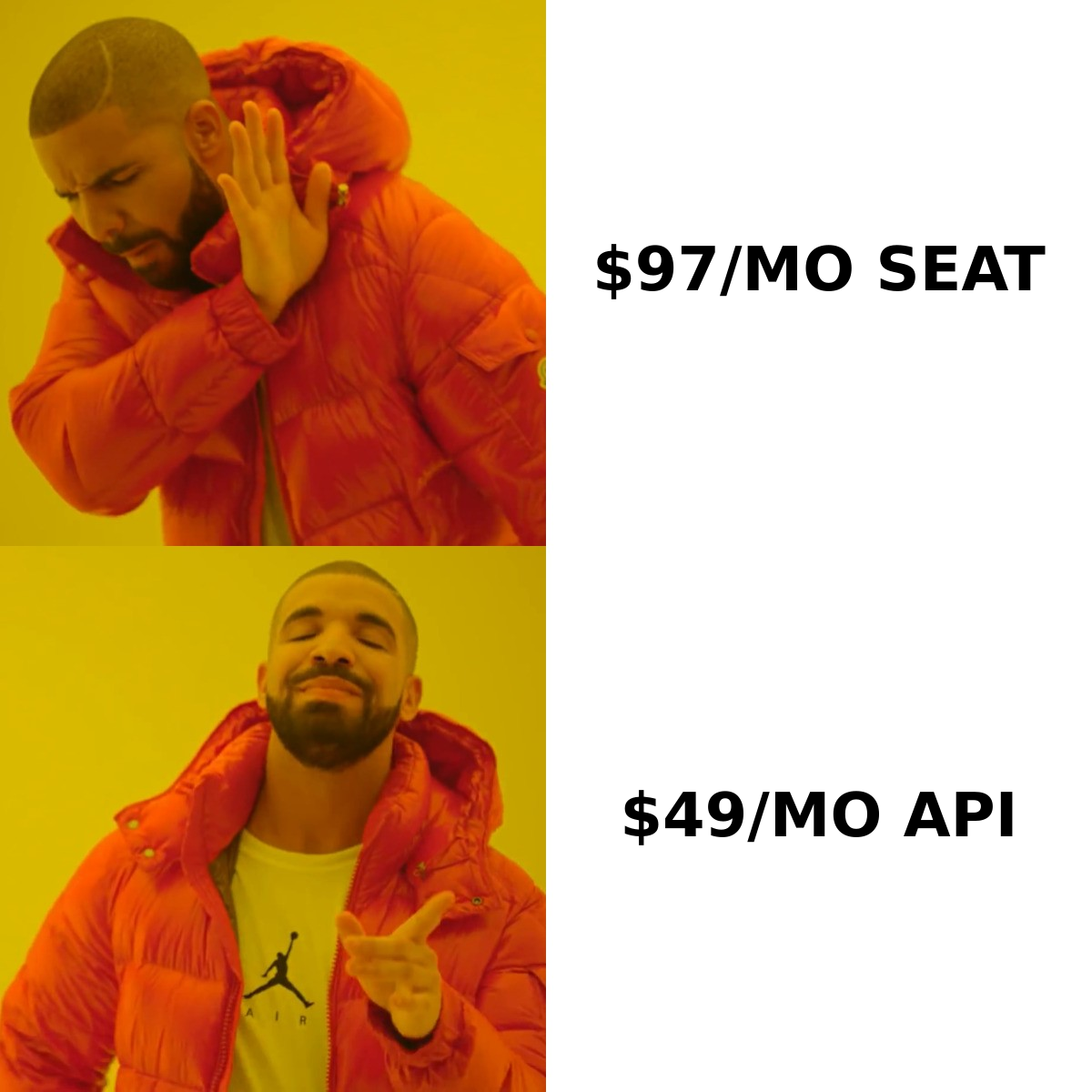
- If you mainly need verified work emails at a specific domain — not a whole database subscription — a dedicated email finder at $49/mo will beat both on cost per usable contact.
What are Generect and ListKit?#
Different products that happen to overlap on one line item: B2B contact data.
Generect positions itself as a lead-data API. Its pitch is programmatic access to LinkedIn-derived people and company records — job titles, headcount, industry, location, technologies — pulled on request rather than served from a stale snapshot. You are expected to have a developer, or at least a RevOps person comfortable with API keys and JSON. The output is data, not a campaign.
ListKit came out of the cold-email agency world and it shows. The product is a filtered search over a large B2B contact database, with verified emails and phone numbers, exportable to CSV or pushed straight into a sending tool. Everything is built to shorten the path from "I want SaaS founders in the UK, 11-50 headcount" to "the sequence is live."
That difference in origin story explains almost every trade-off below. Generect optimizes for feed my system. ListKit optimizes for fill my sequence.
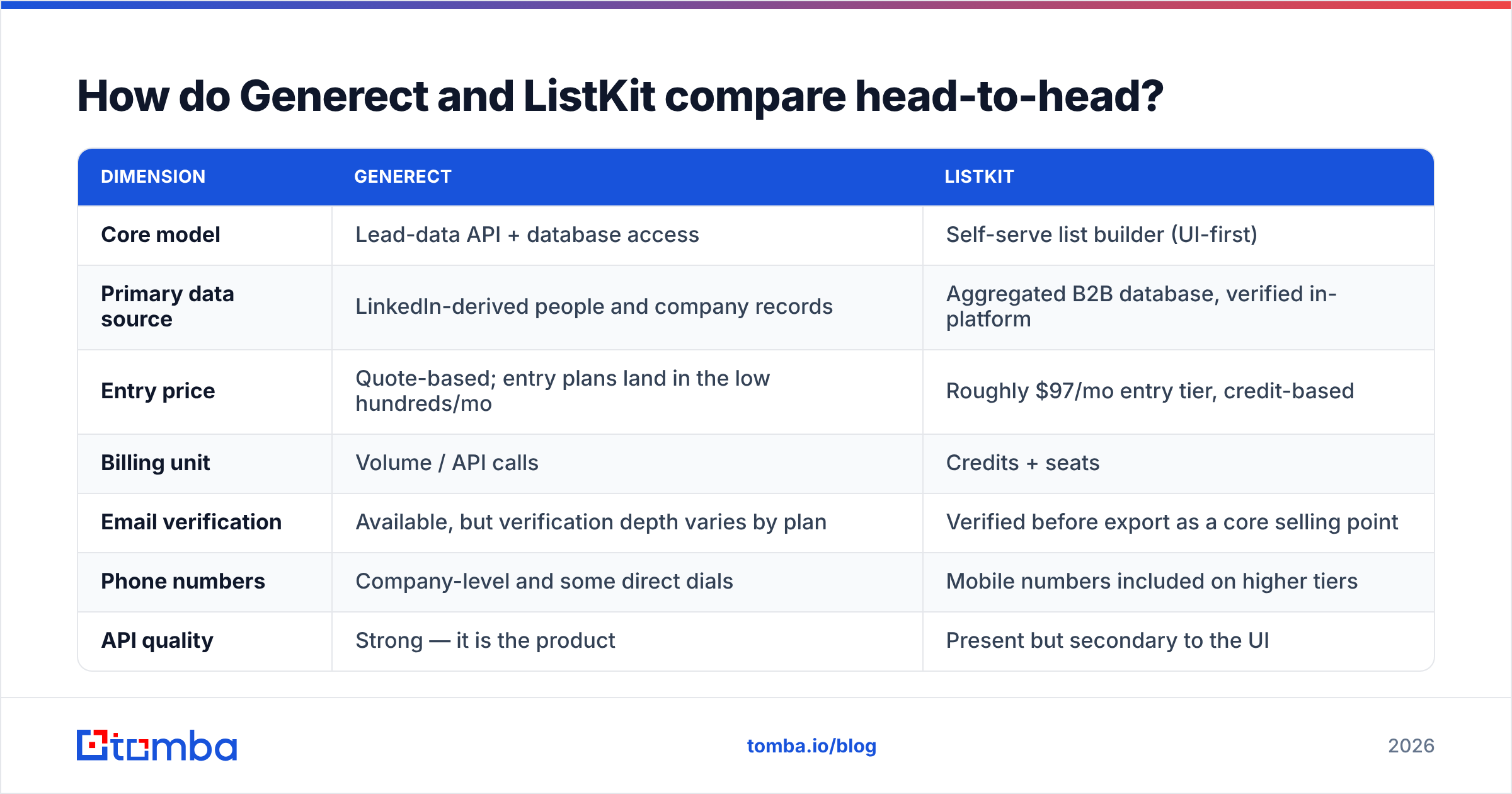
How do Generect and ListKit compare head-to-head?#
Here is the practical comparison. Pricing is what each vendor published at the time of writing — both change tiers frequently, so confirm on their own pages before you commit budget.
| Dimension | Generect | ListKit |
|---|---|---|
| Core model | Lead-data API + database access | Self-serve list builder (UI-first) |
| Primary data source | LinkedIn-derived people and company records | Aggregated B2B database, verified in-platform |
| Entry price | Quote-based; entry plans land in the low hundreds/mo | Roughly $97/mo entry tier, credit-based |
| Billing unit | Volume / API calls | Credits + seats |
| Email verification | Available, but verification depth varies by plan | Verified before export as a core selling point |
| Phone numbers | Company-level and some direct dials | Mobile numbers included on higher tiers |
| API quality | Strong — it is the product | Present but secondary to the UI |
| Free tier | Trial/demo on request | Limited free credits on signup |
| Best for | Engineering-led GTM, data platforms, agencies building tooling | Agencies and SDR teams sending volume today |
| Weakest at | Non-technical users who just want a CSV | Deep firmographic filtering and programmatic pipelines |
Two honest caveats about that table. First, "verified" means different things at different vendors — some verify at export time, some verify at ingest and let records age. Second, both companies serve overlapping ICPs but almost never overlap on why a buyer chose them. Teams rarely evaluate these two side by side unless they are confused about whether they need infrastructure or output.
Which one has better data accuracy?#
The honest answer: measure it yourself on 200 rows from your own ICP, because vendor accuracy claims are unfalsifiable marketing.
That said, there are structural reasons each tool performs differently.
Generect's LinkedIn lineage means job titles and company attributes tend to be current — LinkedIn is the closest thing B2B has to a self-updating dataset, because people update their own profiles when they move. The weakness is that a fresh LinkedIn profile does not automatically produce a valid corporate mailbox. Deriving first.last@company.com from a profile is pattern inference, and pattern inference fails on companies with non-obvious formats, aliases, or catch-all domains.
ListKit's approach is closer to the inverse: it leans on verified contact records, so what you export is more likely to land, but the underlying firmographics can lag when someone changed jobs three months ago and the record still shows the old employer. That produces the worst kind of bounce-free failure — a deliverable email attached to the wrong context, so your personalization is wrong and the reply rate craters even though the deliverability dashboard looks green.

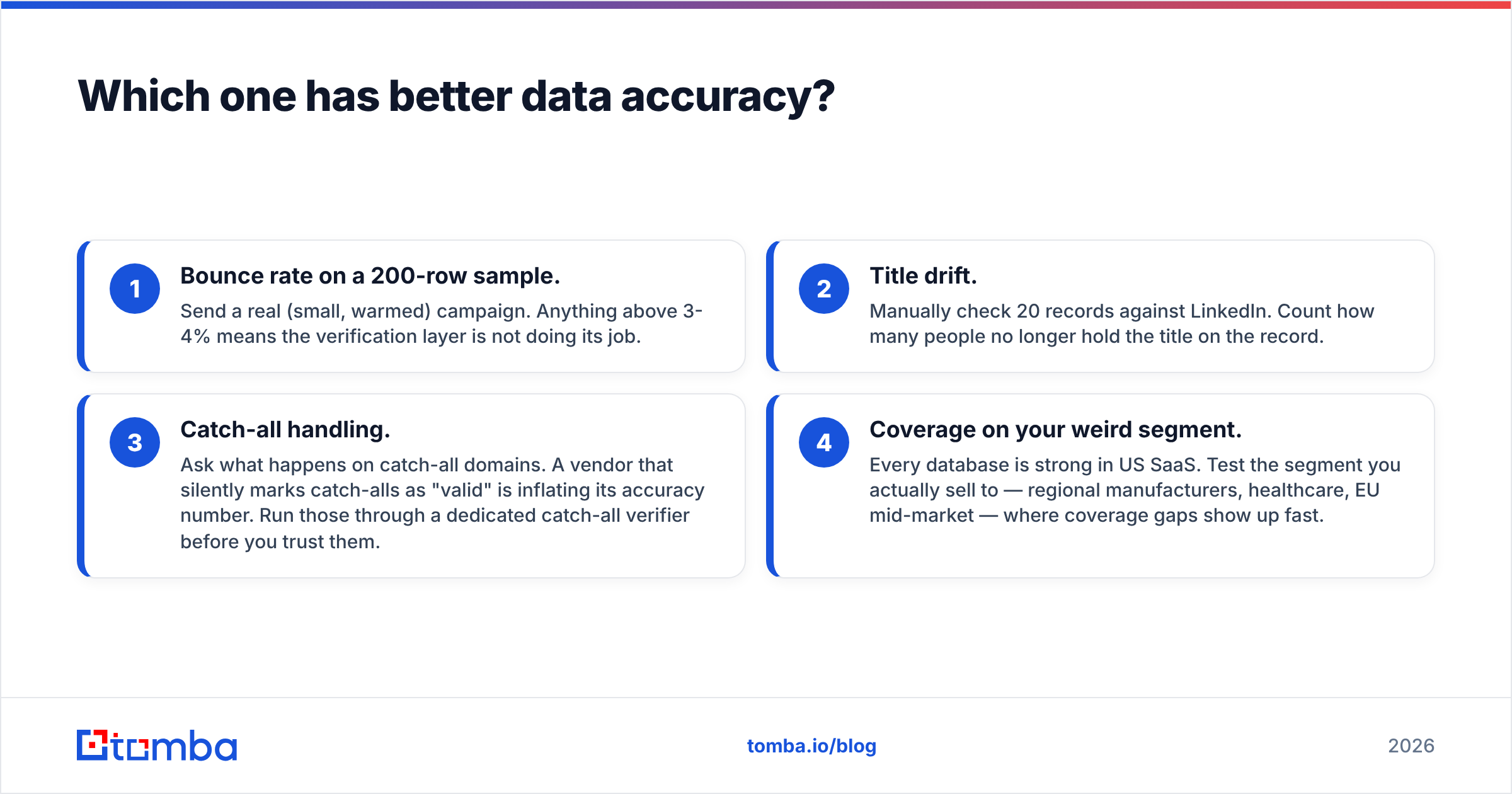
Three things to test in any trial, regardless of which vendor you pick:
- Bounce rate on a 200-row sample. Send a real (small, warmed) campaign. Anything above 3-4% means the verification layer is not doing its job.
- Title drift. Manually check 20 records against LinkedIn. Count how many people no longer hold the title on the record.
- Catch-all handling. Ask what happens on catch-all domains. A vendor that silently marks catch-alls as "valid" is inflating its accuracy number. Run those through a dedicated catch-all verifier before you trust them.
- Coverage on your weird segment. Every database is strong in US SaaS. Test the segment you actually sell to — regional manufacturers, healthcare, EU mid-market — where coverage gaps show up fast.
How does pricing really compare?#
Compare cost per usable contact, not the headline number.
A $97/mo plan with 5,000 credits looks like $0.019 per contact. But if 18% bounce, 12% are the wrong title, and 20% fall outside your true ICP filters, your real cost per usable contact is closer to $0.038 — double the sticker price. Run that math for both vendors using trial data before signing an annual deal.

The structural pricing difference matters for how you scale:
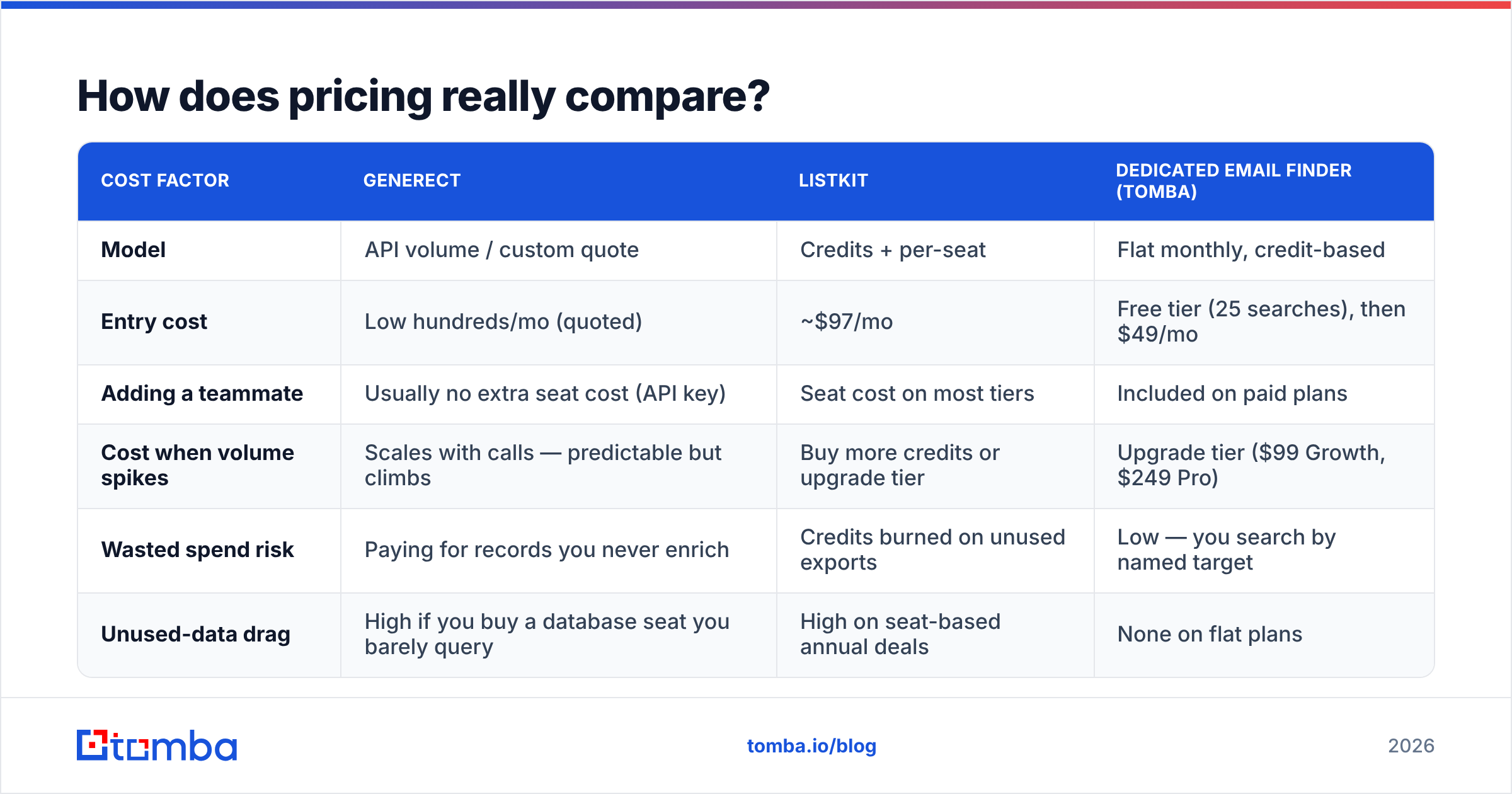
| Cost factor | Generect | ListKit | Dedicated email finder (Tomba) |
|---|---|---|---|
| Model | API volume / custom quote | Credits + per-seat | Flat monthly, credit-based |
| Entry cost | Low hundreds/mo (quoted) | ~$97/mo | Free tier (25 searches), then $49/mo |
| Adding a teammate | Usually no extra seat cost (API key) | Seat cost on most tiers | Included on paid plans |
| Cost when volume spikes | Scales with calls — predictable but climbs | Buy more credits or upgrade tier | Upgrade tier ($99 Growth, $249 Pro) |
| Wasted spend risk | Paying for records you never enrich | Credits burned on unused exports | Low — you search by named target |
| Unused-data drag | High if you buy a database seat you barely query | High on seat-based annual deals | None on flat plans |
Per-seat pricing is the sleeper cost. If you have four SDRs and each needs their own list-building access, a $97/mo product is a ~$388/mo product. API-priced tools sidestep this: one key, everyone's tooling calls it. That is also true of Tomba pricing, where paid plans cover the team rather than the individual.
Which tool fits which workflow?#
Match the tool to how your team actually works, not to the demo that impressed you.
- You have engineers and a data warehouse. Generect. You want records flowing into your own enrichment pipeline, scored by your own model, and surfaced in your own CRM views. A UI is friction, not a feature.
- You run a cold-email agency with 15 client campaigns. ListKit. Speed from filter to CSV is the whole business, and verified-at-export saves you a separate verification step per client.
- You are a two-person startup doing founder-led sales. Neither, initially. You need 50-200 highly specific contacts a month, not a database subscription. A domain search against your target account list is faster and an order of magnitude cheaper.
- You are building a product that needs contact data as a feature. Generect or a pure API vendor. Check rate limits, uptime SLAs, and contractual redistribution rights — many database vendors forbid exposing their data in your product.
- You already have a list and just need emails attached. Neither. Run your existing rows through a bulk email finder and skip the subscription entirely.
- You sell into non-US or non-tech markets. Test both hard, and expect a coverage cliff. Regional coverage is where database vendors diverge most and where marketing claims are least reliable.

What are the real limitations of each?#
Generect's limitations. The API-first design that makes it powerful also makes it inaccessible. If your team's technical ceiling is "we can import a CSV," you will pay for capability you cannot use. Quote-based pricing also means less transparency up front and more sales-cycle friction — you cannot just swipe a card at 11pm and start testing. And because the value is in the pipe, not the interface, you own the work of deduplication, enrichment, and routing.
ListKit's limitations. The credit-and-seat model punishes exploration. When every filtered export burns credits, people stop experimenting with segments and default to the same broad list, which is exactly how a whole agency ends up emailing the same 40,000 SaaS founders as everyone else. There is also less programmatic control: if you want a nightly job that pulls newly-hired VPs of Sales at accounts in your CRM, a UI-first tool fights you.
A limitation both share. Database subscriptions push you toward volume. When you have paid for 50,000 credits, the incentive is to use 50,000 credits. That is the mechanism behind most deliverability collapses in 2026 — not bad tooling, but bad list discipline created by pricing psychology. Google and Yahoo's bulk-sender requirements made this expensive: sustained spam complaints above 0.3% get you throttled regardless of how good your data vendor is. Keep an eye on sender reputation as a first-class metric, not an afterthought.
It is also worth checking current user reviews on G2 before you buy either one. Both products iterate fast, and a 2024 review of a 2026 product tells you nothing useful.
Is there a better alternative to both?#
For most teams, the honest answer is: you probably need less than either sells you.
The database-subscription model assumes your bottleneck is finding people. For a growing number of B2B teams it isn't. You already know the accounts. You built the list in a spreadsheet from a conference roster, a funding announcement feed, a partner referral, or your own website traffic. What you actually need is a reliable way to attach a verified work email to a name and a domain — and to know when that email is risky before you send.
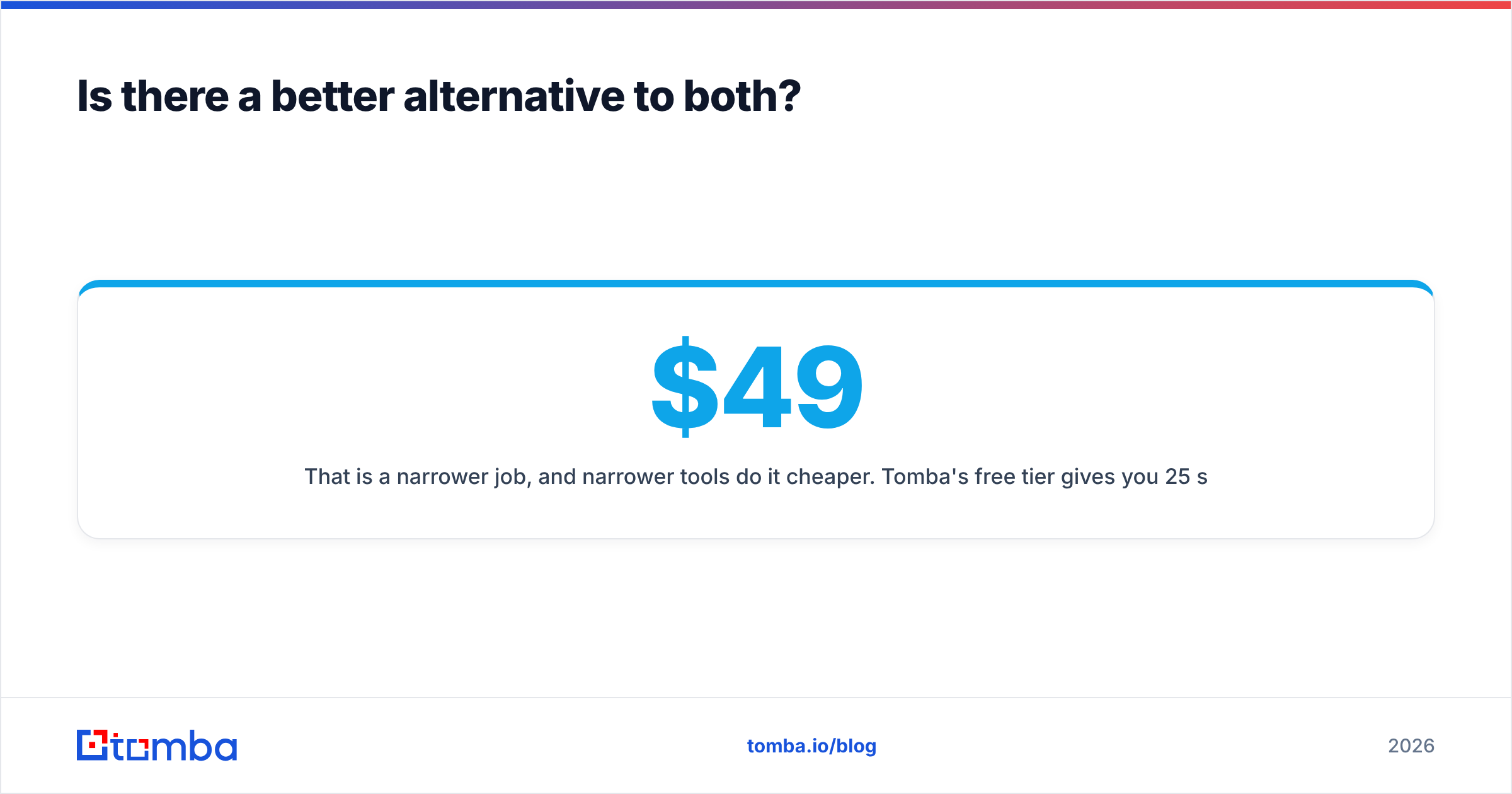
That is a narrower job, and narrower tools do it cheaper. Tomba's free tier gives you 25 searches a month to test the hypothesis, Starter is $49/mo, Growth is $99/mo, and Pro is $249/mo — with no per-seat multiplier. The email verifier runs independently, so you can also use it as a QA layer on data you bought from Generect, ListKit, or anywhere else. A lot of teams end up doing exactly that: buy the database for discovery, verify with a second vendor before sending, because no vendor should grade its own homework.
And if you are a developer evaluating Generect specifically for programmatic access, compare it against the Tomba API on the two metrics that matter in production: response time under load, and what the response says when confidence is low. A data API that returns a guess without a confidence score is worse than one that returns nothing.
Generect vs ListKit: which should you pick?#
Pick Generect if data is infrastructure to you — you have engineers, you are building pipelines or products, and you want LinkedIn-fresh firmographics you can enrich yourself.
Pick ListKit if data is inventory to you — you run campaigns at volume, you need verified rows in a CSV this afternoon, and a clean UI beats an endpoint every time.
Pick neither, yet if you are running fewer than a few hundred targeted touches a month. Subscription database pricing only pays off at scale, and at low volume you are subsidising records you will never use.
Whichever way you go, test on your own ICP with real sends before you sign anything annual. Vendor accuracy claims are marketing; your bounce rate is data.
Ready to test the cheaper path first? Start with the Tomba Email Finder — 25 free searches a month, no card, and a verification result attached to every address so you know what you are sending to before you send it. Run it against 200 rows of your own target list and compare the usable-contact rate to whatever quote is sitting in your inbox.
Related guides#
Ready to find emails that actually work?
Join 150,000+ professionals who stopped guessing and started sending. Free credits on signup — no credit card required.
Get the Tomba newsletter
Practical outbound tactics and product updates — once every two weeks.
About the author