Generect vs MillionVerifier: Which One Do You Need in 2026?
Generect builds lead lists. MillionVerifier cleans them. They are not really rivals — but you probably only have budget for one. Here is how to pick, and when a single platform beats running both.
TL;DR
- Generect and MillionVerifier are not direct competitors. Generect sources B2B contacts (company and people search, LinkedIn-based lists, API delivery). MillionVerifier validates email addresses you already have.
- If your problem is "I have no list", Generect is the relevant category. If your problem is "my list bounces", MillionVerifier is the relevant category.
- MillionVerifier is one of the cheapest credible verifiers on the market, with pay-as-you-go credits that do not expire — that pricing model is its single biggest advantage.
- Generect's value is speed to a targeted list without manual scraping; its weakness is that sourced emails still need an independent verification pass before you send.
- Running both means two vendors, two credit pools, and two APIs. A platform that finds and verifies in one call — like Tomba — usually costs less in total and removes the hand-off step entirely.
What is Generect?#
Generect is a B2B lead generation platform. You define an ideal customer profile — industry, headcount, geography, job title, seniority, tech signals — and it returns matching companies and people, with contact data attached. Delivery happens through a web app, exports, or an API you can wire into your own enrichment pipeline. Its positioning leans heavily on LinkedIn-derived search: the promise is that you can rebuild a Sales Navigator-style search as a structured, exportable dataset without running a scraper yourself.
The buyer for Generect is usually an outbound team or an agency that burns through lists fast and wants sourcing to be an API call rather than a manual afternoon. Check generect.com for current plan structure — they publish tiered subscriptions and quote larger API volumes separately, so the number you see on a review site is rarely the number you pay.
What Generect does not claim to be is a deliverability product. It returns emails; it does not own your bounce rate.
What is MillionVerifier?#
MillionVerifier is a pure email verification service. You upload a list — CSV, integration, or API — and it runs syntax checks, domain and MX record checks, disposable-address detection, role-account flagging, and SMTP-level mailbox probing. Each address comes back classified: good, invalid, catch-all, unknown, or disposable.
Two things made it popular with cold email operators. First, credits are pay-as-you-go and do not expire, which suits agencies with lumpy volume far better than a monthly subscription that resets. Second, the price per verification is aggressively low compared with enterprise-branded verifiers, and it ships a "good only" filter that strips everything risky in one click.
MillionVerifier has no sourcing side at all. If your CRM is empty, it has nothing to do.

Are Generect and MillionVerifier actually competitors?#
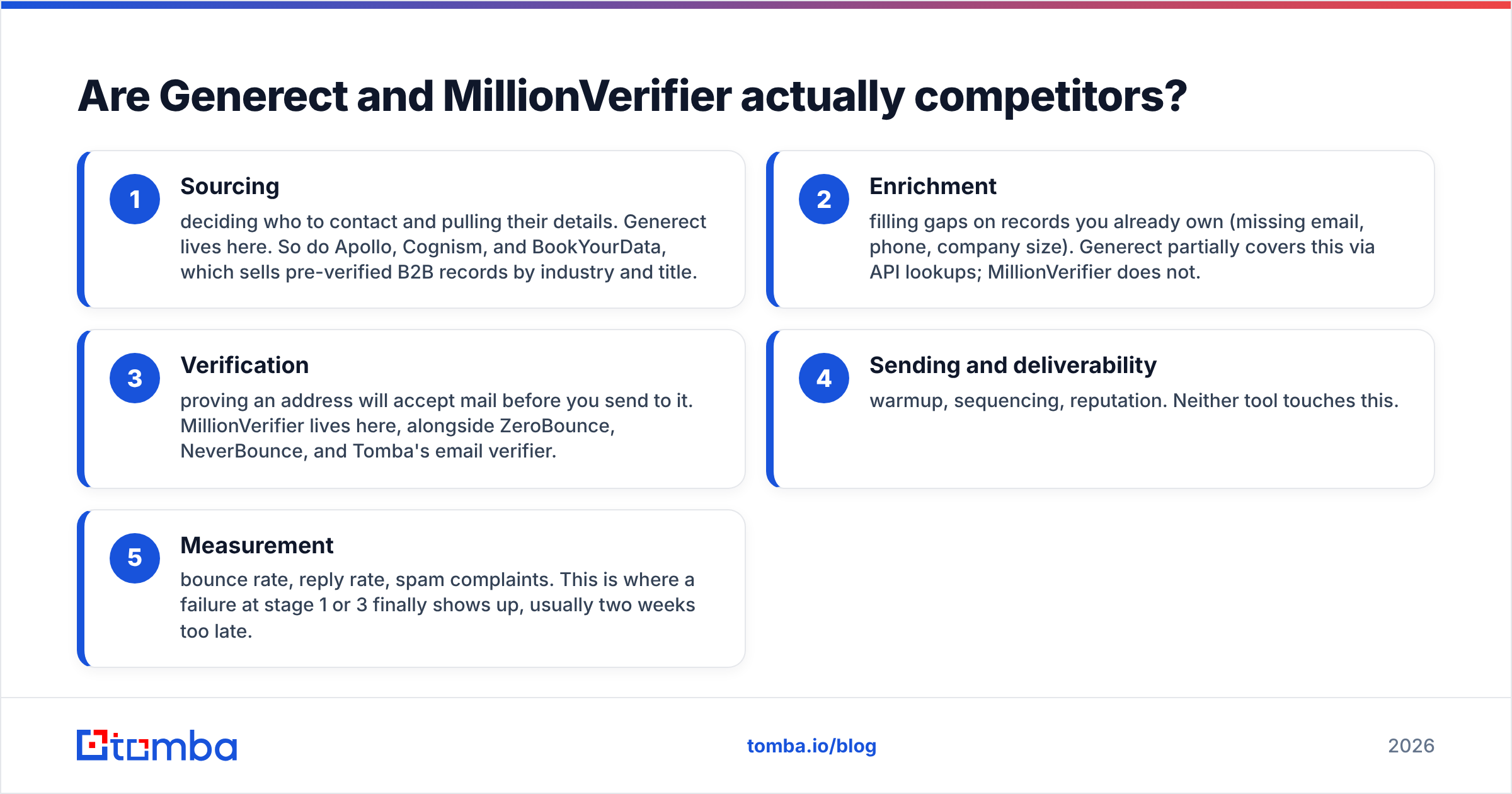
No — and that is the most useful thing to understand before you compare feature lists. They sit at different stages of the same pipeline:
- Sourcing — deciding who to contact and pulling their details. Generect lives here. So do Apollo, Cognism, and BookYourData, which sells pre-verified B2B records by industry and title.
- Enrichment — filling gaps on records you already own (missing email, phone, company size). Generect partially covers this via API lookups; MillionVerifier does not.
- Verification — proving an address will accept mail before you send to it. MillionVerifier lives here, alongside ZeroBounce, NeverBounce, and Tomba's email verifier.
- Sending and deliverability — warmup, sequencing, reputation. Neither tool touches this.
- Measurement — bounce rate, reply rate, spam complaints. This is where a failure at stage 1 or 3 finally shows up, usually two weeks too late.
Teams that get burned are the ones who assume stage 1 includes stage 3. A sourced email marked "verified" by the vendor that supplied it is a vendor grading its own homework. Independent verification exists precisely because the incentives are misaligned.
How accurate is each tool?#
Accuracy means two different things here, and conflating them is where most comparison posts go wrong.
For a sourcing tool like Generect, accuracy is coverage plus correctness: what percentage of your target list returns any email at all, and what percentage of those are real, currently-employed people. Coverage varies enormously by region and company size. Mid-market North American SaaS is well covered by almost every vendor. European SMBs, non-English domains, and companies under 20 employees are where hit rates collapse — and where vendors quietly stop publishing numbers.
For a verification tool like MillionVerifier, accuracy is classification correctness: how often "good" addresses actually accept mail, and how often it wrongly condemns a valid one. The hard cases are catch-all domains, which accept everything at the SMTP layer and tell you nothing. MillionVerifier flags catch-alls honestly rather than pretending to resolve them, which is the right call — but it means those records land back in your lap undecided. A dedicated catch-all verifier is the only way to make that bucket usable instead of discardable.

Practical rule: never trust a single vendor's own accuracy claim, from either category. Take 200 records from your real ICP, run them through a trial, and send a small warmed-up batch. Your bounce rate on that batch is the only accuracy figure that matters, and it will almost always be worse than the marketing page.
Generect vs MillionVerifier: how do they compare?#
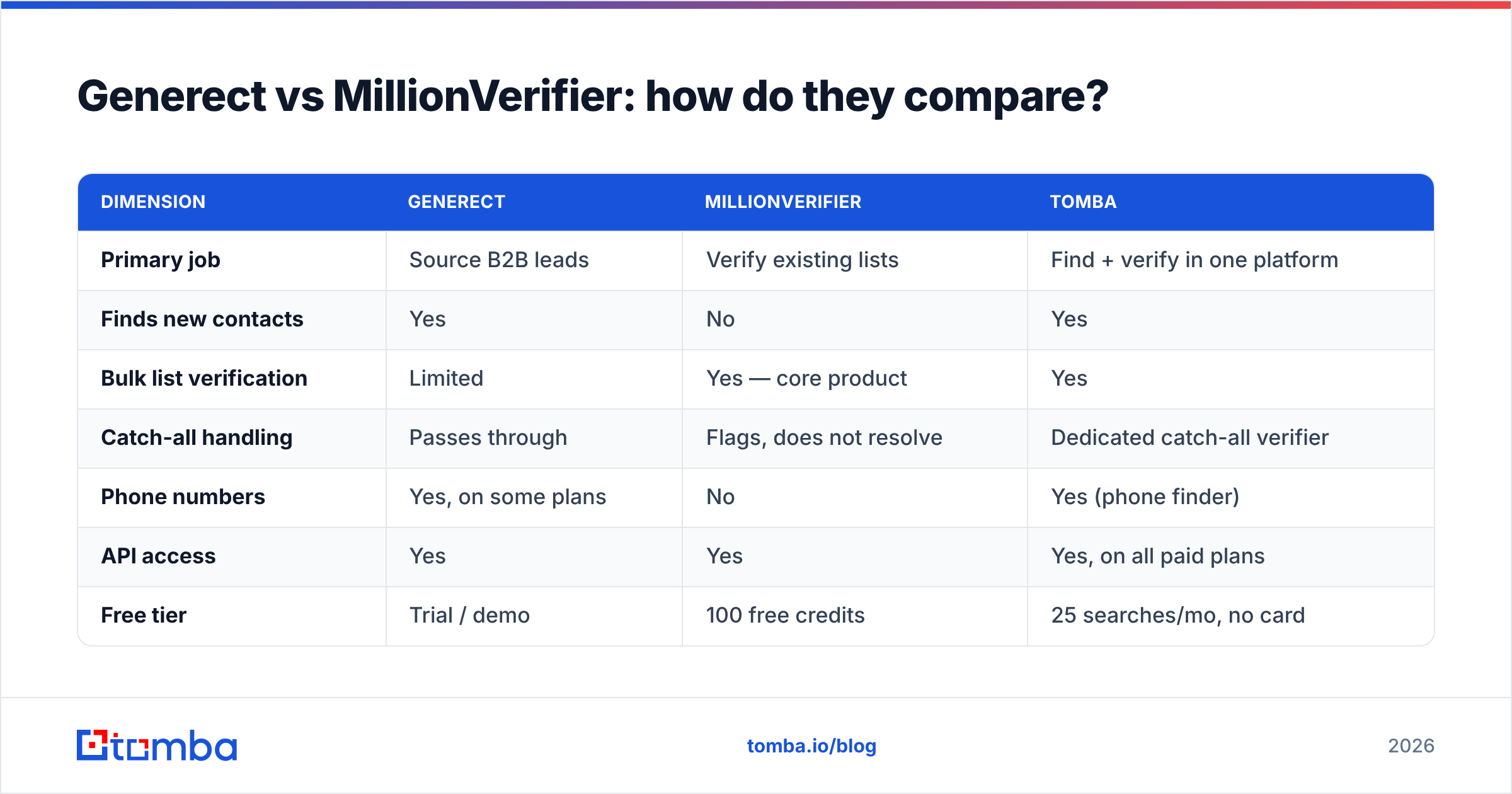
| Dimension | Generect | MillionVerifier | Tomba |
|---|---|---|---|
| Primary job | Source B2B leads | Verify existing lists | Find + verify in one platform |
| Finds new contacts | Yes | No | Yes |
| Bulk list verification | Limited | Yes — core product | Yes |
| Catch-all handling | Passes through | Flags, does not resolve | Dedicated catch-all verifier |
| Phone numbers | Yes, on some plans | No | Yes (phone finder) |
| API access | Yes | Yes | Yes, on all paid plans |
| Free tier | Trial / demo | 100 free credits | 25 searches/mo, no card |
| Credit expiry | Monthly subscription | Credits do not expire | Monthly plan credits |
| Entry price | Tiered, quote-driven | Pay-as-you-go, low per-credit | $49/mo Starter |
| Best for | Teams with no list | Teams with a dirty list | Teams doing both |

The table makes the structural point obvious: the columns barely overlap. You are not choosing between two products that do the same thing badly or well. You are choosing which half of the problem to solve with money and which half to solve some other way.
What does each one cost in practice?#
Pricing models differ more than pricing levels, so compare the model first.
MillionVerifier sells credits outright. Buy 50,000, use 5,000 this month and 45,000 next quarter, nothing burns. For an agency verifying client lists in unpredictable bursts, that is close to ideal, and the per-verification cost at volume is among the lowest in the category. Confirm the current tiers on their site before budgeting — verifier pricing moves often.
Generect sells subscriptions, with API volume quoted based on how many lookups you need. That is standard for sourcing platforms, and it means the sticker price rarely survives contact with a sales call. Budget for the quote, not the pricing page.
Now do the stacking math. A team sourcing 10,000 contacts a month and verifying all of them pays a sourcing subscription plus a verification credit spend plus the internal cost of moving files between two systems. That third cost is invisible on an invoice and real on a calendar.
For comparison, Tomba pricing covers both sides in one plan: Free at 25 searches/month, Starter at $49/mo, Growth at $99/mo, Pro at $249/mo, and Enterprise on quote — with the email finder, verifier, domain search, catch-all checks, and bulk processing drawing from the same credit pool. Whether that beats a two-vendor stack depends on your ratio of finds to verifies, but for most teams the single-pool model wins on total cost and on operational simplicity.

Which one should you choose?#
Pick by the bottleneck you actually have, not the tool that looks most impressive in a demo.
- Choose Generect if your list is the constraint. You know your ICP, you cannot build the list fast enough by hand, and you want sourcing available as an API your ops team can call. Plan to verify the output independently before sending.
- Choose MillionVerifier if your list is the constraint in the other direction. You already have tens of thousands of records — from a CRM, a past campaign, an acquired database — and your bounce rate is above 3%. Cleaning that list is the highest-ROI thing you can do this week, and MillionVerifier does it cheaply.
- Choose both if you are running high-volume outbound at scale and have the ops maturity to keep two credit pools, two contracts, and two failure modes straight.
- Choose a consolidated platform if you are a small-to-mid team where one person owns the whole pipeline. Two vendors is two integrations, two support queues, and one more place for a CSV to go stale.
One caveat worth repeating: verification does not rescue bad targeting. A perfectly deliverable email to someone with no reason to care about your product is still a wasted send, and at scale it damages sender reputation through low engagement rather than hard bounces. Verification protects your infrastructure. It does not protect your relevance.
What do reviewers say about each?#
Check G2 for current sentiment on both, and read the one- and two-star reviews first — that is where category-specific failure modes surface.
The recurring themes are predictable once you know the categories. Sourcing platforms attract complaints about stale records, contacts who changed jobs, and coverage gaps outside the US. Verification services attract complaints about the unknown/catch-all bucket, about credits consumed on records the customer felt should have been free, and about SMTP checks that misclassify addresses on providers with aggressive anti-probing. Neither pattern is a scandal; both are the honest cost of the underlying technology. Judge a vendor on how transparently it reports uncertainty, not on whether uncertainty exists.
Can one platform replace both?#
Yes, for most teams — with a caveat about scale.
A combined finder-and-verifier means the address is validated at the moment it is discovered, inside the same request, before it ever lands in a spreadsheet. No export, no re-upload, no drift between the day you sourced and the day you sent. You can search by company with domain search, resolve individuals, verify in the same pass, and push straight to your CRM.
Where the two-vendor stack still wins: if you are verifying enormous acquired lists that you did not source — millions of records, one-off — a specialist verifier with non-expiring credits is genuinely cheaper for that job. Buy the specialist for the one-off, and run your ongoing pipeline on the consolidated platform. Those are not contradictory decisions.
Frequently asked questions#
Is MillionVerifier a Generect alternative? No. It cannot find a single new contact. If you searched for a Generect alternative and landed on a verifier, you are looking at the wrong shelf.
Does Generect verify the emails it returns? It applies its own validation, as most sourcing platforms do. Treat that as a first pass, not a final one — an independent verification step before sending is standard practice regardless of vendor.
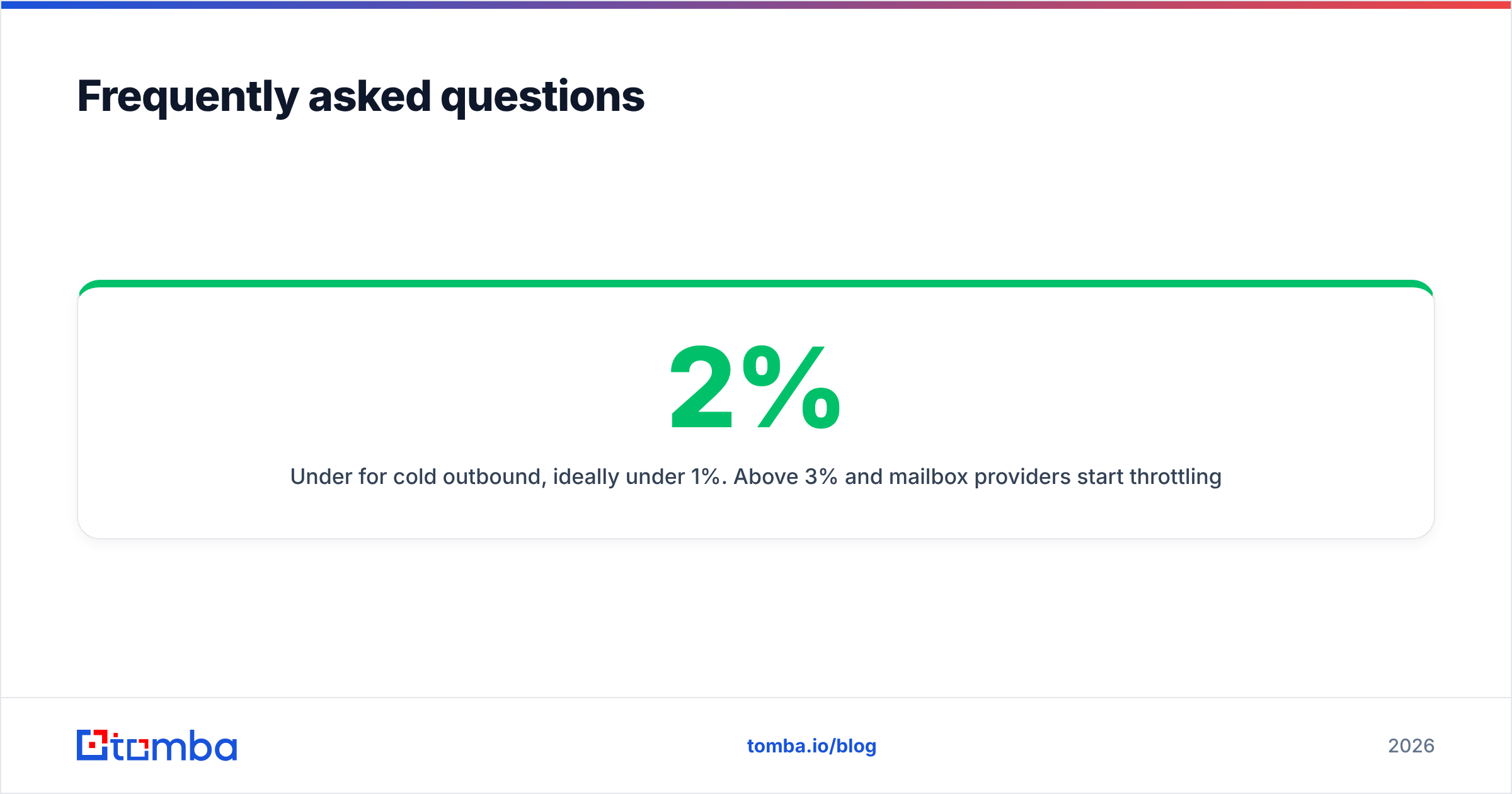
What bounce rate should I target? Under 2% for cold outbound, ideally under 1%. Above 3% and mailbox providers start throttling you; the damage compounds across your whole domain, not just the campaign.
Do I still need warmup if my list is verified? Yes. Verification stops bounces. It does nothing for domain age, sending volume ramp, or engagement signals. Those are separate problems with separate fixes.
Start with the half of the pipeline you can fix today#
If your bounce rate is the emergency, buy verification credits and clean your list this week — MillionVerifier does that job well and cheaply. If your list is empty, sourcing is your bottleneck and a verifier will not help you.
If both are true, and you would rather not run two contracts to solve one workflow, start with the Tomba Email Finder. Find the address, verify it in the same call, catch-all check included, and push the result to your CRM without a CSV ever touching the process. The free tier gives you 25 searches a month with no card — enough to test against your own ICP before you commit a budget to anything.
Related guides#
Ready to find emails that actually work?
Join 150,000+ professionals who stopped guessing and started sending. Free credits on signup — no credit card required.
Get the Tomba newsletter
Practical outbound tactics and product updates — once every two weeks.
About the author