Generect vs OneMoreLead 2026: Which B2B Data Tool Wins?
Generect sells fresh, API-first lead data. OneMoreLead sells a big static B2B database at a low price. Here is how they actually differ on coverage, accuracy, cost and workflow fit in 2026 — and when neither is the right buy.
Generect vs OneMoreLead is a choice between two very different tools. One sells fresh data through an API. The other sells a big, cheap list you download and keep. Pick the wrong one and you pay for it in engineering weeks or in burnt sending domains.
TL;DR
- Generect is an API-first, real-time B2B data provider. It pulls company and people data on demand. That suits engineering teams and RevOps groups who want to build lead flows in code.
- OneMoreLead is a static B2B contact database sold on volume. You search, filter, export a list, and go. It is cheap per record and easy to use. But the data starts to age the day it leaves the platform.
- The two tools do not solve the same problem. Generect competes on fresh data and deep integration. OneMoreLead competes on price and list size.
- Both leave the same job undone: verification before send. Static exports decay 25–30% a year. Real-time pulls still hand back risky catch-all domains.
- Your real need may be simpler: find and verify work emails at scale for a fair price. If so, an email finder plus verification is usually cheaper and more accurate than either database.
What are Generect and OneMoreLead?#
Think of it like buying produce. Generect is the farm that ships the morning you order. OneMoreLead is the wholesale warehouse. Huge stock, low unit price, but you never know how long that crate has sat there.
Generect (generect.com) sells itself as a real-time B2B data engine. Most vendors serve records from a store they refreshed last quarter. Generect builds the record when you ask for it. The API is the heart of the product. Developers call an endpoint, get back a clean lead object, then push it into a CRM, a sequencer or a scoring model. You tend to see Generect in teams that already have engineers and a clear ICP.
OneMoreLead (onemorelead.com) sits at the other end. It sells a large pre-built B2B contact database, with tens of millions of records across the US and other English-speaking markets. You pick industry, job title, company size and location, then download the list. Pricing is built on record volume. The pitch is simple: more contacts per dollar than the big names.
The split in strategy matters more than any feature list:
- Data model — Generect builds records on demand. OneMoreLead serves records from storage.
- Primary user — Generect targets developers and RevOps. OneMoreLead targets SDRs and small marketing teams.
- Buying unit — Generect sells API capacity and integration. OneMoreLead sells contact volume.
- Failure mode — Generect fails on cost and setup friction. OneMoreLead fails on stale data and bounces.
- Time to first list — Generect takes hours or days, because you build the integration. OneMoreLead takes minutes.
Generect vs OneMoreLead: how do they compare head-to-head?#
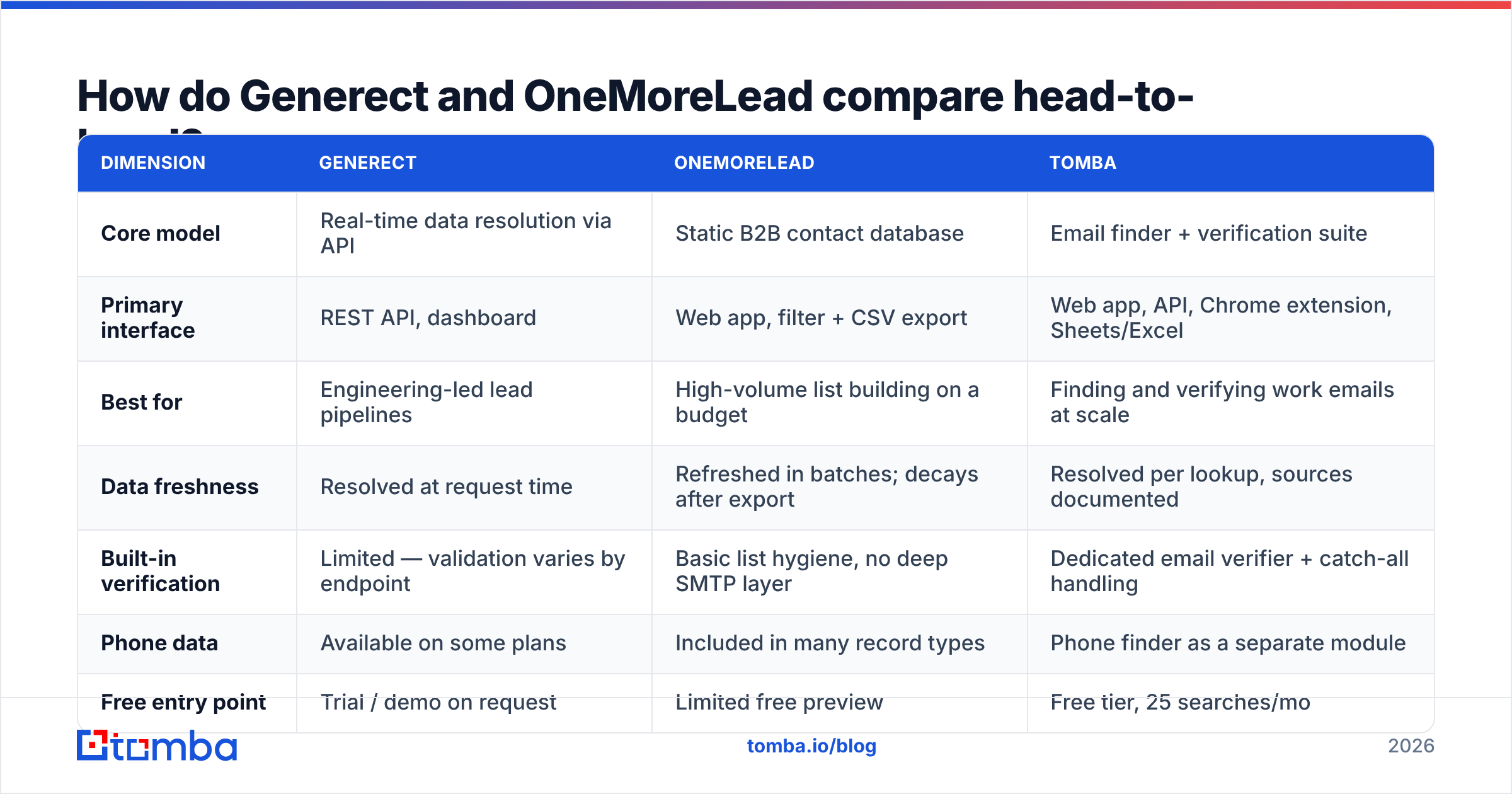
Here is the practical Generect vs OneMoreLead comparison. Both vendors price by quote or by volume, and the numbers move often. Treat the cost row as a shape, not a quote. Check the vendor site before you sign.
| Dimension | Generect | OneMoreLead | Tomba |
|---|---|---|---|
| Core model | Real-time data resolution via API | Static B2B contact database | Email finder + verification suite |
| Primary interface | REST API, dashboard | Web app, filter + CSV export | Web app, API, Chrome extension, Sheets/Excel |
| Best for | Engineering-led lead pipelines | High-volume list building on a budget | Finding and verifying work emails at scale |
| Data freshness | Resolved at request time | Refreshed in batches; decays after export | Resolved per lookup, sources documented |
| Built-in verification | Limited — validation varies by endpoint | Basic list hygiene, no deep SMTP layer | Dedicated email verifier + catch-all handling |
| Phone data | Available on some plans | Included in many record types | Phone finder as a separate module |
| Free entry point | Trial / demo on request | Limited free preview | Free tier, 25 searches/mo |
| Published entry price | Quote-based, mid-market | Volume tiers, low cost per record | $49/mo Starter, $99/mo Growth, $249/mo Pro |
| Setup effort | High (developer required) | Low (point and click) | Low to medium |
| Contract friction | Often annual | Often credit packs | Monthly, no annual lock required |
Two things fall out of that table right away.
First, these products are not swaps for each other. If you are weighing both in earnest, one of them is wrong for your problem. Teams that shortlist them together are usually asking a vague question — where do I get leads? — instead of a sharp one.
Second, neither one ships a full outbound data stack. You still need verification. You still need to enrich the records already in your CRM. And you still need a plan for catch-all domains. That gap holds most of the hidden cost.
Which one has better data coverage?#
Coverage is three questions wearing one coat.
Breadth — how many companies and contacts sit in the index at all. OneMoreLead wins on raw count. A big static database is built to max out that number, and it markets on it.
Depth — how many fields you get per record, and how sound they are. Generect usually wins here. Building a record on request lets it pull firmographics, role data and contact points at once, rather than serving an old snapshot.
Recency — whether the record is still true today. Here the two split hard. B2B contact data decays 22–30% a year through job changes alone. That rate spiked during the 2023–2025 tech layoffs. A static export is a photo. A real-time pull is a live feed. Startups, agencies and venture-backed firms all churn fast. If that is your ICP, recency beats breadth every time.
The honest answer: OneMoreLead gives you more names. Generect gives you more truth per name. Which one wins depends on your motion. A broad awareness play can absorb weak records. A tight, high-value motion cannot, because one bounce can burn a domain you cannot replace.

How accurate is the data, and why does verification matter?#
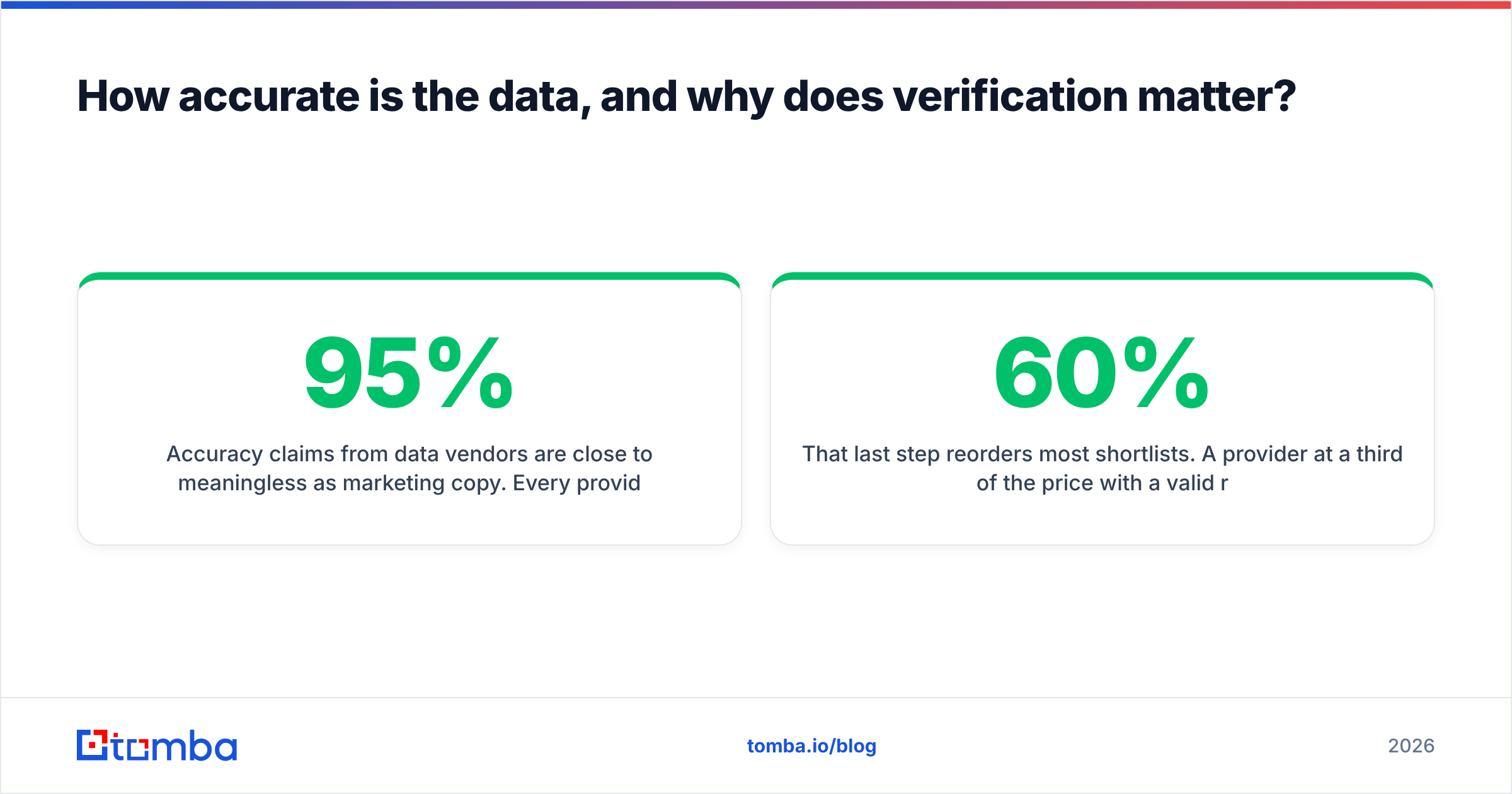
Accuracy claims from data vendors mean very little. Every vendor advertises somewhere between 95% and 99%. Those numbers do not compare, because no two vendors define accuracy the same way. Some count syntax. Some count delivery. Some count whether the record existed at the last refresh.
Run your own test instead. It takes an afternoon:
- Pull 200 records from each vendor on the same ICP filter. Same titles, same company size, same country.
- Run all 400 through one neutral verifier. The measuring stick has to be the same for both.
- Count valid, invalid, catch-all and unknown on their own. Do not let catch-all slide into the valid bucket. That is the most common way vendor accuracy numbers get inflated.
- Check 20 records by hand against LinkedIn or the company site. Job-change errors slip past every verifier.
- Work out cost per verified-valid contact, not cost per record. That is the only number that should drive the buy.
That last step reorders most shortlists. Say one vendor costs a third as much, but only 60% of its records are valid. Per usable contact, it costs more than a full-price vendor at 92%. It also costs you sender reputation, and that never shows up on an invoice.
Catch-all domains deserve their own note. About a fifth of B2B domains accept all inbound mail at the SMTP layer. Standard verification returns unknown, so you are left guessing. Some teams drop them and throw away real pipeline. Others send blind and eat the bounces. A catch-all verifier clears a good share of them. Neither Generect nor OneMoreLead puts that job at the centre of its product.
What does each one actually cost?#
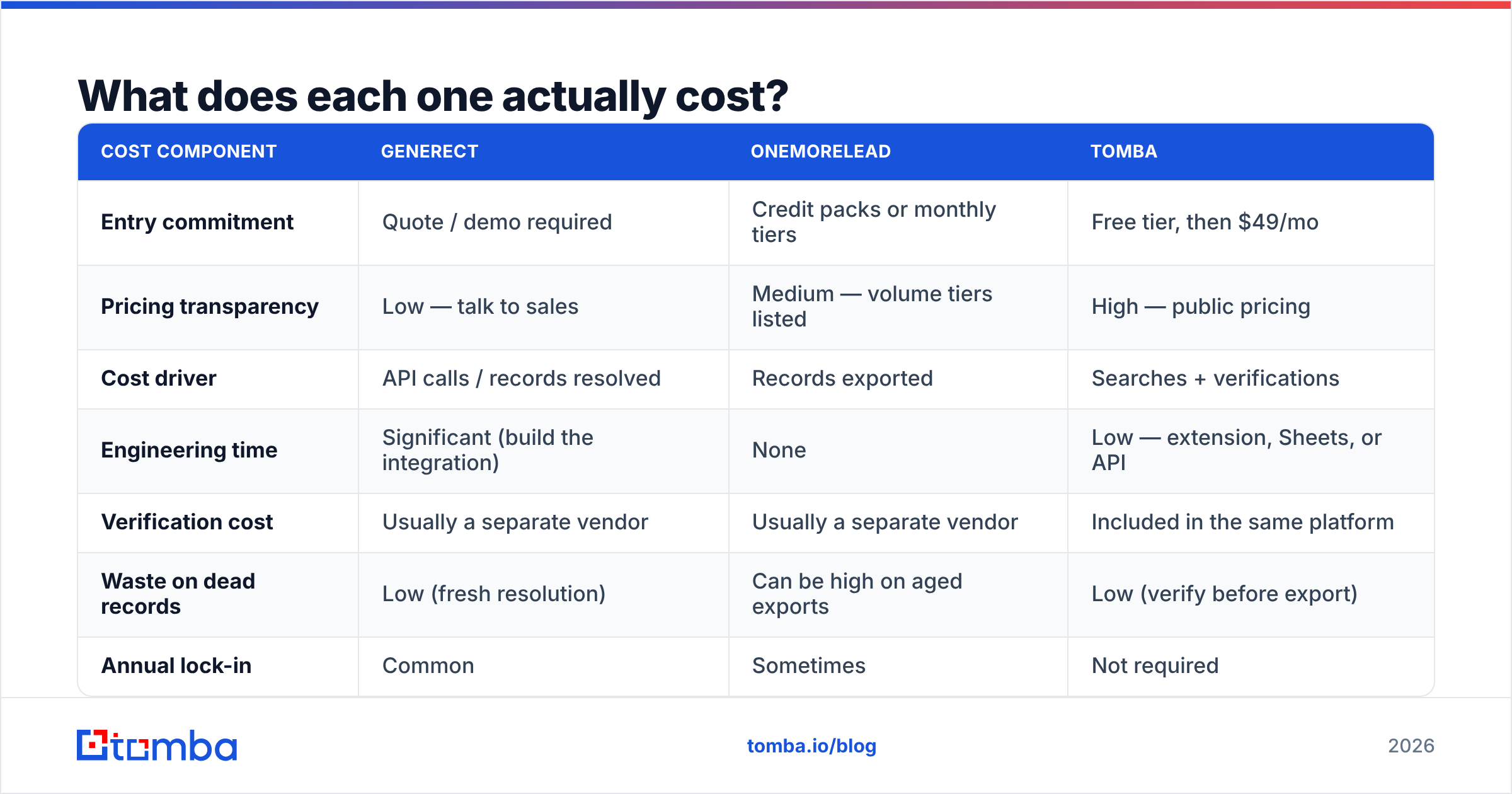
Sticker price is the least interesting part of the cost question. Here is the fuller picture.
| Cost component | Generect | OneMoreLead | Tomba |
|---|---|---|---|
| Entry commitment | Quote / demo required | Credit packs or monthly tiers | Free tier, then $49/mo |
| Pricing transparency | Low — talk to sales | Medium — volume tiers listed | High — public pricing |
| Cost driver | API calls / records resolved | Records exported | Searches + verifications |
| Engineering time | Significant (build the integration) | None | Low — extension, Sheets, or API |
| Verification cost | Usually a separate vendor | Usually a separate vendor | Included in the same platform |
| Waste on dead records | Low (fresh resolution) | Can be high on aged exports | Low (verify before export) |
| Annual lock-in | Common | Sometimes | Not required |
The line that surprises people is engineering time. Generect's API-first design is a real edge if you have developers to spend. It is a real tax if you do not. Budget two to five engineering days for a first useful integration. Then budget upkeep, because schemas and CRM mappings change. At loaded rates, that bill often beats the first year of the subscription.
OneMoreLead's hidden cost runs the other way. It is cheap to buy and costly to use badly. Export a list, skip verification, and bounce rates will get your sending domain throttled. Once email deliverability drops, recovery takes weeks of warmup. That costs far more than the list did.
Which is better for API access and automation?#
Generect, clearly. That is the product. Say your need reads like this: turn a company domain into a decision-maker contact inside our own app. Generect is built for that shape of request. OneMoreLead is not.
But API-first is not one single level of quality. Judge it on the details:
- Latency — a live lookup runs slower than a read from storage. Test it under your real load, not on one demo call.
- Rate limits — check the ceiling on the plan you will buy, not the top plan.
- Schema stability — how often do fields change, and is there a versioned endpoint?
- Failure semantics — what comes back when a record cannot be found, and do you pay for it?
- SDK and tooling — are there official clients, or will you write HTTP wrappers yourself?
Some teams want automation without a build sprint. The middle path is a data tool with an API and no-code surfaces as well. A Tomba API call and the Google Sheets add-on hit the same data. The RevOps analyst and the backend engineer stay on one tool, with one bill.

Who should pick Generect, and who should pick OneMoreLead?#
Pick Generect if:
- You have in-house engineers and a lead flow you want to run in code.
- Your ICP churns fast, so a record from six months ago is worthless.
- You enrich signups or site visitors in real time, rather than building static lists.
- Depth per record matters more to you than record count.
Pick OneMoreLead if:
- You need volume now, on a small budget, with no developer involved.
- Your motion is broad: wide-net outbound, event invites, top-of-funnel awareness. A modest bounce rate is survivable there, as long as you verify first.
- You want to own an exported list rather than rent API access.
- Your ICP sits in stable industries where people change jobs less often.
Pick neither if your real problem sounds like this: I have a list of companies and names, and I need accurate work emails for them. That is an email-finding job. Buying a whole contact database to solve it means paying for millions of records you will never touch. A domain search returns every address it can find at a target company, and verification cleans up the rest. It is a much tighter fit, and it starts free.
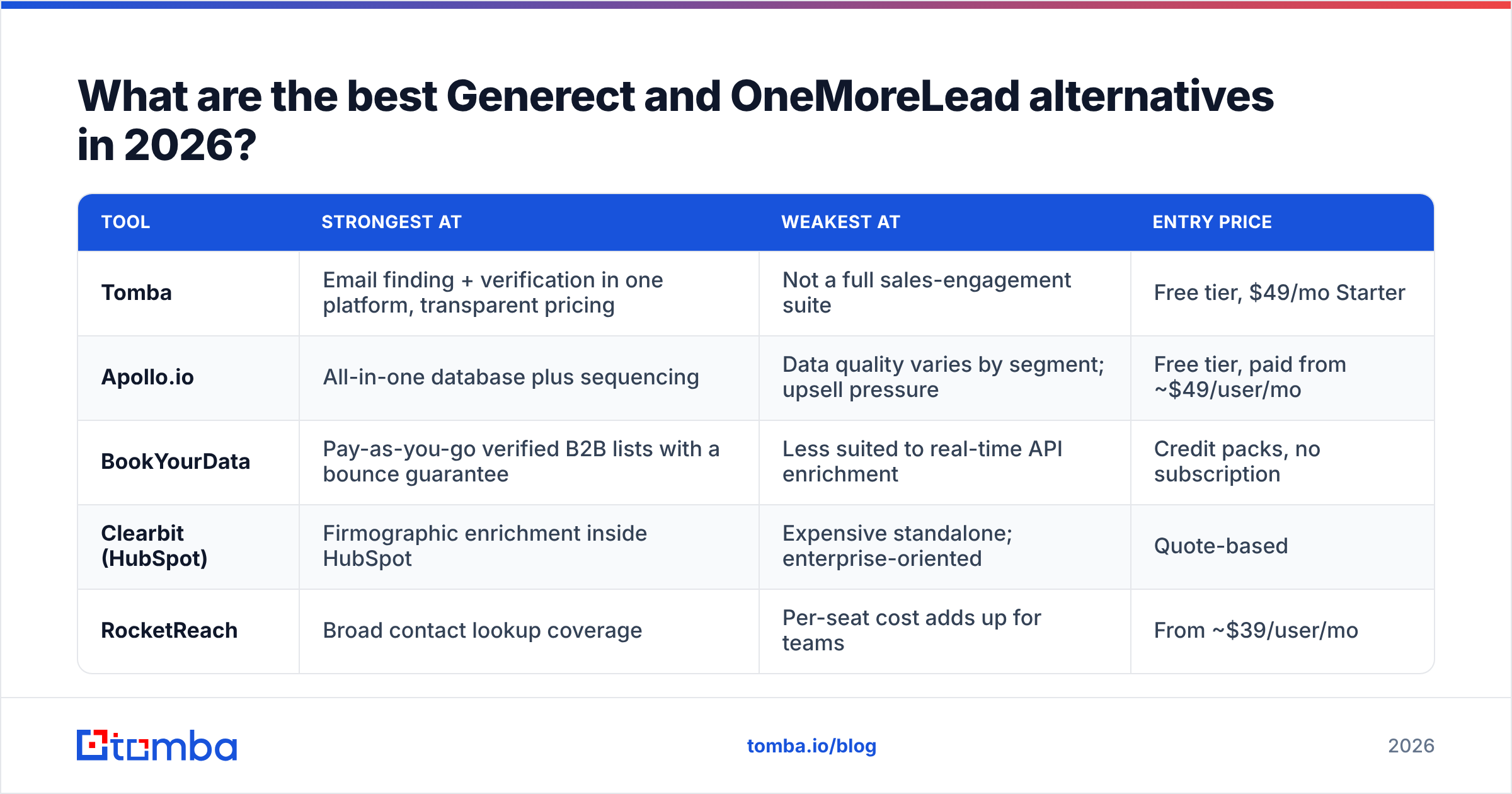
What are the best Generect and OneMoreLead alternatives in 2026?#
| Tool | Strongest at | Weakest at | Entry price |
|---|---|---|---|
| Tomba | Email finding + verification in one platform, transparent pricing | Not a full sales-engagement suite | Free tier, $49/mo Starter |
| Apollo.io | All-in-one database plus sequencing | Data quality varies by segment; upsell pressure | Free tier, paid from ~$49/user/mo |
| BookYourData | Pay-as-you-go verified B2B lists with a bounce guarantee | Less suited to real-time API enrichment | Credit packs, no subscription |
| Clearbit (HubSpot) | Firmographic enrichment inside HubSpot | Expensive standalone; enterprise-oriented | Quote-based |
| RocketReach | Broad contact lookup coverage | Per-seat cost adds up for teams | From ~$39/user/mo |
BookYourData is worth a serious look if your worry about OneMoreLead is data confidence rather than price. Pay-as-you-go with a bounce guarantee drops the subscription and keeps the vendor on the hook. If your worry runs the other way, and you want a live API instead of lists, then Generect and other enrichment-first vendors are the right aisle.
Cross-check any shortlist against real reviews on G2 and Capterra before the demo call. Filter by company size close to yours. Enterprise reviews of a self-serve tool tell you almost nothing.
What should you actually do next?#
Run a bake-off, not a feature-sheet comparison. Take one ICP segment. Pull 200 records from each candidate. Verify them all through the same neutral verifier. Send one identical campaign per source. Then compare cost per meeting booked. Not cost per record. Not advertised accuracy. Not database size.
Nine times out of ten, that test shows the same three things:
- The cheap static database has a valid rate low enough to wipe out its price edge.
- The premium real-time API is truly better, and truly costlier than the plan you were quoting for.
- The verification layer you skipped drove most of the gap in reply rate.
If you would rather not run a procurement cycle to learn that, start with the narrow tool. Tomba's email finder finds work emails by name, domain or company, and verifies them in the same pass. The free tier covers 25 searches a month. Starter costs $49/mo, with no annual contract and no sales call to see a price. Test it against any Generect vs OneMoreLead quote you get, on the same 200 records, and let the verified-valid rate decide.
Related guides#
Ready to find emails that actually work?
Join 150,000+ professionals who stopped guessing and started sending. Free credits on signup — no credit card required.
Get the Tomba newsletter
Practical outbound tactics and product updates — once every two weeks.
About the author