Generect vs Reachfast (2026): Which B2B Data Tool Wins?
Generect sells structured B2B lead data through an API. Reachfast sells fast contact lookups in the browser. Here is how they compare on coverage, accuracy, pricing, and which one actually fits your outbound motion.
TL;DR
- Generect is built for teams who want lead lists and contact data delivered programmatically — search by company, role, or LinkedIn criteria and pull structured records into your own system.
- Reachfast is built for the individual rep — a lookup layer that surfaces an email or mobile number for a person you are already looking at, usually inside the browser.
- They are not really competitors on the same axis: one is a data pipeline, the other is a lookup tool. Picking wrong costs you either wasted seats or wasted engineering hours.
- Neither publishes accuracy numbers you can independently audit, so budget for a separate verification step regardless of which you choose.
- If you want both the API depth and per-contact verification in one bill, a dedicated email finder like Tomba covers the overlap at $49/mo instead of two separate contracts.
What are Generect and Reachfast?#
Generect positions itself as a B2B lead-generation data provider with an API-first delivery model. The pitch is that you describe your ICP — industry, headcount, seniority, geography, LinkedIn search parameters — and Generect returns structured lead records, including work emails, at volume. It is the kind of tool a RevOps or growth engineer buys, not something a single SDR expenses.
Reachfast sits at the opposite end. It is a contact-lookup product aimed at the person doing the prospecting right now: you land on a profile, you want the email and ideally the mobile, you click, you get it. Speed and per-lookup convenience are the value proposition, not bulk delivery.
The reason "generect vs reachfast" gets searched at all is that both answer the same surface-level question — how do I get this person's contact details? — but they answer it for different buyers, at different points in the workflow, at very different price shapes.
Here is the core distinction, stated plainly:
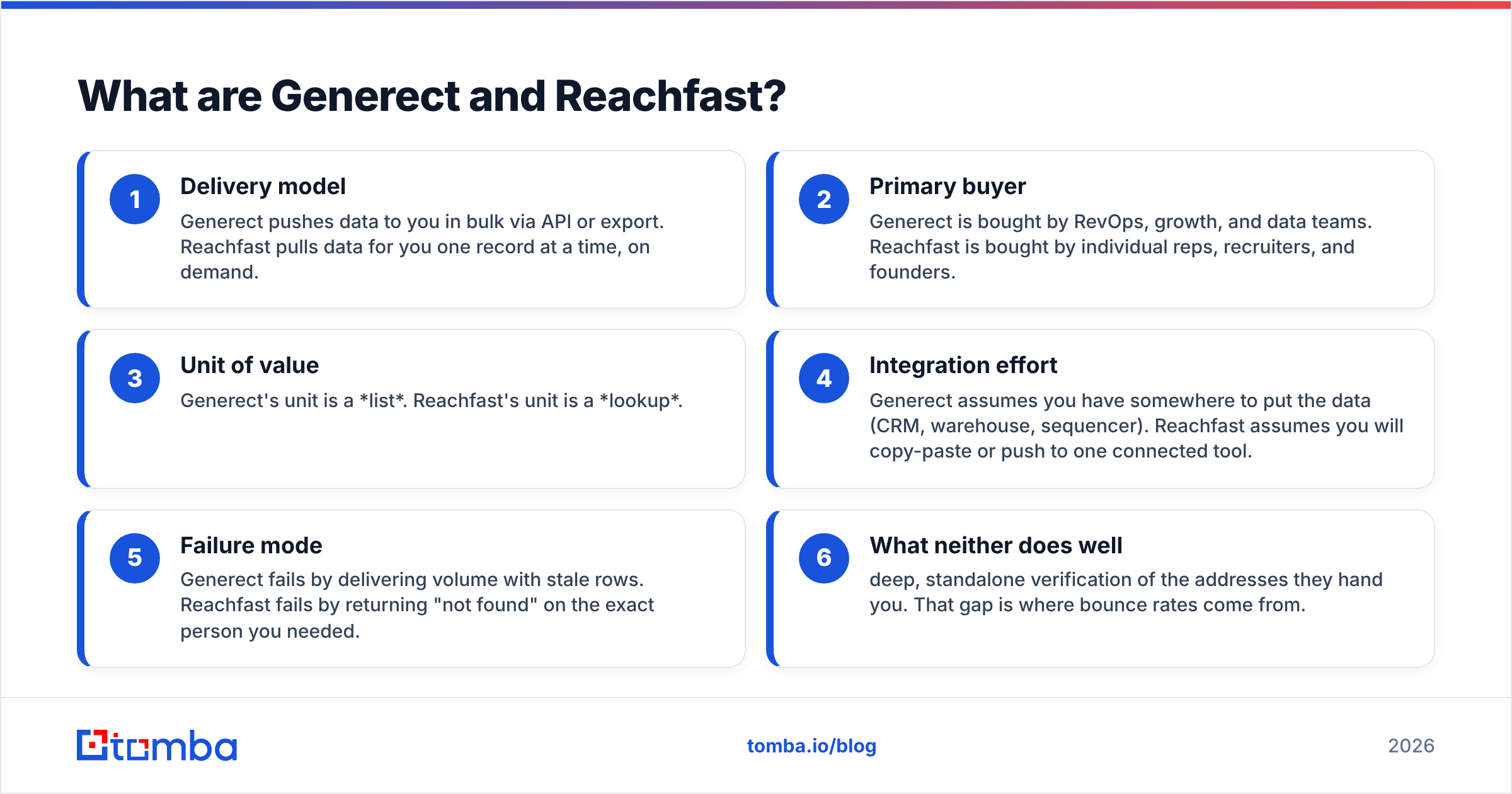
- Delivery model — Generect pushes data to you in bulk via API or export. Reachfast pulls data for you one record at a time, on demand.
- Primary buyer — Generect is bought by RevOps, growth, and data teams. Reachfast is bought by individual reps, recruiters, and founders.
- Unit of value — Generect's unit is a list. Reachfast's unit is a lookup.
- Integration effort — Generect assumes you have somewhere to put the data (CRM, warehouse, sequencer). Reachfast assumes you will copy-paste or push to one connected tool.
- Failure mode — Generect fails by delivering volume with stale rows. Reachfast fails by returning "not found" on the exact person you needed.
- What neither does well — deep, standalone verification of the addresses they hand you. That gap is where bounce rates come from.

How do Generect and Reachfast compare head to head?#
Treat the pricing column as directional rather than gospel — both vendors quote by volume and revise plans without much notice. Confirm current numbers on their own pages before you sign anything.
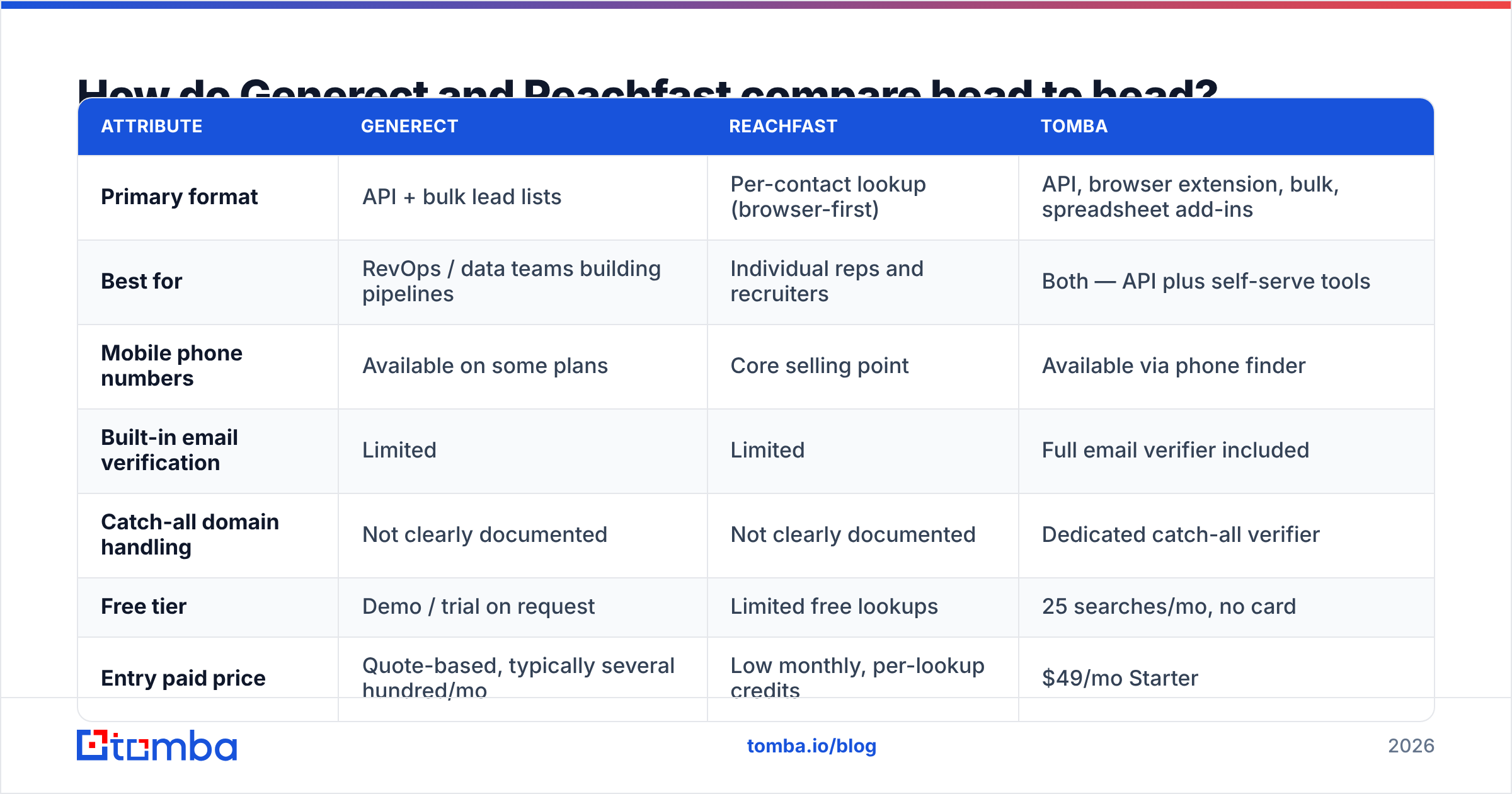
| Attribute | Generect | Reachfast | Tomba |
|---|---|---|---|
| Primary format | API + bulk lead lists | Per-contact lookup (browser-first) | API, browser extension, bulk, spreadsheet add-ins |
| Best for | RevOps / data teams building pipelines | Individual reps and recruiters | Both — API plus self-serve tools |
| Mobile phone numbers | Available on some plans | Core selling point | Available via phone finder |
| Built-in email verification | Limited | Limited | Full email verifier included |
| Catch-all domain handling | Not clearly documented | Not clearly documented | Dedicated catch-all verifier |
| Free tier | Demo / trial on request | Limited free lookups | 25 searches/mo, no card |
| Entry paid price | Quote-based, typically several hundred/mo | Low monthly, per-lookup credits | $49/mo Starter |
| Self-serve signup | Usually sales-assisted | Yes | Yes |
| Spreadsheet workflow | Export → manual import | Manual | Native Google Sheets and Excel add-ins |
The table makes the real trade-off visible. Generect gives you scale but expects you to bring engineering and a destination system. Reachfast gives you immediacy but does not scale past what one human can click. Neither closes the verification loop, which is the part that actually determines whether your campaign lands in an inbox or a spam folder.
Which one finds more valid emails?#
Nobody can answer that with a single number, and you should distrust any comparison post that claims otherwise. What you can do is understand why the answer differs by dataset.
Generect's coverage skews toward companies and roles that are well-represented in professional networks and company websites — mid-market and enterprise SaaS, agencies, technology, consulting. Feed it a niche of 40-person manufacturers in the Midwest and hit rates drop sharply. That is not a Generect flaw; it is a property of every B2B database.
Reachfast's coverage is a per-person lottery. Because the workflow is one lookup at a time, you feel misses acutely — you asked for one specific person, and either you got them or you didn't. Aggregate hit rate matters less to the user experience than whether it worked on the CEO you were about to email.

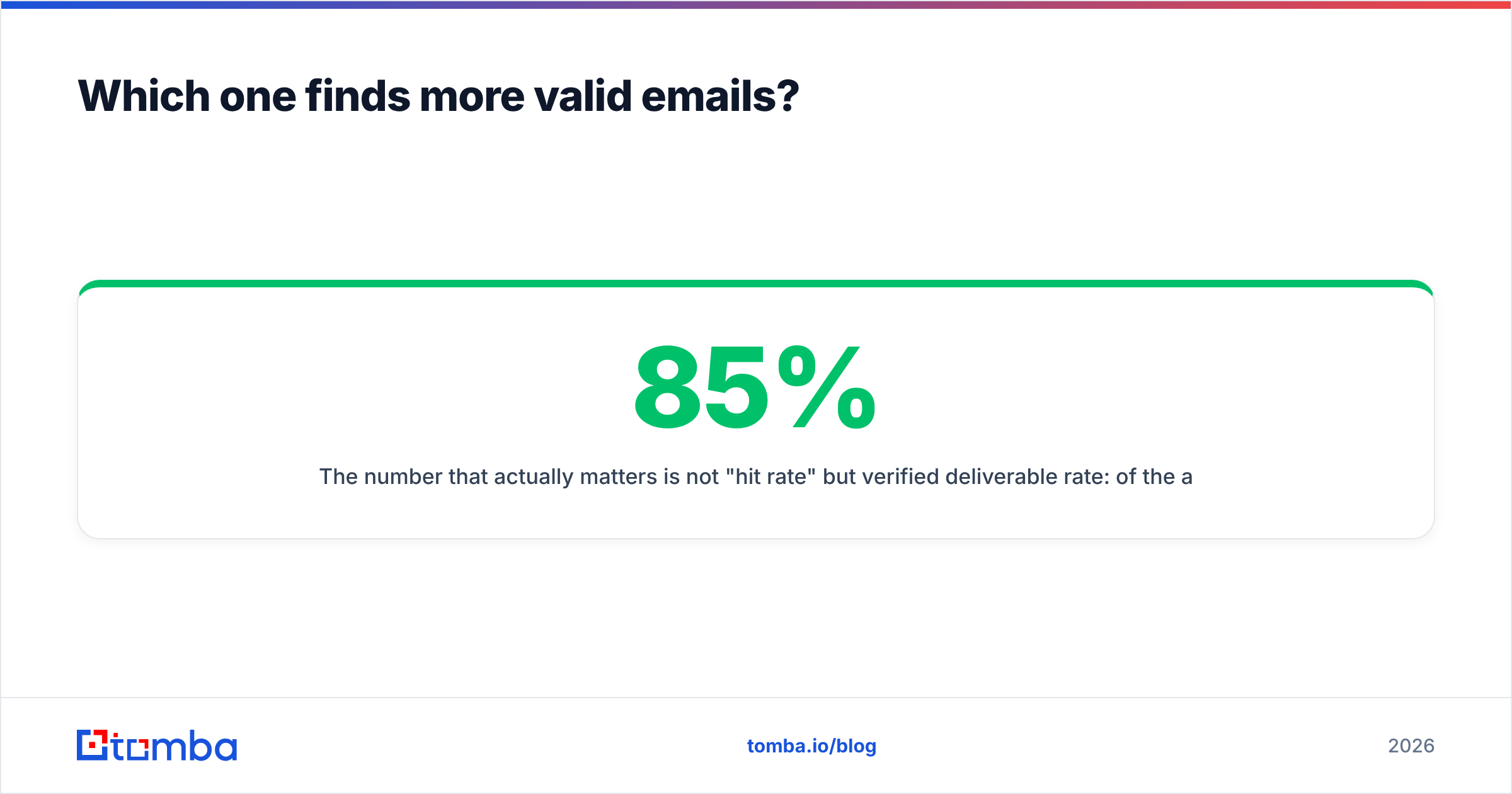
The number that actually matters is not "hit rate" but verified deliverable rate: of the addresses returned, how many survive an independent SMTP-level check. A tool with an 85% hit rate and 95% verified deliverability beats a tool with a 95% hit rate and 70% deliverability, every time. High-volume lists inflate the first number and quietly destroy the second.
Three practical checks before you commit to either vendor:
- Run a 200-row seed test. Take 200 contacts you already know are valid — past customers, current colleagues, closed-won accounts. Feed them to the tool and measure how many it returns correctly. This is a coverage test, not a marketing claim.
- Verify the output somewhere else. Push whatever the tool returns through an independent email verifier and record how many come back risky, catch-all, or invalid.
- Check the catch-all share. Domains configured to accept all mail will pass naive validation and bounce anyway. If more than a fifth of your list is catch-all, you need real catch-all logic, not a green checkmark.

How does pricing actually work?#
This is where the two diverge hardest, and where buyers get surprised.
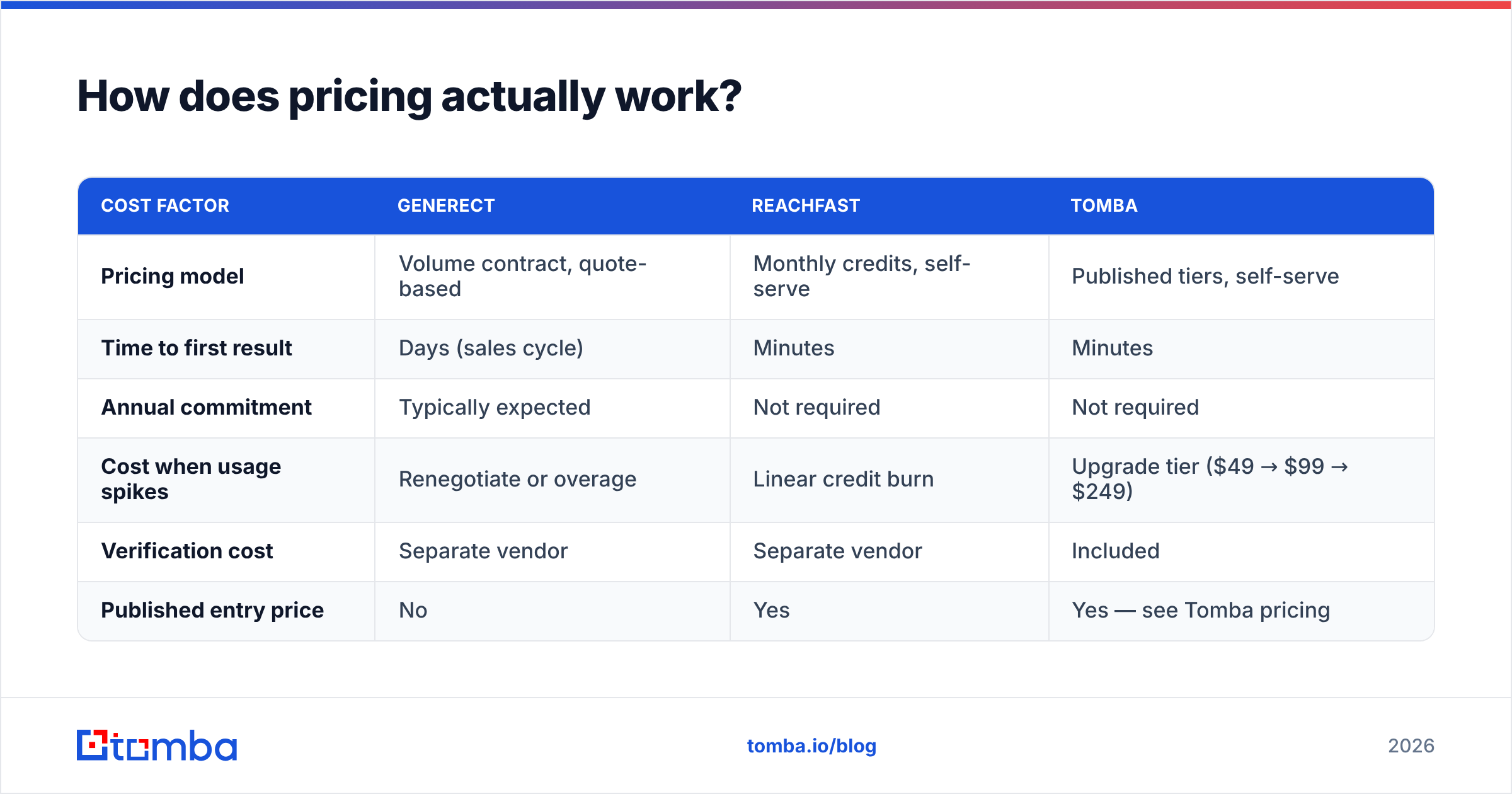
Generect prices like a data vendor: quote-based, tied to record volume and contract length, usually annual, usually with a minimum. That is normal for the category — Gartner has been documenting the shift toward volume-committed B2B data contracts for years — but it means you cannot swipe a card and start today. You will talk to someone, you will scope volume, and you will commit before you know your real hit rate on your ICP.
Reachfast prices like a productivity tool: monthly, credit-based, self-serve. Cheap to start, and cost scales linearly with usage. The catch is the shape of that scaling. Per-lookup credit models get expensive precisely when they are working, because success means more lookups. Teams that start at a low monthly plan often land three times higher within two quarters.
| Cost factor | Generect | Reachfast | Tomba |
|---|---|---|---|
| Pricing model | Volume contract, quote-based | Monthly credits, self-serve | Published tiers, self-serve |
| Time to first result | Days (sales cycle) | Minutes | Minutes |
| Annual commitment | Typically expected | Not required | Not required |
| Cost when usage spikes | Renegotiate or overage | Linear credit burn | Upgrade tier ($49 → $99 → $249) |
| Verification cost | Separate vendor | Separate vendor | Included |
| Published entry price | No | Yes | Yes — see Tomba pricing |
Add the hidden line item people forget: verification. If you buy raw data from either vendor and then pay a separate verification provider, you are running two contracts to produce one usable contact. Check the combined per-verified-contact cost, not the headline per-record cost.

Where does each tool fit in your stack?#
Rather than crowning a winner, map each to the motion it serves.
Choose Generect if: you are building programmatic list generation, you have an engineer who can consume an API, your ICP is well-covered by professional-network data, and your volume justifies a committed contract. Generect makes sense as infrastructure, not as a rep tool.
Choose Reachfast if: your motion is account-based and manual, your reps research individual targets before reaching out, mobile numbers matter to your process, and you would rather pay per successful lookup than commit to volume. Reachfast makes sense as a rep utility, not as a data pipeline.
Choose neither if: you need both shapes and refuse to pay two vendors for it. This is the most common situation for a 5–25 person sales team, and it is exactly the gap that general-purpose finders fill. A single provider with an email finder API, a browser extension, bulk processing, and verification in the same account removes an entire class of integration work.
Peer reviews on G2 for this category are worth reading with one filter in mind: sort by company size. A 500-person org reviewing a data API and a solo recruiter reviewing a lookup extension are describing different products, and their five-star ratings are not comparable.
What are the honest downsides of each?#
Neutral means saying the uncomfortable parts out loud.
Generect's weak points. Sales-gated pricing means you cannot evaluate cost against value until you are already in a conversation. Bulk data ages fast — B2B contact records decay meaningfully every year as people change jobs — so a list you pulled in January is materially worse by July unless you re-enrich. And the API-first model assumes internal capacity you may not have.
Reachfast's weak points. Per-lookup workflows do not scale past individual effort. Credit models punish success. And because it is optimized for speed, the depth of validation on any single result is necessarily shallow — you are trading confidence for latency.
What both share. Neither is a verification platform. Both hand you an address and leave the deliverability question to you. If you send cold email at any volume, that question is not optional: unverified lists drive hard bounces, hard bounces damage sender reputation, and damaged reputation quietly kills campaigns that look fine in your dashboard.
What is the practical recommendation?#
Start by answering one question: is your bottleneck volume or precision?
If it is volume — you need thousands of contacts matching a repeatable pattern — you want a data pipeline. Generect is a legitimate candidate; so is any provider with a well-documented domain search endpoint that lets you pull every relevant contact at a company in one call.
If it is precision — you need the right person at 50 specific accounts — you want a lookup tool. Reachfast fits; so does a browser extension backed by a large index.
If it is both, and it usually is, consolidate. Run a seed test across two or three providers on your actual ICP, measure verified deliverable rate rather than raw hit rate, and pick on that number. Then make verification a permanent step in the pipeline, not a cleanup task you do after a campaign underperforms.
The decision framework in order:
- Define the ICP slice you actually sell to, not the total addressable market.
- Seed-test 200 known contacts through every shortlisted vendor.
- Verify all outputs independently and compute verified deliverable rate.
- Divide total monthly cost by verified contacts to get true unit economics.
- Check integration fit — does it reach your CRM without a custom build?
- Re-run the test in six months. Data providers improve and regress; your vendor choice should not be permanent.
Ready to test coverage on your own list?#
If you would rather not choose between a data API and a rep lookup tool, run your seed test against Tomba Email Finder first. You get domain-level search, single lookups, bulk processing, and verification in one account — free tier is 25 searches a month with no card, Starter is $49/mo, and the same index powers the API, the Chrome extension, and the spreadsheet add-ins. Pull 200 known contacts through it, verify the results, and compare the verified deliverable rate against whatever Generect or Reachfast quotes you. Let the number decide.
Related guides#
Ready to find emails that actually work?
Join 150,000+ professionals who stopped guessing and started sending. Free credits on signup — no credit card required.
Get the Tomba newsletter
Practical outbound tactics and product updates — once every two weeks.
About the author