Generect vs Salesbot: Which B2B Lead Tool Wins in 2026?
Generect sells raw lead data through an API. Salesbot sells an AI agent that works the pipeline for you. Here is the honest breakdown of which one your outbound team actually needs in 2026 — and when neither is the answer.
TL;DR
- Generect is a data company. You buy access to B2B contact and company records — often through an API or LinkedIn-based search — and you build the outbound motion yourself.
- Salesbot is an automation layer. It leans on AI agents and chat/sequence workflows to act on leads, which means it is only as good as the data you feed it.
- They are not really competitors. They sit at different points of the same pipeline: Generect supplies, Salesbot activates.
- Neither vendor publishes a full, transparent price list at every tier — expect quote-based conversations once you go past the entry plan. Verify current numbers on their own sites before you budget.
- If your bottleneck is contact accuracy, fix that layer first with a dedicated email finder and verifier. Automation on top of a 60%-valid list just burns your domain faster.
What are Generect and Salesbot, actually?#
Short answer: one is a pipe, the other is a robot.
Think of outbound as a restaurant. Generect is the supplier who delivers crates of produce to your back door. Salesbot is the line cook who turns whatever arrives into plates. A great cook cannot rescue rotten vegetables, and pristine produce does nothing sitting in the walk-in. That distinction explains almost every disappointing result teams report with either tool.
Generect (generect.com) positions itself as a B2B lead-generation data provider with a heavy API focus. The pitch is programmatic access: query for companies and people, pull structured records, and push them into your own stack. Teams that pick Generect usually have an engineer or a RevOps person who is comfortable writing against an endpoint rather than clicking through a UI.
Salesbot is the AI-agent side of the equation. The category — sometimes called "AI SDR" — covers tools that qualify inbound chats, auto-draft replies, run multi-step sequences, and hand warm conversations to a human. The value proposition is labor: fewer hours spent on the mechanical parts of prospecting.
Here is the part vendors gloss over. An AI agent multiplies whatever you give it. Feed it a list where a third of the addresses bounce, and it will send those bounces faster and more consistently than a human ever would. That is not a hypothetical risk — it is the single most common way teams torch a sending domain in the first 90 days.
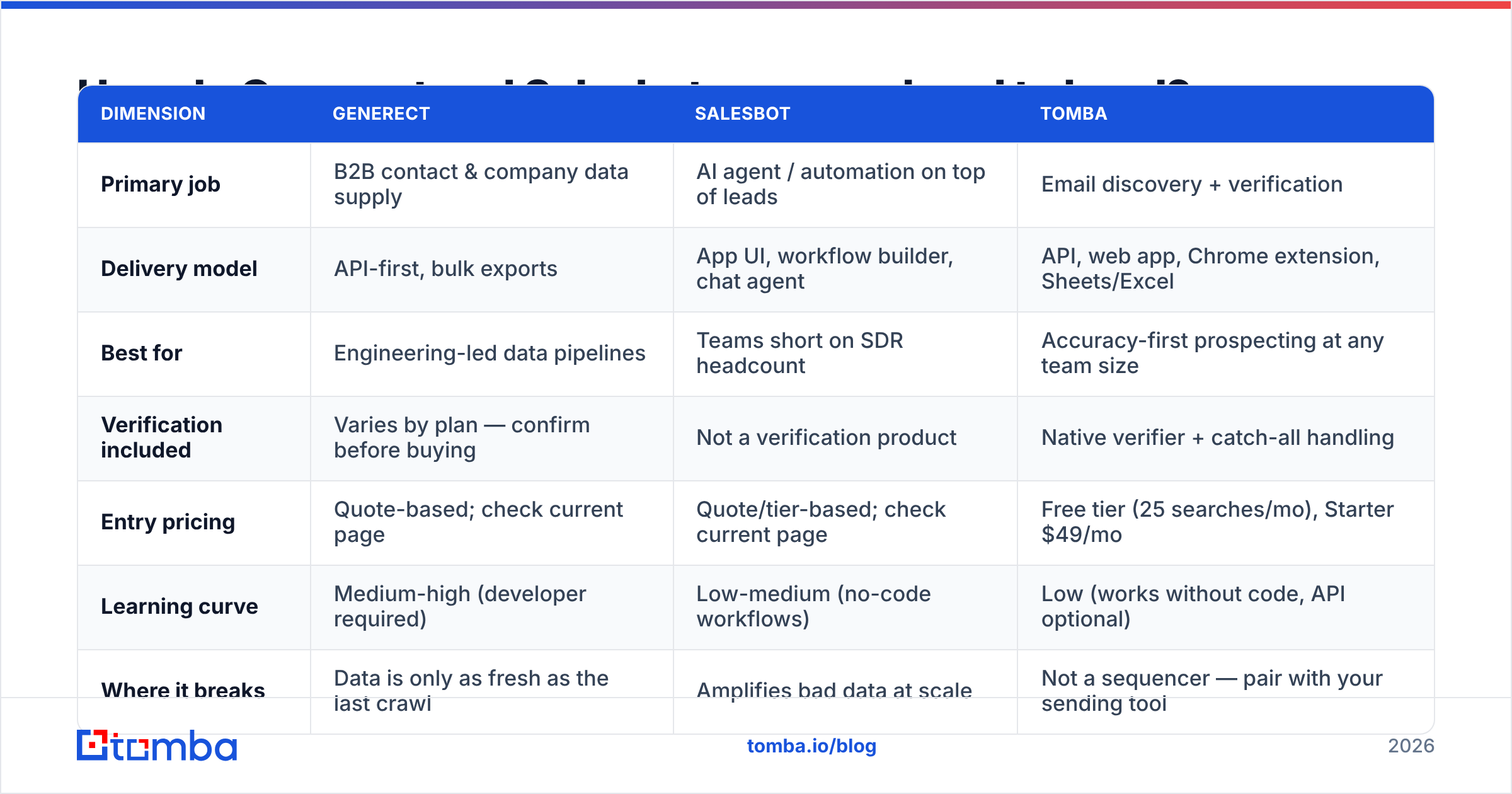
How do Generect and Salesbot compare head to head?#
| Dimension | Generect | Salesbot | Tomba |
|---|---|---|---|
| Primary job | B2B contact & company data supply | AI agent / automation on top of leads | Email discovery + verification |
| Delivery model | API-first, bulk exports | App UI, workflow builder, chat agent | API, web app, Chrome extension, Sheets/Excel |
| Best for | Engineering-led data pipelines | Teams short on SDR headcount | Accuracy-first prospecting at any team size |
| Verification included | Varies by plan — confirm before buying | Not a verification product | Native verifier + catch-all handling |
| Entry pricing | Quote-based; check current page | Quote/tier-based; check current page | Free tier (25 searches/mo), Starter $49/mo |
| Learning curve | Medium-high (developer required) | Low-medium (no-code workflows) | Low (works without code, API optional) |
| Where it breaks | Data is only as fresh as the last crawl | Amplifies bad data at scale | Not a sequencer — pair with your sending tool |
A note on pricing honesty: both vendors move a lot of their commercial detail behind a demo request, and published tiers change. Do not take a number from any blog post — including this one — as gospel. Open their pricing page, then open Tomba pricing, and compare like for like on credits per dollar, not on headline plan names. A "$99 plan" that includes 1,000 credits is four times more expensive than a "$99 plan" with 4,000.
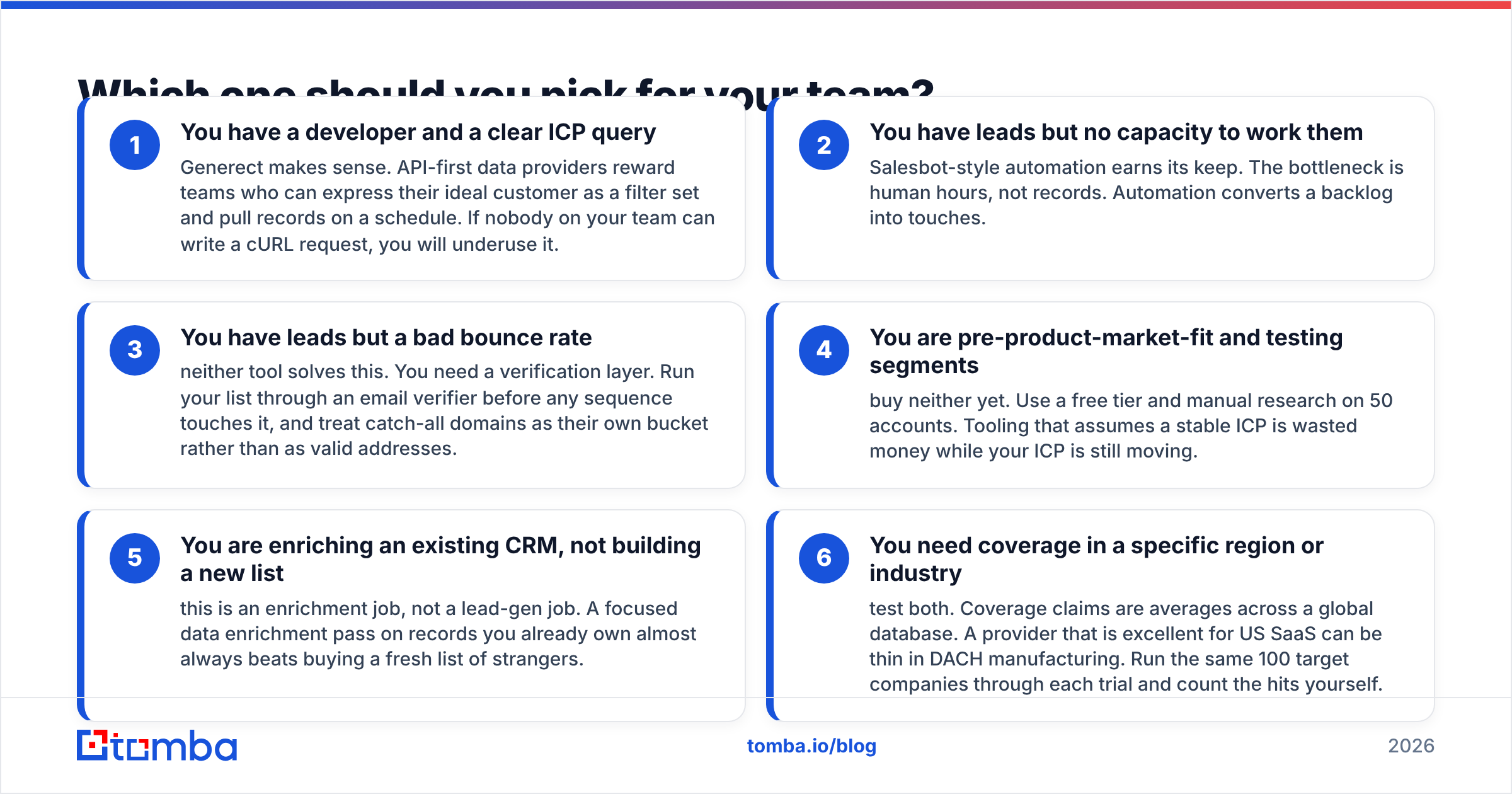
Which one should you pick for your team?#
Use this as a decision list rather than a scoreboard:
- You have a developer and a clear ICP query — Generect makes sense. API-first data providers reward teams who can express their ideal customer as a filter set and pull records on a schedule. If nobody on your team can write a cURL request, you will underuse it.
- You have leads but no capacity to work them — Salesbot-style automation earns its keep. The bottleneck is human hours, not records. Automation converts a backlog into touches.
- You have leads but a bad bounce rate — neither tool solves this. You need a verification layer. Run your list through an email verifier before any sequence touches it, and treat catch-all domains as their own bucket rather than as valid addresses.
- You are pre-product-market-fit and testing segments — buy neither yet. Use a free tier and manual research on 50 accounts. Tooling that assumes a stable ICP is wasted money while your ICP is still moving.
- You are enriching an existing CRM, not building a new list — this is an enrichment job, not a lead-gen job. A focused data enrichment pass on records you already own almost always beats buying a fresh list of strangers.
- You need coverage in a specific region or industry — test both. Coverage claims are averages across a global database. A provider that is excellent for US SaaS can be thin in DACH manufacturing. Run the same 100 target companies through each trial and count the hits yourself.
That last point is the one most teams skip, and it is the only test that actually predicts your results.
Is data quality or automation the bigger risk?#
Data quality, by a wide margin.
Contact data decays constantly. People change jobs, companies restructure, domains get consolidated after acquisitions. Any static database is drifting out of date from the moment it is built. That is not a knock on Generect specifically — it is physics for the entire category, and every honest vendor will tell you the same thing.
The practical consequence is that coverage and accuracy are different metrics, and vendors love to blur them:
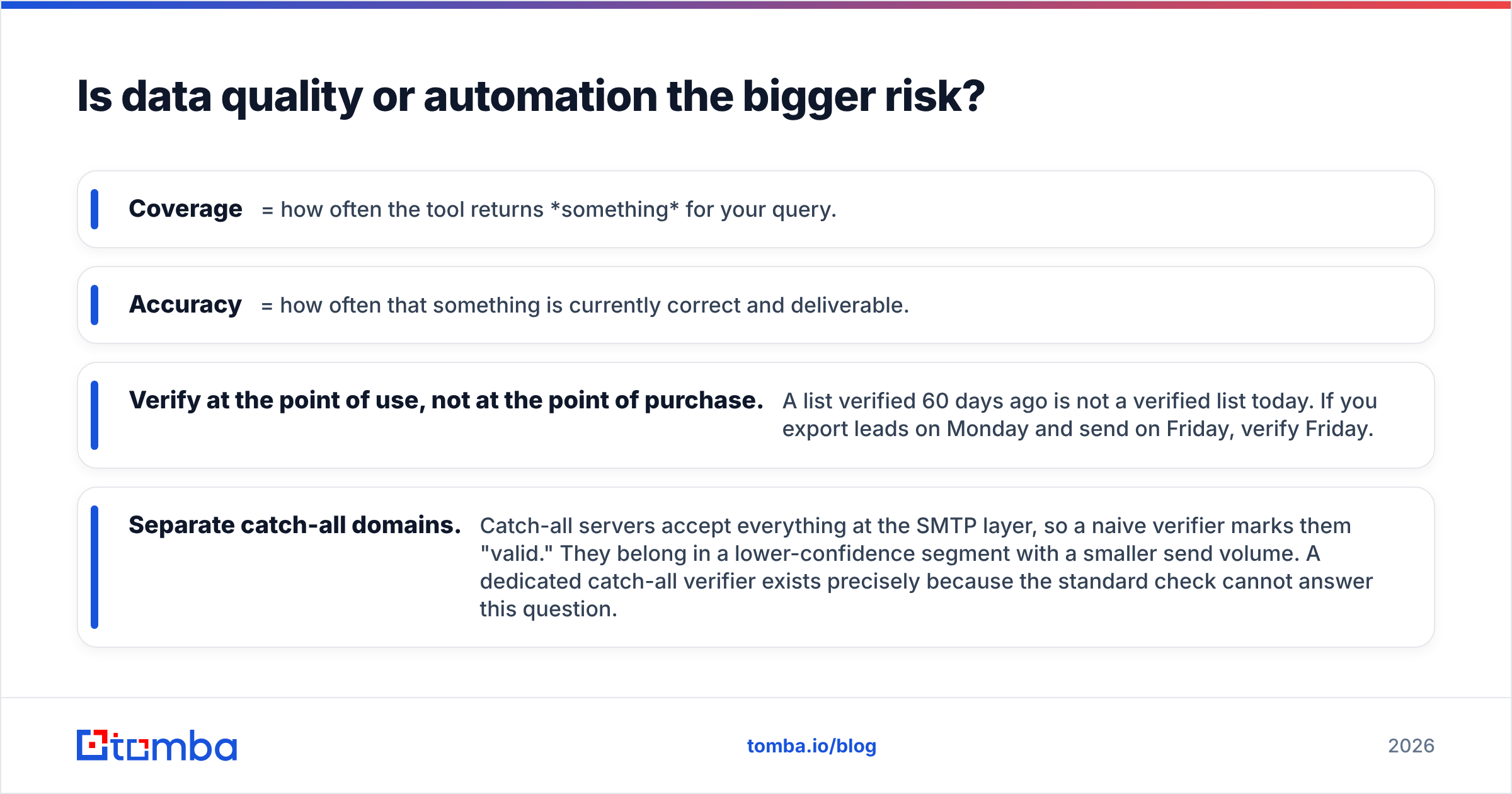
- Coverage = how often the tool returns something for your query.
- Accuracy = how often that something is currently correct and deliverable.
A provider can post a spectacular coverage number by returning pattern-guessed addresses (first.last@domain.com) for every request. Those addresses are frequently right, which is exactly why the failure mode is dangerous — you get a plausible-looking list with a 20–30% invalid rate hiding inside it.
Two habits protect you:
- Verify at the point of use, not at the point of purchase. A list verified 60 days ago is not a verified list today. If you export leads on Monday and send on Friday, verify Friday.
- Separate catch-all domains. Catch-all servers accept everything at the SMTP layer, so a naive verifier marks them "valid." They belong in a lower-confidence segment with a smaller send volume. A dedicated catch-all verifier exists precisely because the standard check cannot answer this question.
If you want the mechanics of why a mailbox provider punishes bounces so aggressively, the fundamentals of email deliverability are worth twenty minutes of your time before you spend anything on tooling.
What does each tool cost in practice?#
Ignore the sticker price and calculate cost per usable contact. The formula is simple:
Cost per usable contact = (monthly price ÷ credits included) ÷ validity rate
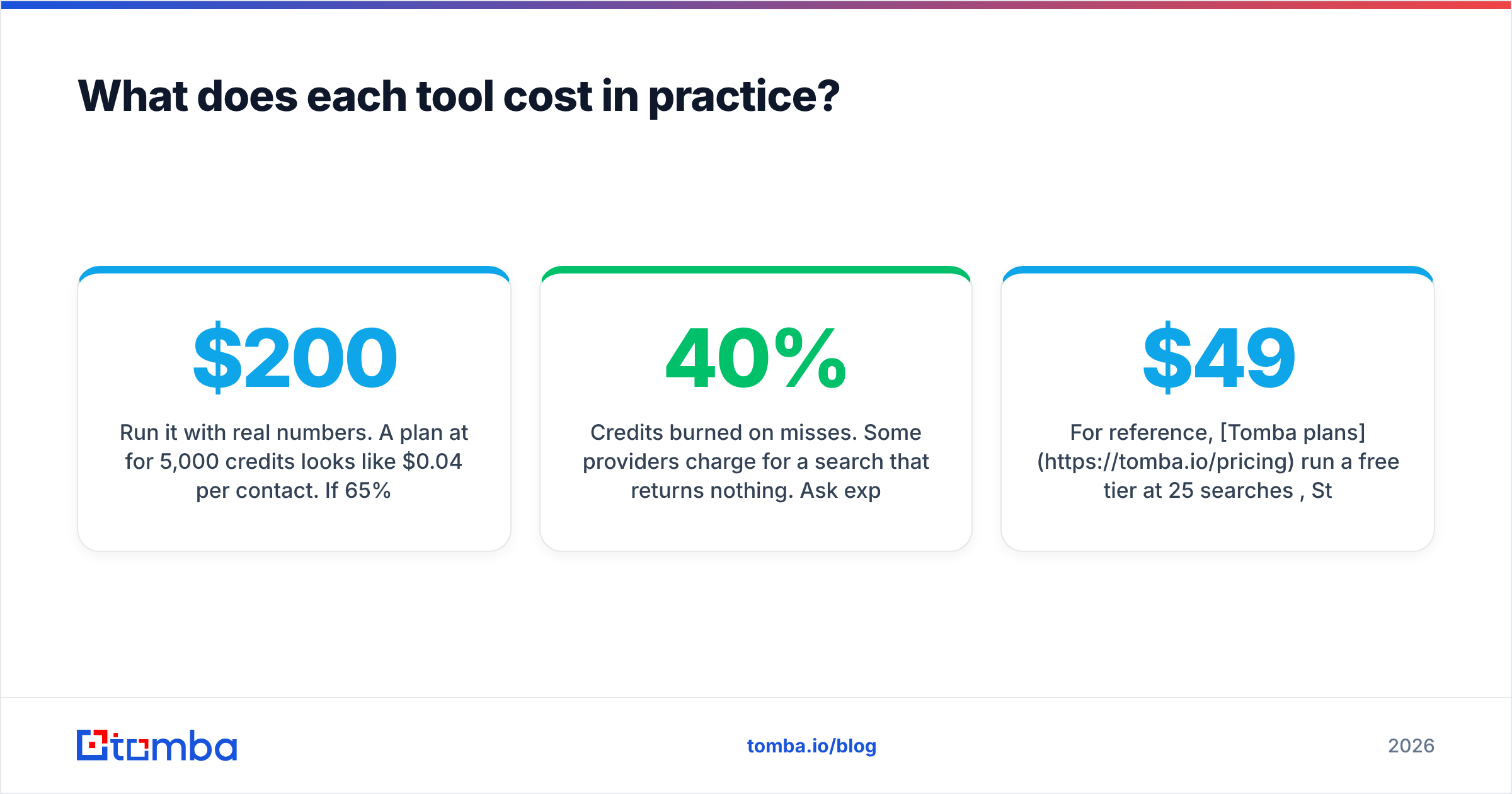
Run it with real numbers. A plan at $200 for 5,000 credits looks like $0.04 per contact. If 65% of those contacts are actually deliverable, your true cost is $0.062. A plan at $249 for 5,000 credits with a 92% validity rate costs $0.054 — cheaper, despite the higher sticker price. This is why "which is cheaper, Generect or Salesbot" is an unanswerable question in the abstract and an easy one once you run a trial on your own target list.
Three cost traps to watch for in both directions:
- Credits burned on misses. Some providers charge for a search that returns nothing. Ask explicitly. It changes effective pricing by 15–40% depending on how obscure your ICP is.
- Seat-based pricing on automation tools. AI agent products often price per seat and per action. A five-person team can quietly double its bill.
- Annual lock-in before you have validated coverage. Never sign a year on a data vendor you have not tested against your own account list. Monthly first, always.
For reference, Tomba plans run a free tier at 25 searches/month, Starter at $49/mo, Growth at $99/mo, Pro at $249/mo, and custom Enterprise — with the verifier, domain search, and API access sitting in the same account rather than sold as separate SKUs. That bundling matters more than it sounds: splitting finding and verifying across two vendors adds a reconciliation step to every list you build.

How do you build a stack that uses all three layers?#
The teams getting real results in 2026 are not picking one tool. They are assembling three layers and keeping each one honest.
Layer 1 — Discovery. Decide who to contact. This is ICP work, account lists, trigger events, and intent. Tools help, but the judgment is yours. A tightly defined list of 300 accounts beats an untargeted 30,000 every time, and it is cheaper.
Layer 2 — Contact resolution. Turn a name and a company into a reachable, verified address. This is the layer where Generect competes, and where a specialist email finder with built-in verification does the most work per dollar. If you are sourcing from LinkedIn, a LinkedIn finder closes the gap between a profile and an inbox without manual guesswork.
Layer 3 — Activation. Sequence, personalize, follow up, route replies. This is Salesbot's territory, alongside the broader sequencing category. Automate aggressively here — but only after layer 2 is clean.
The wiring between layers is where most stacks leak. If your resolution layer exposes a proper email finder API, you can verify at send-time inside the sequencer instead of maintaining a stale CSV round-trip. That single change typically cuts bounce rate more than any vendor swap.
If you are still shortlisting, cross-check user reviews on G2 for both products and filter for reviewers with your company size and region. Vendor case studies are marketing; a 200-word review from a 30-person agency in your market is data. It also helps to understand the broader lead generation category before you assume any single tool covers all of it.
What is the verdict on Generect vs Salesbot?#
Generect wins if your gap is data and you have engineering support. API-first delivery, programmatic queries, records into your own warehouse. You will need someone to own the integration, and you will still want an independent verification pass before sending.
Salesbot wins if your gap is execution. You already have a list you trust and nobody to work it. AI agents convert dormant records into touches at a cost per touch no SDR can match. Just do not point it at unverified data.
Neither wins if your gap is accuracy — which, in our experience reading how teams actually describe their problems, is the most common gap of all. "Our reply rates dropped" is almost never a sequencing problem. It is a bounce-rate problem that became a sender reputation problem three weeks earlier.
Honest caveat: both vendors iterate quickly, and feature sets in this category shift quarter to quarter. Treat this comparison as a framework for evaluating them, not as a frozen spec sheet. Run a 100-account bake-off on your own ICP. It takes an afternoon and it will tell you more than any review roundup.
Start where the leverage is. Before you commit budget to a data API or an AI agent, prove your contact layer. The Tomba Email Finder gives you 25 free searches a month — enough to test coverage on a real slice of your target accounts, with verification built into the same result rather than sold separately. Run your next 50 target contacts through it, compare the validity rate against whatever you are using now, and let the numbers pick your stack.
Related guides#
Ready to find emails that actually work?
Join 150,000+ professionals who stopped guessing and started sending. Free credits on signup — no credit card required.
Get the Tomba newsletter
Practical outbound tactics and product updates — once every two weeks.
About the author