Generect vs SalesIntel: Which B2B Data Tool Wins in 2026?
Generect sells API-first lead generation. SalesIntel sells human-verified contacts and intent. Here is how they actually differ on coverage, accuracy, pricing and contract terms — and who should pick neither.
Generect vs SalesIntel comes down to one choice: a lead data API, or a full contact platform. This guide compares both on coverage, accuracy, price and contract terms. Then it shows the cheaper path most small teams take instead.
TL;DR
- Generect is a lead data API. You send a query, it returns contact records. It is priced like a data pipe, not a seat-based app.
- SalesIntel is a US-focused B2B contact database. Humans check the records. You also get tech data and Bombora intent. You buy it as a yearly, per-seat contract after a demo.
- Pick Generect if you are an agency, a builder, or a founder who wants lead pulls by API with no 12-month lock-in.
- Pick SalesIntel if you sell to US enterprise, need direct dials plus intent, and can fund five figures a year across an SDR team.
- Pick neither if your real job is finding work emails for people you already named. That is a $49/mo problem, not a $12,000/year one.
Generect vs SalesIntel: what is each tool?#
Both sell B2B data. But they solve different halves of the job.
Generect is a lead generation API. You describe an audience: job title, company size, region, industry, tech stack. It returns lead records with work emails. It builds records on request instead of serving one big static index. It suits people who call an endpoint from a script, a workflow tool, or their own product.
SalesIntel is the older, heavier play. It is a database first. Tens of millions of US contact records sit behind it. A research team re-checks the data on a rolling cycle. You also get direct dials, firm data, tech data, and intent topics from Bombora. It plugs into Salesforce, HubSpot and Outreach. Revenue teams buy it as core plumbing.
Here is the easy way to hold Generect vs SalesIntel in your head. Generect is a faucet. SalesIntel is a reservoir. A faucet gives you water when you turn it on, and you pay for what runs through. A reservoir is a big standing asset you rent. You pay for it whether or not you drink.
Generect vs SalesIntel: head-to-head comparison#
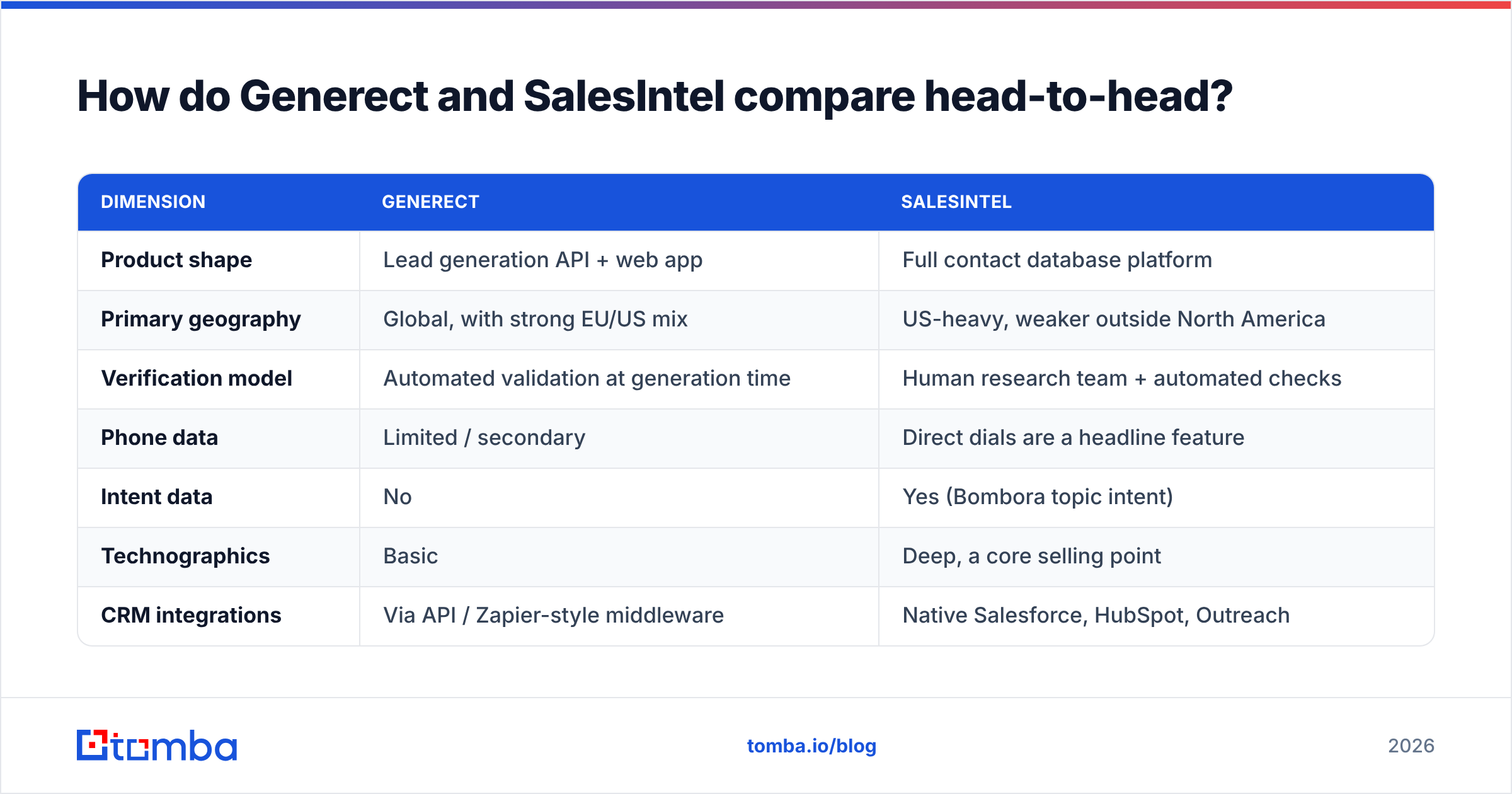
Here is the comparison most buyers need. Both vendors quote custom prices at the top end. So treat any published figure as a rough guide, and confirm it on your own call.
| Dimension | Generect | SalesIntel |
|---|---|---|
| Product shape | Lead generation API + web app | Full contact database platform |
| Primary geography | Global, with strong EU/US mix | US-heavy, weaker outside North America |
| Verification model | Automated validation at generation time | Human research team + automated checks |
| Phone data | Limited / secondary | Direct dials are a headline feature |
| Intent data | No | Yes (Bombora topic intent) |
| Technographics | Basic | Deep, a core selling point |
| CRM integrations | Via API / Zapier-style middleware | Native Salesforce, HubSpot, Outreach |
| Buying motion | Self-serve plans, short commitment | Sales-led, annual contract typical |
| Best for | Agencies, builders, automated pipelines | Mid-market and enterprise SDR teams |
| Typical entry cost | Low hundreds per month | Low five figures per year |
The table hides one big gap. You can try Generect on a Tuesday afternoon. You cannot try SalesIntel without booking a demo. For a solo founder testing an outbound idea, that gap matters more than any feature row.
Generect vs SalesIntel: how accurate is the data?#
Accuracy is where vendor marketing gets slippery. So define your terms first.
Vendors use one word for three different things:
- Valid format — the string looks like an email. That is easy, and near 100% for everyone.
- Deliverable — the mailbox exists and takes mail today. This protects your sender score.
- Right person — the mailbox really belongs to that person, in that role. This protects your reply rate.
SalesIntel aims at #3. Researchers confirm a title and company on a set cycle. That fixes the worst failure in B2B data: a live email tied to someone who left eight months ago. It is real value. It is also why SalesIntel scores well in G2's B2B data category reviews.
Generect aims at #2 and at freshness. Records are built at query time, not pulled from a cached index. So you are less exposed to index rot, the slow decay of a snapshot taken 14 months ago. The trade-off is thinner data per record.

Whatever you buy, verify before your first send. Every provider ships some records that bounce. Generect and SalesIntel are no exception. A hard bounce rate above roughly 3% starts to hurt email deliverability. That damage takes weeks to undo. Running your export through an email verifier costs pennies per record. It is the cheapest insurance in outbound.
Generect vs SalesIntel: what does each one cost?#
This is where the two products stop looking like rivals.
Generect publishes self-serve tiers and sells credits or lead volume. You can start small, spend a few hundred dollars, and stop. There is no purchase cycle to sit through.
SalesIntel does not publish prices. Buyers report yearly contracts priced per seat, with a shared credit pool. For a small SDR team with intent added, that lands in the low-to-mid five figures. Intent is usually an add-on, not part of the base plan. Ask three questions on the call:
- Are credits per seat or pooled? Pooled is far better when usage is uneven.
- Do unused credits roll over? Usually no. Assume no.
- Is intent included or extra? It is almost always extra.
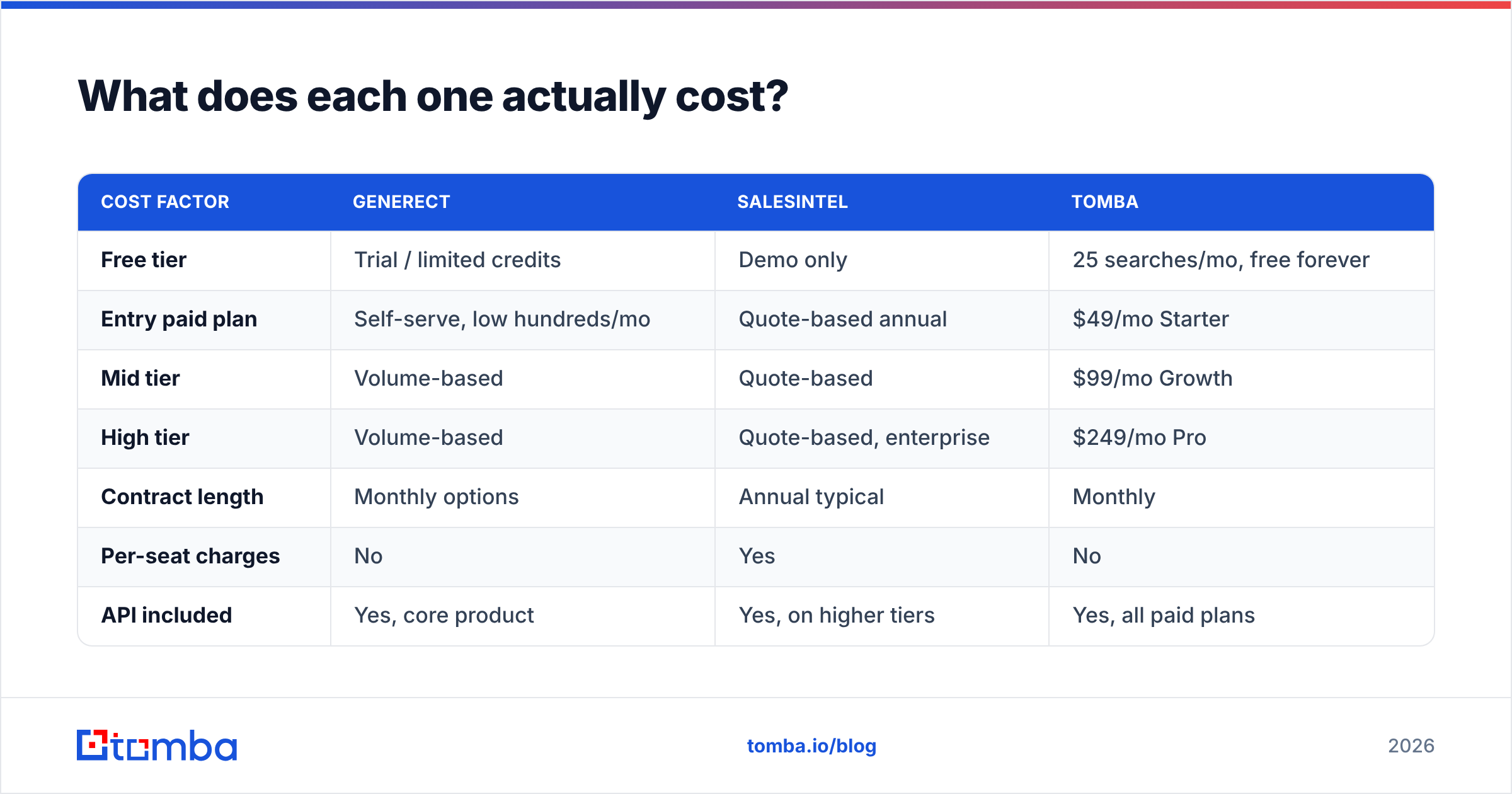
| Cost factor | Generect | SalesIntel | Tomba |
|---|---|---|---|
| Free tier | Trial / limited credits | Demo only | 25 searches/mo, free forever |
| Entry paid plan | Self-serve, low hundreds/mo | Quote-based annual | $49/mo Starter |
| Mid tier | Volume-based | Quote-based | $99/mo Growth |
| High tier | Volume-based | Quote-based, enterprise | $249/mo Pro |
| Contract length | Monthly options | Annual typical | Monthly |
| Per-seat charges | No | Yes | No |
| API included | Yes, core product | Yes, on higher tiers | Yes, all paid plans |

To be fair: SalesIntel is not overpriced for what it is. A human research team costs real money. If intent-led outbound to US mid-market accounts is your whole go-to-market, the math can work.
It is overpriced for what most buyers actually do with it, which is look up email addresses.
Generect vs SalesIntel: which fits your GTM motion?#
Match the tool to the motion, not to the feature list.
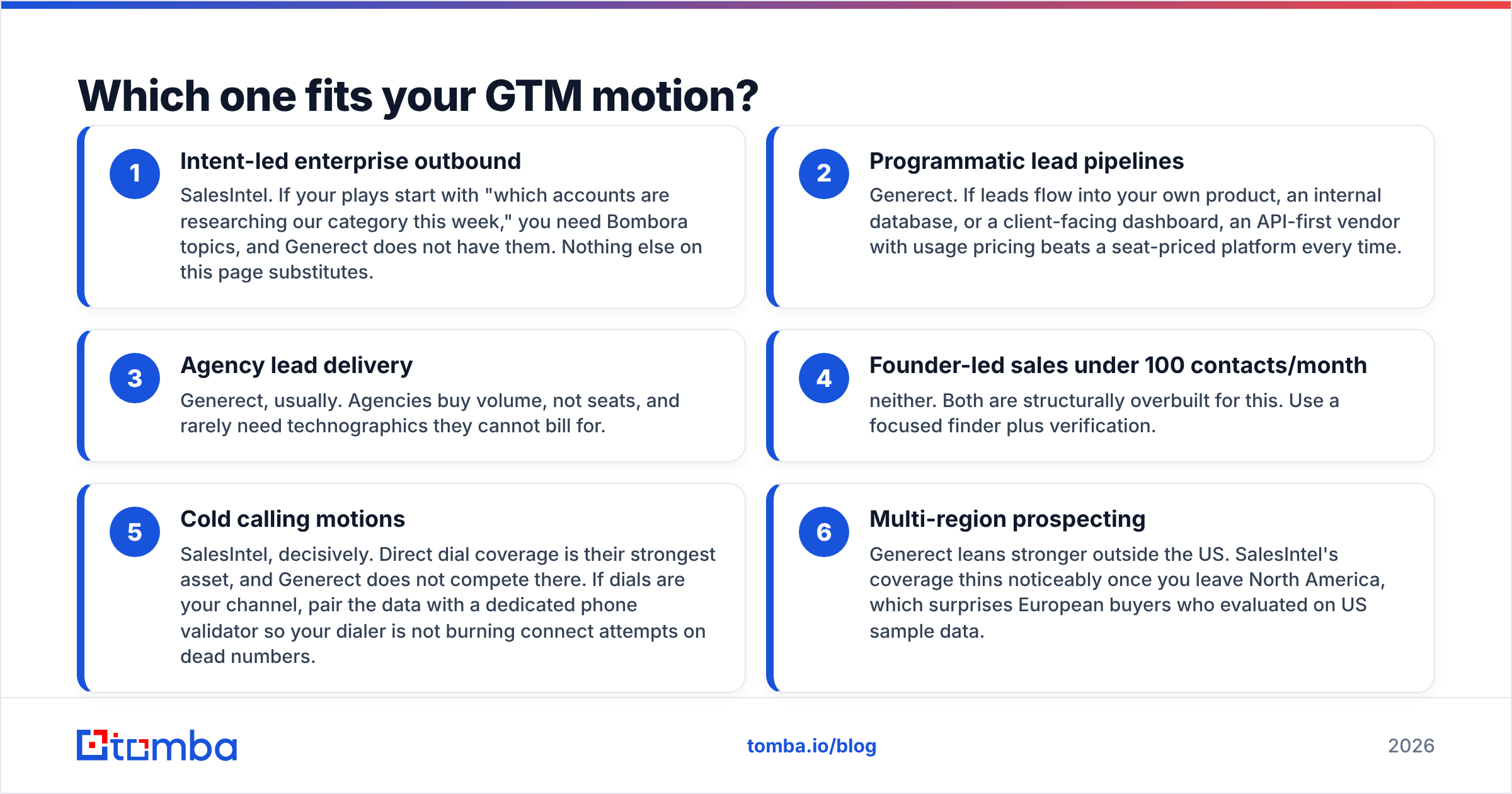
- Intent-led enterprise outbound — SalesIntel. Your plays start with "which accounts are researching our category this week." You need Bombora topics. Generect does not have them.
- Programmatic lead pipelines — Generect. Leads flow into your own product, your database, or a client dashboard. An API with usage pricing beats a seat-priced platform here, every time.
- Agency lead delivery — Generect, usually. Agencies buy volume, not seats. They rarely need tech data they cannot bill for.
- Founder-led sales under 100 contacts a month — neither. Both are far too big for this job. Use a focused finder plus a verifier.
- Cold calling — SalesIntel, clearly. Direct dials are their best asset. Generect does not compete there. Pair the data with a phone validator so your dialer stops burning calls on dead numbers.
- Multi-region prospecting — Generect. It is stronger outside the US. SalesIntel thins out fast once you leave North America. European buyers who tested on US samples are often caught out.

Generect vs SalesIntel: where does each fall short?#
Generect's weak spots:
- Data depth is thinner. You get contact records, not a full account view.
- No intent data. So you cannot rank accounts by in-market signal.
- Native CRM links are light. Expect to build glue with middleware.
- It is a smaller vendor. There are fewer third-party reviews to check claims against.
SalesIntel's weak spots:
- Yearly lock-in. If your outbound test fails in month three, you still pay for months four to twelve.
- Per-seat pricing hurts teams where only two of six reps prospect hard.
- Coverage outside the US drops off sharply.
- Credits expire. Unused credits usually vanish at period end. That quietly raises your true cost per usable record.
- Sales-led buying hides the data. You cannot test quality on your own ICP until you are deep in a demo cycle. Always ask for a sample export against your target accounts, not their demo list.
Neither vendor is bad. Both are simply priced and packaged for buyers who already treat contact data as a strategic line item.
Is there a cheaper Generect vs SalesIntel alternative?#
Yes. And it is worth being blunt. Most teams weighing Generect vs SalesIntel are solving a narrower problem than either product was built for.
The narrow problem sounds like this. You have a list of target companies. You know the roles you want. You need correct, deliverable work emails for those people. And you need it to keep working as a repeatable process.
That is an email-finding problem. An email finder plus a verifier solves it for a fraction of a platform contract. Tomba's Starter plan is $49/mo, Growth is $99/mo, and Pro is $249/mo. A free tier gives you 25 searches a month, so you can test accuracy on your own ICP before you pay. There are no per-seat charges and no yearly lock-in.
Here is the workflow that replaces most of what buyers use these platforms for:
- Start from the account list. Run domain search to pull every contact you can find at a target company, plus that company's email pattern.
- Fill named gaps. When you know the person but not the address, the finder turns first name, last name and domain into a verified address.
- Verify before send. Catch-all domains quietly wreck bounce rates. A catch-all verifier tells you which risky domains are safe to mail.
- Automate it. The Tomba API covers the same use case that draws people to Generect. Native connectors push results into HubSpot, Pipedrive, Sheets or Airtable with no middleware.
What you give up is real, and worth naming. There is no Bombora intent. There are no deep tech filters. No research team confirms job titles by hand.
If those things carry your motion, buy SalesIntel and stop reading comparison posts. If they do not — and for most teams under 20 reps they do not — you are paying five figures for features that sit unused, next to the one you open every day.
Which should you choose?#
Choose SalesIntel when US enterprise accounts, direct dials and intent-led plays drive your revenue, and you have the headcount to absorb a yearly contract. Ask for a sample against your real ICP. Confirm whether credits pool across seats before you sign.
Choose Generect when you want lead data as an API, not as a platform. That covers agency delivery, internal tools, product features and automated pipelines. You would rather pay for volume than for seats.
Choose a focused finder when the real job is turning known companies and known roles into verified, deliverable emails, with no purchase cycle. That describes far more teams than the Generect vs SalesIntel category pages suggest.
One last note, whichever way you go. No data provider frees you from list hygiene. Verify every record before it enters a sequence. Watch bounce rates weekly. Treat sender reputation as the asset it is. The priciest database on the market cannot fix a burned sending domain.
Ready to test the cheap path first? Start with the Tomba Email Finder. You get 25 free searches a month, with no card and no demo call. Run it against 25 contacts from your real target list. Check the results against what you already know is true. Let the accuracy decide whether you need a five-figure platform. If you do, you will negotiate from data instead of from a sales deck.
Related guides#
Ready to find emails that actually work?
Join 150,000+ professionals who stopped guessing and started sending. Free credits on signup — no credit card required.
Get the Tomba newsletter
Practical outbound tactics and product updates — once every two weeks.
About the author