Generect vs Seamless.AI: Which B2B Data Tool Wins in 2026?
One is a LinkedIn-native data API built for engineers. The other is an AI-powered contact database sold by the seat. Here is how Generect and Seamless.AI actually compare on data quality, pricing model, and workflow fit in 2026.
TL;DR
- Generect is a LinkedIn-native lead data provider built around real-time search and an API. It suits teams that want fresh, query-driven lists and are comfortable working programmatically.
- Seamless.AI is a large AI-assisted contact database sold primarily per seat, with a search-and-build-list interface aimed at SDR teams who live inside a UI, not a terminal.
- The real difference is not database size — it is the delivery model. Generect is closer to an API/data feed; Seamless.AI is closer to a sales workstation with credits attached.
- Neither publishes fully transparent pricing. Seamless.AI routes most buyers through a sales call; Generect quotes by volume. Budget for a demo cycle before you can compare like for like.
- Verify before you send, regardless of vendor. Both providers return a meaningful share of stale or guessed addresses, so an independent email verifier step is the difference between a 2% and a 12% bounce rate.
What Are Generect and Seamless.AI, Exactly?#
They solve the same problem from opposite ends of the stack.
Generect positions itself as a B2B lead data platform whose core asset is live search against professional-network profiles — companies, people, and job changes — exposed through both a web app and an API. The pitch is freshness: rather than serving you a row that was scraped 14 months ago and never touched again, Generect resolves the query closer to request time. That matters most for fast-moving segments (startups, agencies, anything where 30% of your ICP changes jobs annually).
Seamless.AI is a contact and company database with an AI layer that assembles and "researches" contact records in real time as you search. Its user is the SDR or AE building a list before a sequence: you filter by title, industry, headcount, and technology, then push contacts into your CRM or sequencer. Seamless.AI has significant market presence and a large G2 review footprint, which cuts both ways — plenty of "it found contacts nobody else had" reviews sit next to plenty of "the emails bounced and the contract auto-renewed" reviews.
Here is the practical way to frame the choice, in the order that actually decides it:
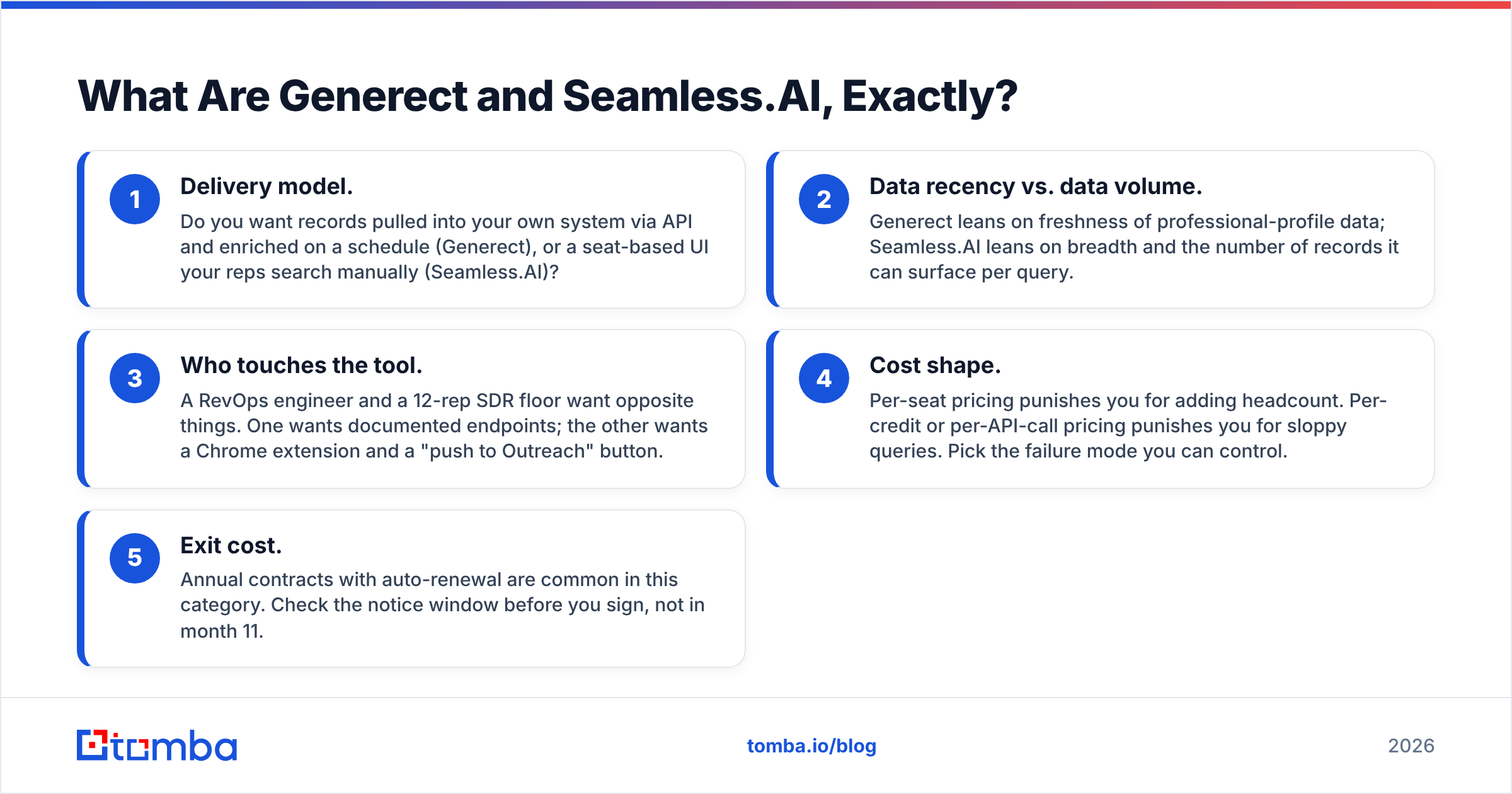
- Delivery model. Do you want records pulled into your own system via API and enriched on a schedule (Generect), or a seat-based UI your reps search manually (Seamless.AI)?
- Data recency vs. data volume. Generect leans on freshness of professional-profile data; Seamless.AI leans on breadth and the number of records it can surface per query.
- Who touches the tool. A RevOps engineer and a 12-rep SDR floor want opposite things. One wants documented endpoints; the other wants a Chrome extension and a "push to Outreach" button.
- Cost shape. Per-seat pricing punishes you for adding headcount. Per-credit or per-API-call pricing punishes you for sloppy queries. Pick the failure mode you can control.
- Exit cost. Annual contracts with auto-renewal are common in this category. Check the notice window before you sign, not in month 11.

How Do Generect and Seamless.AI Compare Head-to-Head?#
The table below reflects publicly available information at the time of writing. Both vendors adjust packaging frequently, and Seamless.AI in particular gates most pricing behind a sales conversation — treat the pricing row as "what you will be quoted around," not a published rate card.

| Attribute | Generect | Seamless.AI | Tomba |
|---|---|---|---|
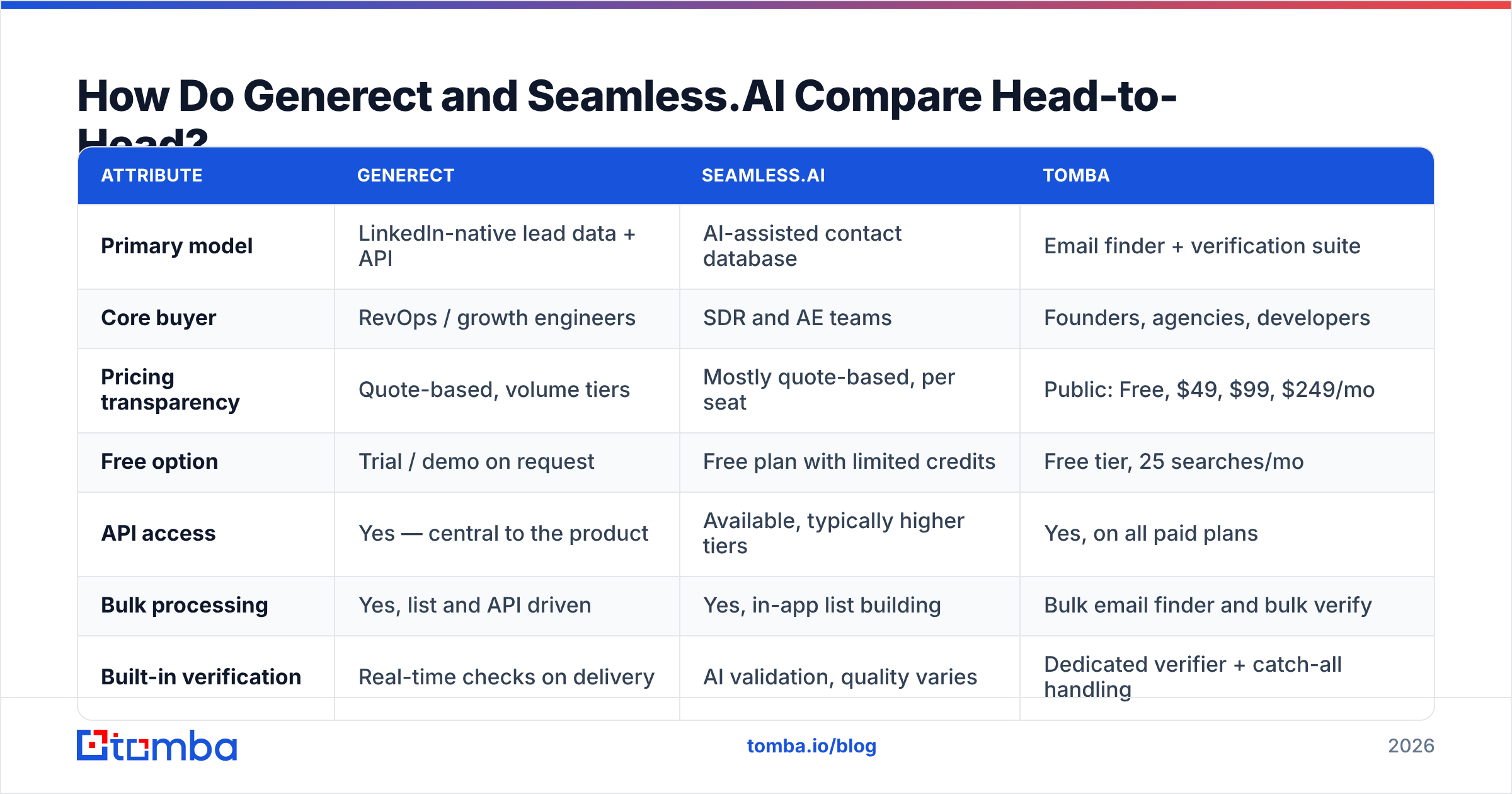
| Primary model | LinkedIn-native lead data + API | AI-assisted contact database | Email finder + verification suite |
| Core buyer | RevOps / growth engineers | SDR and AE teams | Founders, agencies, developers |
| Pricing transparency | Quote-based, volume tiers | Mostly quote-based, per seat | Public: Free, $49, $99, $249/mo |
| Free option | Trial / demo on request | Free plan with limited credits | Free tier, 25 searches/mo |
| API access | Yes — central to the product | Available, typically higher tiers | Yes, on all paid plans |
| Bulk processing | Yes, list and API driven | Yes, in-app list building | Bulk email finder and bulk verify |
| Built-in verification | Real-time checks on delivery | AI validation, quality varies | Dedicated verifier + catch-all handling |
| Phone numbers | Yes, by plan | Yes, mobile numbers advertised | Yes, phone finder + validator |
| CRM integrations | Via API / partner tooling | Salesforce, HubSpot, Outreach, Salesloft | HubSpot, Salesforce, Pipedrive, Zapier, Make |
| Contract shape | Volume commitment common | Annual, per-seat, auto-renew common | Monthly, self-serve, cancel anytime |
The pattern is clear. Generect and Seamless.AI are both data platforms with a commercial motion that assumes a committed annual spend. Tomba sits in a different band: a self-serve email finder with published pricing, which makes it the natural control variable when you are testing the other two.
Which One Has Better Data Accuracy?#
Neither vendor's marketing number should decide this for you. Every provider in this category quotes accuracy figures between 95% and 99%, and every one of those figures is measured on a sample the vendor chose.

What actually differs is how each tool fails.
Generect's approach — resolving against live professional-profile data — tends to fail by returning nothing. If the person's profile does not expose enough signal, you get a miss rather than a guess. Lower coverage, cleaner output. For outbound at scale that is usually the better failure mode, because a null costs you nothing and a bad send costs you sender reputation.
Seamless.AI's approach — AI-assembled records with pattern inference — tends to fail by returning something. This is the recurring theme in critical reviews: the tool produces an address that looks structurally correct (first.last@company.com) for a person who left the company in 2024, or for a domain that uses a completely different pattern. Coverage looks excellent on the dashboard. Bounce rate tells a different story two weeks later.
Run this test before you commit to either:
- Pull 200 contacts you already know are valid — customers, closed-won accounts, people who replied to you last quarter.
- Strip the emails, keep name + domain.
- Run the list through each vendor's trial.
- Score three things separately: hit rate (did it return anything), exact-match rate (did it return the right address), and bounce rate on the remainder after an independent verification pass.
Most teams discover that the vendor with the highest hit rate is not the vendor with the highest exact-match rate. That gap is where your budget leaks. If your target domains are heavy on catch-all configurations, add a catch-all verifier step to the test — catch-all domains accept everything at the SMTP layer and will flatter any provider's numbers.

How Does Pricing Actually Work for Each?#
This is where the two diverge most, and where buyers get surprised.
Seamless.AI prices per seat. Each rep who needs access is a line item, and credits are typically allocated per user. The consequence: if you hire three SDRs in Q2, your data cost rises whether or not your contact volume does. The free plan exists and is genuinely useful for evaluation, but its credit allowance runs out fast during a real test. Reviews consistently flag two friction points — the auto-renewal clause and the difficulty of downgrading mid-term. Read the order form.
Generect prices by volume. You commit to a data tier and consume against it, which fits a centralized model: one RevOps team pulls data via API, enriches the CRM, and distributes records to reps who never log into the vendor at all. Cost scales with contacts, not headcount. The tradeoff is that you need someone who can build against an API, or you are paying platform pricing for a UI that is not the product's strength.
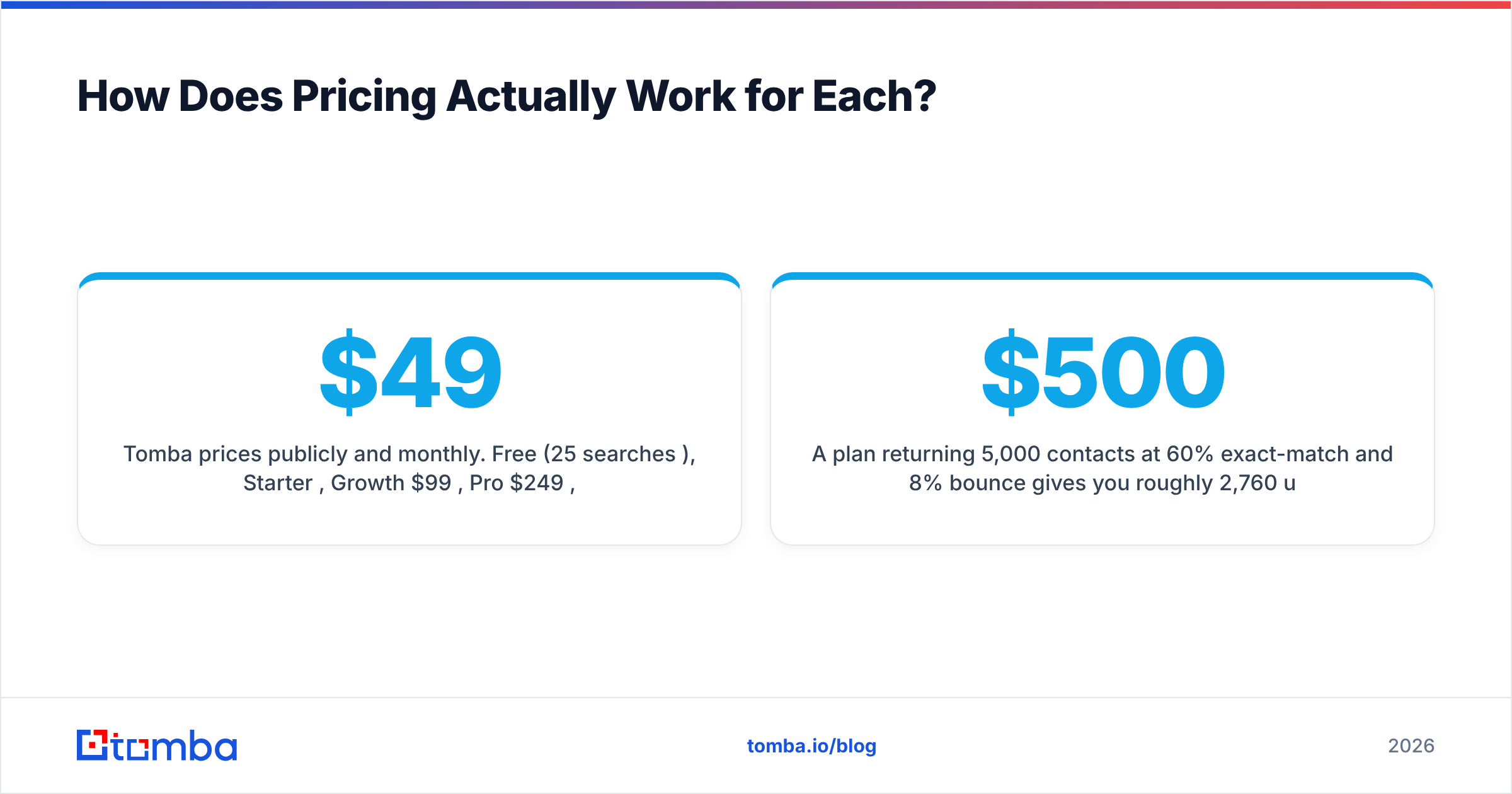
Tomba prices publicly and monthly. Free (25 searches/mo), Starter $49/mo, Growth $99/mo, Pro $249/mo, Enterprise custom — full Tomba pricing is on the site with no demo gate. That transparency is the point: you can run a 30-day bake-off against a quote-based vendor without a procurement cycle.
A useful budgeting frame is cost per usable contact, not cost per credit:
cost per usable contact = monthly spend ÷ (contacts returned × exact-match rate × (1 − bounce rate))A $500/mo plan returning 5,000 contacts at 60% exact-match and 8% bounce gives you roughly 2,760 usable records — about $0.18 each. A $250/mo plan returning 2,000 contacts at 85% exact-match and 2% bounce gives you 1,666 usable records at $0.15 each. The cheaper-looking plan was the more expensive one. Run this math with your own trial numbers before the renewal conversation.
Who Should Pick Generect?#
Choose Generect when:
- You have engineering capacity. The API is the product. If your enrichment runs as a scheduled job against your data warehouse, Generect fits the architecture natively.
- Your ICP moves fast. Job-change and headcount signals decay quickly; a live-resolution model beats a static database dump for early-stage tech, agencies, and consultancies.
- You want centralized data governance. One pipeline, one dedupe policy, one source of truth in the CRM — instead of 12 reps each exporting overlapping CSVs.
- Per-seat pricing is a problem. Growing teams get punished by seat licenses. Volume pricing is more predictable when headcount is the variable.
Skip it when your reps need a point-and-click list builder with a Chrome extension and zero technical setup. That is not the sweet spot.
Who Should Pick Seamless.AI?#
Choose Seamless.AI when:
- Your reps build their own lists. The in-app search, filters, and browser extension are designed for self-serve prospecting during a rep's own workflow.
- You need phone numbers alongside email. Mobile coverage is a genuine strength of the category leaders here, and it matters if your motion is call-first. (Pair it with a phone validator so you are not burning dials on disconnected lines.)
- Native sequencer integrations matter more than API depth. Push-to-Outreach and push-to-Salesloft flows are mature.
- You have procurement patience. You will go through a demo, a quote, and likely an annual commitment. If that is normal for your org, fine. If you need data live by Thursday, it is not.
Skip it if you are a two-person team testing outbound for the first time. The commercial motion is not built for you, and the per-seat math does not work at small scale.
What Are the Alternatives Worth Testing Alongside Them?#
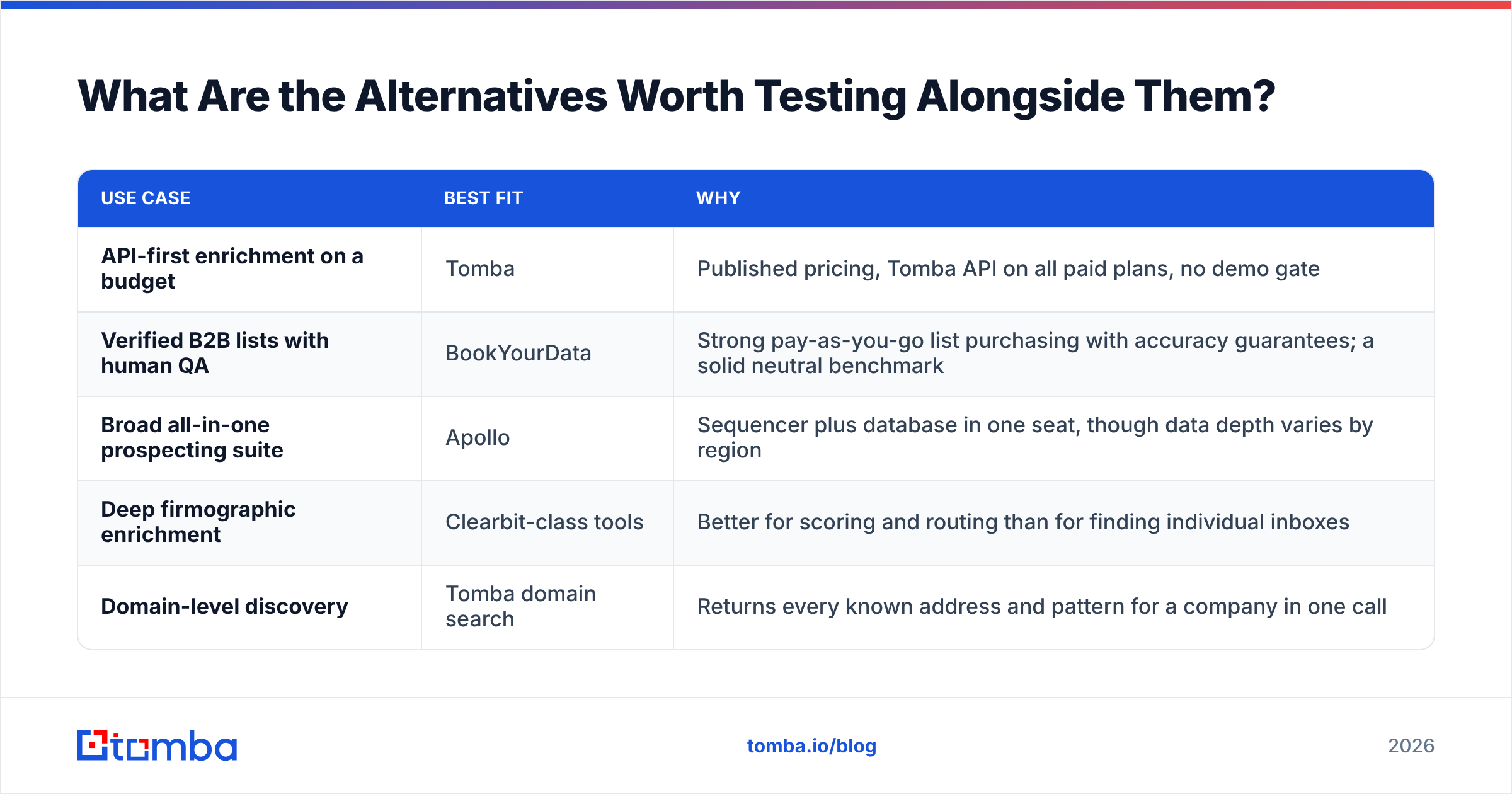
Do not run a two-way bake-off. Run a three-way, because a third data point tells you whether a given result is good or just less bad.
| Use case | Best fit | Why |
|---|---|---|
| API-first enrichment on a budget | Tomba | Published pricing, Tomba API on all paid plans, no demo gate |
| Verified B2B lists with human QA | BookYourData | Strong pay-as-you-go list purchasing with accuracy guarantees; a solid neutral benchmark |
| Broad all-in-one prospecting suite | Apollo | Sequencer plus database in one seat, though data depth varies by region |
| Deep firmographic enrichment | Clearbit-class tools | Better for scoring and routing than for finding individual inboxes |
| Domain-level discovery | Tomba domain search | Returns every known address and pattern for a company in one call |
The cheapest way to keep any of these vendors honest is a standing verification layer that is not owned by the data vendor. When your verifier and your finder are the same company, "verified" means whatever that company wants it to mean. An independent check on a 500-record sample each month is a 10-minute job that has saved plenty of teams from a domain-reputation incident.
What Is the Verdict for 2026?#
Generect wins on architecture; Seamless.AI wins on rep-level usability. If your data flows through a pipeline and your buyers are engineers, Generect's API-native model is the better structural fit and the volume pricing scales more sanely. If your data flows through 10 reps clicking through search filters and pushing to a sequencer, Seamless.AI's interface and integrations will get adopted faster — provided you go in clear-eyed about the annual seat commitment and the need for an external verification step.
For most teams under 20 reps, the honest answer is that both are heavier than the job requires. You need accurate addresses, a way to verify them, and a way to get them into your CRM — not a seven-figure data warehouse relationship.
That is the gap Tomba was built for. The Tomba Email Finder resolves professional addresses by name and domain with confidence scoring and source attribution, includes verification in the same workflow, and starts free at 25 searches a month with Starter at $49/mo — no demo call, no annual commitment, no auto-renewal clause to diary. Run it as the control in your Generect vs. Seamless.AI test. If it wins, you have saved a procurement cycle. If it loses, you have a real benchmark to negotiate against.
Related guides#
Ready to find emails that actually work?
Join 150,000+ professionals who stopped guessing and started sending. Free credits on signup — no credit card required.
Get the Tomba newsletter
Practical outbound tactics and product updates — once every two weeks.
About the author