Generect vs Tami AI (2026): Which B2B Data Tool Wins?
Generect sells API-first B2B contact data. Tami AI sells an AI prospecting agent. They solve different halves of the same problem — here's which one belongs in your outbound stack, and when neither is the answer.
TL;DR
- Generect is an API-first B2B data provider. You send a query, it returns structured lead and company records. It is built for engineers and RevOps teams who want data piped into their own systems.
- Tami AI is an AI prospecting layer. It leans on agents to interpret your ICP, research accounts, and hand back a shortlist with context — less "give me 5,000 rows", more "find me the right 50".
- They are not really competitors. Generect is infrastructure; Tami AI is an application sitting on top of infrastructure. Picking between them is a question about your team, not about which one is "better".
- Neither publishes fully transparent self-serve pricing at the time of writing. Both route serious volume through sales. Budget accordingly and ask for accuracy guarantees in writing.
- If your actual bottleneck is "I have a name and a company and I need a valid work email", a dedicated email finder at $49/mo solves that for a fraction of either platform's cost.
What are Generect and Tami AI?#
Two tools that both promise "better leads" but attack the problem from opposite ends of the stack.
Generect positions itself as a B2B data source you consume programmatically. Its selling point is live lookups against professional profiles and company records rather than a stale warehouse dump. You query by role, seniority, industry, headcount, geography, or technology, and you get back structured JSON: names, titles, company data, and contact points. There is a UI, but the product's center of gravity is the API.
Tami AI positions itself as an AI-driven prospecting assistant. Instead of asking you to build a filter query, it asks you to describe who you sell to and why, then uses AI agents to interpret intent signals, research accounts, and assemble a target list with reasoning attached. The pitch is fewer, better-qualified prospects with the "why now" already written for you.
Here is the practical split:
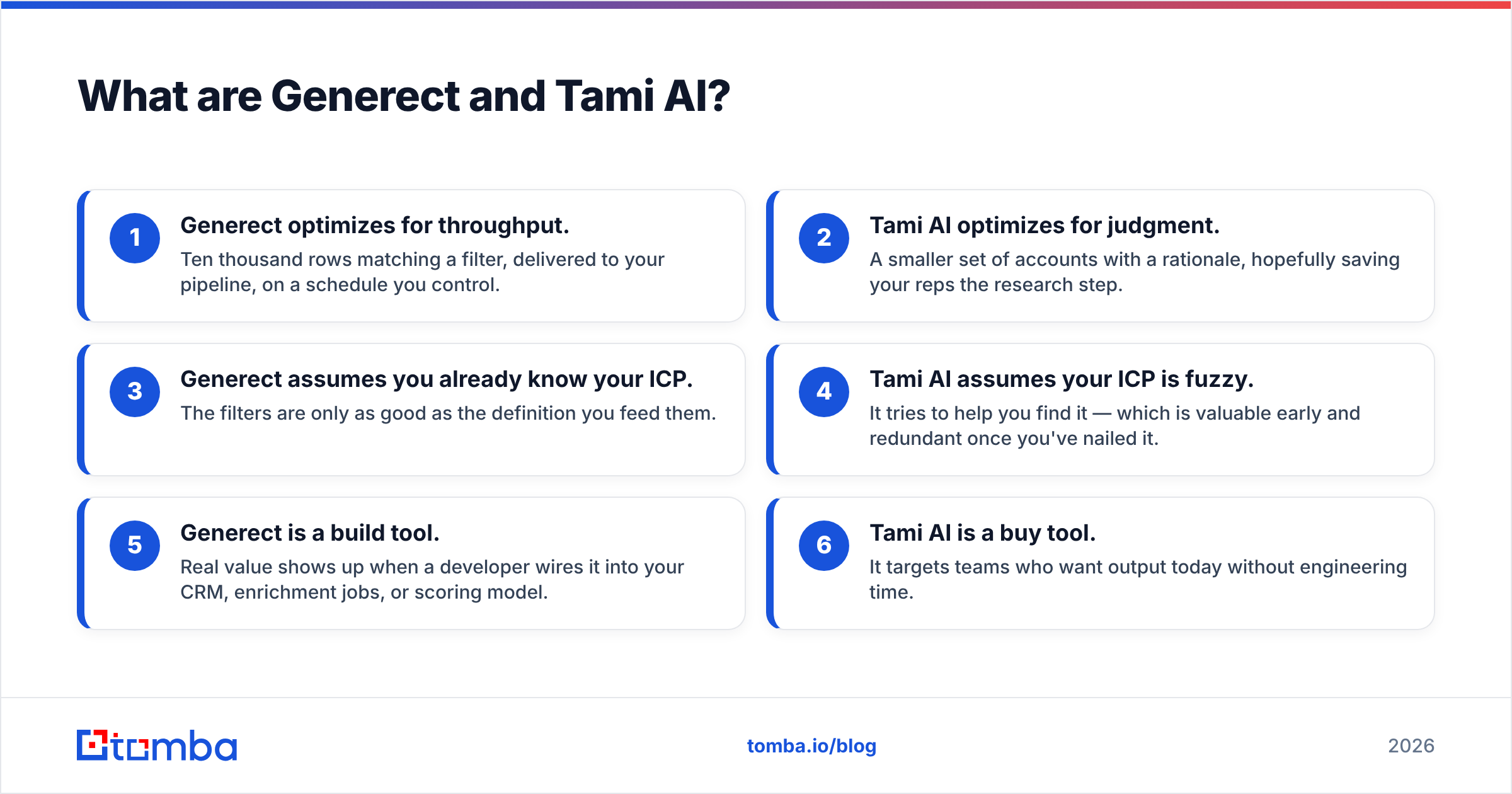
- Generect optimizes for throughput. Ten thousand rows matching a filter, delivered to your pipeline, on a schedule you control.
- Tami AI optimizes for judgment. A smaller set of accounts with a rationale, hopefully saving your reps the research step.
- Generect assumes you already know your ICP. The filters are only as good as the definition you feed them.
- Tami AI assumes your ICP is fuzzy. It tries to help you find it — which is valuable early and redundant once you've nailed it.
- Generect is a build tool. Real value shows up when a developer wires it into your CRM, enrichment jobs, or scoring model.
- Tami AI is a buy tool. It targets teams who want output today without engineering time.

How do Generect and Tami AI compare head-to-head?#
This is where the "which one wins" question gets uncomfortable, because the honest answer depends on which column of the table matches your constraint. Verify current plan details directly with each vendor — data vendors change packaging often, and both route larger deals through sales.
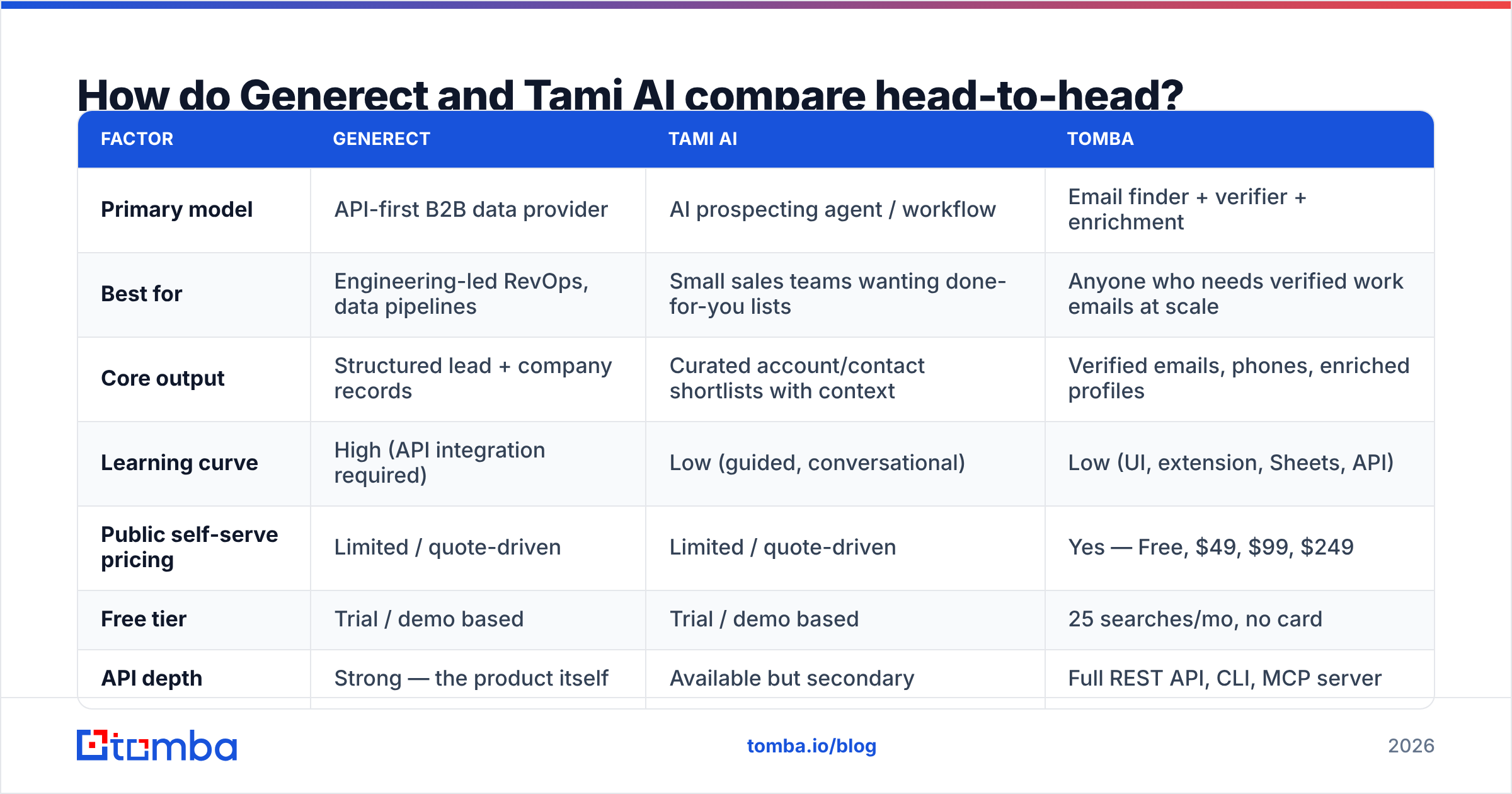
| Factor | Generect | Tami AI | Tomba |
|---|---|---|---|
| Primary model | API-first B2B data provider | AI prospecting agent / workflow | Email finder + verifier + enrichment |
| Best for | Engineering-led RevOps, data pipelines | Small sales teams wanting done-for-you lists | Anyone who needs verified work emails at scale |
| Core output | Structured lead + company records | Curated account/contact shortlists with context | Verified emails, phones, enriched profiles |
| Learning curve | High (API integration required) | Low (guided, conversational) | Low (UI, extension, Sheets, API) |
| Public self-serve pricing | Limited / quote-driven | Limited / quote-driven | Yes — Free, $49, $99, $249 |
| Free tier | Trial / demo based | Trial / demo based | 25 searches/mo, no card |
| API depth | Strong — the product itself | Available but secondary | Full REST API, CLI, MCP server |
| Bulk processing | Yes, via API | Agent-paced, list-oriented | Yes — bulk email finder + CSV |
| Verification built in | Contact data provided, verify separately | Depends on underlying sources | Native email verifier, catch-all handling |
| Who signs the check | CTO / Head of RevOps | VP Sales / founder | SDR lead, growth marketer, developer |

The row that matters most is "who signs the check." Generect wins evaluations run by technical teams because the API is the product and it does what an API should do. Tami AI wins evaluations run by sales leaders because it produces something a rep can act on within an hour of onboarding. Neither team is wrong; they are scoring different exams.
Suggested visual: side-by-side screenshot of the Generect API response payload next to the Tami AI list-building interface.
Which one has better data accuracy?#
Neither vendor should be trusted on this without your own test — and that is not a knock on either of them, it is how the entire category works.
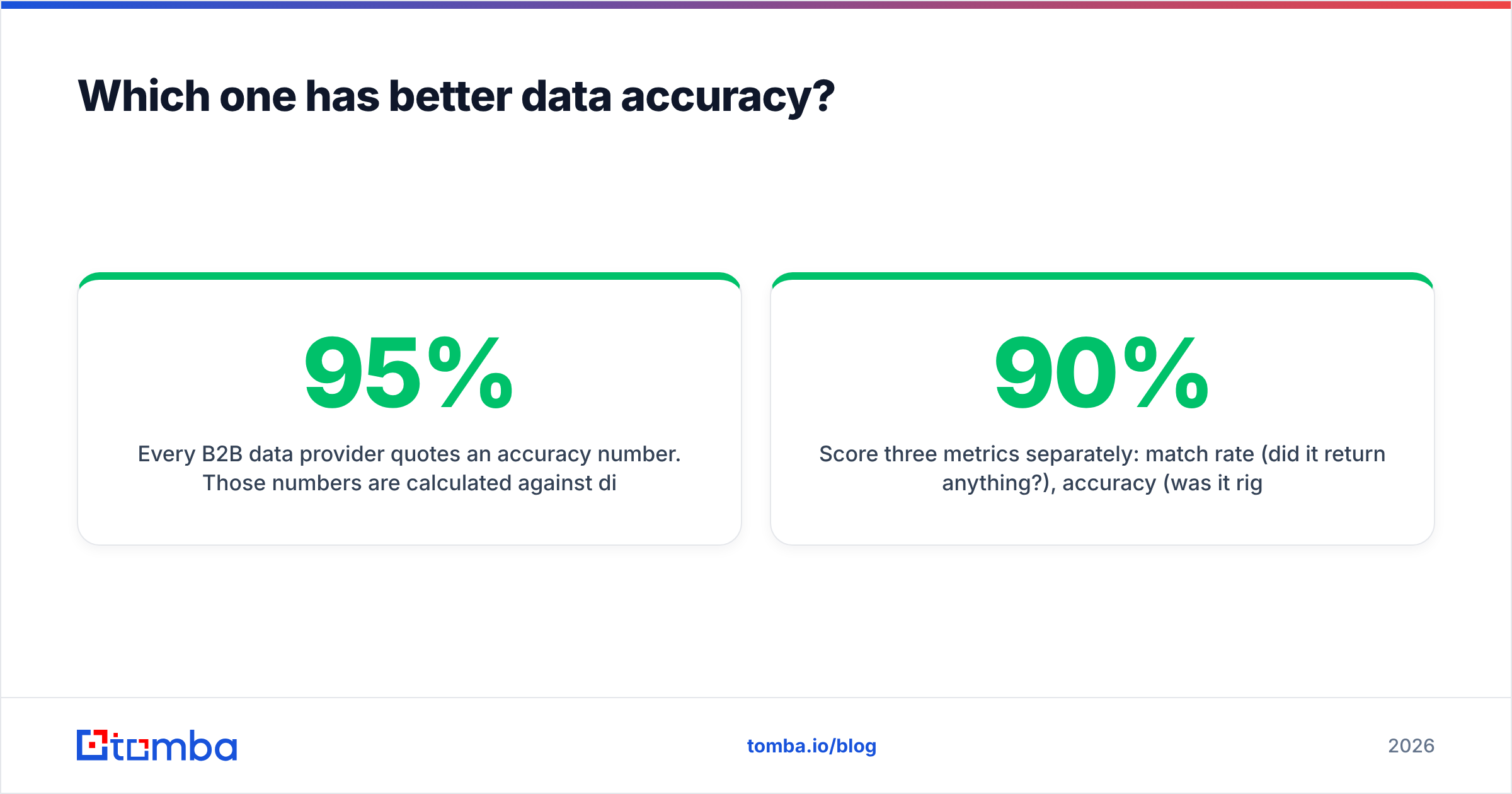
Every B2B data provider quotes an accuracy number. Those numbers are calculated against different denominators, on different samples, at different freshness intervals. A "95% accurate" claim measured on Fortune 500 executives in the US means very little if you sell to 30-person agencies in Southern Europe.

Run this test before signing anything:
- Build a 200-row control set from your own CRM — contacts you already know are correct, spread across your actual segments, not just the easy ones.
- Strip the emails out and ask each vendor to fill them back in from name + company.
- Score three metrics separately: match rate (did it return anything?), accuracy (was it right?), and bounce rate (does it survive an SMTP check?). A vendor with 90% match rate and 70% accuracy is worse than one with 60% match and 98% accuracy.
- Repeat on your hardest segment. Every provider is good at US SaaS. Ask for EMEA mid-market, or non-English domains, or whatever segment actually pays your bills.
- Check the catch-all handling. A large share of B2B domains accept all mail, which means a naive verifier marks them "valid" and your bounce rate finds out later. Tools with a dedicated catch-all verifier give you a real risk signal instead of a shrug.
Whatever you buy, keep verification as a separate, independent step. Deliverability damage is expensive and slow to undo — Google and Yahoo's bulk sender requirements put a hard ceiling on the spam-complaint and bounce rates you can sustain, and blowing through it costs you the domain, not just the campaign.
How does pricing actually work for each?#
Expect a sales call. That is the honest summary.
Both Generect and Tami AI lean toward quote-based commercial models for meaningful volume, which is standard for data vendors but has three consequences worth planning for:
Credits are not comparable across vendors. One provider's "credit" is a search; another's is a returned record; another's is a returned record plus an enrichment call. Before you compare two quotes, normalize to cost-per-verified-contact-you-actually-emailed. That number is often 3-5x the sticker figure once you account for unusable rows.
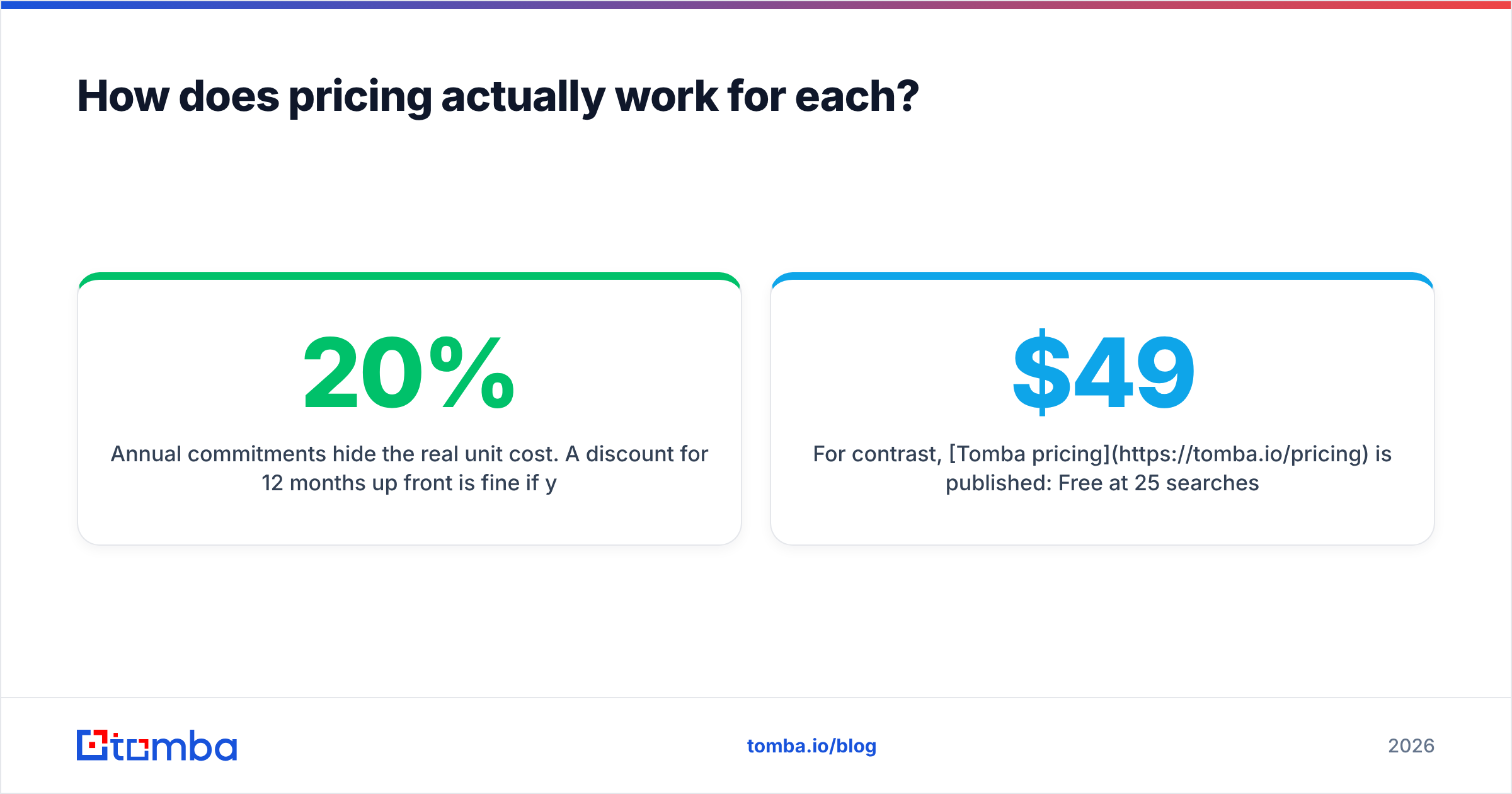
Annual commitments hide the real unit cost. A discount for 12 months up front is fine if your volume is predictable. If you are still testing segments, monthly flexibility is worth more than the 20% you save.
Unused credits usually expire. Ask explicitly about rollover. A plan sized for your best month is a plan you overpay for eleven months a year.
For contrast, Tomba pricing is published: Free at 25 searches/mo, Starter at $49/mo, Growth at $99/mo, Pro at $249/mo, and custom Enterprise. That transparency is not automatically a reason to choose it — it is a reason you can run the math yourself before a demo, which is a real advantage when you're comparing three vendors under time pressure.

Is Generect or Tami AI better for cold outbound?#
For a pure cold-email motion, Generect's model is the closer fit — but only if you have someone to wire it up.
Cold outbound at volume is a pipeline problem: source contacts, verify them, segment them, push to a sequencer, feed replies back into the CRM, suppress the ones who bounced. Generect's API-first design slots into that pipeline naturally. You schedule a job, you get rows, the rows go where you tell them.
Tami AI's model is a better fit for a different motion: low-volume, high-value, research-heavy outbound. If your ACV is $80k and you send 40 emails a week, the AI research layer earns its cost because rep time is your scarce resource, not contact records. If your ACV is $8k and you send 4,000 emails a month, you are paying an intelligence premium on a volume problem.
The failure mode to avoid: buying the AI prospecting layer and still needing a separate data source because coverage gaps show up in your specific segment. That is two line items solving one job. Audit coverage on your segment first, then decide which layer you are actually buying.
Suggested visual: screenshot of an outbound pipeline diagram in your CRM showing where the data source, verification step, and sequencer connect.
Where does Tomba fit in this comparison?#
Tomba is the cheaper, narrower answer when your bottleneck is contact data rather than strategy.
It does not try to be an AI SDR. It finds and verifies professional email addresses, plus adjacent data: domain search for every reachable address at a company, phone numbers, catch-all detection, and enrichment on records you already own. If you already know who you want to reach — because you have a target account list, a conference attendee list, an export from LinkedIn Sales Navigator, or a scraped set of domains — that is the whole job.
Where it lands well against both tools in this comparison:
- You want a public price before a demo. $49/mo Starter, no negotiation cycle.
- You want the API without an enterprise contract. The Tomba API, CLI, and MCP server are available on standard plans, not gated behind Enterprise.
- You need finding and verifying in one place. Sourcing a contact and confirming it's deliverable are the same workflow, not two vendors.
- Your team lives in spreadsheets. Chrome extension, Google Sheets add-on, Excel, Airtable, HubSpot, and Salesforce integrations mean nobody has to learn a new interface.
Where it is genuinely the wrong tool: if you want an agent to define your ICP, research accounts, and write the "why now" paragraph, Tomba doesn't do that and won't pretend to. That is Tami AI's territory. And if you need firehose-scale filtered exports piped nightly into a warehouse, evaluate Generect on its own terms.
Which should you choose in 2026?#
Pick based on which of these sentences describes your last quarter:
"Our reps waste hours researching accounts before they write anything." → Evaluate Tami AI. You have a judgment bottleneck, and an AI research layer is a legitimate answer to it. Validate on your segment, and pressure-test what happens when the AI is confidently wrong about an account.
"We have the strategy, we need clean data flowing into our systems automatically." → Evaluate Generect. You have an infrastructure bottleneck. Budget engineering time for the integration and make sure someone owns it after the person who built it leaves.
"We know exactly who to email, we just can't get valid addresses." → You have a contact-data bottleneck, and it is the cheapest of the three to solve. Start with a free tier, test 200 rows, and only escalate to a platform when you've proven the gap is elsewhere.
"We're not sure which of those three it is." → It is almost always the third one, and teams almost always buy the first. Run the 200-row control test before you spend anything. It costs you an afternoon and it settles the argument with data instead of opinions.
One more framing that helps: read the G2 category reviews for both tools and filter to companies your size in your industry. Vendor case studies are selected; review filters are not. The complaints cluster in useful places — coverage gaps by region, support responsiveness, credit accounting surprises.
Frequently asked questions#
Are Generect and Tami AI direct competitors? Not really. Generect is a data source consumed via API; Tami AI is an AI prospecting application. Some teams run both — one supplies records, the other supplies prioritization. If a vendor tells you they replace the other entirely, ask them to prove it on your segment.
Do I still need an email verifier if I use either tool? Yes. Treat verification as an independent control, regardless of what the provider claims. Data decays roughly 2-3% per month as people change jobs, and a list that was accurate at export can be stale by the time you send. Run a bulk verify pass immediately before each send.
Which is cheaper? You will not know until you get quotes, because both lean quote-driven. Compare on cost-per-verified-contact-emailed, not on headline credit price.
Can I test either without talking to sales? Both offer trial or demo paths, but full self-serve evaluation is limited. If you want to benchmark data quality without a sales cycle, start with a tool that has an open free tier and use it as your accuracy baseline.
Start with the bottleneck you can actually measure. If your reps are sitting on a target account list they can't reach, that is a contact-data problem, not a strategy problem — and it's fixable this week. Run your list through the Tomba Email Finder on the free tier: 25 searches, no card, verified results with confidence scores you can check against your own control set. If the match and bounce numbers hold up, Starter is $49/mo and the API comes with it. If they don't, you'll have real data to bring to the Generect and Tami AI demos instead of a vendor's slide.
Related guides#
Ready to find emails that actually work?
Join 150,000+ professionals who stopped guessing and started sending. Free credits on signup — no credit card required.
Get the Tomba newsletter
Practical outbound tactics and product updates — once every two weeks.
About the author