Generect vs Thomson Data: Which B2B Data Provider Wins?
Generect sells live, API-delivered B2B contact data. Thomson Data sells built-to-order marketing lists. They solve different problems — and only one of them fits a modern outbound stack. Here is the honest breakdown.
TL;DR
- Generect is API-first. You query it, and records come back live from public professional profiles.
- Thomson Data is a list vendor. You brief a rep, and a built-to-order CSV comes back, often license-limited.
- The real question in Generect vs Thomson Data is not record count. It is how stale a row is when it reaches your sequence. Static lists decay 2–3% a month.
- Generect fits digital-first teams with engineering time. Thomson Data fits ABM waves, events, and offline-heavy verticals.
- Only need a verified work email for a known person? Skip both. A finder plus a verifier is cheaper and fresher.
Generect vs Thomson Data: what does each one sell?#
They sit at opposite ends of the B2B data market. Calling both "lead vendors" hides the gap that costs you money.
Generect is a lead-data platform built around an API. You pass filters: industry, headcount, title, geography, tech stack. It returns structured company and person records. Work emails are included, and phone numbers on some plans. The pitch is freshness. You call the endpoint when you need the record, so job changes have less time to rot the row.
Thomson Data is a traditional list-building company. You brief a sales rep on the audience. Say, IT decision-makers at US hospitals with 500+ beds. Their team compiles the file, cleans it, and hands it over. They also sell prebuilt lists for healthcare, technology, and manufacturing. Data appending is on the menu too. You send incomplete records and get them back enriched. The model is a service business, not a SaaS product.
That single difference drives everything else. It sets the price shape, the refresh rate, the compliance risk, and how fast you can change your ICP.

Generect vs Thomson Data: how do the delivery models differ?#
Get the delivery model straight before you compare feature lists. Five things matter in practice.
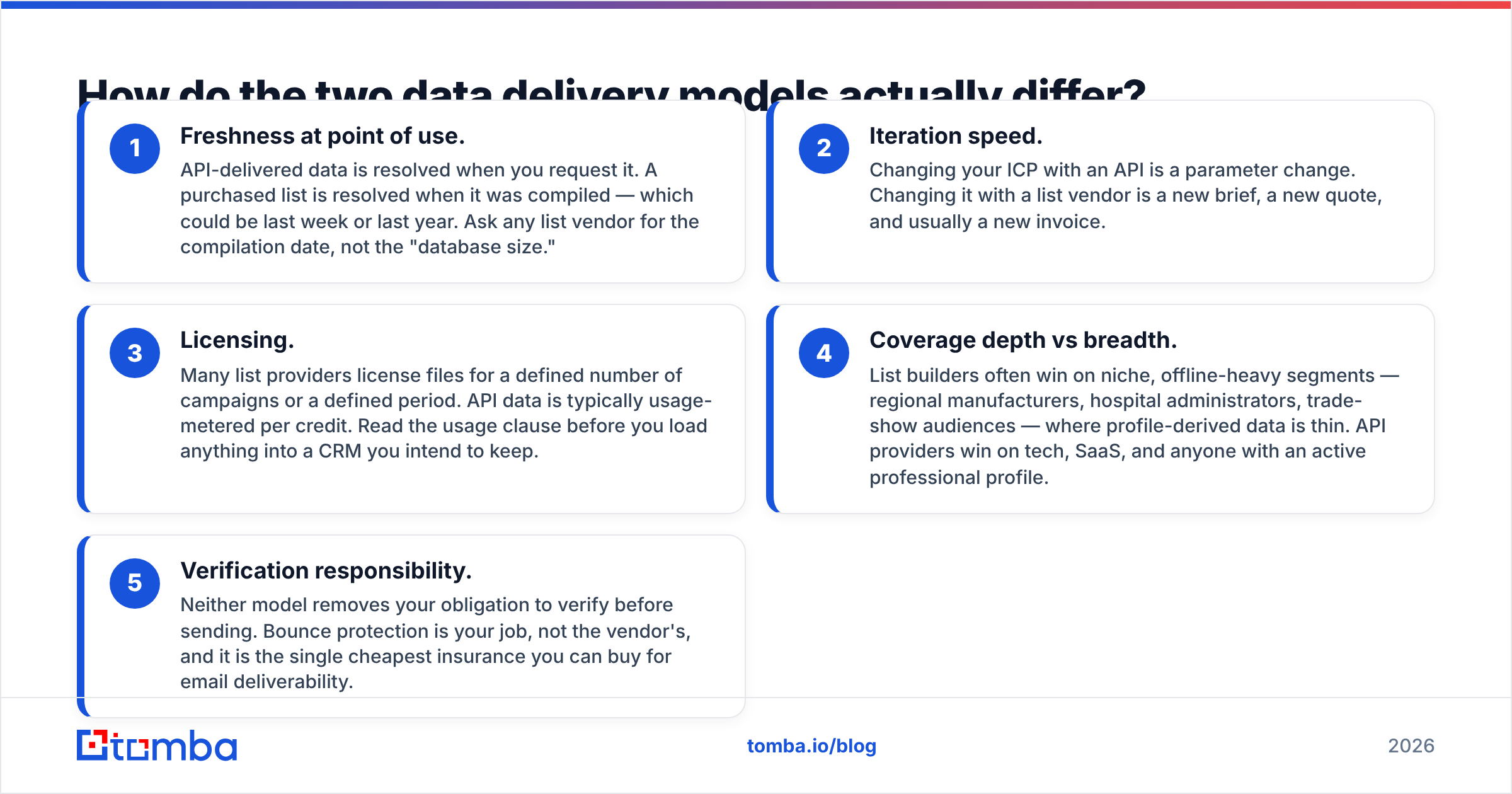
- Freshness at point of use. API data is resolved when you ask for it. A bought list was resolved on the day it was compiled. That could be last week or last year. Ask for the compile date, not the database size.
- Iteration speed. With an API, a new ICP is a new parameter. With a list vendor, it is a new brief, a new quote, and a new invoice.
- Licensing. Many list providers license a file for a set number of campaigns or a set period. API data is usually metered per credit. Read the usage clause before anything lands in your CRM.
Two more are easy to miss.
- Coverage depth vs breadth. List builders win in niche, offline-heavy segments. Think regional manufacturers, hospital administrators, and trade-show crowds. Profile-derived data is thin there. API providers win in tech, SaaS, and anywhere buyers keep a live public profile.
- Verification is still on you. Neither model removes it. Bounce protection is your job, not the vendor's. It is the cheapest insurance you can buy for email deliverability.
Generect vs Thomson Data: how do they compare head-to-head?#
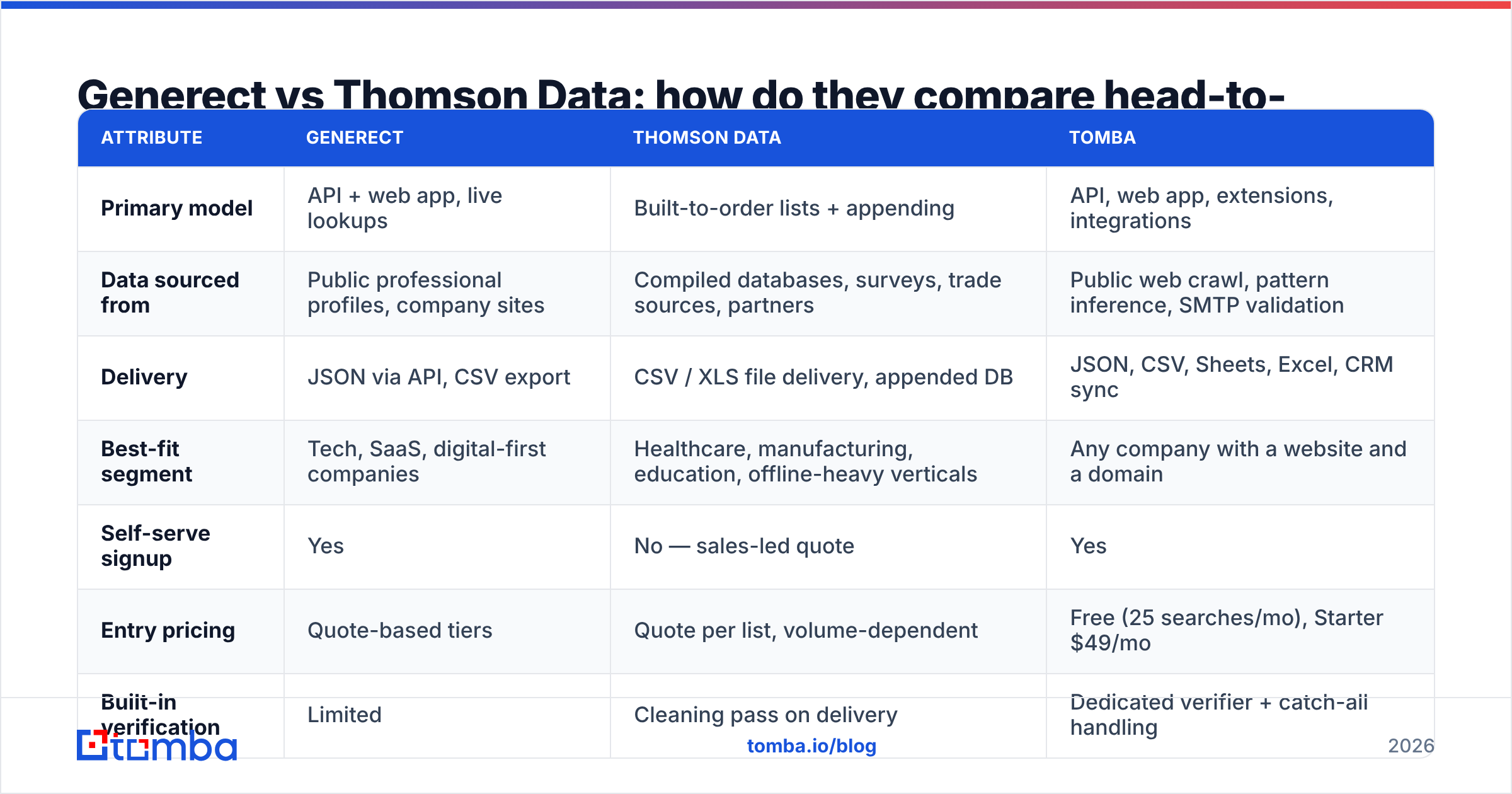
Here is the practical comparison. Treat the pricing rows as directional. Both vendors quote rather than publish full rate cards, so confirm terms before you commit budget.
| Attribute | Generect | Thomson Data | Tomba |
|---|---|---|---|
| Primary model | API + web app, live lookups | Built-to-order lists + appending | API, web app, extensions, integrations |
| Data sourced from | Public professional profiles, company sites | Compiled databases, surveys, trade sources, partners | Public web crawl, pattern inference, SMTP validation |
| Delivery | JSON via API, CSV export | CSV / XLS file delivery, appended DB | JSON, CSV, Sheets, Excel, CRM sync |
| Best-fit segment | Tech, SaaS, digital-first companies | Healthcare, manufacturing, education, offline-heavy verticals | Any company with a website and a domain |
| Self-serve signup | Yes | No — sales-led quote | Yes |
| Entry pricing | Quote-based tiers | Quote per list, volume-dependent | Free (25 searches/mo), Starter $49/mo |
| Built-in verification | Limited | Cleaning pass on delivery | Dedicated verifier + catch-all handling |
| Refresh cadence | Continuous / on request | Per compilation cycle | Continuous, verified at query time |
| Phone numbers | Available on select plans | Available on many lists | Available via phone finder |
| Contract shape | Subscription / credits | Per-file purchase or license | Monthly, cancel anytime |
The pattern holds across every row. Generect optimizes for programmatic access. Thomson Data optimizes for hand-built coverage in segments where automated collection struggles.
Which one has more accurate data?#
Accuracy is where the Generect vs Thomson Data debate gets murky. Neither vendor publishes an audited accuracy figure. Anyone quoting you a precise number is guessing. You can still test both the same way.
Run a blind sample. Pull 300 records from each source against one ICP definition. Then work through four steps.
- Run every address through an email verifier. Record the valid, invalid, and catch-all split.
- Check 30 records by hand against the company site and the person's public profile. Count the job changes.
- Send a small, warmed test from a throwaway domain. Record the hard bounces.
- Compare cost per verified, still-employed contact. Not cost per row.
In our experience, list-compiled data shows more catch-alls and role accounts. Compiled sources soak up generic addresses like info@ and marketing@. Profile-derived API data gets the right individual more often. Its coverage thins out where people keep no public profile.
The trap is the same on both sides. The vendor measures accuracy on compile day. You measure bounces on send day. Deliverability dies in that gap.
Google and Yahoo now cap bulk senders at a 0.3% spam-complaint rate. Repeated hard bounces feed the same reputation signal. So a decaying list is not just wasted spend. It also damages the sending domain you use for everything else. Vendor-neutral reviews in G2's lead intelligence category show one recurring gripe across almost every provider. Coverage is fine. Staleness is not.
How does pricing work for each?#
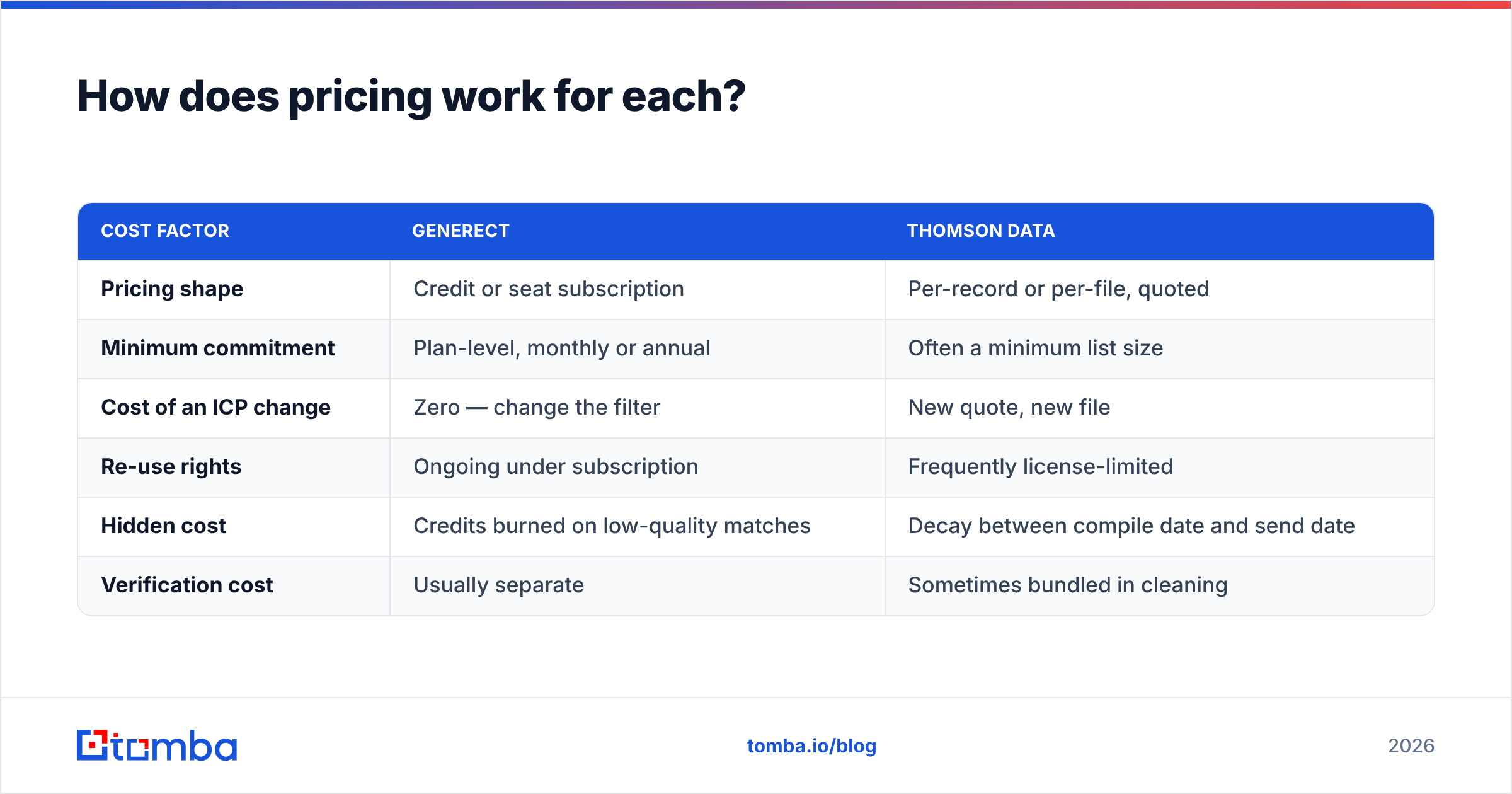
On sticker price, Generect vs Thomson Data is not a fair fight. The two models diverge hardest here, and this is where teams get surprised.
| Cost factor | Generect | Thomson Data |
|---|---|---|
| Pricing shape | Credit or seat subscription | Per-record or per-file, quoted |
| Minimum commitment | Plan-level, monthly or annual | Often a minimum list size |
| Cost of an ICP change | Zero — change the filter | New quote, new file |
| Re-use rights | Ongoing under subscription | Frequently license-limited |
| Hidden cost | Credits burned on low-quality matches | Decay between compile date and send date |
| Verification cost | Usually separate | Sometimes bundled in cleaning |
A per-file purchase looks cheap on the invoice. It is expensive per usable contact. A subscription looks expensive on the invoice and cheap per usable contact, but only if you use the volume. Most teams who regret a list bought 50,000 records to earn a volume discount, then sequenced 4,000.
For a reference point on subscription-shaped pricing, Tomba pricing starts free at 25 searches a month. Starter is $49/mo, Growth is $99/mo, and Pro is $249/mo. Enterprise is quoted. That is not a swap for a bespoke healthcare list. It does set the market rate for verified work emails at volume, self-serve.

Who should choose Generect?#
Pick Generect if most of these are true.
- You have engineering time. The value sits in the API. If nobody wires it into a workflow, you are paying for a UI you could get cheaper.
- Your ICP is digital-first. SaaS, agencies, e-commerce, fintech. Buyers there keep their public profiles current.
- Your ICP changes often. Testing three or four segments a quarter gets punished by per-file pricing and rewarded by query parameters.
- You want enrichment inside the product. Live lookups at signup, lead routing, account scoring. An API fits those jobs far better than a CSV.
- Job-change signal matters. A live lookup surfaces a moved contact instead of bouncing quietly.
Where it disappoints: offline-heavy verticals, very small local businesses, and buyers whose role is real but whose digital footprint is not.
Who should choose Thomson Data?#
Pick Thomson Data if most of these are true.
- Your audience is hard to scrape. Hospital procurement leads, plant managers, school district administrators, regional distributors. Human-assembled data genuinely wins here.
- You need one file, once. A trade-show follow-up or a single ABM wave does not justify a subscription.
- You want appending, not discovery. Sitting on 20,000 half-complete CRM rows? A bulk append is a clean, well-defined job.
- You want a human on the brief. Sales-led delivery helps when segmentation is nuanced and you would rather explain it than encode it.
- Multichannel matters. Postal addresses and direct dials show up more often in compiled lists than in profile data.
Where it disappoints: iteration speed, licensing flexibility, and freshness once the file has sat in a Drive folder for a quarter.
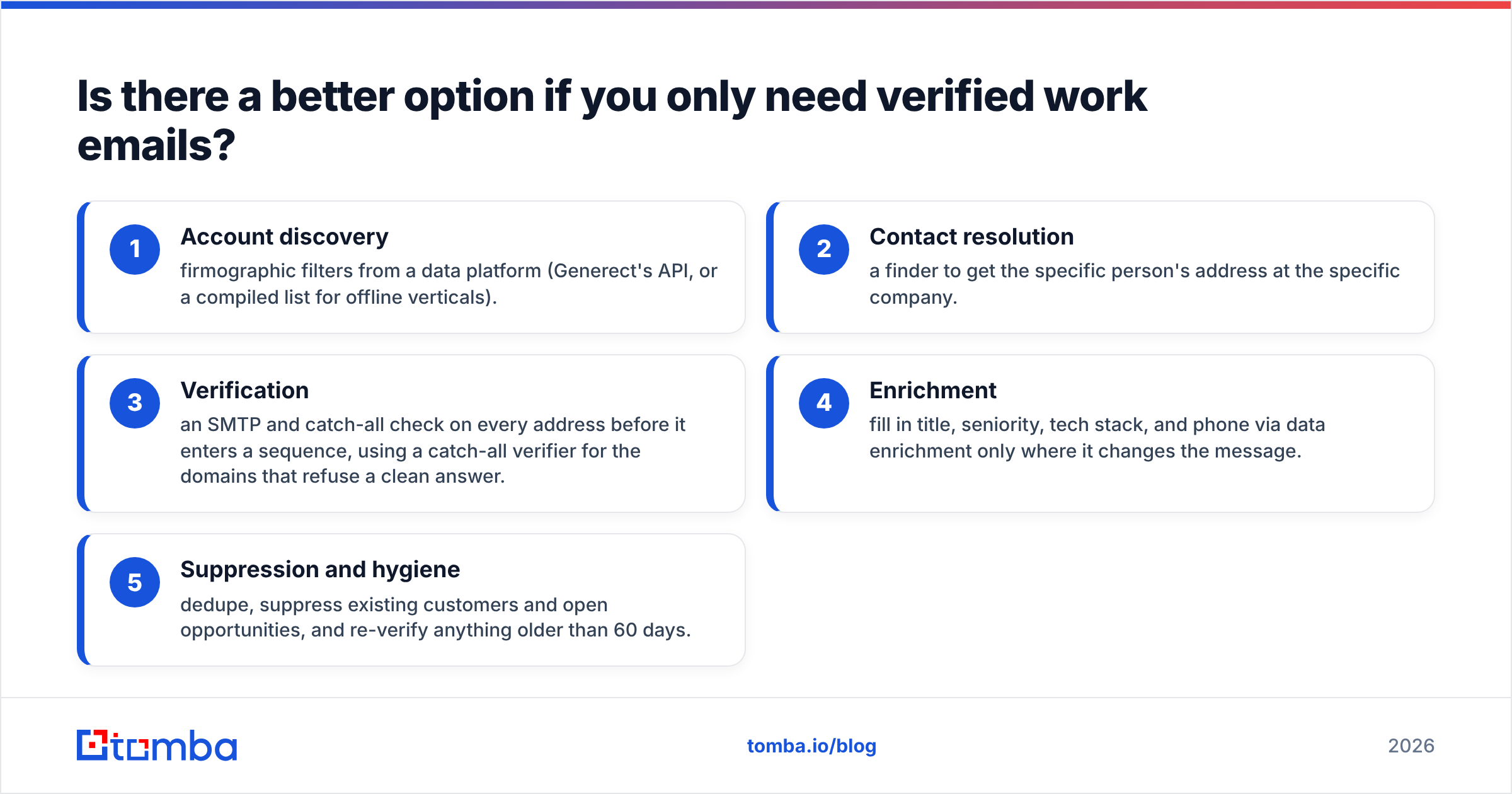
Is there a better option if you only need verified work emails?#
Often, yes. This is the honest gap in the Generect vs Thomson Data matchup. Both vendors sell you an audience. Many teams do not need one. They already know the 400 companies and the three personas they want. They need the address, correct, today.
A purpose-built finder is the cheaper tool for that job. Feed it a domain, or a name plus a company. It returns the address with a confidence score and SMTP-level validation. Tomba's email finder works this way. So does its domain search, which pulls every published address behind a company domain, and its bulk email finder for running a CSV of accounts in one pass. Resolution happens at query time, so there is no compile-date decay to manage.
A third category is worth naming. BookYourData sits between the two models. It is self-serve, pay-as-you-go list building with a bounce guarantee. It suits teams who want a file today without a sales call but still want per-record accountability. It competes with Thomson Data's prebuilt lists, and it does so with a more modern buying experience.
Most well-run outbound teams land on this stack in 2026.
- Account discovery. Firmographic filters from a data platform. Generect's API, or a compiled list for offline verticals.
- Contact resolution. A finder that returns the right person's address at the right company.
- Verification. An SMTP and catch-all check before anything enters a sequence. Use a catch-all verifier for domains that refuse a clean answer.
- Enrichment. Add title, seniority, tech stack, and phone with data enrichment, but only where it changes the message.
- Suppression and hygiene. Dedupe, suppress current customers and open deals, and re-verify anything older than 60 days.
Buying step 1 and skipping steps 2 and 3 is the top reason a well-targeted campaign posts a 9% bounce rate.
What should you actually test before signing?#
Do not sign either contract on a demo. Run a bake-off on Generect vs Thomson Data with five gates.
- Match rate on your list, not theirs. Give both vendors the same 200 target accounts. Global coverage claims mean nothing if they miss your niche.
- Bounce rate after verification. Under 2% hard bounce is acceptable. Over 5% means the underlying data is old.
- Job-change accuracy. Check 25 records by hand. More than three people gone means a stale compile date.
- Licensing and compliance. Get GDPR lawful basis, CCPA deletion handling, and re-use rights in writing. The ICO's guidance on direct marketing data is the reference for UK and EU sends. It is worth ten minutes of a RevOps lead's time.
- Cost per meeting, not cost per record. Run both sources through the same sequence. That is the only number your CFO will remember.
The verdict#
Generect vs Thomson Data comes down to fit, not quality. Generect wins for teams that want live, programmatic B2B data and have a digital-first ICP. Thomson Data wins for teams buying one specific, hard-to-compile audience, especially in offline-heavy verticals like healthcare and manufacturing. Neither is a general-purpose replacement for the other. Neither removes your need to verify before you send.
Is your real bottleneck turning a known company and a known person into a deliverable work email? Start there. Do not buy an audience you have not validated. Run your target accounts through the Tomba Email Finder. The free tier gives you 25 searches a month. Use it to benchmark match rate and bounce rate against whatever quote is sitting in your inbox. Starter is $49/mo if the numbers hold up. Test it against your own account list before you sign anyone's annual contract.
Related guides#
Ready to find emails that actually work?
Join 150,000+ professionals who stopped guessing and started sending. Free credits on signup — no credit card required.
Get the Tomba newsletter
Practical outbound tactics and product updates — once every two weeks.
About the author