Generect vs Truelist: Which B2B Email Tool Wins in 2026?
Generect builds B2B lead lists. Truelist cleans email lists. They are not the same product — and picking the wrong one leaves you paying twice. Here's the honest head-to-head, with pricing, accuracy limits, and a use-case verdict.
TL;DR
- Generect and Truelist solve different halves of the same problem. Generect is a B2B lead database and LinkedIn-sourced data API — it finds contacts. Truelist is an email verification service — it checks contacts you already have.
- If you compare them on a single spec sheet, Generect looks more expensive and Truelist looks cheaper. That comparison is misleading: buying only Truelist means you still need a source of emails, and buying only Generect means you are trusting one vendor's internal validation.
- Generect's strength is fresh, real-time company and people data pulled at query time. Truelist's strength is fast, low-cost bulk list hygiene with a simple pay-as-you-go model.
- Neither handles catch-all domains cleanly, which is where most B2B bounce rates actually come from — roughly a quarter of corporate domains accept everything at the SMTP layer.
- If you want find + verify + catch-all handling under one contract and one API key, a combined platform like Tomba removes a vendor from the stack. If you already have a data source you trust, Truelist alone is a reasonable, cheap add-on.
What are Generect and Truelist, exactly?#
Start here, because half the confusion around "generect vs truelist" comes from treating them as direct competitors.
Generect is a B2B lead generation platform with an API-first pitch. It sells access to company and people data — job titles, seniority, headcount, tech signals, LinkedIn profile data — and returns leads in real time rather than from a static snapshot. Its most-cited differentiator is that it queries live sources at request time instead of serving you a database refreshed once a quarter. Teams use it to build lists from scratch, enrich CRM records, and power in-house prospecting tools.
Truelist is an email verification service. You upload a list (or hit the API), and it runs syntax checks, domain and MX record lookups, disposable-address detection, role-account flagging, and SMTP-level mailbox probing. It returns each address as valid, invalid, risky, or unknown. It does not find email addresses. It has no company database, no job-title filters, no prospecting UI in the sense Generect has.
So the honest framing is: Generect is upstream, Truelist is downstream. One produces the list, the other sanitizes it. A full outbound stack historically needed both — plus a sending tool on top.
How do Generect and Truelist compare head-to-head?#
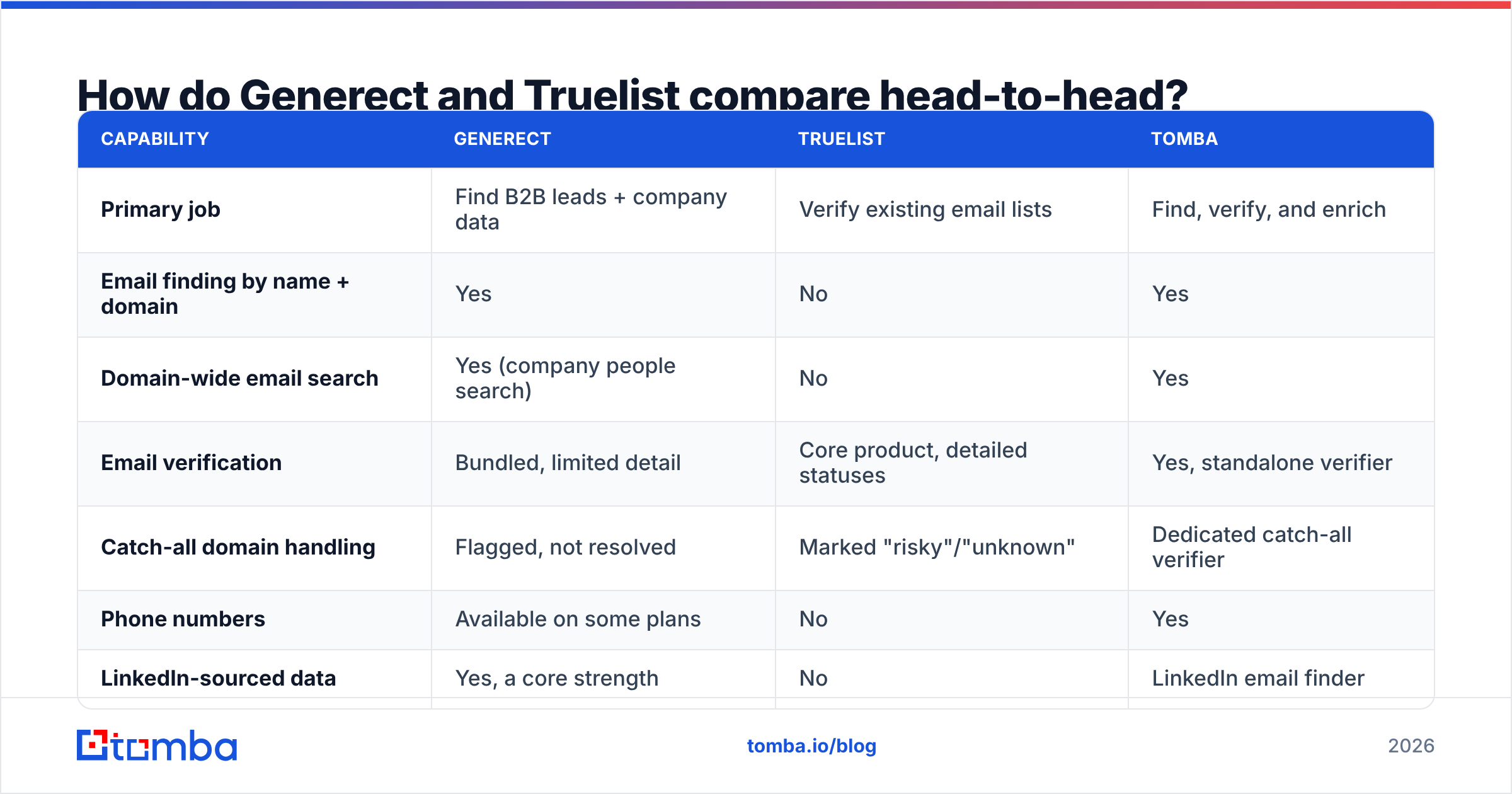
Here is the side-by-side, with a combined platform in the third column so you can see what buying both actually replaces.
| Capability | Generect | Truelist | Tomba |
|---|---|---|---|
| Primary job | Find B2B leads + company data | Verify existing email lists | Find, verify, and enrich |
| Email finding by name + domain | Yes | No | Yes |
| Domain-wide email search | Yes (company people search) | No | Yes |
| Email verification | Bundled, limited detail | Core product, detailed statuses | Yes, standalone verifier |
| Catch-all domain handling | Flagged, not resolved | Marked "risky"/"unknown" | Dedicated catch-all verifier |
| Phone numbers | Available on some plans | No | Yes |
| LinkedIn-sourced data | Yes, a core strength | No | LinkedIn email finder |
| Bulk CSV processing | Yes | Yes, main workflow | Yes |
| Public API | Yes, API-first positioning | Yes | Yes, plus CLI and MCP |
| Free tier | Trial / demo-gated | Free starter credits | 25 searches/mo, no card |
| Best for | Building lists from zero | Cleaning lists you already own | Teams who want one vendor |

The table exposes the real decision. You are not choosing between two tools that do the same thing badly or well. You are deciding how many vendors you want in your contact-data pipeline — and whether the seams between them are worth the money you save.

Which one actually finds emails?#
Only Generect. This is not a close call and it is worth stating plainly, because a lot of "Truelist alternatives" content blurs it.
Generect returns contact records — person, company, role, and in many cases a work email. Its data pipeline leans on live LinkedIn-adjacent sources plus company web data, which is why users report better freshness on recently-changed roles than you get from vendors serving a static quarterly dump. That freshness matters more than raw database size. A 700-million-record database where 30% of job titles are eighteen months stale is worse than a smaller, current one.
Truelist starts after you have an address. Feed it firstname.lastname@company.com and it will tell you whether a mailbox exists. Feed it nothing and it gives you nothing. If your list-building today is manual LinkedIn scraping plus guessed patterns, Truelist is the safety net — not the source.
That distinction changes the accuracy conversation entirely. Generect's accuracy question is "is this the right person and the right address?" Truelist's accuracy question is "does this mailbox accept mail?" Those are different failure modes, and a tool that only answers the second one cannot protect you from the first.

Independent accuracy benchmarking in this category is thin, and every vendor's self-reported number should be read as a ceiling rather than an average. Run your own test: take 100 contacts you can verify by hand — customers, past colleagues, people who replied to you — and score each tool against them. A 40-minute test beats a year of trusting marketing pages. Cross-check the vendor pages on G2 for recent review dates too; a category page with no reviews in the last nine months tells you something about momentum.
What does each cost in 2026?#
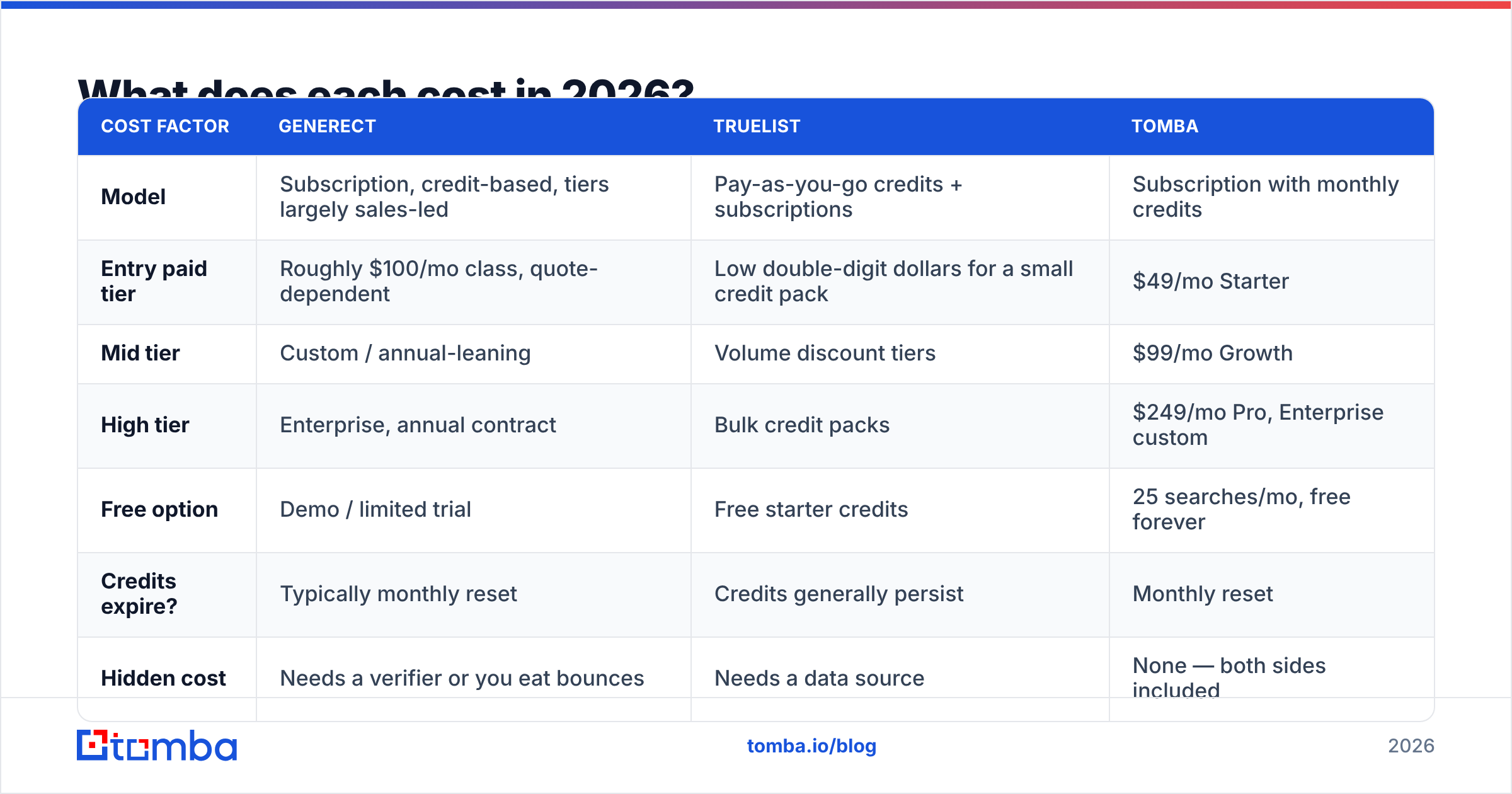
Pricing in this space moves, and both vendors gate parts of it behind a demo request, so treat the numbers below as a shape rather than a quote. Always confirm on the vendor's own pricing page before you commit.
| Cost factor | Generect | Truelist | Tomba |
|---|---|---|---|
| Model | Subscription, credit-based, tiers largely sales-led | Pay-as-you-go credits + subscriptions | Subscription with monthly credits |
| Entry paid tier | Roughly $100/mo class, quote-dependent | Low double-digit dollars for a small credit pack | $49/mo Starter |
| Mid tier | Custom / annual-leaning | Volume discount tiers | $99/mo Growth |
| High tier | Enterprise, annual contract | Bulk credit packs | $249/mo Pro, Enterprise custom |
| Free option | Demo / limited trial | Free starter credits | 25 searches/mo, free forever |
| Credits expire? | Typically monthly reset | Credits generally persist | Monthly reset |
| Hidden cost | Needs a verifier or you eat bounces | Needs a data source | None — both sides included |
The row that gets ignored is the last one. Truelist at $20 for a credit pack looks unbeatable until you add the cost of the tool that produced the addresses. Generect at a few hundred a month looks expensive until you notice it replaces both a database subscription and a chunk of your SDR's manual research time.
Do the arithmetic on your own volume. If you send 2,000 cold emails a month, you need roughly 2,500–3,000 sourced contacts (accounting for discards) and the same number of verifications. Price that basket at each vendor and compare it to a single Tomba plan covering both. For many small teams the consolidated option lands cheaper before you even count the integration work you skip.
Is Truelist enough on its own?#
Only in one scenario: you already own a list you trust and you just need hygiene before sending.
That scenario is more common than vendors admit. If you inherited a 40,000-row marketing database, exported a five-year-old CRM, or bought a prebuilt list from a reputable provider like BookYourData, you do not need a finding tool at all — you need a scrubber. Truelist is well-suited to exactly that: cheap, fast, credit-based, no annual commitment, no seat licences.
Where Truelist alone breaks down:
- Ongoing outbound. You burn through a list in weeks. Without a source, you are back to manual research by month two.
- Account-based motions. You need "the VP of Engineering at these 200 companies," not "clean this CSV." That is a search problem, not a verification problem.
- Job-change churn. B2B contact data decays fast — commonly estimated around 2–3% per month, which compounds to roughly a quarter to a third of a list per year. Verification tells you a mailbox died; it does not tell you where the person went.
- Catch-all domains. Verification returns "unknown" and hands the risk back to you. More on that next.
What about accuracy on catch-all domains?#
This is the failure mode that quietly wrecks campaigns, and it is where both tools have the same structural limitation.
A catch-all (or accept-all) domain is configured to accept mail for any address at that domain at the SMTP layer, then sort it out internally. Ask a standard verifier whether jane.doe@acme.com exists on a catch-all domain and the honest answer is "the server says yes to everything, so I cannot tell you." Truelist marks these risky or unknown. Generect flags them. Neither resolves them.
The problem is scale: catch-all configuration is common across mid-market and enterprise domains — plausibly 20–30% of the corporate addresses in a typical B2B list. If you drop every catch-all, you throw away a meaningful slice of your total addressable market. If you send to all of them blindly, you inflate your bounce rate and take a hit to sender reputation that follows you across every campaign afterward.

The only real fix is a verification layer that does more than SMTP handshakes on these domains — pattern confidence, cross-source corroboration, historical send signals. That is what a dedicated catch-all verifier is for, and it is the single biggest functional gap in a Generect-plus-Truelist stack. Before you finalize any vendor decision, ask both sales teams directly: "What is your accept-all resolution rate, and how do you measure it?" Vague answers are answers.
Which should you pick for your use case?#
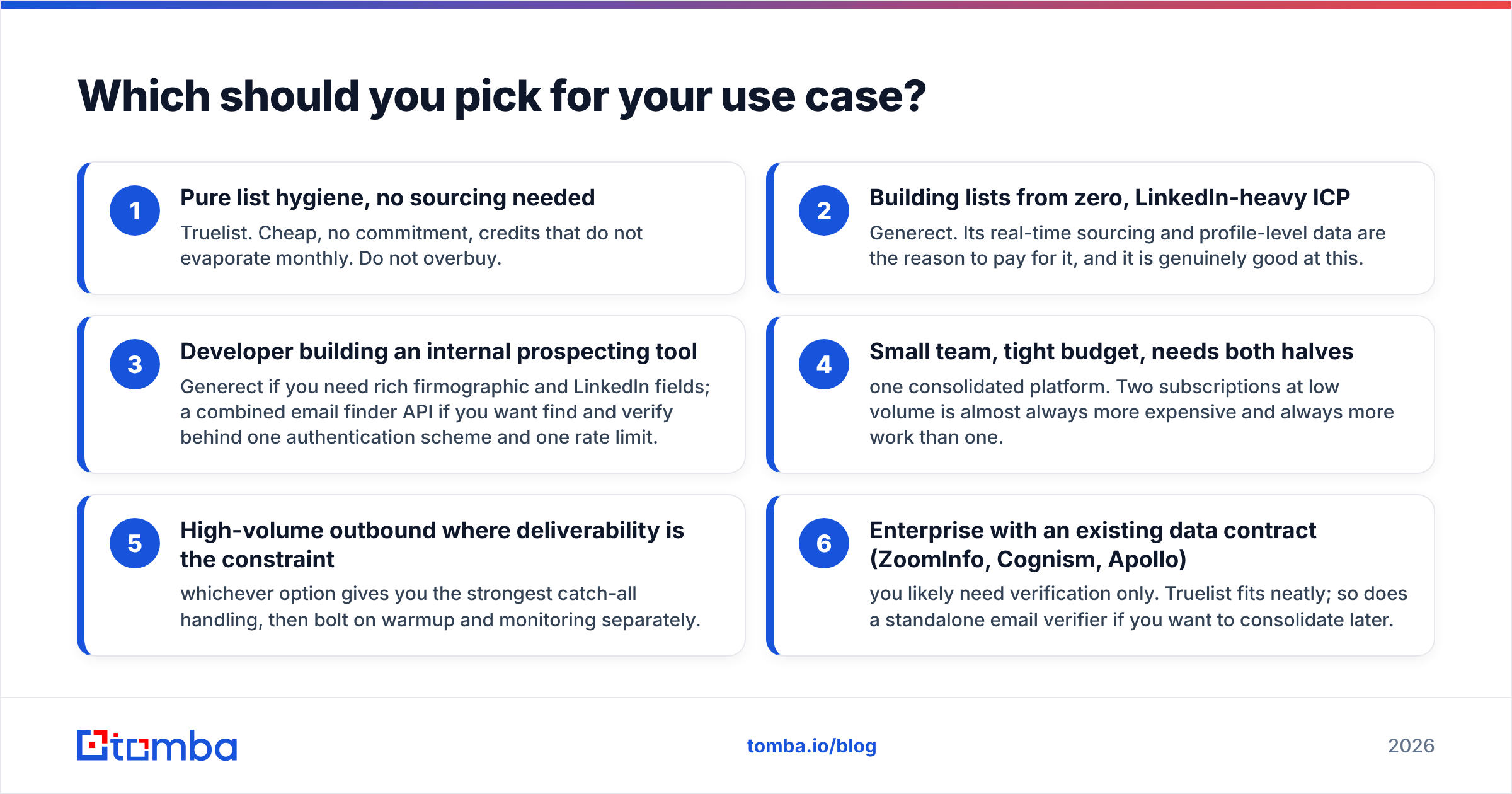
Match the tool to the motion, not to the review-site score.
- Pure list hygiene, no sourcing needed — Truelist. Cheap, no commitment, credits that do not evaporate monthly. Do not overbuy.
- Building lists from zero, LinkedIn-heavy ICP — Generect. Its real-time sourcing and profile-level data are the reason to pay for it, and it is genuinely good at this.
- Developer building an internal prospecting tool — Generect if you need rich firmographic and LinkedIn fields; a combined email finder API if you want find and verify behind one authentication scheme and one rate limit.
- Small team, tight budget, needs both halves — one consolidated platform. Two subscriptions at low volume is almost always more expensive and always more work than one.
- High-volume outbound where deliverability is the constraint — whichever option gives you the strongest catch-all handling, then bolt on warmup and monitoring separately.
- Enterprise with an existing data contract (ZoomInfo, Cognism, Apollo) — you likely need verification only. Truelist fits neatly; so does a standalone email verifier if you want to consolidate later.
Where does a combined platform fit?#
If the answer to "generect vs truelist" is genuinely "I need both," it is worth pricing the third option honestly before signing two contracts.
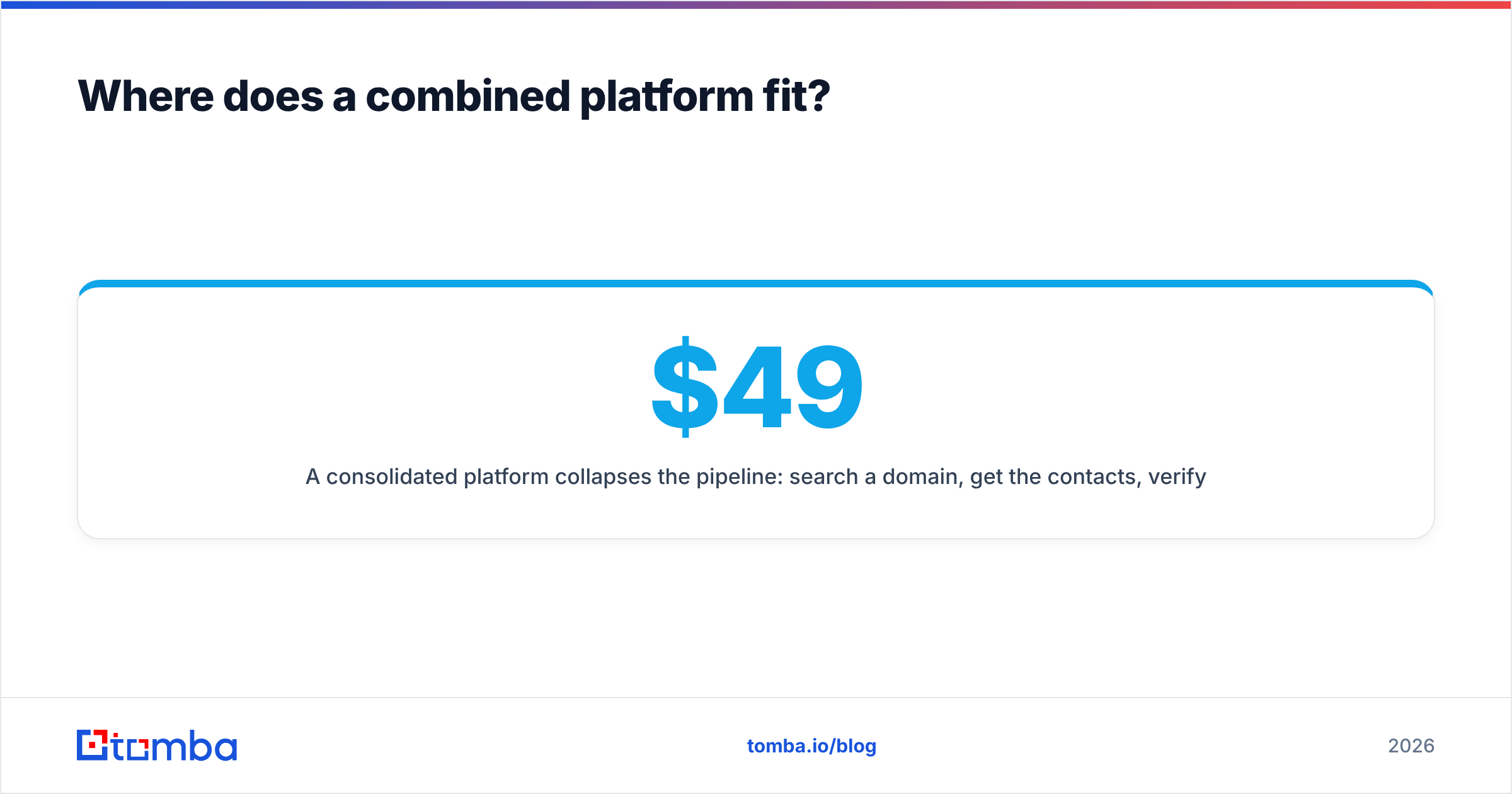
A consolidated platform collapses the pipeline: search a domain, get the contacts, verify them in the same call, push them to your CRM, and handle catch-alls without a second vendor. Tomba's free tier is 25 searches per month with no card, Starter is $49/mo, Growth is $99/mo, and Pro is $249/mo — all of which include both finding and verification rather than metering them separately. There is a bulk email finder for CSV work, native integrations with HubSpot, Salesforce, Pipedrive and Sheets, and a documented API if you are building rather than clicking.
That is not a claim that it beats Generect at every data field. Generect's LinkedIn-adjacent depth is real, and if profile-level enrichment is the core of your product, evaluate it seriously. The consolidation argument is about total cost and total complexity, not about winning every spec row.
Frequently asked questions#
Is Generect a Truelist competitor? Not directly. Generect finds contacts; Truelist verifies them. They overlap only in that Generect performs some validation on the data it returns, which is thinner than what a dedicated verifier provides.
Can I use Truelist with Generect? Yes, and many teams do — pull from Generect, verify in Truelist, then send. It works. It also means two APIs, two invoices, two support queues, and a manual step between them unless you build the glue yourself.
Which has better accuracy? Different questions. Generect's accuracy is about whether the person and address are correct and current. Truelist's is about whether the mailbox accepts mail. Test both against a 100-contact list you can verify by hand rather than trusting either vendor's headline percentage.
Do either handle phone numbers? Generect offers phone data on some plans. Truelist does not — it is email-only. If phone matters, check the vendor's coverage in your specific geography before you buy; global coverage claims rarely survive contact with EMEA or APAC data.
What is the cheapest way to get both find and verify? For most teams under 5,000 contacts a month, a single platform that bundles them beats two point solutions. Run the math on your actual volume rather than on list price.
The bottom line#
Generect wins if your bottleneck is finding people. Truelist wins if your bottleneck is a dirty list. They are complements, not rivals — and the real question is whether you want to manage the seam between them.
If you would rather not, start with the Tomba Email Finder. Search by domain or by name, get verified addresses with catch-all handling included, and test it on 25 free searches a month before you pay anything. If it covers both halves of your pipeline, you have removed a vendor. If it does not, you have lost twenty minutes and learned exactly what your stack needs.
Related guides#
Ready to find emails that actually work?
Join 150,000+ professionals who stopped guessing and started sending. Free credits on signup — no credit card required.
Get the Tomba newsletter
Practical outbound tactics and product updates — once every two weeks.
About the author