Generect vs Validto (2026): Which B2B Email Tool Wins?
Generect finds B2B leads in real time. Validto cleans the list you already have. Here is the honest head-to-head on pricing, accuracy, and which one your outbound motion actually needs in 2026.
TL;DR
- Generect and Validto are not really competitors. Generect is a real-time B2B lead search engine that finds contacts; Validto is a bulk email verification service that cleans lists you already have.
- Generect prices per action — roughly $0.03 per valid contact revealed and $0.02 per export, with a small onboarding credit to test it. Validto sells non-expiring verification credits with volume discounts and 100 free credits on signup.
- If your bottleneck is "I have no leads," Generect solves it. If your bottleneck is "my bounce rate is 9%," Validto solves it. Buying the wrong one wastes a quarter.
- Pay-per-action pricing looks cheap on a 200-contact test and gets expensive fast at 20,000 contacts a month. Run the math before you commit.
- A combined find-plus-verify platform (Tomba, Hunter, Dropcontact-style tools) usually beats stitching two point solutions together unless you have a specific reason to keep them separate.
What is Generect, exactly?#
Generect positions itself as a lead search engine rather than a static database. Instead of selling you access to a warehouse of records scraped 14 months ago, it queries sources in real time when you run a search, then validates the contact before it charges you.
The practical shape of the product:
- Search by filters — company size, industry, geography, job title, seniority, plus LinkedIn-derived audience filters.
- Real-time reveal — you pay when a valid contact comes back, not when you run the query.
- API-first delivery — Generect is frequently listed among lead-generation APIs because the search endpoint is the product, not an afterthought bolted onto a UI.
- Validation Hub — a separate surface for searching or validating individual emails.
That real-time model is the whole pitch. Static B2B databases decay at roughly 25–30% per year as people change jobs, and that decay is invisible until your bounce rate spikes. Generect's answer is to not warehouse the data in the first place.
The trade-off: real-time queries are slower than a database dump, coverage depends on what the sources expose at query time, and per-action pricing means your cost scales linearly with volume forever. There is no point at which you have "bought the data."
What is Validto, exactly?#
Validto is a bulk email list cleaning and verification service. You bring a list — from a database export, a webinar signup, an old CRM segment, a scraped file — and it tells you which addresses are safe to send to.
What it does:
- Bulk list cleaning — upload a CSV, get back a scored, segmented file.
- Single verification — one-off checks for a specific address.
- API verification — real-time checks at the point of form submission or CRM write.
- Spam analysis and custom exports — extras around the core verification job.
Validto advertises 99% accuracy, which is the standard claim in this category and should be read as "SMTP-level validation on non-catch-all domains works well." Every verifier is accurate on clean mailboxes. The differences show up on catch-all domains, role accounts, and greylisting providers — which is exactly where your list is dirtiest.
Its commercial model is the friendly one: pay-as-you-go credits, no contract, no setup fee, and credits that do not expire. For teams that clean a list once a quarter rather than continuously, non-expiring credits are worth more than a lower headline rate on a monthly subscription you underuse.

How do Generect and Validto compare head-to-head?#
Here is the honest side-by-side, with Tomba included as the reference point for what a combined platform looks like.
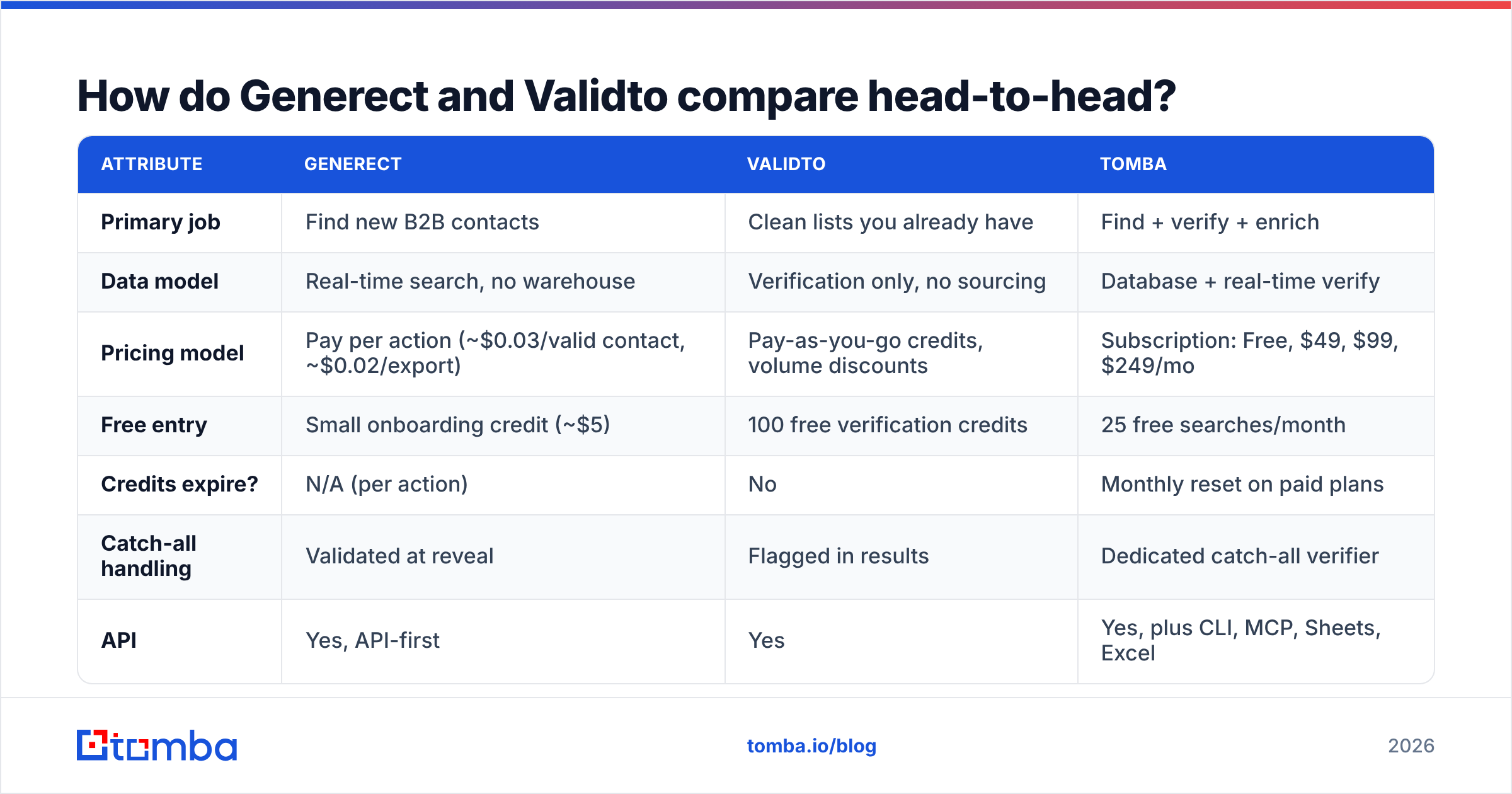
| Attribute | Generect | Validto | Tomba |
|---|---|---|---|
| Primary job | Find new B2B contacts | Clean lists you already have | Find + verify + enrich |
| Data model | Real-time search, no warehouse | Verification only, no sourcing | Database + real-time verify |
| Pricing model | Pay per action (~$0.03/valid contact, ~$0.02/export) | Pay-as-you-go credits, volume discounts | Subscription: Free, $49, $99, $249/mo |
| Free entry | Small onboarding credit (~$5) | 100 free verification credits | 25 free searches/month |
| Credits expire? | N/A (per action) | No | Monthly reset on paid plans |
| Catch-all handling | Validated at reveal | Flagged in results | Dedicated catch-all verifier |
| API | Yes, API-first | Yes | Yes, plus CLI, MCP, Sheets, Excel |
| CRM/native integrations | Limited, API-led | Limited, API-led | HubSpot, Salesforce, Pipedrive, Zapier, Make |
| Best for | Sourcing net-new leads at low volume | Cleaning imported or aging lists | Running the full prospecting loop in one tool |
Read that table twice, because the row that matters most is the first one. A comparison of "Generect vs Validto" is really a comparison of two different line items in your budget. If someone on your team is arguing for one over the other, the first question is not which is better — it is which problem you actually have this quarter.
Which problem do you actually have?#
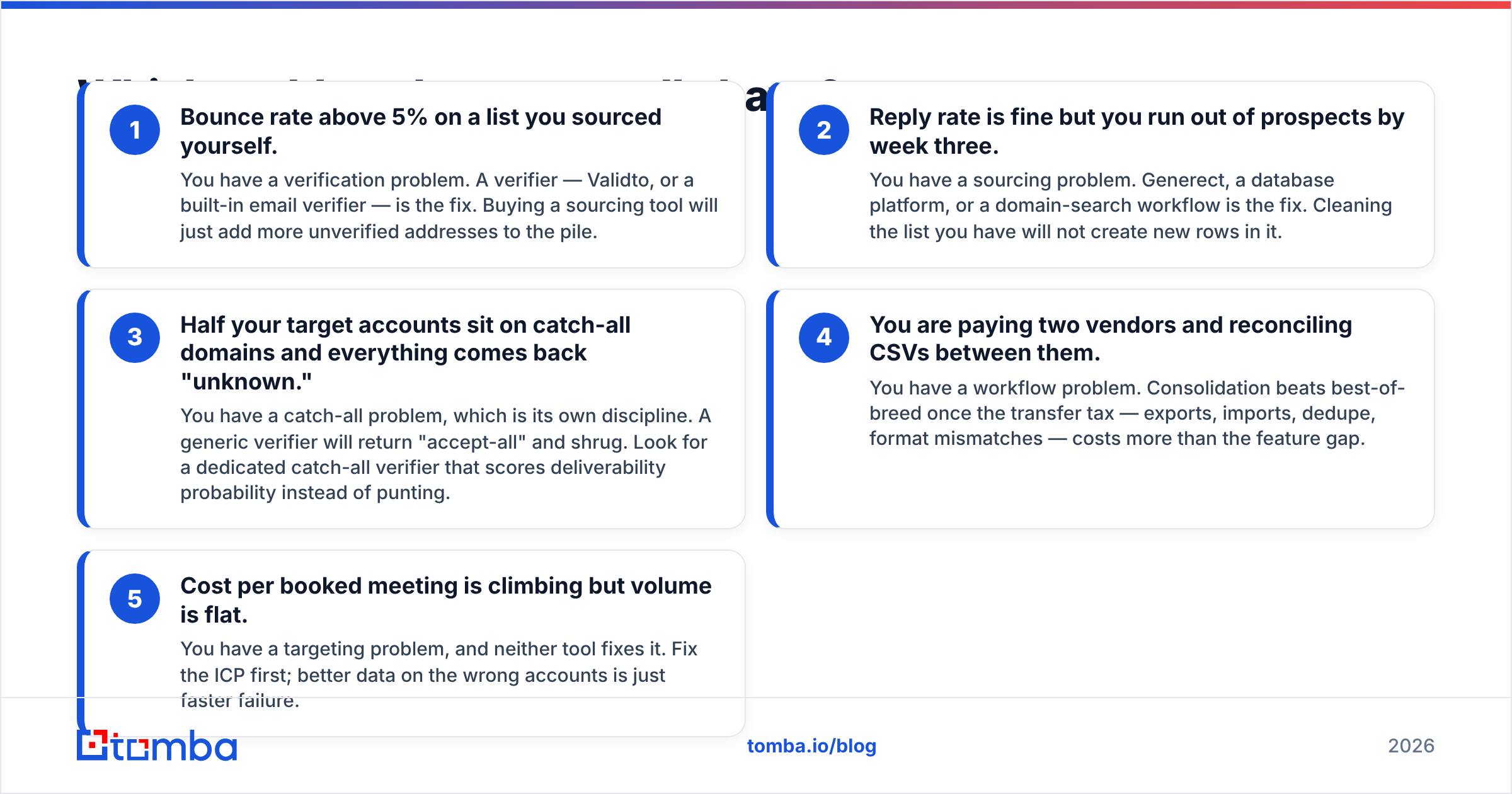
Diagnose before you shop. Four signals, and what each one points to:
- Bounce rate above 5% on a list you sourced yourself. You have a verification problem. A verifier — Validto, or a built-in email verifier — is the fix. Buying a sourcing tool will just add more unverified addresses to the pile.
- Reply rate is fine but you run out of prospects by week three. You have a sourcing problem. Generect, a database platform, or a domain-search workflow is the fix. Cleaning the list you have will not create new rows in it.
- Half your target accounts sit on catch-all domains and everything comes back "unknown." You have a catch-all problem, which is its own discipline. A generic verifier will return "accept-all" and shrug. Look for a dedicated catch-all verifier that scores deliverability probability instead of punting.
- You are paying two vendors and reconciling CSVs between them. You have a workflow problem. Consolidation beats best-of-breed once the transfer tax — exports, imports, dedupe, format mismatches — costs more than the feature gap.
- Cost per booked meeting is climbing but volume is flat. You have a targeting problem, and neither tool fixes it. Fix the ICP first; better data on the wrong accounts is just faster failure.
How does the pricing math actually work?#
This is where the two products diverge hardest, and where most buyers get surprised.
Generect's per-action model is genuinely attractive at low volume. At roughly $0.03 per valid contact, a 500-contact test costs about $15. You cannot get a meaningful trial of most subscription platforms for that. And because you are not charged for misses, the effective cost per usable record is transparent in a way credit-based plans rarely are.
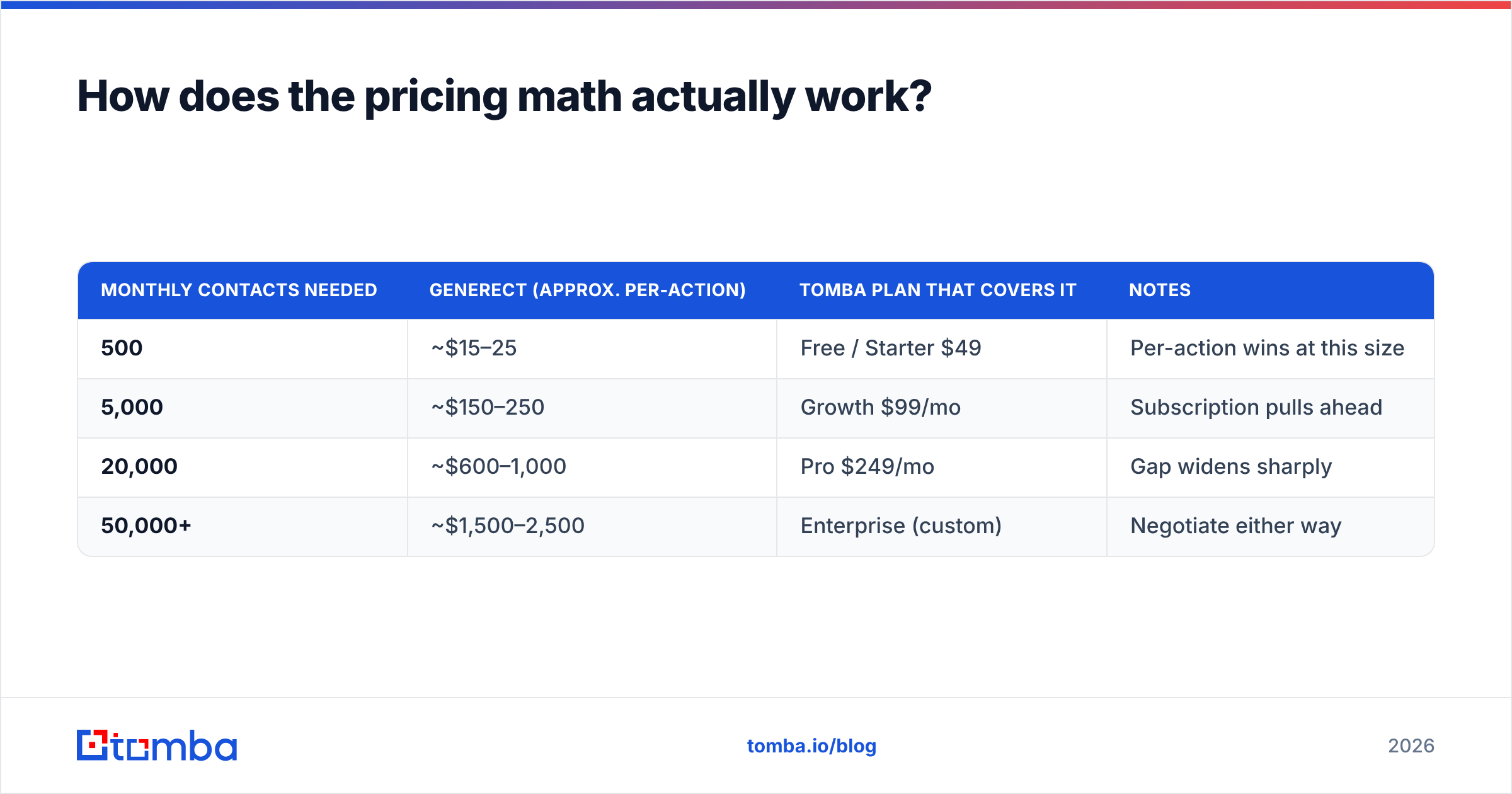
Then you scale. Here is the arithmetic on three realistic volumes:
| Monthly contacts needed | Generect (approx. per-action) | Tomba plan that covers it | Notes |
|---|---|---|---|
| 500 | ~$15–25 | Free / Starter $49 | Per-action wins at this size |
| 5,000 | ~$150–250 | Growth $99/mo | Subscription pulls ahead |
| 20,000 | ~$600–1,000 | Pro $249/mo | Gap widens sharply |
| 50,000+ | ~$1,500–2,500 | Enterprise (custom) | Negotiate either way |
Those Generect figures are estimates built from published per-action rates, not a quote — reveals plus exports plus validation calls stack, and your real number depends on hit rate. Check the current Generect pricing page and compare it against Tomba pricing with your own volume plugged in.
The general rule holds across the category: usage pricing is cheaper until it isn't, and the crossover point is lower than you expect. Somewhere between 2,000 and 5,000 contacts a month, a flat subscription almost always wins. Teams that stay on per-action pricing past that point are usually paying for the comfort of not signing anything.
Validto's math is different again. Verification credits are cheap per unit and get cheaper in bulk, and they do not expire — so the failure mode is not overspending, it is under-verifying because nobody remembered to run the list before the campaign shipped.

Which one is more accurate?#
Accuracy claims in this space are close to meaningless without stating the test set, so treat every "99%" — Generect's, Validto's, and everyone else's — as a claim about clean, non-catch-all mailboxes.

What actually separates tools in production:
- Catch-all domains. Roughly a fifth of B2B domains accept everything at the SMTP layer. A verifier that returns "accept-all" has told you nothing. Tools that score probability using pattern data and historical send outcomes are meaningfully more useful here.
- Role accounts.
info@,sales@,support@are technically valid and commercially worthless for cold outreach. Good tools flag them separately rather than counting them as wins. - Coverage vs. confidence. A tool that returns fewer addresses but is right more often produces better campaigns than one that returns everything at 70% confidence. Judge on usable contacts, not raw hit rate.
- Freshness. Generect's real-time model is genuinely strong here. Database tools compensate with continuous re-verification; check when a vendor last re-validated the record you are about to email, not when it was first collected.
Run your own test before you buy either. Take 200 contacts you already have confirmed emails for, run them through both tools blind, and measure. Twenty minutes of work beats any vendor benchmark, including this one. Third-party review aggregators like G2 are useful for surfacing support and billing complaints, but they are almost useless for accuracy — nobody runs controlled tests before writing a review.
Do you need both — or one tool that does both?#
If you buy Generect and Validto, your workflow looks like this: search in Generect, export a CSV, upload to Validto, download the cleaned file, dedupe against your CRM, import to your sequencer. That is five handoffs, each with its own failure mode, and it happens every time you build a list.
Some teams should absolutely do this. If you have an unusual sourcing need that only Generect's real-time model satisfies, and a compliance requirement that verification happen in a separate system, the transfer tax is worth paying.
Most teams should not. The consolidated alternative collapses those five steps into one:

Tomba's approach is to run sourcing and verification in the same pass — find emails by domain, name, or company, verify them before they ever reach your CSV, and push the result straight to HubSpot, Salesforce, or Pipedrive. For list-level work, bulk email finder handles the same job at file scale without the export-import shuffle.
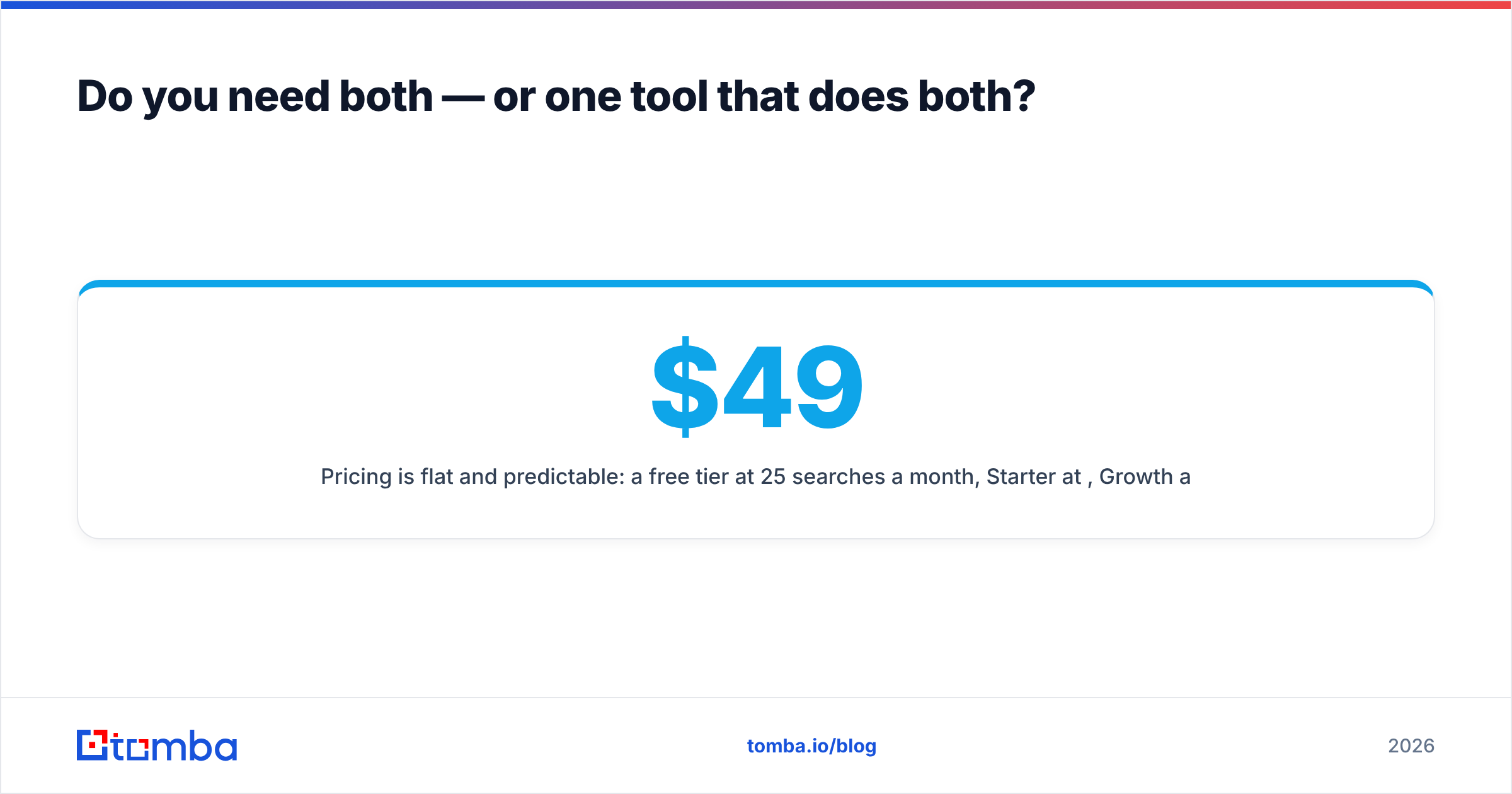
Pricing is flat and predictable: a free tier at 25 searches a month, Starter at $49/mo, Growth at $99/mo, Pro at $249/mo, and custom Enterprise. You know your data cost on the first of the month, which matters more than most finance teams admit when they are approving a usage-based invoice that swung 40% quarter over quarter.
Worth naming the honest limitations too. A combined platform will not always beat a specialist verifier on the hardest catch-all domains, and it will not match Generect's real-time freshness on contacts who changed jobs last week. If those are your primary constraints, buy the specialist. For everything else, the workflow savings dominate.
Which should you pick in 2026?#
The short verdicts:
- Pick Generect if you are sourcing net-new B2B contacts at modest volume, you want zero commitment, you value data freshness above all else, and you are comfortable building against an API. It is a strong fit for agencies running short bursts of prospecting for multiple clients, where a monthly subscription would sit idle half the time.
- Pick Validto if your problem is a dirty list, not an empty one. Non-expiring credits make it a sensible standing purchase for teams that clean quarterly rather than daily, and 100 free credits are enough to sanity-check it against your own known-good addresses.
- Pick a combined platform if you are running continuous outbound at 2,000+ contacts a month, you want one invoice and one integration surface, and you would rather spend your time on messaging than on CSV logistics.
- Pick none of them yet if you have not defined your ICP. Every tool on this page is an amplifier. Amplifying a bad target list just gets you to a worse outcome faster.
One last practical note: whatever you choose, verify immediately before sending, not when you build the list. A record verified six weeks ago and sequenced today is a record you did not verify. Deliverability is a maintenance discipline, not a purchase.
Ready to stop stitching two tools together? The Tomba Email Finder finds professional email addresses by domain, name, or company and verifies them in the same request — no export, no second vendor, no reconciliation step. Start on the free tier with 25 searches a month, test it against whatever you are using now, and upgrade to Starter at $49/mo only when the numbers justify it.
Related guides#
Ready to find emails that actually work?
Join 150,000+ professionals who stopped guessing and started sending. Free credits on signup — no credit card required.
Get the Tomba newsletter
Practical outbound tactics and product updates — once every two weeks.
About the author