Generect vs Xverify (2026): Which B2B Email Tool Wins?
Generect finds B2B leads. Xverify checks whether the addresses you already have are real. Comparing them side by side only makes sense once you know which half of the pipeline you're actually missing.
Generect vs Xverify is a question about pipeline gaps, not feature lists. One tool finds B2B contacts. The other checks the contacts you already have. Here is what each one does, what it costs in 2026, and which gap it fills for you.
TL;DR
- Generect vs Xverify is not a true head-to-head. Generect is a B2B lead-data provider. It serves LinkedIn-sourced contacts and company data through an API.
- Xverify is a data-hygiene tool. It validates email, phone, and postal addresses.
- If your list is empty, Xverify cannot help you. If your list is dirty, Generect is not built to clean it.
- Generect sells quote-based access with a strong real-time API. Xverify sells pay-as-you-go credits with free trial credits.
- Most teams end up paying for both. Or they pay for one platform that finds and verifies from the same credit pool.
- Verdict: pick Generect for net-new prospects. Pick Xverify to clean data you already own. Pick a combined finder-plus-verifier if you run outbound at any real volume.
Generect vs Xverify: what does each tool actually do?#
Start here. The comparison falls apart if you skip it.
Generect is a B2B contact and company data provider. Its pitch is real-time lead generation. You feed it filters — job title, company size, geography, LinkedIn search URLs. It returns contact records with work emails and firmographic fields. The product is API-first. Generect sells to teams building data pipelines, not just to reps clicking around a dashboard.
Xverify is a real-time data validation service. It checks whether an email address exists and can receive mail. It checks whether a phone number is valid. It checks whether a mailing address is deliverable. Its main use case is form protection. An API call fires at signup, so bad data never enters your database.
One fills the bucket. The other stops the bucket leaking. That is the whole distinction. It is also why Generect vs Xverify is really a question about which gap you have.
Here is the practical split:
- Discovery — you have a target account list, or nothing at all. You need names and contactable addresses. That is Generect's job.
- Validation — you have addresses of unknown quality. You need to know which ones will bounce. That is Xverify's job.
- Enrichment — you have partial records and need the missing fields filled. Generect does some of this. Xverify does not.
- Real-time gating — you need a sub-second API call on a web form to block junk signups. Xverify is built for this. Generect is not.
- Compliance hygiene — you need low bounce rates so your domain stays out of spam folders. That is Xverify, but only for lists you already own.
Generect vs Xverify: how do they compare head-to-head?#
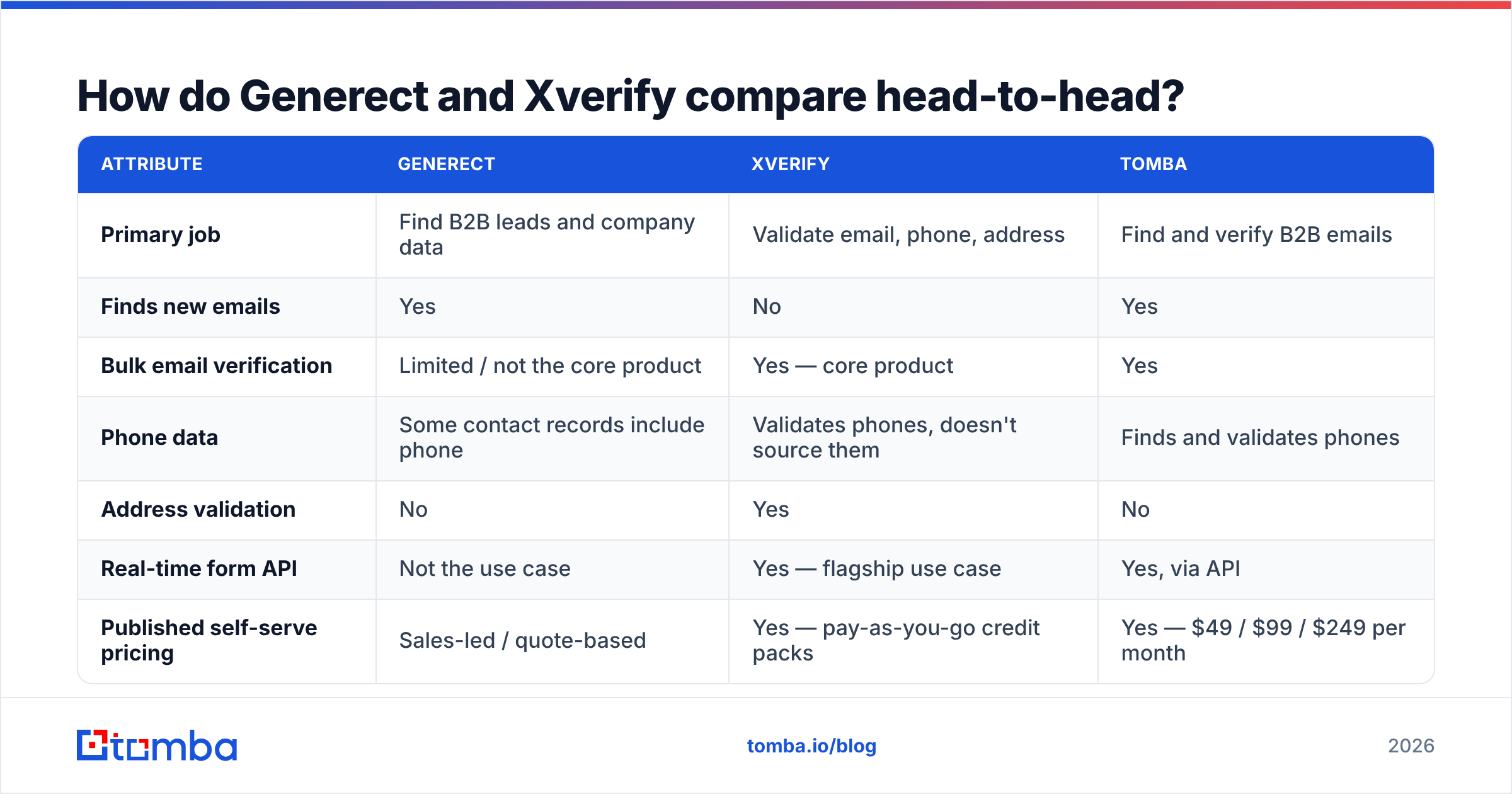
Vendor pricing pages change often. Both firms also gate part of their pricing behind a sales call. Where a number is not published, this table says so. Check the vendor page before you budget.

| Attribute | Generect | Xverify | Tomba |
|---|---|---|---|
| Primary job | Find B2B leads and company data | Validate email, phone, address | Find and verify B2B emails |
| Finds new emails | Yes | No | Yes |
| Bulk email verification | Limited / not the core product | Yes — core product | Yes |
| Phone data | Some contact records include phone | Validates phones, doesn't source them | Finds and validates phones |
| Address validation | No | Yes | No |
| Real-time form API | Not the use case | Yes — flagship use case | Yes, via API |
| Published self-serve pricing | Sales-led / quote-based | Yes — pay-as-you-go credit packs | Yes — $49 / $99 / $249 per month |
| Free tier | Trial on request | Free trial credits | 25 searches per month, no card |
| Best for | Outbound teams needing net-new contacts | Product and marketing teams protecting a database | Outbound teams that want both in one bill |
The row that decides most evaluations is "Finds new emails." If you need contacts you do not have yet, Xverify is out of scope. Its verification engine is genuinely good. It simply does not source data.
Generect vs Xverify: which one finds emails, and which one only checks them?#
Generect finds. Xverify checks. The nuance matters once you compare quotes.
Generect resolves LinkedIn-derived profiles into work emails. Records are refreshed on request, not served from a stale warehouse dump. That matters more than it sounds. A record scraped 14 months ago may point at someone who has since changed jobs. Real-time lookups cost more per record. They also return fewer records per query. That trade is the honest price of fresh data.
Xverify works the other way round. It never guesses at an address. It takes what you give it and runs syntax checks, domain and MX lookups, disposable-domain detection, role-account flags, and SMTP checks where the server allows them. The output is a verdict, not a discovery.
The handoff is where costs stack up. Buy Generect and you still want a verification pass before you load anything into a sequencer. No provider returns 100% deliverable addresses — not Generect, not Tomba, not anyone. Buy Xverify and you still need a source. So you end up with two vendors, two contracts, two credit balances, two sets of API keys, and a glue script in the middle.
That is the case for one stack. Use an email finder whose results are already scored by the same vendor's email verifier. The confidence signal then travels with the record instead of being bolted on later.
How accurate is each tool in practice?#
Accuracy means two different things here. Vendors use that to their advantage.
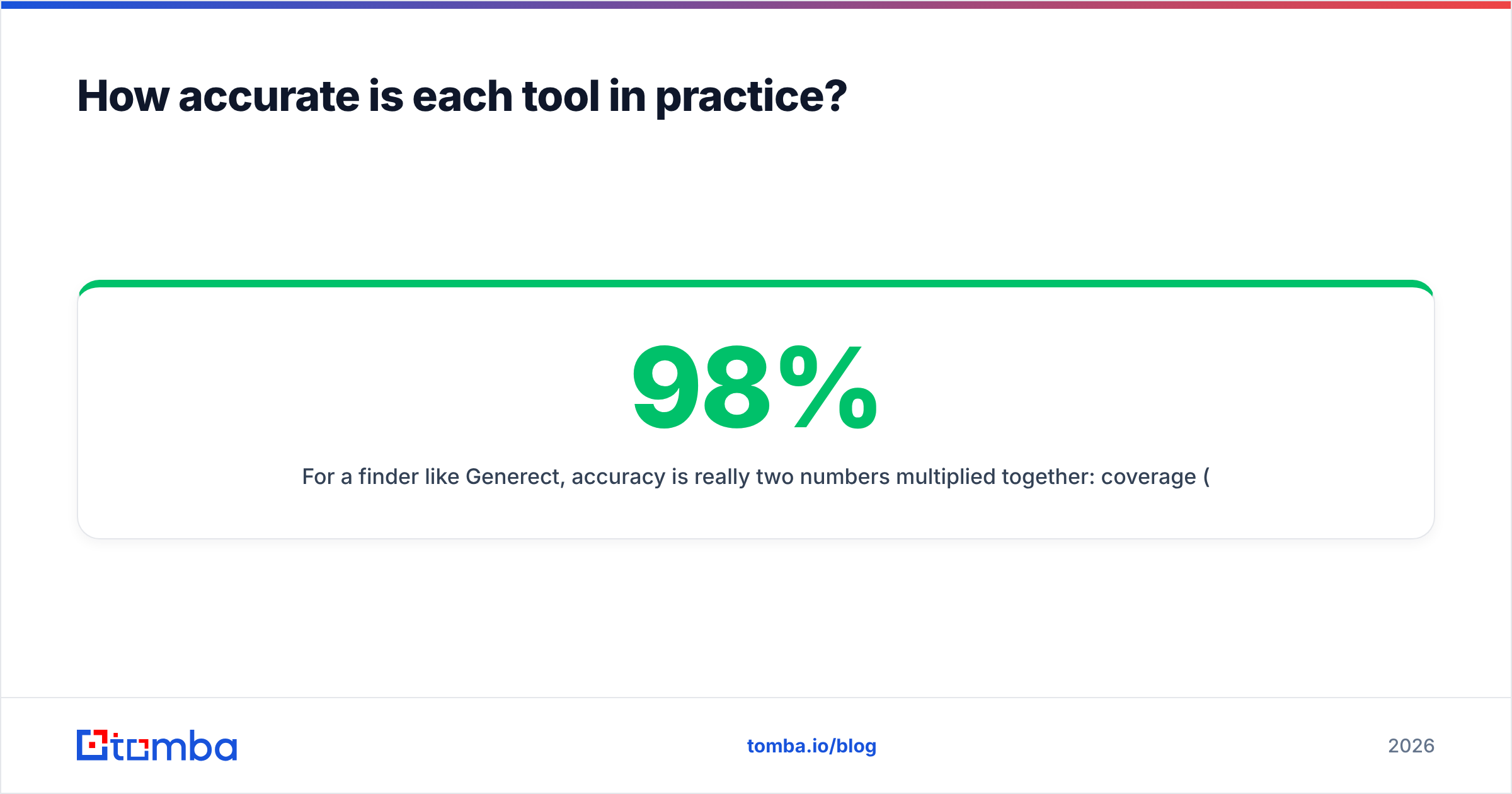
For a finder like Generect, accuracy is two numbers multiplied together. Coverage is the share of your target list that returns any email. Precision is the share of those addresses that actually deliver. A tool with 98% accuracy on a 30% match rate is worse than one with 92% accuracy on a 65% match rate. The second one hands you more usable contacts. Ask for both numbers. Test on your own ICP, not on the vendor's demo list.
For a validator like Xverify, accuracy means false positives and false negatives. A false positive marks a good address as bad, and you lose a real prospect. A false negative marks a bad address as good, and you take a bounce. Catch-all domains are the hard case for every validator. The receiving server accepts everything and reveals nothing. Watch how a validator reports catch-alls. "Unknown" is an honest answer. "Valid" often is not. That is why a dedicated catch-all verifier exists as its own capability.

Here is an honest test. It takes an afternoon:
- Build a 200-row control list from your real ICP. Use companies you know and people you can confirm on LinkedIn.
- Run it through each vendor's trial. Record the match rate, not just the verdicts.
- Send a small, genuine campaign to the survivors from a warmed secondary domain.
- Measure hard bounces per 100 sent. Then divide by the match rate to get cost per delivered contact.
- Compare that one number across vendors. It is the only figure that survives a real quarter.
Peer reviews on G2 help you sanity-check support and billing. Treat published accuracy scores there as marketing until your own control list proves them.
Generect vs Xverify pricing: what does each one cost in 2026?#
Generect is sales-led. Your quote depends on volume, API concurrency, and contract length. The sticker price moves with how well you negotiate. That is normal for API-first data vendors. It also makes a clean cost comparison hard. Expect an annual commitment rather than a month-to-month card charge.
Xverify publishes credit pricing with volume discounts and hands out free trial credits. So you can model cost per verification before you talk to anyone. Verification is cheap per unit. Finding is not. Expect a wide gap between the two. Do not read that gap as one vendor overcharging. You are buying different things.
For a published, self-serve benchmark: Tomba pricing starts free at 25 searches per month. Starter is $49/mo, Growth is $99/mo, and Pro is $249/mo, with custom Enterprise on top. Finding and verification draw on the same credit pool, so you get one invoice instead of two.
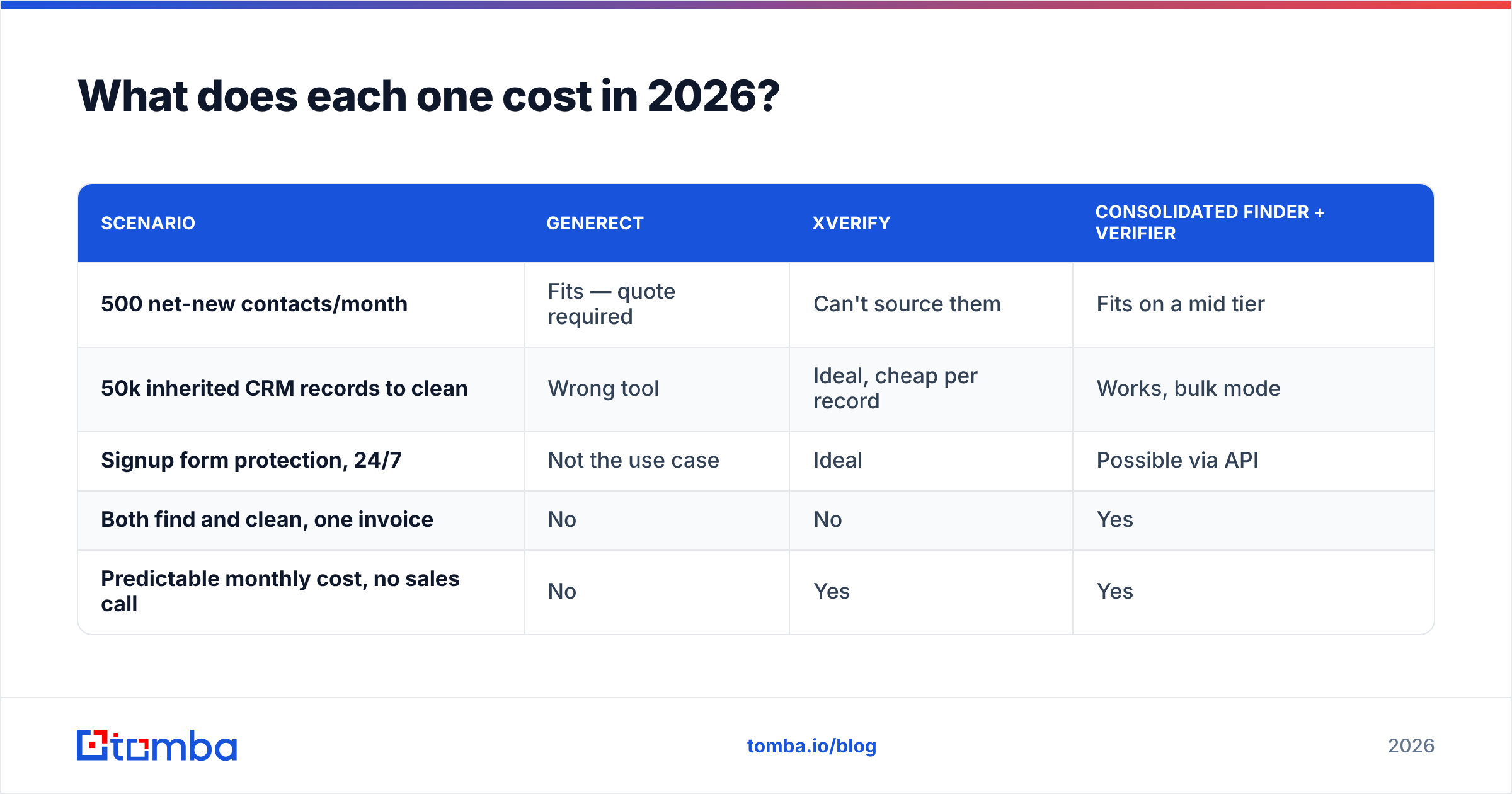
Budget math that actually matters:
| Scenario | Generect | Xverify | Consolidated finder + verifier |
|---|---|---|---|
| 500 net-new contacts/month | Fits — quote required | Can't source them | Fits on a mid tier |
| 50k inherited CRM records to clean | Wrong tool | Ideal, cheap per record | Works, bulk mode |
| Signup form protection, 24/7 | Not the use case | Ideal | Possible via API |
| Both find and clean, one invoice | No | No | Yes |
| Predictable monthly cost, no sales call | No | Yes | Yes |

Is Generect better than Xverify for cold outreach?#
For cold outreach, yes. But only because Xverify is not competing for that job.
Cold outreach starts with a list you do not have. Generect can build it. Xverify can only grade the list you already bought or scraped. If you start from zero, you need discovery first and validation second.
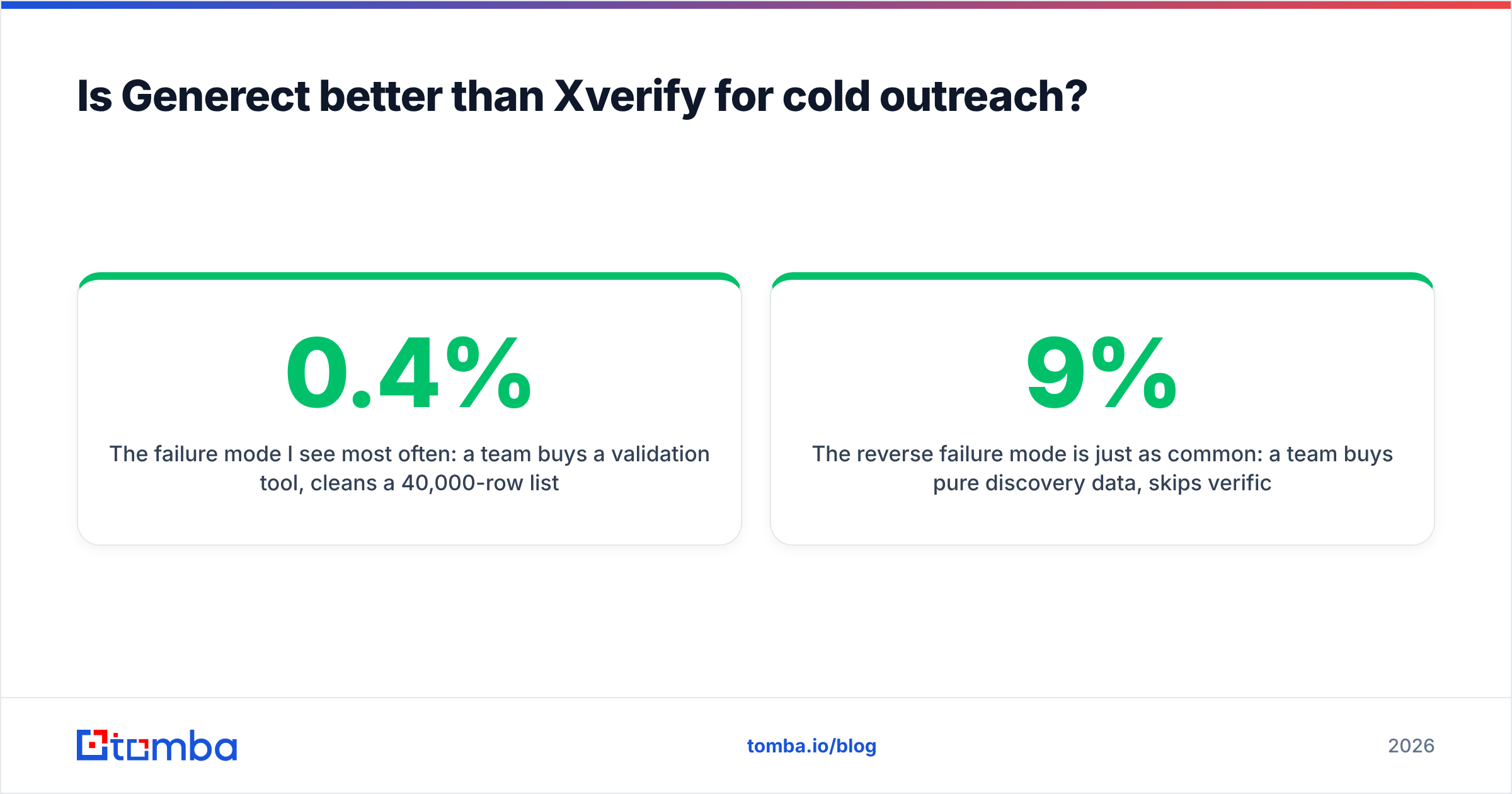
Here is the failure mode I see most. A team buys a validation tool. It cleans a 40,000-row list inherited from a dead campaign. 26,000 addresses come back green. The team sends, and gets 0.4% replies. The data was valid. It just was not relevant. Validation protects your sender reputation. It does nothing for targeting.
The reverse failure is just as common. A team buys raw discovery data and skips verification. It sends 5,000 emails in week one. Hard bounces hit 9%. The domain then takes six weeks to recover. Anything above roughly 2% hard bounces is a warning sign to inbox providers.
You need both halves. The only real question is whether you buy them from one vendor or two.
What are the alternatives to running two separate vendors?#
Consolidation is not always right. Sometimes best-of-breed wins, especially for an unusual need like postal address validation. Most finder platforms simply do not offer it. If you need address and phone checks on a signup form, Xverify's breadth is a real edge.
For a standard B2B outbound motion, though, two vendors add cost and latency without adding capability. A few paths worth pricing:
- Tomba — domain search for company-wide contacts, an email finder for named prospects, and verification on the same credits. There is a documented Tomba API if you build pipelines the way Generect's audience does. Pricing is published, and you can start without a sales call.
- BookYourData — a solid pay-as-you-go option if you would rather buy a pre-built, verified list. It has a delivery guarantee, and it is worth a quote if your motion is list purchase rather than API-driven discovery.
- Enrichment-first platforms — if your CRM already holds the accounts and you only need missing fields filled, a data enrichment endpoint costs less than a discovery contract or a full validation suite.
- Keep Xverify, change the finder — fair enough if form protection is a hard requirement. Pair it with any finder that has a clean API. Then send only the ambiguous results to Xverify to control credit burn.
Generect vs Xverify: which should you pick?#
Match the tool to the gap, not to the review score:
- You need net-new B2B contacts at scale, via API, and can absorb a sales cycle → Generect.
- You need to block junk data at a signup form, or clean a large inherited list with phones and addresses → Xverify.
- You need both, want one invoice, and want to start today without a demo call → a combined finder-and-verifier platform.
- You want to buy a finished list rather than run queries → a list vendor like BookYourData.
- You are testing outbound for the first time and do not know your match rates yet → start on a free tier, build a 200-row control list, and measure before you sign an annual contract.
One last note on process. Whichever you pick, verify right before you send, not at purchase time. Data decays by roughly 2–3% per month as people change roles. A list verified in January and sent in April is not a verified list.
If you want both halves in one place, start with the Tomba Email Finder. You get published pricing, a free tier to test your own control list, and an API built for the same pipeline work Generect's audience cares about. Run 25 searches free, verify them in the same dashboard, and compare the cost per delivered contact against the quote you are holding. That one number settles the Generect vs Xverify decision faster than any feature grid.
Related guides#
Ready to find emails that actually work?
Join 150,000+ professionals who stopped guessing and started sending. Free credits on signup — no credit card required.
Get the Tomba newsletter
Practical outbound tactics and product updates — once every two weeks.
About the author