Generect vs Xverum (2026): B2B Data Provider Comparison
One sells a real-time lead API, the other sells bulk web datasets. Here's how Generect and Xverum actually differ on coverage, freshness, email quality, and cost — and when a cheaper finder beats both.
TL;DR
- Generect is a real-time B2B lead API built around LinkedIn-style search: you send filters, it returns people and companies with contact data on the fly. It fits SDR teams and product builders who need leads now.
- Xverum is a bulk web-data provider: you buy large, refreshed datasets (profiles, companies, jobs) delivered to S3/GCS as JSON or CSV. It fits data teams, ML pipelines, and market-intelligence products.
- They are only competitors on paper. Choosing between them is really a choice between query-time enrichment and dataset ownership.
- Both typically involve sales conversations and commitments that outweigh what a small outbound team needs. If your actual job is "get 5,000 verified work emails this quarter," a dedicated finder plus a verifier is cheaper and faster.
- Our verdict: Generect for outbound motions, Xverum for analytics and data products, and a focused tool like Tomba when contact accuracy — not dataset volume — is the bottleneck.
What are Generect and Xverum, exactly?#
Generect positions itself as a lead-generation data layer. You hit an API (or use its interface) with filters — job title, seniority, headcount, industry, location, technologies — and it returns matching people and companies, including work emails and, on some plans, phone numbers. The pitch is freshness: records are assembled or refreshed close to request time rather than served from a warehouse that was last rebuilt months ago.
Xverum sits at the other end of the pipeline. It is a web-data vendor selling structured datasets at scale — hundreds of millions of professional profiles, tens of millions of company records, plus job postings and related feeds. You do not "search" Xverum in the SDR sense. You subscribe to a dataset, pick a refresh cadence, and receive files or a stream into your cloud storage. Your team does the filtering downstream.
That difference dictates everything else: latency, pricing shape, contract length, and who on your team actually owns the tool.
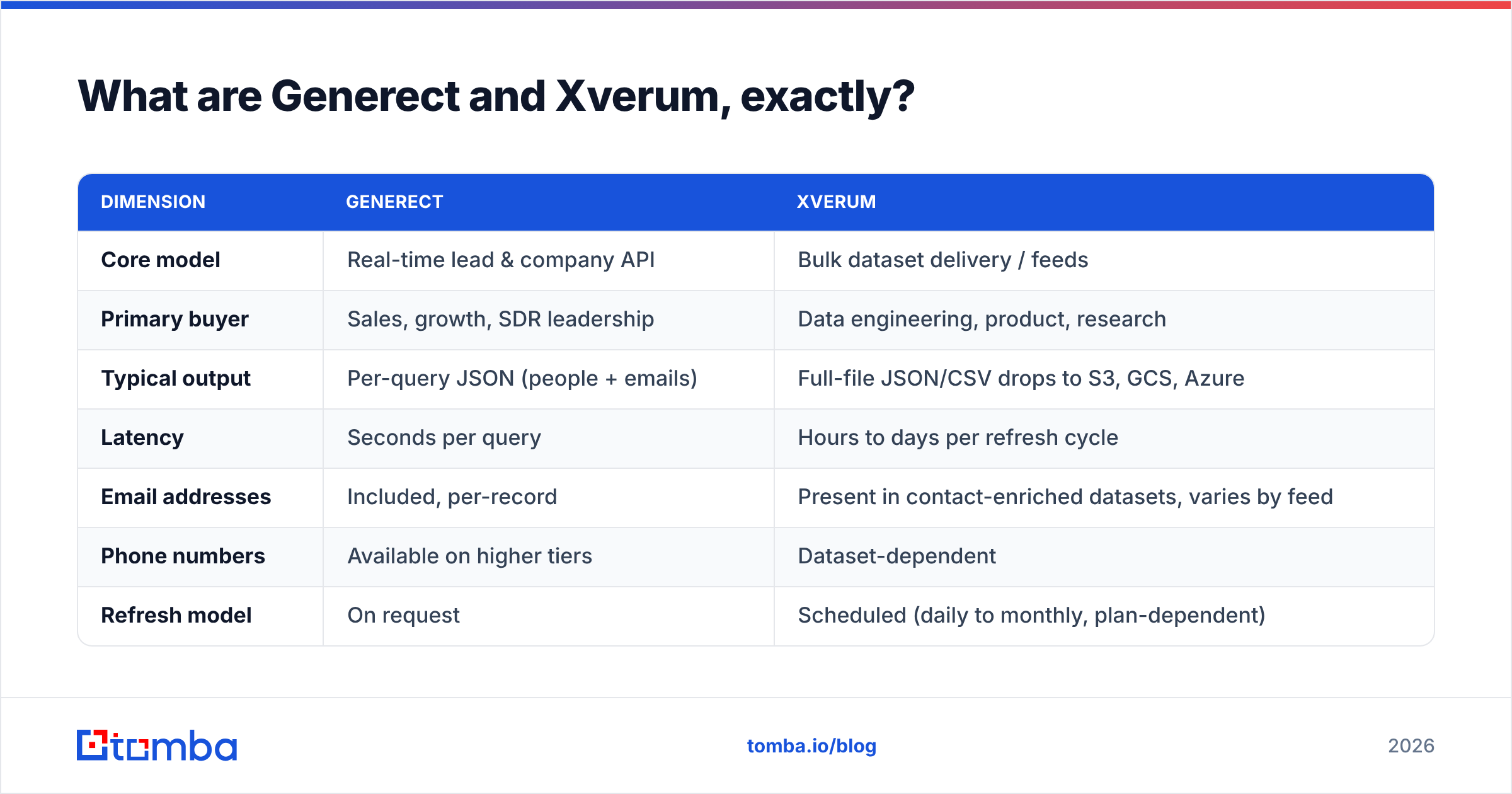
| Dimension | Generect | Xverum |
|---|---|---|
| Core model | Real-time lead & company API | Bulk dataset delivery / feeds |
| Primary buyer | Sales, growth, SDR leadership | Data engineering, product, research |
| Typical output | Per-query JSON (people + emails) | Full-file JSON/CSV drops to S3, GCS, Azure |
| Latency | Seconds per query | Hours to days per refresh cycle |
| Email addresses | Included, per-record | Present in contact-enriched datasets, varies by feed |
| Phone numbers | Available on higher tiers | Dataset-dependent |
| Refresh model | On request | Scheduled (daily to monthly, plan-dependent) |
| Best when | You need 200 leads for a campaign today | You need 20M records inside your own warehouse |
| Worst when | You want to own and re-query the whole dataset | You need one contact, right now |
How do Generect and Xverum compare on coverage and freshness?#
Coverage claims from any B2B data vendor deserve a raised eyebrow. Every provider counts records differently — one counts profiles, another counts "contacts," another counts every email variant it has ever generated. Treat published totals as directional, not as a spec.
What matters more is the shape of the coverage:
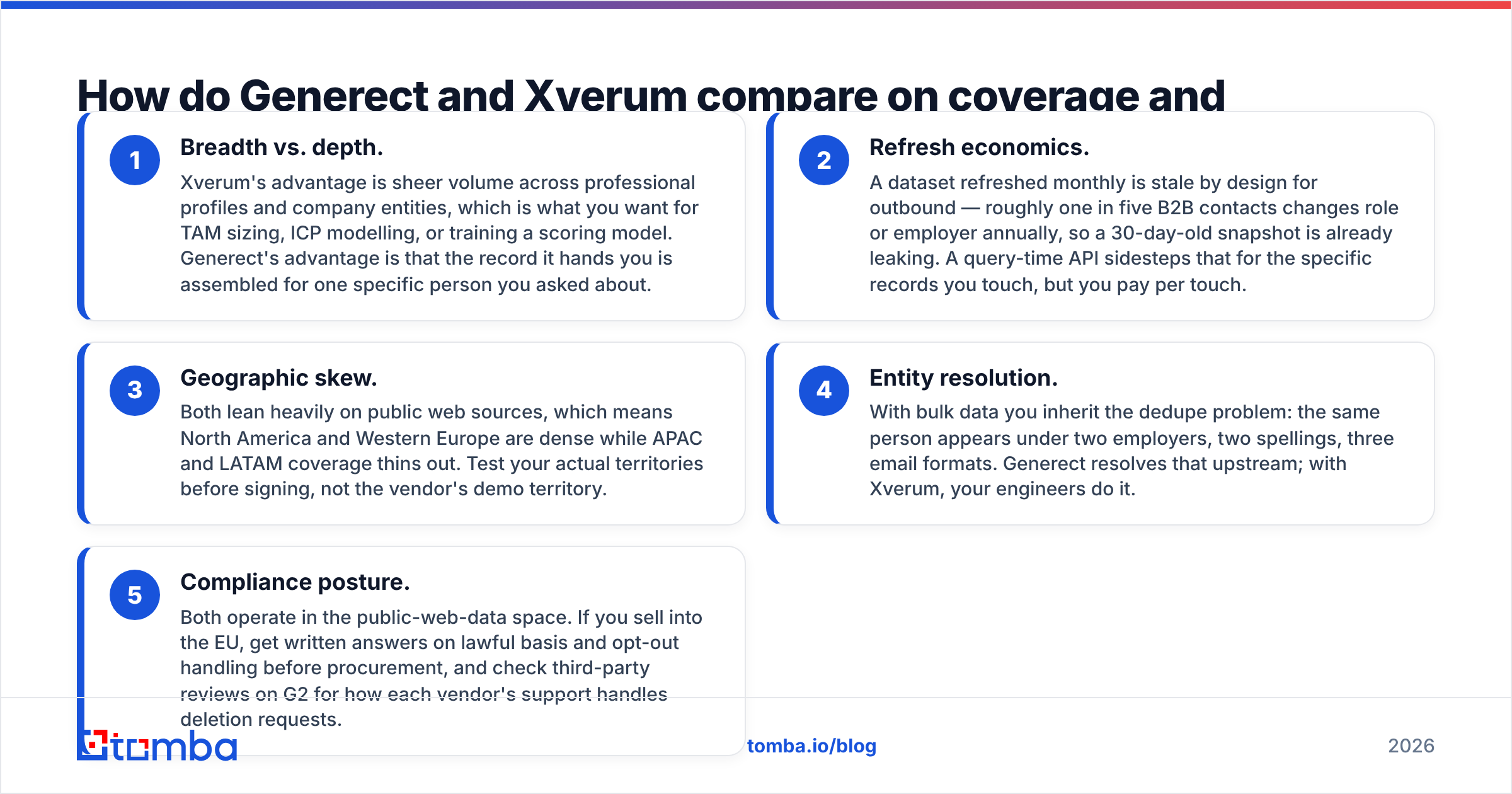
- Breadth vs. depth. Xverum's advantage is sheer volume across professional profiles and company entities, which is what you want for TAM sizing, ICP modelling, or training a scoring model. Generect's advantage is that the record it hands you is assembled for one specific person you asked about.
- Refresh economics. A dataset refreshed monthly is stale by design for outbound — roughly one in five B2B contacts changes role or employer annually, so a 30-day-old snapshot is already leaking. A query-time API sidesteps that for the specific records you touch, but you pay per touch.
- Geographic skew. Both lean heavily on public web sources, which means North America and Western Europe are dense while APAC and LATAM coverage thins out. Test your actual territories before signing, not the vendor's demo territory.
- Entity resolution. With bulk data you inherit the dedupe problem: the same person appears under two employers, two spellings, three email formats. Generect resolves that upstream; with Xverum, your engineers do it.
- Compliance posture. Both operate in the public-web-data space. If you sell into the EU, get written answers on lawful basis and opt-out handling before procurement, and check third-party reviews on G2 for how each vendor's support handles deletion requests.

Is email accuracy actually better with either one?#
Neither vendor is primarily an email-accuracy company, and that is the honest framing.
Generect returns emails as part of the lead record. Xverum can supply contact-enriched feeds. In both cases the address is derived — pattern inference plus source aggregation — and neither vendor's business model is built around defending a bounce-rate SLA the way a dedicated verification tool's is. If you push those addresses straight into a sequencer, your bounce rate is the number you will actually be judged on, and it will not match the vendor's marketing page.
Three practices keep this from wrecking your domain:
- Never trust a supplied email without independent verification. Run every list through an email verifier before it touches your sending tool. A 2% bounce ceiling is the working standard; above 4% you are gambling with your sender reputation.
- Handle catch-all domains separately. A large share of enterprise domains accept everything at the SMTP layer, so "valid" means nothing there. A catch-all verifier gives you a probability instead of a false green light.
- Re-verify anything older than 60 days. This applies double to bulk datasets, where the record may have been assembled well before it reached your bucket.
This is where the honest comparison gets uncomfortable for both tools: if what you need is a correct work email for a named person at a named company, a purpose-built email finder does that job for a fraction of a dataset contract, and it does it with verification in the same call.
How does pricing actually work for each?#
Both vendors quote rather than publish a full price list, which is standard in this category and also the main reason procurement drags. What you can plan around is the shape of the cost.
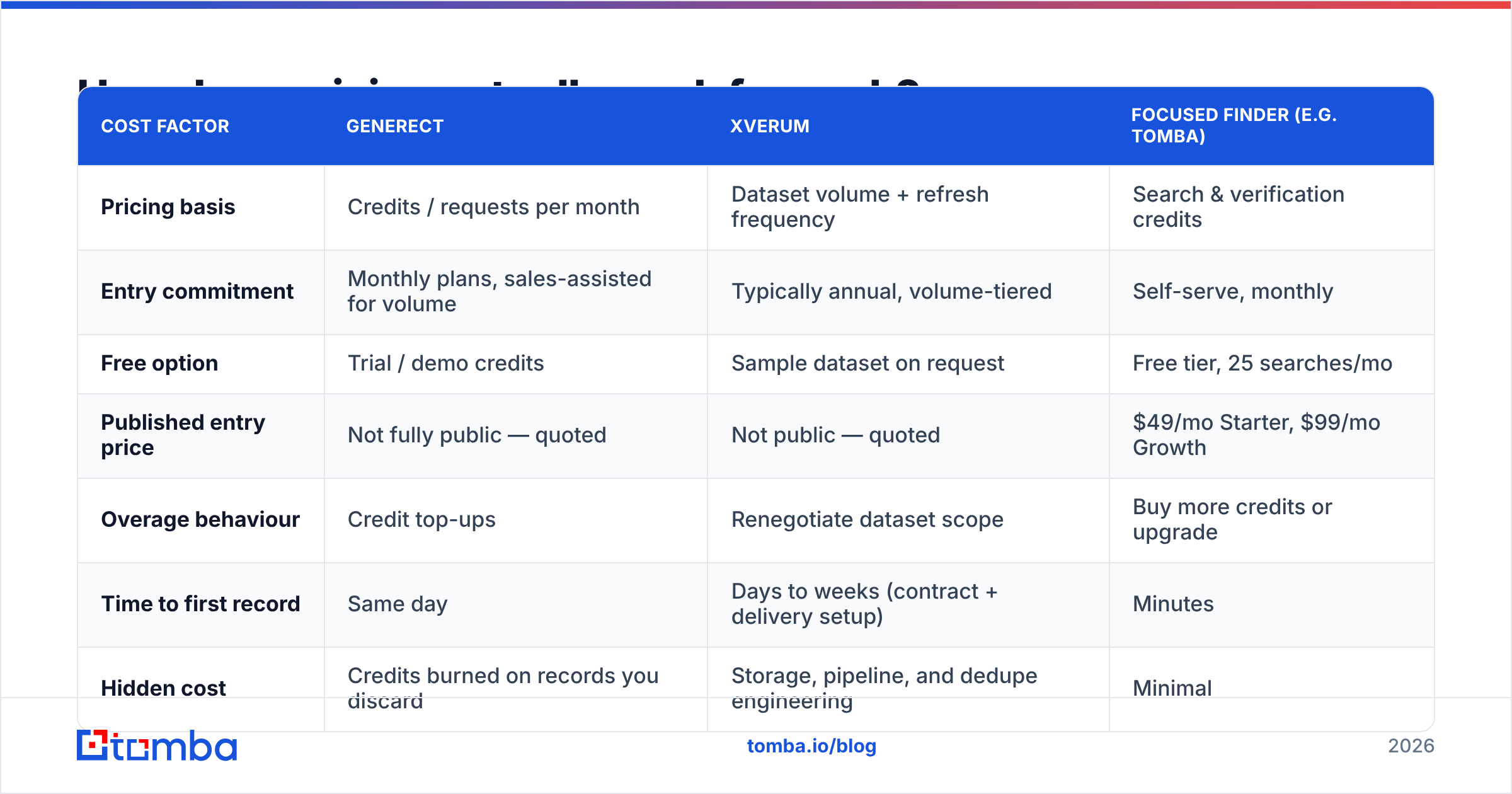
| Cost factor | Generect | Xverum | Focused finder (e.g. Tomba) |
|---|---|---|---|
| Pricing basis | Credits / requests per month | Dataset volume + refresh frequency | Search & verification credits |
| Entry commitment | Monthly plans, sales-assisted for volume | Typically annual, volume-tiered | Self-serve, monthly |
| Free option | Trial / demo credits | Sample dataset on request | Free tier, 25 searches/mo |
| Published entry price | Not fully public — quoted | Not public — quoted | $49/mo Starter, $99/mo Growth |
| Overage behaviour | Credit top-ups | Renegotiate dataset scope | Buy more credits or upgrade |
| Time to first record | Same day | Days to weeks (contract + delivery setup) | Minutes |
| Hidden cost | Credits burned on records you discard | Storage, pipeline, and dedupe engineering | Minimal |
The line that gets underestimated is the last one for Xverum. A 20M-record monthly feed is not free once it lands — you are paying for storage, normalisation, entity resolution, and someone to babysit the pipeline. Budget engineering time at least equal to the licence fee in year one.
For Generect, the underestimated cost is discard rate. Credits are consumed on results, not on results you liked. If your filters are loose, you pay for rows your SDRs will never touch. Tighten ICP filters before you scale spend.
For context on the self-serve end of the market, Tomba pricing is public: free tier at 25 searches per month, Starter at $49/mo, Growth at $99/mo, Pro at $249/mo, with enterprise quoted. Whether that is comparable depends entirely on whether you need lead volume or contact precision.

Which workflows suit Generect?#
Pick Generect when the consumer of the data is a human seller or a live application:
- SDR list building against a moving ICP. Filters change weekly; you do not want to re-license a dataset every time marketing redefines the segment.
- In-product enrichment. A signup form submits a work email or domain and you want firmographics back before the page finishes rendering.
- Territory expansion tests. Cheap to probe a new vertical with a few hundred queries before committing budget.
- Trigger-based outbound. Someone changes jobs, you want their new record — not a snapshot from last quarter's file.
If you are already piping enrichment into a CRM, check how the vendor handles field mapping and dedupe on write; that integration work is usually where "we bought a data API" turns into a two-sprint project. Tomba's HubSpot integration and Tomba API exist for the same reason — the last mile matters more than the raw record.
Which workflows suit Xverum?#
Pick Xverum when the consumer is a machine or an analyst:
- TAM and market sizing. You need the whole universe, not a filtered slice, and you need to re-cut it a dozen ways.
- Model training and lead scoring. ML pipelines want full distributions, including the negatives an API would never return.
- Competitive and hiring intelligence. Job-posting feeds over time are a genuine signal; you cannot reconstruct that from point queries.
- Building a data product. If your own customers consume the data, per-query pricing destroys your margins. Licensing a feed is the correct structure.
The failure mode is buying a feed for an outbound team. Sellers do not want 40 million rows; they want twelve good ones today. Every organisation that has made this mistake has ended up building an internal search UI over the dataset — which is, functionally, rebuilding Generect for more money.
What are the real drawbacks of each?#
Generect drawbacks: pricing opacity until you talk to sales; credit burn on low-quality matches; email accuracy that still needs independent verification; coverage that thins outside core Western markets; you never own the data, so churn means starting over.
Xverum drawbacks: long procurement; annual commitment risk before you have validated fit on your territories; freshness ceiling set by refresh cadence; substantial internal engineering load; contact fields are a secondary feature rather than the core product.
Shared drawback: both sell you records. Neither is accountable for whether those records land in an inbox. That accountability gap is the single most common reason teams end up bolting a verification layer on top of whichever vendor they picked — and why running bulk verification on every import should be a standing rule, not a one-off cleanup.
Generect vs Xverum: which should you choose in 2026?#
Short answer, by team shape:
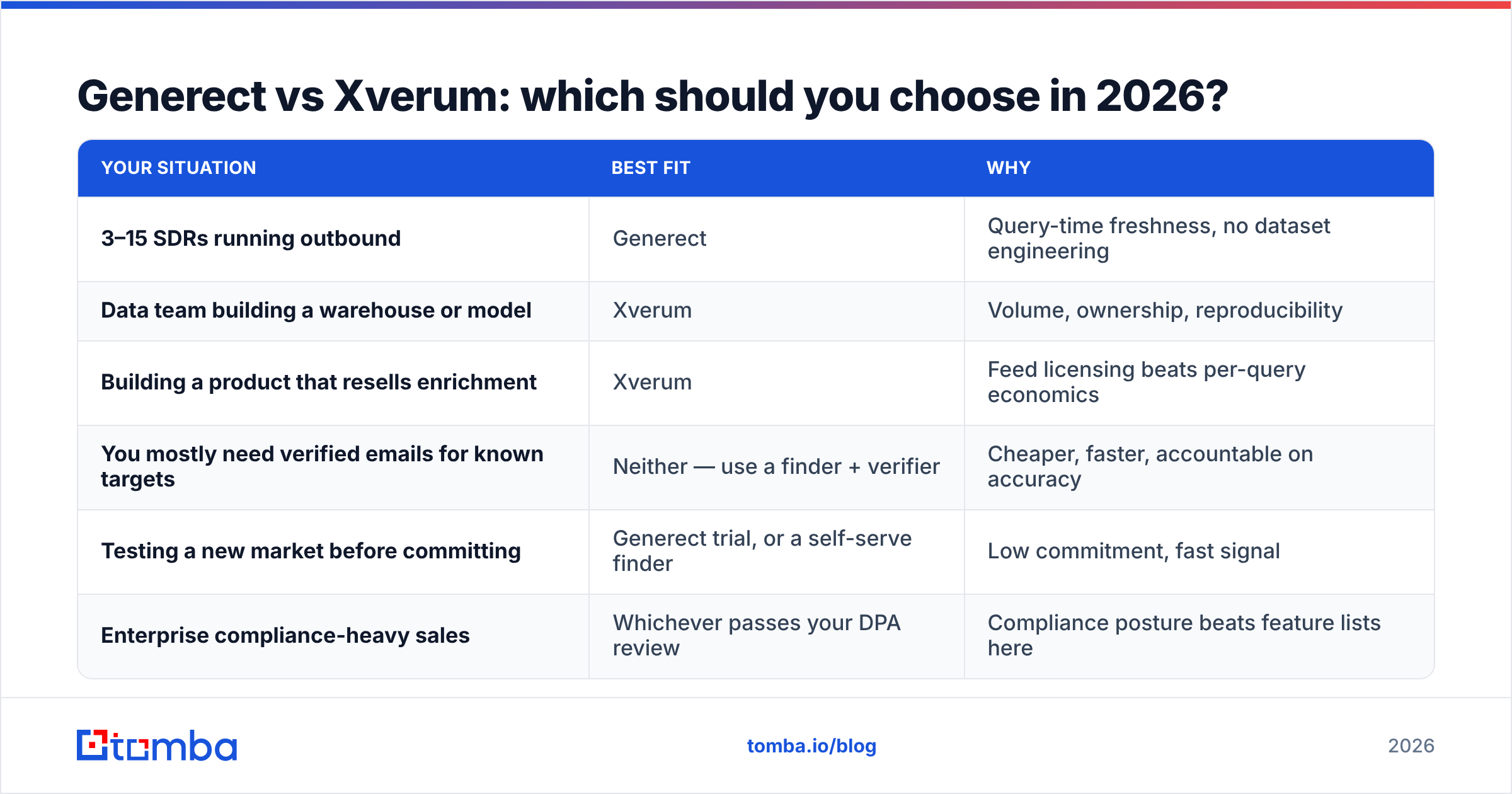
| Your situation | Best fit | Why |
|---|---|---|
| 3–15 SDRs running outbound | Generect | Query-time freshness, no dataset engineering |
| Data team building a warehouse or model | Xverum | Volume, ownership, reproducibility |
| Building a product that resells enrichment | Xverum | Feed licensing beats per-query economics |
| You mostly need verified emails for known targets | Neither — use a finder + verifier | Cheaper, faster, accountable on accuracy |
| Testing a new market before committing | Generect trial, or a self-serve finder | Low commitment, fast signal |
| Enterprise compliance-heavy sales | Whichever passes your DPA review | Compliance posture beats feature lists here |
Run the same 100-contact sample through both — your accounts, your territories, your titles — then measure match rate, bounce rate after independent verification, and cost per usable contact. That last metric is the only one that survives contact with a quarterly target. In most head-to-heads we have seen, cost per usable contact lands 2–4x higher than cost per returned record, and it lands highest for whichever vendor gave you the biggest raw number.
Get verified emails without a dataset contract#
If your bottleneck is not "how many rows can I license" but "how many of these addresses actually deliver," start narrower. The Tomba Email Finder returns work emails by name and domain with a confidence score and built-in verification, on a free tier of 25 searches a month and $49/mo from there — no annual commitment, no pipeline build, no procurement cycle. Test it against whatever Generect or Xverum quotes you, on the same 100 accounts, and let the bounce rate pick the winner.
Related guides#
Ready to find emails that actually work?
Join 150,000+ professionals who stopped guessing and started sending. Free credits on signup — no credit card required.
Get the Tomba newsletter
Practical outbound tactics and product updates — once every two weeks.
About the author