Generect vs ZeroBounce 2026: Which B2B Email Tool Wins?
Generect finds B2B leads; ZeroBounce verifies them. They get compared constantly, but they solve different halves of the same problem. Here is where each one actually wins in 2026 — and what it costs you to run both.
TL;DR
- Generect and ZeroBounce are not really competitors. Generect sources B2B contact data (company, people, LinkedIn-derived records) via search and API. ZeroBounce validates email addresses you already have.
- If your problem is "I have no list," Generect is the relevant tool. If your problem is "my list bounces at 12%," ZeroBounce is the relevant tool.
- Buying both means paying twice — once per lead sourced, again per email verified. That stacked cost is the real reason people search for a single platform.
- ZeroBounce is the stronger pure verification engine with a mature scoring and activity-data layer; Generect is stronger on developer-first lead retrieval and structured company/people search.
- Tomba covers both halves in one credit pool: find, verify, and enrich from $49/mo, with a free tier for testing before you commit.
What are Generect and ZeroBounce, exactly?#
They sit at opposite ends of the same pipeline.
Generect (generect.com) is a B2B lead generation and data retrieval platform. Its pitch is structured access to company and people records — search by industry, headcount, role, geography, or LinkedIn identifiers, then pull the resulting contacts through a UI or an API. It leans developer-first: teams that want to wire lead sourcing into their own product, enrichment service, or internal GTM tooling are its natural buyer. The output is records — names, companies, roles, and contact points you did not have before.
ZeroBounce (zerobounce.net) is an email validation and deliverability platform. You give it addresses; it tells you which ones are valid, invalid, catch-all, disposable, role-based, abuse-prone, or toxic. Around that core it has built a wider deliverability suite: inbox placement testing, blacklist monitoring, an email scoring model for risky-but-not-invalid addresses, and warmup. It does not build your list. It protects it.
Here is the distinction that matters for budget:
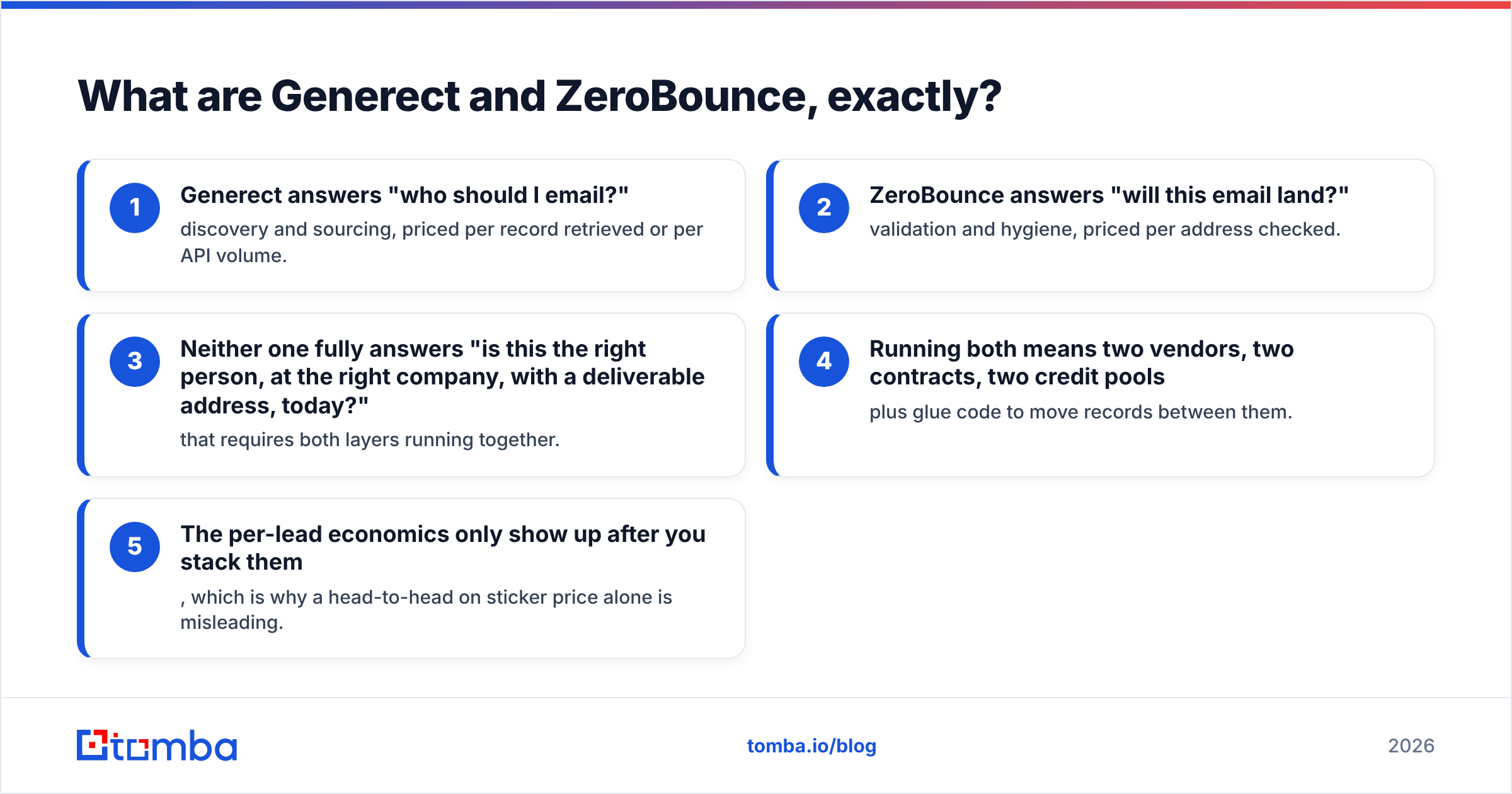
- Generect answers "who should I email?" — discovery and sourcing, priced per record retrieved or per API volume.
- ZeroBounce answers "will this email land?" — validation and hygiene, priced per address checked.
- Neither one fully answers "is this the right person, at the right company, with a deliverable address, today?" — that requires both layers running together.
- Running both means two vendors, two contracts, two credit pools — plus glue code to move records between them.
- The per-lead economics only show up after you stack them, which is why a head-to-head on sticker price alone is misleading.

How do Generect and ZeroBounce compare feature by feature?#
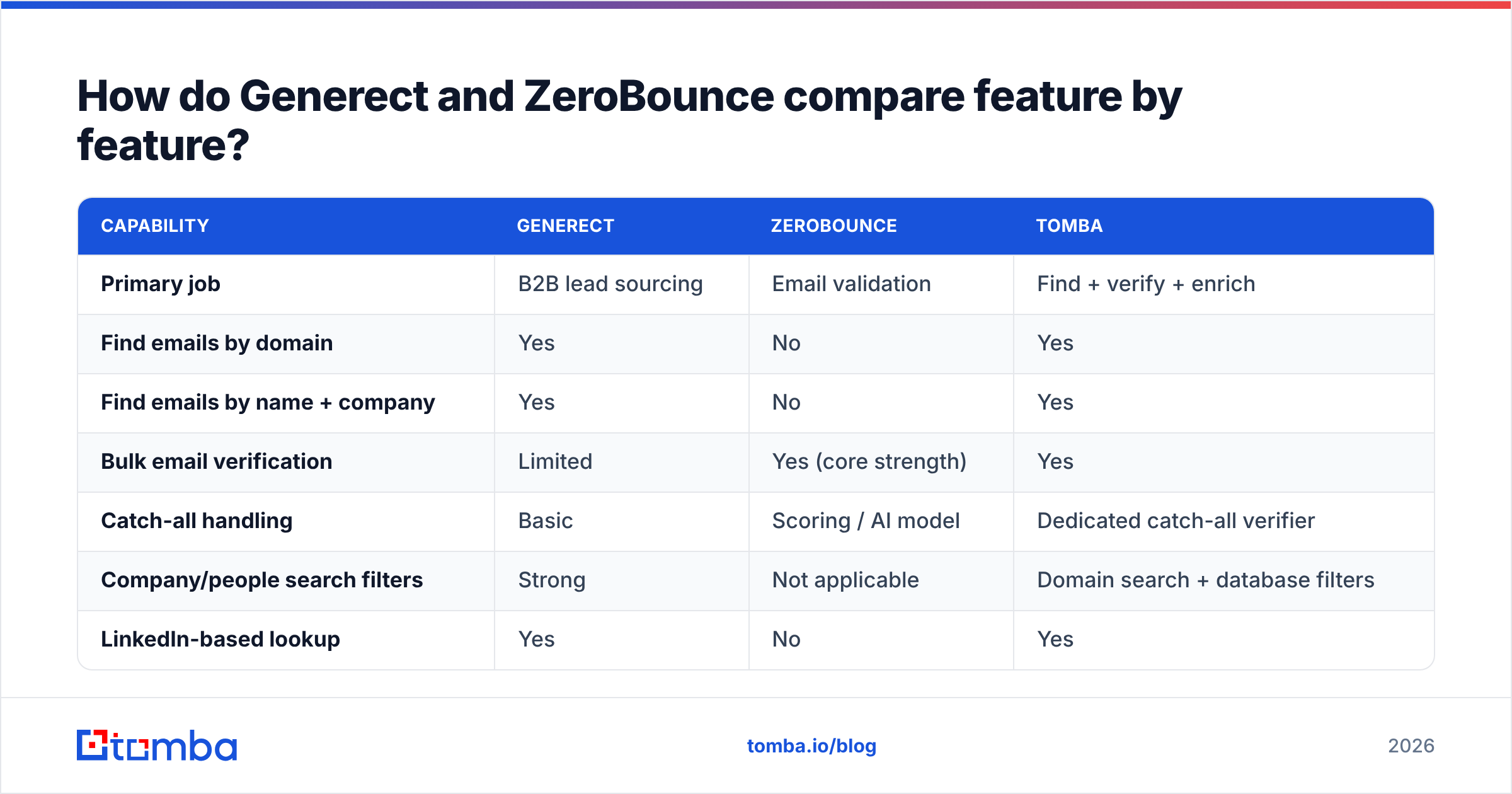
The honest comparison is a coverage map, not a scoreboard. Each tool is close to complete on its own side and mostly absent on the other.
| Capability | Generect | ZeroBounce | Tomba |
|---|---|---|---|
| Primary job | B2B lead sourcing | Email validation | Find + verify + enrich |
| Find emails by domain | Yes | No | Yes |
| Find emails by name + company | Yes | No | Yes |
| Bulk email verification | Limited | Yes (core strength) | Yes |
| Catch-all handling | Basic | Scoring / AI model | Dedicated catch-all verifier |
| Company/people search filters | Strong | Not applicable | Domain search + database filters |
| LinkedIn-based lookup | Yes | No | Yes |
| Phone numbers | Partial | No | Yes |
| Inbox placement / blacklist tools | No | Yes | No (verification only) |
| Public API | Yes | Yes | Yes |
| Spreadsheet add-ons | Limited | Yes | Excel + Google Sheets |
| Free tier | Trial / demo-led | 100 credits/month | 25 searches/month |
| Entry paid plan | Quote-led, volume-based | Pay-as-you-go from ~$18 | $49/mo |

Two things stand out. First, ZeroBounce's advantage is depth on a narrow job — nobody builds a better bounce-prevention stack by accident, and its deliverability tooling around the verifier is genuinely more complete than what most finders ship. Second, Generect's advantage is retrieval flexibility — if you need programmatic access to structured B2B records rather than a seat-based UI, that is a real differentiator.
Neither advantage helps you if you bought the wrong half.
Which one is more accurate — and accurate at what?#
This is where most comparison posts go wrong, because "accuracy" means two different things here.
For Generect, accuracy means coverage and freshness. Did it return an email for the contact you asked about, and is that person still in that role? Sourcing tools fail in two directions: they return nothing (low hit rate) or they return a stale address for someone who left the company eight months ago. Job-change churn in B2B runs roughly 20–30% a year in sales and marketing roles, so a database refreshed quarterly is structurally different from one refreshed continuously.
For ZeroBounce, accuracy means classification correctness. Did it correctly mark a valid address as valid, and — harder — did it avoid marking a good address as invalid? False positives are the expensive failure mode nobody measures. If a verifier throws away 4% of your deliverable contacts to protect a headline bounce rate, that is revenue you never see.

The hardest case for both tools is catch-all domains. A catch-all server accepts every address at the domain, so a standard SMTP check returns "valid" for asdfgh@company.com just as readily as for the CEO. ZeroBounce handles this with a scoring model that estimates likelihood rather than returning a binary verdict. Generect, like most sourcing tools, gives you a confidence signal but is not built to resolve catch-alls at scale. If a meaningful share of your ICP sits behind Microsoft 365 tenants configured as catch-all — and in enterprise it often does — this single behaviour decides which vendor you need.
Tomba's approach is a dedicated catch-all verifier that runs pattern confidence, historical observation, and SMTP evidence together instead of forcing a coin flip. That is worth testing against whichever incumbent you use, on your own list, before you take anyone's published benchmark at face value.
How to run that test properly:
- Pull 500 addresses you already know the truth about — contacts who replied in the last 90 days, plus a set of confirmed hard bounces.
- Run the same file through each tool on the same day.
- Score four cells, not one: true valid, true invalid, false valid (bounces you'll eat), false invalid (revenue you'll lose).
- Repeat with a catch-all-heavy segment separately. Blended numbers hide the failure that matters.
How does the pricing actually compare?#
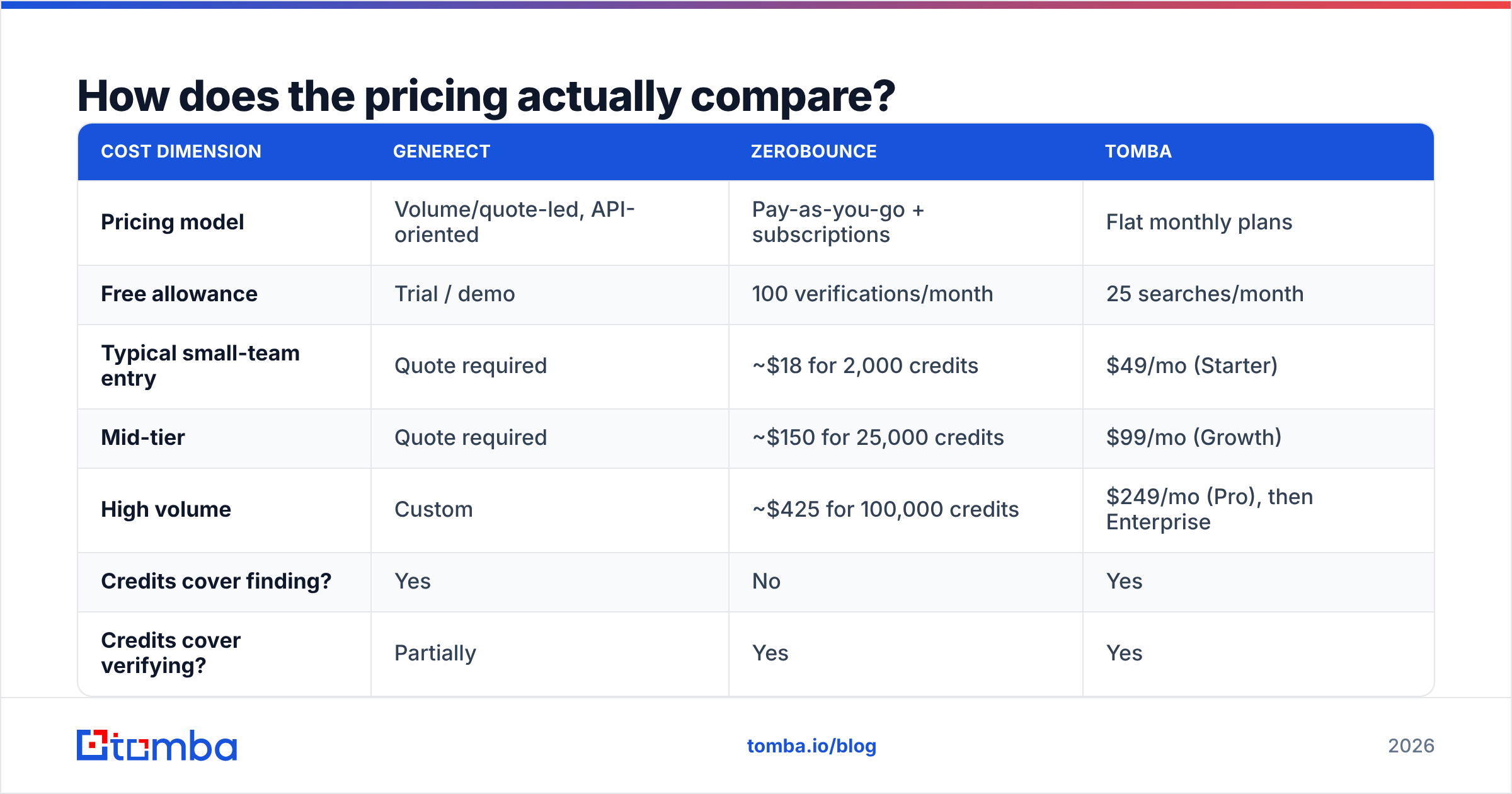
Direct comparison is awkward because the units differ. Generect prices access to records; ZeroBounce prices verification volume. Both publish or quote tiers that change over time, so treat the figures below as shape rather than gospel and check the vendor pages before you sign.
| Cost dimension | Generect | ZeroBounce | Tomba |
|---|---|---|---|
| Pricing model | Volume/quote-led, API-oriented | Pay-as-you-go + subscriptions | Flat monthly plans |
| Free allowance | Trial / demo | 100 verifications/month | 25 searches/month |
| Typical small-team entry | Quote required | ~$18 for 2,000 credits | $49/mo (Starter) |
| Mid-tier | Quote required | ~$150 for 25,000 credits | $99/mo (Growth) |
| High volume | Custom | ~$425 for 100,000 credits | $249/mo (Pro), then Enterprise |
| Credits cover finding? | Yes | No | Yes |
| Credits cover verifying? | Partially | Yes | Yes |
| Rollover / expiry | Contract-dependent | PAYG credits do not expire | Plan-dependent — see Tomba pricing |
The stacked-cost math is the part worth sitting with. Say you source 10,000 contacts a month and verify all of them. You pay a sourcing vendor for 10,000 records, then a verification vendor for 10,000 checks. Even at friendly rates, you have doubled the per-contact cost of a list that has not sent a single email yet. And roughly 15–25% of those records will be discarded at the verification step — meaning you paid full sourcing price for data you then threw away.
A combined platform does not magically make data free, but it removes the second invoice and lets you verify at the moment of retrieval rather than as a separate batch job days later. That timing difference matters: an address verified the same hour it was sourced is meaningfully more reliable than one verified after sitting in a CSV for three weeks.

Who should pick Generect?#
Generect makes sense when sourcing is the bottleneck and you have engineers.
- You are building a product or internal tool that needs B2B records on demand, not a rep clicking through a UI.
- Your targeting is structural — industry, headcount band, geography, function — rather than account-by-account.
- You already have a verification layer you trust and are not looking to replace it.
- You want LinkedIn-derived records as a primary sourcing path rather than a bolt-on.
It is a weaker fit if you are a two-person sales team that wants to look up thirty prospects a week. The overhead of an API-first workflow is not worth it at that scale, and quote-led pricing rarely favours small volumes.
Who should pick ZeroBounce?#
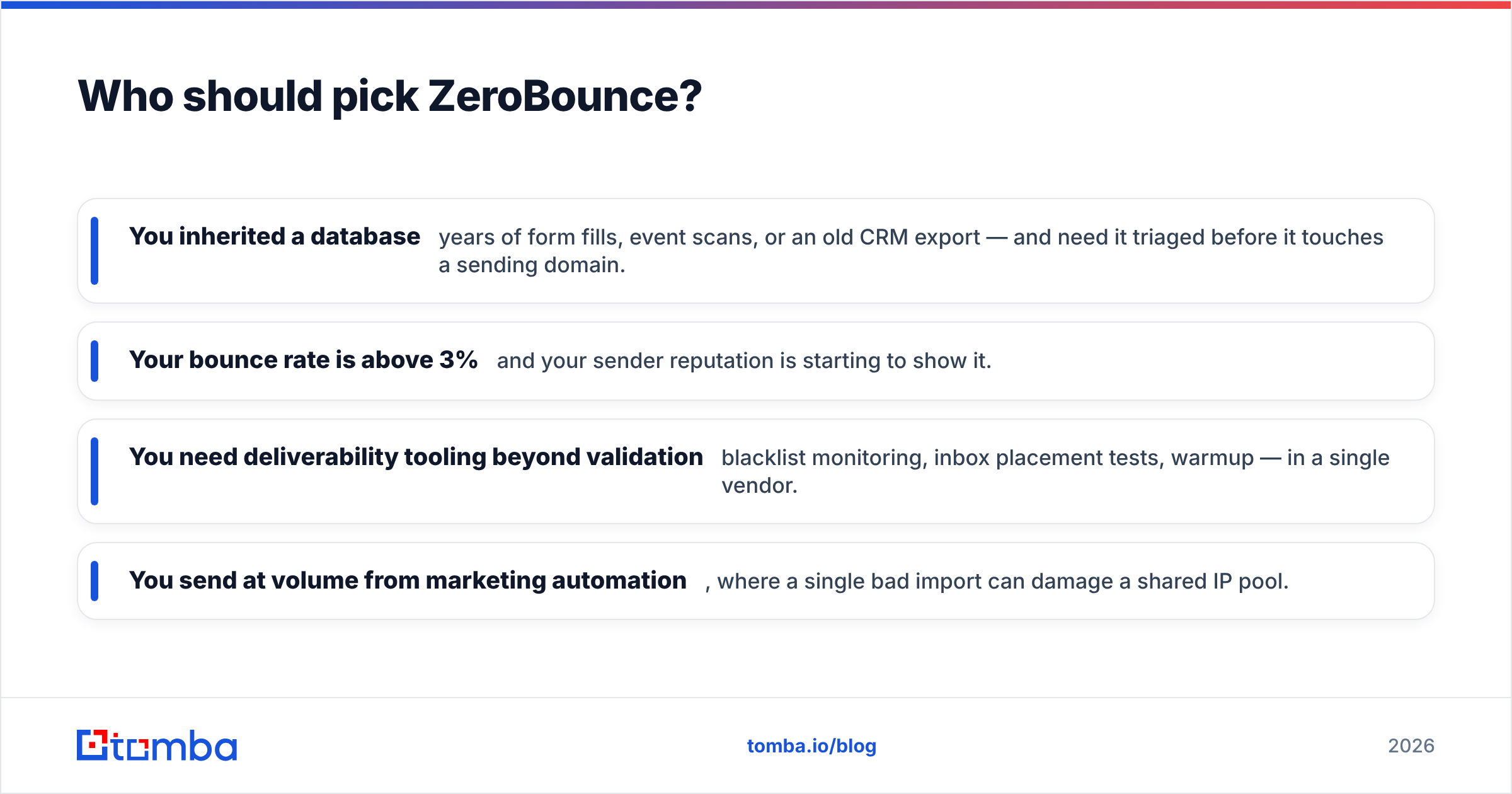
ZeroBounce makes sense when your list already exists and your problem is what happens after you press send.
- You inherited a database — years of form fills, event scans, or an old CRM export — and need it triaged before it touches a sending domain.
- Your bounce rate is above 3% and your sender reputation is starting to show it.
- You need deliverability tooling beyond validation — blacklist monitoring, inbox placement tests, warmup — in a single vendor.
- You send at volume from marketing automation, where a single bad import can damage a shared IP pool.
It is the wrong tool if you have no list. ZeroBounce cannot manufacture contacts, and no amount of validation credits will fix an empty pipeline. Reviews on G2 reflect this cleanly: praise clusters around accuracy and support, complaints cluster around people expecting prospecting features that were never advertised.
Do you actually need both — or one platform?#
Ask what your pipeline looks like twelve months from now.
If you will keep sourcing new contacts continuously, you need finding and verifying permanently — not as a one-time cleanup. In that case a combined platform usually wins on cost, latency, and fewer moving parts. If your list is essentially fixed and your only recurring job is hygiene, a dedicated verifier is the cleaner buy and you should not pay for sourcing capacity you never use.
There is a third pattern worth naming: teams that buy pre-verified list data outright. Vendors like BookYourData occupy that middle ground well — you are buying records that arrive already validated, which collapses both steps into a purchase rather than a workflow. That suits campaign-based teams with defined, finite target lists; it suits continuous outbound less well, because static lists decay from the day you buy them.
For everyone else, the combined-platform route is where the arithmetic lands. Tomba's email finder and email verifier draw on one credit pool, so a contact discovered by domain search is validated in the same call rather than exported, batched, and re-imported. The same operations are available through the Tomba API if you are building rather than clicking — which covers the developer use case Generect targets — and through Excel, Google Sheets, and a Chrome extension if you are not.
What is the verdict on Generect vs ZeroBounce?#
Neither is better. They are answers to different questions, and picking the wrong one wastes a quarter.
- Choose Generect if sourcing structured B2B records through an API is your bottleneck, you have engineering capacity, and verification is already solved elsewhere.
- Choose ZeroBounce if your list exists, your bounce rate is hurting you, and you want deliverability depth from a specialist. It is the stronger tool on that axis than any generalist finder, including generalists that market themselves on verification.
- Choose neither, and consolidate, if you are doing both jobs monthly and paying two vendors for what is really one workflow. That is the most common situation and the one most likely to be quietly overspending.
Whatever you pick, run the 500-address test described above on your own data before committing annual budget. Vendor accuracy claims are measured on vendor-chosen samples. Yours will differ.
Ready to test the consolidated path? Start with the Tomba Email Finder — 25 free searches a month, no card, with verification included in the same result so you can see the found-and-verified hit rate on your real ICP before you compare it to anything else. If it beats your current stack on cost per deliverable contact, the migration pays for itself in the first month; if it does not, you have lost nothing but an afternoon.
Related guides#
Ready to find emails that actually work?
Join 150,000+ professionals who stopped guessing and started sending. Free credits on signup — no credit card required.
Get the Tomba newsletter
Practical outbound tactics and product updates — once every two weeks.
About the author