Generect vs ZoomInfo: B2B Data Accuracy and Cost Compared
One is an API-first LinkedIn-sourced lead database with self-serve pricing. The other is the enterprise GTM data standard with annual contracts. Here is how Generect and ZoomInfo actually compare on coverage, accuracy, cost and lock-in.
Generect vs ZoomInfo comes down to one question. Do you want a data feed, or a data platform? Generect sells an API-first lead database, month to month. ZoomInfo sells a full go-to-market suite on a yearly contract. Here is how the two stack up on data, price, and lock-in.
TL;DR
- Generect is an API-first B2B lead database. It is built on LinkedIn-sourced company and people data, and you can buy it self-serve.
- ZoomInfo is a full GTM platform: data, intent, call recording, and workflow. You buy it through a rep, on a yearly deal.
- Building a product, an agency workflow, or an outbound machine? Generect's API and monthly terms are far easier to live with.
- Need deep North American data, org charts, intent signals, and CRM controls for 40 reps? ZoomInfo still has the widest moat. Expect five figures a year.
- Neither tool is a safety net. Both ship stale addresses. Both will bill you for bounces. Run a separate email verifier before any send.
- Most teams under 20 reps buy too much. An email finder plus a verifier covers about 80% of the job.
What are Generect and ZoomInfo?#
Generect is a B2B data provider built on LinkedIn-style records. The pitch is simple. It gives you an API that returns companies, people, and contact details.
You filter the way you would in LinkedIn Sales Navigator: headcount, industry, region, job title, tech stack. There is a UI too. But the API and bulk export are the heart of the product.
Pricing is public, self-serve, and month to month. That alone sets it apart from the big incumbents.
ZoomInfo is the incumbent. It began as a contact database and grew into a full sales system.
Today it bundles contact and company data, buyer intent signals, tech data, org charts, and website visitor tracking. It also sells a sales engagement layer (Engage) and a call analysis tool (Chorus). Both plug straight into Salesforce and HubSpot.
You buy it on a yearly contract, priced per seat plus blocks of credits, through a rep.
So the real question is not "whose emails are better." It is this: do you want a data feed, or a data platform? Answer that first. It settles the choice before you look at a single accuracy number.
Generect vs ZoomInfo: how do they compare at a glance?#
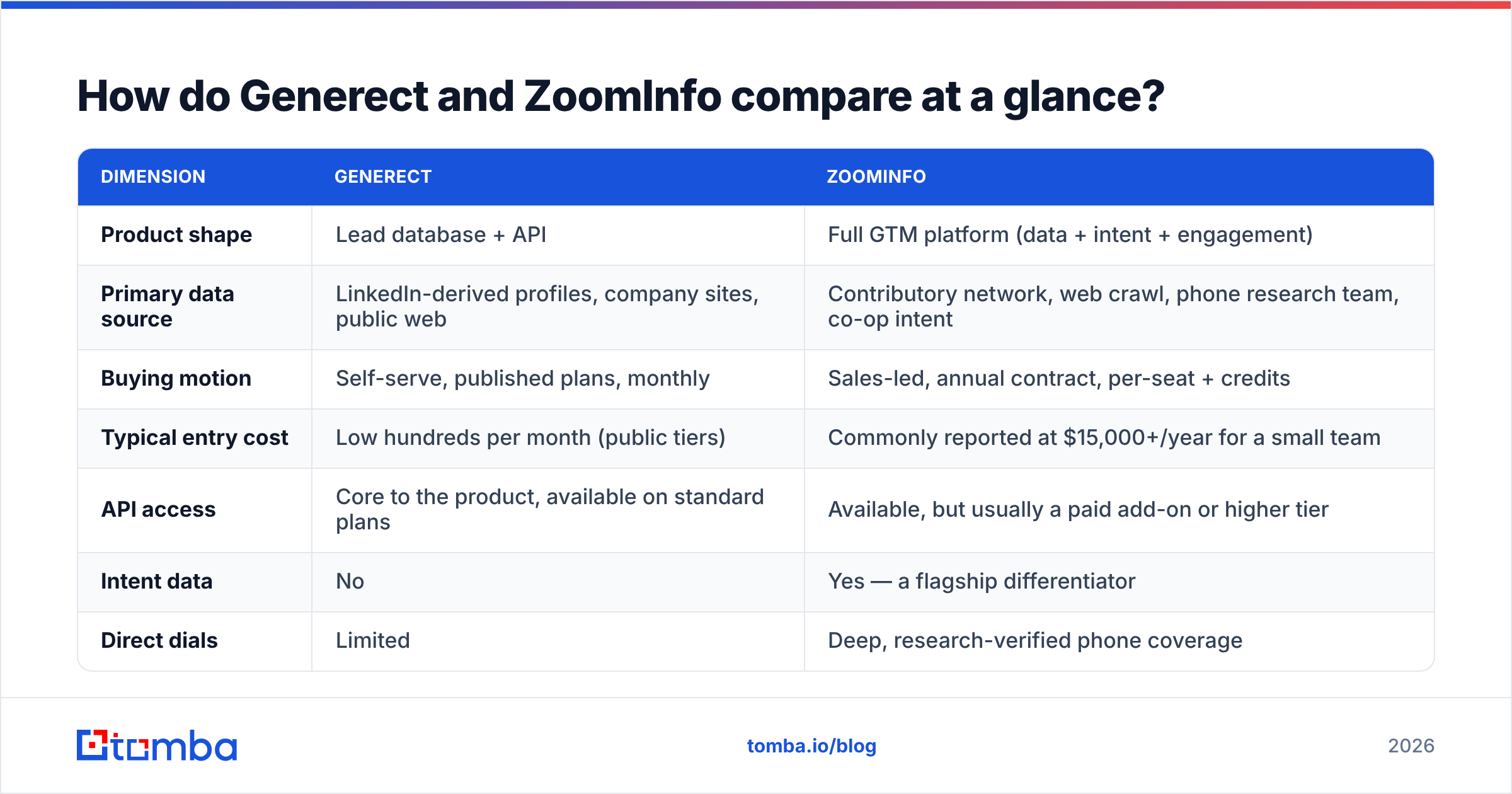
| Dimension | Generect | ZoomInfo |
|---|---|---|
| Product shape | Lead database + API | Full GTM platform |
| Main data source | LinkedIn-style profiles, company sites, public web | Contributory network, web crawl, phone team, intent co-op |
| Buying motion | Self-serve, public plans, monthly | Sales-led, yearly contract |
| Entry cost | Low hundreds per month | Often $15,000+ per year |
| Contract term | Cancel monthly | Yearly minimum, auto-renew |
| Capability | Generect | ZoomInfo |
|---|---|---|
| API access | Core, on standard plans | Usually a paid add-on |
| Intent data | No | Yes — the flagship feature |
| Direct dials | Limited | Deep, phone-checked |
| Org charts | Basic | Strong |
| Geography | Global, strong in Europe | Strongest in North America |
| Best for | Developers, agencies, lean teams | Big sales orgs with RevOps staff |
Those two tables are the whole argument. Generect wins on access and freedom. ZoomInfo wins on breadth and depth. Neither wins on both.

Where does each one get its data?#
Source matters more than any accuracy claim. It tells you what goes stale, and how fast.
- Generect — built from profiles. Records come from LinkedIn profiles and public company pages. Emails are then guessed from company patterns. Job titles stay fresh, because people update their own profiles. But many emails are inferred, not observed, and direct dials are thin.
- ZoomInfo — built from a co-op. Users install ZoomInfo tools, which share signals from their email and calendar data. The platform matches that against web crawls and a human research team. Coverage in North America is unmatched, and the phone numbers get dialed. The trade-off: the co-op model raises consent questions in the EU, and non-US coverage thins out.
- Decay is the real enemy. B2B contact data rots by 25–30% a year, mostly from job changes. G2 research and vendor benchmarks both land near that mark. A database refreshed once a quarter is wrong about one time in eight.
- Neither replaces a verifier. A vendor can call an address "valid" at export time. That says nothing about whether the mailbox accepts mail today. That is a live SMTP question.

How accurate is the email data in practice?#
Treat every published accuracy claim as marketing. Both vendors quote numbers in the 90s. Both picked the dataset they measured.
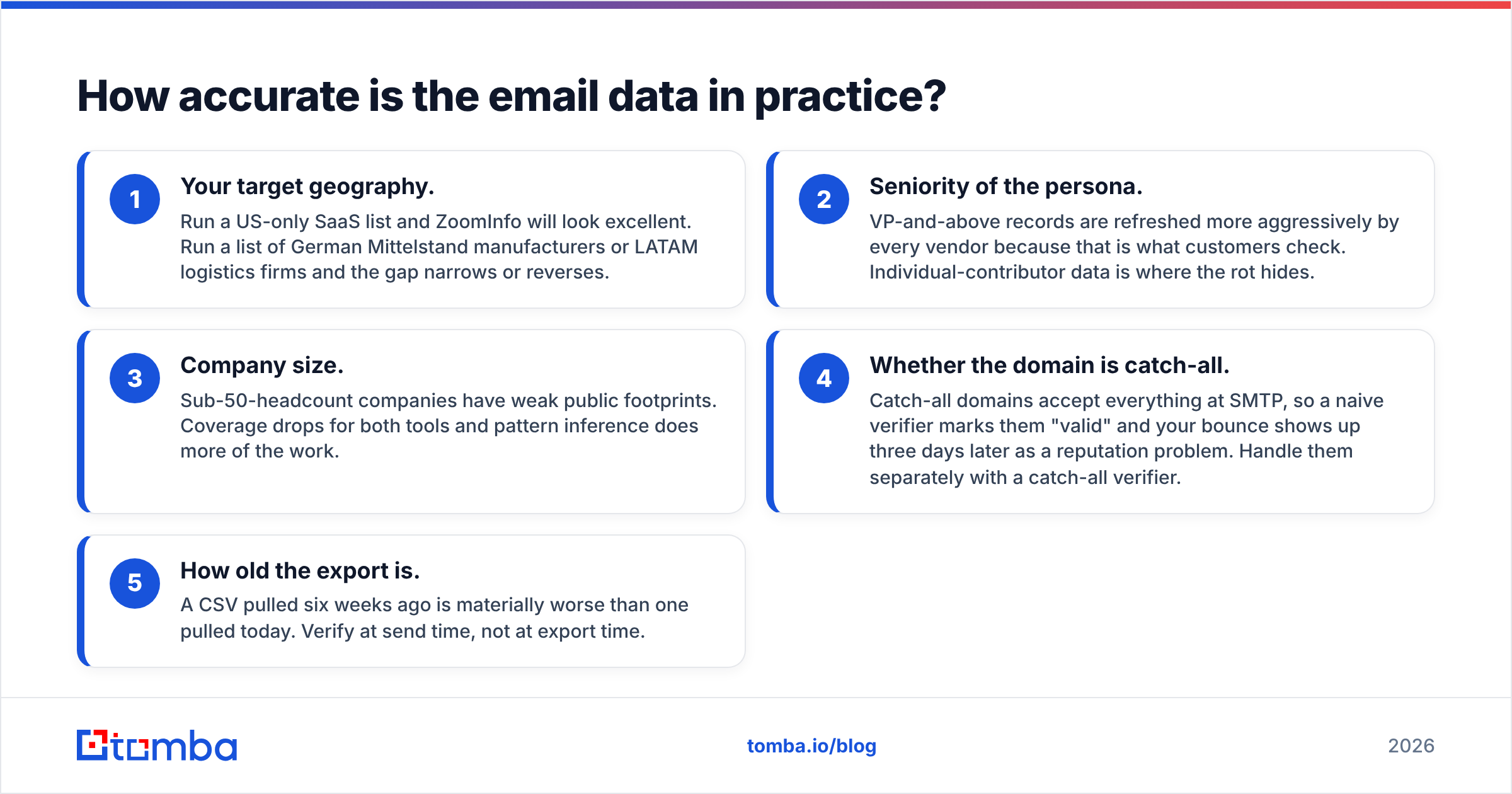
Five things actually drive your bounce rate:
- Your target region. Run a US-only SaaS list and ZoomInfo looks great. Run German manufacturers or LATAM logistics firms and the gap shrinks, or flips.
- How senior the persona is. Every vendor refreshes VP-level records first, because that is what buyers spot-check. The rot hides in individual-contributor data.
- Company size. Firms under 50 people leave a thin public trail. Coverage drops for both tools, and guesswork does more of the work.
- Catch-all domains. These accept every address at SMTP. A basic verifier calls them "valid," and the bounce lands three days later as a sender-reputation problem. Handle them with a catch-all verifier.
- How old the export is. A CSV pulled six weeks ago is much worse than one pulled today. Verify at send time, not at export time.
Here is a test that beats any comparison post, including this one. Pull 250 records of your exact ICP from each tool. Run them all through one neutral verifier. Then compare three numbers: how many records came back with an email, how many were valid, and how many were catch-all. It costs you an afternoon.
What does each one actually cost?#
Generect lists its tiers in public. They sit in the self-serve range and scale by credits and API calls. There is no minimum term. Check the live page before you budget, because self-serve vendors reprice often.
ZoomInfo does not publish prices. Reported deals on G2 and buyer forums put small teams at $15,000–$25,000 a year. You pay per seat, on top of a shared credit pool. Intent, Engage, Chorus, and API access all cost extra.
The Generect vs ZoomInfo cost gap is the widest part of this comparison. Three things catch first-time buyers off guard:
- Credits are the real unit. Seats give access. Credits give exports. Teams burn the year's credits by month seven, then top up mid-term at a worse rate.
- Auto-renewal is the default. Standard paper gives you a 30–60 day notice window. Put it in your calendar on day one.
- API access is rarely included. If you plan to pipe data into your own system, price that before you sign.
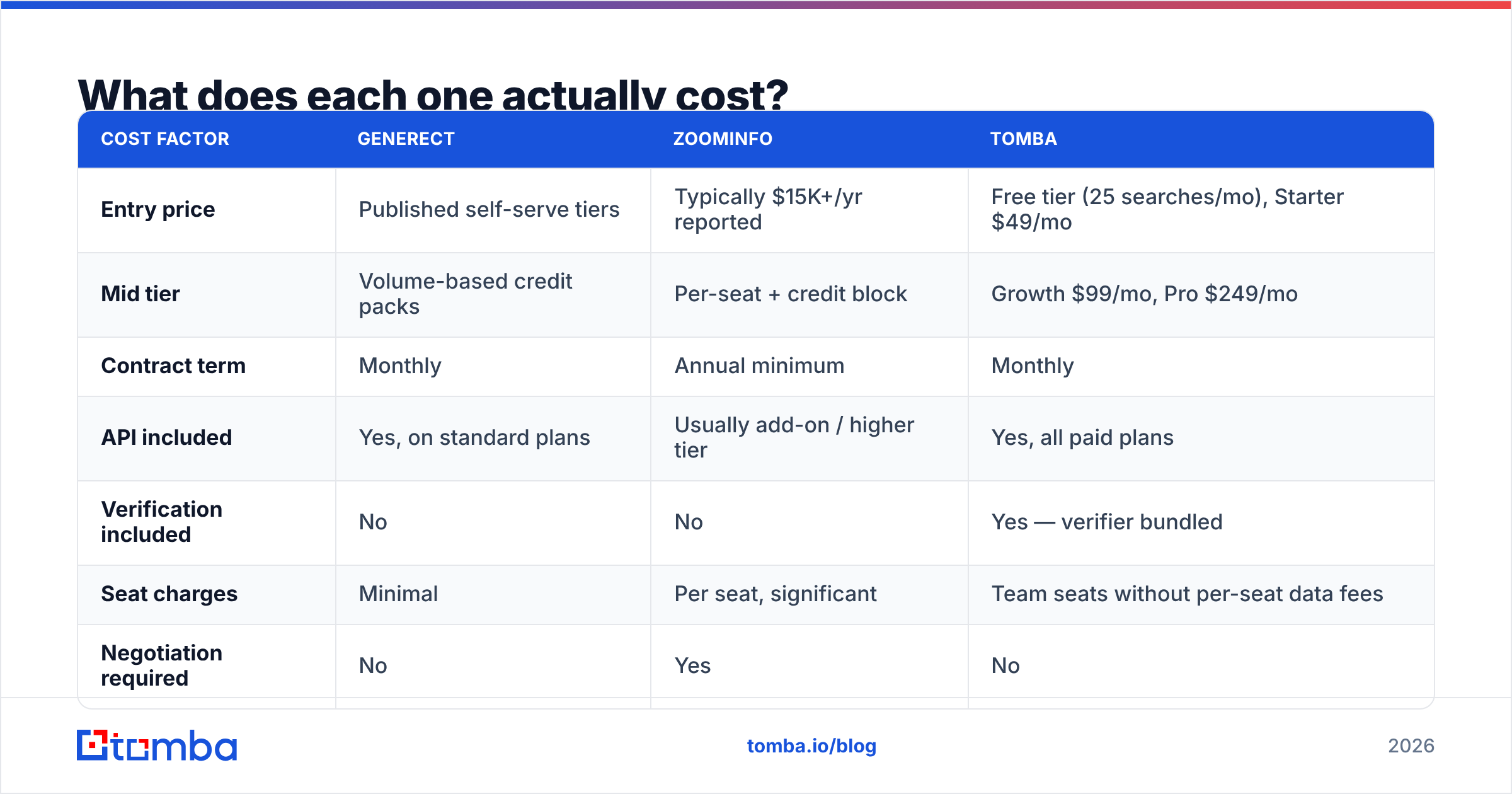
Here is the cost picture side by side, including where a focused finder-plus-verifier stack sits:
| Cost factor | Generect | ZoomInfo | Tomba |
|---|---|---|---|
| Entry price | Published self-serve tiers | Typically $15K+/yr reported | Free tier (25 searches/mo), Starter $49/mo |
| Mid tier | Volume-based credit packs | Per-seat + credit block | Growth $99/mo, Pro $249/mo |
| Contract term | Monthly | Annual minimum | Monthly |
| API included | Yes, on standard plans | Usually add-on / higher tier | Yes, all paid plans |
| Verification included | No | No | Yes — verifier bundled |
| Seat charges | Minimal | Per seat, significant | Team seats without per-seat data fees |
| Negotiation required | No | Yes | No |

Which is better for API and automation work?#
Generect, by a wide margin, if you are building something.
Say you run lead gen for 15 clients. Or you wire enrichment into product onboarding. Or you build a routing pipeline. You need three things: a documented endpoint, clear per-call pricing, and no procurement cycle. Generect gives you all three on a card swipe.
ZoomInfo has an API, and it is capable. But it sits behind a sales conversation and a higher tier. Its rate limits and usage terms are written for big integration projects, not experiments.
The flip side: say your goal is Salesforce hygiene at scale. Nightly enrichment of 200,000 accounts, with mapped fields and audit trails. ZoomInfo's native integration beats anything you would build from a raw API. Different jobs.
If you build your own stack, an email finder API with flat, public per-call pricing is often the missing piece. It lets you re-check contacts on demand, instead of trusting a six-month-old export.
What about GDPR and compliance risk?#
Both vendors publish compliance docs. Both operate legally. Their risk profiles still differ.
ZoomInfo's co-op model draws the most scrutiny, because user email and calendar data feeds the database. It has faced US class actions over publicity rights. In the EU, its legal basis for holding resident records is still debated. ZoomInfo offers notice, opt-out, and a DPA. Legal teams usually get comfortable, but they spend time on it.
Generect raises a different question. Its LinkedIn-based sourcing is a platform terms issue more than a consent issue. Its strong EU coverage means GDPR applies to a large share of its records.
The advice is the same either way. Write down your legitimate-interest assessment. Honor suppression requests on time. Keep a source note for every record. Never buy data whose origin you cannot explain. Ask both vendors where one record came from — the answer tells you a lot. Tomba publishes its own data sources for that reason.
Generect vs ZoomInfo: which should you choose?#
- Choose ZoomInfo if you sell to US mid-market or enterprise buyers. You need RevOps staff to run it. You want intent signals and direct dials. And a five-figure line item is normal for your budget. It is the safe institutional pick, and North American coverage earns it.
- Choose Generect if you are technical and want data as an input to something you build. It fits teams selling in Europe or worldwide. It also fits anyone who refuses to sign a year-long deal just to test an idea. Self-serve API access is the real differentiator.
- Choose neither if your real problem sounds like this: "I have 500 target companies and I need the right person's email at each one." That is a finder-and-verifier job, not a database job. Paying database prices for it is the most common overspend in early outbound.
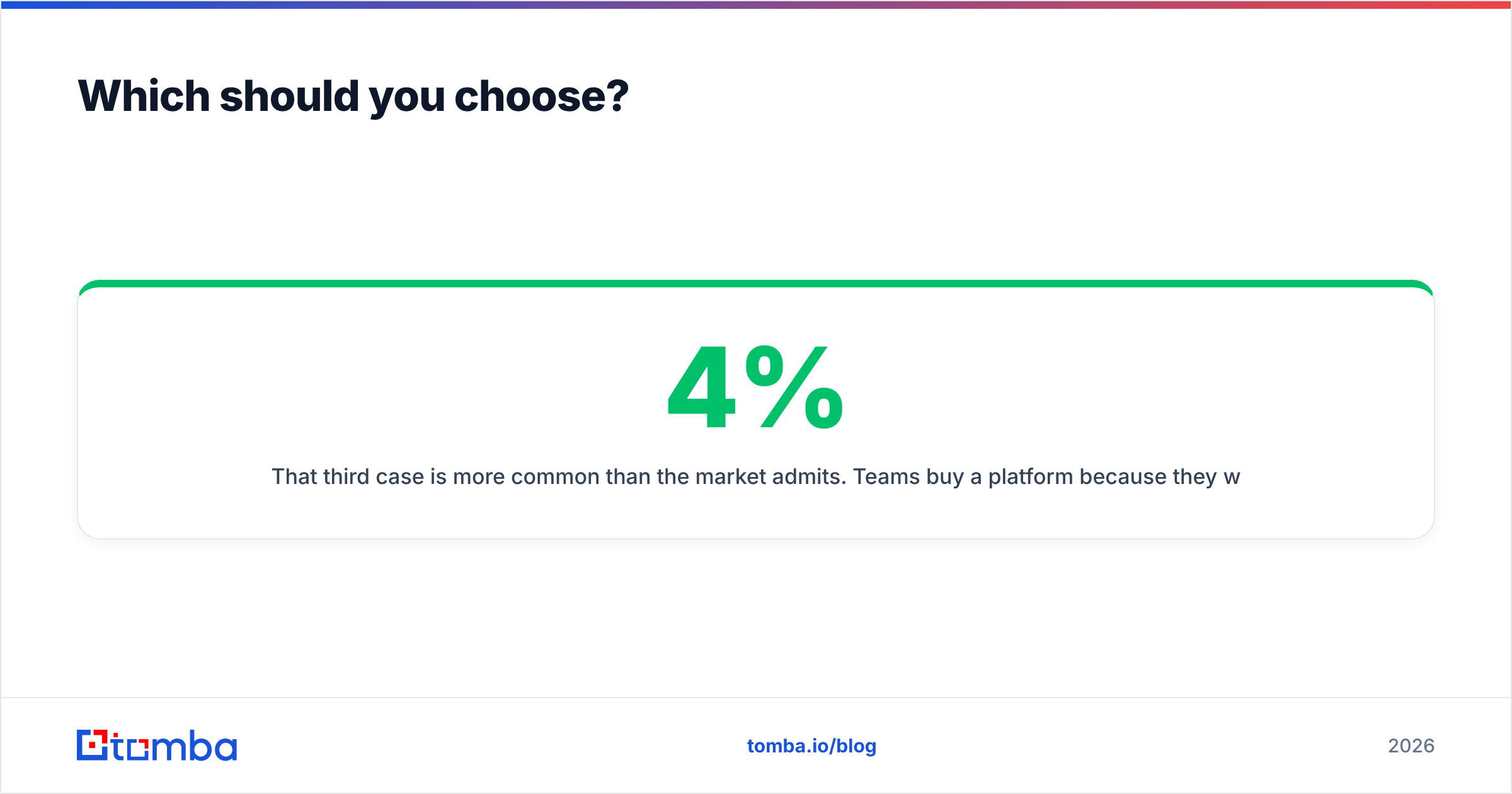
That third case is more common than the market admits. Teams buy a platform for coverage. Then they use 4% of the features and 30% of the credits. And they still bounce at 6%, because nothing in the stack verifies at send time.
Where does Tomba fit in?#
Tomba is not trying to be ZoomInfo. There is no intent graph, no call analysis, no org chart.
It does one narrow job that both databases treat as a side feature. Find the right work email for a named person at a named company. Verify it before you send. Expose all of it through an API and a bulk tool.
That covers domain search across a whole team, catch-all handling, LinkedIn lookups, phone finding, and data enrichment on records you already own. Pricing starts free and tops out at $249/mo for Pro. No yearly commitment. No per-seat data tax.
Here is the realistic stack for most teams under 20 reps. Use a database when you truly need new names at scale. Use a dedicated finder and verifier for everything else. Solve the second half first, and the first half often turns out not to be the bottleneck.
Final verdict#
Generect vs ZoomInfo is not a quality contest. Generect wins on access, freedom, and developer experience. ZoomInfo wins on depth, signal, and enterprise controls.
The right answer depends on what you are buying: a feed or a platform. It also depends on whether your ICP lives in Ohio or Osnabrück.
Whichever you pick, verify before you send. No database is accountable for your bounce rate. Your domain is.
Run your next list through Tomba Email Finder. Start free with 25 searches a month. Test it on the same 250 ICP records you pull from Generect or ZoomInfo. Then compare valid rates on your own data, not on somebody's landing page.
Related guides#
Ready to find emails that actually work?
Join 150,000+ professionals who stopped guessing and started sending. Free credits on signup — no credit card required.
Get the Tomba newsletter
Practical outbound tactics and product updates — once every two weeks.
About the author