Gentle Follow Up Meaning: How to Nudge Without Annoying
A gentle follow-up is a low-pressure nudge that adds value instead of demanding a reply. Here's what the phrase actually means, when it works, when it backfires, and the exact wording that gets responses in 2026.
TL;DR
- A "gentle follow-up" is a low-pressure reminder that re-surfaces your previous message without demanding an answer, apologizing for existing, or piling on guilt.
- The phrase is now so overused in B2B email that "just a gentle follow-up" reads as filler. The intent still works; the wording mostly doesn't.
- Gentle works when the relationship is warm, the ask is small, or the recipient already signalled interest. It fails when you have no prior context — then you need a new angle, not a softer one.
- The best-performing soft nudges add one new thing: a resource, a data point, a shorter ask, or an easy exit.
- Before you optimise wording, check the address is real. A "no reply" that's actually a silent bounce is a deliverability problem, not a copy problem.
What is the gentle follow up meaning in plain English?#
A gentle follow-up is a short, polite message that reminds someone about a previous email or request while explicitly lowering the pressure to respond. "Gentle" signals two things at once: I know you're busy, and I'm not going to make this awkward.
Think of it like tapping someone's shoulder in a library versus shouting their name across the room. Same goal — get attention. Very different social cost. The gentle version protects the relationship even if the answer is no.
Structurally, almost every gentle follow-up contains four parts:
- A context anchor — one line reminding them what this is about ("Following up on the pricing breakdown I sent Tuesday").
- A pressure reducer — an acknowledgement that the delay is fine ("No rush at all if this isn't a priority right now").
- A single, small ask — one question, one link, one yes/no ("Worth a 15-minute call, or should I close the loop?").
- An easy exit — permission to say no without ghosting ("If it's a no, just reply 'not now' and I'll stop").
Where most people go wrong is writing only part 2. A message that's entirely pressure reduction — "just circling back", "sorry to bother you", "gentle bump" — gives the reader nothing new to react to. It's a reminder that they ignored you, not a reason to reply.
Is "just a gentle follow-up" still worth writing in 2026?#
The intent is worth keeping. The literal phrase is not.
"Just a gentle follow-up" and its cousins — "just bumping this", "circling back", "checking in" — have been recycled through every sales-enablement deck for a decade. Recipients pattern-match them instantly. Worse, three of those phrases actively weaken you:
- "Just" minimises your own message before the reader does it for you.
- "Sorry to bother" frames your outreach as an imposition, which invites the reader to agree.
- "Checking in" describes an action with no benefit to the recipient. It's the email equivalent of standing in a doorway.
The fix isn't to be aggressive. It's to be gentle in tone and specific in substance. Keep the low pressure. Replace the empty bump with one new piece of value: a relevant customer example, a link to something they mentioned, a shorter version of the ask, or a genuine deadline if one exists.
What's the difference between a gentle follow-up and a direct follow-up?#
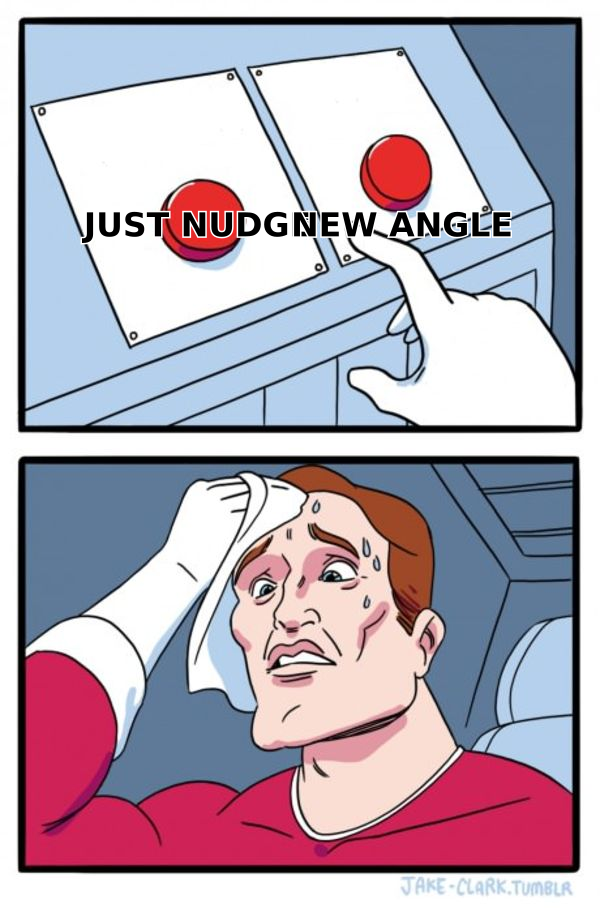
Both are legitimate. They're tools for different situations, and picking the wrong one is the actual mistake — not "being too soft" or "being too pushy" in the abstract.
| Dimension | Gentle follow-up | Direct follow-up |
|---|---|---|
| Best used when | Warm lead, prior conversation, referral, post-meeting | Cold sequence, stalled deal with a real deadline, inbound request |
| Typical opening | "No rush on this — one quick thing" | "Quick question: is this still on your roadmap for Q3?" |
| Ask size | One small yes/no or a resource share | A specific meeting slot or decision |
| Emotional register | Deferential, relationship-first | Confident, business-first |
| Risk if misused | Reads as filler, gets ignored, trains the reader to skip you | Reads as entitled, can burn a warm relationship |
| Typical reply lift vs. no follow-up | Meaningful on warm lists | Higher on cold lists where you have nothing to soften |
| Number in sequence | Touches 2-3 | Touches 1, 4, and the breakup |
A practical rule: soften the tone, never the ask. You can be warm and still say exactly what you want. What kills reply rates is vagueness — "let me know your thoughts" — not politeness.
When does a gentle follow-up actually work?#
It works in five specific situations, and it's worth being honest that outside these, a soft nudge is usually wasted.
- After a real conversation. They took the call, said "send me something", then went quiet. A gentle nudge respects that they meant it and life intervened.
- When your ask is genuinely tiny. Confirming a date, getting a document signed, a one-word answer. Low friction deserves low pressure.
- When you have a warm introduction. Someone vouched for you. Heavy-handed follow-up spends borrowed credibility.
- When there's a legitimate reason for the delay. Budget season, a product launch, a reorg. Naming the reason ("guessing planning season has you buried") shows you understand their world.
- When you're closing the loop. The final message in a sequence — the polite goodbye — often outperforms every touch before it, because it removes the obligation entirely.
Outside those, silence usually means your first email didn't land, and repeating it more softly won't fix that. Change the angle: new subject line, new pain point, new format, new stakeholder.
How do you write a gentle follow-up that gets a reply?#
Use a structure, not a script. Here are four patterns you can adapt, with the mechanism spelled out so you're not just copy-pasting.
1. The value-add nudge. Instead of reminding, contribute.
Subject: the onboarding benchmark you asked about
Hi Dana — you mentioned onboarding time was the metric your team gets judged on. Ran into this teardown of how three fintechs cut theirs by ~40%, thought of your setup: [link]
No reply needed. If it's useful and you want the 15-minute version of how we'd apply it, I'm around Thursday.
Mechanism: it costs them nothing to read and gives them something to forward internally.
2. The shrinking ask. Each touch reduces the friction of replying.
Touch 1: "Worth a 30-minute walkthrough?"
Touch 2: "Happy to just send a 3-minute Loom instead."
Touch 3: "Or just reply with a 1-10 on how relevant this is — I'll take it from there."
Mechanism: eventually the ask is smaller than the effort of ignoring you.
3. The context reset. Assume they never read the first one.
Subject: re: cutting your list-cleaning time
Hi Marcus — resending in case this got buried. Short version: your team runs ~8k contacts a month through manual checks. We automate that step and most teams get it under an hour.
Not urgent. If it's not a fit, "not now" is a perfectly good answer.
Mechanism: it's self-contained, so they don't have to scroll to understand.
4. The graceful close. The highest-reply message in most sequences.
Subject: closing the file
Hi Priya — I'll assume the timing isn't right and stop emailing. If that changes, my door's open. Genuinely appreciate you reading this far.
Mechanism: loss aversion plus zero obligation. People reply to endings.
Notice what none of these say: "just following up", "per my last email", or "any updates?". Every one gives a reason for the message to exist.
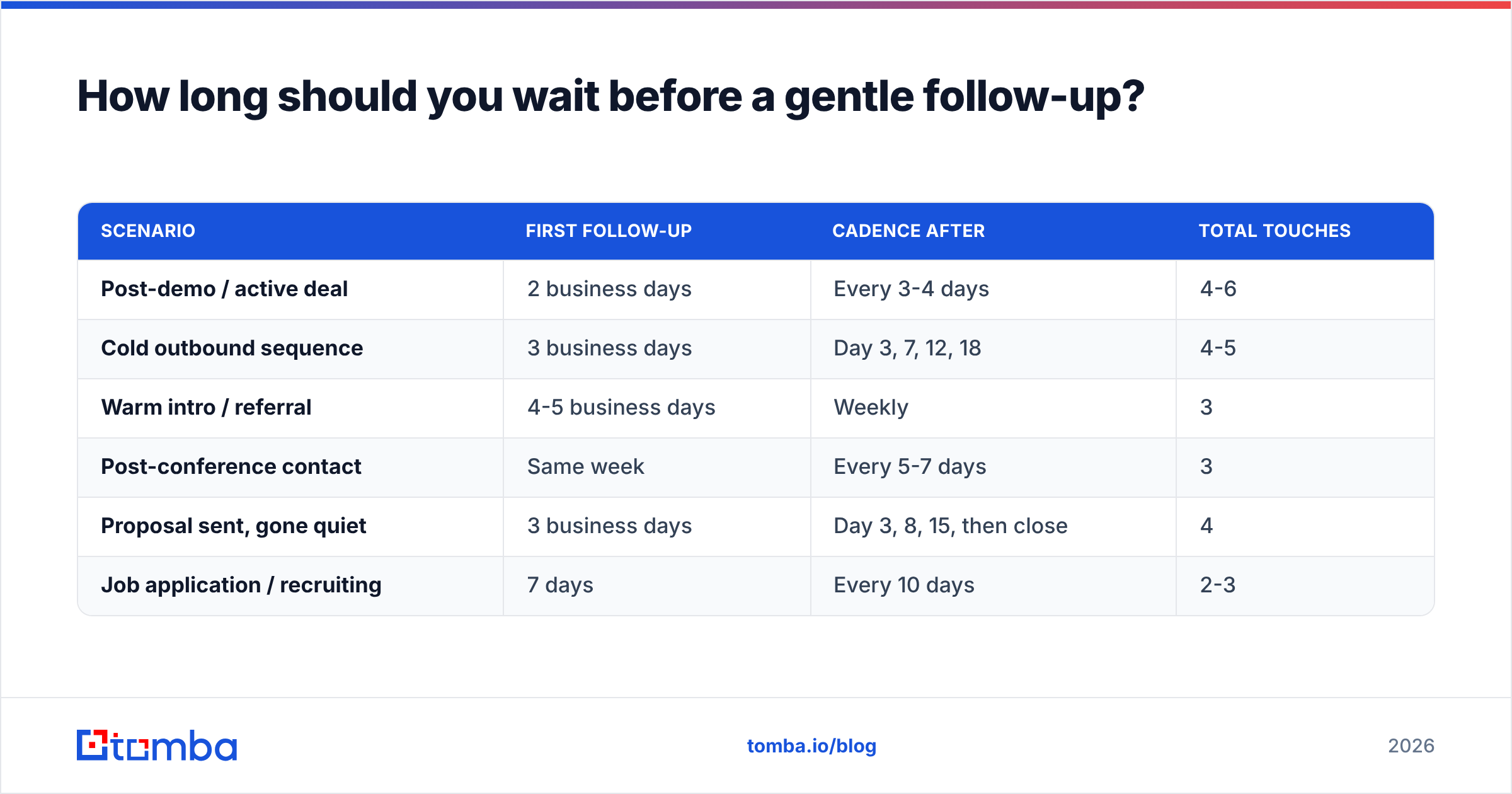
How long should you wait before a gentle follow-up?#
Match the cadence to the temperature of the relationship. Waiting too long is a bigger sin than waiting too little — momentum dies fast.
| Scenario | First follow-up | Cadence after | Total touches |
|---|---|---|---|
| Post-demo / active deal | 2 business days | Every 3-4 days | 4-6 |
| Cold outbound sequence | 3 business days | Day 3, 7, 12, 18 | 4-5 |
| Warm intro / referral | 4-5 business days | Weekly | 3 |
| Post-conference contact | Same week | Every 5-7 days | 3 |
| Proposal sent, gone quiet | 3 business days | Day 3, 8, 15, then close | 4 |
| Job application / recruiting | 7 days | Every 10 days | 2-3 |
Two rules that matter more than the exact numbers:
- Reply to your own thread for touches 2 and 3, then start a fresh thread with a new subject line for touch 4. Threading preserves context; a new subject gets a second shot at the inbox preview.
- Stop at your stated number. If you said "I'll stop after this", stop. Credibility compounds; so does the opposite.
Why do gentle follow-ups get ignored even when the copy is good?#
Because a large share of "no replies" were never read. Before you rewrite the message for the fifth time, rule out the boring causes.
- The address is wrong or dead. Guessed patterns, stale job data, and role accounts silently absorb sequences. Run addresses through an email verifier before the first send, not after the third bounce.
- Catch-all domains are hiding failures. A catch-all accepts everything and delivers nothing you can measure. A catch-all verifier tells you whether the mailbox is real rather than just accepted.
- You're in the promotions tab or spam. Email deliverability issues — bad SPF, no DMARC alignment, a cold domain, image-heavy HTML — mean your gentle nudge is technically perfect and invisible. Google's own Postmaster Tools documentation is the fastest way to see whether your domain's reputation is the problem.
- You're following up with the wrong person. If the buyer changed roles, no amount of softness helps. Re-verify the contact and find the current owner.
- Your first email had no hook. Follow-ups amplify the original message. If touch 1 was generic, touches 2-4 are generic too, just more often.
Fix the plumbing first. Copy optimisation on a broken list is theatre.
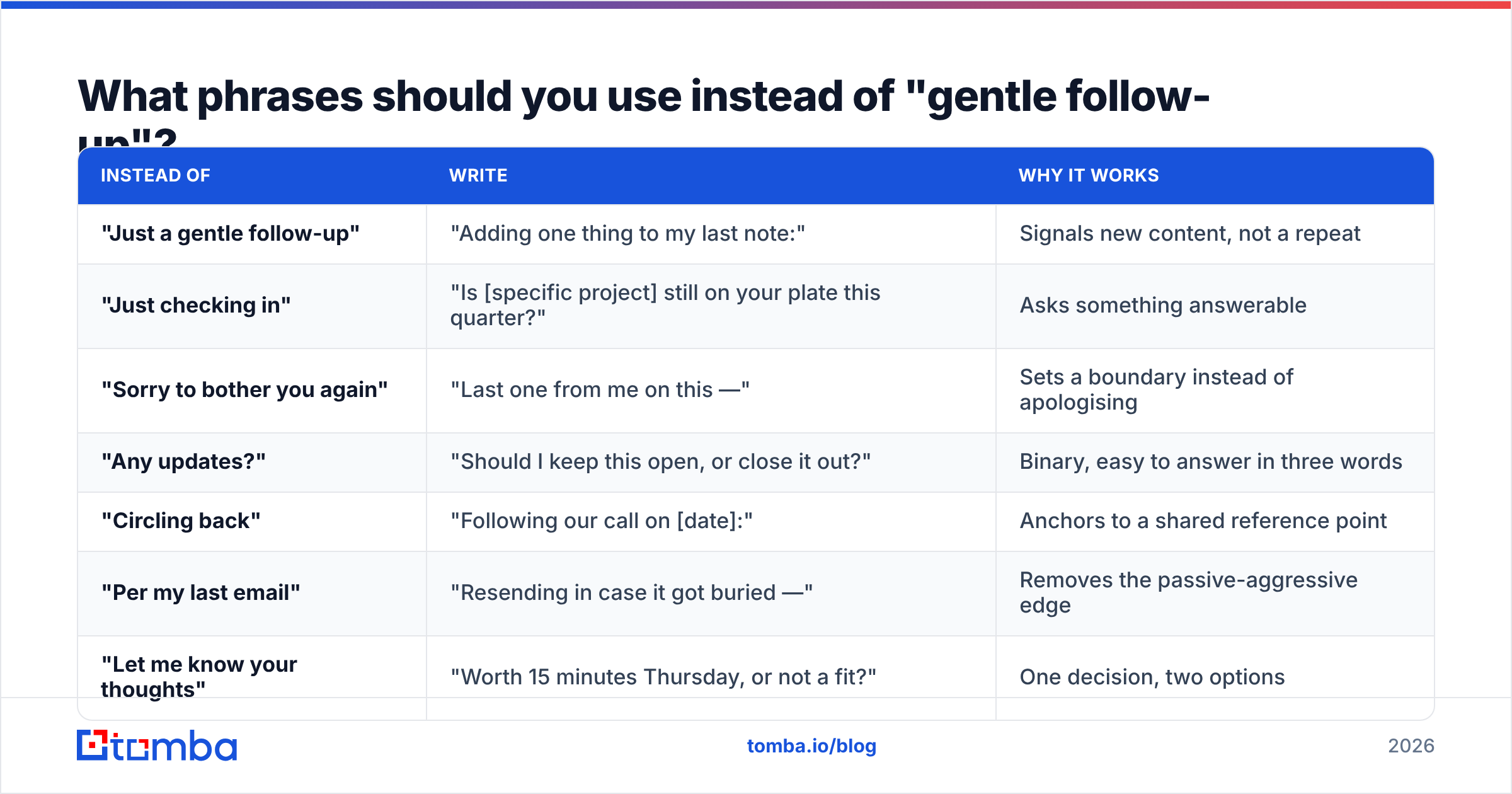
What phrases should you use instead of "gentle follow-up"?#
Swap the tired phrase for something that carries information. These are direct replacements, ordered from softest to firmest:
| Instead of | Write | Why it works |
|---|---|---|
| "Just a gentle follow-up" | "Adding one thing to my last note:" | Signals new content, not a repeat |
| "Just checking in" | "Is [specific project] still on your plate this quarter?" | Asks something answerable |
| "Sorry to bother you again" | "Last one from me on this —" | Sets a boundary instead of apologising |
| "Any updates?" | "Should I keep this open, or close it out?" | Binary, easy to answer in three words |
| "Circling back" | "Following our call on [date]:" | Anchors to a shared reference point |
| "Per my last email" | "Resending in case it got buried —" | Removes the passive-aggressive edge |
| "Let me know your thoughts" | "Worth 15 minutes Thursday, or not a fit?" | One decision, two options |
The pattern: replace emotional hedging with a concrete reference point and a single decision. You keep the warmth. You lose the mush.
For subject lines specifically, shorter beats clever on follow-ups — the thread already carries context. If you're testing variants, a subject line tester will catch the spam-trigger words and length problems before you send.
How do you scale gentle follow-ups without sounding like a robot?#
Personalisation at volume is a data problem before it's a writing problem. The reason mass follow-ups sound generic is that the sender only knows the recipient's first name and company.
Three levers, in order of impact:
- Enrich before you write. Role, seniority, tech stack, recent funding, and content they've published give you something specific to reference. Contact enrichment turns an email address into a reason to write.
- Segment your cadence, not just your copy. A VP gets three touches. A practitioner who downloaded a guide can handle five. Same words, different pressure.
- Template the structure, write the first line. Keep the four-part skeleton constant and hand-write only the context anchor. That's usually 15 seconds per contact and it's the line that determines whether they read the rest.
Research on B2B buying consistently points the same direction: buyers reward relevance and punish volume. Gartner's B2B buying research has documented for years that buyers spend only a small fraction of their time with any single vendor — which is exactly why your follow-up needs to earn its slot rather than just occupy one. Peer-review platforms like G2 show the same tension in tool reviews: teams that automate sending without fixing targeting see volume rise and reply rates fall.
If you're comparing tooling for this, evaluate on data quality first and sequencing features second. A perfect cadence engine firing at unverified addresses produces expensive silence.
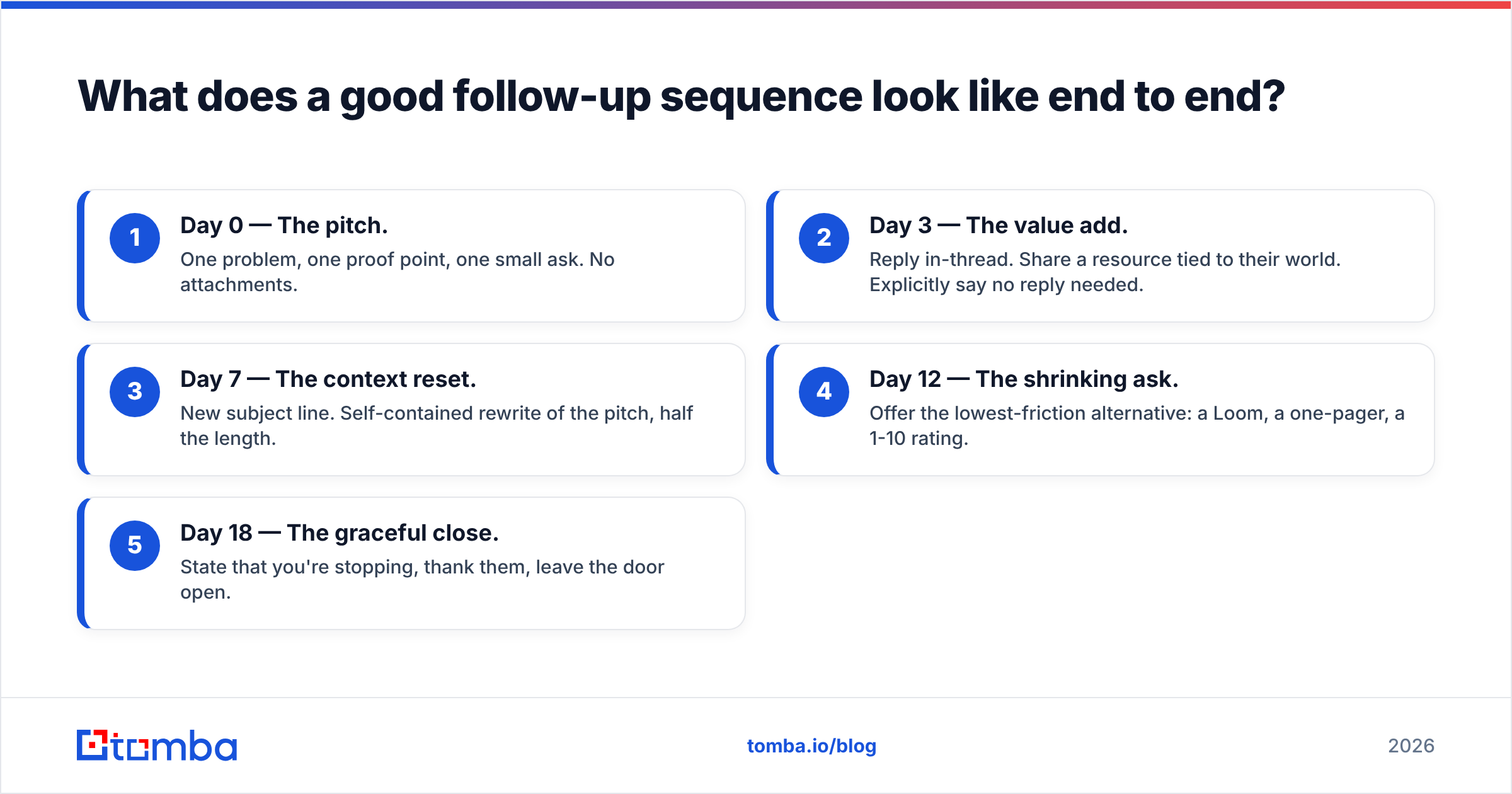
What does a good follow-up sequence look like end to end?#
Here's a five-touch structure that stays gentle throughout while still moving toward a decision:
- Day 0 — The pitch. One problem, one proof point, one small ask. No attachments.
- Day 3 — The value add. Reply in-thread. Share a resource tied to their world. Explicitly say no reply needed.
- Day 7 — The context reset. New subject line. Self-contained rewrite of the pitch, half the length.
- Day 12 — The shrinking ask. Offer the lowest-friction alternative: a Loom, a one-pager, a 1-10 rating.
- Day 18 — The graceful close. State that you're stopping, thank them, leave the door open.
Every touch is polite. None of them is empty. That's the whole trick — "gentle" describes the pressure, not the content.
Before you run that sequence at scale, make sure the foundation holds: verified addresses, an accurate contact for the role you're targeting, and clean domain reputation. Start with Tomba Email Finder to build the list from real company domains, verify it, and enrich it so your first line has something true to say. The free tier gives you 25 searches a month to test the workflow, and paid plans start at $49/mo on Tomba pricing — cheaper than another quarter of gentle follow-ups landing in dead mailboxes.
Related guides#
Ready to find emails that actually work?
Join 150,000+ professionals who stopped guessing and started sending. Free credits on signup — no credit card required.
Get the Tomba newsletter
Practical outbound tactics and product updates — once every two weeks.
About the author