GetProspect vs Influno: Which B2B Email Tool Wins in 2026?
GetProspect sells a 200M-contact database with LinkedIn extraction. Influno sells cold email sending. We compare pricing, data accuracy, and deliverability to show which one actually belongs in your stack.
TL;DR — GetProspect vs Influno in one screen#
- They are not the same category. GetProspect is a contact database plus LinkedIn email extractor. Influno is a cold email sending and sequencing platform. Comparing them head-to-head only makes sense if you are trying to decide which half of the outbound problem to buy first.
- If your list is the bottleneck, GetProspect wins — it ships a large B2B database, a Chrome extension for LinkedIn, and bulk enrichment. Influno gives you almost nothing here.
- If your sending is the bottleneck, Influno wins — inbox rotation, warmup, and sequence logic that GetProspect does not attempt.
- Neither is a complete stack. Most teams that buy one end up paying for the other within a quarter, which is why per-seat plus per-credit math matters more than the sticker price.
- Verification is the hidden cost. Extracted LinkedIn emails and database exports both bounce. Running a dedicated email verifier before send is cheaper than burning a domain.
What is GetProspect, actually?#
GetProspect is a lead-database company that grew out of a LinkedIn email-finder Chrome extension. You install the extension, browse LinkedIn or Sales Navigator, select a list of profiles, and GetProspect appends work emails to them. Alongside that sits a searchable database of B2B contacts filtered by job title, company size, industry, technology, and location.
The product is built around three motions:
- Extract from LinkedIn — browse a Sales Navigator search, export the profiles, get emails appended.
- Search the database — build a list from filters without ever touching LinkedIn.
- Enrich a CSV — upload names and domains you already have, get emails and firmographics back.
There is a light CRM layer and a basic email-sending add-on, but nobody buys GetProspect for the sending. The sequencing features exist to keep users from immediately exporting to another tool. They are thin compared to a purpose-built sender.
Accuracy is where GetProspect gets judged. LinkedIn-derived emails are frequently pattern guesses validated against an SMTP check. That works fine for large companies with predictable patterns (first.last@) and gets shaky at small companies, catch-all domains, and anyone using a privacy-forward mail host.
What is Influno, actually?#
Influno is a cold email outreach platform. Its job starts after you have a list. You connect mailboxes, warm them up, build multi-step sequences with conditional logic, and let the platform pace sending across inboxes so no single domain looks like a spam cannon.
The feature set clusters around deliverability and workflow:
- Unlimited or high-count mailbox connection so volume spreads across many sending identities
- Built-in warmup that exchanges real-looking mail between accounts to build sender reputation
- Sequence branching — different follow-ups based on open, click, or reply
- Unified inbox so replies from twelve mailboxes land in one place
- Reporting on reply rate, bounce rate, and per-mailbox health
What Influno does not do is find contacts. There is no meaningful database, no LinkedIn scraper, no enrichment engine. You bring the CSV. If the CSV is bad, Influno will faithfully deliver your bad list to spam traps and tank your domain — which is exactly how most first-time cold emailers destroy a domain in week two.

GetProspect vs Influno: how do they compare on paper?#
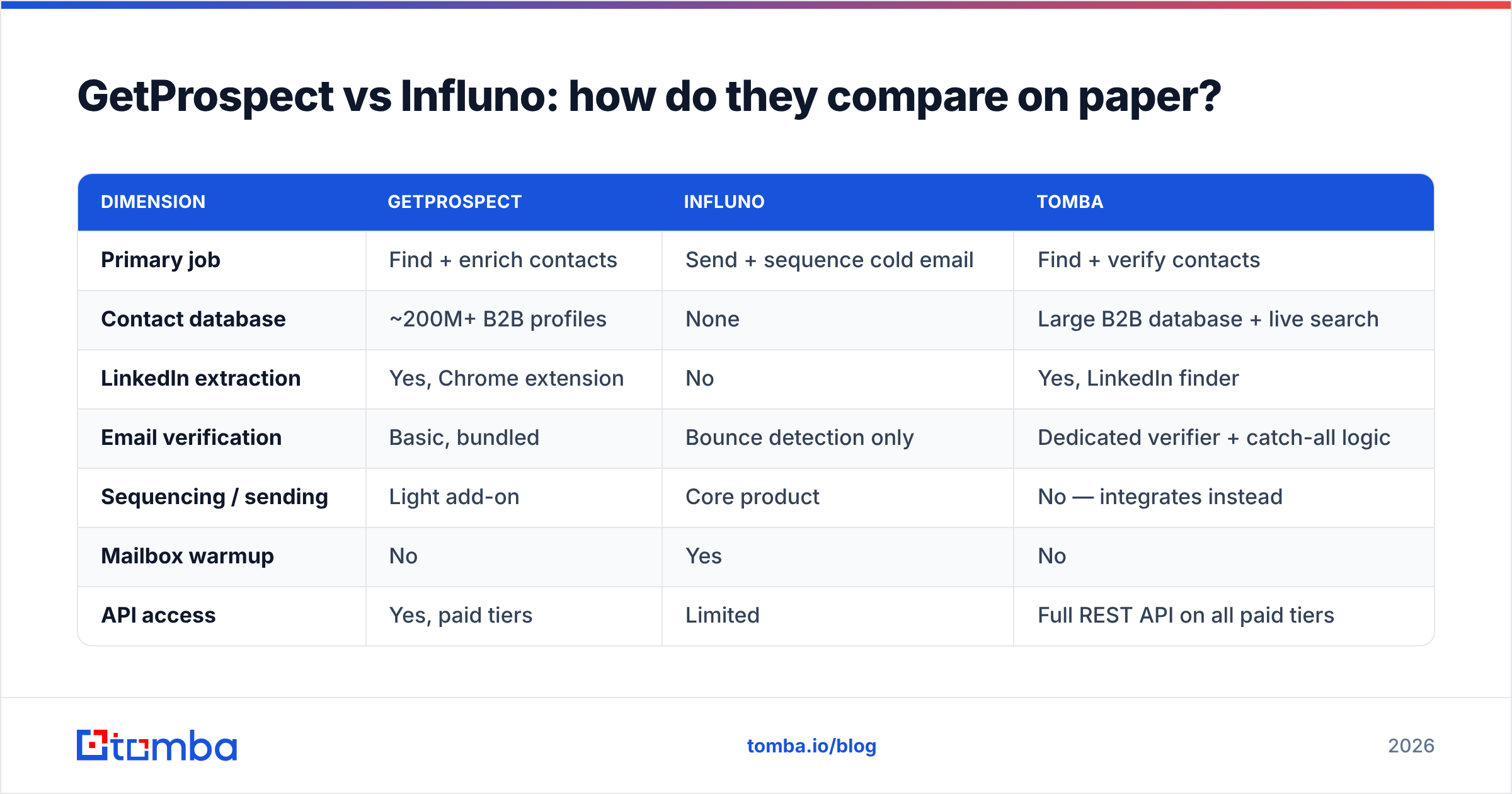
Here is the honest side-by-side. Prices move; check both vendors before you sign, and treat this as directional rather than a contract.
| Dimension | GetProspect | Influno | Tomba |
|---|---|---|---|
| Primary job | Find + enrich contacts | Send + sequence cold email | Find + verify contacts |
| Contact database | ~200M+ B2B profiles | None | Large B2B database + live search |
| LinkedIn extraction | Yes, Chrome extension | No | Yes, LinkedIn finder |
| Email verification | Basic, bundled | Bounce detection only | Dedicated verifier + catch-all logic |
| Sequencing / sending | Light add-on | Core product | No — integrates instead |
| Mailbox warmup | No | Yes | No |
| API access | Yes, paid tiers | Limited | Full REST API on all paid tiers |
| Free tier | ~50 credits/mo | Trial only | 25 searches/mo |
| Entry paid price | ~$49/mo | ~$29–49/mo per seat | $49/mo Starter |
| Best for | List building | Sending at volume | Accuracy-first list building + API |
The table exposes the real story: the two products barely overlap. The overlap column is "email tooling," which is like saying a drill and a saw are both "workshop tools."
Which one should you buy first?#
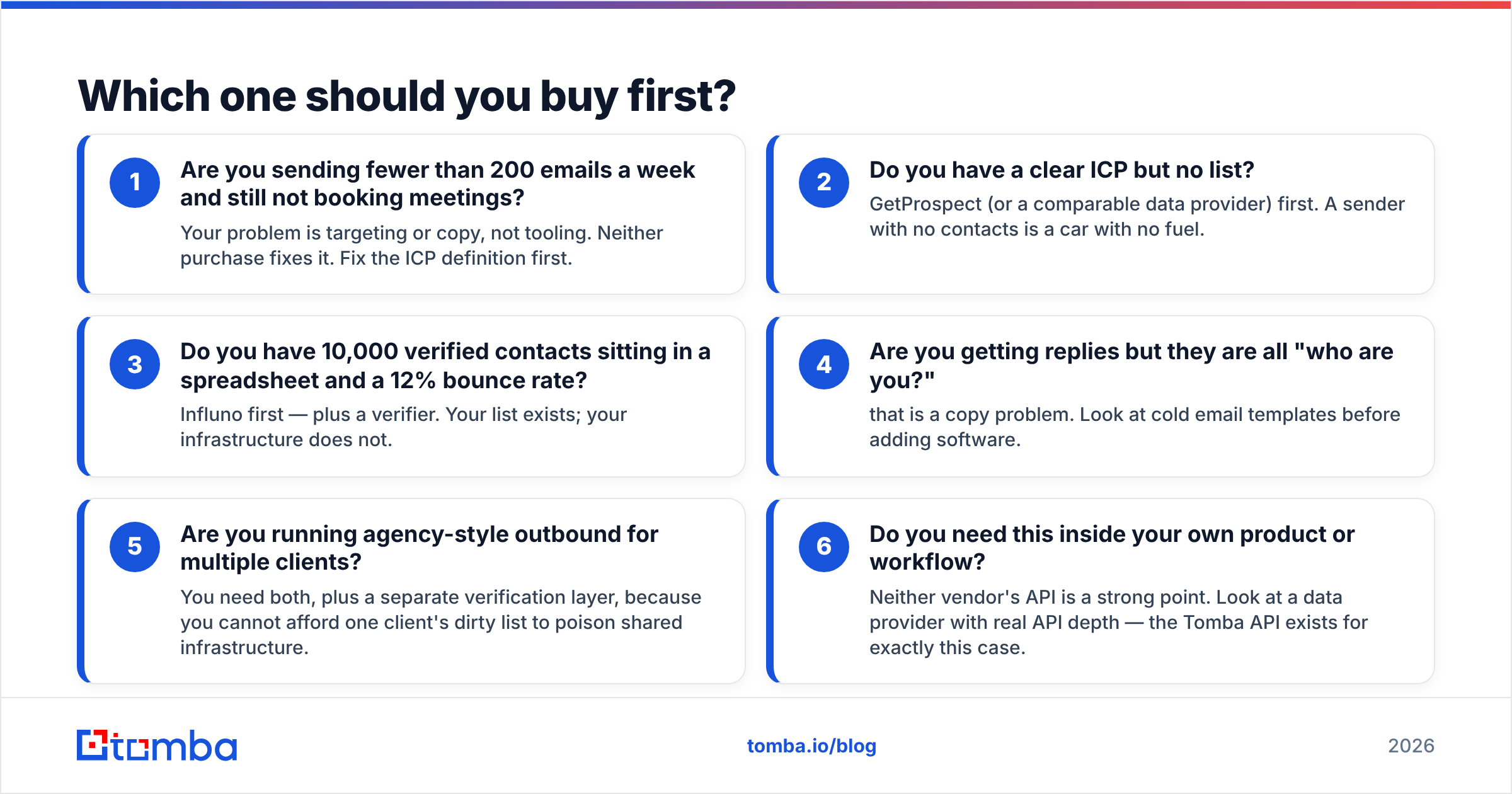
Buy the one that fixes your actual bottleneck. Run this diagnostic:
- Are you sending fewer than 200 emails a week and still not booking meetings? Your problem is targeting or copy, not tooling. Neither purchase fixes it. Fix the ICP definition first.
- Do you have a clear ICP but no list? GetProspect (or a comparable data provider) first. A sender with no contacts is a car with no fuel.
- Do you have 10,000 verified contacts sitting in a spreadsheet and a 12% bounce rate? Influno first — plus a verifier. Your list exists; your infrastructure does not.
- Are you getting replies but they are all "who are you?" — that is a copy problem. Look at cold email templates before adding software.
- Are you running agency-style outbound for multiple clients? You need both, plus a separate verification layer, because you cannot afford one client's dirty list to poison shared infrastructure.
- Do you need this inside your own product or workflow? Neither vendor's API is a strong point. Look at a data provider with real API depth — the Tomba API exists for exactly this case.
Is GetProspect's data accurate enough for cold outreach?#
Short answer: good enough at enterprise domains, unreliable at SMB and catch-all domains — which is true of almost every LinkedIn-derived dataset, not a GetProspect-specific flaw.
The mechanics matter here. Most LinkedIn email extractors work in three steps:
- Pattern inference — the tool knows
acme.comusesfirst.last@, so it constructs the address. - SMTP probe — it opens a connection to the mail server and asks whether the recipient exists, without sending mail.
- Confidence score — it labels the result valid, risky, or unknown.
Step two breaks on catch-all domains, which accept every address at the SMTP layer and then silently discard the invalid ones. Roughly a fifth to a quarter of B2B domains are catch-all, and that number keeps climbing as more companies sit behind Microsoft 365 defaults and security gateways. A tool that reports those as "valid" is inflating its own accuracy number.
This is why a separate catch-all verifier is not a nice-to-have. It applies a different technique — pattern corroboration, historical send data, secondary sources — instead of trusting an SMTP handshake that is designed to lie to you.
Practical rule: whatever your data vendor claims, sample 100 rows, send to them from a throwaway domain, and measure the real bounce rate. Vendors quote lab numbers. Your ICP is not the lab. G2's category reviews are useful for spotting patterns in complaints, but they will not tell you the bounce rate on your specific vertical.
Does Influno actually solve deliverability?#
Partly. Influno solves the mechanical side of deliverability: spreading volume across inboxes, ramping new mailboxes gradually, pacing sends, and detecting when a mailbox starts underperforming.
It does not solve the reputational side, which is driven by three things it cannot control:
- List quality. Bounces above roughly 2–3% signal to receiving mail systems that you are guessing at addresses. No amount of warmup outruns a 15% bounce rate.
- Authentication. SPF, DKIM, and DMARC have to be configured correctly on every sending domain. Google and Yahoo tightened bulk-sender requirements in 2024 and have not loosened since — Google's sender guidelines remain the reference document. Run an SPF checker on every domain before you connect it.
- Recipient engagement. If nobody replies or opens, mailbox providers learn your mail is unwanted. That is a copy and targeting problem wearing a deliverability costume.
Warmup tools have also gotten less magical over time. Mailbox providers have gotten better at recognizing synthetic warmup traffic — reciprocal networks where the same 5,000 accounts email each other in patterns no human produces. Warmup still helps as a ramp, but treating it as an insurance policy against a bad list is the single most expensive mistake in cold outbound.

What are the realistic total costs?#
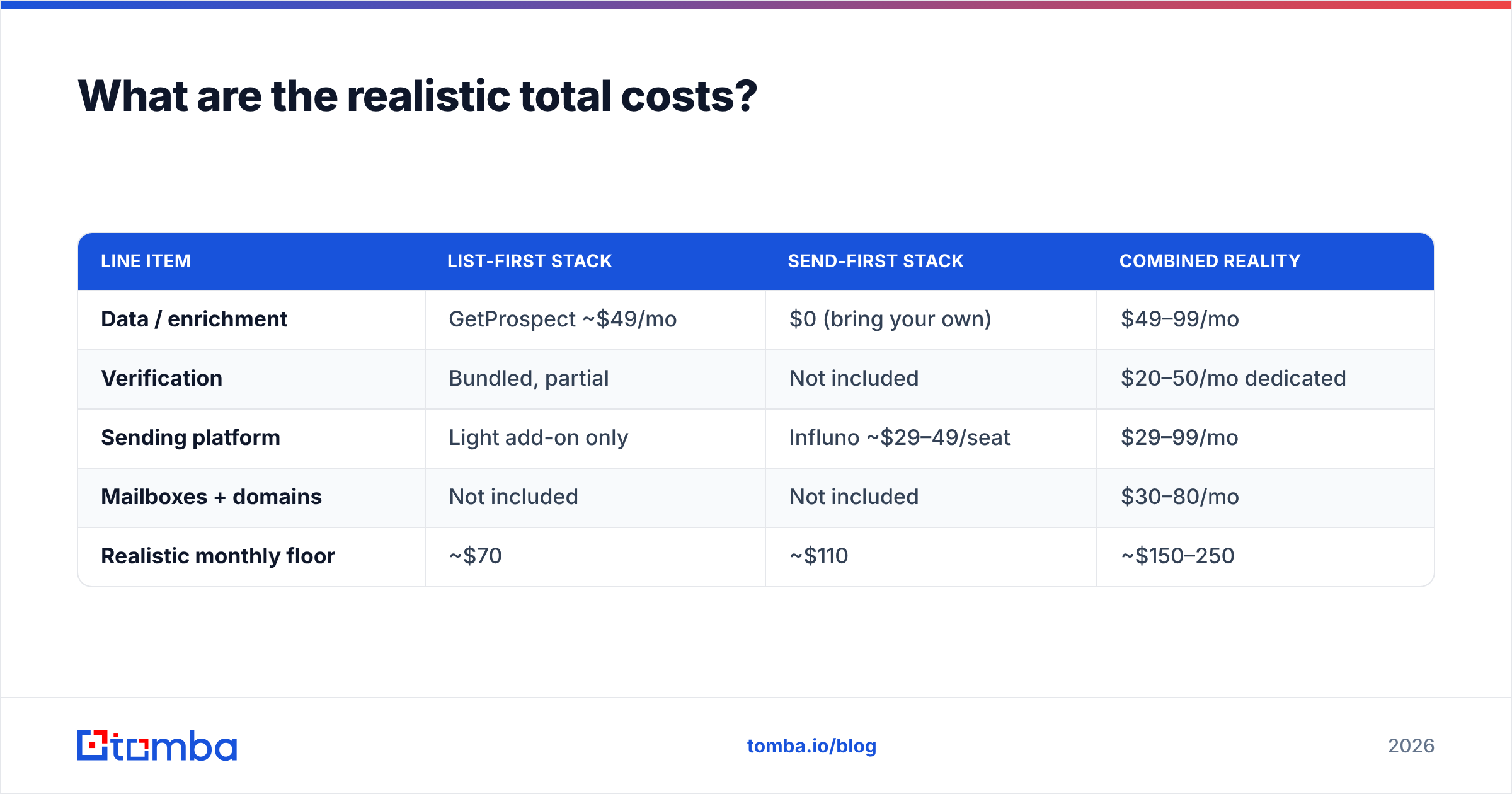
Sticker price is not the number that matters. Model the stack.
| Line item | List-first stack | Send-first stack | Combined reality |
|---|---|---|---|
| Data / enrichment | GetProspect ~$49/mo | $0 (bring your own) | $49–99/mo |
| Verification | Bundled, partial | Not included | $20–50/mo dedicated |
| Sending platform | Light add-on only | Influno ~$29–49/seat | $29–99/mo |
| Mailboxes + domains | Not included | Not included | $30–80/mo |
| Realistic monthly floor | ~$70 | ~$110 | ~$150–250 |
Two costs surprise people. First, credits are not contacts — a failed lookup often still consumes a credit at most vendors, so a 60% hit rate on a hard vertical means your effective cost per usable email is nearly double the advertised rate. Second, seats multiply. Sending platforms usually price per seat; data platforms usually price per credit. A five-person SDR team hits very different math on each.
For reference, Tomba pricing runs a 25-search free tier, $49/mo Starter, $99/mo Growth, and $249/mo Pro, with verification and catch-all handling in the same product rather than as a separate line item. That consolidation is the main reason teams collapse two vendors into one.
How do these compare to the wider market?#
Neither GetProspect nor Influno is the only option in its lane, and pretending otherwise does you no favors.
On the data side, the field includes Apollo (database plus sequencing, aggressive pricing, mixed accuracy at SMB), ZoomInfo (enterprise-grade coverage, enterprise-grade contracts), Clearbit-style enrichment APIs, and BookYourData, which sells pre-verified downloadable B2B lists with a bounce guarantee — a genuinely different purchase model that suits teams who want a one-time list rather than a subscription. If GetProspect's LinkedIn dependency bothers you, an Apollo alternative comparison is a reasonable next read.
On the sending side, Influno competes with Instantly, Smartlead, Lemlist, and Saleshandy. The feature sets have converged hard — inbox rotation, warmup, unified inbox, and AI copy assistance are table stakes now. Differentiation comes down to price per mailbox, API quality, and how the vendor handles your account when a client complains.
On the verification side, this is where consolidating pays. Running a dedicated bulk email finder and verification pass between your data source and your sender means you never hand a sending platform a list you have not checked. That single step does more for deliverability than any warmup feature.
The category boundary is also blurring. Data vendors keep bolting on sequencers; sequencers keep bolting on databases. Both bolt-ons are usually worse than the specialist product. Buy the specialist for the job that is actually hard for you, and use APIs or integrations to connect them.
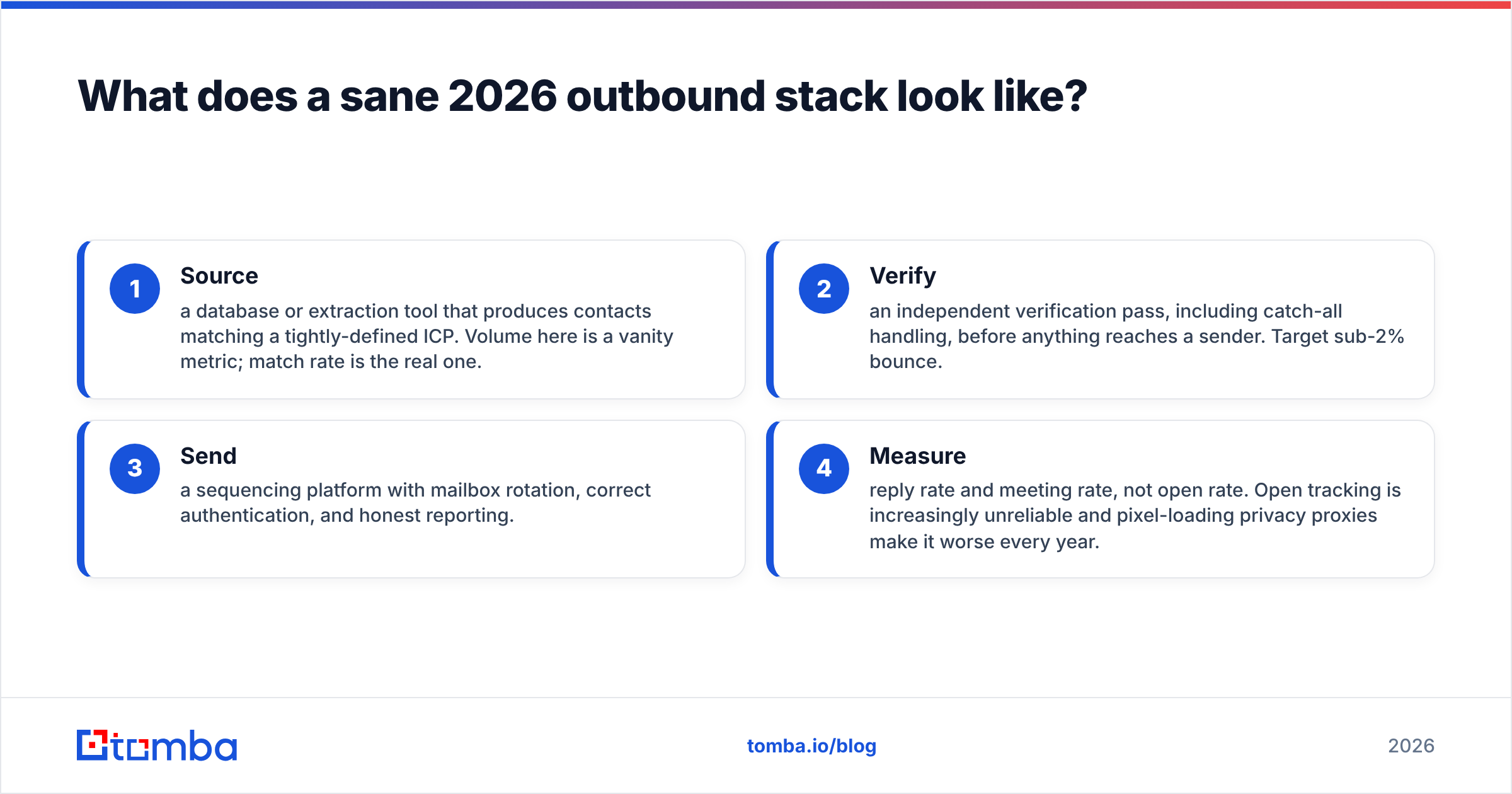
What does a sane 2026 outbound stack look like?#
Four layers, in order:
- Source — a database or extraction tool that produces contacts matching a tightly-defined ICP. Volume here is a vanity metric; match rate is the real one.
- Verify — an independent verification pass, including catch-all handling, before anything reaches a sender. Target sub-2% bounce.
- Send — a sequencing platform with mailbox rotation, correct authentication, and honest reporting.
- Measure — reply rate and meeting rate, not open rate. Open tracking is increasingly unreliable and pixel-loading privacy proxies make it worse every year.
GetProspect covers layer one and half of layer two. Influno covers layer three and part of layer four. Neither covers all four, and any vendor claiming to do so is selling you a weak version of at least two of them.
If you only remember one thing: the ordering matters. Fixing layer three while layer two is broken is how good sending platforms get blamed for bad data.
The bottom line#
GetProspect if you need lists. Influno if you need to send. Both if you are running real outbound volume — and a verification layer regardless.
Do not let the "email tool" label trick you into thinking this is an either/or. It is a sequencing question: which bottleneck is costing you meetings this month?
If the answer is data quality — wrong addresses, bounces, catch-all domains you cannot confirm — start with the source. The Tomba Email Finder gives you 25 free searches a month to test hit rate on your own ICP before spending anything, with verification and catch-all logic built into the same workflow instead of sold as a separate subscription. Run 100 of your hardest target accounts through it, compare the bounce rate against whatever you are using now, and let the numbers pick the winner.
Related guides#
Ready to find emails that actually work?
Join 150,000+ professionals who stopped guessing and started sending. Free credits on signup — no credit card required.
Get the Tomba newsletter
Practical outbound tactics and product updates — once every two weeks.
About the author