GetProspect vs Istari.ai (2026): Which B2B Data Tool Wins?
GetProspect sells verified contact emails. Istari.ai sells AI-generated company intelligence. They get compared constantly and they solve different problems — here is the honest breakdown, with pricing, coverage, and the case for using neither alone.
GetProspect vs Istari.ai is a strange matchup. One tool hands you verified work emails. The other tells you which companies to target in the first place. Here is what each one does, what it costs, and which one your pipeline actually needs.
TL;DR
- They are not the same category. GetProspect is a contact-data tool: names, job titles, verified work emails, and lists pulled from LinkedIn. Istari.ai is a market-intelligence platform. Its AI reads company websites at scale and turns them into structured company and technology signals.
- If you need an email address today, GetProspect wins by default. Istari.ai does not sell itself as a contact-finding product. Buying it to get emails is a category error.
- If you need to decide which 4,000 companies deserve outreach, Istari.ai wins. Its website-derived indices surface segments that static databases miss. Think SIC and NAICS codes, or headcount fields that nobody updates.
Two more points before the details.
- Pricing transparency is lopsided. GetProspect publishes self-serve tiers. Istari.ai quotes you a price. Expect procurement, not a credit card.
- The realistic stack is both layers, and neither vendor covers both well. Many teams pair a targeting layer with a dedicated finder like the Tomba Email Finder. That way contact accuracy is not the weak link.
GetProspect vs Istari.ai: what each tool actually is#
Start here. The comparison only makes sense once you accept that these two products barely overlap.
GetProspect is a B2B contact database and email finder. You search by company, domain, job title, location, or headcount. It returns people with work email addresses.
Its best-known surface is a Chrome extension. The extension pulls contact data off LinkedIn search results and profiles. That is why it shows up in every LinkedIn email extractor roundup. It also handles CSV enrichment, list building, and basic verification. The current feature set is on getprospect.com. Category peers: Hunter, Apollo, Findymail, Tomba.
Istari.ai is a different animal. The company spun out of research work in Mannheim, Germany. It crawls company websites and reads them with NLP models.
That text becomes structured, comparable data. What does the company actually do? Which technologies does it talk about? Does it signal AI adoption, green activity, or export plans? Buyers use it for market research, ICP definition, and account scoring across huge company lists. Their positioning is on istari.ai. Category peers: Vainu, the sales intelligence layers of 6sense and Demandbase, and Clay-style enrichment providers.
Put plainly: GetProspect answers who do I email at this company. Istari.ai answers which companies are worth emailing at all.

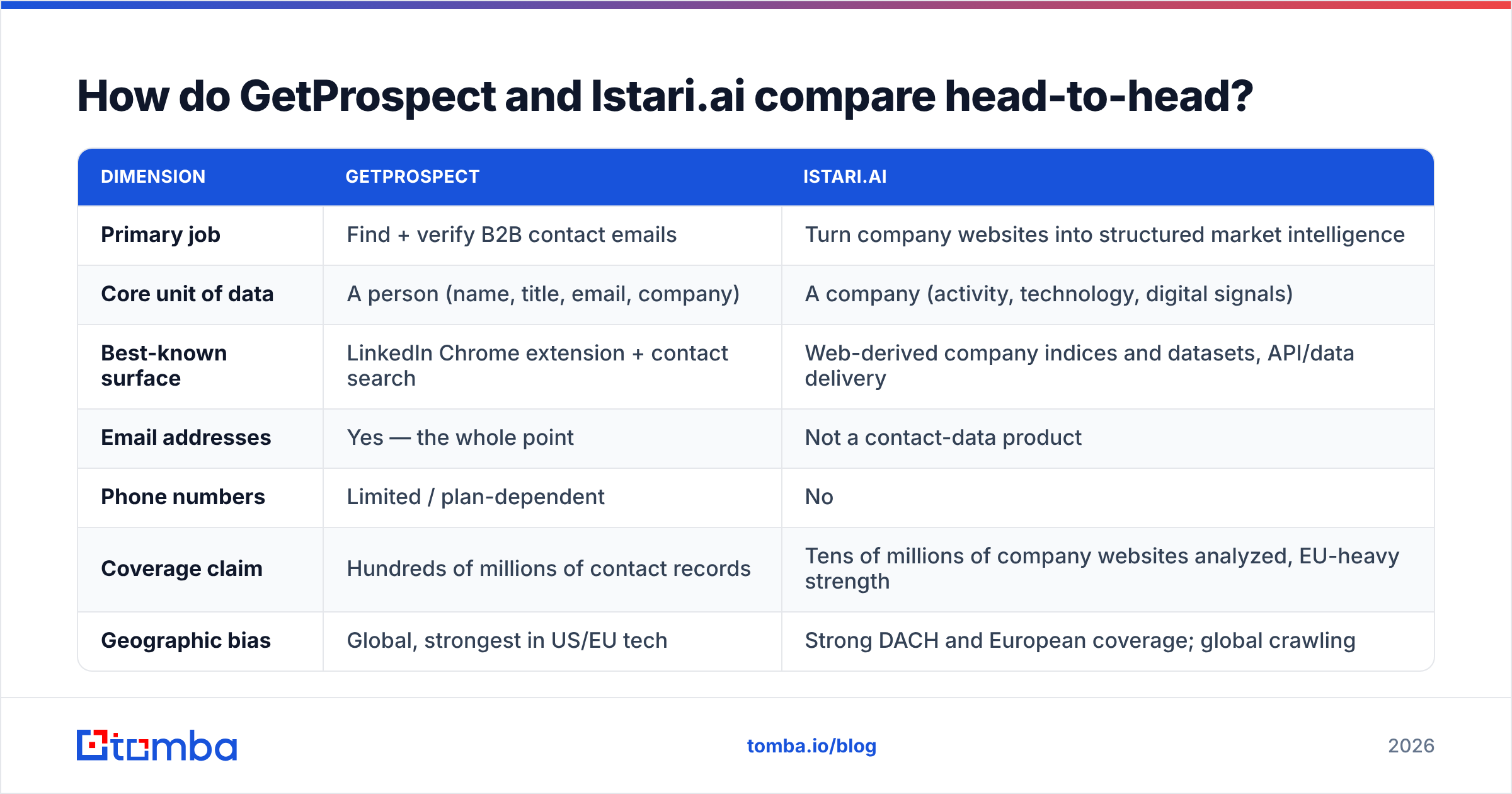
GetProspect vs Istari.ai: the head-to-head table#
Here is the honest side by side. Where a vendor does not publish a number, we say so rather than invent one.
| Dimension | GetProspect | Istari.ai |
|---|---|---|
| Primary job | Find + verify B2B contact emails | Turn company websites into structured market intelligence |
| Core unit of data | A person (name, title, email, company) | A company (activity, technology, digital signals) |
| Best-known surface | LinkedIn Chrome extension + contact search | Web-derived company indices and datasets, API/data delivery |
| Email addresses | Yes — the whole point | Not a contact-data product |
| Phone numbers | Limited / plan-dependent | No |
| Coverage claim | Hundreds of millions of contact records | Tens of millions of company websites analyzed, EU-heavy strength |
| Geographic bias | Global, strongest in US/EU tech | Strong DACH and European coverage; global crawling |
| Pricing model | Public self-serve tiers, free plan available | Custom / quote-based, enterprise-shaped |
| Time to first value | Minutes (install extension, export list) | Weeks (scoping, data schema, integration) |
| Typical buyer | SDR lead, founder, growth marketer | Market research, strategy, RevOps, data teams, public institutions |
| Verification depth | Built-in, adequate for warm lists | Not applicable |
Two things fall out of that table.
First, the buyer is different. A two-person startup does not run a procurement cycle for a market-intelligence dataset. A federal research unit does not install a LinkedIn scraper extension.
Second, most people search for GetProspect vs Istari.ai because a consultant put both names on one slide. If that is you, your real question is simpler. Do you have a targeting problem, or a contact-data problem? Those have different answers.
Which tool actually finds email addresses?#
GetProspect, without question. Istari.ai does not compete here.
But finding email addresses hides three separate jobs. They matter a lot once you send at volume.
- Discovery — take a person and a company, then produce a candidate address. Tools infer patterns like
first.last@domain.comand check sourced records. Every finder does this. - Verification — prove the mailbox exists before you send. That means SMTP checks, MX checks, and flags for role or throwaway addresses. This is where tools separate.
- Catch-all handling — about a third of B2B domains accept every address at the SMTP layer. A naive verifier will call garbage valid. Doing this right needs extra signal, which is why a dedicated catch-all verifier exists as its own product.
GetProspect handles the first job well and the second one acceptably. User reviews on G2 repeat the same themes. Good value. Easy LinkedIn workflow. Stale records on smaller or non-US companies. That is fair for most mid-market finders.
Do not lean on any single tool's built-in verification if bounce rate is your scorecard. Run the final list through a dedicated email verifier first. A 3% bounce rate is survivable. At 8% you start losing inbox placement, and no clever copy fixes a burned domain.
What Istari.ai does that an email finder cannot#
This part is worth taking seriously. It is genuinely hard to copy.
Old-school B2B databases sort companies by codes assigned years ago. Headcount fields update whenever someone gets around to it. Ask one for manufacturers adopting industrial AI in the DACH region. You get NAICS 33xxxx plus a keyword filter, which is noisy in both directions.
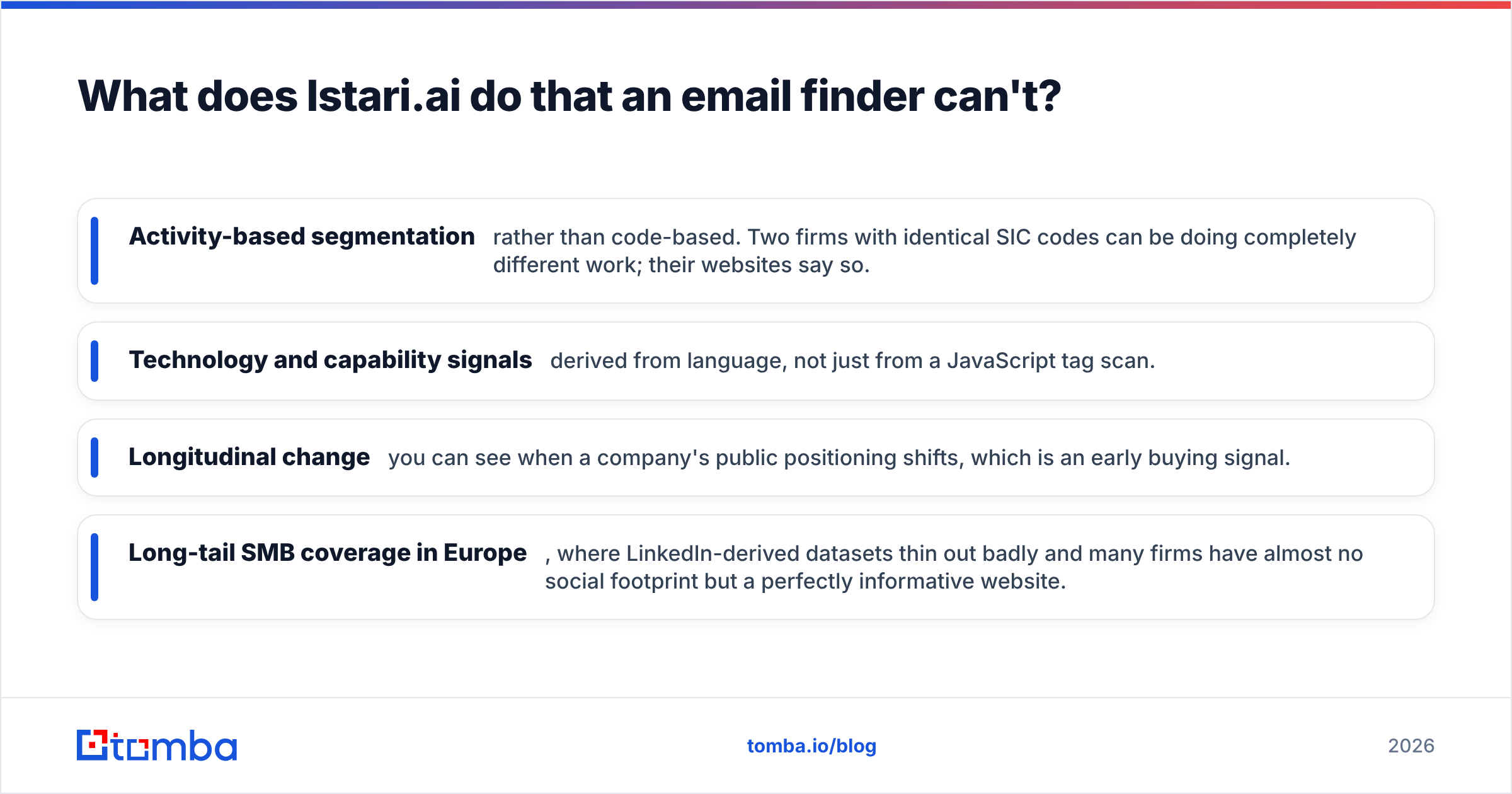
Istari.ai reads what each company says about itself today, on its own site. Then it turns that into comparable variables. A contact database cannot produce this:
- Segments based on activity, not codes. Two firms can share a SIC code and do totally different work. Their websites say so.
- Technology and capability signals pulled from language, not just from a script tag scan.
- Change over time. You can see when a company shifts its public message, which is an early buying signal.
- Long-tail SMB coverage in Europe. LinkedIn-based data thins out badly there. Many firms have almost no social footprint but a useful website.
For an ABM team building a 3,000-account list, that beats a filter like companies with 50 to 200 employees in software.
What it will not give you is a person to contact. You still need a domain search or an email finder to turn example-gmbh.de into k.mueller@example-gmbh.de.
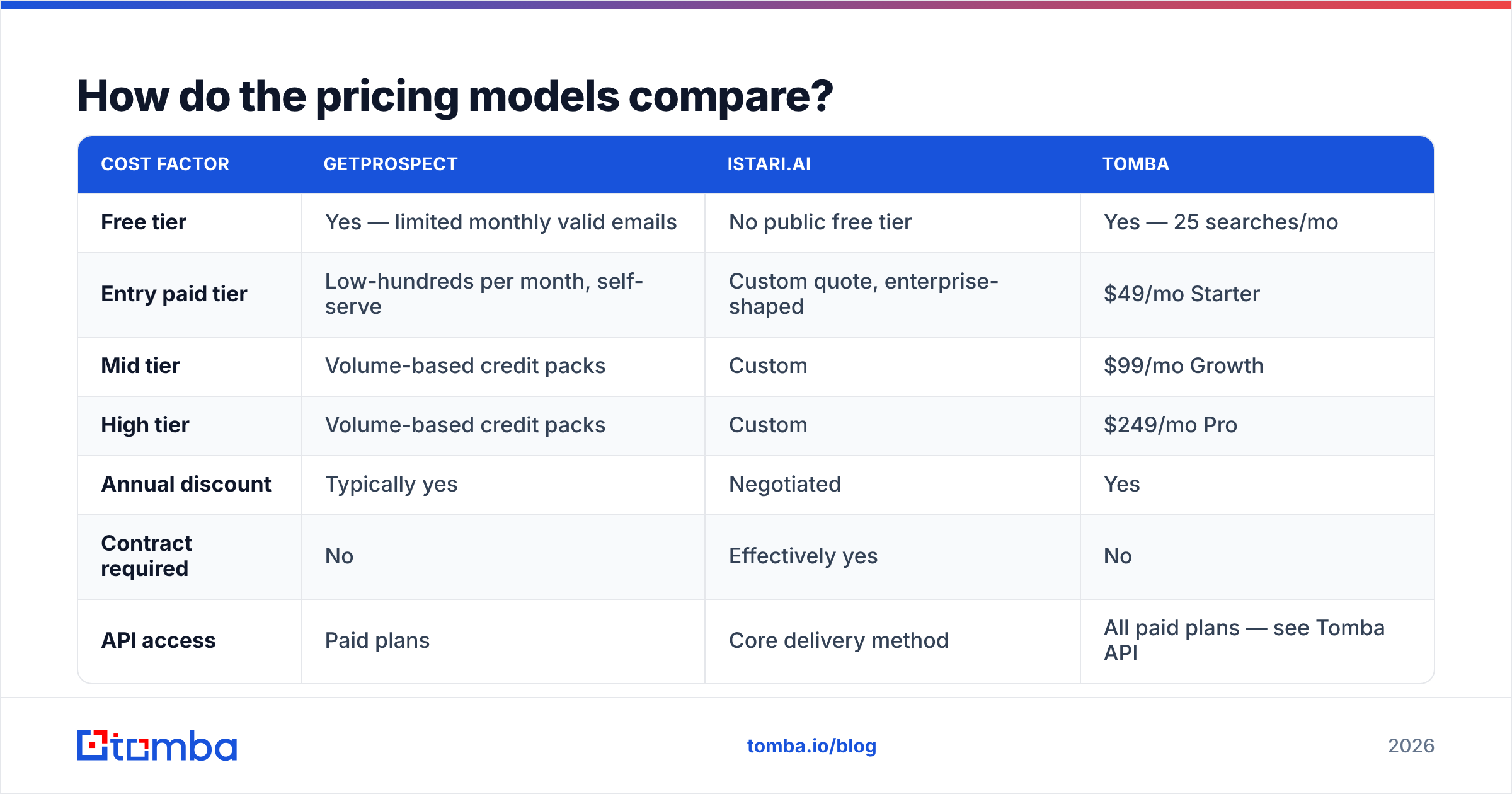
GetProspect vs Istari.ai pricing: how the models compare#
Be careful with published numbers. B2B data vendors change tiers often. A credit can mean one search, one export, one verification, or one enrichment. Confirm on the vendor page before you budget.
| Cost factor | GetProspect | Istari.ai | Tomba |
|---|---|---|---|
| Free tier | Yes — limited monthly valid emails | No public free tier | Yes — 25 searches/mo |
| Entry paid tier | Low-hundreds per month, self-serve | Custom quote, enterprise-shaped | $49/mo Starter |
| Mid tier | Volume-based credit packs | Custom | $99/mo Growth |
| High tier | Volume-based credit packs | Custom | $249/mo Pro |
| Annual discount | Typically yes | Negotiated | Yes |
| Contract required | No | Effectively yes | No |
| API access | Paid plans | Core delivery method | All paid plans — see Tomba API |
The structural point is simple. GetProspect and Tomba are priced like SaaS tools. Istari.ai is priced like a data partnership. If you cannot get budget for a five-figure annual data contract, the comparison ends there.
Tomba pricing is public, credit definitions included. That is worth checking against any vendor that reveals per-credit costs only after a sales call.

GetProspect vs Istari.ai: which should you choose?#
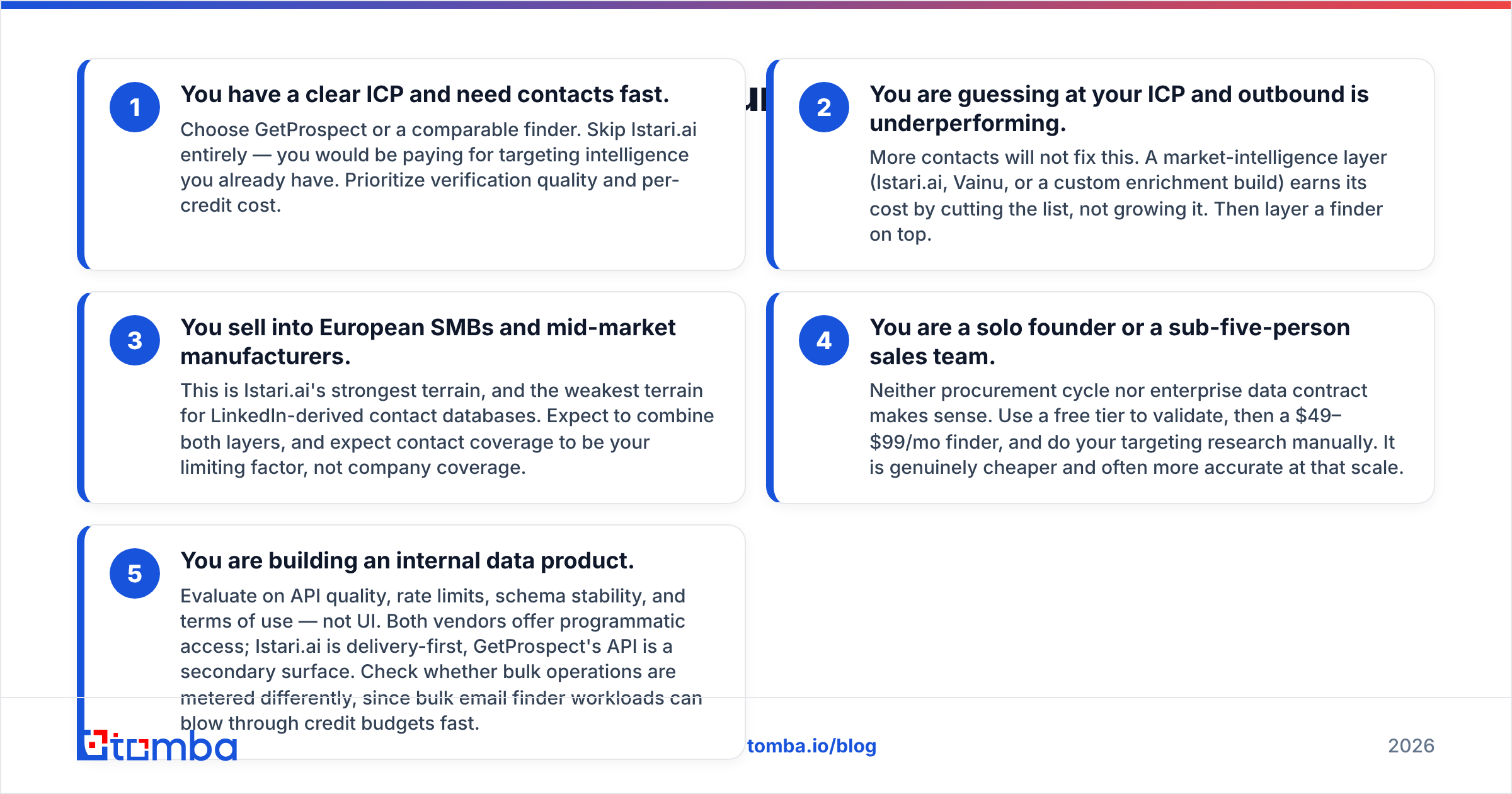
Match the tool to your real bottleneck. Here are the five common cases.
- You have a clear ICP and need contacts fast. Choose GetProspect or a similar finder. Skip Istari.ai. You would be paying for targeting you already have. Judge on verification quality and cost per credit.
- You are guessing at your ICP and outbound is flat. More contacts will not fix that. A market-intelligence layer earns its keep by cutting the list, not growing it. Add a finder on top afterwards.
- You sell to European SMBs and mid-market manufacturers. This is Istari.ai's home turf. It is the weakest turf for LinkedIn-based contact data. Plan on both layers. Contact coverage will be your limit, not company coverage.
The last two cases point away from this matchup entirely.
- You are a solo founder or a team of four. Neither a procurement cycle nor an enterprise data contract makes sense. Use a free tier to test. Then pay $49 to $99 a month for a finder and do your targeting research by hand. At that scale it is cheaper and often sharper.
- You are building an internal data product. Judge on API quality, rate limits, schema stability, and terms of use. Ignore the UI. Both vendors offer programmatic access. Istari.ai is delivery-first, while GetProspect's API is a side surface. Check how bulk calls are metered, because bulk email finder jobs can burn a credit budget fast.
Is either tool enough on its own?#
No. That is the most common mistake in this evaluation.
A working outbound data stack has three layers.
Targeting layer — which accounts. Firmographics, tech signals, intent, web data. Istari.ai lives here.
Contact layer — which people, and how to reach them. Names, titles, emails, phones. GetProspect and Tomba live here.
Hygiene layer — is the address still real, is the domain a catch-all, will this send bounce. Verification, deduplication, suppression. Teams skip this layer. It is the one that decides whether the other two produce anything.
So the GetProspect vs Istari.ai debate often misses the point. Teams buy layer one, buy layer two, skip layer three, then blame the vendors when replies dry up. Bounces are a deliverability problem first. High bounce rates hurt your sender reputation, and that buries the clean addresses too. One bad list poisons the good ones.
If you can only invest properly in one layer, make it hygiene. It is the cheapest, and it multiplies everything upstream.
What about data compliance?#
This is worth flagging, because the two vendors sit differently under GDPR.
Istari.ai reads public company website content. That is corporate information, not personal data in most cases. European buyers tend to find that a comfortable position.
Contact databases are the opposite. A work email is personal data under GDPR. Using legitimate interest for B2B outreach takes real work: a documented balancing test, a clear opt-out, honored erasure requests, and a known source for every record. Any vendor should be able to explain where its data comes from. If it cannot, that is your answer. Tomba publishes its data sources for this reason.
Selling into the EU? Ask every vendor on your shortlist for a DPA and their lawful-basis notes before the trial, not after.
The verdict: GetProspect vs Istari.ai#
For most readers, GetProspect is the relevant product and Istari.ai is not a real alternative to it. The two land on the same shortlist because both get called B2B data. That label is about as useful as software.
Choose GetProspect if you need a list of people with email addresses, you want self-serve pricing, and LinkedIn is your main source.
Choose Istari.ai if you need a solid view of a market: which companies exist, what they do, and how that is changing. You also need the budget and the analysts to use structured company data well.
Choose both if you run ABM into the European mid-market and can afford the stack.
Whichever targeting layer you pick, treat contact discovery and verification as its own decision. Accuracy compounds there. Every wrong address costs a credit, a bounce, a slice of domain reputation, and a rep's afternoon.
Want that layer cheap, transparent, and API-first? Start with the Tomba Email Finder. The free tier gives you 25 searches a month.
Test it against your own account list before you spend anything. Run the same 50 target companies through every tool on your shortlist. Then compare hit rate and bounce rate on real data instead of vendor marketing. Paid plans start at $49/mo. Verification is built in, not sold separately. The same credits cover email finding, domain search, catch-all checks, and enrichment. That is the practical end of the GetProspect vs Istari.ai question: pick a targeting layer, then make the contact layer accurate.
Related guides#
Ready to find emails that actually work?
Join 150,000+ professionals who stopped guessing and started sending. Free credits on signup — no credit card required.
Get the Tomba newsletter
Practical outbound tactics and product updates — once every two weeks.
About the author