GetProspect vs LeadGenius: Which B2B Data Tool Wins in 2026?
GetProspect is a self-serve email finder with a free tier. LeadGenius is a managed custom-data service with five-figure contracts. Here's which one actually fits your team, and when a third option beats both.
TL;DR
- GetProspect is a self-serve email finder and LinkedIn scraper. Free tier (50 valid emails/mo), paid plans from roughly $49/mo. You do the work; the tool gives you contacts.
- LeadGenius is a managed data service, not software you log into and run. Human researchers plus automation build custom datasets on request. Contracts typically start in the five figures annually.
- They are not really competitors. GetProspect competes with Tomba, Hunter, and Apollo. LeadGenius competes with ZoomInfo Enterprise, Bombora, and offshore research teams.
- Choose GetProspect if you need volume email discovery on a startup budget. Choose LeadGenius if you need data fields no database sells — headcount by department, store-level attributes, custom intent signals.
- If you want GetProspect-style economics with stricter verification and a real API, look at Tomba: free tier at 25 searches/mo, Starter $49/mo, Growth $99/mo.
What Are GetProspect and LeadGenius, Exactly?#
They solve the same business problem — "get me contact data for people who might buy" — through completely different mechanics.
GetProspect is a Ukraine-founded, self-serve prospecting tool built around a Chrome extension and a searchable B2B database. You filter by job title, company size, industry, and location, then export verified emails to CSV or your CRM. Its strongest feature is LinkedIn extraction: run a Sales Navigator search, click the extension, and it pulls profiles into a list with emails appended. It also ships a light CRM layer so you can tag, segment, and track contacts without a second tool.
LeadGenius works nothing like that. It is a managed data operation — often described as "data-as-a-service" — combining machine learning with a distributed human research team. You do not run searches. You brief an account team on what you need ("every Shopify Plus store in DACH with more than 50 employees, plus the name of whoever owns their loyalty program"), and LeadGenius delivers a custom dataset piped into Salesforce, HubSpot, or Snowflake on a recurring schedule.
That difference explains everything downstream: the pricing gap, the sales cycle, the accuracy profile, and who on your team actually touches the product.

How Do GetProspect and LeadGenius Compare Head to Head?#
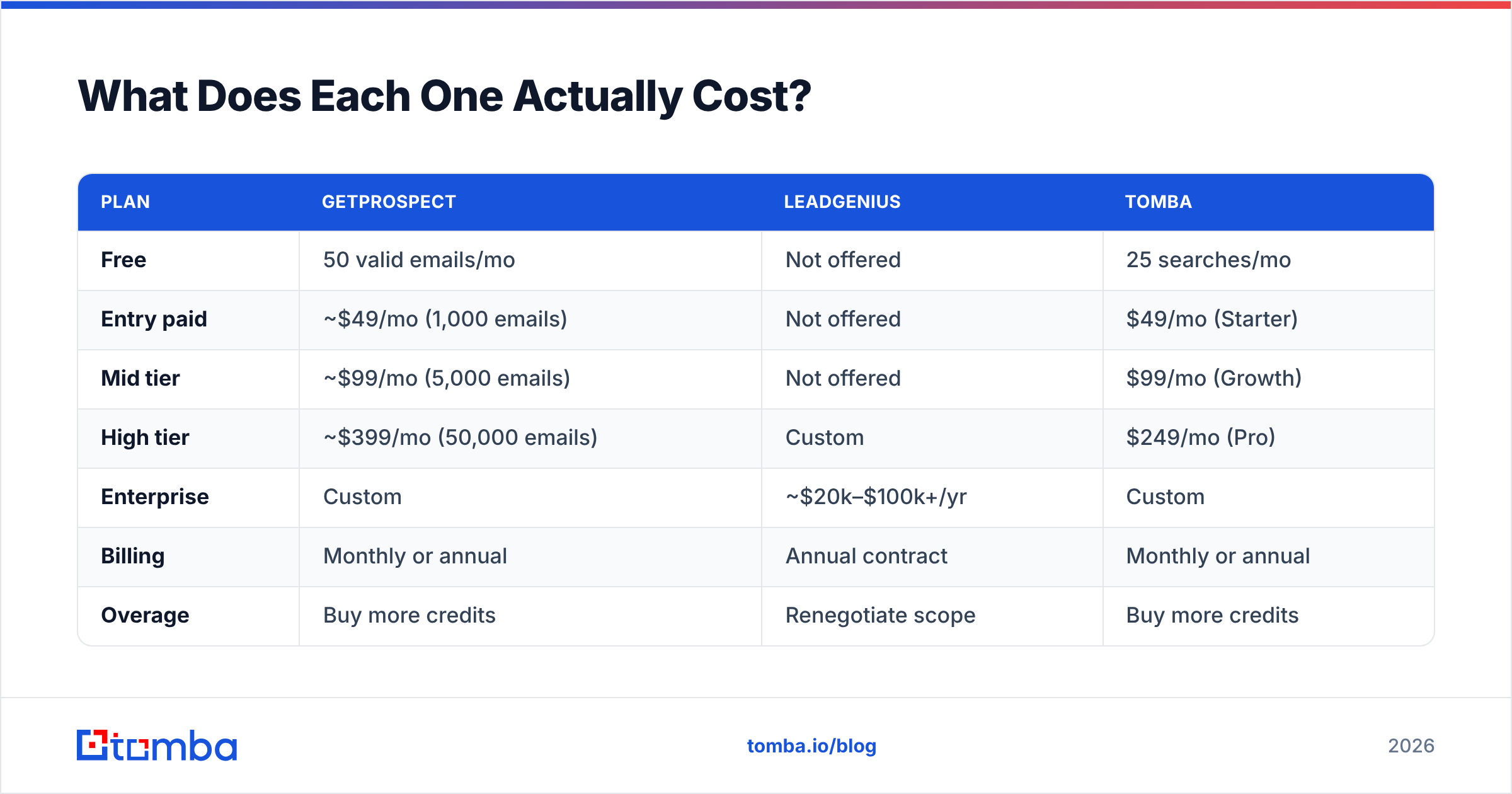
| Dimension | GetProspect | LeadGenius |
|---|---|---|
| Model | Self-serve SaaS | Managed data service (DaaS) |
| Free tier | 50 valid emails/mo | None — sales call required |
| Entry price | ~$49/mo | Custom; commonly $20k+/yr |
| Time to first data | Under 5 minutes | 2–6 weeks (scoping + build) |
| Data source | Proprietary DB + LinkedIn extraction | Human researchers + ML + web crawl |
| Custom fields | No | Yes — the core value prop |
| API | Yes, on paid plans | Yes, plus warehouse delivery |
| Best for | SDRs, founders, agencies | Enterprise RevOps, ABM, data teams |
| Contract | Monthly, cancel anytime | Annual, negotiated |
| Learning curve | An afternoon | Handled by their team |
Read that table as two different purchases. GetProspect is a tool you buy with a credit card on a Tuesday and use on Wednesday. LeadGenius is a vendor relationship your procurement team reviews, with a scoping call, a pilot, and a legal round.
Which One Has Better Data Accuracy?#
Neither wins outright, because they measure accuracy differently.
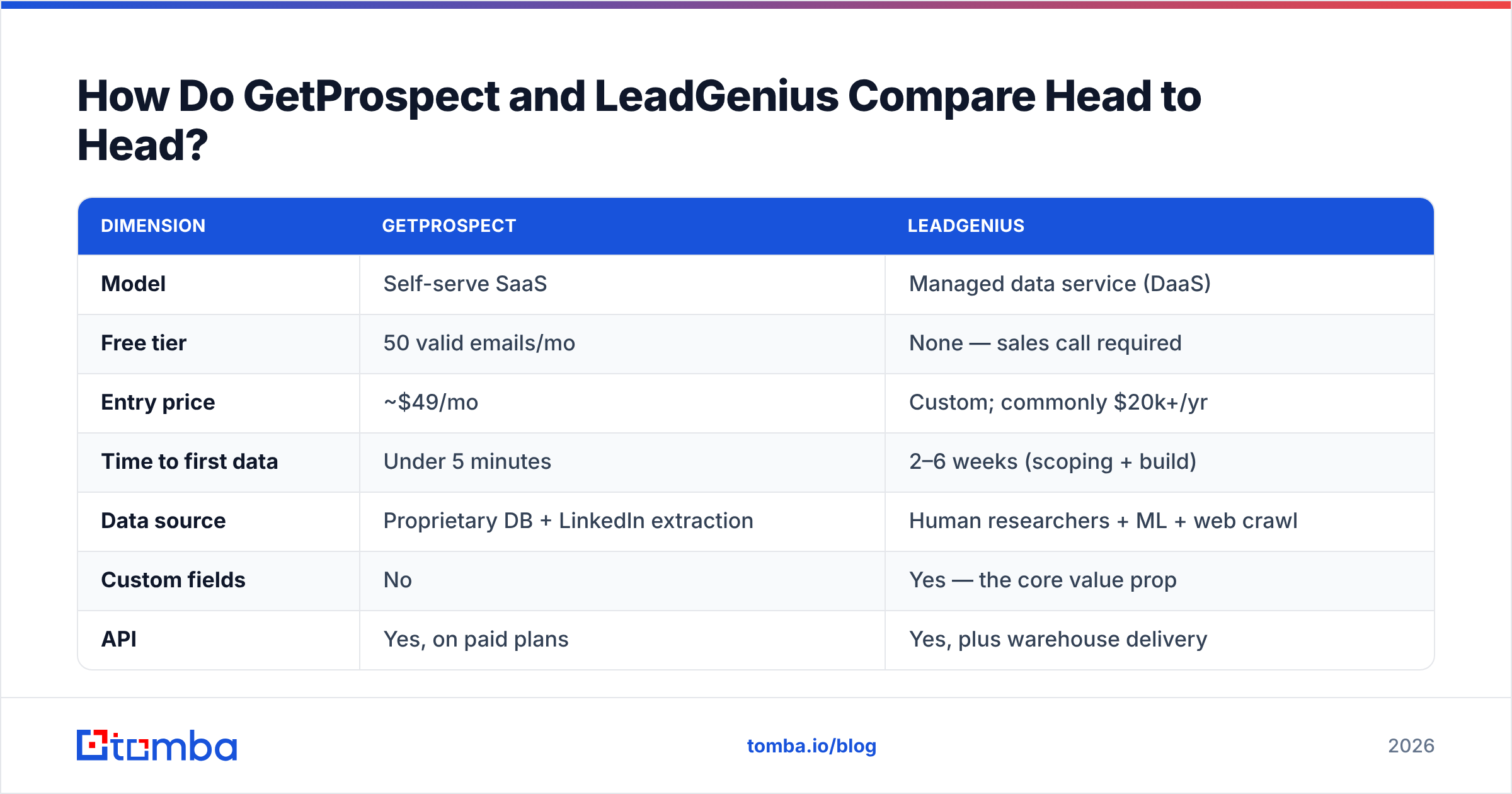
GetProspect publishes deliverability figures in the 95%+ range for emails it marks "valid," which is standard marketing across this category — Hunter, Apollo, and Tomba all cite similar numbers. In practice, independent user reports put real-world bounce rates on GetProspect exports somewhere in the 3–8% band, which is respectable but not category-leading. The weak spot is coverage: like most database-plus-pattern tools, it performs well on US and Western European tech companies and thins out fast on SMBs, non-English markets, and companies without a public web footprint.
LeadGenius approaches accuracy from the opposite end. Because a human verifies fields that no crawler can infer reliably, custom attributes come back with unusually high precision — 95%+ on the fields they commit to, per their own case studies and G2 reviews. But that precision is scoped to the dataset you commissioned. Ask for something outside the brief and you are back to a scoping call.
Here is the practical framing:
- Standard contact fields (name, title, company email, company domain) — GetProspect and every other self-serve finder handle these well enough. Price and volume decide the winner, not accuracy.
- Hard-to-find contacts (SMBs, non-tech verticals, EMEA and APAC) — coverage gaps hit self-serve tools hardest. Test with your actual ICP before committing.
- Custom attributes (tech stack detail, store counts, department headcount, compliance status) — no self-serve tool touches these. LeadGenius exists for exactly this.
- Refresh cadence — databases decay 25–30% per year as people change jobs. GetProspect re-verifies at export; LeadGenius rebuilds on a schedule you define.
- Verification depth — a good email verifier catches what any finder's export misses, including catch-all domains that inflate "valid" counts.
That last point deserves emphasis. Several tools count catch-all addresses as valid because the receiving server accepts everything. If your list is heavy on catch-all domains, run it through a catch-all verifier before you send. Otherwise your "95% valid" list can still bounce at 15%.
What Does Each One Actually Cost?#
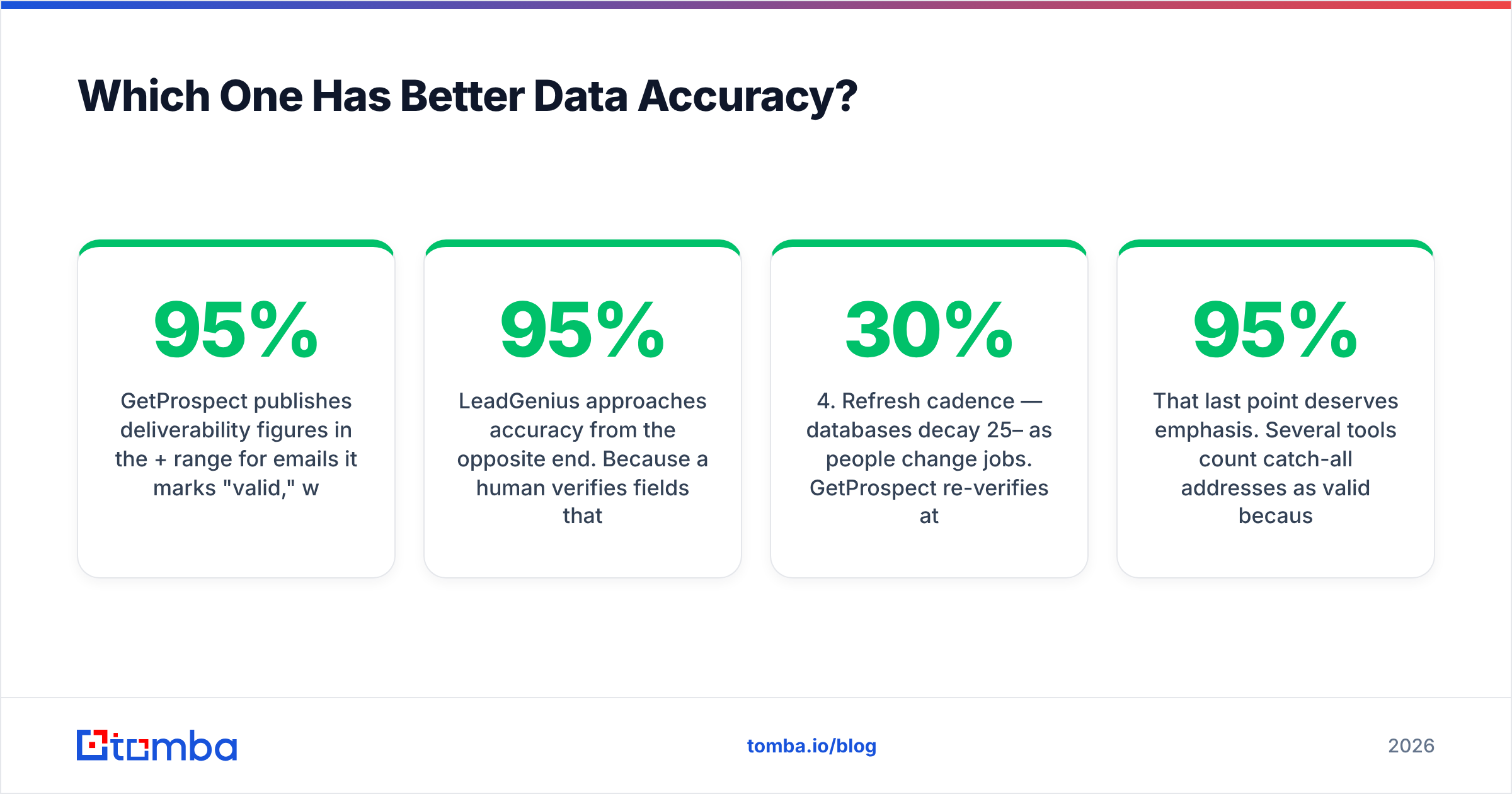
| Plan | GetProspect | LeadGenius | Tomba |
|---|---|---|---|
| Free | 50 valid emails/mo | Not offered | 25 searches/mo |
| Entry paid | ~$49/mo (1,000 emails) | Not offered | $49/mo (Starter) |
| Mid tier | ~$99/mo (5,000 emails) | Not offered | $99/mo (Growth) |
| High tier | ~$399/mo (50,000 emails) | Custom | $249/mo (Pro) |
| Enterprise | Custom | ~$20k–$100k+/yr | Custom |
| Billing | Monthly or annual | Annual contract | Monthly or annual |
| Overage | Buy more credits | Renegotiate scope | Buy more credits |
The gap is not a rounding error. LeadGenius's entry point is roughly what you would spend on GetProspect for 20 to 30 years. That is not a criticism — you are buying labor, not database queries. A researcher confirming that a specific regional manager owns the procurement budget costs real money, and no scraper replaces that.
But it does mean the comparison collapses for most buyers. If your annual data budget is under $10,000, LeadGenius is not on your list regardless of how good it is. Compare GetProspect against Tomba, Hunter, Findymail, or BookYourData — which sells pay-as-you-go verified lists and is a genuinely strong option when you want to buy a list outright rather than run searches yourself.

When Should You Pick LeadGenius Over a Self-Serve Tool?#
Four situations justify the price:
- Your ICP is defined by attributes nobody sells. "Manufacturers running SAP with a facility in Mexico and an active ISO 14001 certification" is not a filter in any database. It is a research project.
- You are running true account-based marketing. ABM at the enterprise level needs full buying-committee mapping — eight to twelve named people per account with roles, not just whoever showed up in a title search.
- Your data team wants a pipe, not a UI. LeadGenius delivers into Snowflake and BigQuery. If your GTM motion runs on a warehouse and reverse ETL, that matters more than any interface.
- Coverage in a market self-serve tools ignore. Japanese mid-market, Brazilian logistics, German Mittelstand — human researchers reach where crawlers do not.
If none of those describe you, LeadGenius is expensive infrastructure for a problem you do not have. The honest read is that most teams evaluating "GetProspect vs LeadGenius" got there through a search result, not a real overlap in their shortlist.
When Is GetProspect the Right Call — and When Is It Not?#
GetProspect fits well when you are running LinkedIn-first prospecting, need bulk exports from Sales Navigator, and want a light CRM without adding another subscription. The free tier is genuinely usable for testing, and the Chrome extension is one of the better ones in this category.
Where it strains:
- API depth. The API works, but teams building automated enrichment pipelines often find the endpoint coverage and rate limits thinner than dedicated API-first vendors.
- Verification rigor. Exports are verified, but layering a separate verification pass is still standard practice. Budget for that.
- Non-LinkedIn discovery. If your prospects are not well-represented on LinkedIn — trades, local services, many non-US markets — extraction-first tooling underperforms.
- Credit economics at scale. Per-email pricing at high volume gets expensive relative to flat-rate competitors.
What Are the Alternatives Worth Testing?#
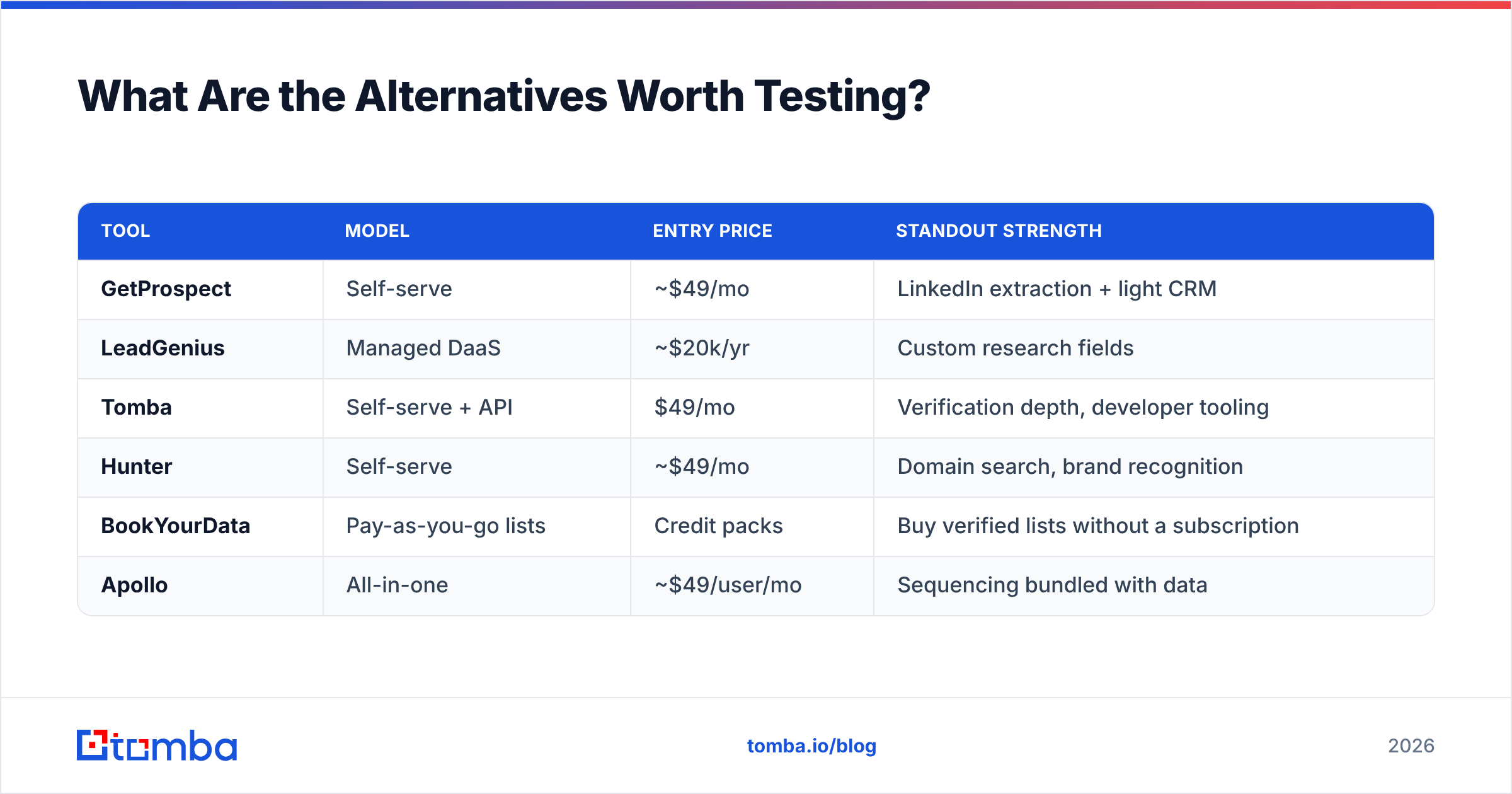
Before you commit to either, test three tools against 200 real prospects from your own list. Measure bounce rate, match rate, and cost per verified contact. That 30-minute test beats any review site.
| Tool | Model | Entry price | Standout strength |
|---|---|---|---|
| GetProspect | Self-serve | ~$49/mo | LinkedIn extraction + light CRM |
| LeadGenius | Managed DaaS | ~$20k/yr | Custom research fields |
| Tomba | Self-serve + API | $49/mo | Verification depth, developer tooling |
| Hunter | Self-serve | ~$49/mo | Domain search, brand recognition |
| BookYourData | Pay-as-you-go lists | Credit packs | Buy verified lists without a subscription |
| Apollo | All-in-one | ~$49/user/mo | Sequencing bundled with data |
Tomba lands closest to GetProspect on price while going deeper on the verification and infrastructure side. The domain search surfaces every discoverable address at a company with pattern confidence attached, the Tomba API covers finder, verifier, enrichment, and phone lookup under one key, and there are native add-ins for Google Sheets and Excel if your team lives in spreadsheets. Full Tomba pricing runs Free (25 searches/mo), Starter $49/mo, Growth $99/mo, and Pro $249/mo.
If you are on the fence between vendors, sites like G2 are useful for spotting recurring complaints — support responsiveness, billing surprises, sudden coverage drops — that vendor pages never mention.
How Should You Decide?#
Answer three questions honestly.
One: is your data problem discovery or definition? If you know who you want and just need their email, that is discovery — buy self-serve. If you cannot even describe your target list with existing filters, that is definition — you need research, and LeadGenius or a similar service is the category.
Two: what is your annual budget? Under $5k means self-serve only. $5k–$25k means self-serve plus a verification layer, or a pay-as-you-go list vendor. Above $25k, managed data starts to make sense.
Three: who operates it? An SDR who needs contacts today wants a Chrome extension. A RevOps lead building a warehouse-fed enrichment pipeline wants an API and a data contract. Buy for the operator, not the org chart.
Most teams reading this are in the first bucket in all three answers. That means the real decision is not GetProspect vs LeadGenius — it is which self-serve finder gives you the best cost per verified contact, and whether its verification is strict enough that you are not paying twice.
Ready to Test It Yourself?#
Run the same 200 prospects through whichever tools make your shortlist and compare bounce rates. If you want a strict baseline to test against, start with the Tomba Email Finder — the free tier gives you 25 searches a month with no card, verification is built into the same workflow rather than sold as an upsell, and the API is there when your manual process outgrows the browser extension. Test it against your real ICP, not a demo list, and let the bounce rate decide.
Related guides#
Ready to find emails that actually work?
Join 150,000+ professionals who stopped guessing and started sending. Free credits on signup — no credit card required.
Get the Tomba newsletter
Practical outbound tactics and product updates — once every two weeks.
About the author