GetProspect vs Mattermark: Which B2B Data Tool Wins in 2026
One finds verified work emails at scale. The other tracks company growth signals. Here is an honest breakdown of GetProspect vs Mattermark — pricing, data depth, coverage gaps, and which one your outbound motion actually needs.
GetProspect vs Mattermark is an odd matchup. One tool finds work emails. The other tracks how fast companies grow. Pick the wrong one and you burn a quarter of budget on data you cannot use.
TL;DR
- GetProspect and Mattermark barely compete. GetProspect finds contacts. Mattermark scores companies. It is a phone book next to a stock ticker.
- Need 2,000 verified work emails for VP Marketing at Series B SaaS firms? GetProspect wins. Mattermark was never built to hand you inboxes.
- Need to know which 200 companies are growing fast enough to buy this quarter? Mattermark's company data fits better. One caveat: check that the product is still sold and still fresh.
- Mattermark has changed owners more than once since 2017. Verify what you are buying before you sign. GetProspect still ships updates.
- Most teams need both jobs done. Use a company-data source for targeting. Then use an email finder and verifier for contacts. That is where Tomba and its email verifier fit, at a lower cost per record.
What Are GetProspect and Mattermark, Really?#
Start with the category mix-up. It explains most bad buys here.
GetProspect is a B2B contact database and email finder. Give it a name and a domain, a LinkedIn URL, or filters like job title, company size, or location. It returns work emails with a validity status. It also ships a Chrome extension for LinkedIn, a light list manager, and an API. The unit of output is a person you can email.
Mattermark is a company intelligence platform. The old pitch was "quantify every company in the world." Think funding rounds, headcount trends, web traffic, and growth scores. Sales and investment teams used it to build target account lists. It flagged fast movers early. The unit of output is a company worth watching.
That gap matters more than any feature checkbox. Buy Mattermark for a pile of verified emails and you will be let down. Buy GetProspect for funding alerts and growth scores and you will be let down too.
One more thing before you take Mattermark seriously. FullContact bought it in 2017. An investor group bought it back in 2018. Products with many owners tend to ship slowly. Review activity on G2 has thinned since the 2015–2017 peak. That is not proof of bad data. It is a reason to check. Ask for a current data freshness report. Ask for a live trial before you spend.

GetProspect vs Mattermark: How Do They Compare Head-to-Head?#
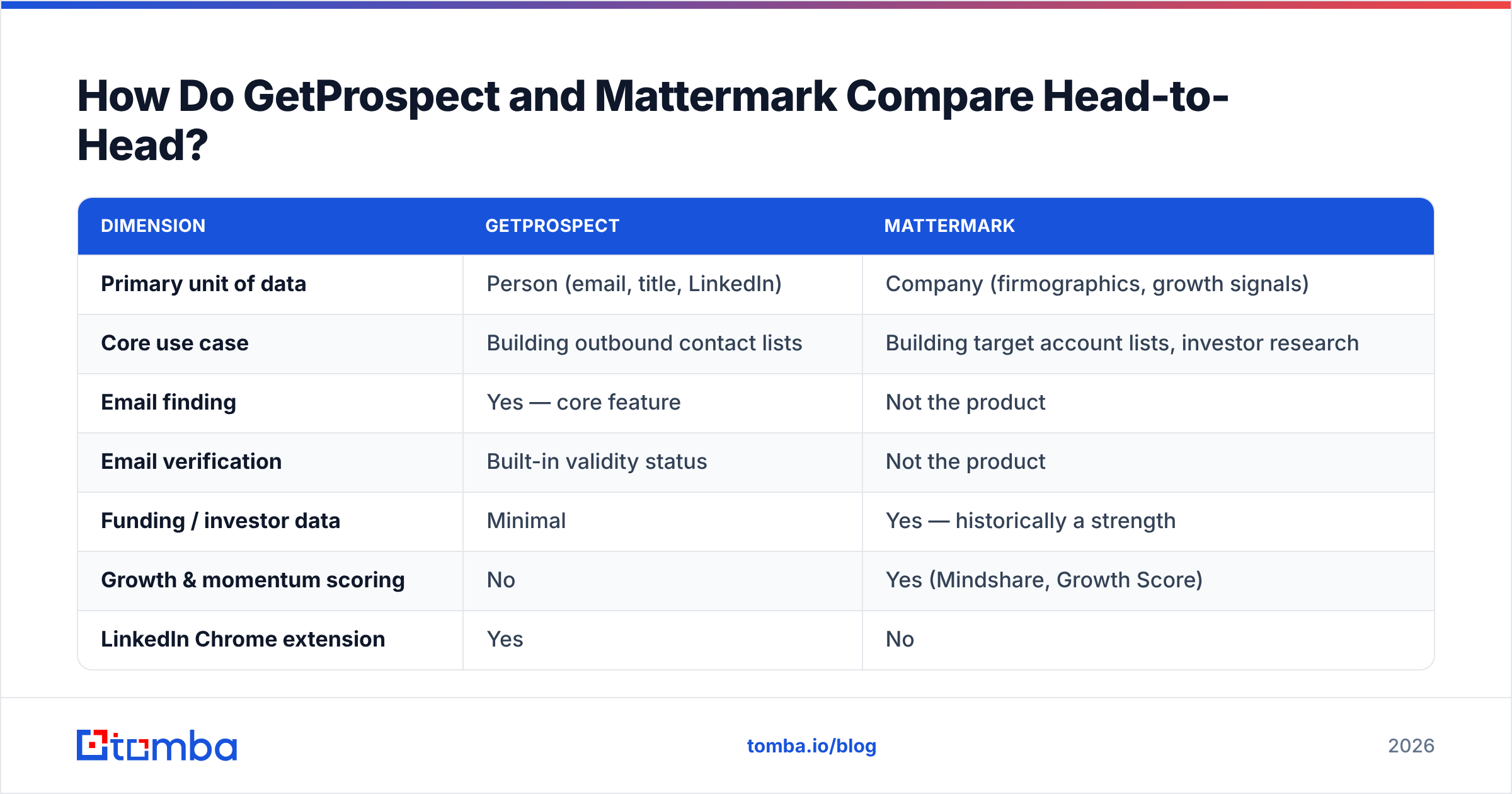
Here is the honest side by side. "Not the product" means the vendor never sold it that way. It does not mean the tool does it badly.
| Dimension | GetProspect | Mattermark |
|---|---|---|
| Primary unit of data | Person (email, title, LinkedIn) | Company (firmographics, growth signals) |
| Core use case | Building outbound contact lists | Building target account lists, investor research |
| Email finding | Yes — core feature | Not the product |
| Email verification | Built-in validity status | Not the product |
| Funding / investor data | Minimal | Yes — historically a strength |
| Growth & momentum scoring | No | Yes (Mindshare, Growth Score) |
| LinkedIn Chrome extension | Yes | No |
| Bulk enrichment from CSV | Yes | Limited / export-driven |
| API access | Yes, on paid tiers | Historically yes; verify current availability |
| Free tier | Yes — limited monthly credits | No public free tier |
| Best fit team | SDR, growth, agency, recruiter | RevOps, VC, corp dev, market research |
| Roadmap velocity (2026) | Actively shipping | Uncertain — verify before buying |
The table makes the choice clear. You are not picking between two versions of one tool. You are picking which half of the prospecting problem to solve first.
What Does Each Tool Actually Cost in 2026?#
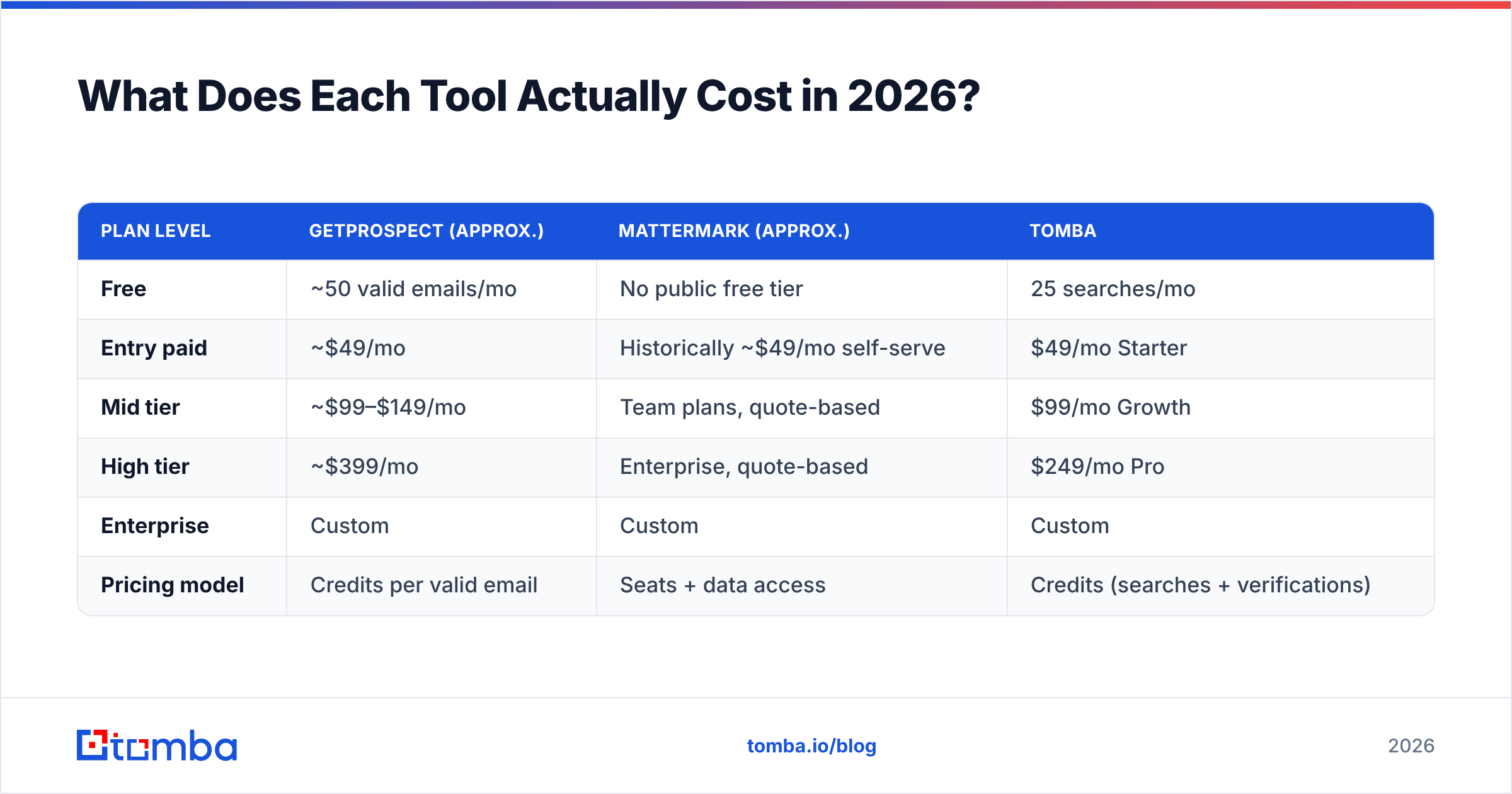
Prices move. Mattermark's public pricing has been patchy since it changed hands. Treat the numbers below as a guide. Confirm them on the vendor page before you budget.
| Plan level | GetProspect (approx.) | Mattermark (approx.) | Tomba |
|---|---|---|---|
| Free | ~50 valid emails/mo | No public free tier | 25 searches/mo |
| Entry paid | ~$49/mo | Historically ~$49/mo self-serve | $49/mo Starter |
| Mid tier | ~$99–$149/mo | Team plans, quote-based | $99/mo Growth |
| High tier | ~$399/mo | Enterprise, quote-based | $249/mo Pro |
| Enterprise | Custom | Custom | Custom |
| Pricing model | Credits per valid email | Seats + data access | Credits (searches + verifications) |
Two things stand out.
First, credit rules are where budgets die. GetProspect charges for valid emails found. That is friendlier than charging for every lookup. Ask any vendor three questions. Do I pay when you return nothing? Do I pay again to re-verify the same record in 90 days? Do unused credits roll over? The answers can move real cost by 2–3x.
Second, seat pricing punishes small teams. Company-data platforms charge per seat because analysts use them. Contact platforms charge per record because volume drives the value. Say two analysts need Mattermark-style data and eight reps need contact data. Buying one tool for all ten is the costly mistake.
Which One Has Better Data Quality?#
Wrong question. They measure quality on different axes.
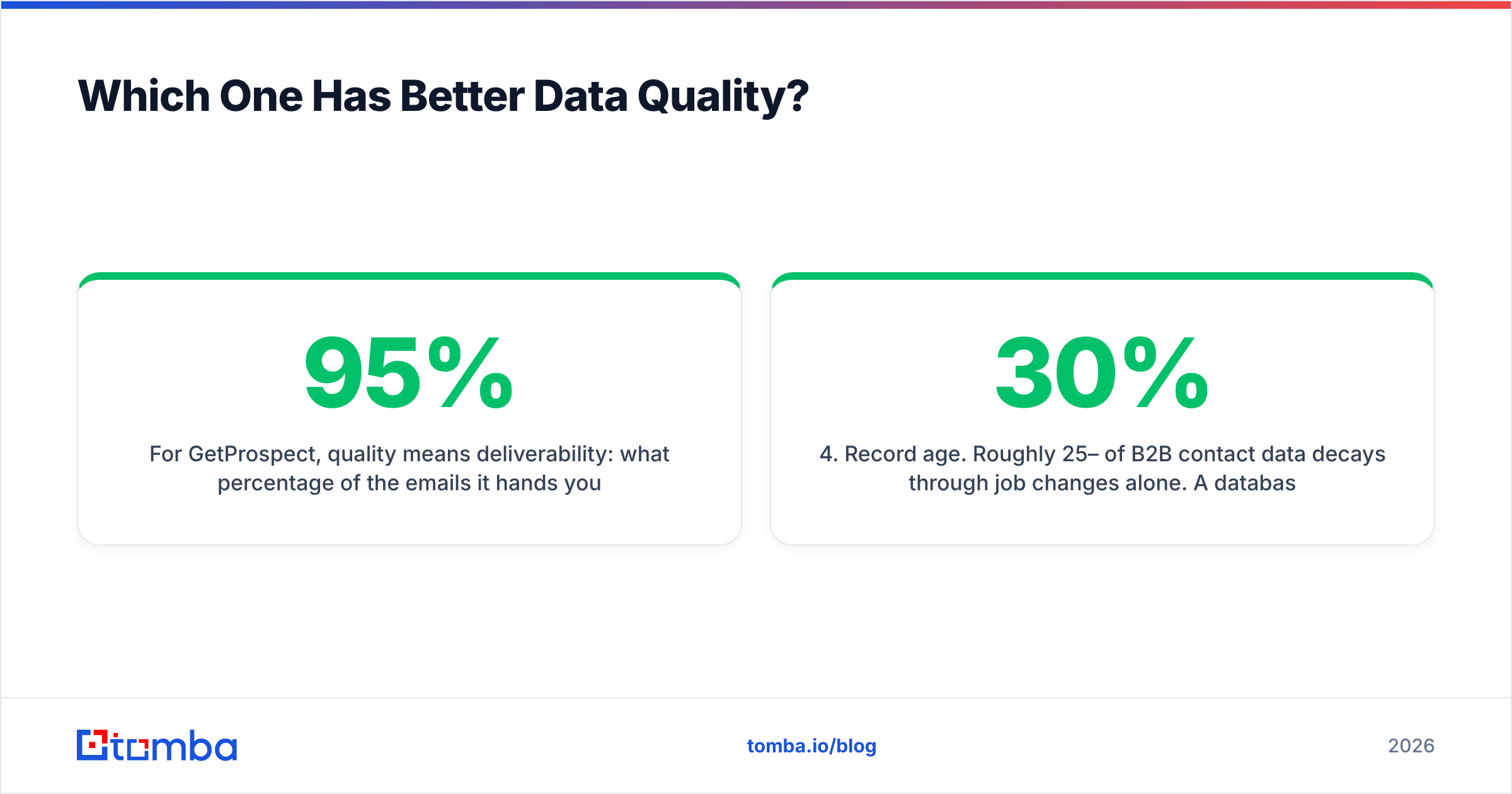
For GetProspect, quality means deliverability. How many of the emails accept mail? Tools in this class usually land at 85–95% on common domains. That rate drops fast on catch-all domains, small businesses with no web presence, and regions with light LinkedIn use. Any vendor claiming 99% across all domains is quoting a lab number, not your list.
For Mattermark, quality means freshness. Is the headcount from this quarter or from 2019? Did the Series C close, or did a blog guess? Stale company data is worse than missing data. It makes you confident about dead facts.
Five things drive your hit rate, whatever you buy. Start with the first three:
- Domain type. Google Workspace and Microsoft 365 domains verify cleanly. Catch-all domains accept everything and confirm nothing. Use a catch-all verifier to get a real read instead of a coin flip.
- Title seniority. VP and C-level emails are published more often. Coverage on individual contributors at mid-market firms is where databases quietly fail.
- Geography. North America and Western Europe are deep at every vendor. APAC, LATAM, and non-English markets are where vendors differ by 30 points, not 3.
The last two are about timing, and most teams skip the fifth:
- Record age. Job changes rot 25–30% of B2B contact data each year. A database that never re-checks is selling you last year's org chart.
- Verification at send time. Even clean data goes stale between purchase and launch. Re-verify right before you send, not when you buy.
That last step is the cheapest insurance in outbound. Re-verifying a 5,000-record list costs a few dollars. A flagged sending domain costs you weeks.

Who Should Actually Use GetProspect?#
Pick GetProspect when contact volume is the bottleneck, not account choice. Concrete profiles:
- SDR teams with a set ICP. You already know the 3,000 companies. You need the people inside them. Filter, export, and the LinkedIn extension cover it.
- Agencies running outbound for clients. Credit pricing scales with client load, not headcount. List segmentation is built in.
- Recruiters. Sourcing works like prospecting: title, company, seniority, then contact.
- Teams already paying for account data. If Clearbit, ZoomInfo, or a warehouse tells you which accounts matter, you only need the contact layer.
Where it struggles: deep company data, intent signals, and non-Western coverage. It is a contact tool with light company data bolted on, not the reverse.
Who Should Actually Use Mattermark?#
Mattermark suits a narrower group, but the fit is real:
- Venture and corp dev teams watching which private companies speed up before a round goes public.
- Market researchers sizing a segment by headcount growth and funding, not by contact count.
- RevOps teams scoring accounts who want a momentum input that plain firmographics miss.
- ABM programs with 200 target accounts, where good intel per account is cheap.
Where it struggles: everything after the account list. You still need contacts, a verifier, and a sending tool. Mattermark hands you the map. It does not hand you the key.
Again: check product status, data refresh cadence, and support during a trial. A tool with a messy ownership history earns more scrutiny than one shipping weekly changelogs.
Is There a Better Option Than Either for Contact Data?#
For most outbound teams, contact data is the real bottleneck. In that case the GetProspect vs Mattermark debate is the wrong one to run. Compare GetProspect with other dedicated email finders instead.
Score them on five things:
- Cost per verified email, not cost per credit. Divide the monthly price by records you can actually send to.
- Verification bundled or not. Paying one vendor to find and a second to verify nearly doubles your cost per record.
- Catch-all handling. Roughly 15–20% of B2B domains are catch-all. A vendor that returns "unknown" on all of them quietly caps your list.
- Workflow fit. If your team lives in Sheets, HubSpot, or Airtable, export-import loops burn hours. Native integrations remove that tax.
- API access. Enrichment on signup, CRM cleanup, and lead routing need code, not a UI.
Tomba scores well on those points. Finder, verifier, domain search, catch-all handling, and enrichment share one credit pool. The free tier is 25 searches a month. Starter is $49/mo, the same entry price as GetProspect, with verification included rather than metered on the side. The pricing page spells out what each credit buys, which few vendors here publish openly. Run one 200-record list through both tools and compare what lands. That ten-minute test beats any review site.
For account data, the honest answer is that the modern Mattermark alternatives are broader tools. Crunchbase covers funding. LinkedIn Sales Navigator covers headcount signals. Intent vendors cover buying stage. Crunchbase alone covers much of the ground Mattermark opened.
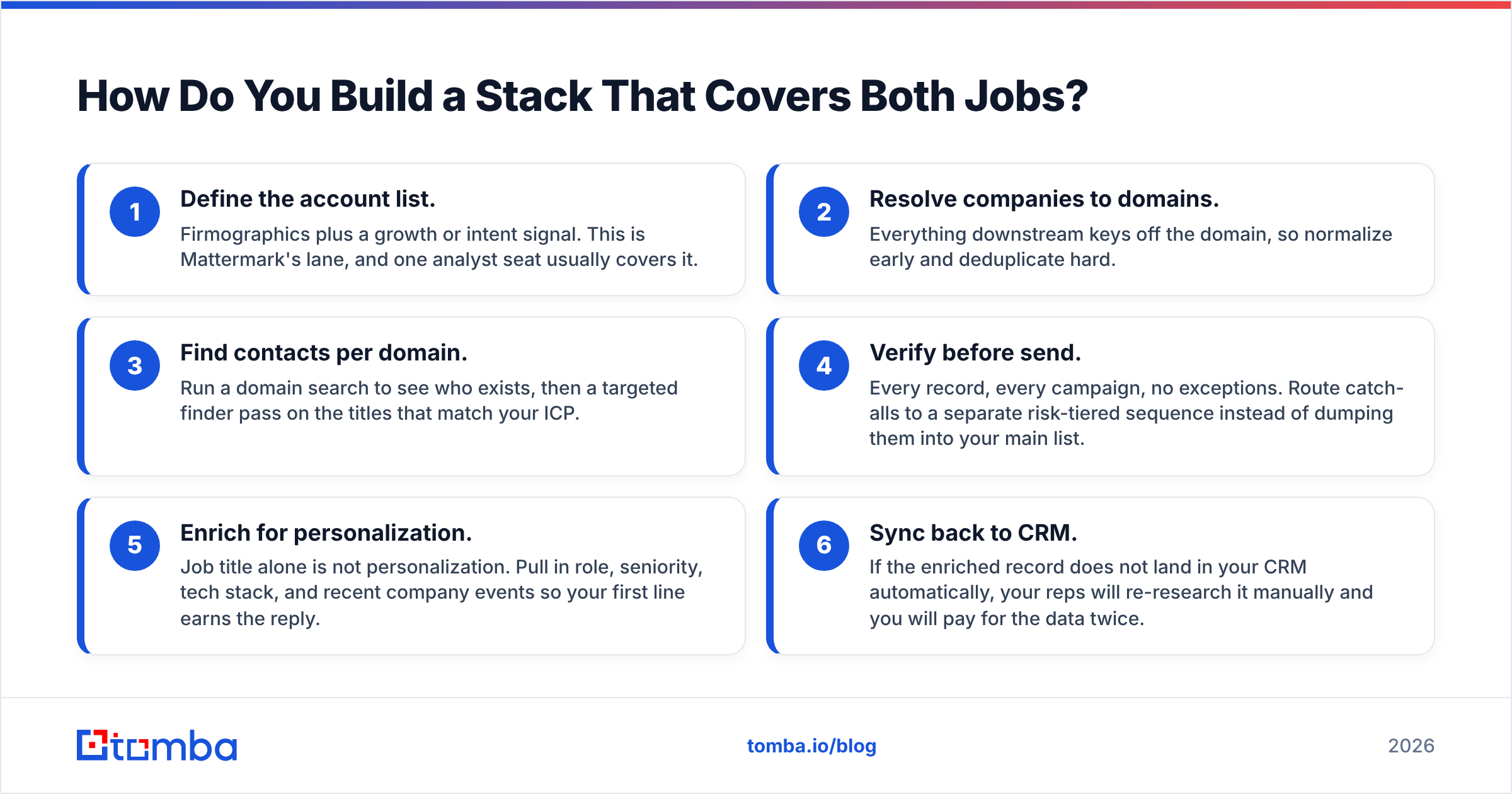
How Do You Build a Stack That Covers Both Jobs?#
Keep targeting and contacting apart:
- Define the account list. Company data plus a growth or intent signal. One analyst seat usually covers it.
- Resolve companies to domains. Everything downstream keys off the domain. Normalize early and dedupe hard.
- Find contacts per domain. Run a domain search to see who exists. Then run a finder pass on the titles that match your ICP.
- Verify before send. Every record, every campaign, no exceptions. Route catch-alls into their own sequence instead of your main list.
- Enrich for personalization. A job title is not personalization. Pull role, seniority, tech stack, and recent company news so your first line earns a reply.
- Sync back to CRM. If the record does not land in the CRM by itself, reps redo the research and you pay for the data twice.
Steps 3 to 6 belong to one vendor. Steps 1 and 2 belong to another. Buying a single tool for all six is how teams overpay for features half the org never opens.
Frequently Asked Questions#
Is Mattermark still operating in 2026? The brand has changed hands at least twice since 2017. Do not trust a secondhand claim. Ask the vendor for a live trial and a data-freshness sample before you buy.
Does GetProspect verify emails, or do I need a separate tool? It returns a validity status on the emails it finds. Many teams still run their own check right before sending, because records decay between purchase and launch.
Which is cheaper? GetProspect's entry tier is credit-based and predictable. Mattermark's team pricing has been quote-based and seat-driven. That usually costs more once you pass three users.
Can I use both? Yes. For ABM it is the sensible setup: account intel upstream, contact data and verification downstream.
What if I only need emails? Then skip company-intelligence tools and compare dedicated email finders on cost per deliverable record.
Start With the Contact Layer#
If your problem is "we know who to target, we just cannot reach them," fix the contact layer first. It is the cheaper and faster half.
The Tomba Email Finder gives you 25 free searches a month. Test coverage on your own ICP before you spend. Verification, domain search, and catch-all handling draw from the same credit pool. Run your real target list through it, measure what lands, and let your own numbers pick the winner.
Related guides#
Ready to find emails that actually work?
Join 150,000+ professionals who stopped guessing and started sending. Free credits on signup — no credit card required.
Get the Tomba newsletter
Practical outbound tactics and product updates — once every two weeks.
About the author