GetProspect vs NeverBounce: Which Tool Do You Need?
GetProspect finds emails. NeverBounce verifies them. They solve different halves of the same problem — here's how pricing, accuracy and workflow fit compare, and when one tool beats buying both.
TL;DR
- GetProspect and NeverBounce are not really competitors. GetProspect finds email addresses from a B2B database and LinkedIn; NeverBounce verifies email addresses you already have.
- If your list is empty, NeverBounce cannot help you. If your list is full of guesses, GetProspect's built-in checking is lighter than a dedicated verifier.
- NeverBounce (part of ZoomInfo) is priced per verification — roughly cents-per-email on pay-as-you-go, cheaper in bulk. GetProspect is priced per valid email or per credit on monthly plans.
- Most teams that buy both are paying two vendors for one job. A combined finder plus verifier — Tomba starts free at 25 searches/mo, then $49/mo — removes a CSV hand-off from the workflow.
- Buy NeverBounce only if you have large inherited lists (webinar exports, old CRM data, marketing databases) that need scrubbing at scale and you already have a separate sourcing tool.
What are GetProspect and NeverBounce, really?#
Think of it like building a guest list. GetProspect is the person who digs up who to invite and what their address is. NeverBounce is the person who checks each address is still occupied before you mail the invitations. Both jobs matter. Neither one does the other.
GetProspect is a B2B lead-generation platform: a searchable contact database, a LinkedIn Chrome extension that pulls emails off profiles and Sales Navigator lists, and a lightweight CRM-ish list manager. You go in with a filter — "Head of Marketing, SaaS, 51-200 employees, Germany" — and come out with names and email addresses.
NeverBounce is a pure email verification service, acquired by ZoomInfo in 2019. You upload a list or hit the API, and it returns a status for each address: valid, invalid, catch-all (they call it "accept-all"), disposable, or unknown. It does not find anything. It grades what you bring.
That distinction is the whole comparison. Everything below is about which half of the pipeline is currently costing you money.
Which problem do you actually have?#
Before you compare feature grids, diagnose the failure. Outbound breaks in one of two places, and the fix is different for each.
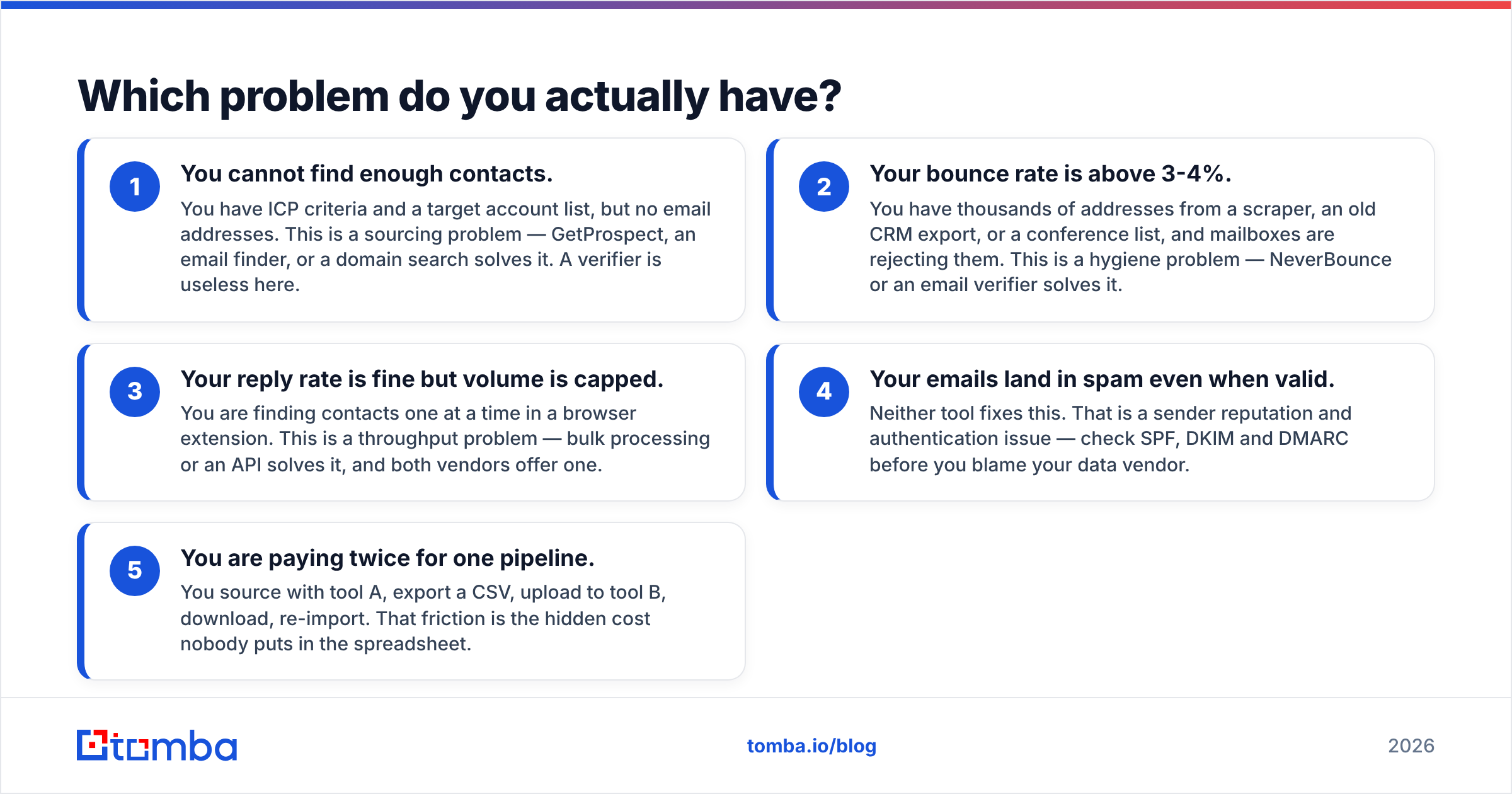
- You cannot find enough contacts. You have ICP criteria and a target account list, but no email addresses. This is a sourcing problem — GetProspect, an email finder, or a domain search solves it. A verifier is useless here.
- Your bounce rate is above 3-4%. You have thousands of addresses from a scraper, an old CRM export, or a conference list, and mailboxes are rejecting them. This is a hygiene problem — NeverBounce or an email verifier solves it.
- Your reply rate is fine but volume is capped. You are finding contacts one at a time in a browser extension. This is a throughput problem — bulk processing or an API solves it, and both vendors offer one.
- Your emails land in spam even when valid. Neither tool fixes this. That is a sender reputation and authentication issue — check SPF, DKIM and DMARC before you blame your data vendor.
- You are paying twice for one pipeline. You source with tool A, export a CSV, upload to tool B, download, re-import. That friction is the hidden cost nobody puts in the spreadsheet.
Most teams that Google "getprospect vs neverbounce" are actually in bucket five. They already own one and are wondering whether they need the other.

How accurate is each one?#
Accuracy means two different things here, which is why vendor claims are hard to compare.
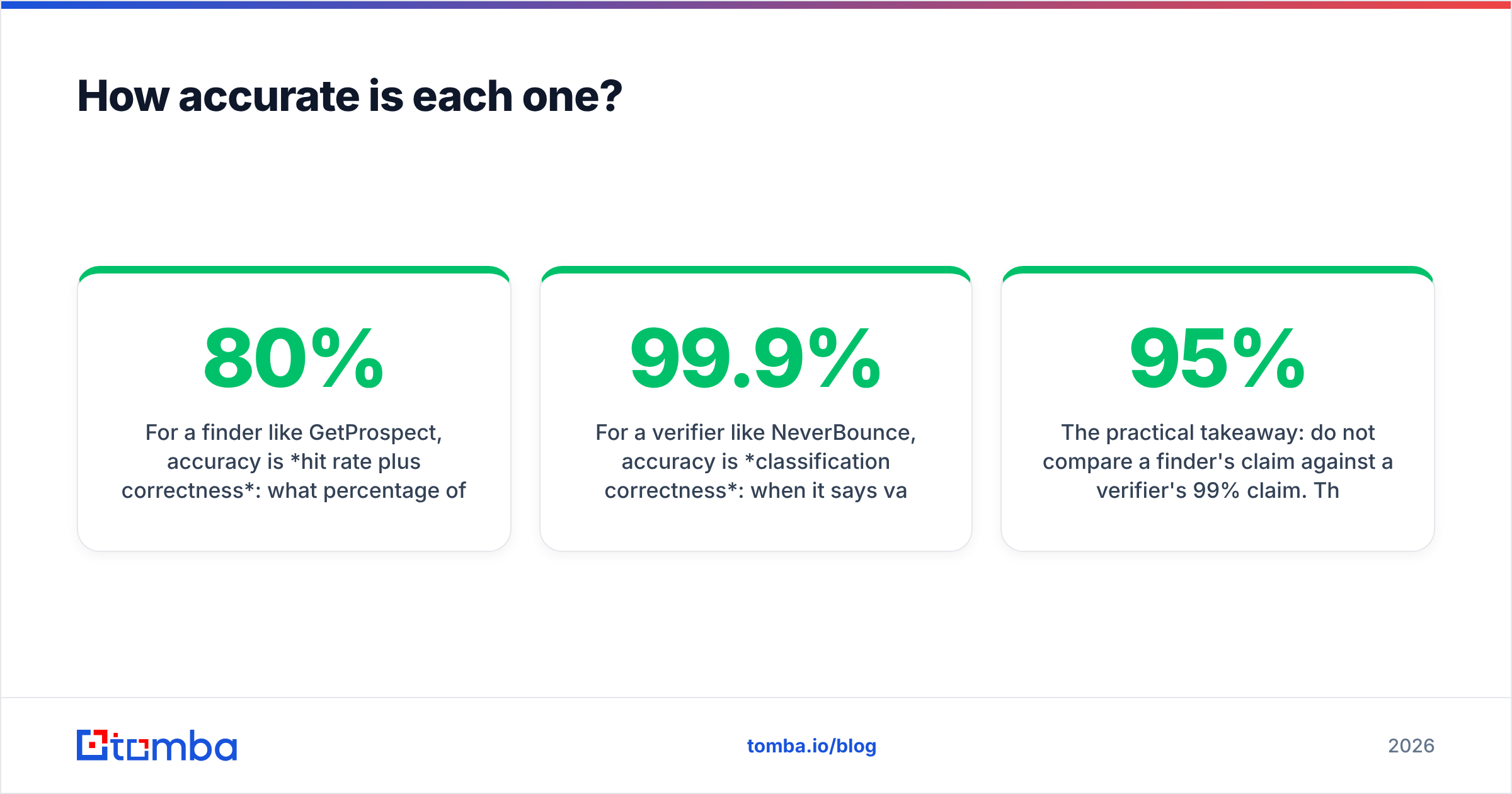
For a finder like GetProspect, accuracy is hit rate plus correctness: what percentage of your target list returns an address, and what percentage of those addresses actually deliver. A finder that returns an email for 80% of your list at 90% deliverability nets you 72% usable contacts. A finder that returns 55% at 97% nets 53%. The first one wins on volume, the second on list health — and both marketing pages will say "high accuracy."
For a verifier like NeverBounce, accuracy is classification correctness: when it says valid, is it valid, and when it says invalid, is it really dead. NeverBounce publicly claims around 99.9% accuracy and runs a multi-step process including syntax checks, MX record lookups, SMTP handshakes and known-bounce lists. Independent user reviews on G2 generally back up that it is a strong performer in the verification category, with the usual caveat that no verifier can definitively resolve catch-all domains.
That catch-all problem deserves its own paragraph. Roughly one in five business domains accepts mail for any address at the SMTP layer, so a standard verification handshake cannot prove whether jane.doe@ exists. NeverBounce marks these "accept-all" and leaves the decision to you. Some teams delete them, which throws away real contacts; others mail them, which risks bounces. Tools with dedicated catch-all verification apply extra signal layers to resolve part of that grey zone instead of shrugging.

The practical takeaway: do not compare a finder's 95% claim against a verifier's 99% claim. They are measuring different things. Run 100 known-good contacts from your own CRM through both and count.
GetProspect vs NeverBounce: how do they compare on features and price?#
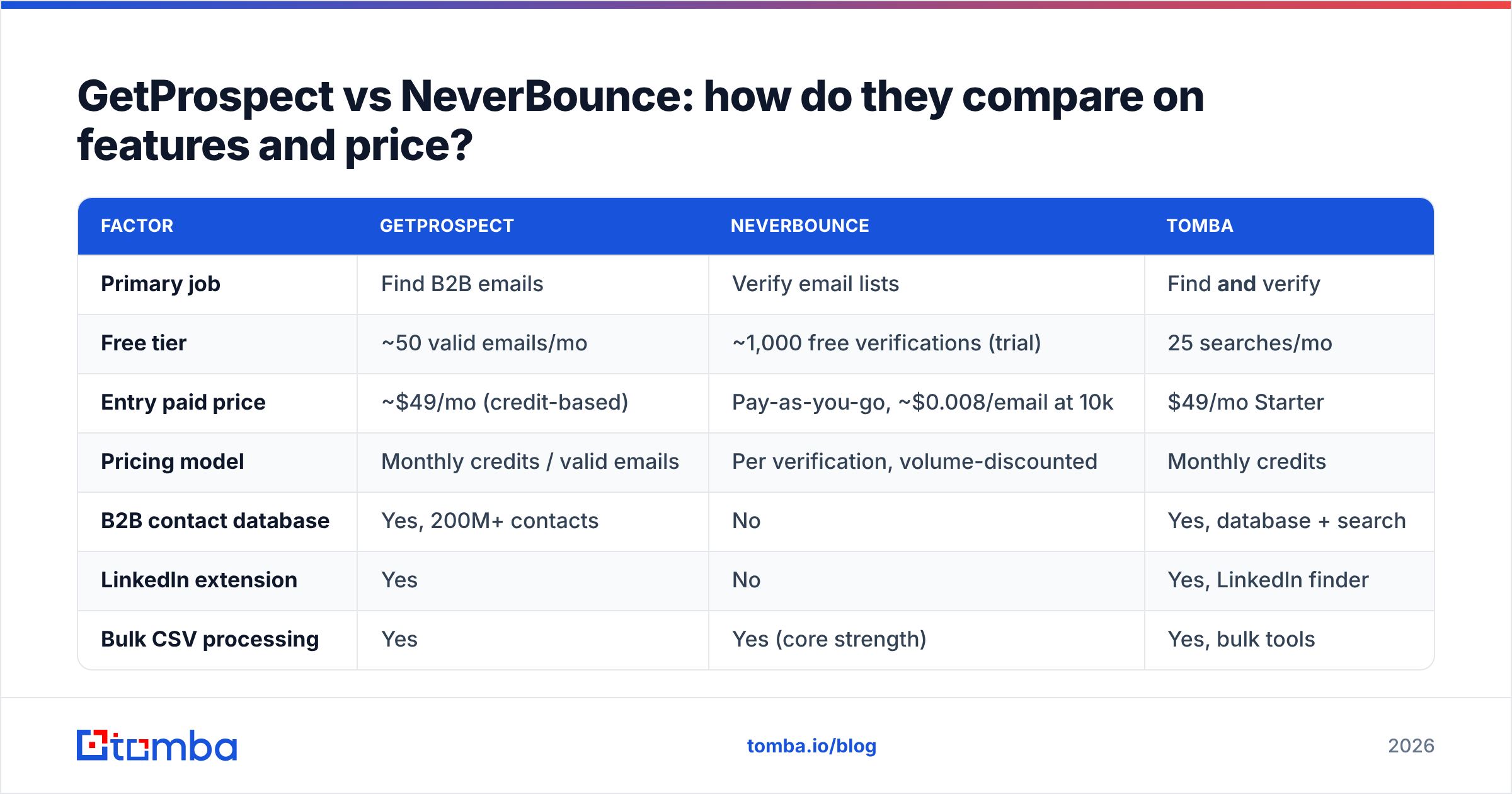
Pricing on both platforms changes, and both offer annual discounts and volume tiers — treat the figures below as the shape of each model rather than a quote. Check the vendor pages before you buy.
| Factor | GetProspect | NeverBounce | Tomba |
|---|---|---|---|
| Primary job | Find B2B emails | Verify email lists | Find and verify |
| Free tier | ~50 valid emails/mo | ~1,000 free verifications (trial) | 25 searches/mo |
| Entry paid price | ~$49/mo (credit-based) | Pay-as-you-go, ~$0.008/email at 10k | $49/mo Starter |
| Pricing model | Monthly credits / valid emails | Per verification, volume-discounted | Monthly credits |
| B2B contact database | Yes, 200M+ contacts | No | Yes, database + search |
| LinkedIn extension | Yes | No | Yes, LinkedIn finder |
| Bulk CSV processing | Yes | Yes (core strength) | Yes, bulk tools |
| Real-time API | Yes | Yes, strong uptime record | Yes, Tomba API |
| Catch-all handling | Flags them | Marks "accept-all", no resolution | Dedicated catch-all verifier |
| Phone numbers | Limited | No | Yes, phone finder |
| Best for | Filling an empty pipeline | Scrubbing large inherited lists | Teams wanting one pipeline |

Two things stand out in that grid.
First, the pricing models are not comparable line for line. NeverBounce charges per verification with steep volume discounts, so verifying 100,000 addresses once is cheap per unit but a real line item in absolute terms. GetProspect charges monthly for a credit pool whether you use it or not. If your volume is spiky — a big list once a quarter — pay-as-you-go wins. If it is steady, subscriptions win.
Second, the overlap is thin. GetProspect does run basic validity checks on the emails it returns, which is enough for many senders. NeverBounce does nothing on the sourcing side. So the honest answer to "which should I buy" is usually "the one matching the half you are missing."
When should you buy NeverBounce over GetProspect?#
Buy NeverBounce when verification is the actual bottleneck and the volume is serious:
- You inherited a marketing database of 50,000+ addresses of unknown age and need it clean before a migration or a reactivation campaign.
- You run a signup form and need real-time API validation at the point of entry, not batch cleaning afterwards.
- You are already inside the ZoomInfo ecosystem and want billing and support in one place.
- Your sourcing is already handled by an existing tool, a data partner, or inbound, and you only need the hygiene layer.
NeverBounce is a mature, focused product with a good reliability record. If verification-at-scale is genuinely a standalone job in your stack, it is a defensible purchase. It is worth noting that some teams also pull from curated list vendors like BookYourData, which sell pre-verified contacts — a different model that reduces (but does not eliminate) the need for a separate verification pass.
When should you buy GetProspect over NeverBounce?#
Buy GetProspect when you are starting from an empty list:
- You have an ICP definition but no contacts, and you want filter-and-export rather than one-off lookups.
- Your reps live in LinkedIn Sales Navigator and want a browser extension that pulls addresses as they browse.
- You want a light list-management layer without paying for a full sales-engagement platform.
- Your monthly volume is predictable enough that a credit subscription makes sense.
What you should not do is buy GetProspect expecting verification-grade hygiene. Finder-side validation is a sanity check, not a full SMTP audit of a 40,000-row list.

Is there a way to avoid buying both?#
Yes — and this is where the two-vendor setup starts to look expensive.
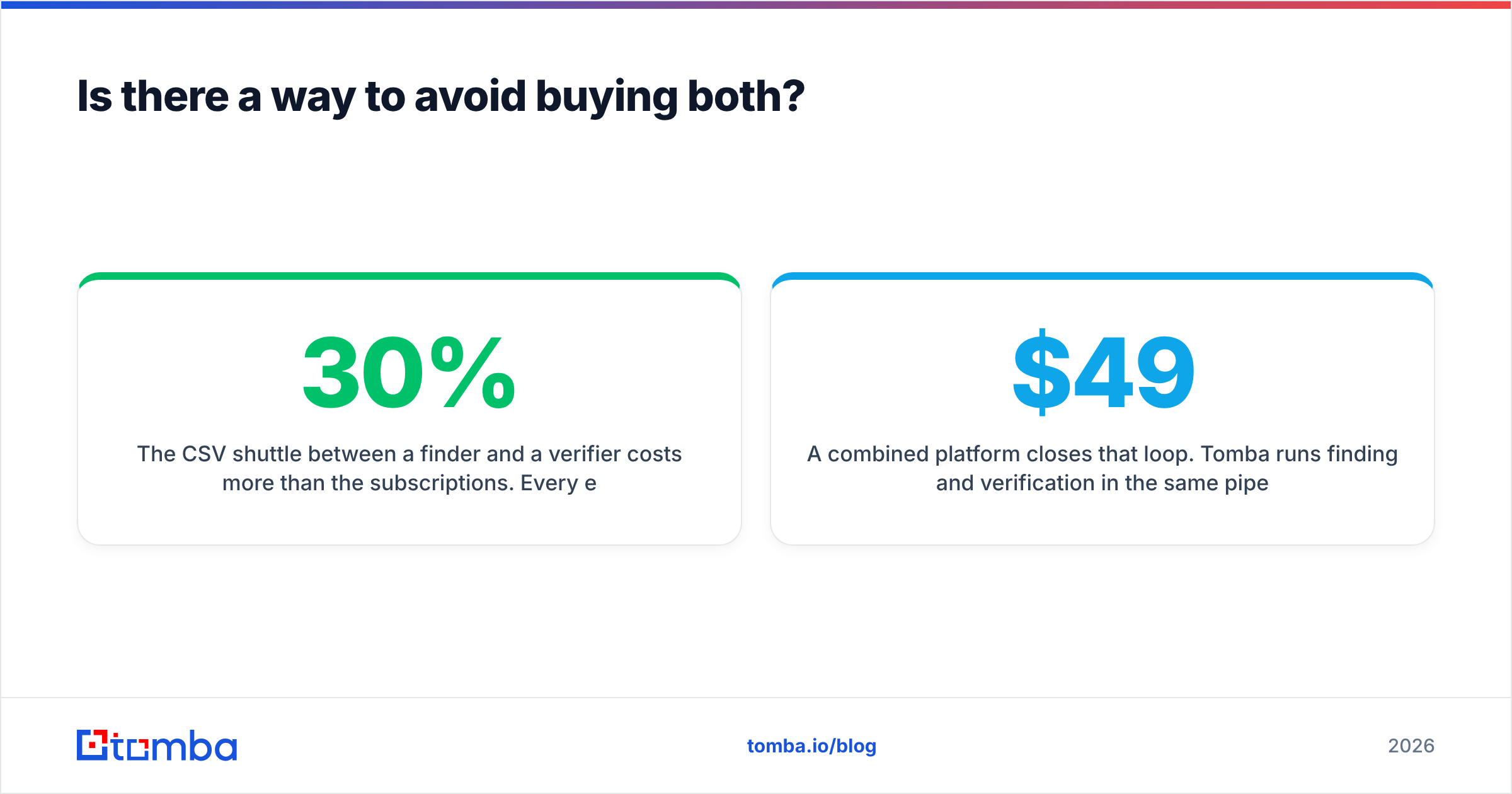
The CSV shuttle between a finder and a verifier costs more than the subscriptions. Every export-upload-download-reimport cycle is a place where columns get mangled, duplicates creep in, and someone mails a list that was verified three months ago. Data decays at roughly 22-30% per year as people change jobs, so a list verified in January is meaningfully stale by June. If verification is a separate manual step, it quietly stops happening.
A combined platform closes that loop. Tomba runs finding and verification in the same pipeline: find email addresses by domain or name, verify them in the same call, resolve catch-alls with a dedicated checker, and push the result straight into HubSpot, Pipedrive or a sheet. Pricing is a single subscription — free at 25 searches/mo, $49/mo Starter, $99/mo Growth, $249/mo Pro — rather than a subscription plus a per-verification meter. Full Tomba pricing is public, with no per-seat surcharge for the sourcing side.
The honest caveat: if you genuinely verify millions of addresses a year and source almost nothing, a specialist verifier's volume pricing will beat a bundled plan on raw unit cost. Bundling wins when both jobs are real and roughly balanced — which describes most outbound teams under 50 reps.
How should you run a fair test?#
Do not decide from pricing pages. Run this in an afternoon:
- Build a 100-row truth set. Pull 100 contacts from your CRM where you know the email works — you have replies from them. Strip the email column.
- Run the finder test. Feed names plus company domains to GetProspect (or any finder) and measure two numbers: how many rows returned an address, and how many matched your known-good value.
- Run the verifier test. Take 100 addresses you know are dead (hard bounces from your ESP logs) plus your 100 good ones, shuffle, and send them through NeverBounce. Count false positives — dead addresses marked valid. Those are the ones that hurt.
- Time the workflow. Stopwatch the full cycle from "I need contacts" to "clean list in my sequencer." Include the export and re-import steps. That number is what you are actually buying.
- Check the catch-all bucket. Note what percentage of results land in unresolved territory and decide, in advance, what you will do with them.
Whatever tool wins on step 4 usually wins in practice, even if it loses by a point or two on steps 2 and 3.
The verdict#
GetProspect vs NeverBounce is not a head-to-head — it is a diagnosis. Empty list, buy the finder. Dirty list, buy the verifier. Both problems at once, and you are the exact buyer who should question why two invoices are involved.
If your outbound needs contacts and clean contacts — which is nearly everyone running cold email in 2026 — start with a platform that does both in one pass. Tomba Email Finder sources addresses by domain, name or LinkedIn profile, verifies each one before it reaches your sequencer, and hands off through the API, Chrome extension or Google Sheets. Try it free with 25 searches a month, run it against the 100-row truth set above, and let the bounce log decide.
Related guides#
Ready to find emails that actually work?
Join 150,000+ professionals who stopped guessing and started sending. Free credits on signup — no credit card required.
Get the Tomba newsletter
Practical outbound tactics and product updates — once every two weeks.
About the author