GetProspect vs OutboundView: Which Fits Your Pipeline?
One is a self-serve email database you run yourself. The other is an outsourced SDR team that runs outbound for you. Here's the honest cost, control, and speed trade-off between GetProspect and OutboundView — plus when neither is the right call.
TL;DR
- These are not the same category. GetProspect is self-serve software — a B2B contact database and email finder you operate yourself. OutboundView is a done-for-you outbound agency that supplies SDRs, sequences, and booked meetings.
- Price gap is roughly 20x. A prospecting tool subscription lands in the tens-to-low-hundreds of dollars per month. An outsourced SDR engagement is typically a four-to-five-figure monthly retainer with a multi-month commitment.
- Pick software if you have someone who will actually send the emails, and you want to own the data, the domain reputation, and the learnings.
- Pick an agency if you have budget but no headcount, no playbook, and a mandate to show meetings in 90 days.
- The middle path most teams land on: buy accurate data through an API-first provider, keep one in-house SDR, and skip the retainer entirely.
What are GetProspect and OutboundView, exactly?#
The reason "GetProspect vs OutboundView" is a confusing search is that you're comparing a hammer to a contractor.
GetProspect is a B2B lead database with an email finder attached. You search by company, job title, industry, or location; you install a Chrome extension to pull contacts off LinkedIn; you export a CSV or push to your CRM. It's freemium — there's a free monthly allowance of verified emails, then paid tiers scale with the number of contacts you unlock. You do all the outreach yourself.
OutboundView is an outbound sales agency based in Indianapolis. You hire them, and they staff the function: appointment setting, cold email campaign execution, inbound lead follow-up, and sales-process consulting. They build the list, write the sequences, run the sends, handle replies, and hand you calendar invites. Pricing isn't published — it's scoped per engagement, which is standard for agencies in this space.
So the real question isn't "which product is better." It's:
- Do you have someone to run outbound? No headcount means software sits unused. That's the single most common reason a prospecting subscription gets cancelled at month three.
- Do you need to own the muscle long-term? Agencies rent you results. When the contract ends, the playbook and the reply data often leave with them.
- How fast do you need meetings? An agency can be sending within two to three weeks. An in-house motion built from scratch usually takes six to ten weeks to produce reliable meetings.
- What's your ACV? Under roughly $5K annual contract value, a five-figure monthly retainer rarely math out. Above $50K ACV, a handful of extra meetings pays for almost anything.
- How weird is your ICP? Agencies do well with recognizable titles at recognizable companies. Niche technical buyers, regional markets, or non-English territories tend to expose the limits of a generalist SDR pod.
- Who owns the sending domain? This one gets skipped and it matters — burned domains are expensive to replace.
How much does each option actually cost?#
Here's the honest comparison, with the caveat that agency pricing is negotiated and GetProspect's tiers change over time — always check the live pricing pages before you budget.
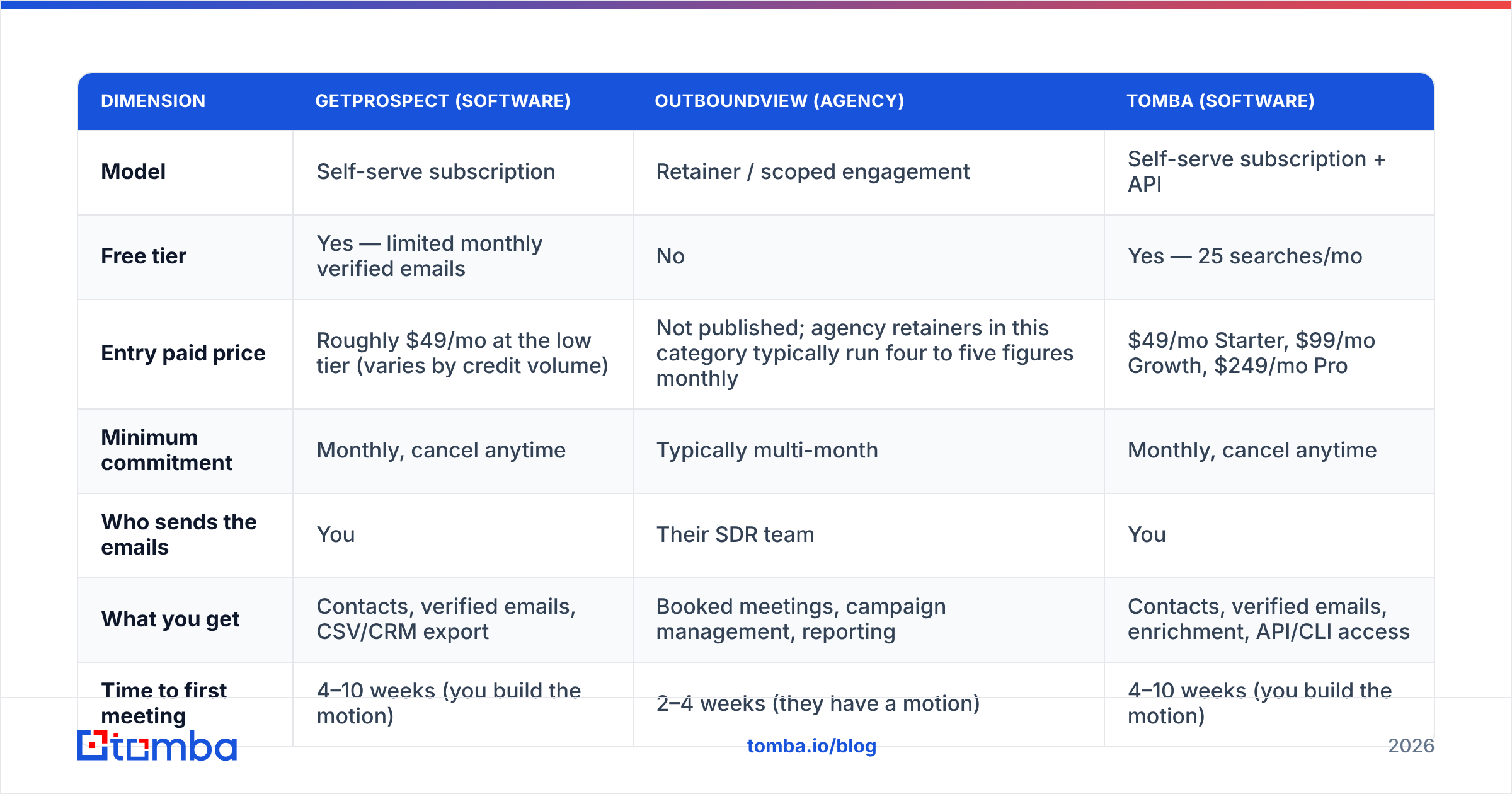
| Dimension | GetProspect (software) | OutboundView (agency) | Tomba (software) |
|---|---|---|---|
| Model | Self-serve subscription | Retainer / scoped engagement | Self-serve subscription + API |
| Free tier | Yes — limited monthly verified emails | No | Yes — 25 searches/mo |
| Entry paid price | Roughly $49/mo at the low tier (varies by credit volume) | Not published; agency retainers in this category typically run four to five figures monthly | $49/mo Starter, $99/mo Growth, $249/mo Pro |
| Minimum commitment | Monthly, cancel anytime | Typically multi-month | Monthly, cancel anytime |
| Who sends the emails | You | Their SDR team | You |
| What you get | Contacts, verified emails, CSV/CRM export | Booked meetings, campaign management, reporting | Contacts, verified emails, enrichment, API/CLI access |
| Time to first meeting | 4–10 weeks (you build the motion) | 2–4 weeks (they have a motion) | 4–10 weeks (you build the motion) |
| You keep after churn | Your exported data and your playbook | Meetings booked; playbook ownership varies | Your exported data, your API integration |
The gap isn't subtle. A year of prospecting software at the mid tier costs about what one month of an outsourced SDR pod costs. That's not an argument against agencies — it's an argument for being honest about what the retainer is buying. You're not paying for data. You're paying for labor, management, and speed.
Is GetProspect's data good enough to run outbound on?#
Good enough, with the usual asterisks that apply to every database vendor.
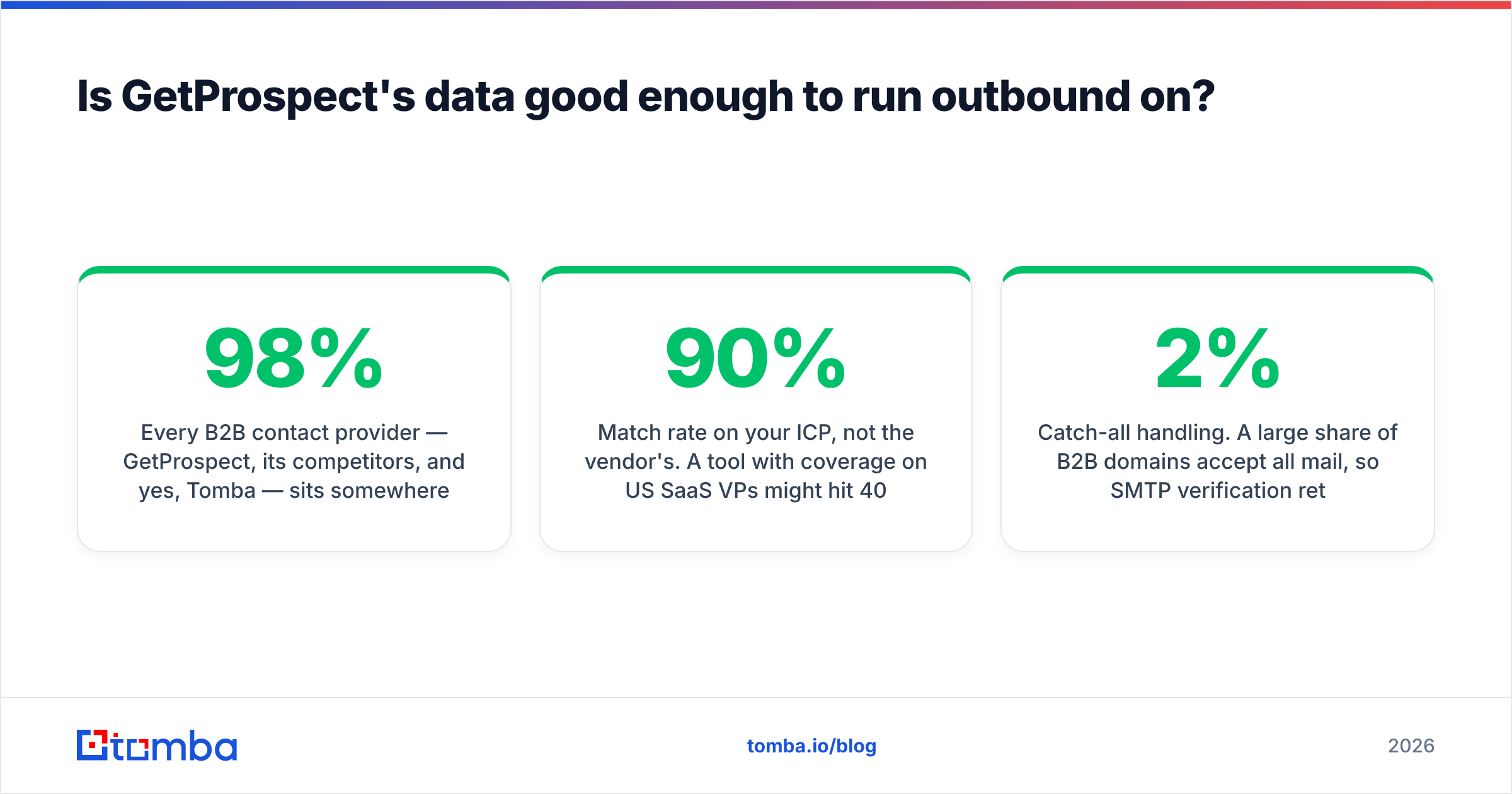
Every B2B contact provider — GetProspect, its competitors, and yes, Tomba — sits somewhere between two failure modes. Either the database is huge and stale, or it's fresh and thin. Coverage and accuracy pull against each other. Anyone quoting you "98% accuracy" without telling you the coverage rate on your specific ICP is quoting a marketing number.
Three things actually determine whether the data works for you:
- Match rate on your ICP, not the vendor's. A tool with 90% coverage on US SaaS VPs might hit 40% on German manufacturing plant managers. Test with 100 of your real accounts before you commit.
- Catch-all handling. A large share of B2B domains accept all mail, so SMTP verification returns "unknown." How a vendor treats those addresses — silently include, silently exclude, or flag them — changes your bounce rate more than raw database size does. A dedicated catch-all verifier is what separates a 2% bounce list from a 9% one.
- Recency of the role data. Someone who left in January is a hard bounce in March. Ask when the record was last confirmed, not when it was first collected.
Whichever provider you choose, run the export through an email verifier before it touches a sending domain. Vendor-side verification and pre-send verification are not the same check, and the second one is the one that protects your reputation.
What does OutboundView do that software can't?#
Three things, and they're real.
It supplies the person. Software doesn't write sequences, doesn't handle objection replies, doesn't chase a warm lead on day nine. An agency does. If your alternative is "the founder will do outbound between fundraising calls," an agency will genuinely outperform.
It compresses ramp time. A good agency has already burned through the mistakes: domain warmup schedules, subject-line patterns that survive spam filters, the right cadence between touches. You're buying a compressed learning curve, which for a team with zero outbound history is worth something.
It absorbs infrastructure risk. Secondary domains, inbox warmup, deliverability monitoring — done for you. If nobody on your team understands email deliverability, that's a genuine hazard you're handing off.
Where agencies get criticized — and you'll see this across G2 reviews of the whole category, not this vendor specifically — is consistency of SDR quality, list-building that skews broad, and the awkward handoff when a "meeting" turns out to be a curiosity call. Those are category risks. Manage them in the contract: define what counts as a qualified meeting, in writing, before you sign.
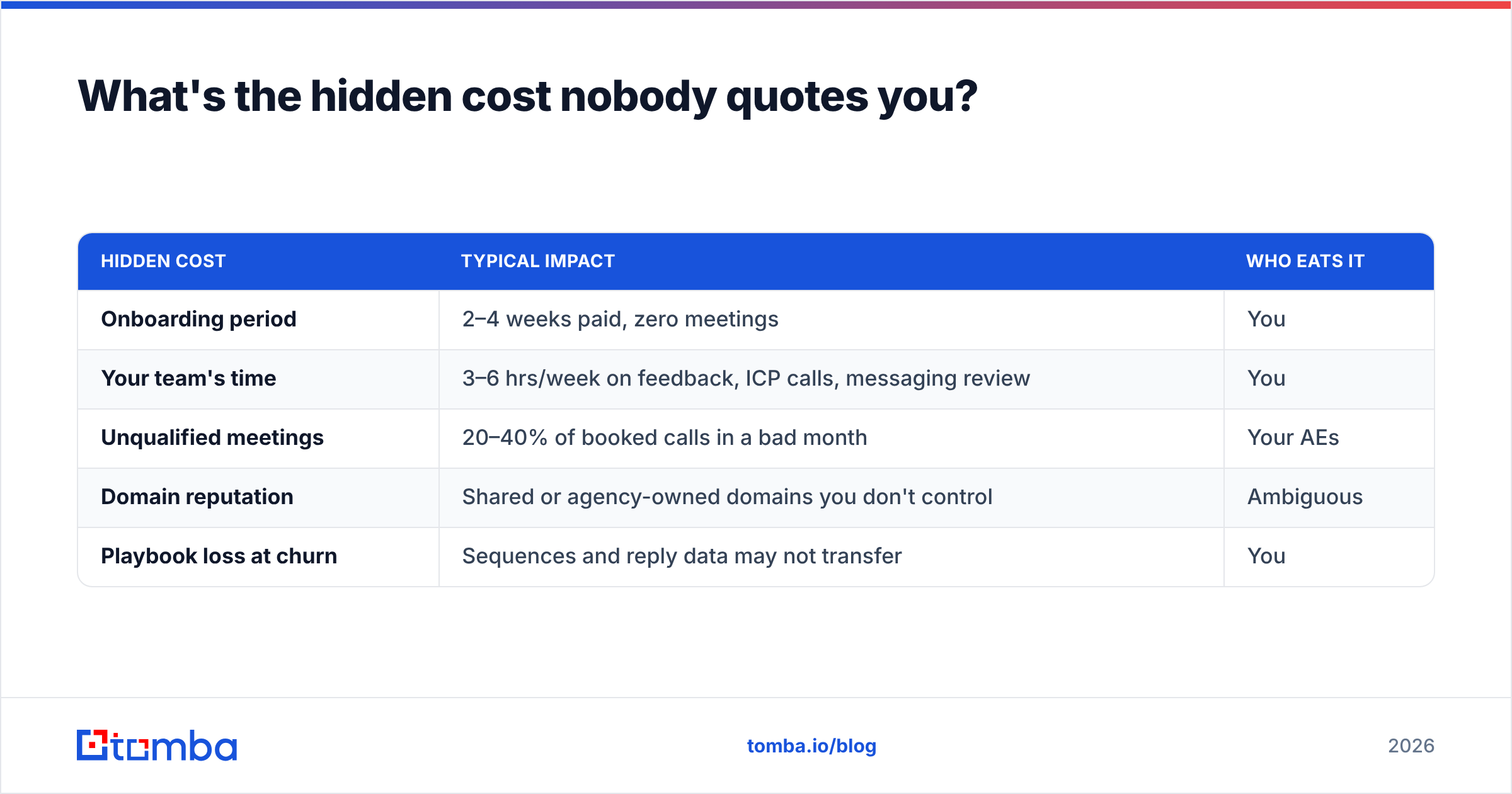
What's the hidden cost nobody quotes you?#
The retainer is not the total cost of an agency engagement. Budget for these too:
| Hidden cost | Typical impact | Who eats it |
|---|---|---|
| Onboarding period | 2–4 weeks paid, zero meetings | You |
| Your team's time | 3–6 hrs/week on feedback, ICP calls, messaging review | You |
| Unqualified meetings | 20–40% of booked calls in a bad month | Your AEs |
| Domain reputation | Shared or agency-owned domains you don't control | Ambiguous |
| Playbook loss at churn | Sequences and reply data may not transfer | You |
And the software side has its own quiet costs: credits that expire monthly, exports that don't dedupe against your CRM, and the hours a junior rep spends cleaning a CSV. If you're paying someone $60K to spend a day a week in spreadsheets, that's $12K a year of hidden data-ops cost — often more than the tooling itself. That's the case for automating the pipe with a proper email finder API instead of a human with a browser extension.
Which should you choose — GetProspect, OutboundView, or neither?#
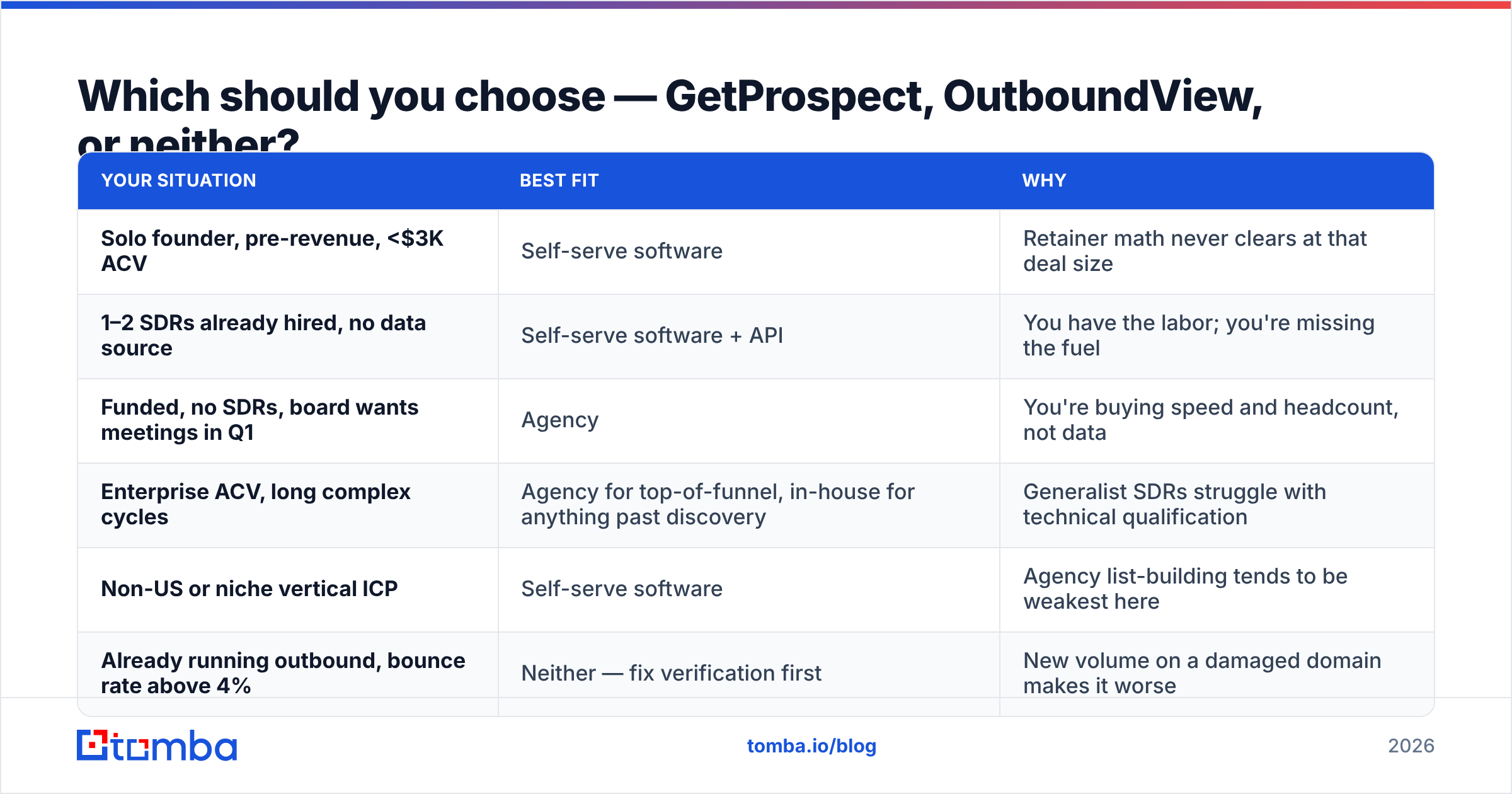
Match your situation to the row:
| Your situation | Best fit | Why |
|---|---|---|
| Solo founder, pre-revenue, <$3K ACV | Self-serve software | Retainer math never clears at that deal size |
| 1–2 SDRs already hired, no data source | Self-serve software + API | You have the labor; you're missing the fuel |
| Funded, no SDRs, board wants meetings in Q1 | Agency | You're buying speed and headcount, not data |
| Enterprise ACV, long complex cycles | Agency for top-of-funnel, in-house for anything past discovery | Generalist SDRs struggle with technical qualification |
| Non-US or niche vertical ICP | Self-serve software | Agency list-building tends to be weakest here |
| Already running outbound, bounce rate above 4% | Neither — fix verification first | New volume on a damaged domain makes it worse |
The pattern in that table: agencies solve a headcount problem, software solves a data problem. If you diagnose a headcount problem and buy software, the subscription goes unused. If you diagnose a data problem and hire an agency, you pay $8K/month for lists you could have built for $99.
Is there a smarter third option?#
For most teams under 50 employees, yes: one in-house SDR plus an API-first data stack.
The economics are straightforward. One junior SDR at fully loaded cost is comparable to a mid-tier agency retainer — except the SDR is yours, learns your product, and compounds. Add a data layer for a couple hundred dollars a month and you've replicated the agency's output with permanent institutional knowledge.
That's the gap Tomba is built for. The core email finder resolves professional addresses by name and domain, with domain search for pulling every reachable contact at a target account, verification built into the same workflow, and bulk email finder processing for list-level work. Pricing runs $49/mo Starter, $99/mo Growth, and $249/mo Pro, with a free tier at 25 searches a month if you just want to test match rates on your own account list first — the full breakdown is on the Tomba pricing page.
Where it differs from a browser-extension-first tool: the API, CLI, and MCP server mean enrichment can live inside your existing workflow rather than in a separate tab. If your RevOps person wants CRM records enriched on create instead of a weekly CSV ritual, that's a materially different day-to-day.
How do you test either option without wasting a quarter?#
Run the same 30-day evaluation regardless of which direction you lean.
- Build a 200-account ICP list by hand first. If you can't define the ICP precisely, no vendor and no agency can either. This is the step everyone skips and everyone regrets.
- Run the software trial against those exact 200 accounts. Measure match rate and bounce rate on your ICP, not the vendor's demo dataset. Anything under 60% match on your core segment is a red flag.
- Ask the agency for references in your vertical, at your ACV. Not their best logo — their closest analog. Ask those references about month four, not month one.
- Get the qualification definition in writing. What counts as a meeting? What happens to no-shows? What's the make-good policy?
- Check the domain arrangement. Who owns the sending domains? Who monitors reputation? Use a free email checker and a blacklist check on any domain you're handed.
- Set one kill criterion before you start. "If we're below X qualified meetings by day 60, we stop." Written down, in advance, before sunk cost starts talking.
Do this and the GetProspect vs OutboundView question mostly answers itself. Teams that complete step one and can't staff step two need an agency. Teams that complete step one and already have a rep need data — and should spend the difference on more pipeline, not more overhead.
The bottom line#
GetProspect and OutboundView aren't competitors so much as two answers to different bottlenecks. Software is cheap, permanent, and useless without an operator. An agency is expensive, fast, and rented. Diagnose which resource you're actually short on — data or people — before you sign anything.
If it's data, start with the free tier and test on your own account list. The Tomba Email Finder gives you 25 searches a month at no cost, with verification in the same workflow, so you can measure real match and bounce rates on your ICP before committing a dollar. Run your 200 accounts through it this week, compare the numbers to whatever an agency quotes you per meeting, and let the arithmetic decide.
Related guides#
Ready to find emails that actually work?
Join 150,000+ professionals who stopped guessing and started sending. Free credits on signup — no credit card required.
Get the Tomba newsletter
Practical outbound tactics and product updates — once every two weeks.
About the author