GetProspect vs ProsperFleet Valgen: Which One Is Real?
One of these tools has thousands of public reviews and a documented API. The other has almost no verifiable footprint. Here is how the GetProspect vs ProsperFleet Valgen matchup actually shakes out, and what to buy instead.
TL;DR
- GetProspect is a real, well-documented LinkedIn-centric email finder with a free tier, public pricing, and thousands of third-party reviews you can read before you buy.
- ProsperFleet Valgen has no verifiable public footprint we could confirm as of August 2026: no indexed pricing page, no G2 or Capterra profile, no API docs. Treat any claim about it as unverified.
- In a head-to-head, you cannot fairly compare a documented product against an undocumented one. What you can do is apply a vendor-verification checklist before spending a dollar.
- If you want LinkedIn-first prospecting, GetProspect is a legitimate pick. If you want API-first email finding with published accuracy handling and a $49/mo entry plan, Tomba is the stronger buy.
- Never pay for a data vendor that will not show you a live accuracy test on your own domain list. That single rule kills most bad purchases.
What are GetProspect and ProsperFleet Valgen?#
Short answer: one is a mainstream B2B email finder, and the other is a name that does not survive basic verification.
GetProspect is a Ukraine-founded email finder and lead database built primarily around LinkedIn workflows. You install a Chrome extension, browse a LinkedIn search or Sales Navigator list, and pull work emails into a list you can export or sync. It also offers a searchable contact database with filters for job title, company size, industry, and technology, plus bulk enrichment from a CSV of names and domains. It has been on the market since 2016 and carries hundreds of public reviews across G2 and similar directories.
ProsperFleet Valgen is the harder half of this comparison. We looked for the things any real SaaS vendor leaves behind: an indexed homepage with pricing, developer documentation, a G2 or Capterra listing, a company registration, a LinkedIn company page with employees, changelog entries, and independent reviews. We could not confirm those. That does not automatically mean the name is fictional, and it does not mean anyone is acting in bad faith. It does mean that at the time of writing, nothing about the product can be independently checked, and you should not treat marketing copy about it as fact.
This is more common than people admit. Search volume exists for tool names that turn out to be rebrands, white-labels of a shared underlying database, affiliate-generated listicle entries, or products that shut down and left their SEO shell behind. The useful move is not to guess. It is to run the same verification process on every vendor, including the ones you already trust.

Why does the "unverifiable vendor" problem matter for email data?#
Because in the email-finding category, the product is a claim, not an artifact.
When you buy a project management tool, you can log in and see whether it works in ten minutes. When you buy an email finder, you get a CSV of addresses that look plausible. You cannot tell from the file whether those addresses are current, whether they were scraped from a 2019 breach dump, whether the catch-all domains were silently marked "valid," or whether the vendor is reselling the same table as four other brands. You find out weeks later when your bounce rate crosses 5% and your domain reputation drops.
That asymmetry is exactly why unverifiable vendors cluster in this category. The failure is delayed, diffuse, and easy to blame on your copy instead of your data. Three concrete risks:
- Bounce damage compounds. A 12% bounce rate on a 3,000-contact send does not just waste 360 emails. It signals to mailbox providers that you do not maintain your list, and inbox placement drops for the other 2,640.
- Compliance exposure is real. Under GDPR, you are responsible for the lawful basis behind contact data you process, even when a third party supplied it. A vendor that will not document its data sources is transferring that risk to you.
- Sunk-cost lock-in. Annual prepay plus non-refundable credits is the standard structure. If accuracy is bad, you have already paid.

Accuracy is where the gap between vendors is widest and least visible. A responsible provider tells you what "valid" means in its output: whether SMTP was actually probed, how catch-all domains are labeled, and what the accepted-vs-guaranteed distinction is. A vendor that just returns "valid" for everything is not more accurate. It is less honest about uncertainty.
How do GetProspect, ProsperFleet Valgen, and Tomba compare?#
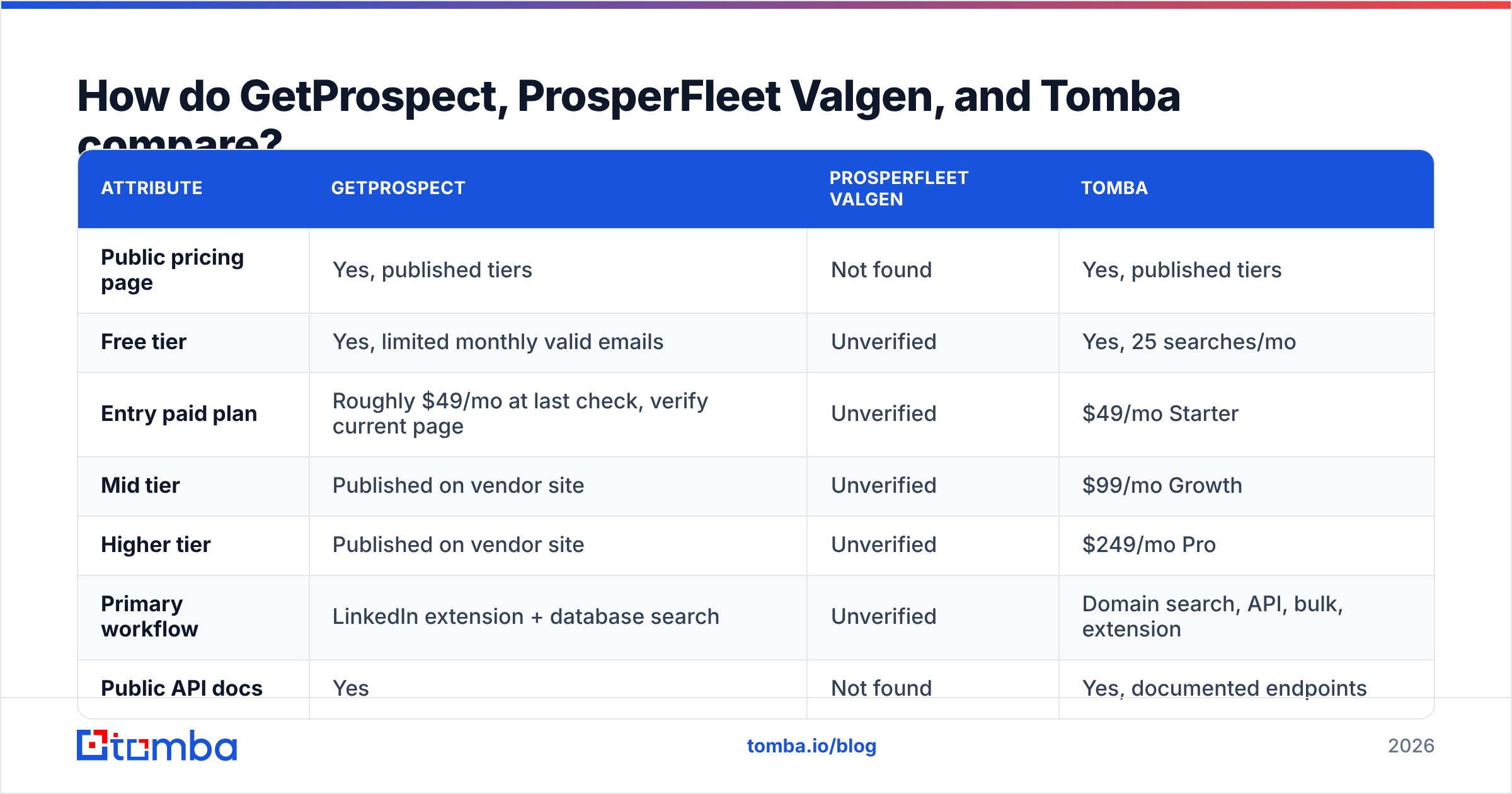
Here is the honest scorecard. Where we could not verify something, the cell says so rather than inventing a number.
| Attribute | GetProspect | ProsperFleet Valgen | Tomba |
|---|---|---|---|
| Public pricing page | Yes, published tiers | Not found | Yes, published tiers |
| Free tier | Yes, limited monthly valid emails | Unverified | Yes, 25 searches/mo |
| Entry paid plan | Roughly $49/mo at last check, verify current page | Unverified | $49/mo Starter |
| Mid tier | Published on vendor site | Unverified | $99/mo Growth |
| Higher tier | Published on vendor site | Unverified | $249/mo Pro |
| Primary workflow | LinkedIn extension + database search | Unverified | Domain search, API, bulk, extension |
| Public API docs | Yes | Not found | Yes, documented endpoints |
| Catch-all handling disclosed | Partially | Unverified | Yes, dedicated catch-all verifier |
| Third-party reviews (G2/Capterra) | Hundreds | None found | Present |
| Independent uptime/changelog | Limited | Not found | Public changelog |
| Verdict | Legitimate LinkedIn-first pick | Cannot recommend without verification | Best for API-first and volume workflows |
Read the middle column as a warning label, not a criticism. If ProsperFleet Valgen publishes docs, pricing, and a trial tomorrow, this column changes. Until then, the rational position is abstention.

Two things stand out. First, GetProspect and Tomba land in a similar price band at entry, which means the decision is about workflow shape rather than budget. Second, the columns that separate a serious vendor from a shell are not feature columns. They are the boring ones: docs, changelog, reviews, disclosed methodology.
How do you verify any email data vendor before paying?#
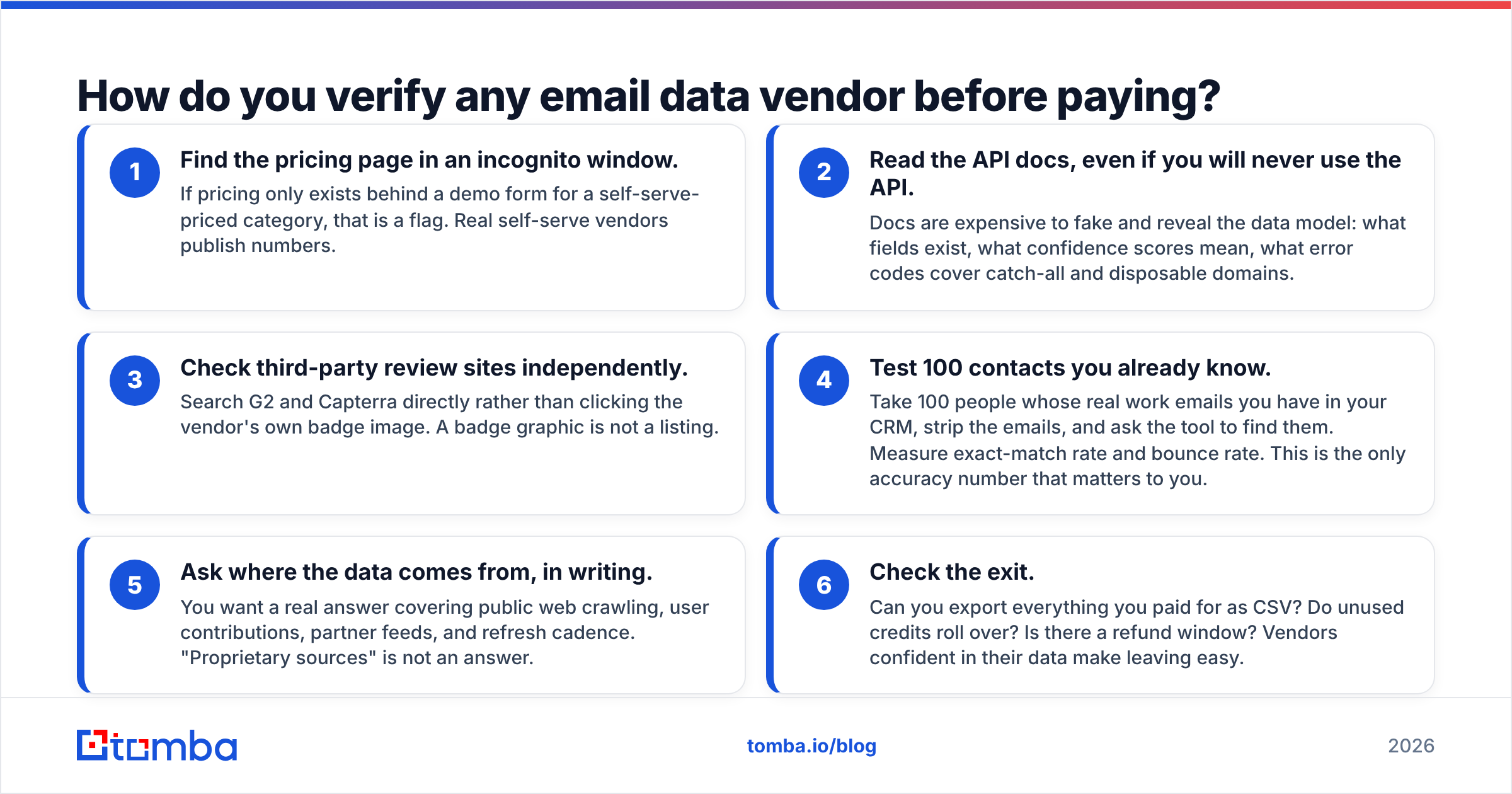
Run this six-step check. It takes about 40 minutes and it is the highest-ROI due diligence in outbound.
- Find the pricing page in an incognito window. If pricing only exists behind a demo form for a self-serve-priced category, that is a flag. Real self-serve vendors publish numbers.
- Read the API docs, even if you will never use the API. Docs are expensive to fake and reveal the data model: what fields exist, what confidence scores mean, what error codes cover catch-all and disposable domains.
- Check third-party review sites independently. Search G2 and Capterra directly rather than clicking the vendor's own badge image. A badge graphic is not a listing.
- Test 100 contacts you already know. Take 100 people whose real work emails you have in your CRM, strip the emails, and ask the tool to find them. Measure exact-match rate and bounce rate. This is the only accuracy number that matters to you.
- Ask where the data comes from, in writing. You want a real answer covering public web crawling, user contributions, partner feeds, and refresh cadence. "Proprietary sources" is not an answer.
- Check the exit. Can you export everything you paid for as CSV? Do unused credits roll over? Is there a refund window? Vendors confident in their data make leaving easy.
Anything that fails steps 1, 2, or 3 does not deserve step 4. That is where ProsperFleet Valgen currently sits.
Is GetProspect worth it on its own merits?#
Yes, for a specific buyer: the seller who lives inside LinkedIn.
GetProspect's real strength is workflow adjacency. If your prospecting motion is "run a Sales Navigator search, filter to 200 people, get their work emails," the extension collapses that into a couple of clicks and keeps list structure intact. The database filters are decent for mid-market targeting, and the free tier is generous enough to evaluate honestly.
Where it gets weaker:
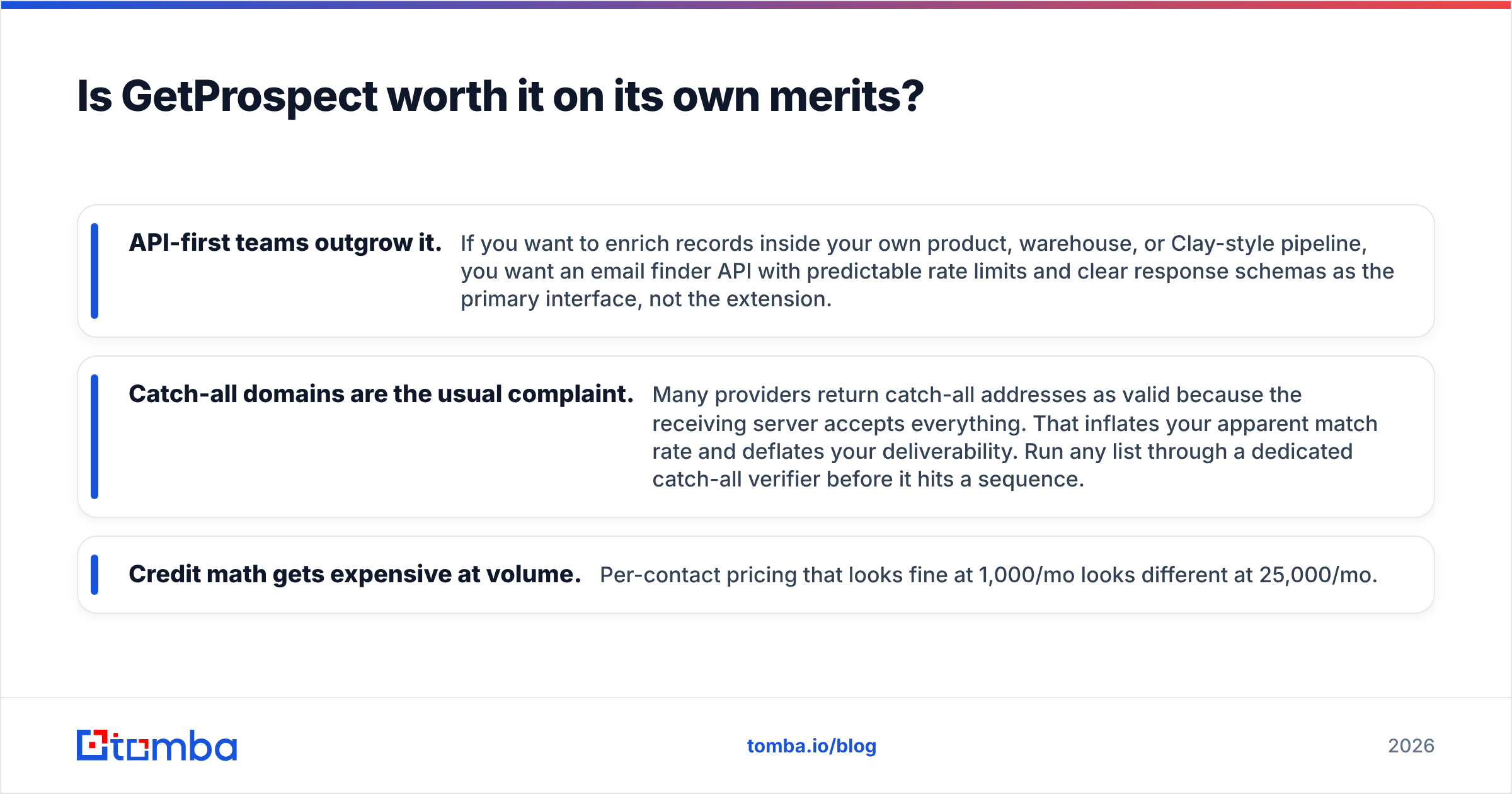
- API-first teams outgrow it. If you want to enrich records inside your own product, warehouse, or Clay-style pipeline, you want an email finder API with predictable rate limits and clear response schemas as the primary interface, not the extension.
- Catch-all domains are the usual complaint. Many providers return catch-all addresses as valid because the receiving server accepts everything. That inflates your apparent match rate and deflates your deliverability. Run any list through a dedicated catch-all verifier before it hits a sequence.
- Credit math gets expensive at volume. Per-contact pricing that looks fine at 1,000/mo looks different at 25,000/mo.
For context on where GetProspect sits among peers: BookYourData is a solid option if you want prepaid, pay-as-you-go B2B lists with a verification guarantee rather than a subscription. Different model, respectable execution, and worth a look if your buying pattern is bursty rather than continuous.

What should you actually buy in 2026?#
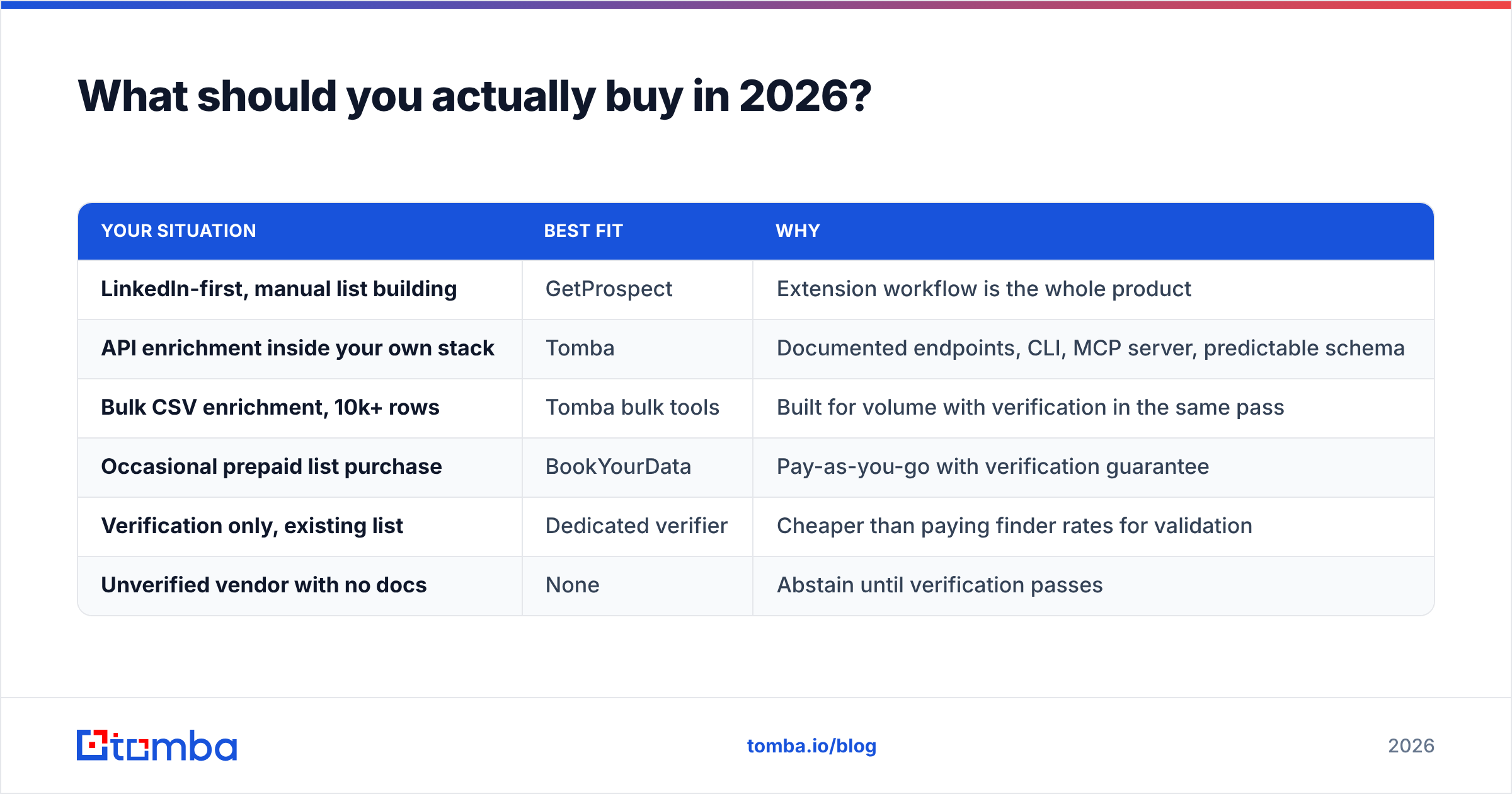
Match the tool to the shape of your motion, not to a review score.
| Your situation | Best fit | Why |
|---|---|---|
| LinkedIn-first, manual list building | GetProspect | Extension workflow is the whole product |
| API enrichment inside your own stack | Tomba | Documented endpoints, CLI, MCP server, predictable schema |
| Bulk CSV enrichment, 10k+ rows | Tomba bulk tools | Built for volume with verification in the same pass |
| Occasional prepaid list purchase | BookYourData | Pay-as-you-go with verification guarantee |
| Verification only, existing list | Dedicated verifier | Cheaper than paying finder rates for validation |
| Unverified vendor with no docs | None | Abstain until verification passes |
The practical stack for most teams is two layers, not one. A finder that gets you candidate addresses, and a verifier that decides which of them are safe to send to. Running email verification as a separate step before every send is the single change that fixes most bounce problems, regardless of which finder produced the list.
On budget: Tomba's published tiers are a free plan at 25 searches/mo, Starter at $49/mo, Growth at $99/mo, Pro at $249/mo, and custom Enterprise. You can see the full breakdown on the Tomba pricing page. GetProspect sits in a comparable range at entry, so pick on workflow fit and API needs rather than on a few dollars of monthly difference.
What is the final verdict on GetProspect vs ProsperFleet Valgen?#
GetProspect wins by default, because it is the only side of the matchup you can verify.
That is not a rhetorical dodge. In data procurement, verifiability is a feature, and it outranks every claimed accuracy percentage on a landing page. A vendor with published pricing, real docs, and independent reviews can be held to its promises. A vendor with none of those cannot be held to anything, which means every number it publishes is unfalsifiable by design.
If ProsperFleet Valgen turns out to be a real product with a real roadmap, this post ages into a footnote and you will be able to run the six-step check against it in under an hour. Until that happens, put your credits somewhere accountable.
And whichever finder you pick, do the 100-contact test on your own known-good data before you scale. Vendor benchmarks are marketing. Your bounce rate is truth.
Ready to test against your own list? Start with the Tomba Email Finder free tier: 25 searches a month, no card, with catch-all detection and verification confidence exposed in the response rather than hidden behind a green checkmark. Run the same 100 contacts through it that you run through anything else, compare exact-match and bounce rates side by side, and let the numbers pick your vendor. If the API is your real interface, the $49/mo Starter plan gets you documented endpoints, bulk processing, and integrations with HubSpot, Salesforce, Sheets, and Zapier on day one.
Related guides#
Ready to find emails that actually work?
Join 150,000+ professionals who stopped guessing and started sending. Free credits on signup — no credit card required.
Get the Tomba newsletter
Practical outbound tactics and product updates — once every two weeks.
About the author